
Measuring Fish Respiration A handson laboratory exercise Megan
Measuring Fish Respiration A hands-on laboratory exercise Megan Kepler
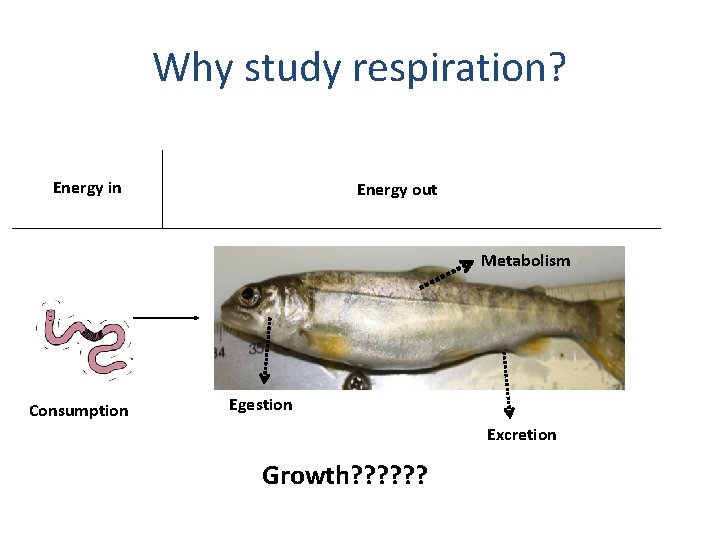
Why study respiration? Energy in Energy out Metabolism Consumption Egestion Excretion Growth? ? ?
Respiration • Part of metabolism (active vs. resting) – Easiest to measure resting in the lab with closed chambers – Function of gills, dissolved oxygen from water, role of plants – What do you think influences respiration rate? • Temperature, fish size, activity, environmental conditions, stress, etc.

Let’s get the lab started…… That way we have time to interpret some the data…. . -Quantitative vs. qualitative experiments
Questions for thought – How do respiration rates vary with fish size? (Fish Physiology) – How do respiration rates vary with temperature? (Fish Physiology) – Why could respiration rates be important for fisheries management?
Overview of experimentation • Respiration experiment – Measure change in DO with a fish respiring in a closed chamber for an allotted period of time. • Experiment objectives – Understand how fish respiration changes with fish size and temperature – Relate respiration experiments to fisheries management, physiology, and aquaculture
Items you will need…. . • • • Fernbach Flasks Rubber stopper Large Tub Dissolved Oxygen Meter Scale If temperature change is desired…. – Ice/heater
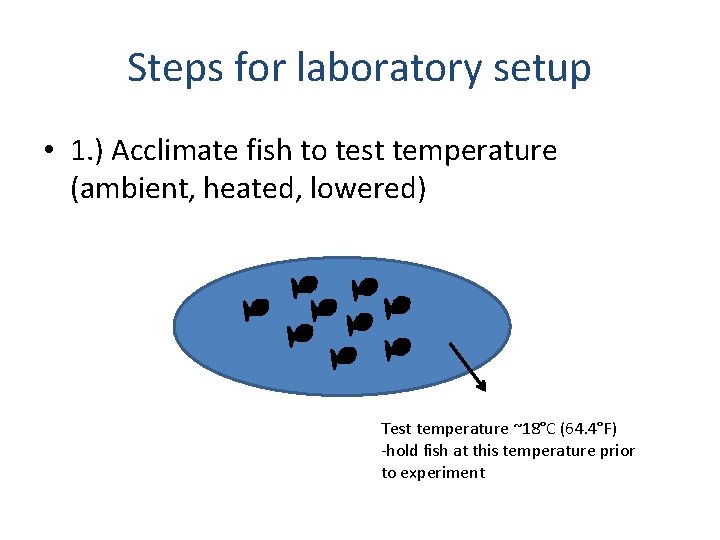
Steps for laboratory setup • 1. ) Acclimate fish to test temperature (ambient, heated, lowered) Test temperature ~18°C (64. 4°F) -hold fish at this temperature prior to experiment
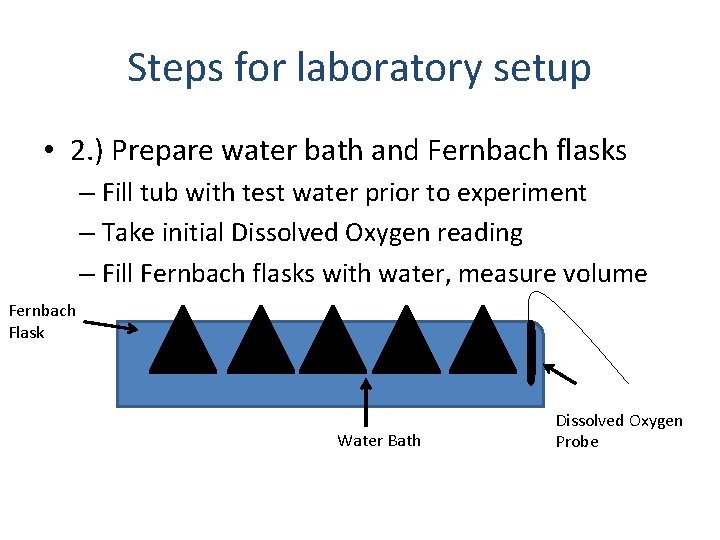
Steps for laboratory setup • 2. ) Prepare water bath and Fernbach flasks – Fill tub with test water prior to experiment – Take initial Dissolved Oxygen reading – Fill Fernbach flasks with water, measure volume Fernbach Flask Water Bath Dissolved Oxygen Probe
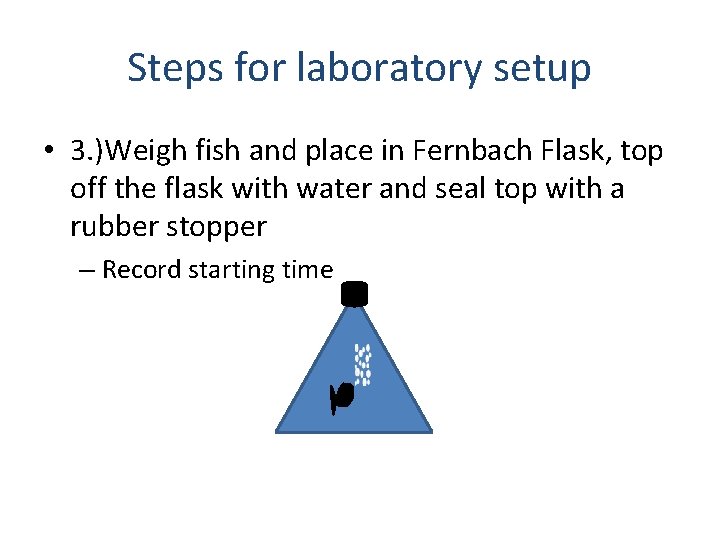
Steps for laboratory setup • 3. )Weigh fish and place in Fernbach Flask, top off the flask with water and seal top with a rubber stopper – Record starting time
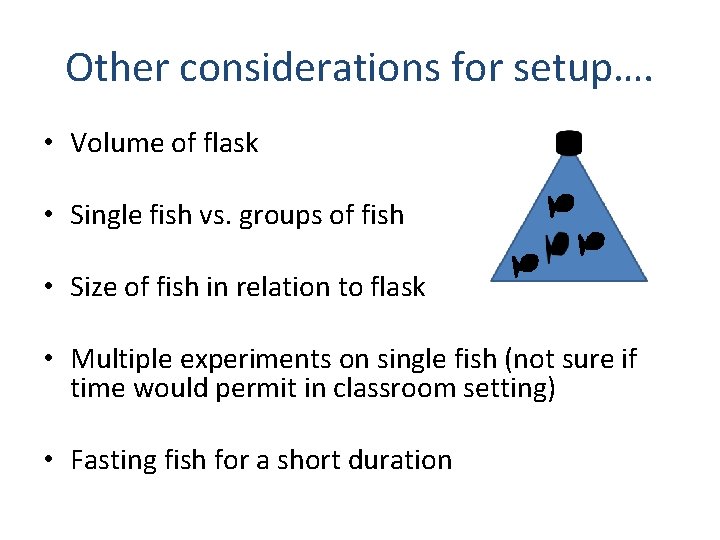
Other considerations for setup…. • Volume of flask • Single fish vs. groups of fish • Size of fish in relation to flask • Multiple experiments on single fish (not sure if time would permit in classroom setting) • Fasting fish for a short duration
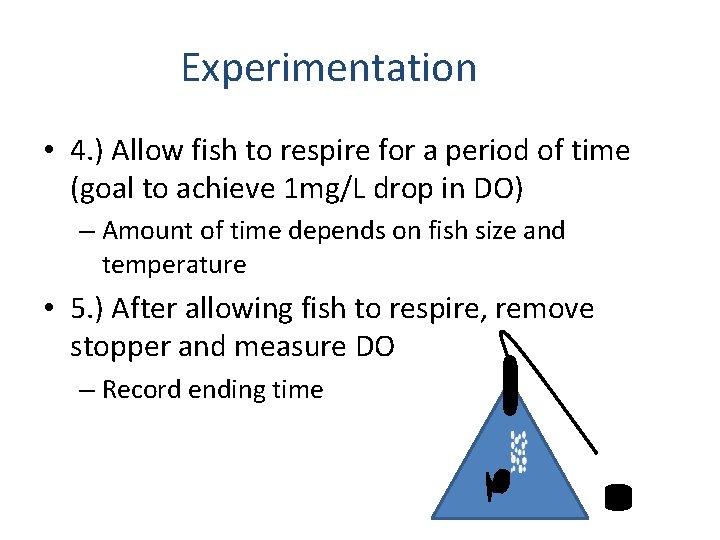
Experimentation • 4. ) Allow fish to respire for a period of time (goal to achieve 1 mg/L drop in DO) – Amount of time depends on fish size and temperature • 5. ) After allowing fish to respire, remove stopper and measure DO – Record ending time
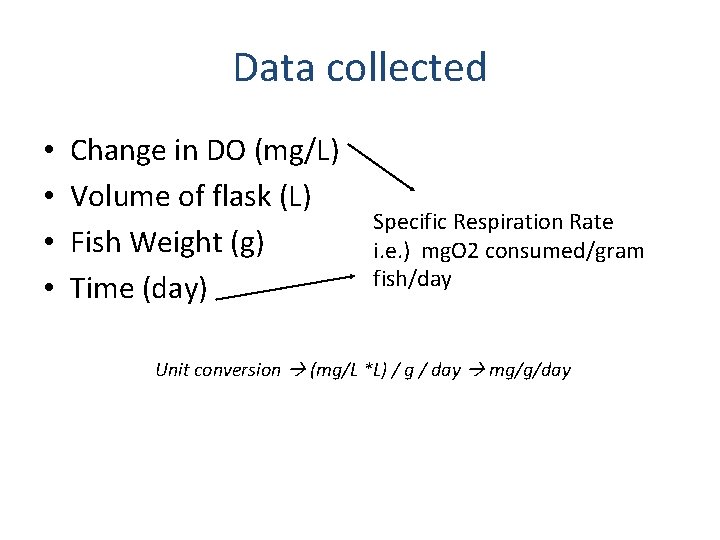
Data collected • • Change in DO (mg/L) Volume of flask (L) Fish Weight (g) Time (day) Specific Respiration Rate i. e. ) mg. O 2 consumed/gram fish/day Unit conversion (mg/L *L) / g / day mg/g/day
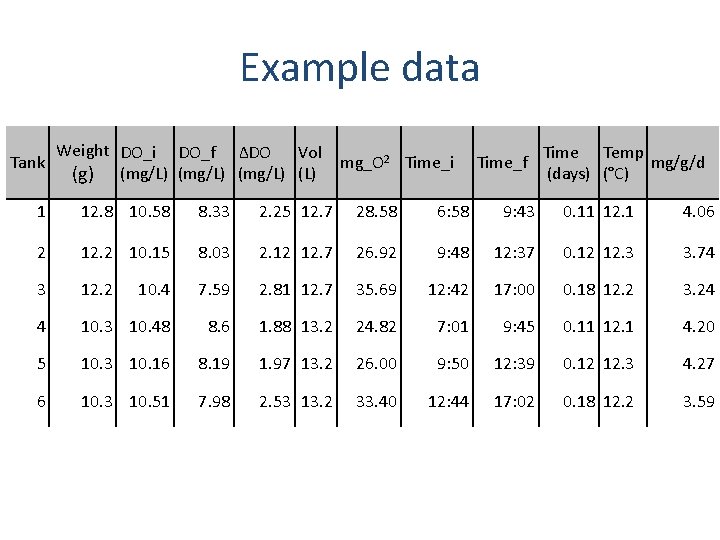
Example data Tank Weight DO_i DO_f ΔDO Vol (g) (mg/L) (L) mg_O 2 Time_i Time_f Time Temp mg/g/d (days) (°C) 1 12. 8 10. 58 8. 33 2. 25 12. 7 28. 58 6: 58 9: 43 0. 11 12. 1 4. 06 2 12. 2 10. 15 8. 03 2. 12 12. 7 26. 92 9: 48 12: 37 0. 12 12. 3 3. 74 3 12. 2 10. 4 7. 59 2. 81 12. 7 35. 69 12: 42 17: 00 0. 18 12. 2 3. 24 4 10. 3 10. 48 8. 6 1. 88 13. 2 24. 82 7: 01 9: 45 0. 11 12. 1 4. 20 5 10. 3 10. 16 8. 19 1. 97 13. 2 26. 00 9: 50 12: 39 0. 12 12. 3 4. 27 6 10. 3 10. 51 7. 98 2. 53 13. 2 33. 40 12: 44 17: 02 0. 18 12. 2 3. 59
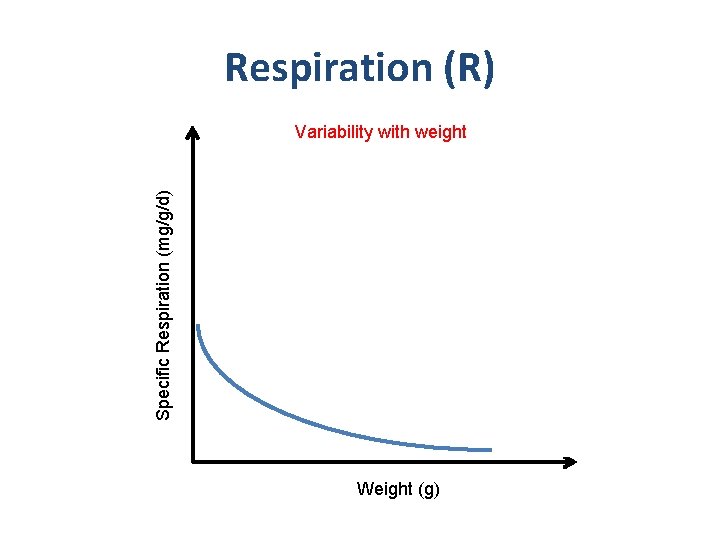
Respiration (R) Specific Respiration (mg/g/d) Variability with temperature Variability with weight Temperature Weight (°C) (g)
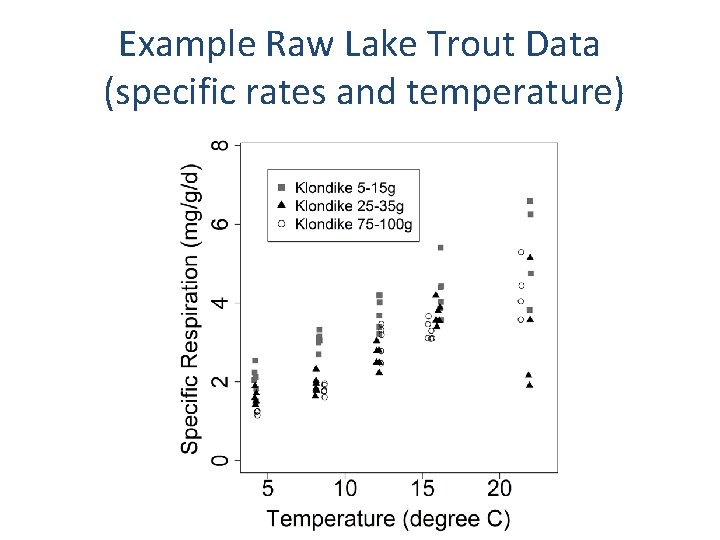
Example Raw Lake Trout Data (specific rates and temperature)
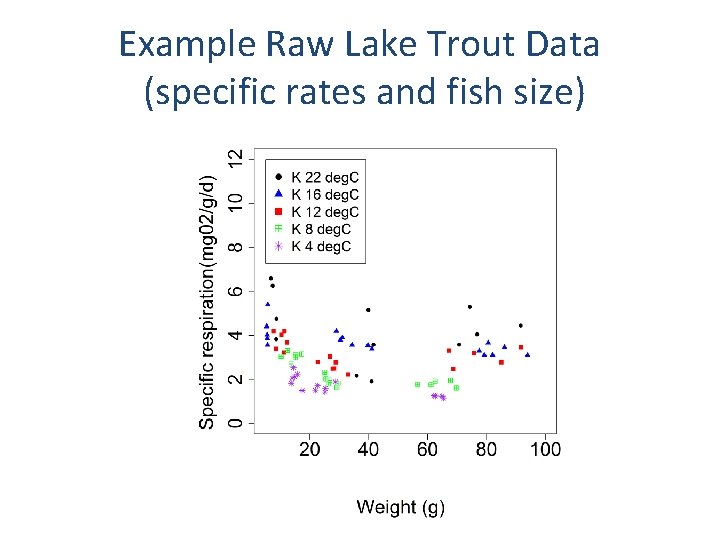
Example Raw Lake Trout Data (specific rates and fish size)
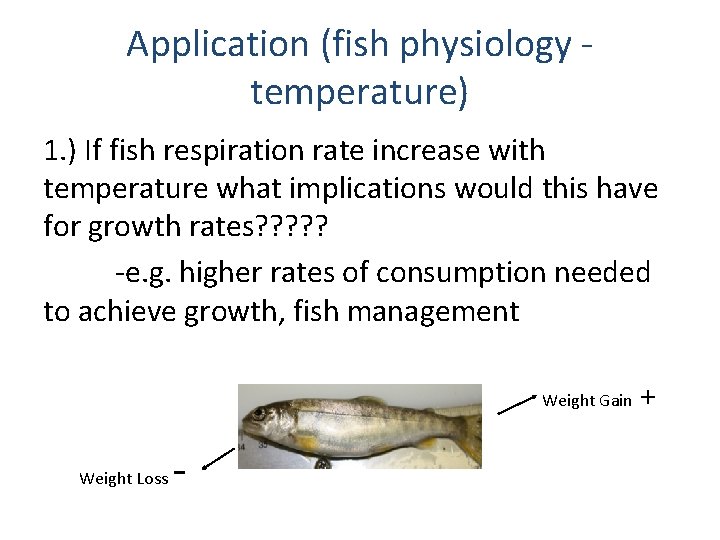
Application (fish physiology temperature) 1. ) If fish respiration rate increase with temperature what implications would this have for growth rates? ? ? -e. g. higher rates of consumption needed to achieve growth, fish management Weight Gain Weight Loss - +
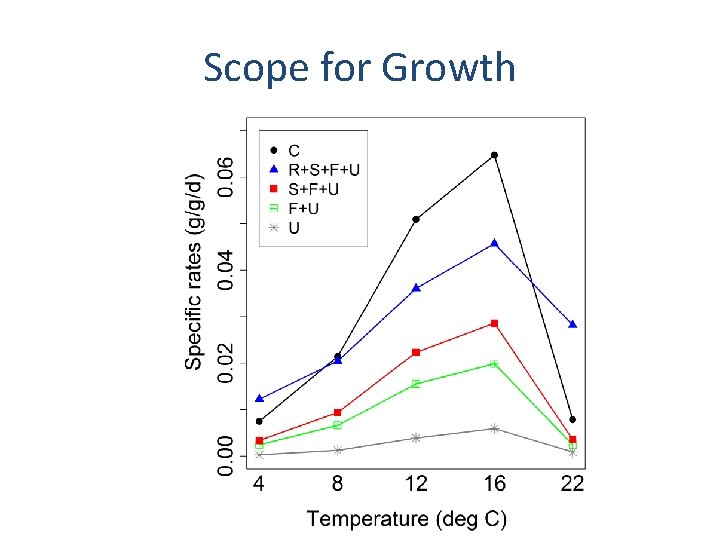
Scope for Growth
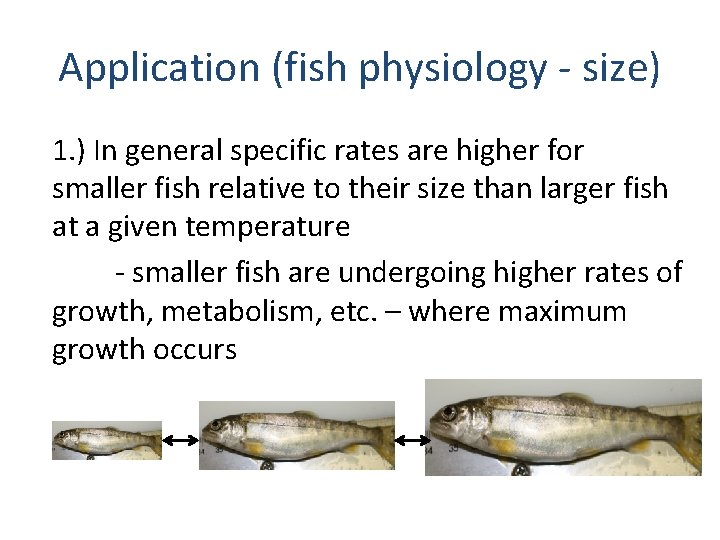
Application (fish physiology - size) 1. ) In general specific rates are higher for smaller fish relative to their size than larger fish at a given temperature - smaller fish are undergoing higher rates of growth, metabolism, etc. – where maximum growth occurs
Hypothetical questions/aquaculture • 1. ) Determine the amount of oxygen to be consumed in a day using calculated specific respiration rates……… – e. g. at 60°C specific respiration rate for a 10 g fish = 4 mg. O 2/g/day – How many milligrams of oxygen would 25 (10 g) fish require in a day?
Hypothetical questions/aquaculture • 2. ) Determine the total amount of dissolved oxygen available for fish usage……. (DO in tank is 9 mg/L, threshold is 5 mg/L) – Part A. ) How much dissolved oxygen is available in a 50 gallon tank (189. 3 L) for a 4 mg/L drop in DO? • 757. 2 mg O 2
Hypothetical questions/aquaculture • Question 2, part B – How many 10 gram fish will this support for 1 day at 4 mg/g/day respiration rate (without aeration)? • 1 – 10 g fish = 40 mg O 2/day • 757. 2 mg. O 2/40 mg. O 2 / day=18. 9 or 18 fish for 1 day
PSTA Science and Technology Standards • Inquiry and Design-3. 2. 7, 3. 2. 10, 3. 2. 12; Parts A and B • Biological Sciences- 3. 3. 12; Part B • Earth Sciences – 3. 5. 7, 10, 12; Part D

Let’s check on our experiment and collect data!
Modifications of experiments • • • Temperature Size Individual vs. Group experiments Duration of experiments Multiple measurements on fish

Questions? ? ?
- Slides: 27