
Measuring Evolution of Populations HardyWeinberg Principle AP Biology
Measuring Evolution of Populations: Hardy-Weinberg Principle AP Biology

Vocab Review: Populations & gene pools § Concepts u u u AP Biology A population is a localized group of interbreeding individuals. Gene pool is collection of alleles in the population. What is an allele?
Today we are going to look at: § Allele frequency is how common is that allele in the population § how many A vs. a in whole population § So if you are looking at a population, the allele frequency can tell you how often the dominant and recessive appear in the population. AP Biology

Evolution § Remember: u Evolution = change in allele frequencies in a population § What are some things that could cause evolution in a population? AP Biology
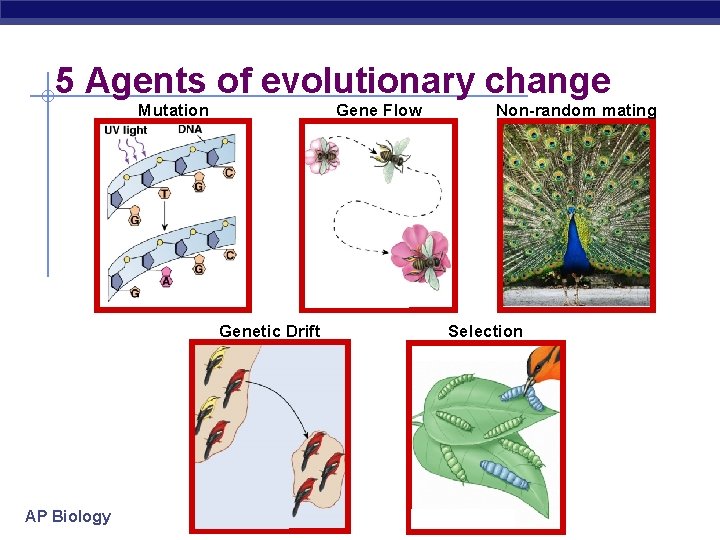
5 Agents of evolutionary change Mutation Gene Flow Genetic Drift AP Biology Non-random mating Selection
Evolution of populations § In order to use the Hardy-Weinberg equation, evolution cannot occur!!! u In a non-evolving population we must remove all of the things that cause evolution. 1. 2. 3. 4. 5. AP Biology very large population size (no genetic drift) no migration (no gene flow in or out) no mutation (no genetic change) random mating (no sexual selection) no natural selection (everyone is equally fit)
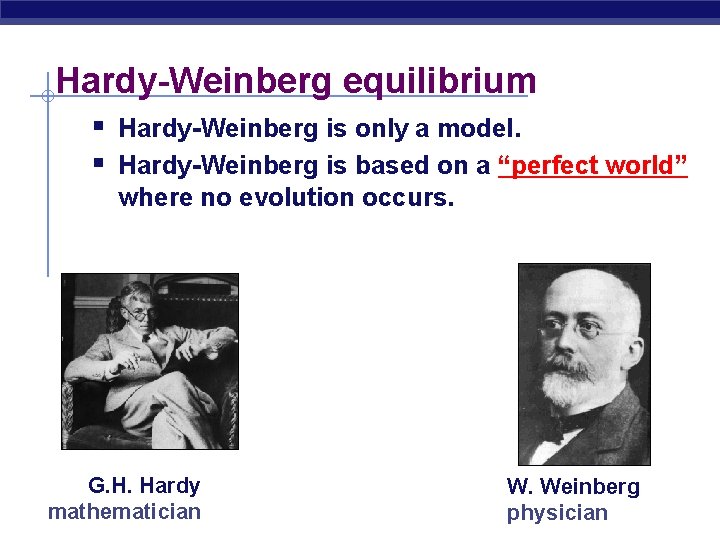
Hardy-Weinberg equilibrium § Hardy-Weinberg is only a model. § Hardy-Weinberg is based on a “perfect world” where no evolution occurs. G. H. Hardy APmathematician Biology W. Weinberg physician
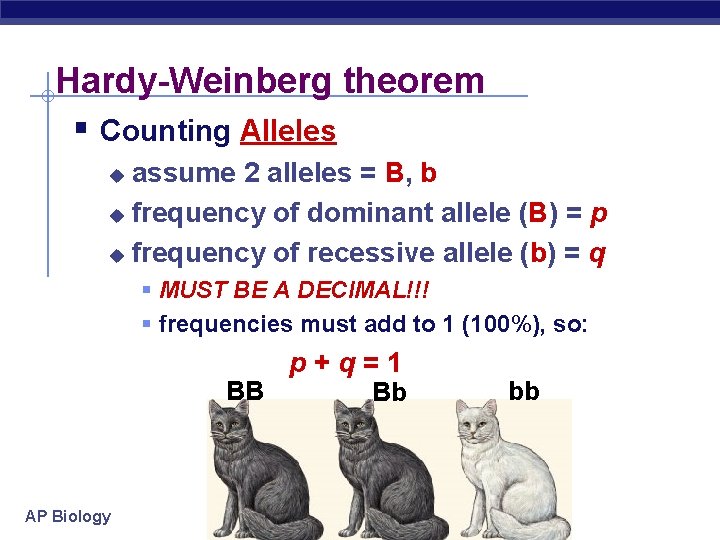
Hardy-Weinberg theorem § Counting Alleles assume 2 alleles = B, b u frequency of dominant allele (B) = p u frequency of recessive allele (b) = q u § MUST BE A DECIMAL!!! § frequencies must add to 1 (100%), so: BB AP Biology p+q=1 Bb bb

Hardy-Weinberg theorem § Counting Individuals u frequency of homozygous dominant: p x p = p 2 u frequency of homozygous recessive: q x q = q 2 u frequency of heterozygotes: (p x q) + (q x p) = 2 pq § frequencies of all individuals must add to 1 (100%), so: p 2 + 2 pq + q 2 = 1 AP Biology
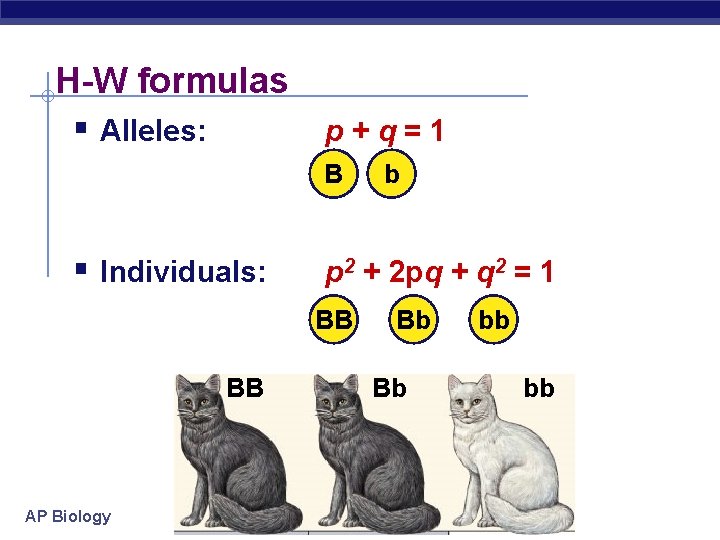
H-W formulas § Alleles: p+q=1 B § Individuals: p 2 + 2 pq + q 2 = 1 BB BB AP Biology b Bb Bb bb bb
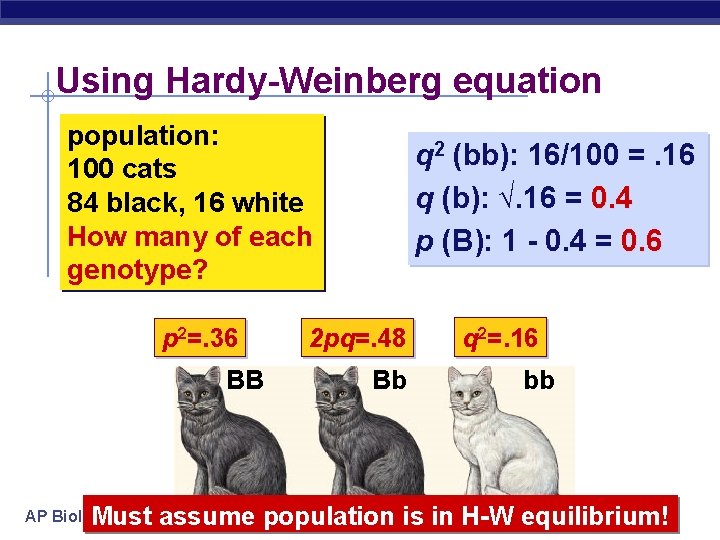
Using Hardy-Weinberg equation population: 100 cats 84 black, 16 white How many of each genotype? p 2=. 36 BB q 2 (bb): 16/100 =. 16 q (b): √. 16 = 0. 4 p (B): 1 - 0. 4 = 0. 6 2 pq=. 48 Bb q 2=. 16 bb What assume Must are the genotype population frequencies? is in H-W equilibrium! AP Biology

Using Hardy-Weinberg equation p 2=. 36 Assuming H-W equilibrium 2 pq=. 48 q 2=. 16 BB Bb bb p 2=. 20 =. 74 BB 2 pq=. 64 2 pq=. 10 Bb q 2=. 16 bb Null hypothesis Sampled data How do you explain the data? AP Biology

Any Questions? ? AP Biology 2005 -2006

Hardy-Weinberg Lab Data Mutation AP Biology Gene Flow Genetic Drift Selection Non-random mating 2006 -2007

Hardy Weinberg Lab: Equilibrium Original population 18 individuals 36 alleles p (A): 0. 5 q (a): 0. 5 AA. 25 AP Biology Aa. 50 aa. 25 Case #1 F 5 AA Aa aa 4 7 7 total alleles = 36 p (A): (4+4+7)/36 =. 42 q (a): (7+7+7)/36 =. 58 AA. 22 Aa. 39 How do you explain these data? aa. 39

Hardy Weinberg Lab: Selection Original population 15 individuals 30 alleles p (A): 0. 5 q (a): 0. 5 AA. 25 AP Biology Aa. 50 aa. 25 Case #2 F 5 AA Aa aa 9 6 0 total alleles = 30 p (A): (9+9+6)/30 =. 80 q (a): (0+0+6)/30 =. 20 AA. 60 Aa. 40 How do you explain these data? aa 0
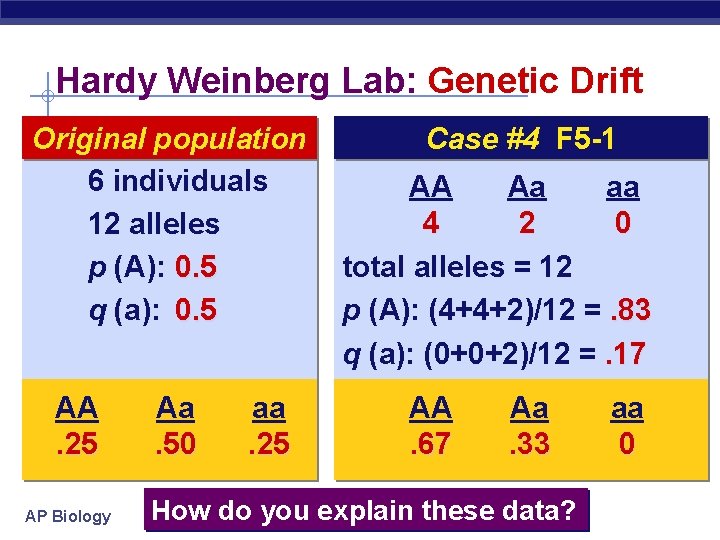
Hardy Weinberg Lab: Genetic Drift Original population 6 individuals 12 alleles p (A): 0. 5 q (a): 0. 5 AA. 25 AP Biology Aa. 50 aa. 25 Case #4 F 5 -1 AA Aa aa 4 2 0 total alleles = 12 p (A): (4+4+2)/12 =. 83 q (a): (0+0+2)/12 =. 17 AA. 67 Aa. 33 How do you explain these data? aa 0
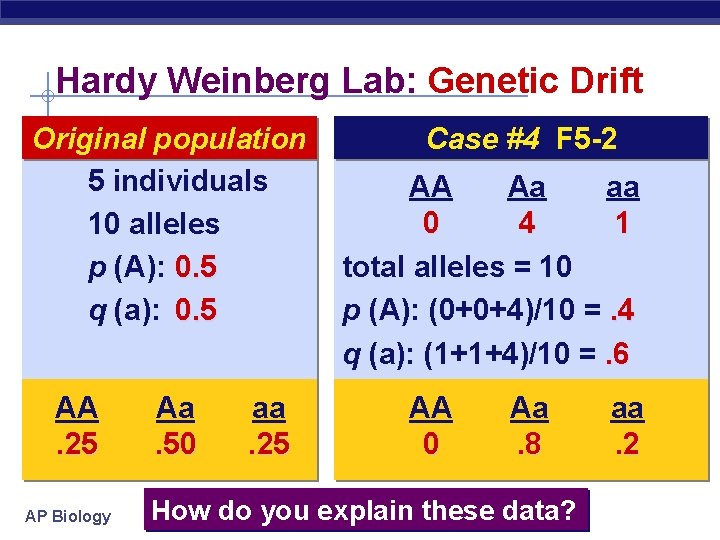
Hardy Weinberg Lab: Genetic Drift Original population 5 individuals 10 alleles p (A): 0. 5 q (a): 0. 5 AA. 25 AP Biology Aa. 50 aa. 25 Case #4 F 5 -2 AA Aa aa 0 4 1 total alleles = 10 p (A): (0+0+4)/10 =. 4 q (a): (1+1+4)/10 =. 6 AA 0 Aa. 8 How do you explain these data? aa. 2

Hardy Weinberg Lab: Genetic Drift Original population 5 individuals 10 alleles p (A): 0. 5 q (a): 0. 5 AA. 25 AP Biology Aa. 50 aa. 25 Case #4 F 5 -3 AA Aa aa 2 2 1 total alleles = 10 p (A): (2+2+2)/10 =. 6 q (a): (1+1+2)/10 =. 4 AA. 4 Aa. 4 How do you explain these data? aa. 2

Hardy Weinberg Lab: Genetic Drift Original population 5 individuals 10 alleles p (A): 0. 5 q (a): 0. 5 AA. 25 AP Biology Aa. 50 Case #4 F 5 AA Aa aa p q 1. 67. 33 0. 83. 17 2 0 . 8 . 2 . 4. 6 3 4 . 2 . 6. 4 aa. 25 How do you explain these data?
Any Questions? ? AP Biology 2007 -2008
- Slides: 21