
Measuring Enthalpy Changes Calorimetry Calorimetry the measurement of

- Slides: 9
Measuring Enthalpy Changes
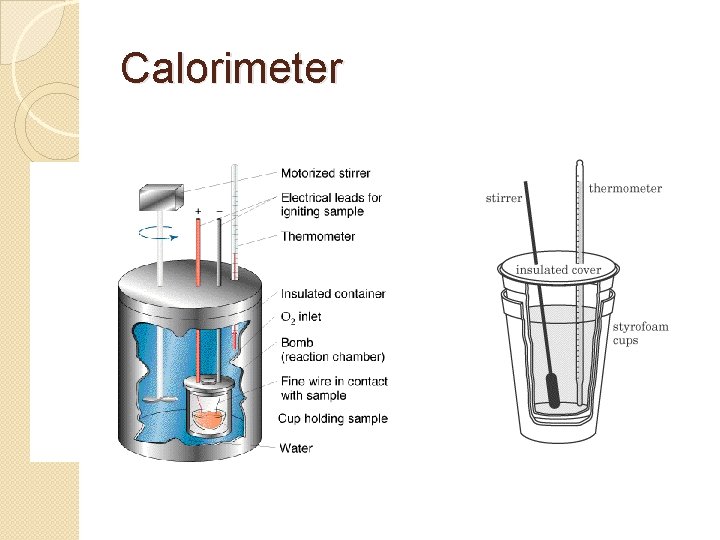
Calorimetry �Calorimetry - the measurement of heat/ energy changes in a chemical reaction �Calorimeter: insulated device used to measure the absorption or release of heat in chemical or physical processes �Bomb Calorimeter: uses constant volume
Calorimeter
Enthalpy �Enthalpy - represents heat energy �Change in Enthalpy (D Ho) - energy difference between the products and reactants �Exothermic: energy released, ∆ enthalpy (- ) ◦ In the combustion of CH 4, D Ho = – 211 kcal �Endothermic: energy absorbed, ∆ enthalpy (+) o
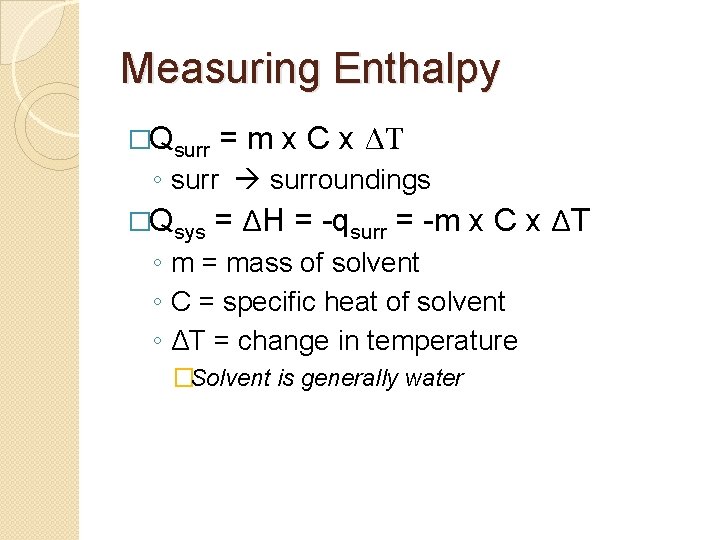
Measuring Enthalpy �Qsurr = m x C x ΔT �Qsys = ΔH = -qsurr = -m x C x ΔT ◦ surroundings ◦ m = mass of solvent ◦ C = specific heat of solvent ◦ ΔT = change in temperature �Solvent is generally water
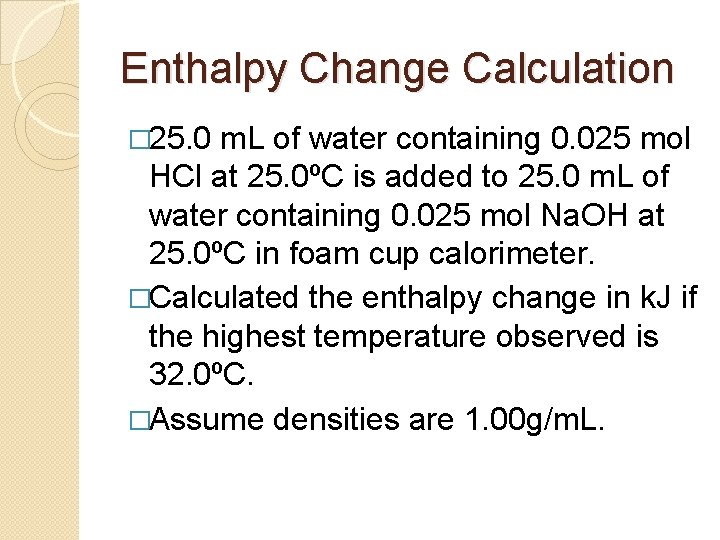
Enthalpy Change Calculation � 25. 0 m. L of water containing 0. 025 mol HCl at 25. 0ºC is added to 25. 0 m. L of water containing 0. 025 mol Na. OH at 25. 0ºC in foam cup calorimeter. �Calculated the enthalpy change in k. J if the highest temperature observed is 32. 0ºC. �Assume densities are 1. 00 g/m. L.
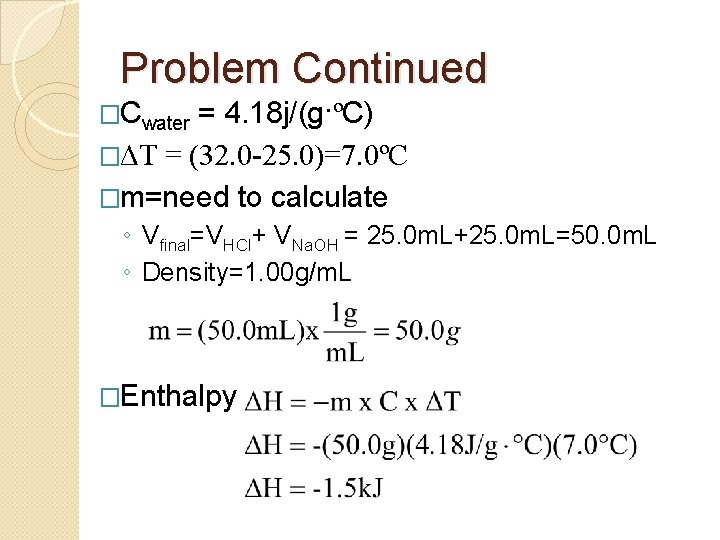
Problem Continued �Cwater = 4. 18 j/(g·ºC) �ΔT = (32. 0 -25. 0)=7. 0ºC �m=need to calculate ◦ Vfinal=VHCl+ VNa. OH = 25. 0 m. L+25. 0 m. L=50. 0 m. L ◦ Density=1. 00 g/m. L �Enthalpy
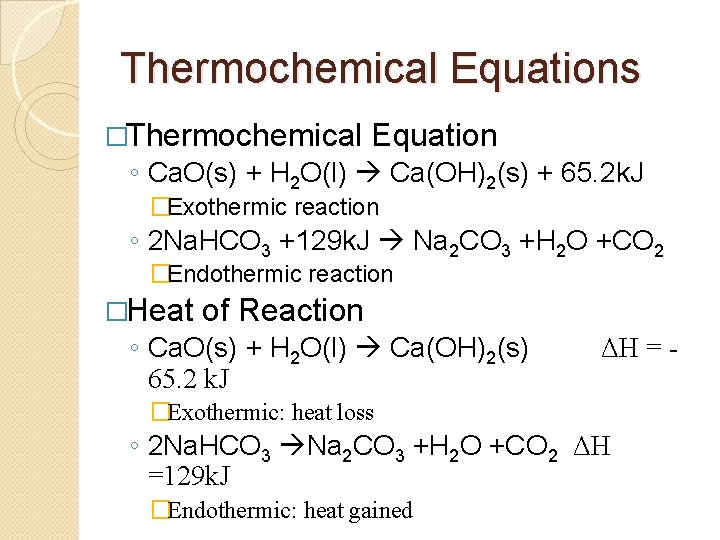
Thermochemical Equations �Thermochemical Equation ◦ Ca. O(s) + H 2 O(l) Ca(OH)2(s) + 65. 2 k. J �Exothermic reaction ◦ 2 Na. HCO 3 +129 k. J Na 2 CO 3 +H 2 O +CO 2 �Endothermic reaction �Heat of Reaction ◦ Ca. O(s) + H 2 O(l) Ca(OH)2(s) 65. 2 k. J ΔH = - �Exothermic: heat loss ◦ 2 Na. HCO 3 Na 2 CO 3 +H 2 O +CO 2 ΔH =129 k. J �Endothermic: heat gained
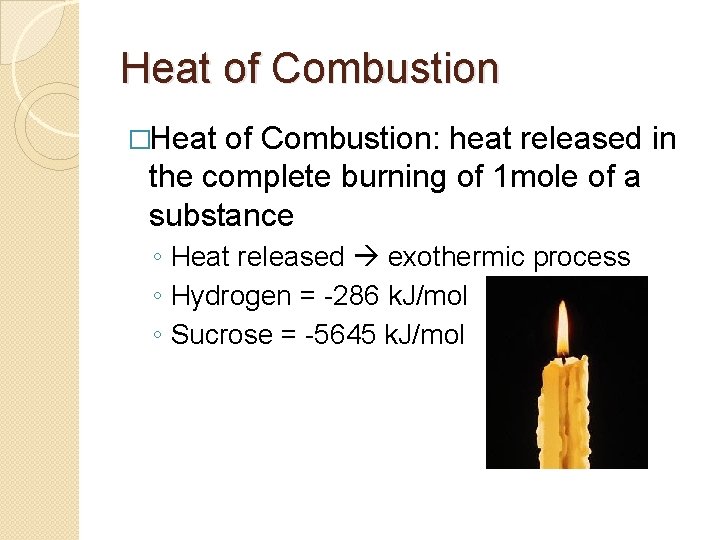
Heat of Combustion �Heat of Combustion: heat released in the complete burning of 1 mole of a substance ◦ Heat released exothermic process ◦ Hydrogen = -286 k. J/mol ◦ Sucrose = -5645 k. J/mol