
Measuring Engine Performance The main goal of this
- Slides: 66
Measuring Engine Performance
The main goal of this chapter is to determine functional horsepower through different measurements and formulas
Small Gasoline Engine – Internal Combustion
Small Gasoline Engine – Internal Combustion • Air/fuel mixture is ignited inside the engine
Small Gasoline Engine – Internal Combustion • Air/fuel mixture is ignited inside the engine • The gasses (when ignited ) expand in all directions
Small Gasoline Engine – Internal Combustion • Air/fuel mixture is ignited inside the engine • The gasses (when ignited ) expand in all directions • Only the piston is allowed to move
Small Gasoline Engine – Internal Combustion • Air/fuel mixture is ignited inside the engine • The gasses (when ignited ) expand in all directions • Only the piston is allowed to move – Inertia
Small Gasoline Engine – Internal Combustion • Air/fuel mixture is ignited inside the engine • The gasses (when ignited ) expand in all directions • Only the piston is allowed to move – Inertia • A physical law that states an object in motion will continue in motion or an object at rest will continue at rest unless an additional force is applied.
Small Gasoline Engine – Internal Combustion • Air/fuel mixture is ignited inside the engine • The gasses (when ignited ) expand in all directions • Only the piston is allowed to move – Inertia • A physical law that states an object in motion will continue in motion or an object at rest will continue at rest unless an additional force is applied. – The piston reaches TDC then reverses direction, repeating the process at BDC. This places extreme stress on the engine by changing the inertia
Performance • Defined as the work engines do
Performance • Defined as the work engines do also, • Defined as how well they do the work
Bore • The diameter or width across the top of the cylinder – Measured using caliper or telescoping gauges and micrometers
Stroke • The up or down movement of the piston. – Measured from TDC to BDC. – Determined by the amount of offset on the crankshaft.
Stroke • The up or down movement of the piston. – Measured from TDC to BDC. – Determined by the amount of offset on the crankshaft. or by the vernier depth gauge
Square? • An engine is considered square if the bore and stroke measurements are identical
Square? • An engine is considered square if the bore and stroke measurements are identical • An engine is considered over square if the bore diameter is greater than the stroke
Square? • An engine is considered square if the bore and stroke measurements are identical • An engine is considered over square if the bore diameter is greater than the stroke • An engine is considered under square if the bore diameter is smaller than the stroke.
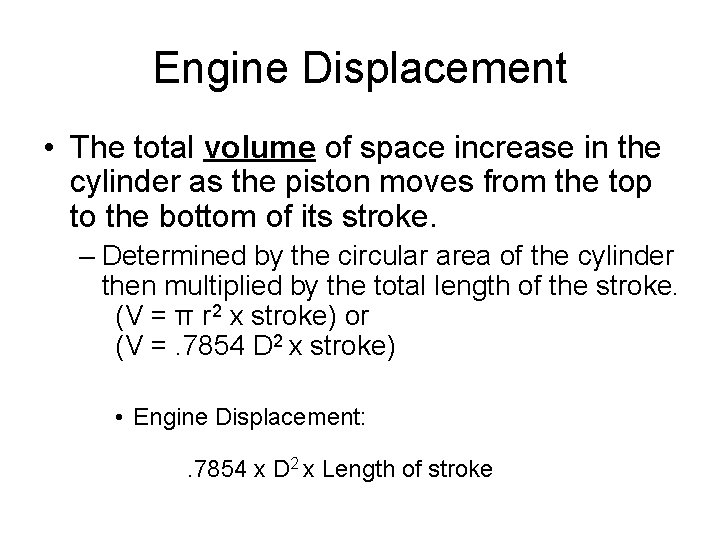
Engine Displacement • The total volume of space increase in the cylinder as the piston moves from the top to the bottom of its stroke.
Engine Displacement • The total volume of space increase in the cylinder as the piston moves from the top to the bottom of its stroke. – Determined by the circular area of the cylinder then multiplied by the total length of the stroke.
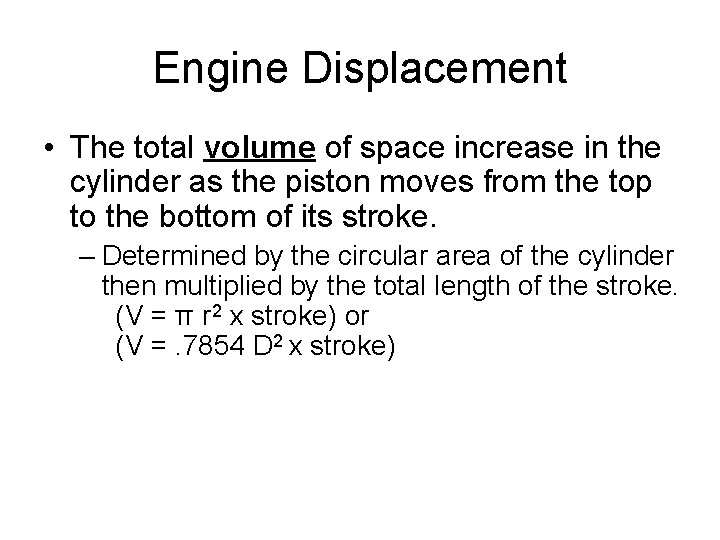
Engine Displacement • The total volume of space increase in the cylinder as the piston moves from the top to the bottom of its stroke. – Determined by the circular area of the cylinder then multiplied by the total length of the stroke. (V = π r 2 x stroke) or (V =. 7854 D 2 x stroke)
Engine Displacement • The total volume of space increase in the cylinder as the piston moves from the top to the bottom of its stroke. – Determined by the circular area of the cylinder then multiplied by the total length of the stroke. (V = π r 2 x stroke) or (V =. 7854 D 2 x stroke) • Engine Displacement: . 7854 x D 2 x Length of stroke
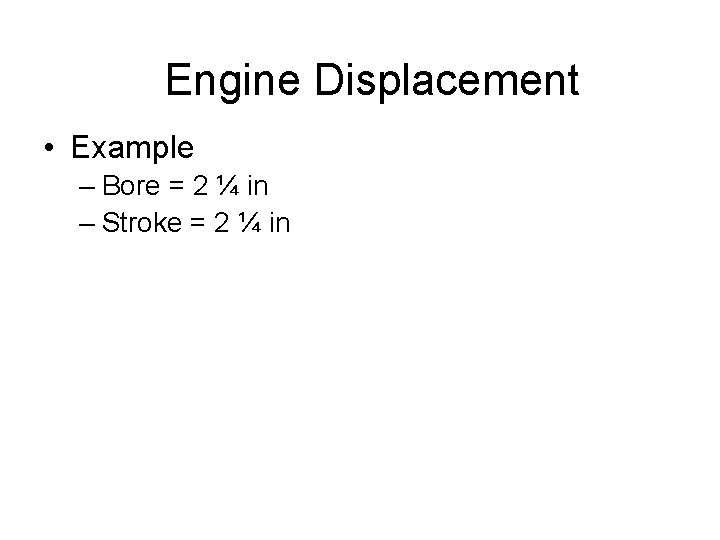
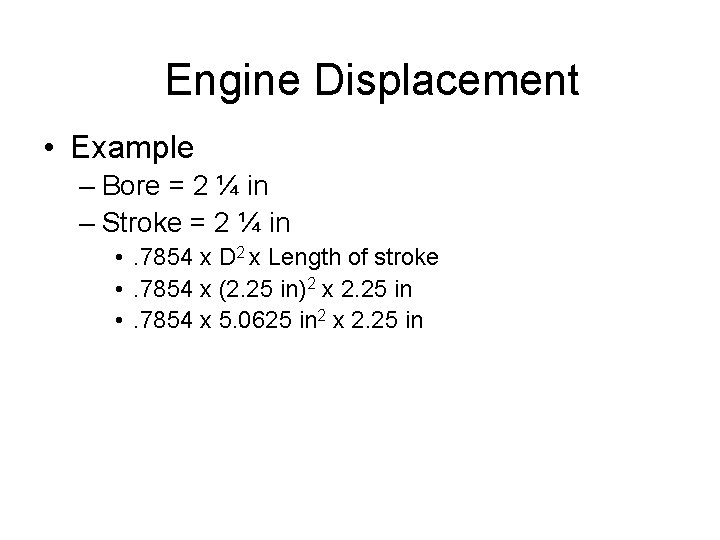
Engine Displacement • Example – Bore = 2 ¼ in – Stroke = 2 ¼ in
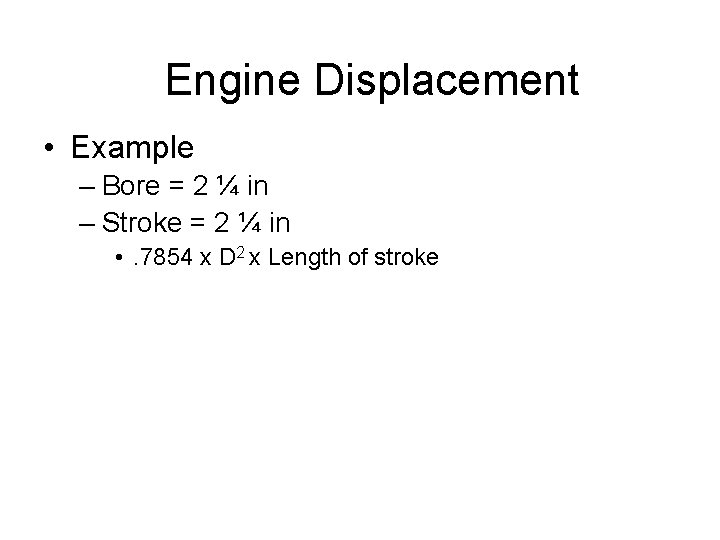
Engine Displacement • Example – Bore = 2 ¼ in – Stroke = 2 ¼ in • . 7854 x D 2 x Length of stroke
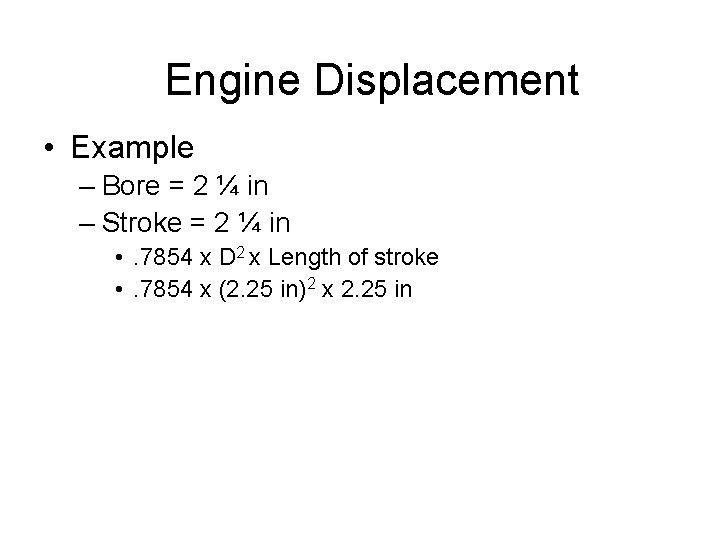
Engine Displacement • Example – Bore = 2 ¼ in – Stroke = 2 ¼ in • . 7854 x D 2 x Length of stroke • . 7854 x (2. 25 in)2 x 2. 25 in
Engine Displacement • Example – Bore = 2 ¼ in – Stroke = 2 ¼ in • . 7854 x D 2 x Length of stroke • . 7854 x (2. 25 in)2 x 2. 25 in • . 7854 x 5. 0625 in 2 x 2. 25 in
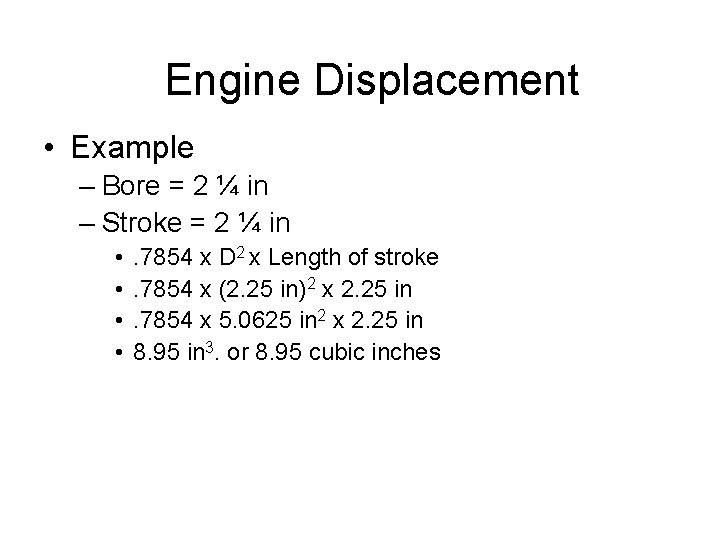
Engine Displacement • Example – Bore = 2 ¼ in – Stroke = 2 ¼ in • • . 7854 x D 2 x Length of stroke. 7854 x (2. 25 in)2 x 2. 25 in. 7854 x 5. 0625 in 2 x 2. 25 in 8. 95 in 3. or 8. 95 cubic inches
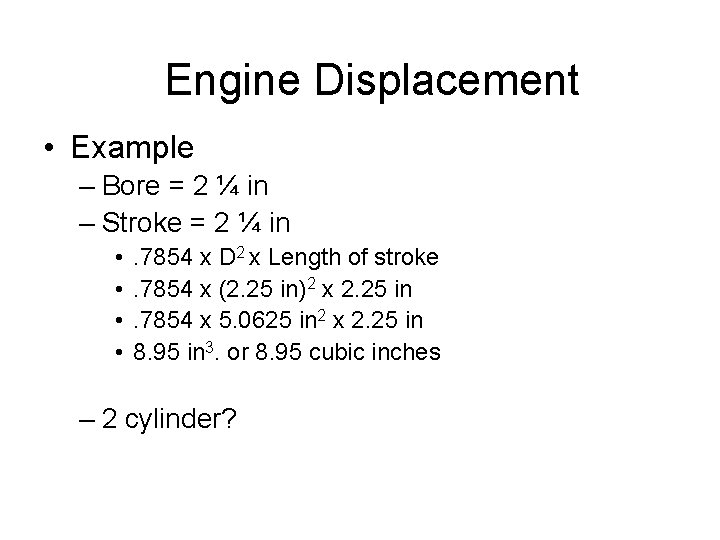
Engine Displacement • Example – Bore = 2 ¼ in – Stroke = 2 ¼ in • • . 7854 x D 2 x Length of stroke. 7854 x (2. 25 in)2 x 2. 25 in. 7854 x 5. 0625 in 2 x 2. 25 in 8. 95 in 3. or 8. 95 cubic inches – 2 cylinder?
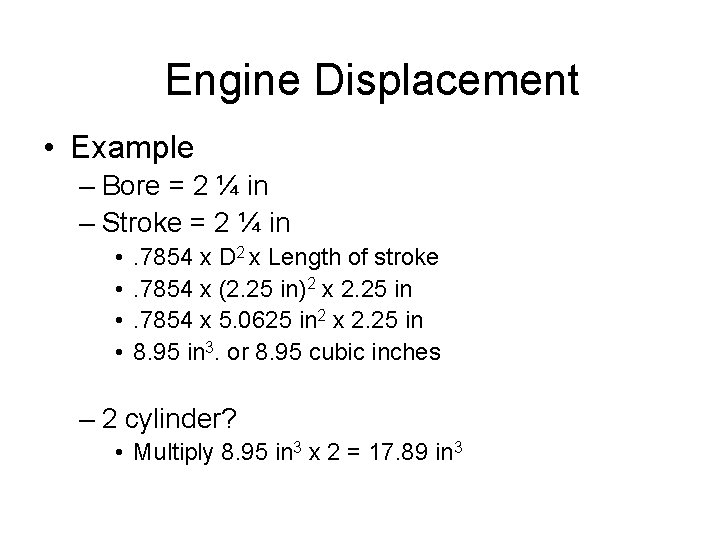
Engine Displacement • Example – Bore = 2 ¼ in – Stroke = 2 ¼ in • • . 7854 x D 2 x Length of stroke. 7854 x (2. 25 in)2 x 2. 25 in. 7854 x 5. 0625 in 2 x 2. 25 in 8. 95 in 3. or 8. 95 cubic inches – 2 cylinder? • Multiply 8. 95 in 3 x 2 = 17. 89 in 3
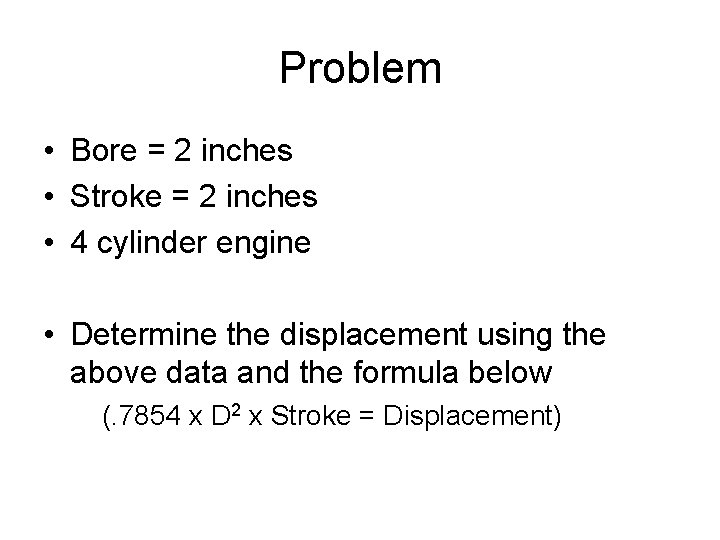
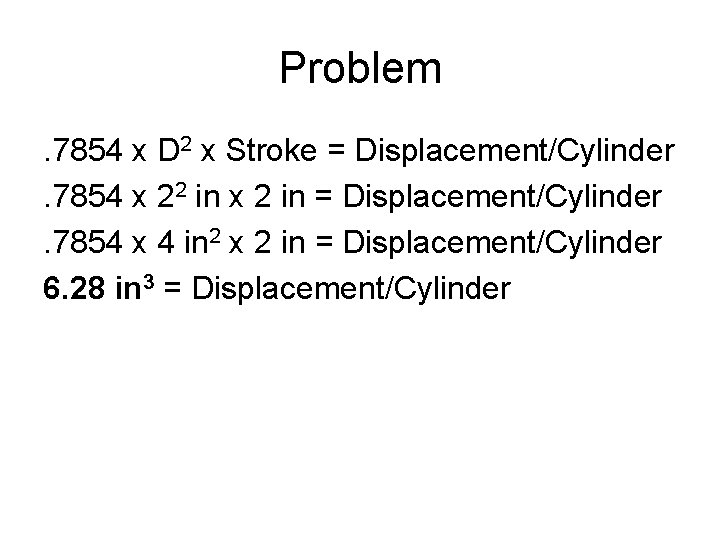
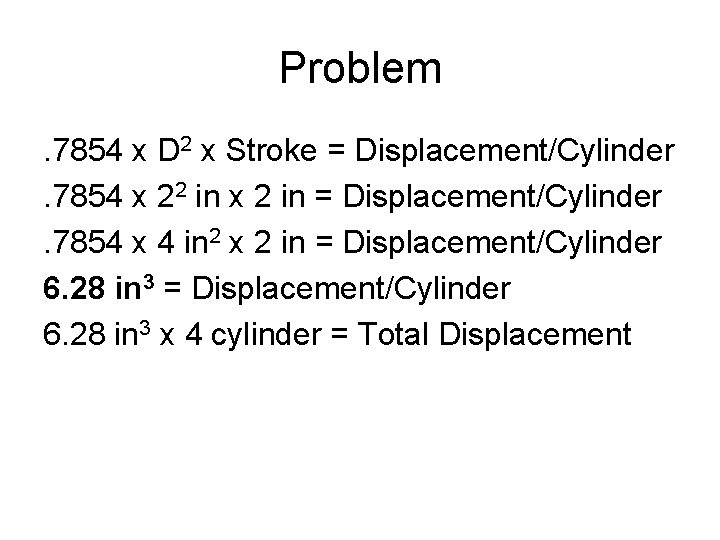
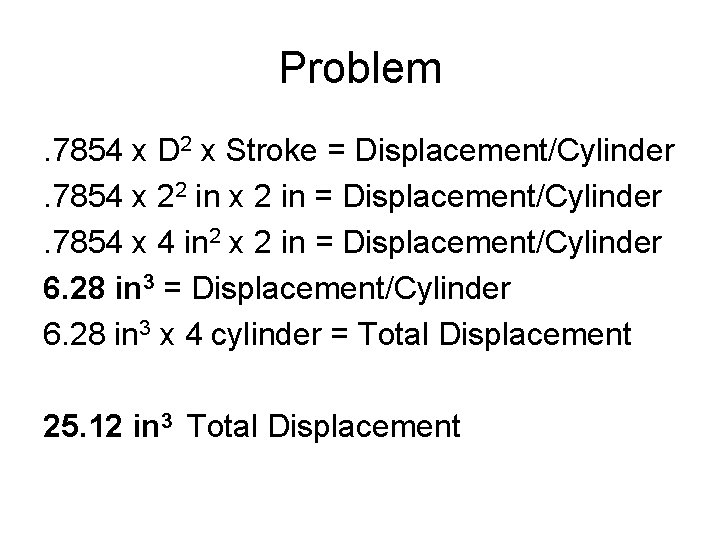
Problem • Bore = 2 inches • Stroke = 2 inches • 4 cylinder engine • Determine the displacement using the above data and the formula below (. 7854 x D 2 x Stroke = Displacement)
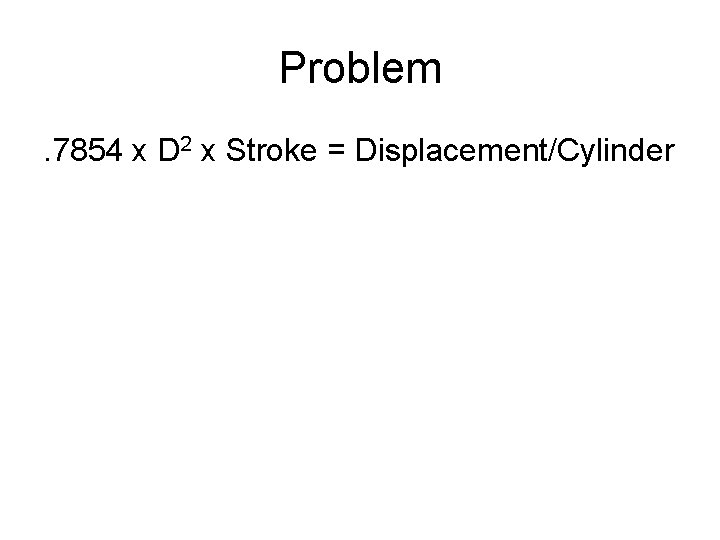
Problem. 7854 x D 2 x Stroke = Displacement/Cylinder
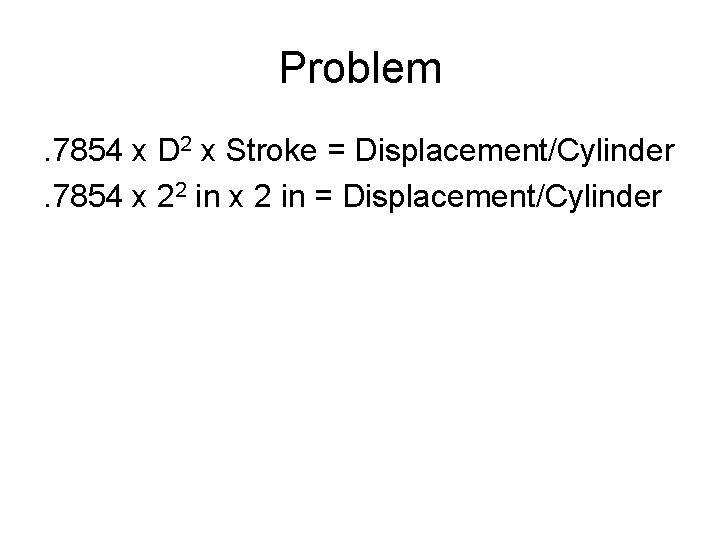
Problem. 7854 x D 2 x Stroke = Displacement/Cylinder. 7854 x 22 in x 2 in = Displacement/Cylinder
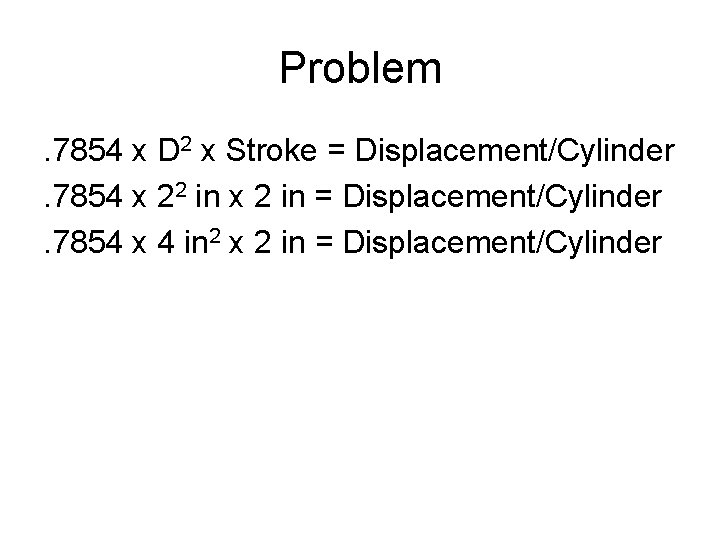
Problem. 7854 x D 2 x Stroke = Displacement/Cylinder. 7854 x 22 in x 2 in = Displacement/Cylinder. 7854 x 4 in 2 x 2 in = Displacement/Cylinder
Problem. 7854 x D 2 x Stroke = Displacement/Cylinder. 7854 x 22 in x 2 in = Displacement/Cylinder. 7854 x 4 in 2 x 2 in = Displacement/Cylinder 6. 28 in 3 = Displacement/Cylinder
Problem. 7854 x D 2 x Stroke = Displacement/Cylinder. 7854 x 22 in x 2 in = Displacement/Cylinder. 7854 x 4 in 2 x 2 in = Displacement/Cylinder 6. 28 in 3 x 4 cylinder = Total Displacement
Problem. 7854 x D 2 x Stroke = Displacement/Cylinder. 7854 x 22 in x 2 in = Displacement/Cylinder. 7854 x 4 in 2 x 2 in = Displacement/Cylinder 6. 28 in 3 x 4 cylinder = Total Displacement 25. 12 in 3 Total Displacement
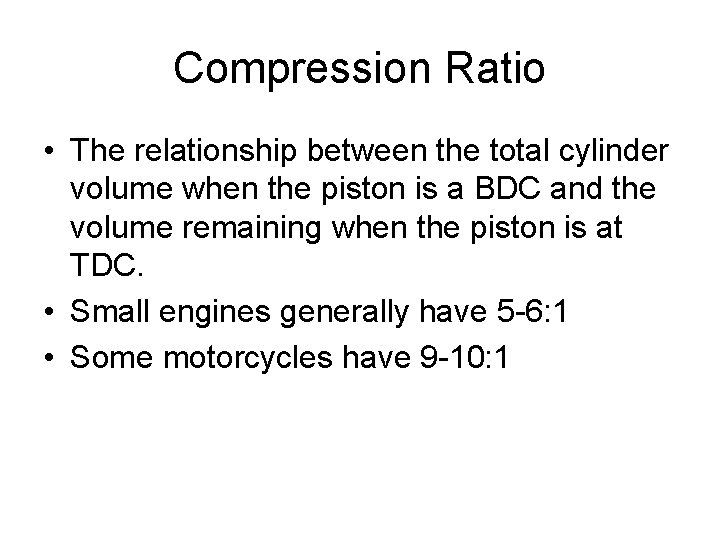
Compression Ratio • The relationship between the total cylinder volume when the piston is a BDC and the volume remaining when the piston is at TDC. • Small engines generally have 5 -6: 1 • Some motorcycles have 9 -10: 1
Force • The pushing or pulling of one body on another.
Force • The pushing or pulling of one body on another. – Weight of you on a chair
Force • The pushing or pulling of one body on another. – Weight of you on a chair – Centrifugal force • The ball at the end of a string tries to move outward from its path when twirled
Force • The pushing or pulling of one body on another. – Weight of you on a chair – Centrifugal force • The body tries to move outward from its path when twirled – Tensile Stress • the pushing or pulling stress (on the string)
Force • The pushing or pulling of one body on another. – Weight of you on a chair – Centrifugal force • The body tries to move outward from its path when twirled – Tensile Stress • the pushing or pulling stress – Ex. The piston reversing direction several times a second
Work • Accomplished only when a force is applied through some distance
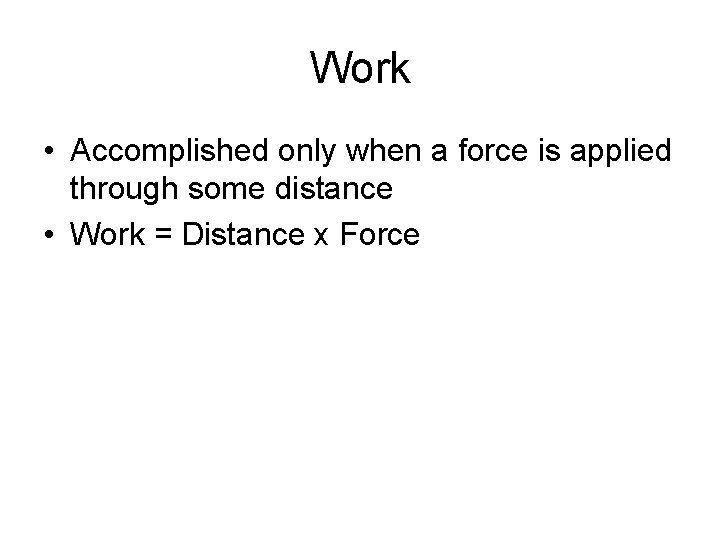
Work • Accomplished only when a force is applied through some distance • Work = Distance x Force
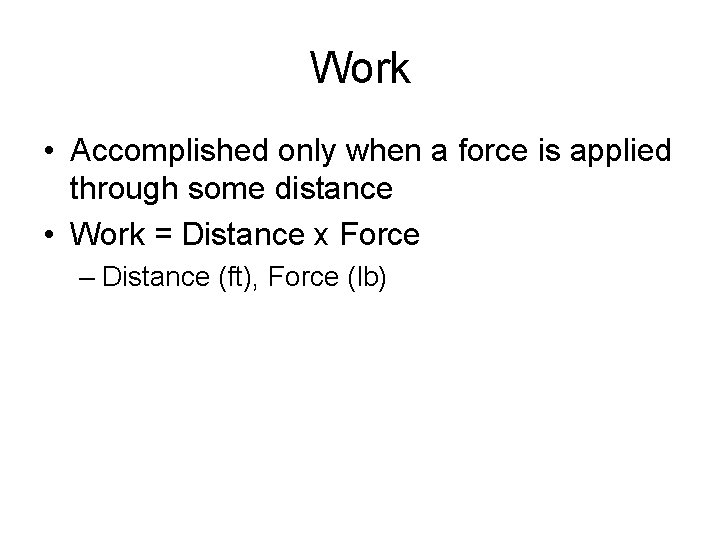
Work • Accomplished only when a force is applied through some distance • Work = Distance x Force – Distance (ft), Force (lb)
Work • Accomplished only when a force is applied through some distance • Work = Distance x Force – Distance (ft), Force (lb) – Work Unit = ft·lb
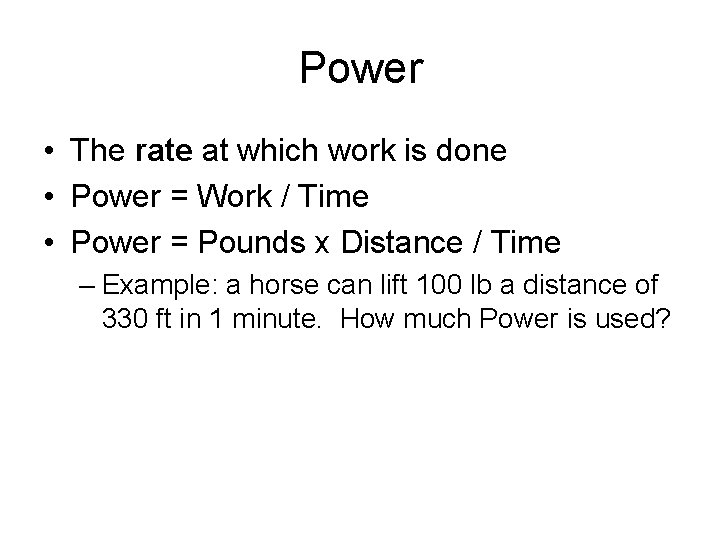
Power • The rate at which work is done
Power • The rate at which work is done • Power = Work / Time
Power • The rate at which work is done • Power = Work / Time • Power = Pounds x Distance / Time
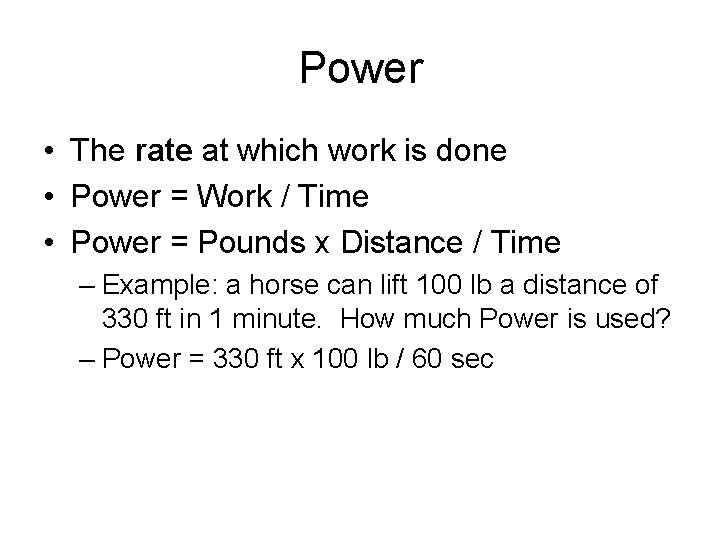
Power • The rate at which work is done • Power = Work / Time • Power = Pounds x Distance / Time – Example: a horse can lift 100 lb a distance of 330 ft in 1 minute. How much Power is used?
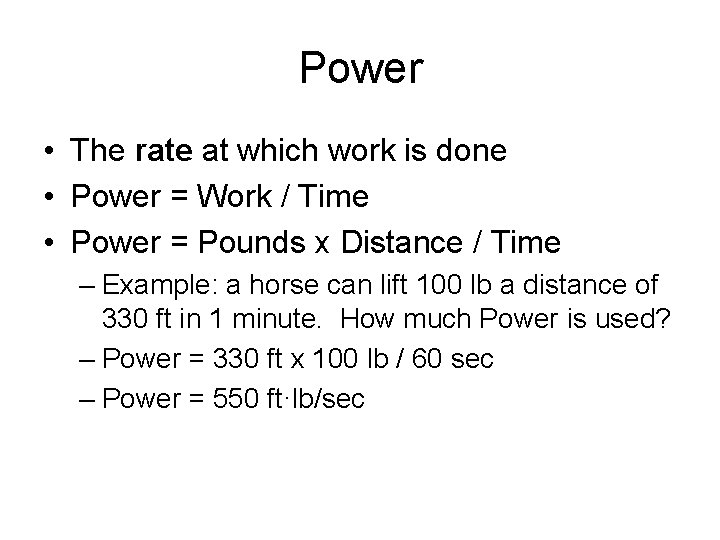
Power • The rate at which work is done • Power = Work / Time • Power = Pounds x Distance / Time – Example: a horse can lift 100 lb a distance of 330 ft in 1 minute. How much Power is used? – Power = 330 ft x 100 lb / 60 sec
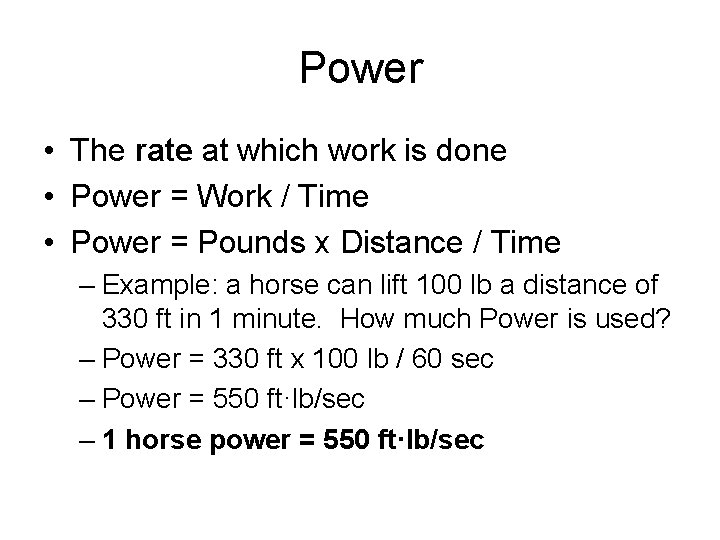
Power • The rate at which work is done • Power = Work / Time • Power = Pounds x Distance / Time – Example: a horse can lift 100 lb a distance of 330 ft in 1 minute. How much Power is used? – Power = 330 ft x 100 lb / 60 sec – Power = 550 ft·lb/sec
Power • The rate at which work is done • Power = Work / Time • Power = Pounds x Distance / Time – Example: a horse can lift 100 lb a distance of 330 ft in 1 minute. How much Power is used? – Power = 330 ft x 100 lb / 60 sec – Power = 550 ft·lb/sec – 1 horse power = 550 ft·lb/sec
Horsepower • Calculate the amount of work and engine does and divide it by 550 ft·lb/sec. This will give the rated horsepower.
Horsepower • Calculate the amount of work and engine does and divide it by 550 ft·lb/sec. This will give the rated horsepower. • Brake Horsepower
Horsepower • Calculate the amount of work and engine does and divide it by 550 ft·lb/sec. This will give the rated horsepower. • Brake Horsepower – Usable horsepower
Horsepower • Calculate the amount of work and engine does and divide it by 550 ft·lb/sec. This will give the rated horsepower. • Brake Horsepower – Usable horsepower – Measured by
Horsepower • Calculate the amount of work and engine does and divide it by 550 ft·lb/sec. This will give the rated horsepower. • Brake Horsepower – Usable horsepower – Measured by • Prony brake (fiction) • Dynamometer (hydraulics)
Horsepower • Increases with increased speeds.
Horsepower • Increases with increased speeds. • Engines generally run at 3600 rpm.
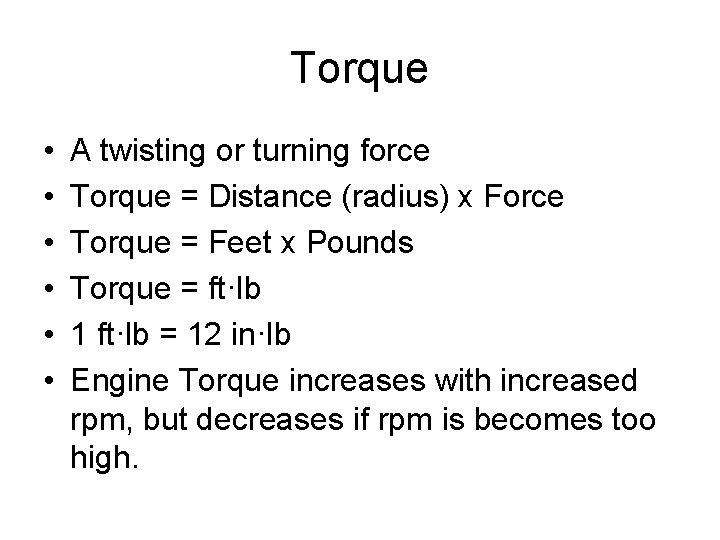
Torque • A twisting or turning force
Torque • A twisting or turning force • Torque = Distance (radius) x Force
Torque • A twisting or turning force • Torque = Distance (radius) x Force • Torque = Feet x Pounds
Torque • • A twisting or turning force Torque = Distance (radius) x Force Torque = Feet x Pounds Torque = ft·lb
Torque • • • A twisting or turning force Torque = Distance (radius) x Force Torque = Feet x Pounds Torque = ft·lb 1 ft·lb = 12 in·lb
Torque • • • A twisting or turning force Torque = Distance (radius) x Force Torque = Feet x Pounds Torque = ft·lb 1 ft·lb = 12 in·lb Engine Torque increases with increased rpm, but decreases if rpm is becomes too high.
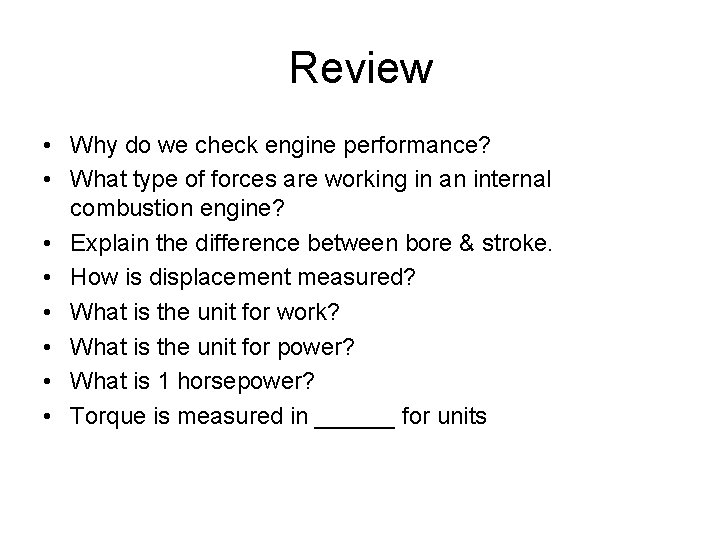
Review • Why do we check engine performance? • What type of forces are working in an internal combustion engine? • Explain the difference between bore & stroke. • How is displacement measured? • What is the unit for work? • What is the unit for power? • What is 1 horsepower? • Torque is measured in ______ for units