
MEASURING EFFECTIVENESS OF INSTRUCTIONAL GAMES AND SIMULATIONS RODNEY

- Slides: 22
MEASURING EFFECTIVENESS OF INSTRUCTIONAL GAMES AND SIMULATIONS RODNEY D. MYERS, PH. D. INDEPENDENT SCHOLAR THEODORE W. FRICK, PH. D. 1 PROFESSOR EMERITUS, INDIANA UNIVERSITY
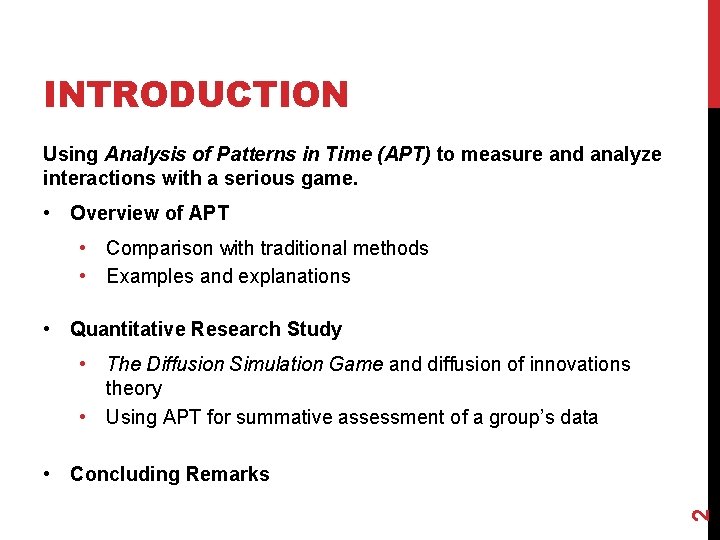
INTRODUCTION Using Analysis of Patterns in Time (APT) to measure and analyze interactions with a serious game. • Overview of APT • Comparison with traditional methods • Examples and explanations • Quantitative Research Study • The Diffusion Simulation Game and diffusion of innovations theory • Using APT for summative assessment of a group’s data 2 • Concluding Remarks
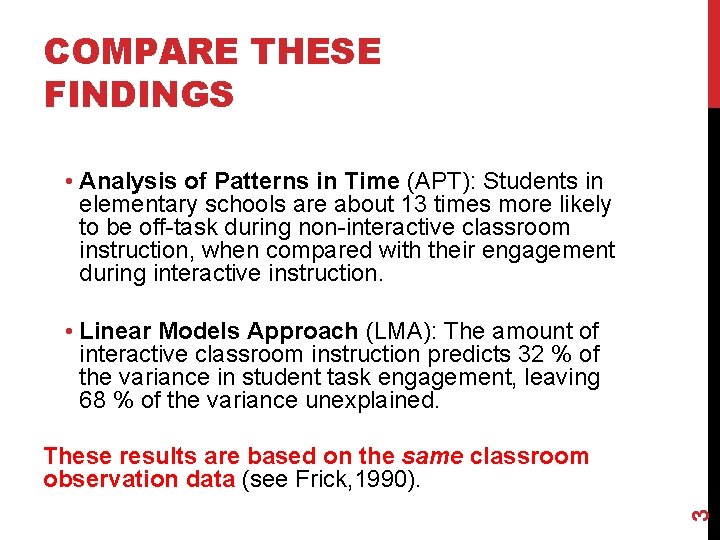
COMPARE THESE FINDINGS • Analysis of Patterns in Time (APT): Students in elementary schools are about 13 times more likely to be off-task during non-interactive classroom instruction, when compared with their engagement during interactive instruction. • Linear Models Approach (LMA): The amount of interactive classroom instruction predicts 32 % of the variance in student task engagement, leaving 68 % of the variance unexplained. 3 These results are based on the same classroom observation data (see Frick, 1990).
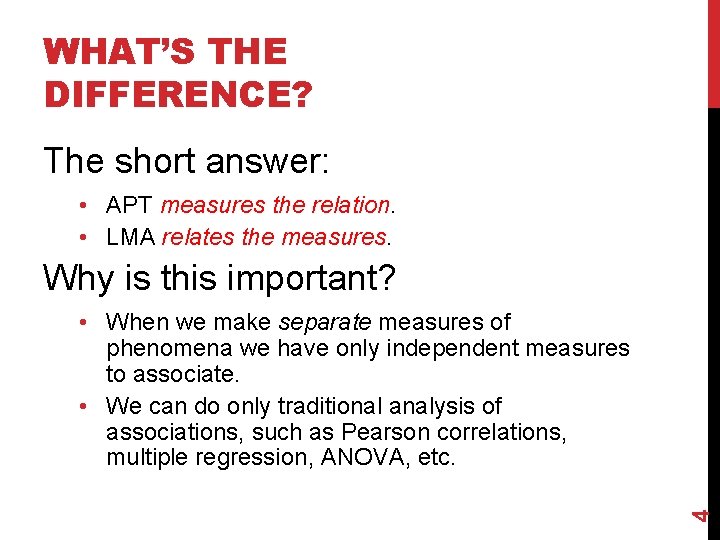
WHAT’S THE DIFFERENCE? The short answer: • APT measures the relation. • LMA relates the measures. Why is this important? 4 • When we make separate measures of phenomena we have only independent measures to associate. • We can do only traditional analysis of associations, such as Pearson correlations, multiple regression, ANOVA, etc.
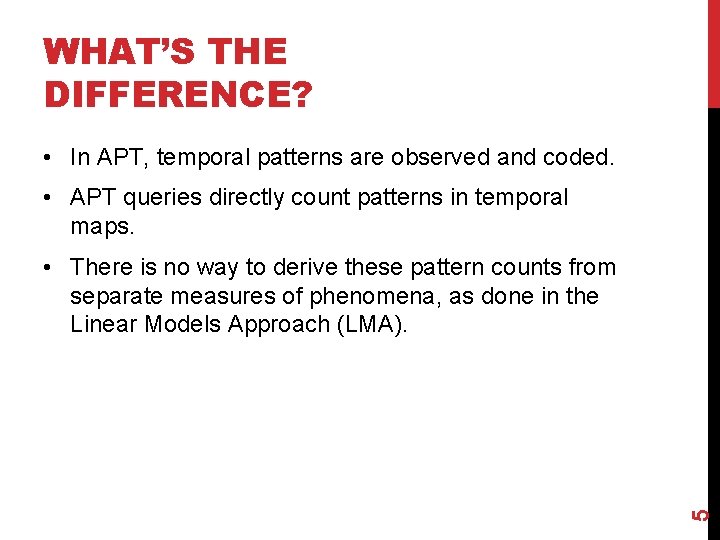
WHAT’S THE DIFFERENCE? • In APT, temporal patterns are observed and coded. • APT queries directly count patterns in temporal maps. 5 • There is no way to derive these pattern counts from separate measures of phenomena, as done in the Linear Models Approach (LMA).
WHAT’S THE DIFFERENCE (CONT’D) • “The mathematical conclusion is that there is no way to uniquely determine the joint probability distribution given only the marginal probability distributions. . . ” (Frick, 1984, p. 79) • The LMA is handicapped, as was Humpty Dumpty after falling from the wall: • We cannot reconstruct the relations of those pieces to each after Humpty Dumpty fell (we cannot “put Humpty Dumpty together again”) • We are limited to counting the separate pieces on the ground, not their relations to each other. • We refer to this problem as “aggregation aggravation. ” 6 • Maybe we should instead call it the “Humpty Dumpty Effect. ”
EXAMPLE OF APT TEMPORAL MAP FOR THE DIFFUSION SIMULATION GAME • If we have a good Internet connection: https: //www. indiana. edu/~simed/aptmulti map/aptdsg. Summary. php 19 • Show a couple of maps. • Do a couple of queries.
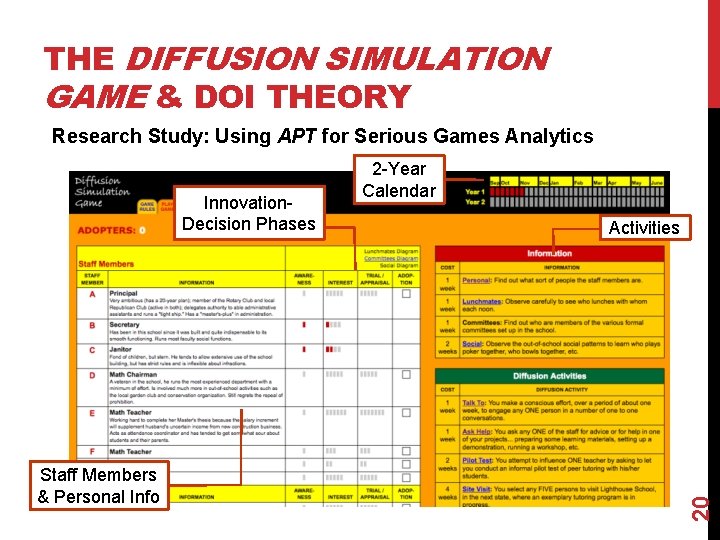
THE DIFFUSION SIMULATION GAME & DOI THEORY Research Study: Using APT for Serious Games Analytics Staff Members & Personal Info Activities 20 Innovation. Decision Phases 2 -Year Calendar
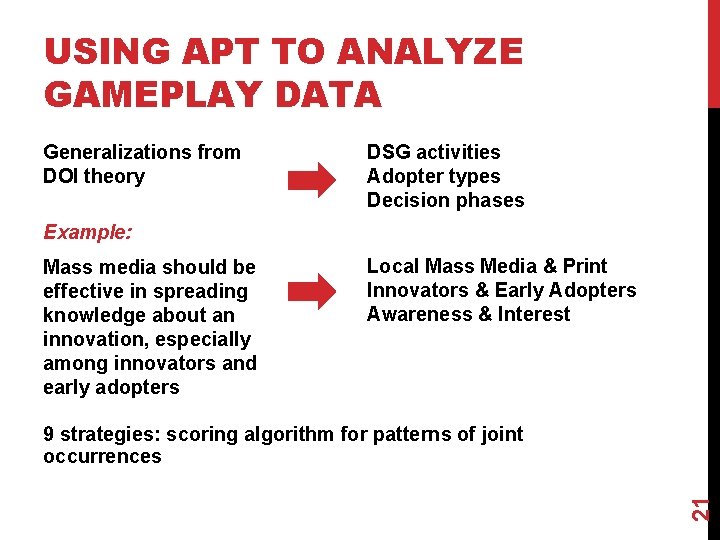
USING APT TO ANALYZE GAMEPLAY DATA Generalizations from DOI theory DSG activities Adopter types Decision phases Example: Mass media should be effective in spreading knowledge about an innovation, especially among innovators and early adopters Local Mass Media & Print Innovators & Early Adopters Awareness & Interest 21 9 strategies: scoring algorithm for patterns of joint occurrences
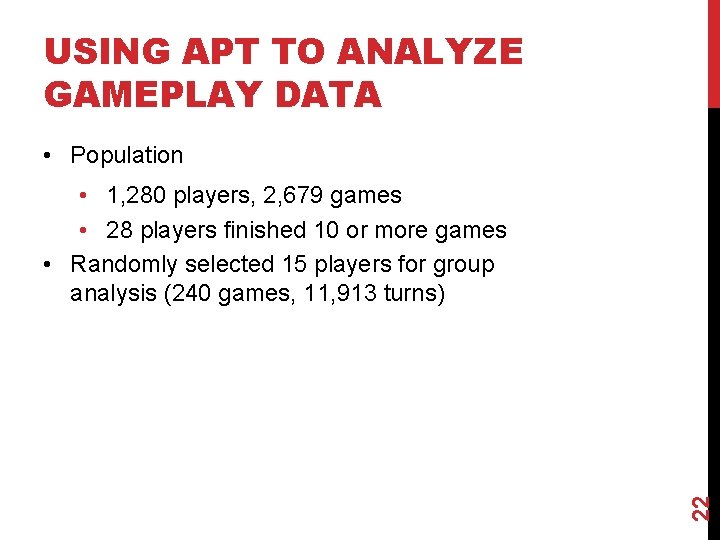
USING APT TO ANALYZE GAMEPLAY DATA • Population 22 • 1, 280 players, 2, 679 games • 28 players finished 10 or more games • Randomly selected 15 players for group analysis (240 games, 11, 913 turns)
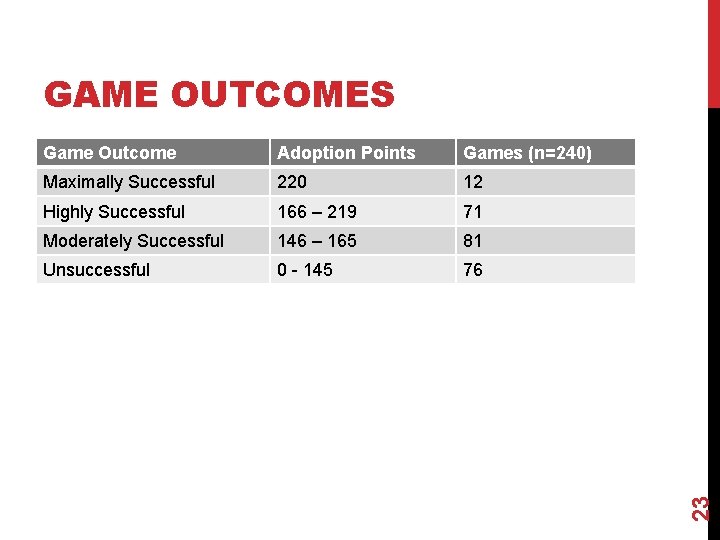
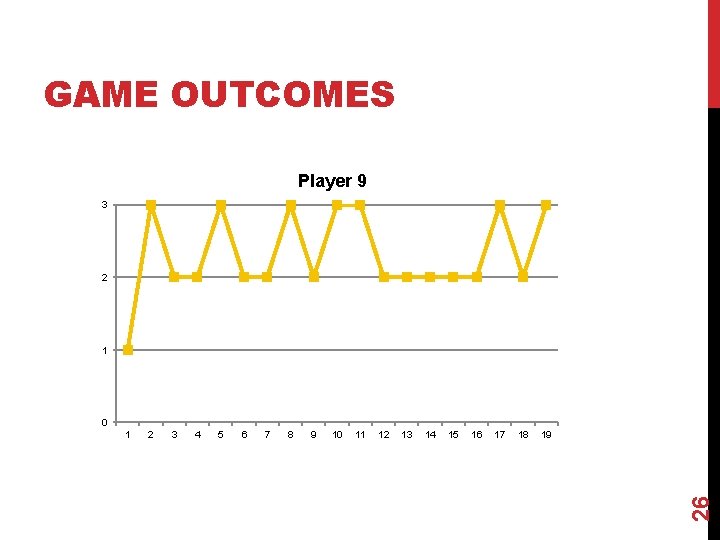
Game Outcome Adoption Points Games (n=240) Maximally Successful 220 12 Highly Successful 166 – 219 71 Moderately Successful 146 – 165 81 Unsuccessful 0 - 145 76 23 GAME OUTCOMES
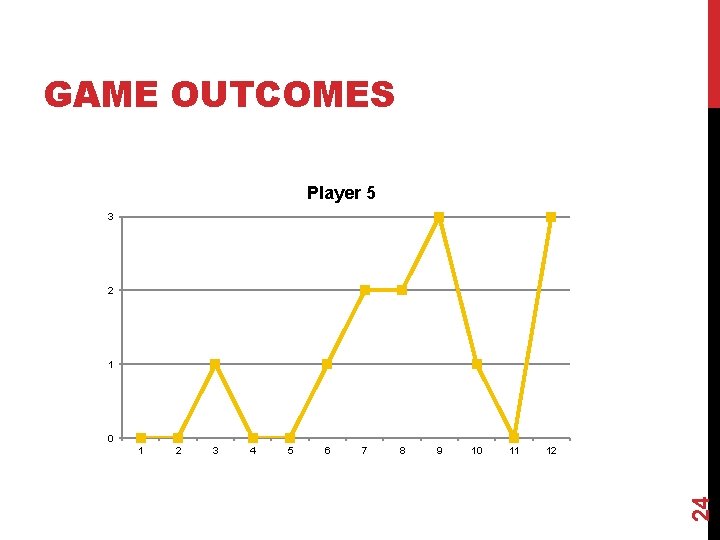
GAME OUTCOMES Player 5 3 2 1 0 2 3 4 5 6 7 8 9 10 11 12 24 1
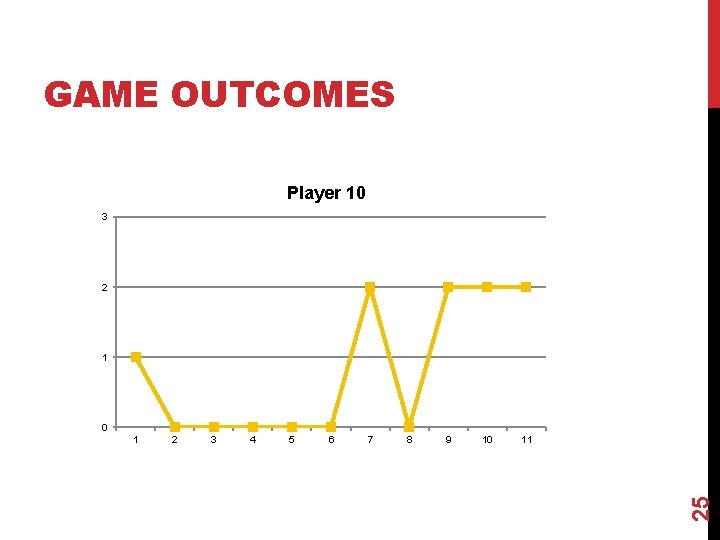
GAME OUTCOMES Player 10 3 2 1 0 2 3 4 5 6 7 8 9 10 11 25 1
GAME OUTCOMES Player 9 3 2 1 0 2 3 4 5 6 7 8 9 10 11 12 13 14 15 16 17 18 19 26 1
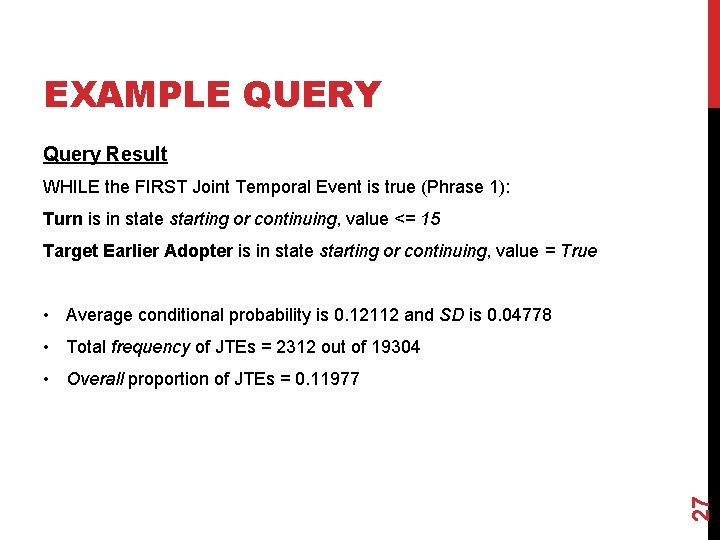
EXAMPLE QUERY Query Result WHILE the FIRST Joint Temporal Event is true (Phrase 1): Turn is in state starting or continuing, value <= 15 Target Earlier Adopter is in state starting or continuing, value = True • Average conditional probability is 0. 12112 and SD is 0. 04778 • Total frequency of JTEs = 2312 out of 19304 27 • Overall proportion of JTEs = 0. 11977
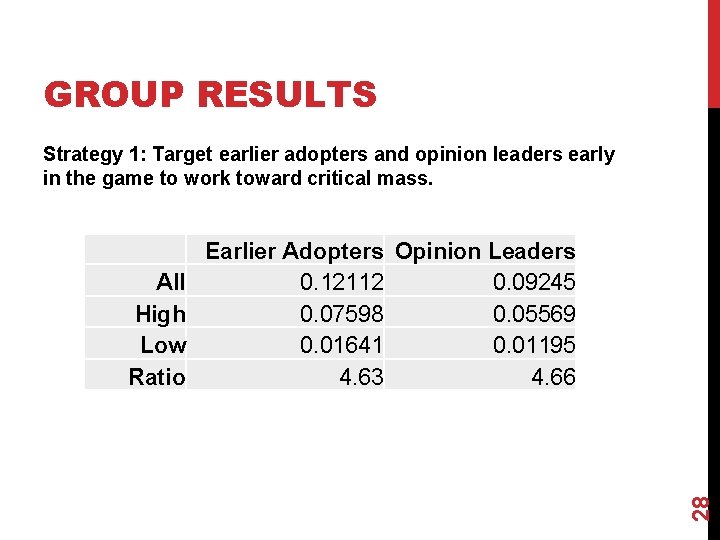
GROUP RESULTS Strategy 1: Target earlier adopters and opinion leaders early in the game to work toward critical mass. 28 All High Low Ratio Earlier Adopters Opinion Leaders 0. 12112 0. 09245 0. 07598 0. 05569 0. 01641 0. 01195 4. 63 4. 66
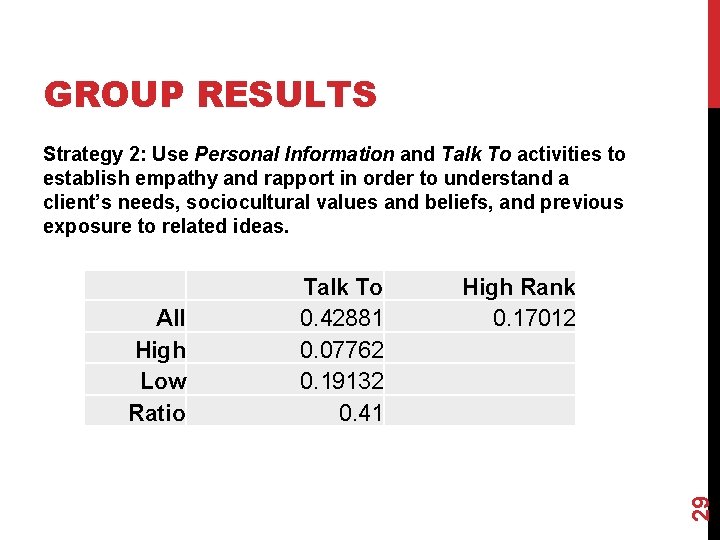
GROUP RESULTS Strategy 2: Use Personal Information and Talk To activities to establish empathy and rapport in order to understand a client’s needs, sociocultural values and beliefs, and previous exposure to related ideas. High Rank 0. 17012 29 All High Low Ratio Talk To 0. 42881 0. 07762 0. 19132 0. 41
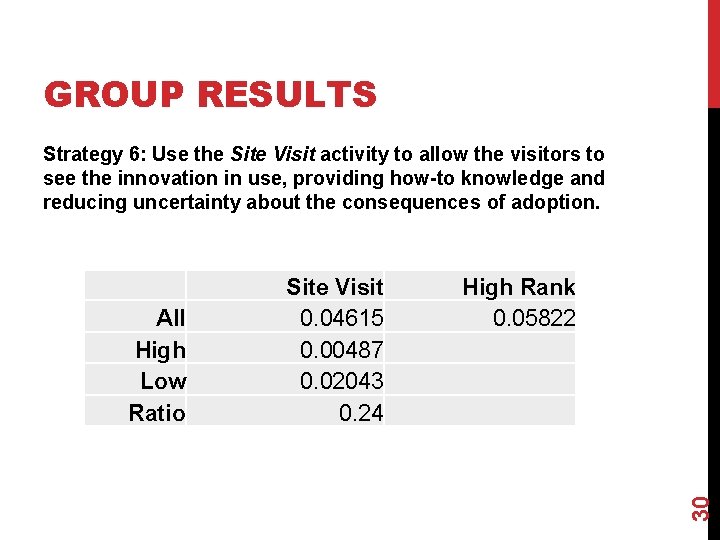
GROUP RESULTS Strategy 6: Use the Site Visit activity to allow the visitors to see the innovation in use, providing how-to knowledge and reducing uncertainty about the consequences of adoption. High Rank 0. 05822 30 All High Low Ratio Site Visit 0. 04615 0. 00487 0. 02043 0. 24
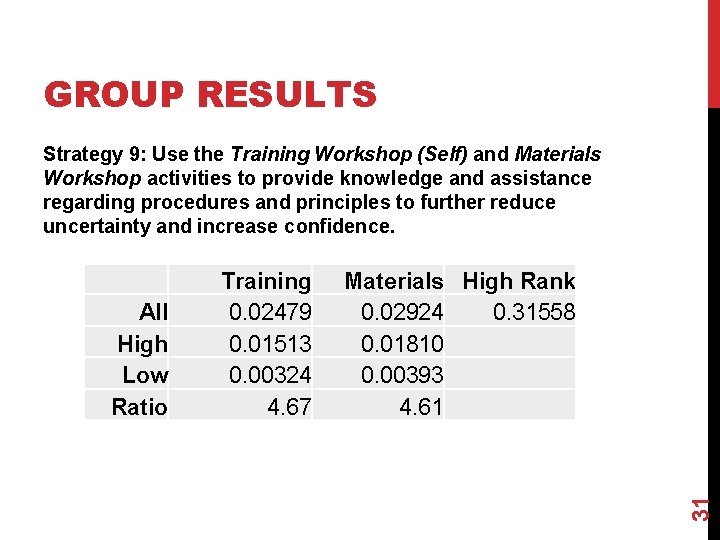
GROUP RESULTS Strategy 9: Use the Training Workshop (Self) and Materials Workshop activities to provide knowledge and assistance regarding procedures and principles to further reduce uncertainty and increase confidence. Materials High Rank 0. 02924 0. 31558 0. 01810 0. 00393 4. 61 31 All High Low Ratio Training 0. 02479 0. 01513 0. 00324 4. 67
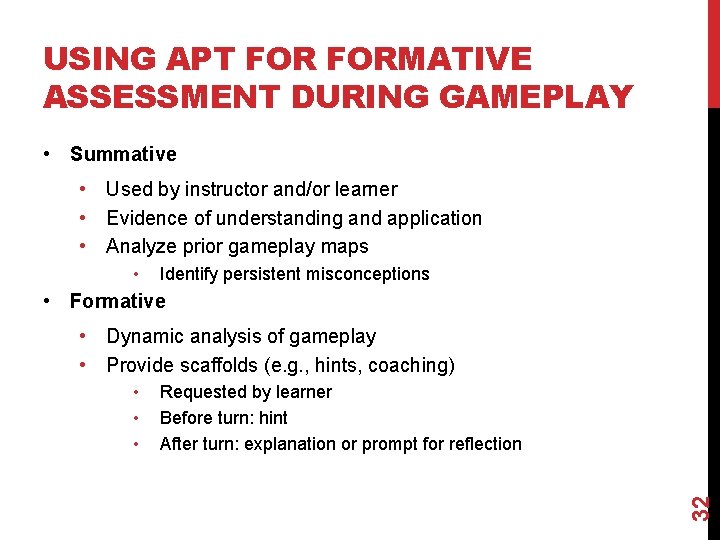
USING APT FORMATIVE ASSESSMENT DURING GAMEPLAY • Summative • Used by instructor and/or learner • Evidence of understanding and application • Analyze prior gameplay maps • Identify persistent misconceptions • Formative • Dynamic analysis of gameplay • Provide scaffolds (e. g. , hints, coaching) Requested by learner Before turn: hint After turn: explanation or prompt for reflection 32 • • •
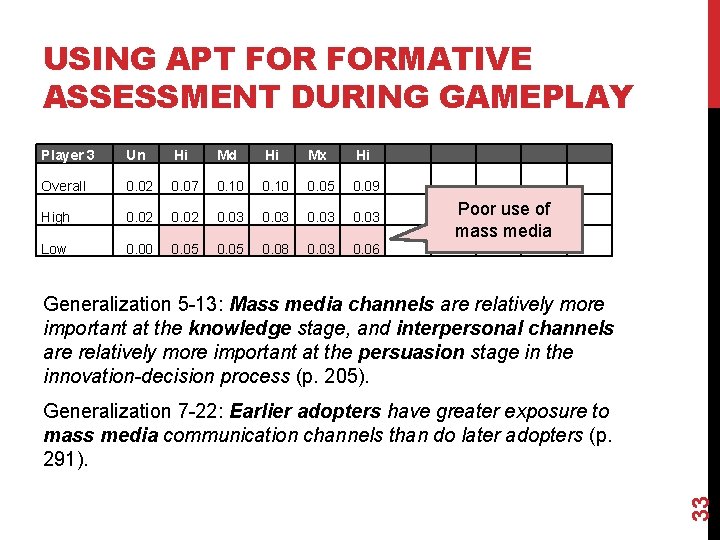
USING APT FORMATIVE ASSESSMENT DURING GAMEPLAY Player 3 Un Hi Md Hi Mx Hi Overall 0. 02 0. 07 0. 10 0. 05 0. 09 High 0. 02 0. 03 Low 0. 00 0. 05 0. 08 0. 03 0. 06 Poor use of mass media Generalization 5 -13: Mass media channels are relatively more important at the knowledge stage, and interpersonal channels are relatively more important at the persuasion stage in the innovation-decision process (p. 205). 33 Generalization 7 -22: Earlier adopters have greater exposure to mass media communication channels than do later adopters (p. 291).
CONCLUDING REMARKS “Using Pattern Matching to Assess Gameplay” (Chapter 19) Loh, C. S. , Sheng, Y. , & Ifenthaler, D. (Eds. ). (2015). Serious game analytics: Methodologies for performance measurement, assessment, and improvement. New York, NY: Springer. Contact us: Rod Myers – rod@webgrok. com 34 Ted Frick – frick@indiana. edu