
Measuring Earthquakes 1 How are earthquakes studied l
- Slides: 29
Measuring Earthquakes
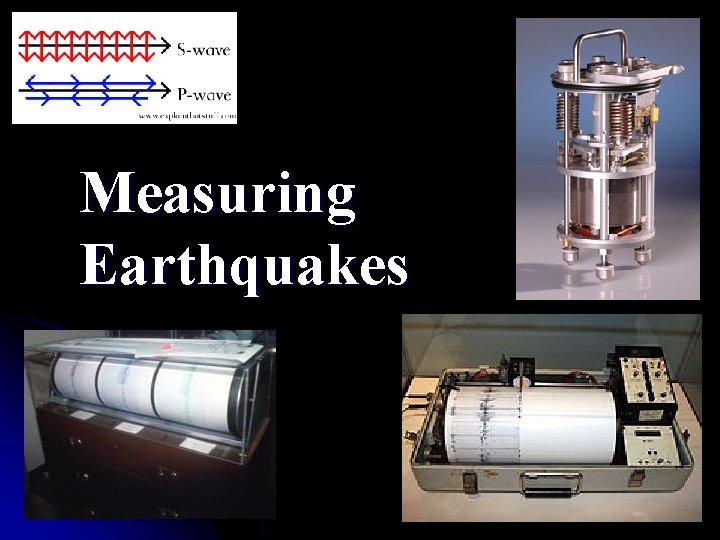
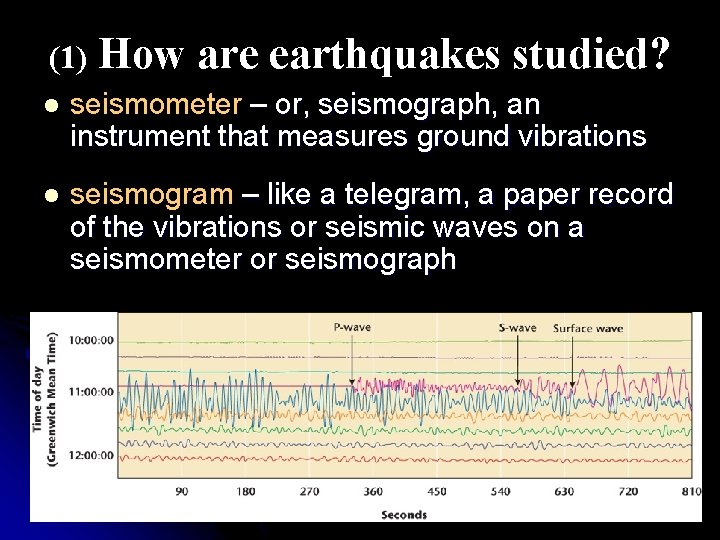
(1) How are earthquakes studied? l seismometer – or, seismograph, an instrument that measures ground vibrations l seismogram – like a telegram, a paper record of the vibrations or seismic waves on a seismometer or seismograph
(2) l How big was that ‘quake? Magnitude – a number value for the earthquake’s strength or size of ground motion
(2) How big was that ‘quake? l Magnitude – a number value for the earthquake’s strength or size of ground motion l Magnitude is the same no matter where you are, or how strong or weak the shaking was in various locations EXAMPLE- Did the April 4, 2010 earthquake feel different in San Diego, compared to Mexicali?
(2) How big was that ‘quake? l Magnitude – a number value for the earthquake’s strength or size of ground motion l Magnitude is the same no matter where you are, or how strong or weak the shaking was in various locations EXAMPLE- Did the April 4, 2010 earthquake feel different in San Diego, compared to Mexicali? Yes! Though it felt different in San Diego, the Mexicali earthquake has been rated at a 7. 2 magnitude
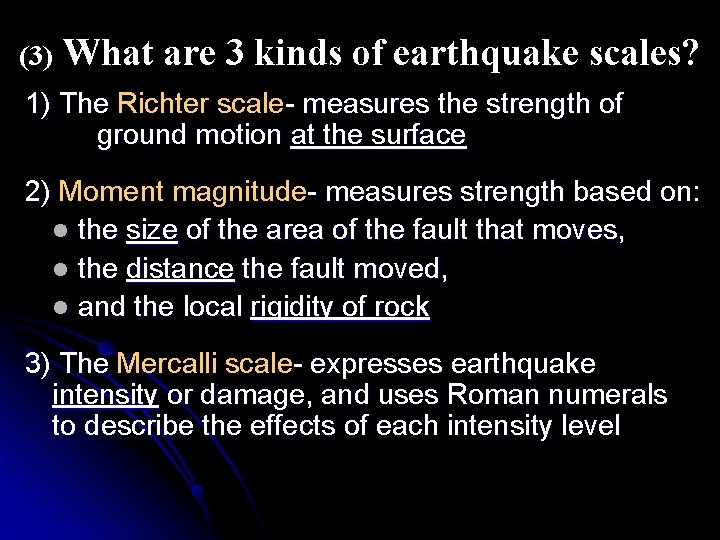
What are 3 kinds of earthquake scales? the strength of 1) The Richter scale- measures (3) ground motion at the surface
What are 3 kinds of earthquake scales? the strength of 1) The Richter scale- measures (3) ground motion at the surface 2) Moment magnitude- measures strength based on: l the size of the area of the fault that moves, l the distance the fault moved, l and the local rigidity of rock
What are 3 kinds of earthquake scales? the strength of 1) The Richter scale- measures (3) ground motion at the surface 2) Moment magnitude- measures strength based on: l the size of the area of the fault that moves, l the distance the fault moved, l and the local rigidity of rock
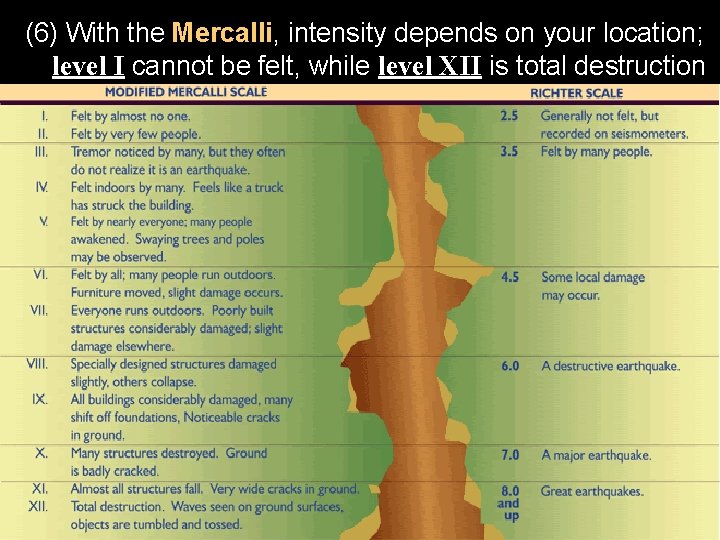
(3) What are 3 kinds of earthquake scales? 1) The Richter scale- measures the strength of ground motion at the surface 2) Moment magnitude- measures strength based on: l the size of the area of the fault that moves, l the distance the fault moved, l and the local rigidity of rock 3) The Mercalli scale- expresses earthquake intensity or damage, and uses Roman numerals to describe the effects of each intensity level
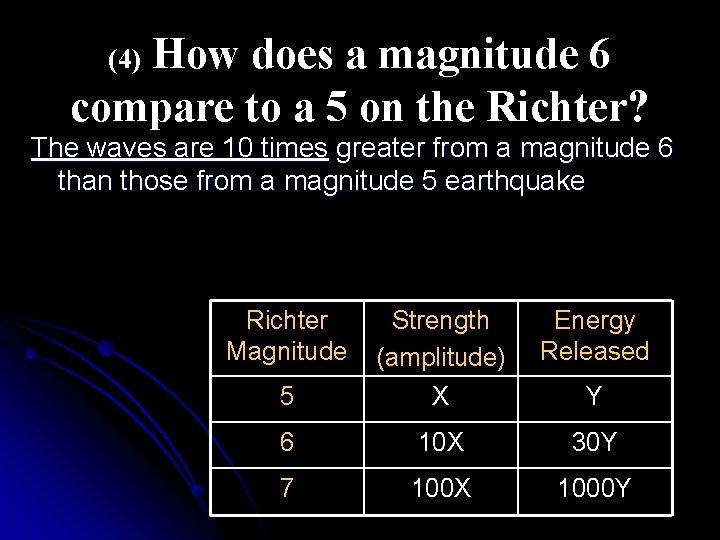
How does a magnitude 6 compare to a 5 on the Richter? (4) The waves are 10 times greater from a magnitude 6 than those from a magnitude 5 earthquake Richter Magnitude Energy Released 5 Strength (amplitude) X 6 10 X 30 Y 7 100 X 1000 Y Y
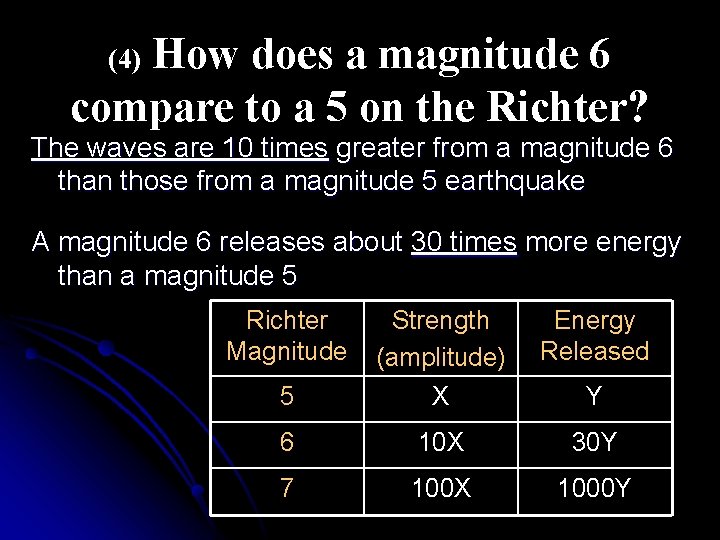
How does a magnitude 6 compare to a 5 on the Richter? (4) The waves are 10 times greater from a magnitude 6 than those from a magnitude 5 earthquake A magnitude 6 releases about 30 times more energy than a magnitude 5 Richter Magnitude Energy Released 5 Strength (amplitude) X 6 10 X 30 Y 7 100 X 1000 Y Y
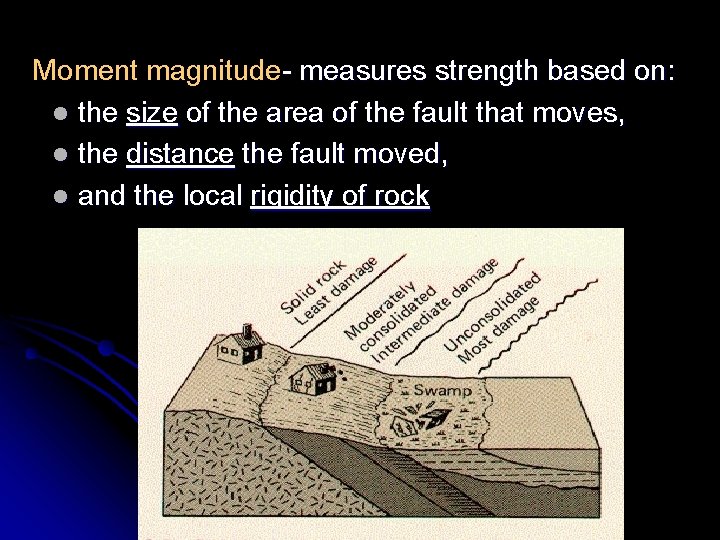
Moment magnitude- measures strength based on: l the size of the area of the fault that moves, l the distance the fault moved, l and the local rigidity of rock
(5) How do the earthquake scales compare? n For larger earthquakes, moment magnitude is more accurate than the Richter
(5) How do the earthquake scales compare? n For larger earthquakes, moment magnitude is more accurate than the Richter n 9. 5 is the highest moment magnitude on record, while the largest Richter earthquakes are about 8. 8
(5) How do the earthquake scales compare? n For larger earthquakes, moment magnitude is more accurate than the Richter n 9. 5 is the highest moment magnitude on record, while the largest Richter earthquakes are about 8. 8 n The largest ‘quake on the San Andreas in the last 200 years, was in 1906 in San Francisco = 7. 9 on the moment magnitude scale, 8. 3 on the Richter n Loma Prieta was the epicenter of the 1989 earthquake that hit San Francisco = 6. 9 on the moment magnitude scale, … 7. 0 on the Richter
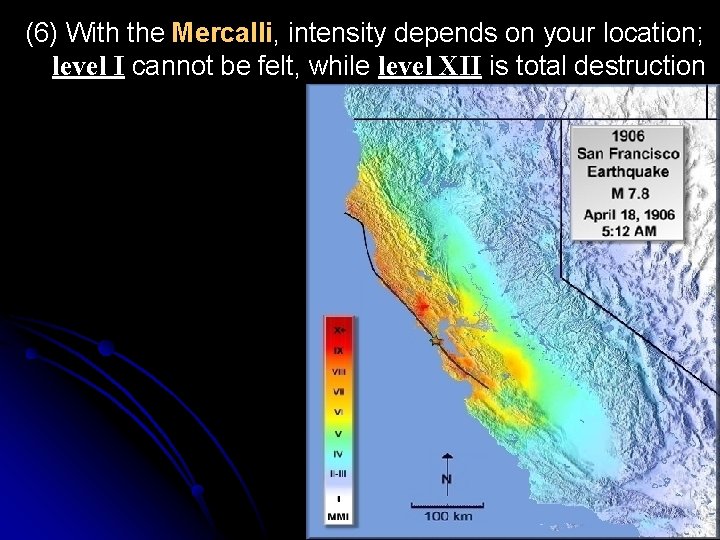
(6) With the Mercalli, intensity depends on your location; level I cannot be felt, while level XII is total destruction
(6) With the Mercalli, intensity depends on your location; level I cannot be felt, while level XII is total destruction
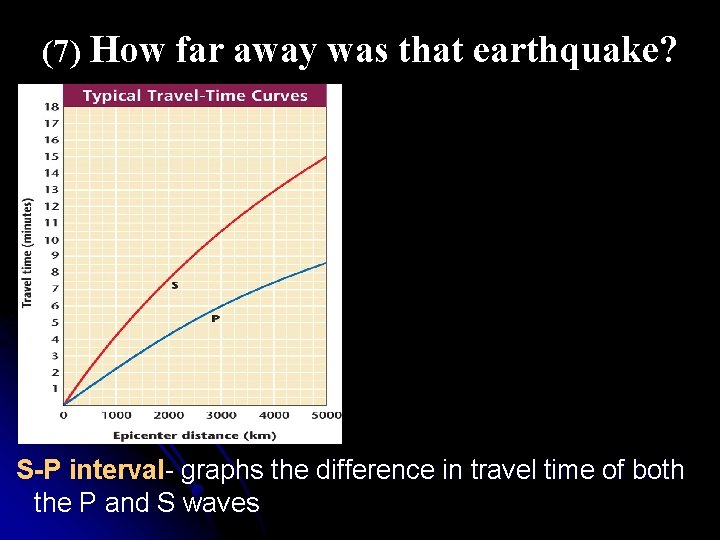
(7) How far away was that earthquake? S-P interval- graphs the difference in travel time of both the P and S waves
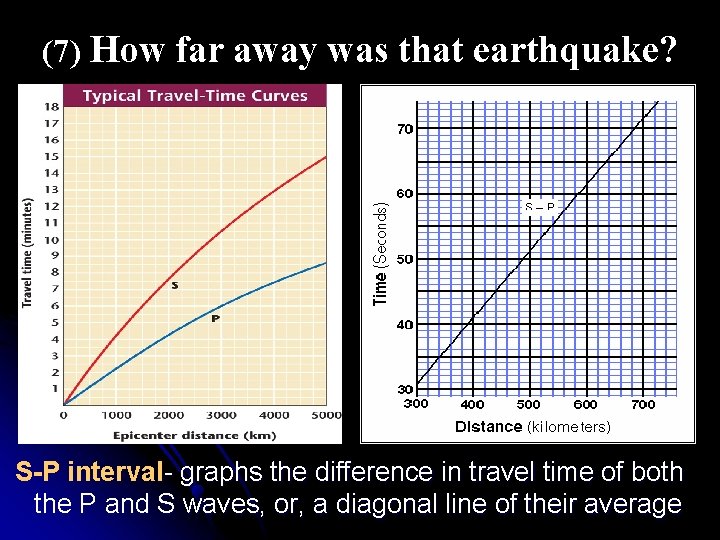
(7) How far away was that earthquake? S-P interval- graphs the difference in travel time of both the P and S waves, or, a diagonal line of their average
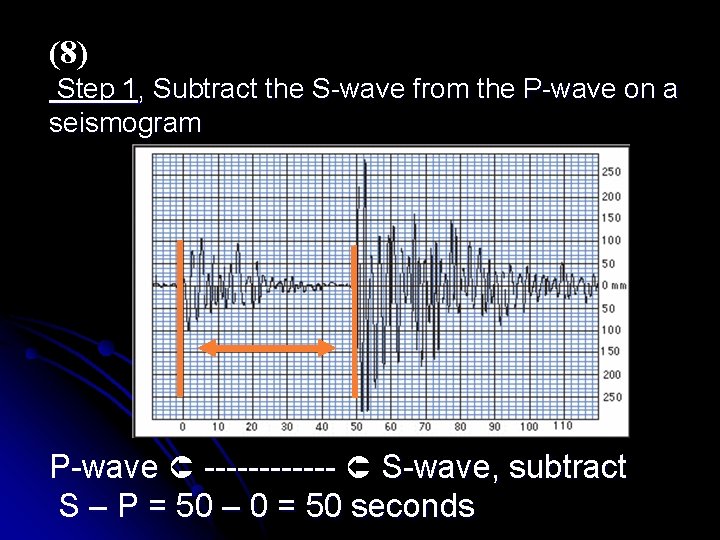
(8) Step 1, Subtract the S-wave from the P-wave on a seismogram P-wave ------ S-wave, subtract S – P = 50 – 0 = 50 seconds
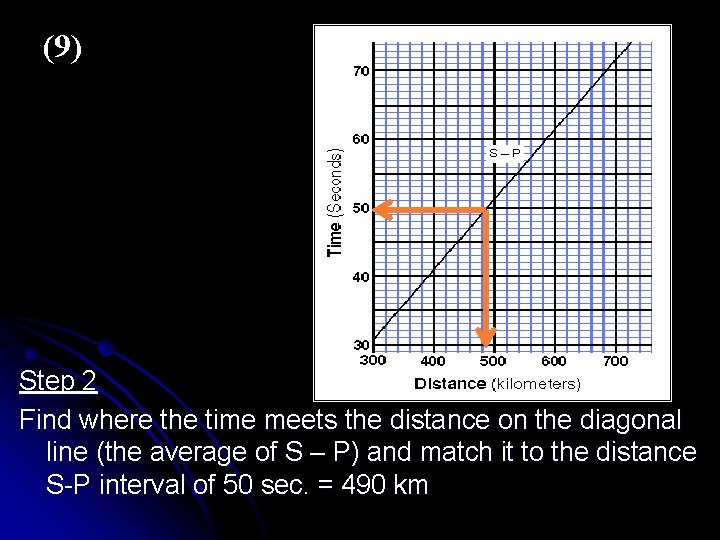
(9) Step 2 Find where the time meets the distance on the diagonal line (the average of S – P) and match it to the distance S-P interval of 50 sec. = 490 km
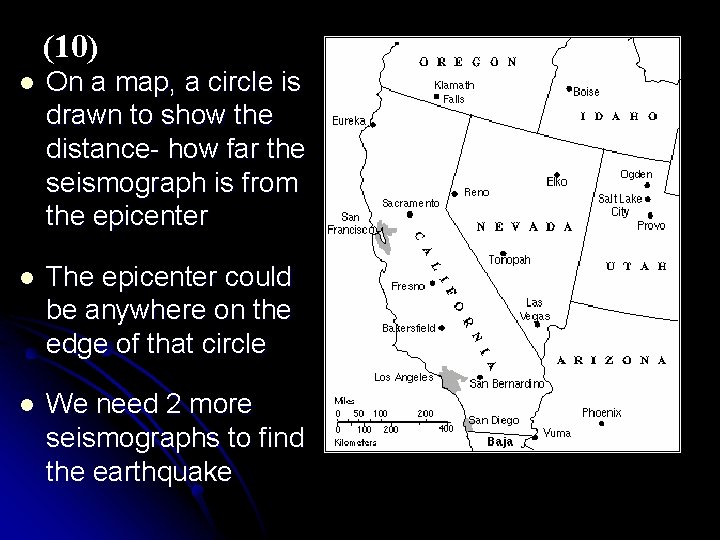
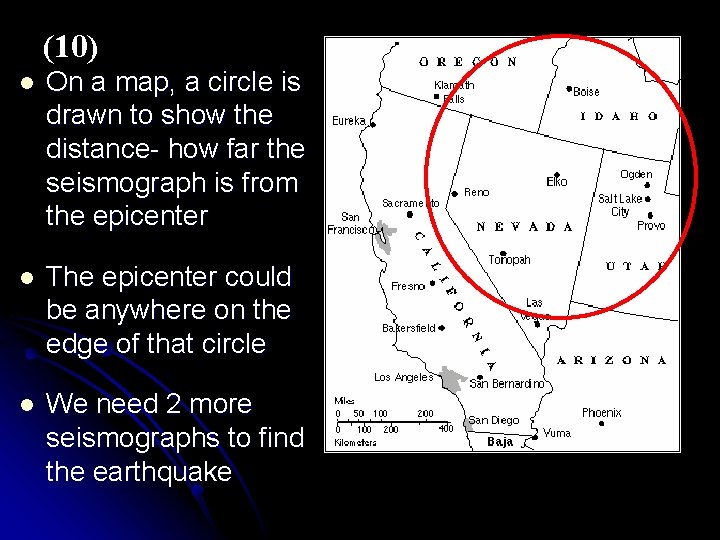
(10) l On a map, a circle is drawn to show the distance- how far the seismograph is from the epicenter l The epicenter could be anywhere on the edge of that circle l We need 2 more seismographs to find the earthquake
(10) l On a map, a circle is drawn to show the distance- how far the seismograph is from the epicenter l The epicenter could be anywhere on the edge of that circle l We need 2 more seismographs to find the earthquake
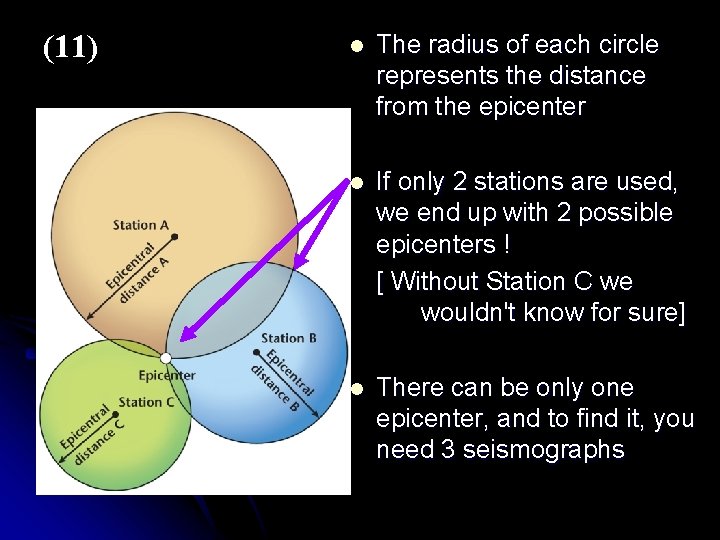
(11) l The radius of each circle represents the distance from the epicenter l If only 2 stations are used, we end up with 2 possible epicenters ! [ Without Station C we wouldn't know for sure] l There can be only one epicenter, and to find it, you need 3 seismographs
http: //blogs. agu. org/mountainbeltway/cate gory/japan/ l Penn. State Univ. http: //eqseis. geosc. psu. edu/~cammon/HT ML/Classes/Intro. Quakes/Notes/waves_an d_interior. html l http: //earthquake. usgs. gov/regional/nca/19 06/18 april/magnitude. php l
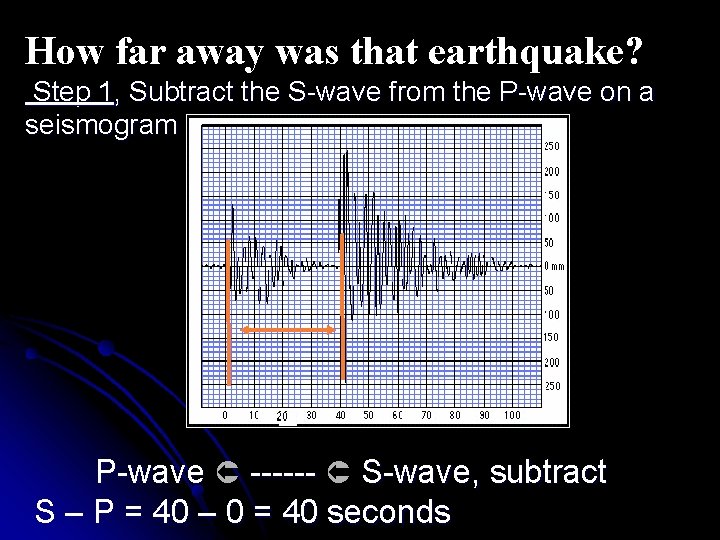
How far away was that earthquake? Step 1, Subtract the S-wave from the P-wave on a seismogram P-wave ------ S-wave, subtract S – P = 40 – 0 = 40 seconds
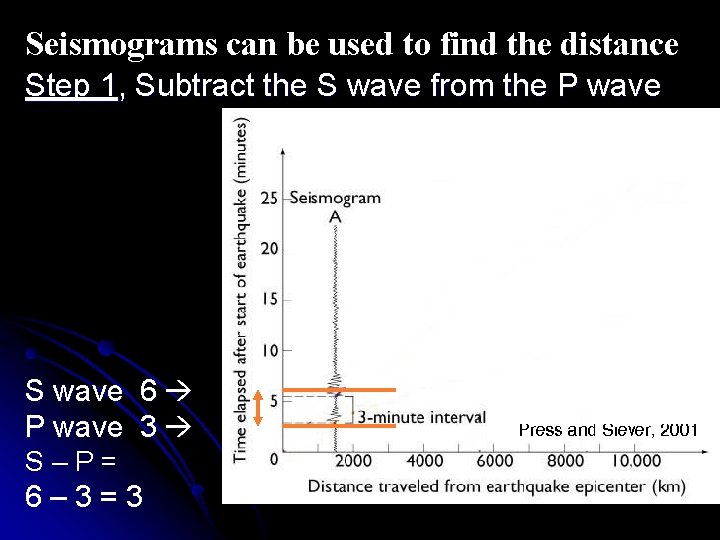
Seismograms can be used to find the distance Step 1, Subtract the S wave from the P wave S wave 6 P wave 3 S–P= 6– 3=3
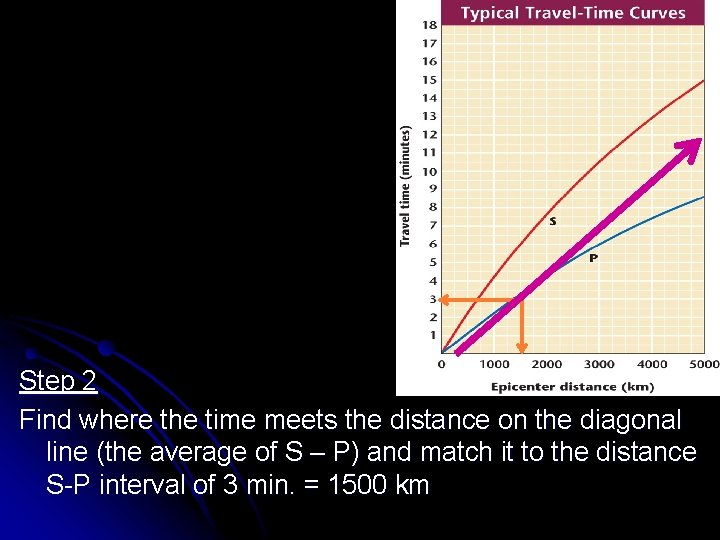
Step 2 Find where the time meets the distance on the diagonal line (the average of S – P) and match it to the distance S-P interval of 3 min. = 1500 km
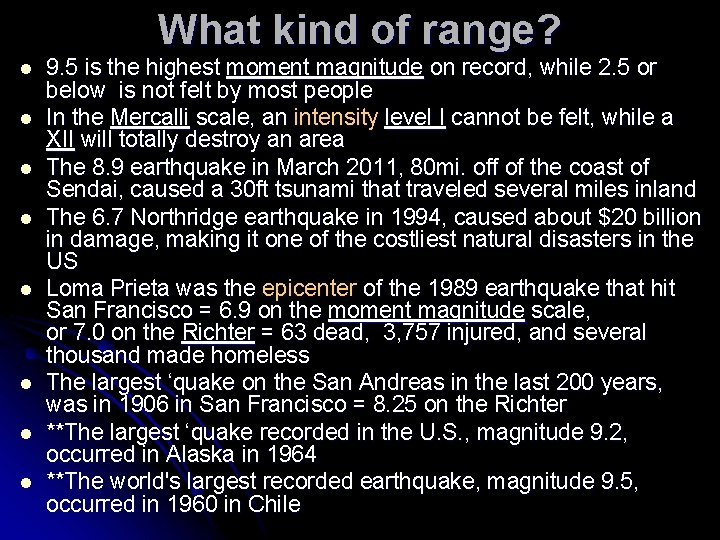
What kind of range? l l l l 9. 5 is the highest moment magnitude on record, while 2. 5 or below is not felt by most people In the Mercalli scale, an intensity level I cannot be felt, while a XII will totally destroy an area The 8. 9 earthquake in March 2011, 80 mi. off of the coast of Sendai, caused a 30 ft tsunami that traveled several miles inland The 6. 7 Northridge earthquake in 1994, caused about $20 billion in damage, making it one of the costliest natural disasters in the US Loma Prieta was the epicenter of the 1989 earthquake that hit San Francisco = 6. 9 on the moment magnitude scale, or 7. 0 on the Richter = 63 dead, 3, 757 injured, and several thousand made homeless The largest ‘quake on the San Andreas in the last 200 years, was in 1906 in San Francisco = 8. 25 on the Richter **The largest ‘quake recorded in the U. S. , magnitude 9. 2, occurred in Alaska in 1964 **The world's largest recorded earthquake, magnitude 9. 5, occurred in 1960 in Chile