
Measuring Development measures how economically socially culturally or
- Slides: 2
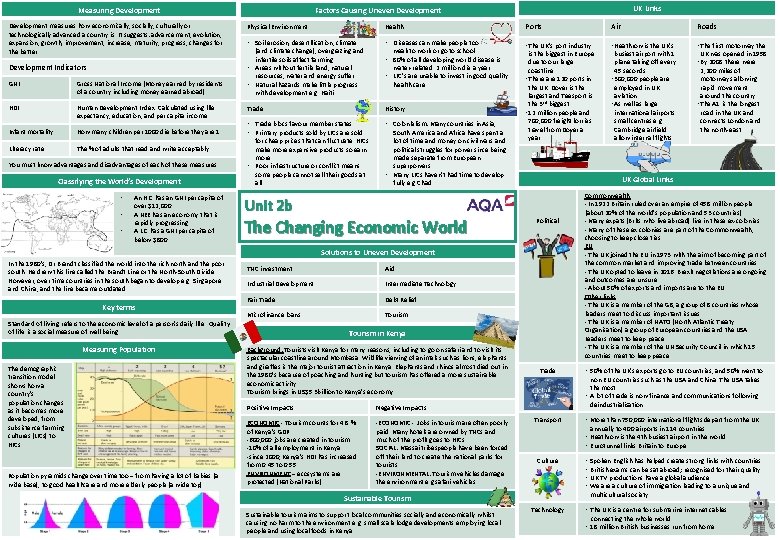
Measuring Development measures how economically, socially, culturally or technologically advanced a country is. It suggests: advancement, evolution, expansion, growth, improvement, increase, maturity, progress, changes for the better. Development Indicators GNI Gross National Income (Money earned by residents of a country including money earned abroad). HDI Human Development Index. Calculated using life expectancy, education, and per capita income. Infant mortality How many children per 1000 die before they are 1. Literacy rate The % of adults that read and write acceptably. You must know advantages and disadvantages of each of these measures. Classifying the World’s Development • • • An HIC has an GNI per capita of over $12, 000. A NEE has an economy that is rapidly progressing. A LIC has a GNI per capita of below $800. UK Links Factors Causing Uneven Development Physical Environment Health Ports Air Roads • Soil erosion, desertification, climate • Diseases can make people too • The UK’s port industry • Heathrow is the UK’s • The first motorway the (and climate change), overgrazing and infertile soils affect farming. • Areas without fertile land, natural resources, water and energy suffer. • Natural hazards make little progress with development e. g. Haiti. weak to work or go to school. • 80% of all developing world disease is water-related. 2 million die a year. • LIC’s are unable to invest in good quality health care Trade History • Trade blocs favour member states. • Primary products sold by LICs are sold • Colonialism: Many countries in Asia, for cheap prices that can fluctuate. HICs make more expensive products so earn more. • Poor infrastructure or conflict means some people cannot sell their goods at all. South America and Africa have spent a lot of time and money on civil wars and political struggles for power since being made separate from European superpowers. • Many LICs haven’t had time to develop fully e. g Chad is the biggest in Europe due to our large coastline. • There are 120 ports in the UK. Dover is the largest and Teesport is the 3 rd biggest. • 12 million people and 700, 000 freight lorries travel from Dover a year. Political Solutions to Uneven Development In the 1980’s, Dr Brandt classified the world into the rich north and the poor south. He drew this line called the Brandt Line or the North-South Divide. However, over time countries in the south began to develop e. g. Singapore and China, and the line became outdated. Key terms TNC investment Aid Industrial Development Intermediate Technology Fair Trade Debt Relief Microfinance loans Tourism Standard of living refers to the economic level of a person’s daily life. Quality of life is a social measure of well being. Measuring Population The demographic transition model shows how a country’s population changes as it becomes more developed, from subsistence farming cultures (LICs) to HICs. Population pyramids change over time too – from having a lot of babies (a wide base), to good healthcare and more elderly people (a wide top). Tourism in Kenya Background: Tourists visit Kenya for many reasons, including to go on safari and to visit its spectacular coastline around Mombasa. Wildlife viewing of animals such as lions, elephants and giraffes is the major tourist attraction in Kenya. Elephants and rhinos almost died out in the 1980’s because of poaching and hunting but tourism has offered a more sustainable economic activity. Tourism brings in US$5. 3 billion to Kenya’s economy Positive Impacts Negative Impacts ECONOMIC - Tourism counts for 4. 8 % of Kenya’s GDP. -600, 000 jobs are created in tourism -10% of all employment in Kenya. -since 2000, Kenya’s HDI has increased from 0. 45 to 0. 55. ENVIRONMENT – ecosystems are protected (National Parks) -ECONOMIC - Jobs in tourism are often poorly paid. Many hotels are owned by TNCs and much of the profit goes to HICs. SOCIAL: Massai tribespeople have been forced off their land to create the national parks for tourists. -ENVIRONMENTAL: Tourism vehicles damage the environment e. g safari vehicles 2, 200 miles of motorways allowing rapid movement around the country. • The A 1 is the longest road in the UK and connects London and the north-east. Commonwealth - In 1922 Britain ruled over an empire of 458 million people (about 20% of the world’s population and 53 countries). - Many expats (Brits who live abroad) live in these ex-colonies. - Many of these ex colonies are part of the Commonwealth, choosing to keep close ties. EU - The UK joined the EU in 1973 with the aim of becoming part of the common market and improving trade between countries. - The UK opted to leave in 2016. Brexit negotiations are ongoing and outcomes are unsure. - About 50% of exports and imports are to the EU. Other links - The UK is a member of the G 8, a group of 8 countries whose leaders meet to discuss important issues. - The UK is a member of NATO (North Atlantic Treaty Organisation) a group of European countries and the USA. Leaders meet to keep peace. - The UK is a member of the UN Security Council in which 15 countries meet to keep peace. Trade • 50% of the UK’s exports go to EU countries, and 50% went to Transport • More than 750, 000 international flights depart from the UK non-EU countries such as the USA and China. The USA takes the most. • A lot of trade is now finance and communications following deindustrialisation. annually to 400 airports in 114 countries. • Heathrow is the 4 th busiest airport in the world. • Eurotunnel links Britain to Europe. Culture Sustainable Tourism Sustainable tourism aims to support local communities socially and economically whilst causing no harm to the environment e. g. small scale lodge developments employing local people and using local foods in Kenya. UK was opened in 1958. • By 2008 there were UK Global Links Unit 2 b The Changing Economic World busiest airport with 1 plane taking off every 45 seconds. • 300, 000 people are employed in UK aviation. • As well as large international airports small centres e. g. Cambridge airfield allow internal flights. Technology • • Spoken English has helped create strong links with countries. British exams can be sat abroad; recognised for their quality. UK TV productions have a global audience. We are a culture of immigration leading to a unique and multicultural society. • The UK is a centre for submarine internet cables connecting the whole world. • 18 million British businesses run from home.
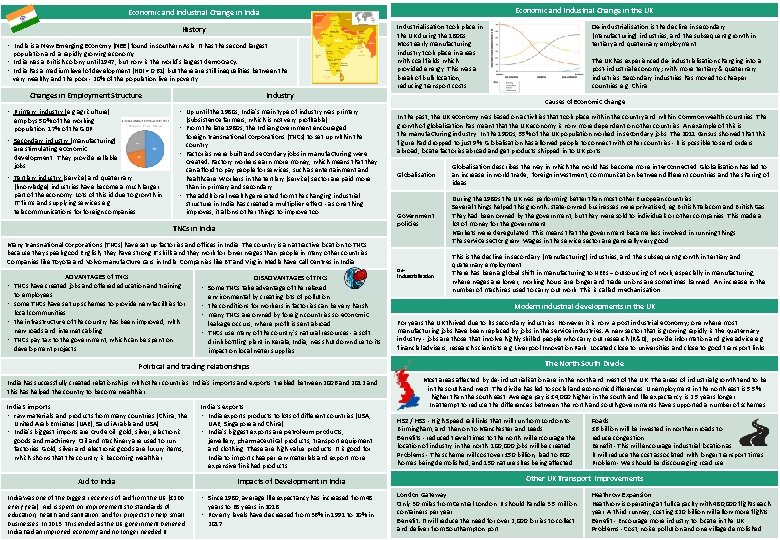
Economic and Industrial Change in the UK Economic and Industrial Change in India History • India is a New Emerging Economy (NEE) found in southern Asia. It has the second largest population and a rapidly growing economy. • India was a British colony until 1947, but now is the world's largest democracy. • India has a medium level of development (HDI = 0. 61) but there are still inequalities between the very wealthy and the poor - 20% of the population live in poverty. Changes in Employment Structure Industrialisation took place in the UK during the 1800 s. Most early manufacturing industry took place in areas with coal fields which provided energy. This was a break of bulk location, reducing transport costs. Industry • Up until the 1980 s, India's main type of industry was primary. • Primary industry (e. g agriculture) (subsistence farmers, which is not very profitable). employs 50% of the working population. 17% of the GDP. • From the late 1980 s, the Indian government encouraged foreign transnational corporations (TNCs) to set up within the country. • Factories were built and secondary jobs in manufacturing were created. Factory workers earn more money, which means that they can afford to pay people for services, such as entertainment and healthcare. Workers in the tertiary (service) sector are paid more than in primary and secondary. • The additional wealth generated from the changing industrial structure in India has created a multiplier effect - as one thing improves, it allows other things to improve too. • Secondary industry (manufacturing) are stimulating economic development. They provide reliable jobs. • Tertiary industry (service) and quaternary (knowledge) industries have become a much larger part of the economy. Lots of this id due to growth in IT firms and supplying services e. g telecommunications foreign companies. TNCs in India ADVANTAGES of TNCs to employees • some TNCs have set up schemes to provide new facilities for local communities • the infrastructure of the country has been improved, with new roads and internet cabling • TNCs pay tax to the government, which can be spent on development projects DISADVANTAGES of TNCs • Some TNCs take advantage of the relaxed environmental by creating lots of pollution • the conditions for workers in factories can be very harsh • many TNCs are owned by foreign countries so economic leakage occurs, where profit is sent abroad • TNCs use many of the country's natural resources - a soft drink bottling plant in Kerala, India, was shut down due to its impact on local water supplies Political and trading relationships India has successfully created relationships with other countries. India's imports and exports trebled between 2006 and 2012 and this has helped the country to become wealthier. India's imports • raw materials and products from many countries (China, the United Arab Emirates (UAE), Saudi Arabia and USA). • India's biggest imports are crude oil gold, silver, electronic goods and machinery. Oil and machinery are used to run factories. Gold, silver and electronic goods are luxury items, which shows that the country is becoming wealthier. Aid to India was one of the biggest receivers of aid from the UK (£ 200 every year). Aid is spent on improvements to standards of education, health and sanitation and for projects to help small businesses. In 2015 this ended as the UK government believed India had an improved economy and no longer needed it. India's exports • India exports products to lots of different countries (USA, UAE, Singapore and China) • India's biggest exports are petroleum products, jewellery, pharmaceutical products, transport equipment and clothing. These are high value products. It is good for India to import cheaper raw materials and export more expensive finished products. Impacts of Development in India • Since 1980, average life expectancy has increased from 48 years to 68 years in 2018. • Poverty levels have decreased from 36% in 1991 to 20% in 2017. The UK has experienced de-industrialisation changing into a post-industrial economy; with more tertiary & quaternary industries. Secondary industries has moved to cheaper countries e. g. China. Causes of Economic Change In the past, the UK economy was based on activities that took place within the country and within Commonwealth countries. The growth of globalisation has meant that the UK economy is now more dependent on other countries. An example of this is the manufacturing industry. In the 1900 s, 55% of the UK population worked in secondary jobs. The 2011 census showed that this figure had dropped to just 9%. Globalisation has allowed people to connect with other countries - it is possible to send orders abroad, locate factories abroad and get products shipped in to UK ports. Globalisation describes the way in which the world has become more interconnected. Globalisation has led to an increase in world trade, foreign investment, communication between different countries and the sharing of ideas. Government policies During the 1980 s the UK was performing better than most other European countries. Several things helped this growth: state-owned businesses were privatised, eg British Telecom and British Gas. They had been owned by the government, but they were sold to individuals or other companies. This made a lot of money for the government. Markets were deregulated. This means that the government became less involved in running things. The service sector grew. Wages in the service sector are generally very good. Deindustrialisation This is the decline in secondary (manufacturing) industries, and the subsequent growth in tertiary and quaternary employment. There has been a global shift in manufacturing to NEEs – outsourcing of work, especially in manufacturing, where wages are lower, working hours are longer and trade unions are sometimes banned. An increase in the number of machines used to carry out work. This is called mechanisation. Many transnational corporations (TNCs) have set up factories and offices in India. The country is an attractive location to TNCs because they speak good English, they have strong IT skills and they work for lower wages than people in many other countries. Companies like Toyota and Volvo manufacture cars in India. Companies like BT and Virgin Media have call centres in India. • TNCs have created jobs and offered education and training De-industrialisation is the decline in secondary (manufacturing) industries, and the subsequent growth in tertiary and quaternary employment. Modern industrial developments in the UK For years the UK thrived due to its secondary industries. However it is now a post industrial economy; one where most manufacturing jobs have been replaced by jobs in the service industries. A new sector that is growing rapidly is the quaternary industry - jobs are those that involve highly skilled people who carry out research (R&D), provide information and give advice e. g. financial advisers, research scientists e. g Liverpool Innovation Park. Located close to universities and close to good transport links The North-South Divide Most areas affected by de-industrialisation are in the north and west of the UK. The areas of industrial growth tend to be in the south and west. The divide has led to social and economic differences. Unemployment in the north east is 5. 5% higher than the south east. Average pay is £ 4, 000 higher in the south and life expectancy is 2. 5 years longer. In attempt to reduce the differences between the north and south governments have supported a number of schemes. HS 2 / HS 3 - High Speed rail links that will run from London to Birmingham, and then on to Manchester and Leeds. Benefits - reduced travel times to the north will encourage the location of industry in the north. 100, 000 jobs will be created. Problems - The scheme will cost over £ 50 billion, lead to 600 homes being demolished, and 150 nature sites being affected. Roads £ 6 billion will be invested in northern roads to reduce congestion. Benefit - This will encourage industrial location as it will reduce the cost associated with longer transport times. Problem - We should be discouraging road use. Other UK Transport Improvements London Gateway Only 30 miles from Central London. It should handle 3. 5 million containers per year. Benefit: It will reduce the need for over 2, 000 lorries to collect and deliver from Southampton port. Heathrow Expansion Heathrow is operating at full capacity with 480, 000 flights each year. A third runway, costing £ 20 billion will allow more flights. Benefit - Encourage more industry to locate in the UK. Problems - Cost, noise pollution and one village demolished.