
Measuring consumer welfare in the digital economy Avinash



![Non-digital goods: Breakfast Cereal WTAmedian = $48. 46/year [$42. 01, $55. 60] Implied Consumer](https://slidetodoc.com/presentation_image_h2/52183a5aaab47aea1ee0f39b5e62f37d/image-23.jpg "Non-digital goods: Breakfast Cereal WTAmedian = $48. 46/year [$42. 01, $55. 60] Implied Consumer")
- Slides: 38
Measuring consumer welfare in the digital economy Avinash Collis MIT www. avinash. info
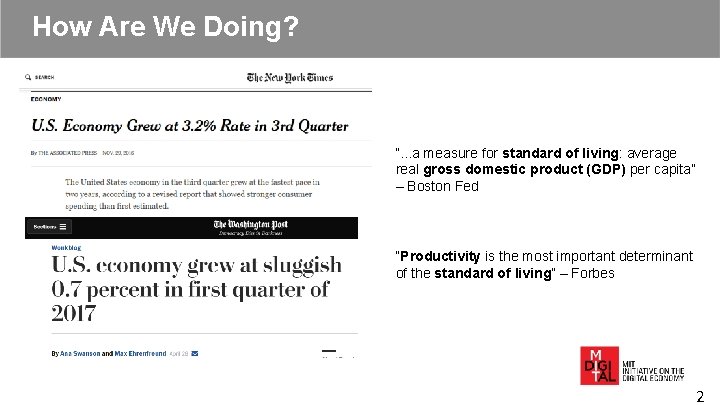
How Are We Doing? “. . . a measure for standard of living: average real gross domestic product (GDP) per capita” – Boston Fed “Productivity is the most important determinant of the standard of living” – Forbes 2
“The welfare of a nation can scarcely be inferred from a measurement of national income as defined [by the GDP. ]” - Simon Kuznets, 1934 GDP is a measure of production, not well-being 3
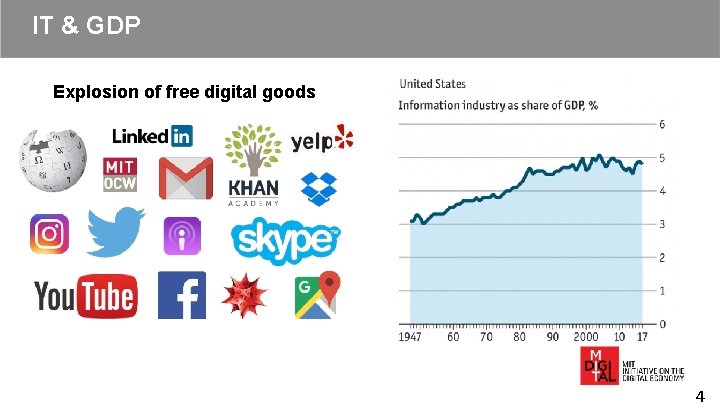
IT & GDP Explosion of free digital goods 4
GDP vs. Consumer Welfare 5
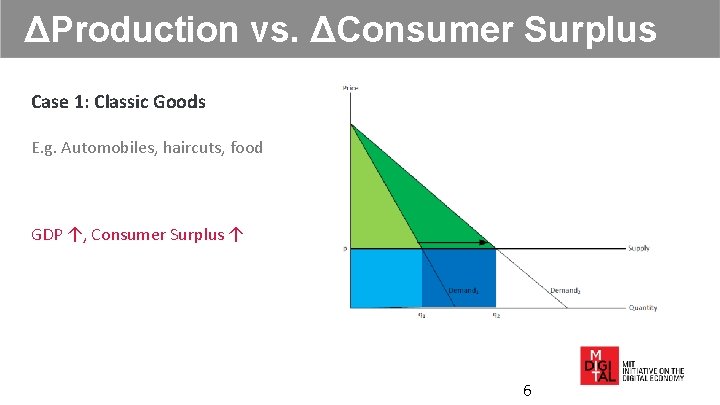
ΔProduction vs. ΔConsumer Surplus Case 1: Classic Goods E. g. Automobiles, haircuts, food GDP ↑, Consumer Surplus ↑ 6
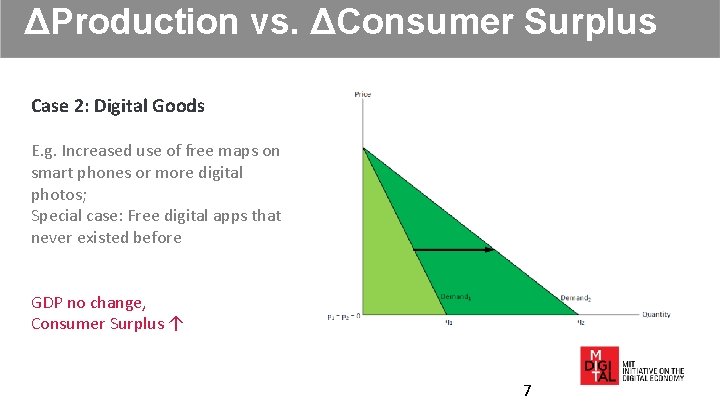
ΔProduction vs. ΔConsumer Surplus Case 2: Digital Goods E. g. Increased use of free maps on smart phones or more digital photos; Special case: Free digital apps that never existed before GDP no change, Consumer Surplus ↑ 7
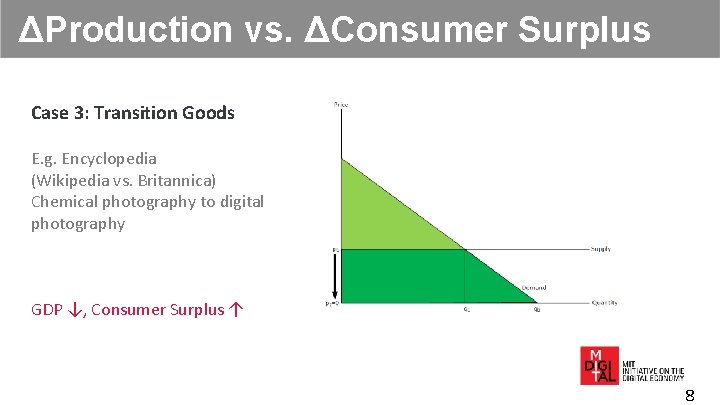
ΔProduction vs. ΔConsumer Surplus Case 3: Transition Goods E. g. Encyclopedia (Wikipedia vs. Britannica) Chemical photography to digital photography GDP ↓, Consumer Surplus ↑ 8
Using Massive Online Choice Experiments to Measure Changes in Well-being with Erik Brynjolfsson, Felix Eggers 9
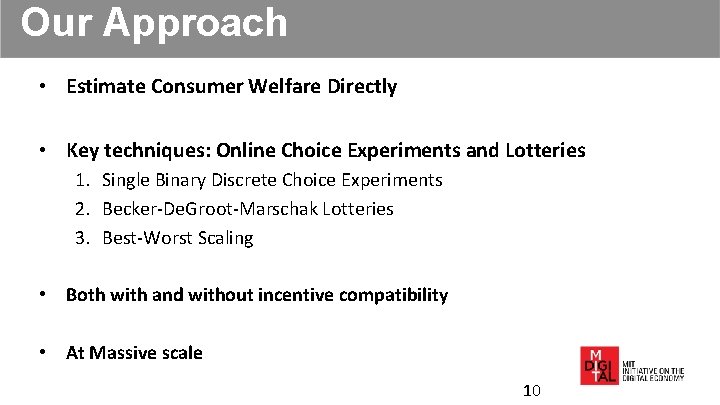
Our Approach • Estimate Consumer Welfare Directly • Key techniques: Online Choice Experiments and Lotteries 1. Single Binary Discrete Choice Experiments 2. Becker-De. Groot-Marschak Lotteries 3. Best-Worst Scaling • Both with and without incentive compatibility • At Massive scale 10
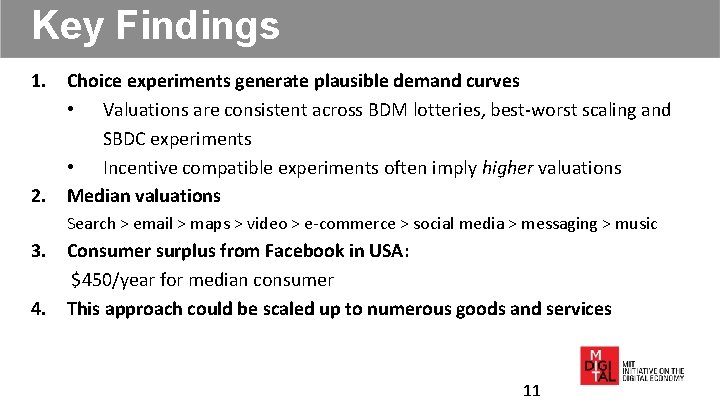
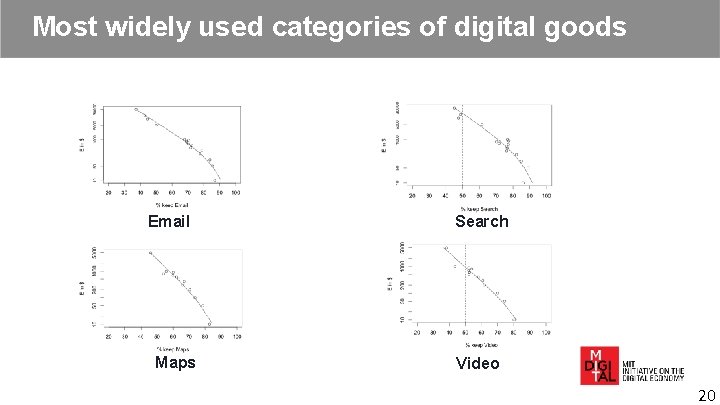
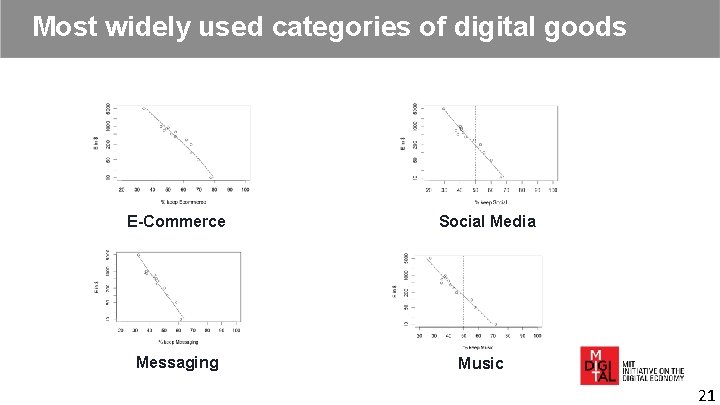
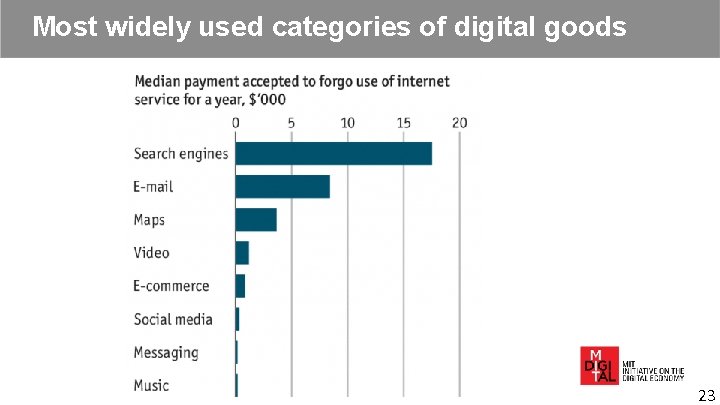
Key Findings 1. Choice experiments generate plausible demand curves • Valuations are consistent across BDM lotteries, best-worst scaling and SBDC experiments • Incentive compatible experiments often imply higher valuations 2. Median valuations Search > email > maps > video > e-commerce > social media > messaging > music 3. Consumer surplus from Facebook in USA: $450/year for median consumer 4. This approach could be scaled up to numerous goods and services 11
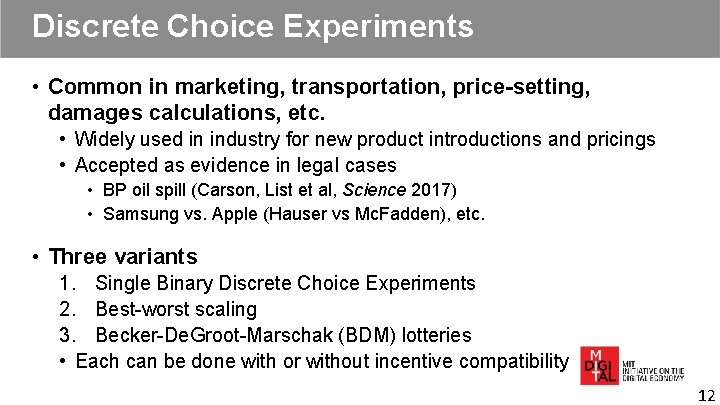
Discrete Choice Experiments • Common in marketing, transportation, price-setting, damages calculations, etc. • Widely used in industry for new product introductions and pricings • Accepted as evidence in legal cases • BP oil spill (Carson, List et al, Science 2017) • Samsung vs. Apple (Hauser vs Mc. Fadden), etc. • Three variants 1. Single Binary Discrete Choice Experiments 2. Best-worst scaling 3. Becker-De. Groot-Marschak (BDM) lotteries • Each can be done with or without incentive compatibility 12
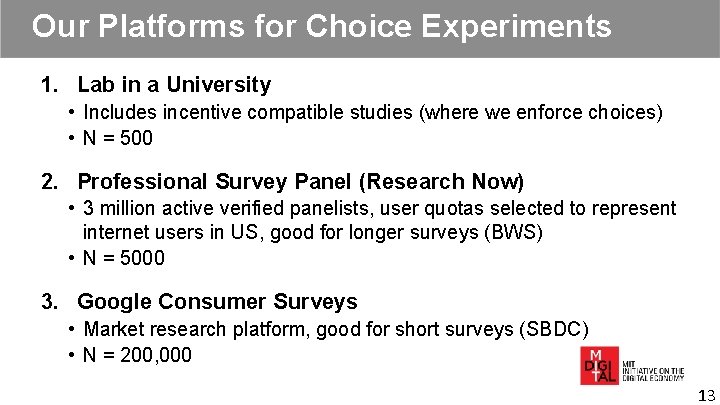
Our Platforms for Choice Experiments 1. Lab in a University • Includes incentive compatible studies (where we enforce choices) • N = 500 2. Professional Survey Panel (Research Now) • 3 million active verified panelists, user quotas selected to represent internet users in US, good for longer surveys (BWS) • N = 5000 3. Google Consumer Surveys • Market research platform, good for short surveys (SBDC) • N = 200, 000 13
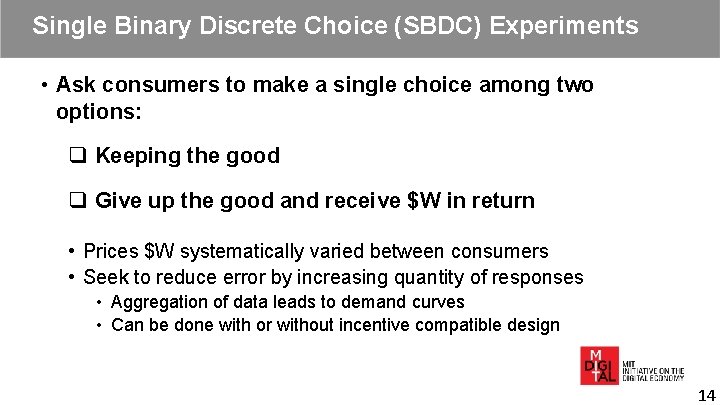
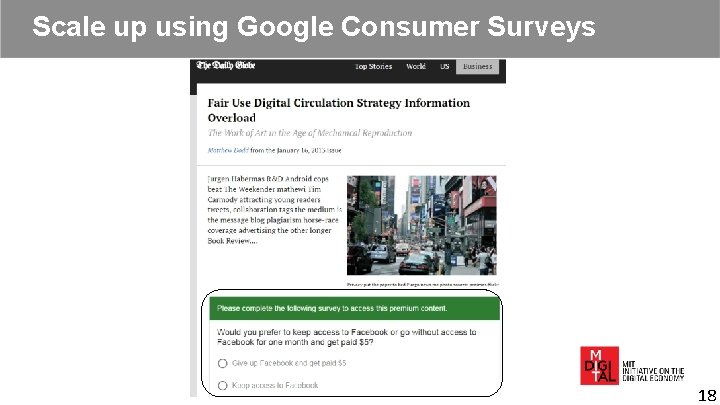
Single Binary Discrete Choice (SBDC) Experiments • Ask consumers to make a single choice among two options: q Keeping the good q Give up the good and receive $W in return • Prices $W systematically varied between consumers • Seek to reduce error by increasing quantity of responses • Aggregation of data leads to demand curves • Can be done with or without incentive compatible design 14
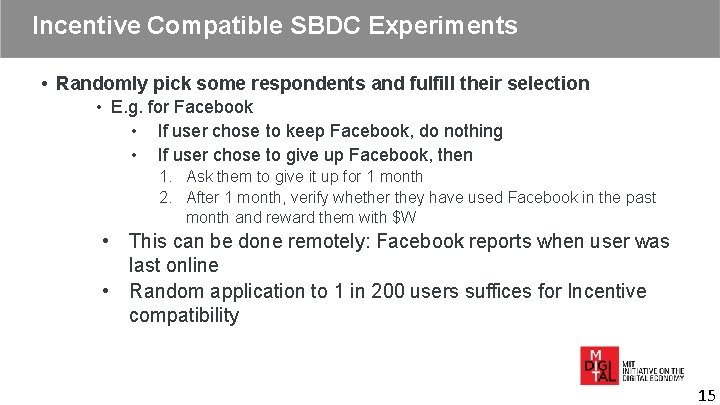
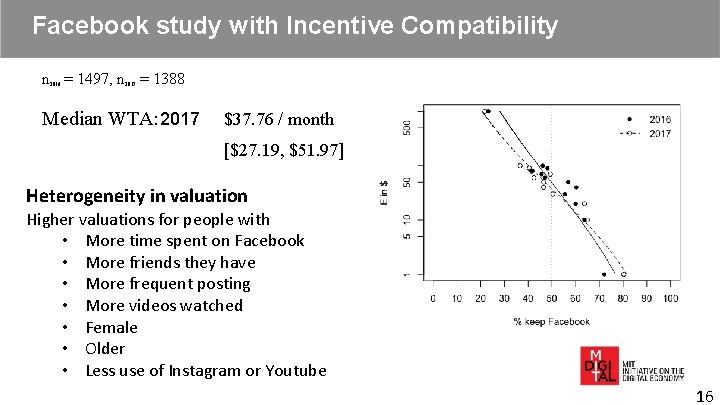
Incentive Compatible SBDC Experiments • Randomly pick some respondents and fulfill their selection • E. g. for Facebook • If user chose to keep Facebook, do nothing • If user chose to give up Facebook, then 1. Ask them to give it up for 1 month 2. After 1 month, verify whether they have used Facebook in the past month and reward them with $W • This can be done remotely: Facebook reports when user was last online • Random application to 1 in 200 users suffices for Incentive compatibility 15
Facebook study with Incentive Compatibility n = 1497, n = 1388 2016 2017 Median WTA: 2017 $37. 76 / month [$27. 19, $51. 97] Heterogeneity in valuation Higher valuations for people with • More time spent on Facebook • More friends they have • More frequent posting • More videos watched • Female • Older • Less use of Instagram or Youtube 16
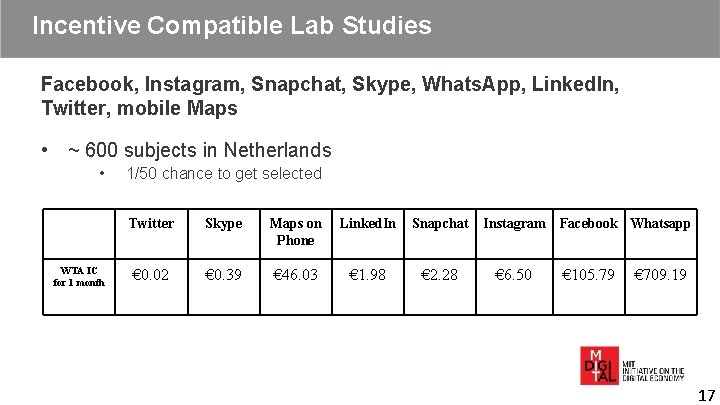
Incentive Compatible Lab Studies Facebook, Instagram, Snapchat, Skype, Whats. App, Linked. In, Twitter, mobile Maps • ~ 600 subjects in Netherlands • WTA IC for 1 month 1/50 chance to get selected Twitter Skype Maps on Phone Linked. In Snapchat Instagram € 0. 02 € 0. 39 € 46. 03 € 1. 98 € 2. 28 € 6. 50 Facebook Whatsapp € 105. 79 € 709. 19 17
Scale up using Google Consumer Surveys 18
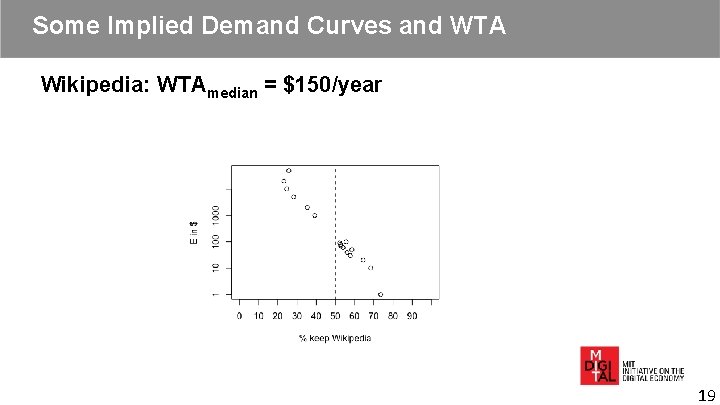
Some Implied Demand Curves and WTA Wikipedia: WTAmedian = $150/year 19
Most widely used categories of digital goods Email Maps Search Video 20
Most widely used categories of digital goods E-Commerce Messaging Social Media Music 21
Most widely used categories of digital goods 23
Non-digital goods: Breakfast Cereal WTAmedian = $48. 46/year [$42. 01, $55. 60] Implied Consumer Surplus = $15 billion Compare: US Cereal Revenue = $10 billion
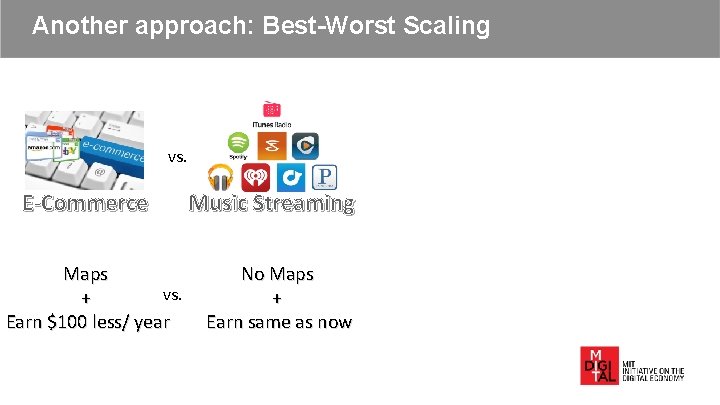
Another approach: Best-Worst Scaling vs. E-Commerce Maps vs. + Earn $100 less/ year Music Streaming No Maps + Earn same as now
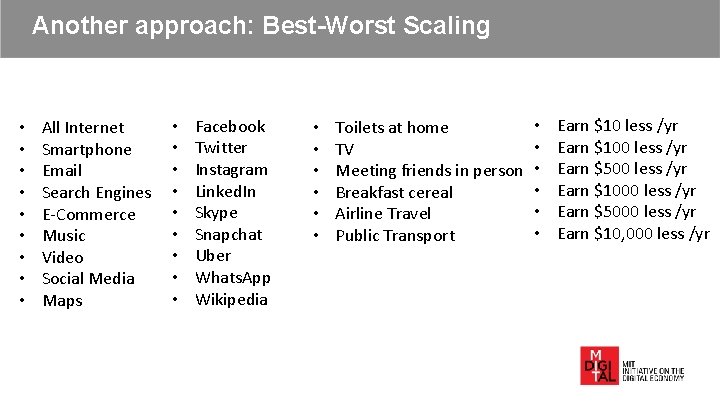
Another approach: Best-Worst Scaling • • • All Internet Smartphone Email Search Engines E-Commerce Music Video Social Media Maps • • • Facebook Twitter Instagram Linked. In Skype Snapchat Uber Whats. App Wikipedia • • • Toilets at home TV Meeting friends in person Breakfast cereal Airline Travel Public Transport • • • Earn $10 less /yr Earn $100 less /yr Earn $500 less /yr Earn $1000 less /yr Earn $5000 less /yr Earn $10, 000 less /yr
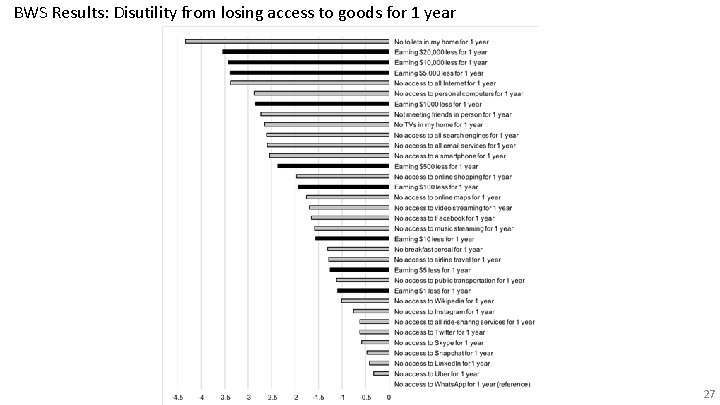
BWS Results: Disutility from losing access to goods for 1 year 27
What about inferring welfare changes for normal goods with prices? • In theory, changes in GDP would be equivalent to changes in welfare for goods with prices. • However this requires that proper quality adjustment is done • In practice, really hard to do quality adjustments, especially for tech products which are improving constantly 28
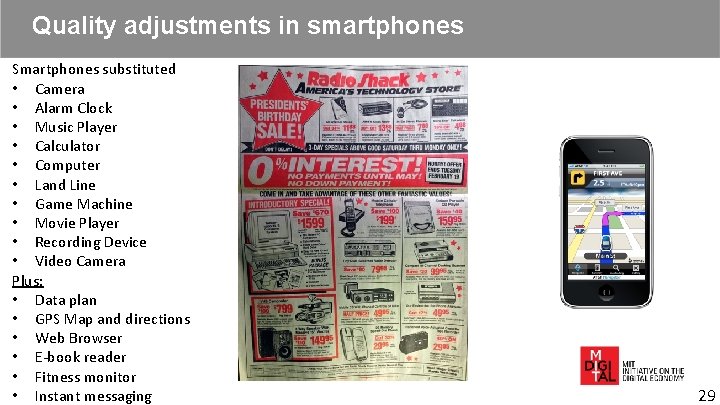
Quality adjustments in smartphones Smartphones substituted • Camera • Alarm Clock • Music Player • Calculator • Computer • Land Line • Game Machine • Movie Player • Recording Device • Video Camera Plus: • Data plan • GPS Map and directions • Web Browser • E-book reader • Fitness monitor • Instant messaging 29
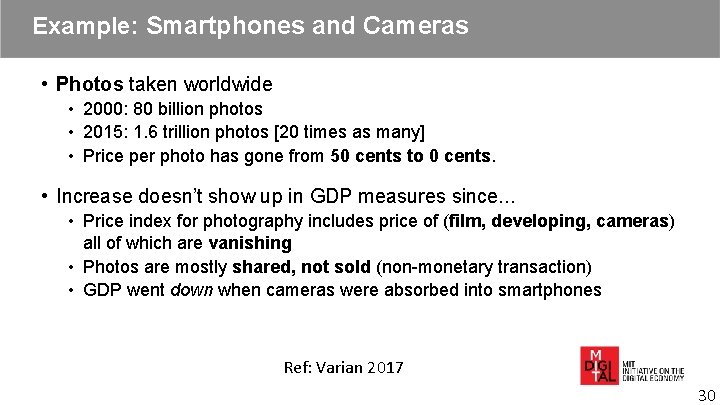
Example: Smartphones and Cameras • Photos taken worldwide • 2000: 80 billion photos • 2015: 1. 6 trillion photos [20 times as many] • Price per photo has gone from 50 cents to 0 cents. • Increase doesn’t show up in GDP measures since. . . • Price index for photography includes price of (film, developing, cameras) all of which are vanishing • Photos are mostly shared, not sold (non-monetary transaction) • GDP went down when cameras were absorbed into smartphones Ref: Varian 2017 30
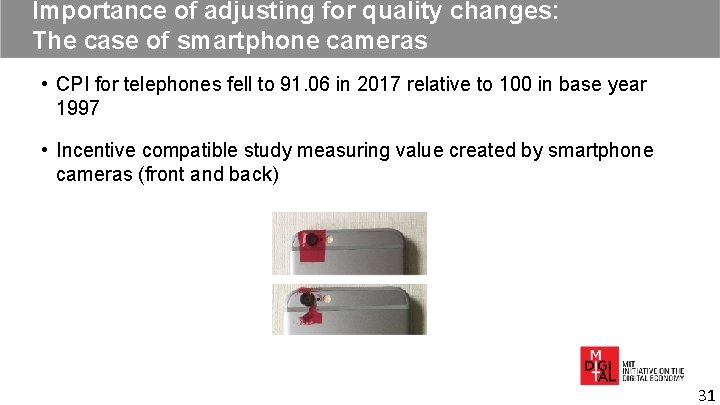
Importance of adjusting for quality changes: The case of smartphone cameras • CPI for telephones fell to 91. 06 in 2017 relative to 100 in base year 1997 • Incentive compatible study measuring value created by smartphone cameras (front and back) 31
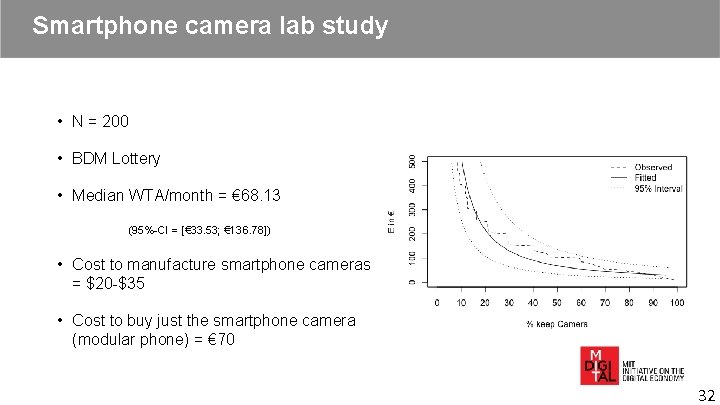
Smartphone camera lab study • N = 200 • BDM Lottery • Median WTA/month = € 68. 13 (95%-CI = [€ 33. 53; € 136. 78]) • Cost to manufacture smartphone cameras = $20 -$35 • Cost to buy just the smartphone camera (modular phone) = € 70 32
Integrating GDP growth accounting for new and free goods The digital economy, GDP and consumer welfare: theory and evidence with Erik Brynjolfsson, Erwin Diewert, Felix Eggers, Kevin Fox
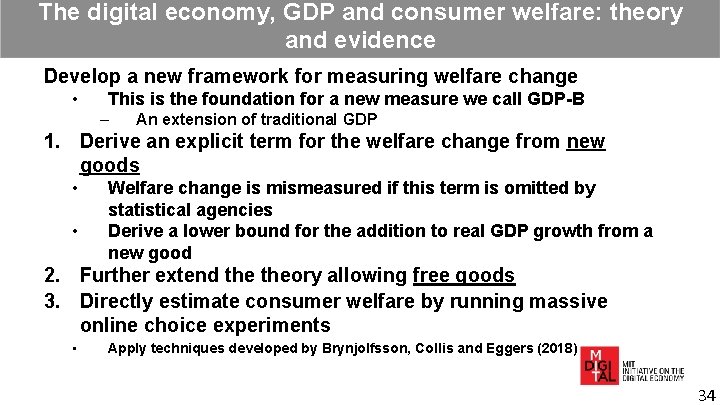
The digital economy, GDP and consumer welfare: theory and evidence Develop a new framework for measuring welfare change • This is the foundation for a new measure we call GDP-B – An extension of traditional GDP 1. Derive an explicit term for the welfare change from new goods • • Welfare change is mismeasured if this term is omitted by statistical agencies Derive a lower bound for the addition to real GDP growth from a new good 2. Further extend theory allowing free goods 3. Directly estimate consumer welfare by running massive online choice experiments • Apply techniques developed by Brynjolfsson, Collis and Eggers (2018) 34
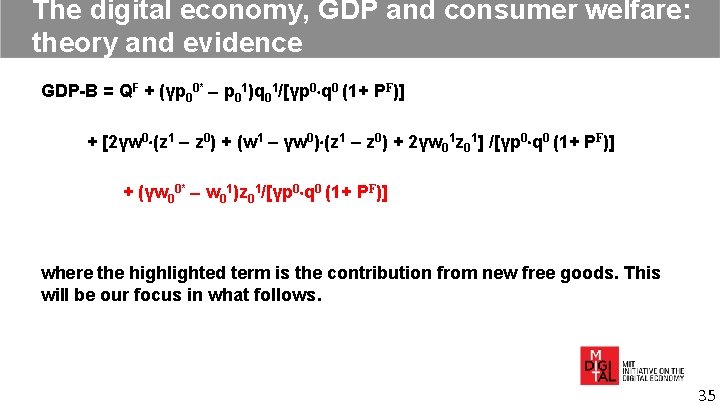
The digital economy, GDP and consumer welfare: theory and evidence GDP-B = QF + (γp 00* p 01)q 01/[γp 0 q 0 (1+ PF)] + [2γw 0 (z 1 z 0) + (w 1 γw 0) (z 1 z 0) + 2γw 01 z 01] /[γp 0 q 0 (1+ PF)] + (γw 00* w 01)z 01/[γp 0 q 0 (1+ PF)] where the highlighted term is the contribution from new free goods. This will be our focus in what follows. 35
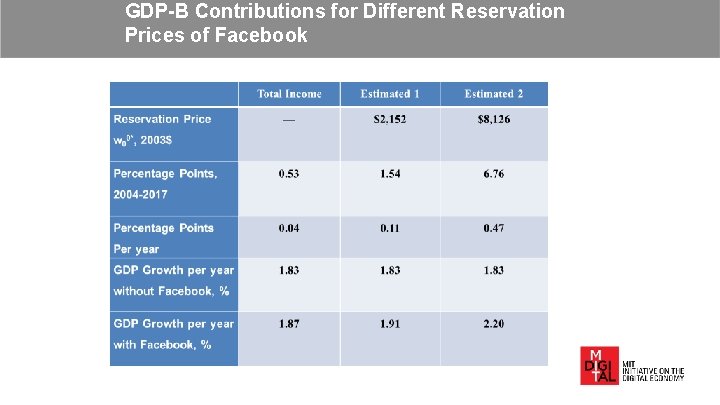
GDP-B Contributions for Different Reservation Prices of Facebook
Conclusion 1. GDP, developed in 1930 s, remains the de facto metric of economic growth. 2. Conceptually, consumer surplus is a better metric of well-being. 3. Massive online choice experiments have the potential to reinvent and significantly supplement the measurement of economic welfare. • • • Can be used for goods whether they have zero price or positive price Highly scalable Can be run in near real time to track changes in well-being 4. This approach can be incorporated into the national accounts 37
References 1. Brynjolfsson, Collis & Eggers (2018). Using Massive Online Choice Experiments to measure changes in Well-being. NBER Working Paper No. 24514. 2. Brynjolfsson, Collis, Diewert, Eggers & Fox (2018). The digital economy, GDP and Consumer Welfare: Theory and Evidence. Working Paper. 38
More Information MIT Measuring the Economy Project www. Measuring. The. Economy. org