
Measuring Biodiversity You need to know What we
Measuring Biodiversity You need to know: • What we mean by ‘biodiversity’ • How to estimate biodiversity
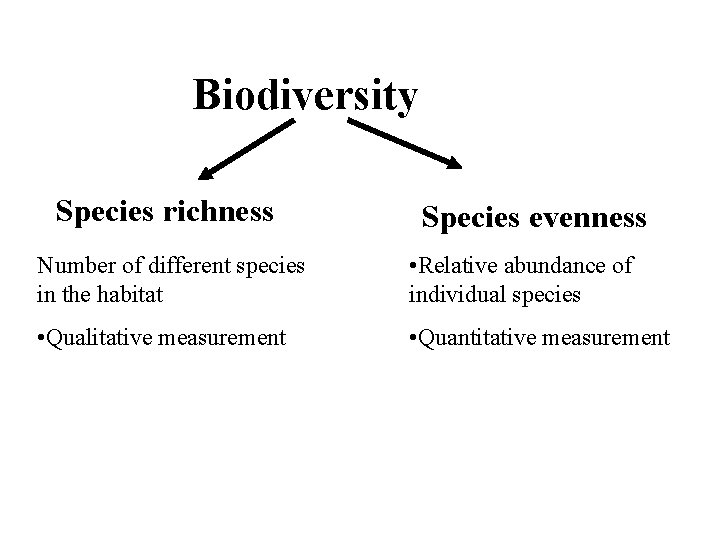
Biodiversity Species richness Species evenness Number of different species in the habitat • Relative abundance of individual species • Qualitative measurement • Quantitative measurement
Measuring species richness =Quantitative. • Count the number of different species. • Can use random quadrat technique • No need to identify the species • NB this measurement means that 1 daisy is worth as much as 100 buttercups…. . so…
Measuring species evenness = Quantitative • Plants – use random quadrats , count the number of each species or % cover. • Calculate RELATIVE abundance.
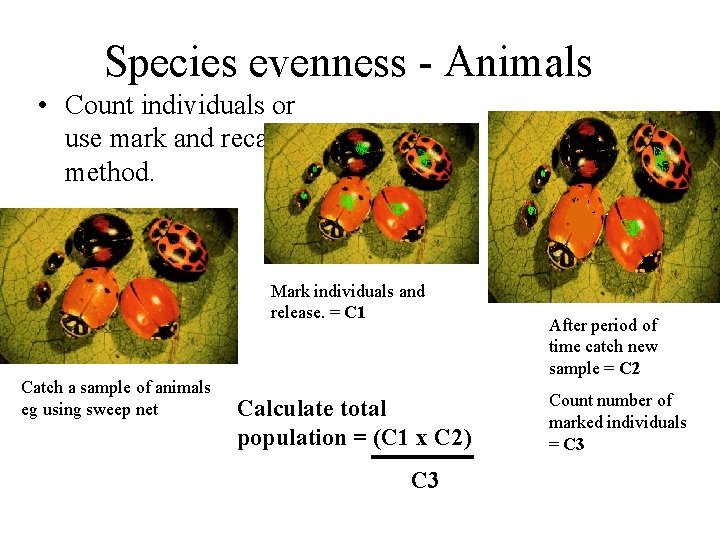
Species evenness - Animals • Count individuals or use mark and recapture method. Mark individuals and release. = C 1 Catch a sample of animals eg using sweep net Calculate total population = (C 1 x C 2) C 3 After period of time catch new sample = C 2 Count number of marked individuals = C 3
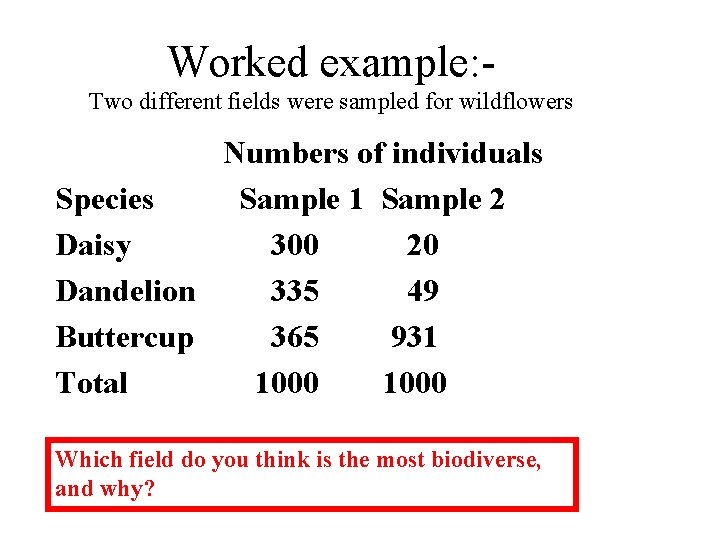
Worked example: Two different fields were sampled for wildflowers Numbers of individuals Species Sample 1 Sample 2 Daisy 300 20 Dandelion 335 49 Buttercup 365 931 Total 1000 Which field do you think is the most biodiverse, and why?
A community dominated by one or two species is considered to be less diverse than one in which several different species have a similar abundance. As species richness and evenness increase, so diversity increases. Simpson's Diversity Index is a measure of diversity which takes into account both richness and evenness.
![Simpsons diversity index D = 1 - [ Σ(n / N)2 ] D =](http://slidetodoc.com/presentation_image_h2/2619f923279ba35ddbe545b5f8ce9897/image-8.jpg "Simpsons diversity index D = 1 - [ Σ(n / N)2 ] D =")
Simpsons diversity index D = 1 - [ Σ(n / N)2 ] D = diversity of habitat Σ = sum of n = the total number of organisms of a particular species or percentage cover N = the total number of organisms of all species or % cover Using 1 - means that as D increases so does the diversity.
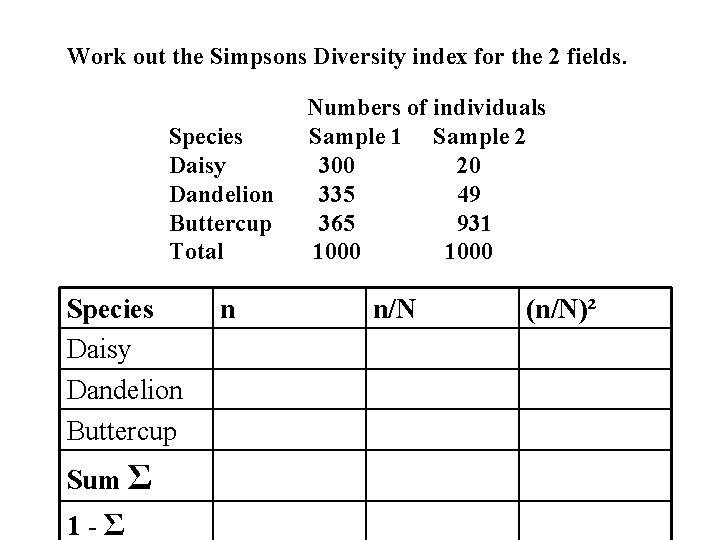
Work out the Simpsons Diversity index for the 2 fields. Species Daisy Dandelion Buttercup Total Species Daisy Dandelion Buttercup Sum Σ 1 -Σ n Numbers of individuals Sample 1 Sample 2 300 20 335 49 365 931 1000 n/N (n/N)²
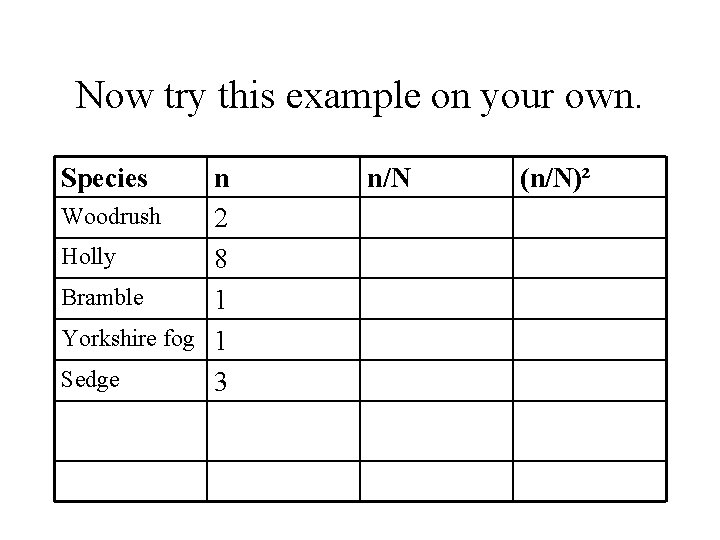
Now try this example on your own. Species n Woodrush 2 Holly 8 Bramble 1 Yorkshire fog 1 Sedge 3 n/N (n/N)²
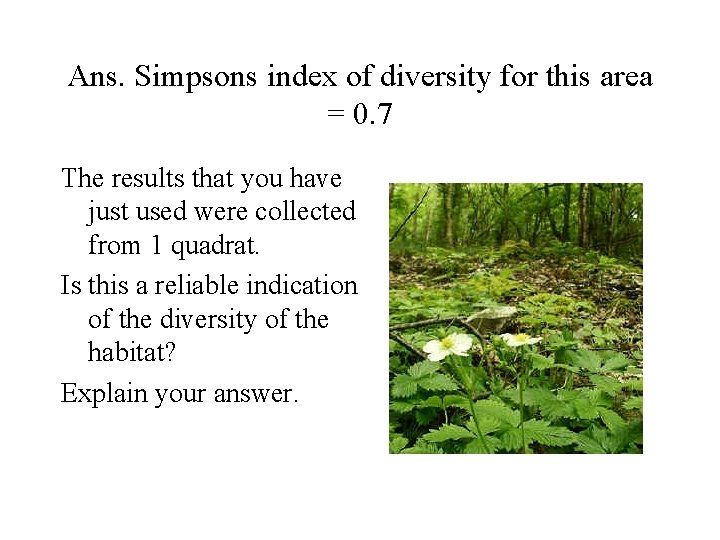
Ans. Simpsons index of diversity for this area = 0. 7 The results that you have just used were collected from 1 quadrat. Is this a reliable indication of the diversity of the habitat? Explain your answer.
- Slides: 11