
Measuring and scoring cardiac autonomic neuropathy a first

- Slides: 14
Measuring and scoring cardiac autonomic neuropathy : a first comparison in diabetes M. Fevre-Genoulaz M. J. Lafitte S. S. Srikanta
Aim of the study Compare the classification of cardiac autonomic neuropathy (CAN) given by standard autonomic scoring and by a new device : the ANSiscope. TM (Dyansys) in healthy volunteers and in diabetic patients
Study population n n 21 type 2 diabetic patients (mean age=50+/-9 yrs). 4 of them had complications due to diabetes : retinopathy, and hypertension 9 non-diabetic volunteers (mean age 38 +/-9 yrs)
Exclusion criteria n n n Causes of autonomic neuropathy other than diabetes History of psychoactive drug or alcohol abuse Cardiac arrythmia
Methods n Each patient underwent 2 sets of tests : n Autonomic tests n ANSiscope. TM autonomic dysfunction test
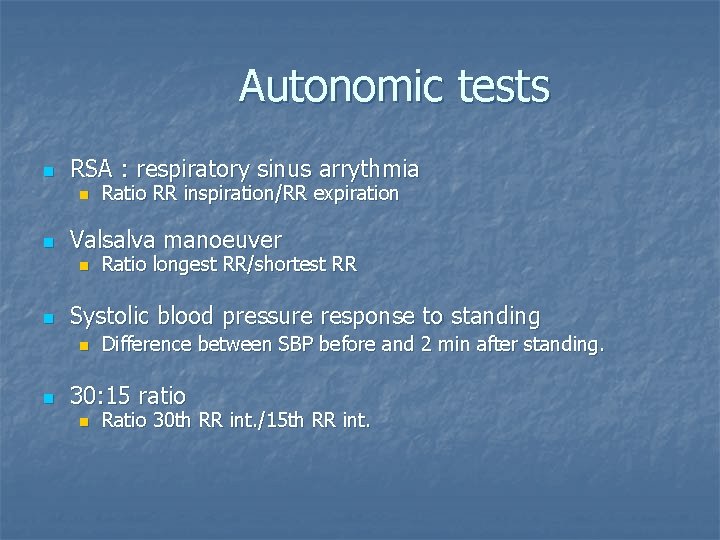
Autonomic tests n RSA : respiratory sinus arrythmia n n Valsalva manoeuver n n Ratio longest RR/shortest RR Systolic blood pressure response to standing n n Ratio RR inspiration/RR expiration Difference between SBP before and 2 min after standing. 30: 15 ratio n Ratio 30 th RR int. /15 th RR int.
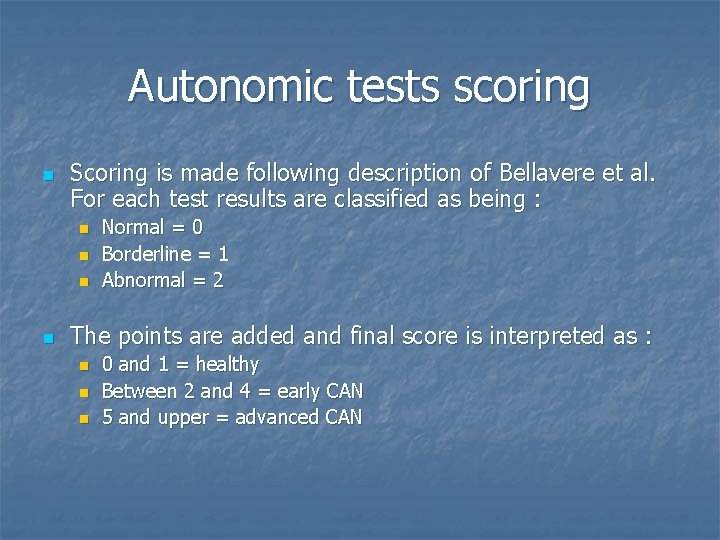
Autonomic tests scoring n Scoring is made following description of Bellavere et al. For each test results are classified as being : n n Normal = 0 Borderline = 1 Abnormal = 2 The points are added and final score is interpreted as : n n n 0 and 1 = healthy Between 2 and 4 = early CAN 5 and upper = advanced CAN
Assessment of autonomic scoring n n minimum 30 minutes of testing 45 minutes of signal analysis Complete patient participation Trained medical team
Measurement with the ANSiscope. TM n n This device extracts from the RR intervals (recorded with 3 leads ECG) the activity of the sympathetic and parasympathetic systems on a beat by beat basis. Measurement of dysautonomia is expressed as a lack of coupling between both activites. Result is expressed as a percentage and a group classification.
Measurement conditions with the ANSiscope. TM n n A recording of 572 RR intervals is needed (around 5 -7 minutes) Patient must be at rest in supine condition without external stimulation (which may activate sympathetic system).
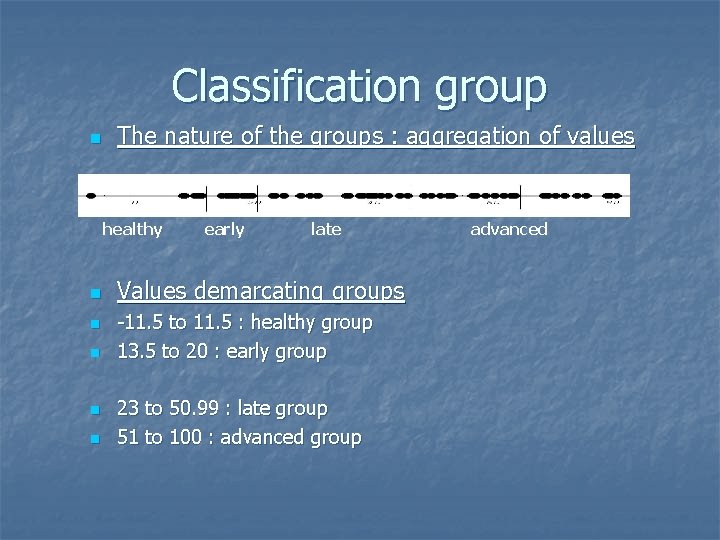
Classification group n The nature of the groups : aggregation of values healthy n n n early late Values demarcating groups -11. 5 to 11. 5 : healthy group 13. 5 to 20 : early group 23 to 50. 99 : late group 51 to 100 : advanced group advanced
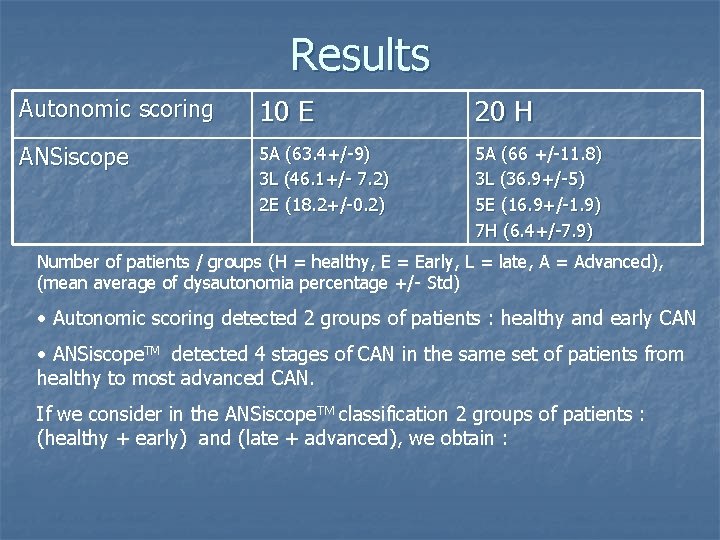
Results Autonomic scoring 10 E 20 H ANSiscope 5 A (63. 4+/-9) 3 L (46. 1+/- 7. 2) 2 E (18. 2+/-0. 2) 5 A (66 +/-11. 8) 3 L (36. 9+/-5) 5 E (16. 9+/-1. 9) 7 H (6. 4+/-7. 9) Number of patients / groups (H = healthy, E = Early, L = late, A = Advanced), (mean average of dysautonomia percentage +/- Std) • Autonomic scoring detected 2 groups of patients : healthy and early CAN • ANSiscope. TM detected 4 stages of CAN in the same set of patients from healthy to most advanced CAN. If we consider in the ANSiscope. TM classification 2 groups of patients : (healthy + early) and (late + advanced), we obtain :
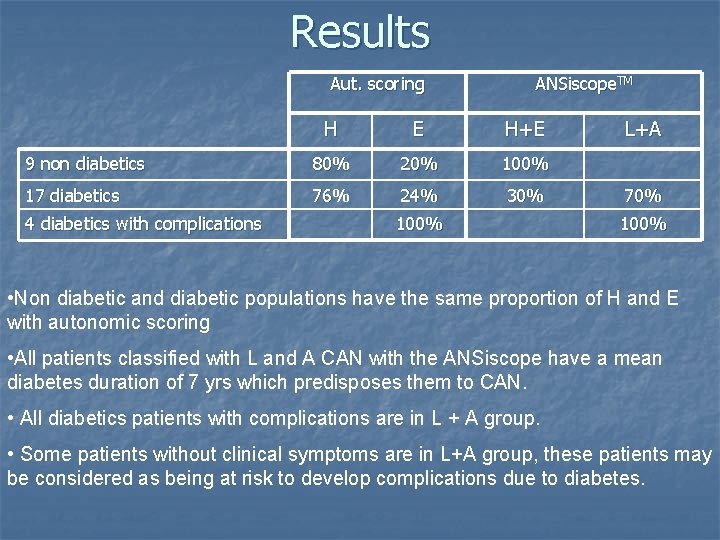
Results Aut. scoring ANSiscope. TM H E H+E 9 non diabetics 80% 20% 100% 17 diabetics 76% 24% 30% 4 diabetics with complications 100% L+A 70% 100% • Non diabetic and diabetic populations have the same proportion of H and E with autonomic scoring • All patients classified with L and A CAN with the ANSiscope have a mean diabetes duration of 7 yrs which predisposes them to CAN. • All diabetics patients with complications are in L + A group. • Some patients without clinical symptoms are in L+A group, these patients may be considered as being at risk to develop complications due to diabetes.
Conclusion n These first results suggest that the ANSiscope. TM allows to detect precociously CAN and classify patients accurately compared to autonomic scoring. Method is simple, quick and does not require particular training, it thus represents a good tool to measure autonomic neuropathy in clinical practice. Further studies need to be performed on larger population.