
MEASURING AND MANAGING STRATEGIC PRIORITIES LEADING FOR IMPACT
- Slides: 21
MEASURING AND MANAGING STRATEGIC PRIORITIES LEADING FOR IMPACT Session 6 This presentation and all LFI materials are available online at www. bridgespan. org/LFIresources
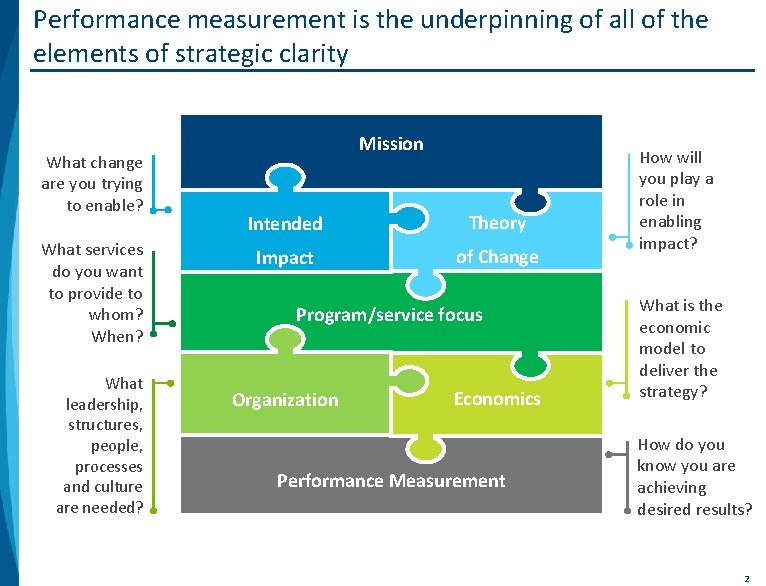
Performance measurement is the underpinning of all of the elements of strategic clarity What change are you trying to enable? What services do you want to provide to whom? When? What leadership, structures, people, processes and culture are needed? Mission Intended Theory Impact of Change Program/service focus Organization Economics Performance Measurement How will you play a role in enabling impact? What is the economic model to deliver the strategy? How do you know you are achieving desired results? 2
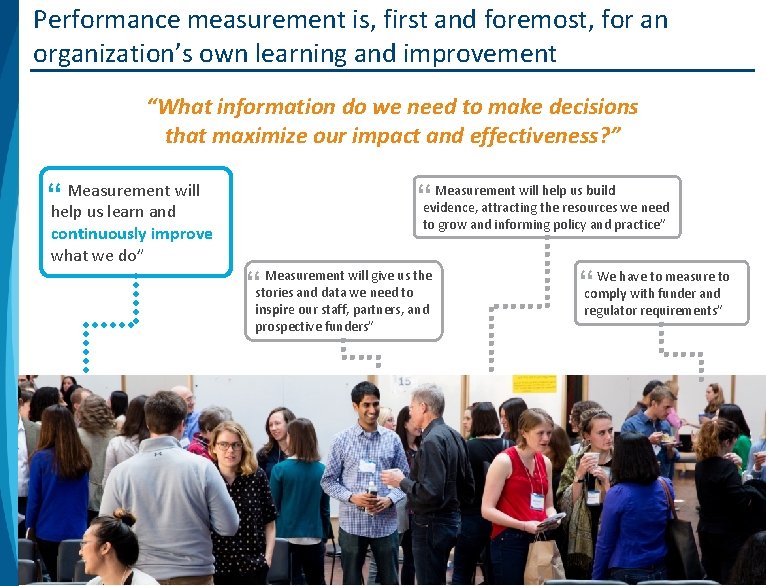
Performance measurement is, first and foremost, for an organization’s own learning and improvement “What information do we need to make decisions that maximize our impact and effectiveness? ” Measurement will “help us learn and continuously improve what we do” Measurement will help us build “evidence, attracting the resources we need to grow and informing policy and practice” Measurement will give us the “stories and data we need to inspire our staff, partners, and prospective funders” We have to measure to “comply with funder and regulator requirements” 3
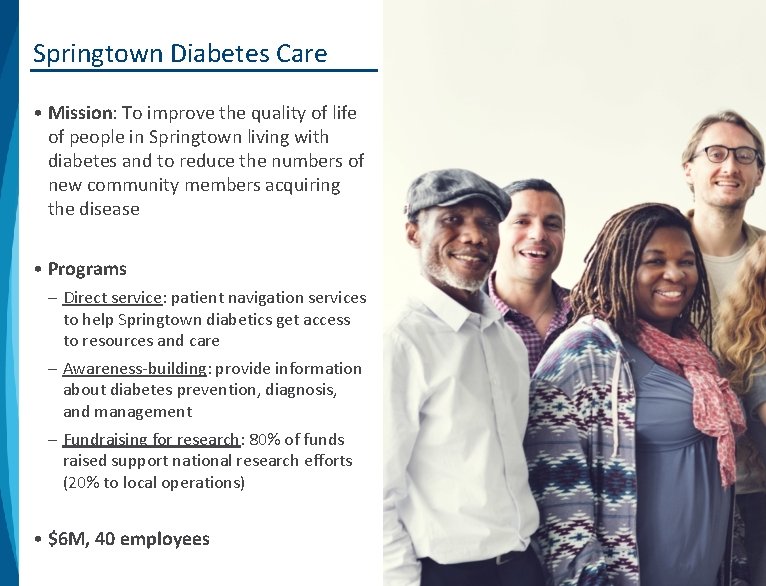
Springtown Diabetes Care • Mission: To improve the quality of life of people in Springtown living with diabetes and to reduce the numbers of new community members acquiring the disease • Programs – Direct service: patient navigation services to help Springtown diabetics get access to resources and care – Awareness-building: provide information about diabetes prevention, diagnosis, and management – Fundraising for research: 80% of funds raised support national research efforts (20% to local operations) • $6 M, 40 employees
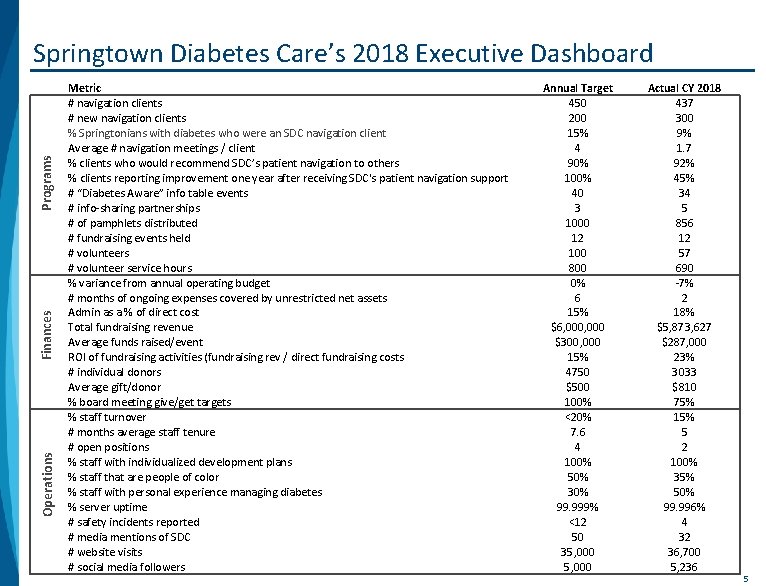
Operations Finances Programs Springtown Diabetes Care’s 2018 Executive Dashboard Metric # navigation clients # new navigation clients % Springtonians with diabetes who were an SDC navigation client Average # navigation meetings / client % clients who would recommend SDC’s patient navigation to others % clients reporting improvement one year after receiving SDC's patient navigation support # “Diabetes Aware” info table events # info-sharing partnerships # of pamphlets distributed # fundraising events held # volunteers # volunteer service hours % variance from annual operating budget # months of ongoing expenses covered by unrestricted net assets Admin as a % of direct cost Total fundraising revenue Average funds raised/event ROI of fundraising activities (fundraising rev / direct fundraising costs # individual donors Average gift/donor % board meeting give/get targets % staff turnover # months average staff tenure # open positions % staff with individualized development plans % staff that are people of color % staff with personal experience managing diabetes % server uptime # safety incidents reported # media mentions of SDC # website visits # social media followers Annual Target 450 200 15% 4 90% 100% 40 3 1000 12 100 800 0% 6 15% $6, 000 $300, 000 15% 4750 $500 100% <20% 7. 6 4 100% 50% 30% 99. 999% <12 50 35, 000 Actual CY 2018 437 300 9% 1. 7 92% 45% 34 5 856 12 57 690 -7% 2 18% $5, 873, 627 $287, 000 23% 3033 $810 75% 15% 5 2 100% 35% 50% 99. 996% 4 32 36, 700 5, 236 5
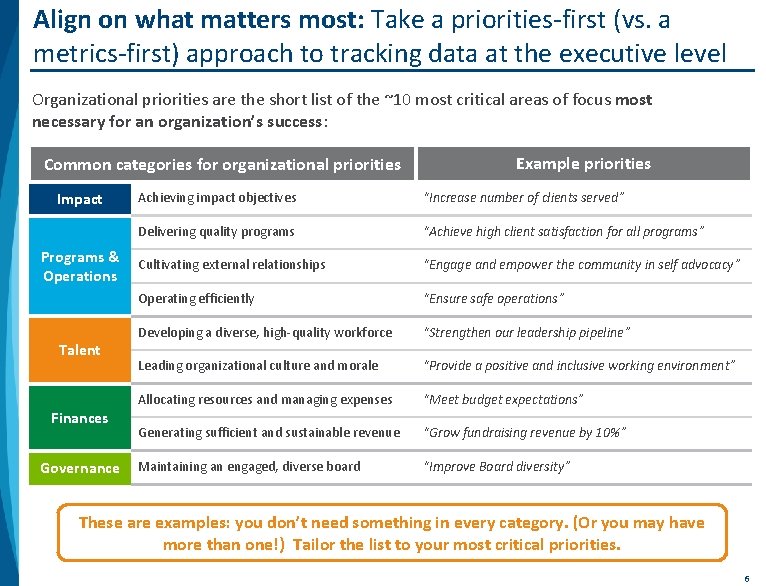
Align on what matters most: Take a priorities-first (vs. a metrics-first) approach to tracking data at the executive level Organizational priorities are the short list of the ~10 most critical areas of focus most necessary for an organization’s success: Common categories for organizational priorities Impact Programs & Operations Talent Finances Governance Example priorities Achieving impact objectives “Increase number of clients served” Delivering quality programs “Achieve high client satisfaction for all programs” Cultivating external relationships “Engage and empower the community in self advocacy” Operating efficiently “Ensure safe operations” Developing a diverse, high-quality workforce “Strengthen our leadership pipeline” Leading organizational culture and morale “Provide a positive and inclusive working environment” Allocating resources and managing expenses “Meet budget expectations” Generating sufficient and sustainable revenue “Grow fundraising revenue by 10%” Maintaining an engaged, diverse board “Improve Board diversity” These are examples: you don’t need something in every category. (Or you may have more than one!) Tailor the list to your most critical priorities. 6
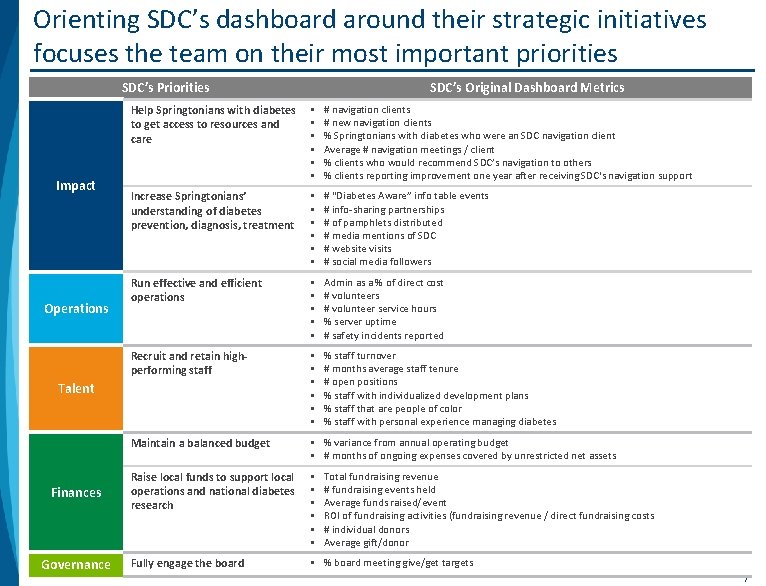
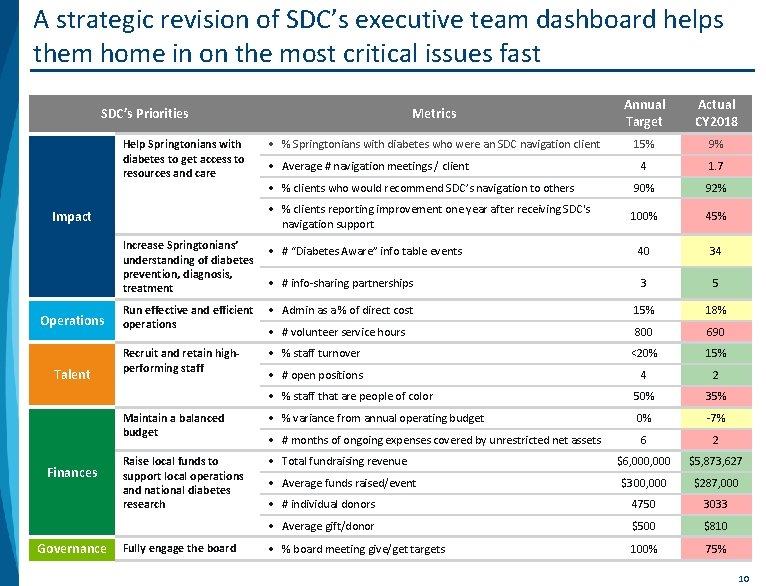
Orienting SDC’s dashboard around their strategic initiatives focuses the team on their most important priorities SDC’s Priorities Impact Operations Help Springtonians with diabetes to get access to resources and care • • • # navigation clients # new navigation clients % Springtonians with diabetes who were an SDC navigation client Average # navigation meetings / client % clients who would recommend SDC’s navigation to others % clients reporting improvement one year after receiving SDC's navigation support Increase Springtonians’ understanding of diabetes prevention, diagnosis, treatment • • • # “Diabetes Aware” info table events # info-sharing partnerships # of pamphlets distributed # media mentions of SDC # website visits # social media followers Run effective and efficient operations • • • Admin as a % of direct cost # volunteers # volunteer service hours % server uptime # safety incidents reported Recruit and retain highperforming staff • • • % staff turnover # months average staff tenure # open positions % staff with individualized development plans % staff that are people of color % staff with personal experience managing diabetes Maintain a balanced budget • % variance from annual operating budget • # months of ongoing expenses covered by unrestricted net assets Raise local funds to support local operations and national diabetes research • • • Fully engage the board • % board meeting give/get targets Talent Finances Governance SDC’s Original Dashboard Metrics Total fundraising revenue # fundraising events held Average funds raised/event ROI of fundraising activities (fundraising revenue / direct fundraising costs # individual donors Average gift/donor 7
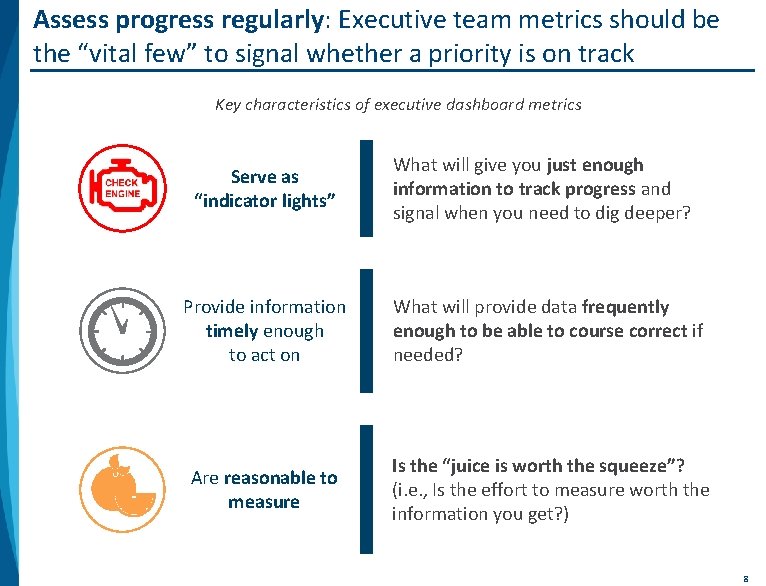
Assess progress regularly: Executive team metrics should be the “vital few” to signal whether a priority is on track Key characteristics of executive dashboard metrics Serve as “indicator lights” What will give you just enough information to track progress and signal when you need to dig deeper? Provide information timely enough to act on What will provide data frequently enough to be able to course correct if needed? Are reasonable to measure Is the “juice is worth the squeeze”? (i. e. , Is the effort to measure worth the information you get? ) 8
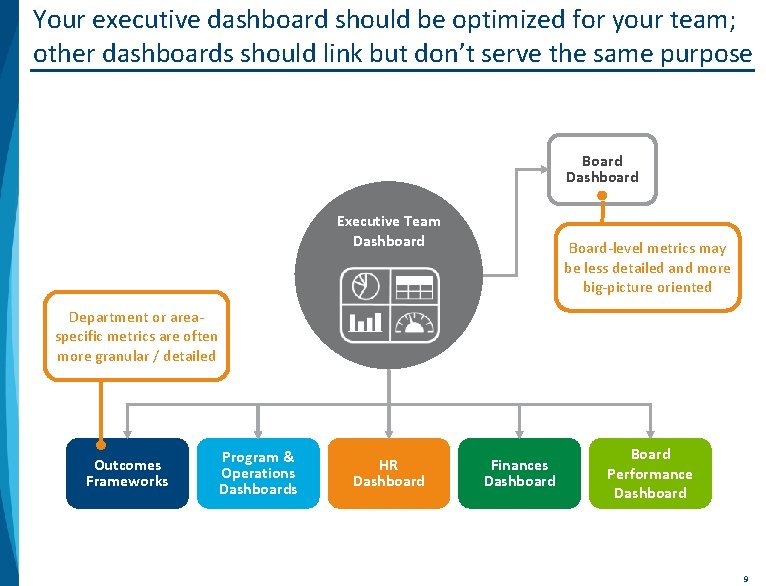
Your executive dashboard should be optimized for your team; other dashboards should link but don’t serve the same purpose Board Dashboard Executive Team Dashboard Board-level metrics may be less detailed and more big-picture oriented Department or areaspecific metrics are often more granular / detailed Outcomes Frameworks Program & Operations Dashboards HR Dashboard Finances Dashboard Board Performance Dashboard 9
A strategic revision of SDC’s executive team dashboard helps them home in on the most critical issues fast Metrics Annual Target Actual CY 2018 • % Springtonians with diabetes who were an SDC navigation client 15% 9% 4 1. 7 • % clients who would recommend SDC’s navigation to others 90% 92% • % clients reporting improvement one year after receiving SDC's navigation support 100% 45% SDC’s Priorities Help Springtonians with diabetes to get access to resources and care Impact Operations Talent Finances Governance • Average # navigation meetings / client Increase Springtonians’ understanding of diabetes prevention, diagnosis, treatment • # “Diabetes Aware” info table events 40 34 • # info-sharing partnerships 3 5 Run effective and efficient operations • Admin as a % of direct cost 15% 18% • # volunteer service hours 800 690 Recruit and retain highperforming staff • % staff turnover <20% 15% • # open positions 4 2 • % staff that are people of color 50% 35% Maintain a balanced budget • % variance from annual operating budget 0% -7% 6 2 Raise local funds to support local operations and national diabetes research • Total fundraising revenue $6, 000 $5, 873, 627 $300, 000 $287, 000 • # individual donors 4750 3033 • Average gift/donor $500 $810 • % board meeting give/get targets 100% 75% Fully engage the board • # months of ongoing expenses covered by unrestricted net assets • Average funds raised/event 10
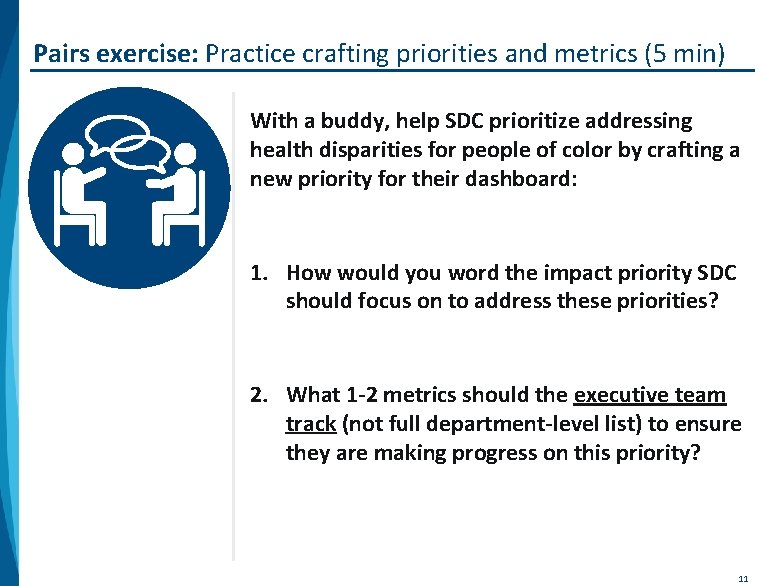
Pairs exercise: Practice crafting priorities and metrics (5 min) With a buddy, help SDC prioritize addressing health disparities for people of color by crafting a new priority for their dashboard: 1. How would you word the impact priority SDC should focus on to address these priorities? 2. What 1 -2 metrics should the executive team track (not full department-level list) to ensure they are making progress on this priority? 11
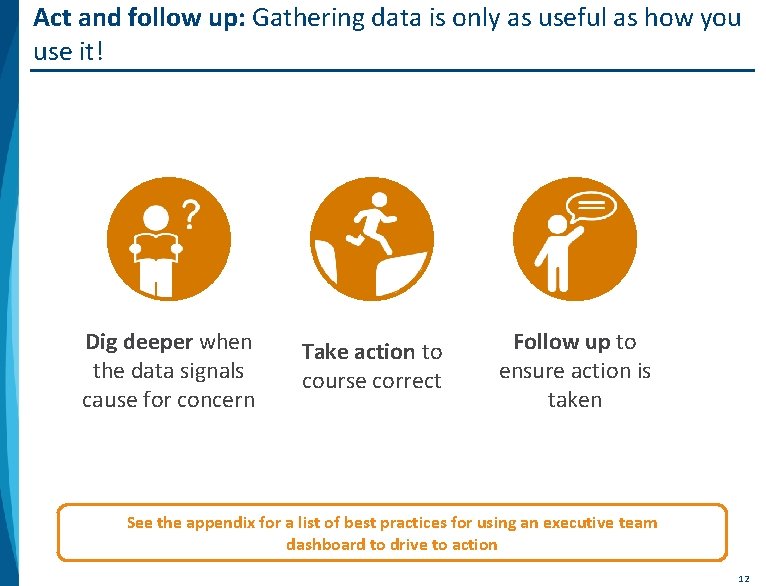
Act and follow up: Gathering data is only as useful as how you use it! Dig deeper when the data signals cause for concern Take action to course correct Follow up to ensure action is taken See the appendix for a list of best practices for using an executive team dashboard to drive to action 12
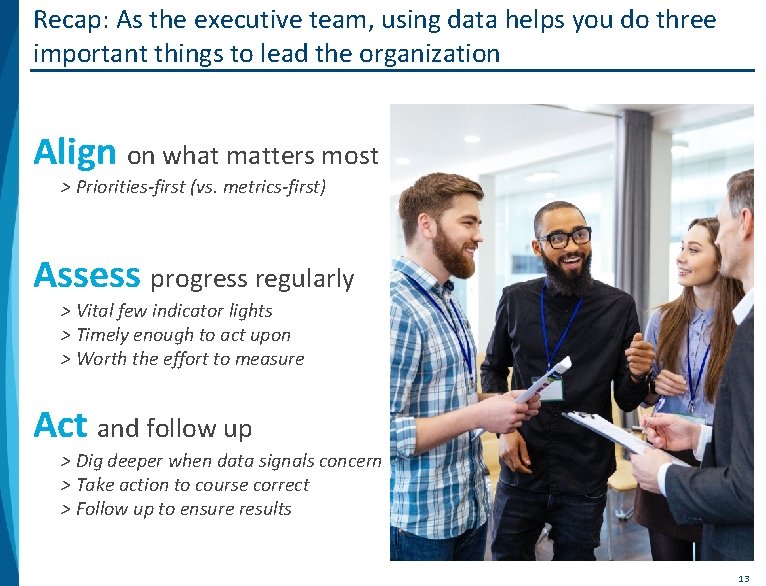
Recap: As the executive team, using data helps you do three important things to lead the organization Align on what matters most > Priorities-first (vs. metrics-first) Assess progress regularly > Vital few indicator lights > Timely enough to act upon > Worth the effort to measure Act and follow up > Dig deeper when data signals concern > Take action to course correct > Follow up to ensure results 13
Team exercise: Explore how you can better use data to manage your most critical priorities (60 min) 1. (15 min) Identify 2 -3 of your organizational priorities where data could most help focus and improve your executive team’s leadership > Use the organizational priorities you drafted for Session 2 2. (25 min) For each priority you selected, identify the metric(s) most critical for you to track as an executive team 3. (10 min) Reflect as a team: How could you improve how your executive team uses data to manage your priorities? If you already have a dashboard, use Handout 2 to review your dashboard against the concepts we discussed today 4. (10 min) Discuss next steps: Will you take action on this topic in the next year, if so, how? 14
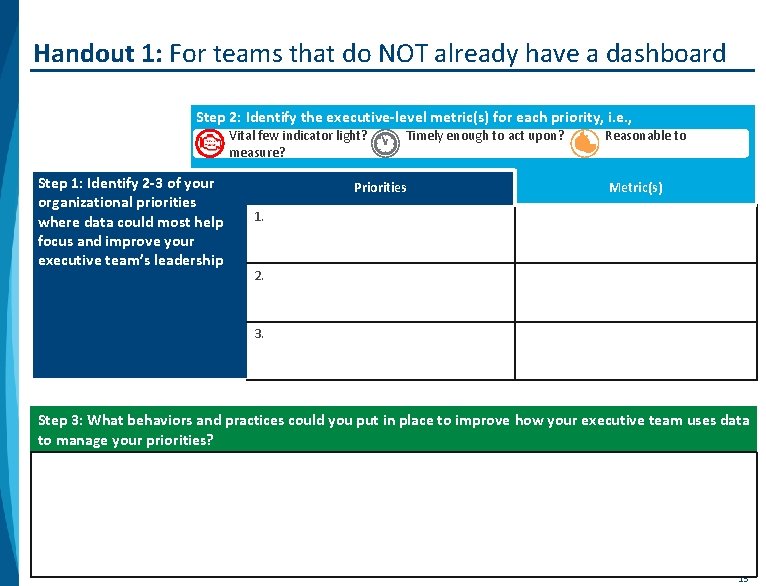
Handout 1: For teams that do NOT already have a dashboard Step 2: Identify the executive-level metric(s) for each priority, i. e. , Vital few indicator light? measure? Step 1: Identify 2 -3 of your organizational priorities where data could most help focus and improve your executive team’s leadership Timely enough to act upon? Priorities Reasonable to Metric(s) 1. 2. 3. Step 3: What behaviors and practices could you put in place to improve how your executive team uses data to manage your priorities? 15
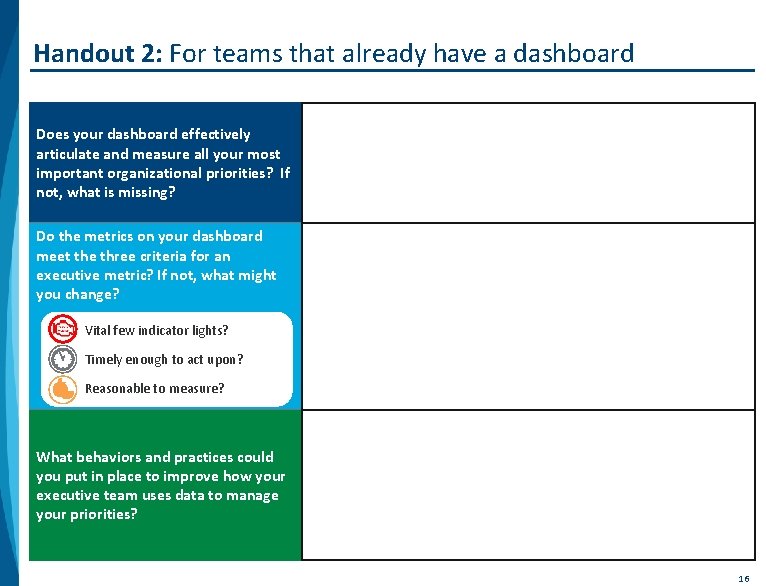
Handout 2: For teams that already have a dashboard Does your dashboard effectively articulate and measure all your most important organizational priorities? If not, what is missing? Do the metrics on your dashboard meet the three criteria for an executive metric? If not, what might you change? Vital few indicator lights? Timely enough to act upon? Reasonable to measure? What behaviors and practices could you put in place to improve how your executive team uses data to manage your priorities? 16
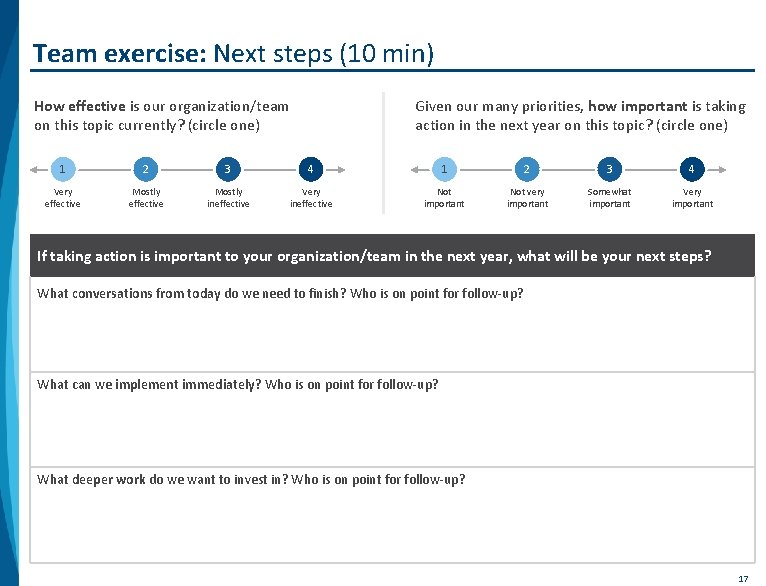
Team exercise: Next steps (10 min) How effective is our organization/team on this topic currently? (circle one) Given our many priorities, how important is taking action in the next year on this topic? (circle one) 1 2 3 4 Very effective Mostly ineffective Very ineffective Not important Not very important Somewhat important Very important If taking action is important to your organization/team in the next year, what will be your next steps? What conversations from today do we need to finish? Who is on point for follow-up? What can we implement immediately? Who is on point for follow-up? What deeper work do we want to invest in? Who is on point for follow-up? 17
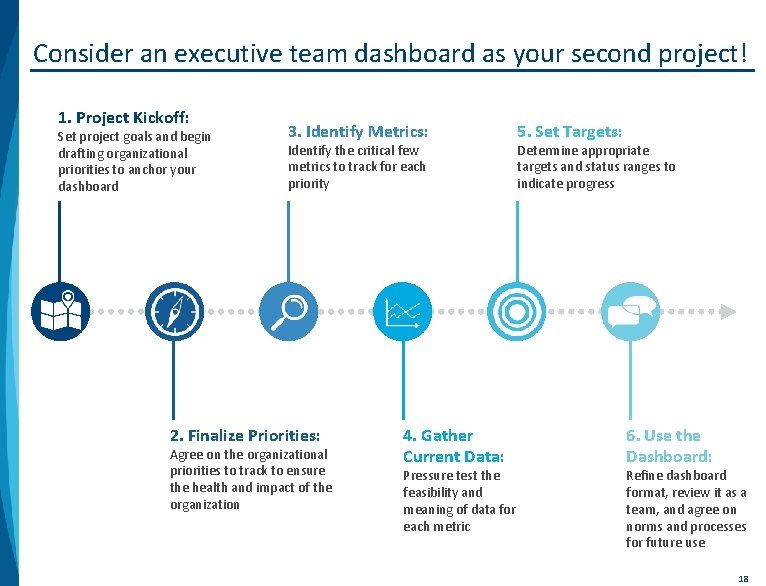
Consider an executive team dashboard as your second project! 1. Project Kickoff: Set project goals and begin drafting organizational priorities to anchor your dashboard 3. Identify Metrics: Identify the critical few metrics to track for each priority 2. Finalize Priorities: Agree on the organizational priorities to track to ensure the health and impact of the organization 4. Gather Current Data: Pressure test the feasibility and meaning of data for each metric 5. Set Targets: Determine appropriate targets and status ranges to indicate progress 6. Use the Dashboard: Refine dashboard format, review it as a team, and agree on norms and processes for future use 18
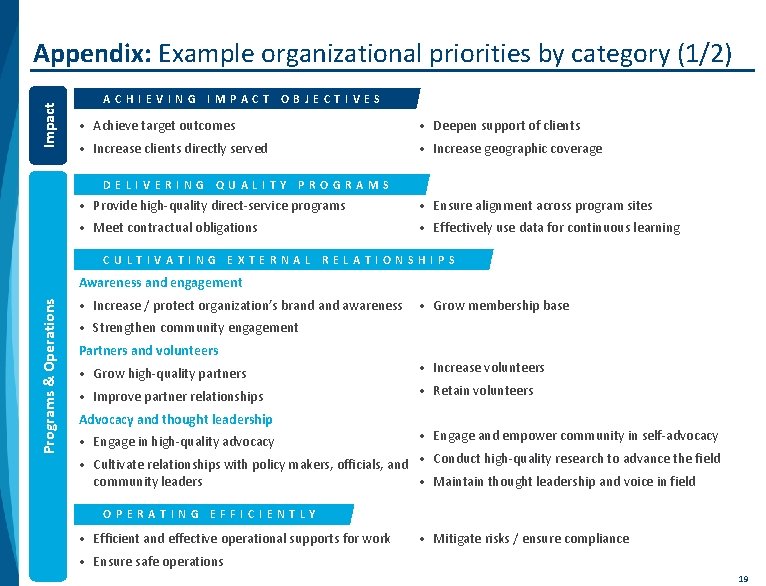
Impact Appendix: Example organizational priorities by category (1/2) A C H Iimpact E V I Nobjectives G IMPACT OBJECTIVES Achieving • Achieve target outcomes • Deepen support of clients • Increase clients directly served • Increase geographic coverage Delivering program D E L I quality VERIN G Q U offerings: A L I T Y Service P R O Gdelivery RAMS • Provide high-quality direct-service programs • Ensure alignment across program sites • Meet contractual obligations • Effectively use data for continuous learning Delivering C U L Tquality I V A T program I N G E offerings: X T E R N APartnerships L RELATIONSHIPS Programs & Operations Awareness and engagement • Increase / protect organization’s brand awareness • Grow membership base • Strengthen community engagement Partners and volunteers • Grow high-quality partners • Improve partner relationships Advocacy and thought leadership • Engage in high-quality advocacy • Increase volunteers • Retain volunteers • Engage and empower community in self-advocacy • Cultivate relationships with policy makers, officials, and • Conduct high-quality research to advance the field • Maintain thought leadership and voice in field community leaders OPERATING EFFICIENTLY • Efficient and effective operational supports for work • Mitigate risks / ensure compliance • Ensure safe operations 19
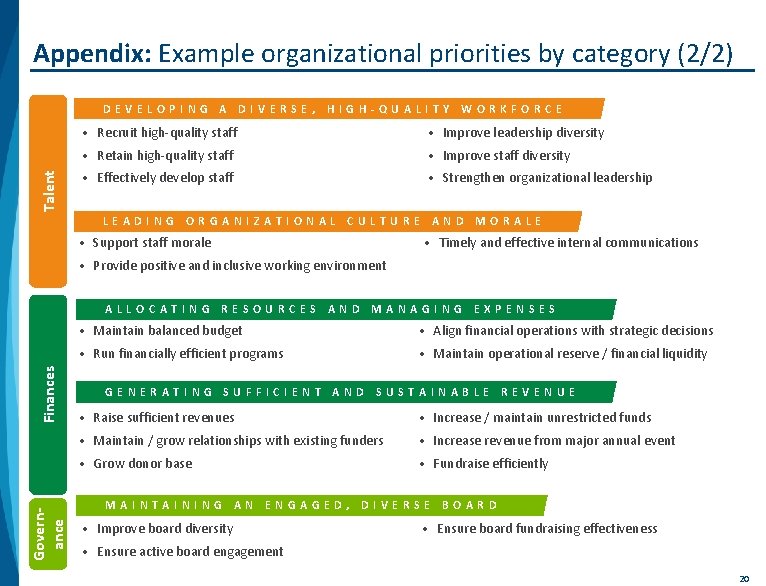
Appendix: Example organizational priorities by category (2/2) Talent D E V E La O P I N Ghigh-quality A D I V E workforce RSE, HIGH-QUALITY WORKFORCE Developing diverse, • Recruit high-quality staff • Improve leadership diversity • Retain high-quality staff • Improve staff diversity • Effectively develop staff • Strengthen organizational leadership Leading L E Aorganizational D I N G O R Gculture A N I Zand A T morale IONAL CULTURE AND MORALE • Support staff morale • Timely and effective internal communications • Provide positive and inclusive working environment Governance Finances Budgeting A L L Oand C Aallocating T I N G Rresources ESOURCES AND MANAGING EXPENSES • Maintain balanced budget • Align financial operations with strategic decisions • Run financially efficient programs • Maintain operational reserve / financial liquidity G E N E sufficient R A T I N and G Ssustainable U F F I C I E revenue NT AND SUSTAINABLE REVENUE Generating • Raise sufficient revenues • Increase / maintain unrestricted funds • Maintain / grow relationships with existing funders • Increase revenue from major annual event • Grow donor base • Fundraise efficiently Maintaining M A I N Tan. Aengaged, I N G diverse A N EBoard NGAGED, DIVERSE BOARD • Improve board diversity • Ensure board fundraising effectiveness • Ensure active board engagement 20
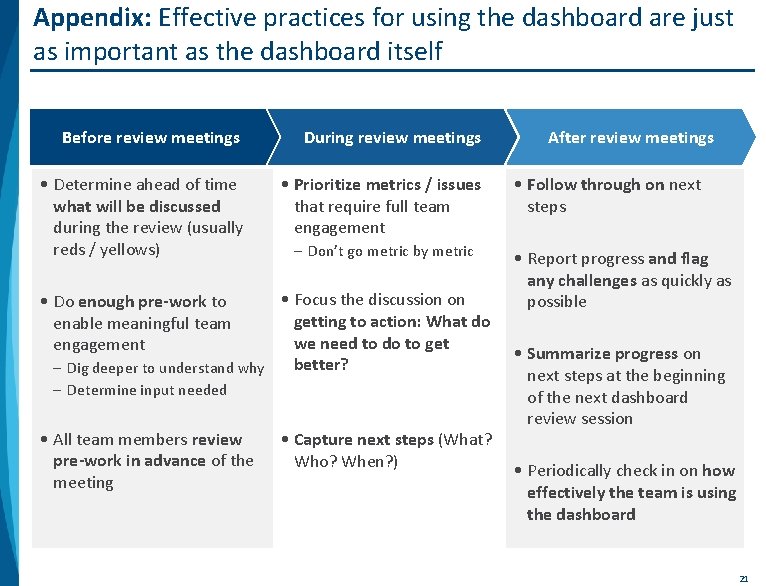
Appendix: Effective practices for using the dashboard are just as important as the dashboard itself Before review meetings During review meetings • Determine ahead of time what will be discussed during the review (usually reds / yellows) • Prioritize metrics / issues that require full team engagement – Don’t go metric by metric • Focus the discussion on getting to action: What do we need to do to get better? – Dig deeper to understand why • Do enough pre-work to enable meaningful team engagement – Determine input needed • All team members review pre-work in advance of the meeting • Capture next steps (What? Who? When? ) After review meetings • Follow through on next steps • Report progress and flag any challenges as quickly as possible • Summarize progress on next steps at the beginning of the next dashboard review session • Periodically check in on how effectively the team is using the dashboard 21