
Measuring and Calculating a k a Handling Numbers
Measuring and Calculating (a. k. a. – Handling Numbers in Science) All numbers have 3 characteristics which give them their complete meaning… 1. Value (how much? ) 2. Label (of what? ) 3. Precision (do we know it roughly or specifically? )
VALUE Scientists often need to express VERY large numbers (like the distances between galaxies) and VERY small numbers (like the diameter of a red blood cell). We can abbreviate these kinds of values using SCIENTIFIC NOTATION (a. k. a. “Sci Not” or Exponential Notation).
VALUE (continued) Three Goals for Sci-Not: Students will be able to; 1. Change; Regular Sci-Not (note: regular notation is also called decimal notation) 2. 3. Make simple Sci-Not Calculations w/out a calculator. Enter Sci-Not numbers into your calculator CORRECTLY!
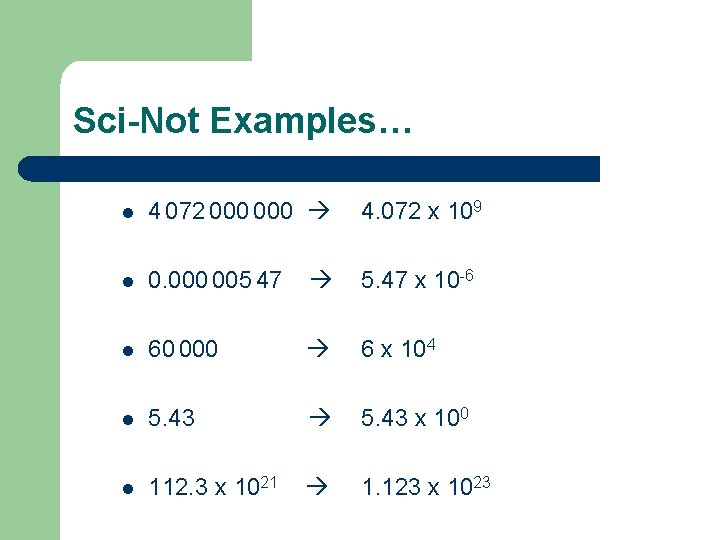
Sci-Not Examples… l 4 072 000 4. 072 x 109 l 0. 000 005 47 5. 47 x 10 -6 l 60 000 6 x 10⁴ l 5. 43 x 100 l 112. 3 x 10²¹ 1. 123 x 1023
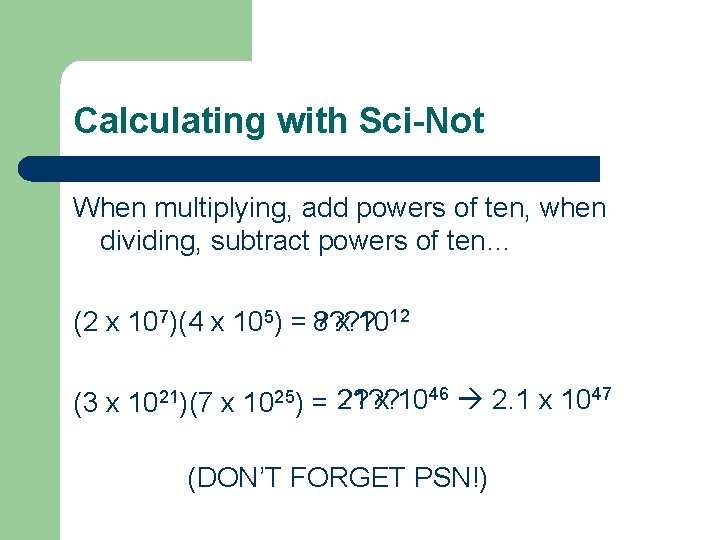
Calculating with Sci-Not When multiplying, add powers of ten, when dividing, subtract powers of ten… 8 x 10¹² (2 x 10⁷)(4 x 10⁵) = ? ? 21 x 1046 2. 1 x 1047 (3 x 10²¹)(7 x 1025) = ? ? (DON’T FORGET PSN!)
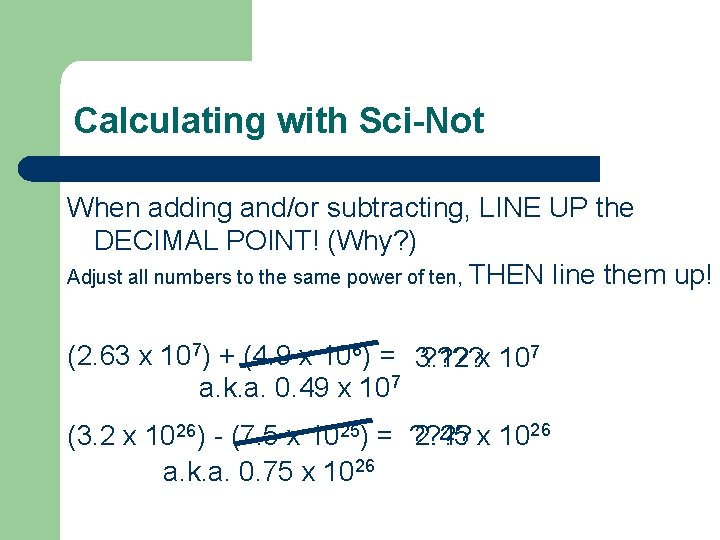
Calculating with Sci-Not When adding and/or subtracting, LINE UP the DECIMAL POINT! (Why? ) Adjust all numbers to the same power of ten, THEN line them up! (2. 63 x 107) + (4. 9 x 10⁶) = 3. 12 ? ? x 107 a. k. a. 0. 49 x 107 2. 45 x 1026 (3. 2 x 1026) - (7. 5 x 1025) = ? ? a. k. a. 0. 75 x 1026
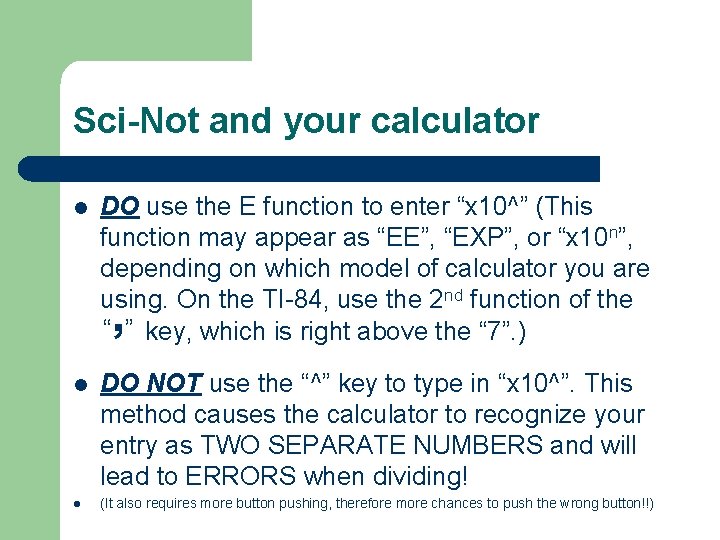
Sci-Not and your calculator l DO use the E function to enter “x 10^” (This function may appear as “EE”, “EXP”, or “x 10 n”, depending on which model of calculator you are using. On the TI-84, use the 2 nd function of the “ ” key, which is right above the “ 7”. ) , l l DO NOT use the “^” key to type in “x 10^”. This method causes the calculator to recognize your entry as TWO SEPARATE NUMBERS and will lead to ERRORS when dividing! (It also requires more button pushing, therefore more chances to push the wrong button!!)

INTRODUCING… CRAZY MIXED-UP UNITZ!!
Ratio of an igloo’s circumference to its diameter = Eskimo Pi (p)

2000 pounds of Chinese soup
One millionth of a mouthwash = One microscope
One million aches and pains = ONE MEGAHERTZ
2000 mockingbirds = Two kilomockingbirds
453. 6 Graham Crackers = 1 pound cake
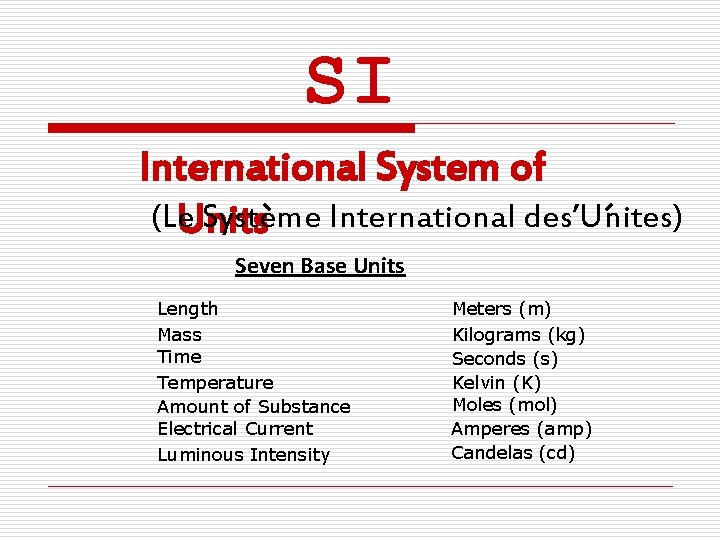
SI International System of (Le Systeme International des’Unites) Units Seven Base Units Length Mass Time Temperature Amount of Substance Electrical Current Luminous Intensity Meters (m) Kilograms (kg) Seconds (s) Kelvin (K) Moles (mol) Amperes (amp) Candelas (cd)
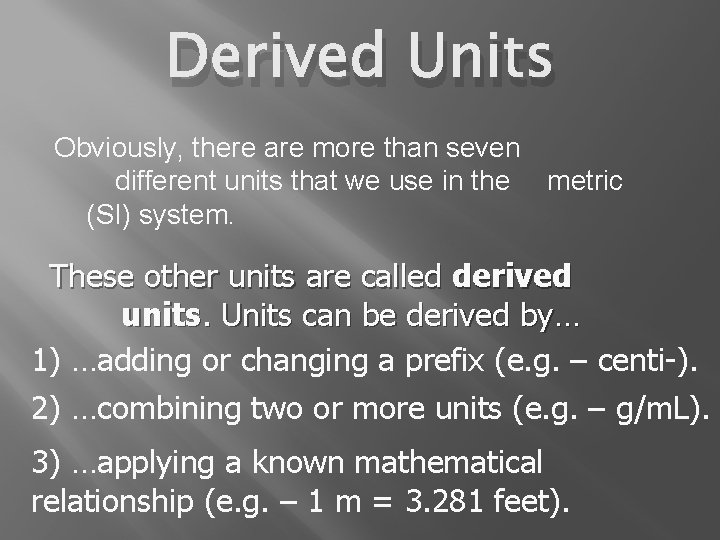
Derived Units Obviously, there are more than seven different units that we use in the metric (SI) system. These other units are called derived units. Units can be derived by… 1) …adding or changing a prefix (e. g. – centi-). 2) …combining two or more units (e. g. – g/m. L). 3) …applying a known mathematical relationship (e. g. – 1 m = 3. 281 feet).
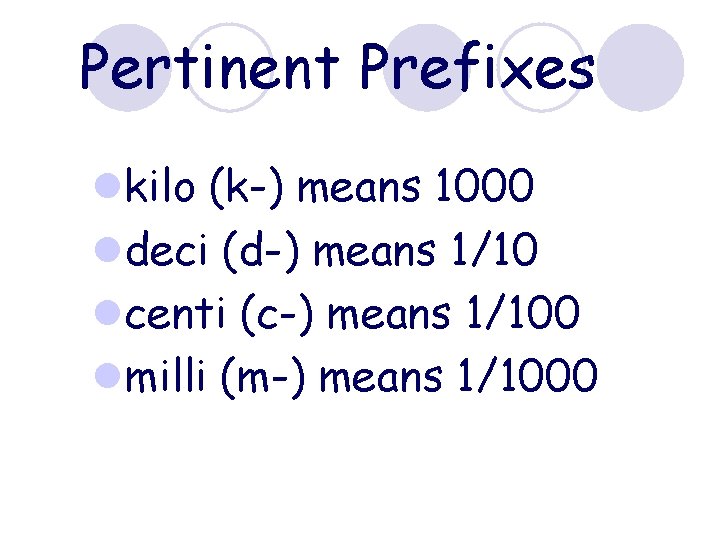
Pertinent Prefixes lkilo (k-) means 1000 ldeci (d-) means 1/10 lcenti (c-) means 1/100 lmilli (m-) means 1/1000
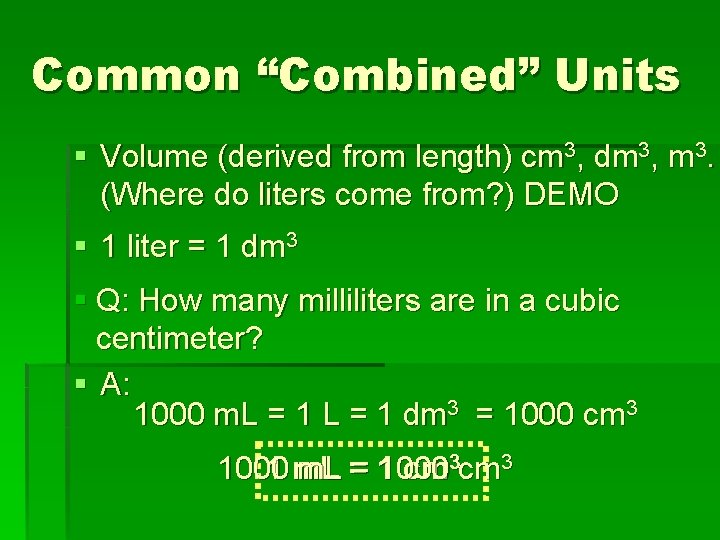
Common “Combined” Units § Volume (derived from length) cm 3, dm 3, m 3. (Where do liters come from? ) DEMO § 1 liter = 1 dm 3 § Q: How many milliliters are in a cubic centimeter? § A: 1000 m. L = 1 dm 3 = 1000 cm 3 1000 1 m. L = 11000 cm 3
Common “Combined” Units § Speed (mi/h, m/s, etc. , ) § Density (g/ml, g/cm 3, etc. , ) § Area (cm 2, etc. , ) § And various others we will encounter…
What about weight? ? Weight ≠ Mass! Mass is the amount of matter in an object. Weight is the downward force caused by an object. Which one would stay the same on the moon? A SCALE uses springs and measures WEIGHT. A BALANCE uses a fulcrum and measures MASS.
Other Derived Units… ► feet (3. 281 feet = 1 m) ► degrees celcius ( C = K -273) ► minutes (1 minute = 60 seconds) ► and many others we will encounter…
Converting Units n To help us convert units accurately and efficiently, we will learn about conversion factors and the factor label method.
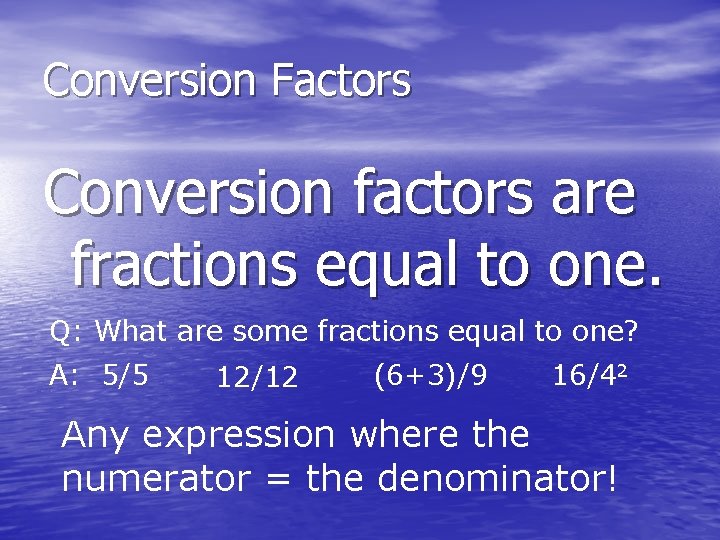
Conversion Factors Conversion factors are fractions equal to one. Q: What are some fractions equal to one? A: 5/5 12/12 (6+3)/9 16/42 Any expression where the numerator = the denominator!
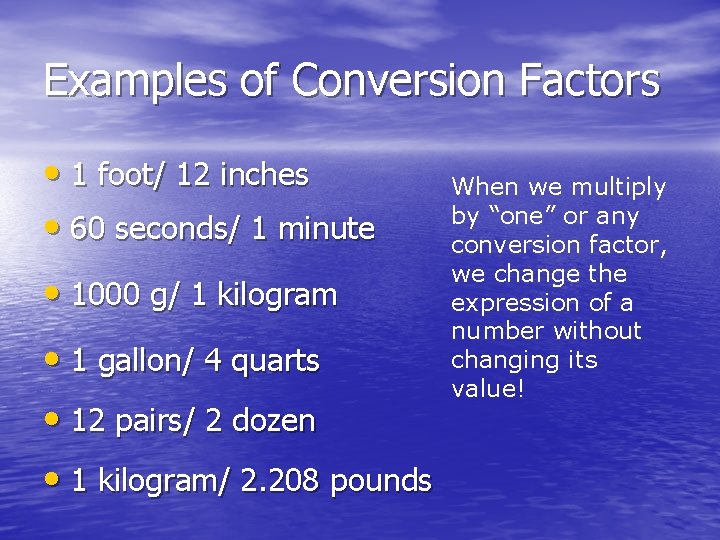
Examples of Conversion Factors • 1 foot/ 12 inches • 60 seconds/ 1 minute • 1000 g/ 1 kilogram • 1 gallon/ 4 quarts • 12 pairs/ 2 dozen • 1 kilogram/ 2. 208 pounds When we multiply by “one” or any conversion factor, we change the expression of a number without changing its value!
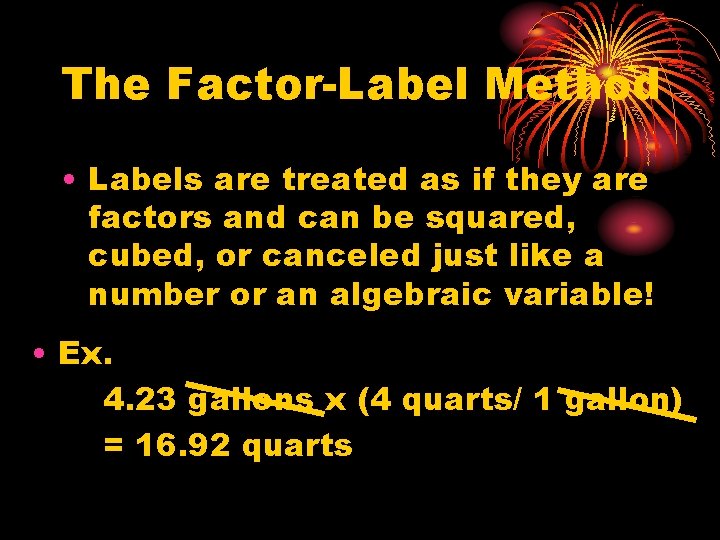
The Factor-Label Method • Labels are treated as if they are factors and can be squared, cubed, or canceled just like a number or an algebraic variable! • Ex. 4. 23 gallons x (4 quarts/ 1 gallon) = 16. 92 quarts
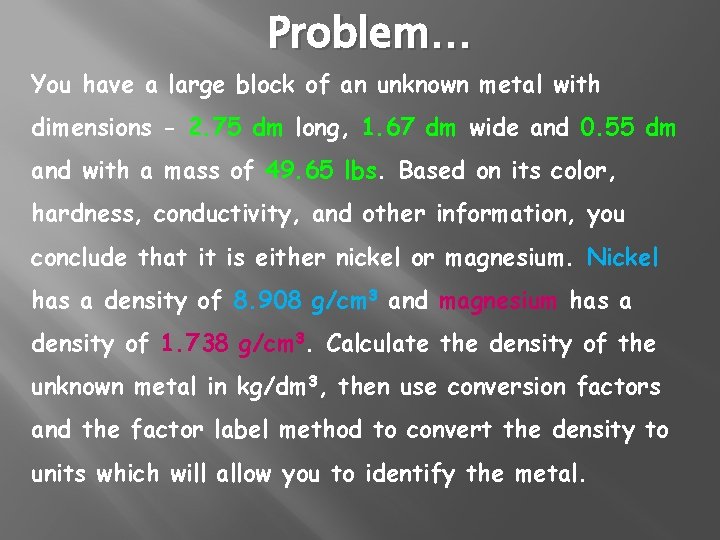
Problem… You have a large block of an unknown metal with dimensions - 2. 75 dm long, 1. 67 dm wide and 0. 55 dm and with a mass of 49. 65 lbs. Based on its color, hardness, conductivity, and other information, you conclude that it is either nickel or magnesium. Nickel has a density of 8. 908 g/cm 3 and magnesium has a density of 1. 738 g/cm 3. Calculate the density of the unknown metal in kg/dm 3, then use conversion factors and the factor label method to convert the density to units which will allow you to identify the metal.
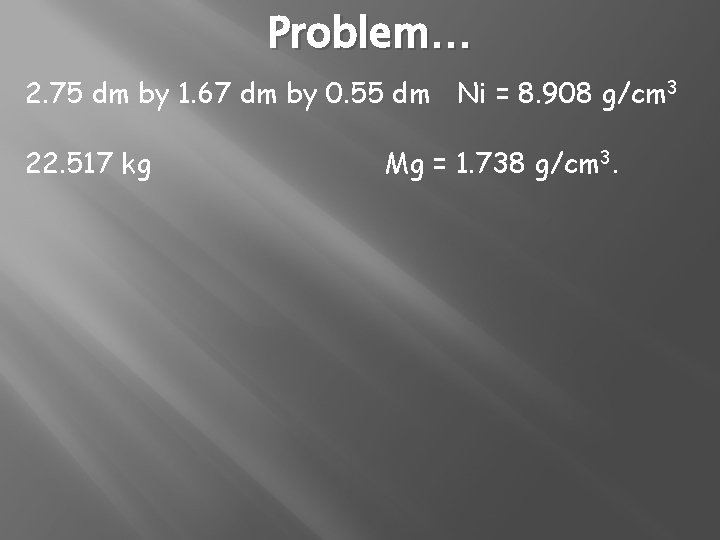
Problem… 2. 75 dm by 1. 67 dm by 0. 55 dm Ni = 8. 908 g/cm 3 22. 517 kg Mg = 1. 738 g/cm 3.
…Precision n Scientists use the concept of SIGNIFICANT FIGURES (Sig Figs) to indicate how precise their numbers are. A SIG FIG (a. k. a. -significant digit) is a digit that is measured or known with reasonable certainty. The sig figs in any number include all the digits we know for sure, plus one estimated digit.
Precision… n n …is NOT equal to accuracy! Accuracy is how close a number is to the actual value. Precision is the degree of detail to which we know a number. If an object has a mass of 5. 16 g and student A measures 5. 2 g and student B measures 4. 98 g, which one is more precise? Which one is more accurate?
SIG FIGS Three Goals for Sig Figs… 1. Measure with the correct precision. (Read between the lines!) 2. 3. Recognize sig figs in recorded numbers. Round off answers to calculations to the correct degree of precision.
Sig Figs and Measurement PRECISION PRINCIPLE…READ BETWEEN THE LINES!!!!! (Need I say any more? We learned this in the intro to lab unit!)
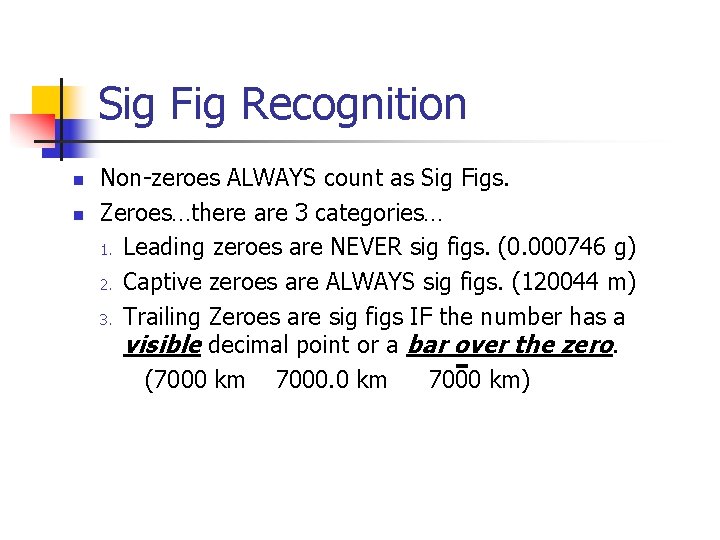
Sig Fig Recognition n n Non-zeroes ALWAYS count as Sig Figs. Zeroes…there are 3 categories… 1. Leading zeroes are NEVER sig figs. (0. 000746 g) 2. Captive zeroes are ALWAYS sig figs. (120044 m) 3. Trailing Zeroes are sig figs IF the number has a visible decimal point or a bar over the zero. (7000 km)
Sig Fig Recognition n Exact numbers have infinite sig figs. There is NO SUCH THING as an exact measurement, but numbers which are counted or defined have unlimited precision. 25 students, 47 cars, 13 paper clips 1 h = 60 min, 1 ft = 12 in, 1000 g = 1 kg
Sig Figs and Sci-Not n Numbers in scientific notation do not need placeholders, so ALL digits are sig figs.
Sig Figs n n n Significant does NOT mean important in this context! It means “known with reasonable certainty”. Place-holders are important, but they are NOT necessarily sig figs.
Sig Figs & Calculating n There are TWO rules for rounding off answers to calculations, but more importantly there is ONE principle to keep in mind… AN ANSWER CAN NEVER BE MORE PRECISE THAN THE NUMBERS YOU USE TO CALCULATE THE ANSWER!
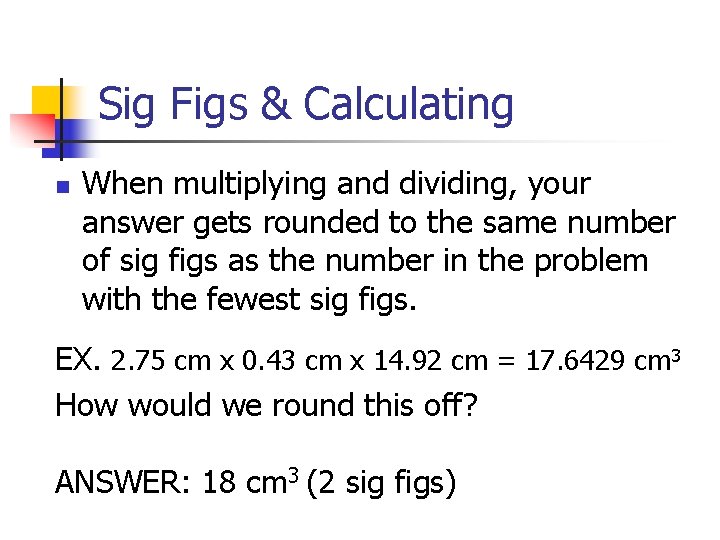
Sig Figs & Calculating n When multiplying and dividing, your answer gets rounded to the same number of sig figs as the number in the problem with the fewest sig figs. EX. 2. 75 cm x 0. 43 cm x 14. 92 cm = 17. 6429 cm 3 How would we round this off? ANSWER: 18 cm 3 (2 sig figs)
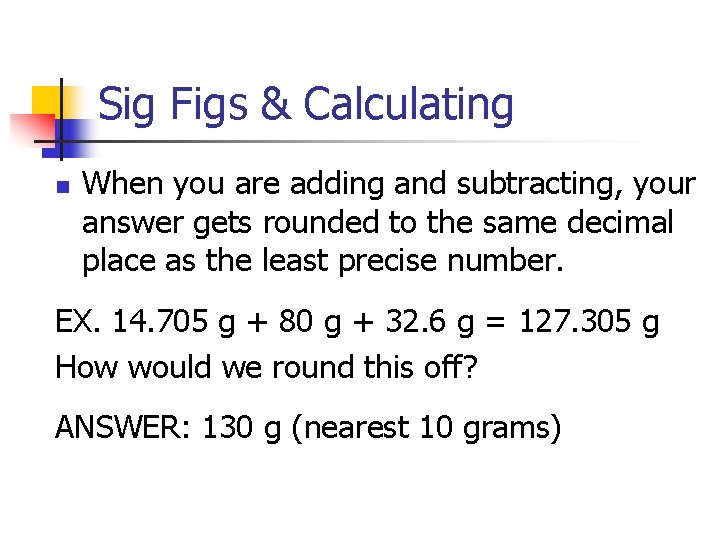
Sig Figs & Calculating n When you are adding and subtracting, your answer gets rounded to the same decimal place as the least precise number. EX. 14. 705 g + 80 g + 32. 6 g = 127. 305 g How would we round this off? ANSWER: 130 g (nearest 10 grams)
Sig Figs & Calculating n n Remember that when multiplying and dividing, the question is HOW MANY SIG FIGS SHOULD MY ANSWER HAVE? But… When adding and subtracting, the question is WHERE DO I ROUND OFF? (Which decimal place. )
SIG FIGS QUIZ n n Part I – Know the Definition (a digit which is measured or known with reasonable certainty. ) Part II – Measuring (Precision Principle) Part III – SF Identification (Counting) Part IV – Rounding Calculations
- Slides: 40