
Measuring Adaptive Behaviour in a Retail Planning Context
Measuring Adaptive Behaviour in a Retail Planning Context; A Multi-Stakeholder Conjoint Measurement Experiment Ingrid Janssen Co-authors: Aloys Borgers & Harry Timmermans June 2010
Agenda ¢ ¢ Introduction l Retail planning in the Netherlands l Multi-actor decision making Approach l l l ¢ ¢ ¢ 2 Online conjoint experiment Multiple stakeholders Choice modelling Model specification Results Conclusion
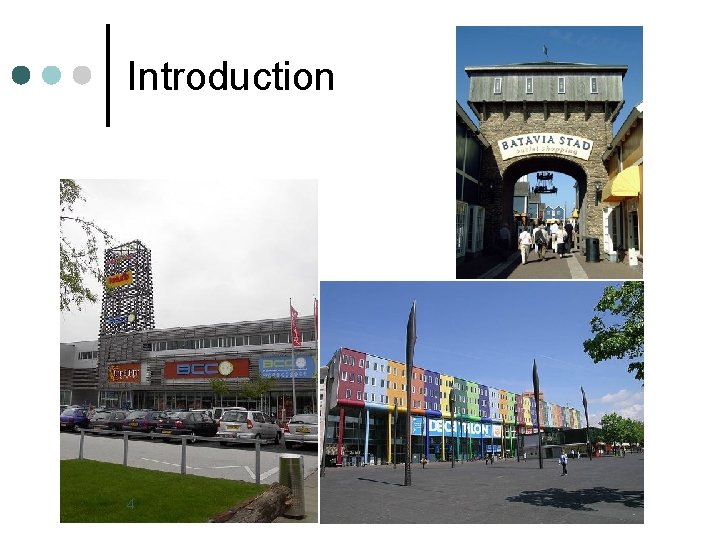
Introduction Retail planning: Multi-Stakeholder decision making ¢ Planning philosophy: From plan-driven to market-driven ¢ Introduction “Nota Ruimte”: l Development planning l No strict rules for new out-of-town retail locations l Responsibility planning decisions delegated to local governments l Regional governments have a steering role ¢ Dominant retail development industry 3
Introduction 4
Introduction Retail planning in the Netherlands: à Retail planning nowadays is a result of negotiations between multiple actors 1. Developers 2. Retailers 3. Local governments à To understand the behavioral aspects underlying (retail) planning decisions there is a need for multi-actor approaches. à Focus: adaptive behavior 5
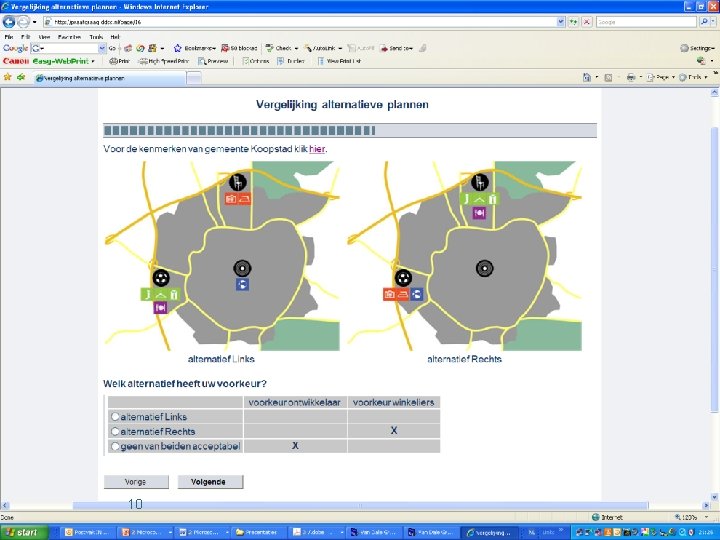
Approach ¢ ¢ ¢ 6 Suitable approach: A conjoint experiment in combination with choice modelling Experiment: deciding on the expansion of retail supply in an imaginary city. Three stakeholders involved: developers, local governments, retailers. How: conjoint analysis. l Alternatives are pre-specified References: l Borgers & Timmermans (1993) -> household decisions l Hensher et. al. (2007) -> freight distribution decisions
Research objectives The aim of the experiment is… ¢ …to understand the preferences of different stakeholder groups regarding the planning of out-of-town retail facilities. ¢ …to measure adaptive behaviour between agents involved in retail planning, as one of the behavioural aspects. 7
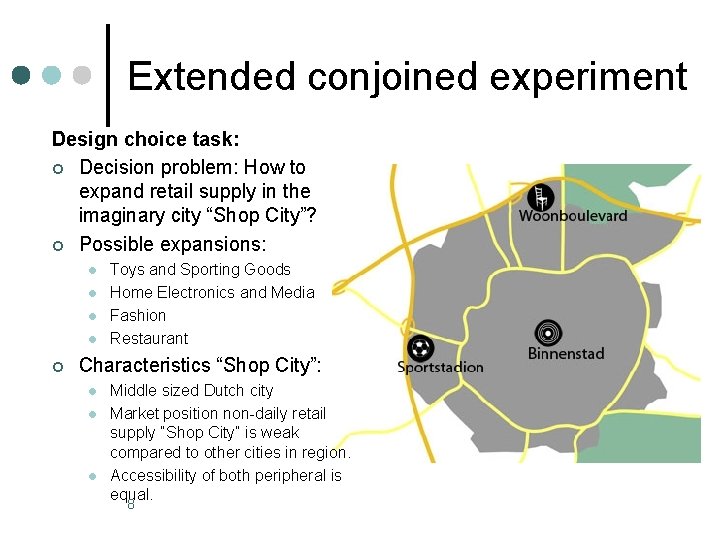
Extended conjoined experiment Design choice task: ¢ Decision problem: How to expand retail supply in the imaginary city “Shop City”? ¢ Possible expansions: l l ¢ Toys and Sporting Goods Home Electronics and Media Fashion Restaurant Characteristics “Shop City”: l l l Middle sized Dutch city Market position non-daily retail supply “Shop City” is weak compared to other cities in region. Accessibility of both peripheral is equal. 8
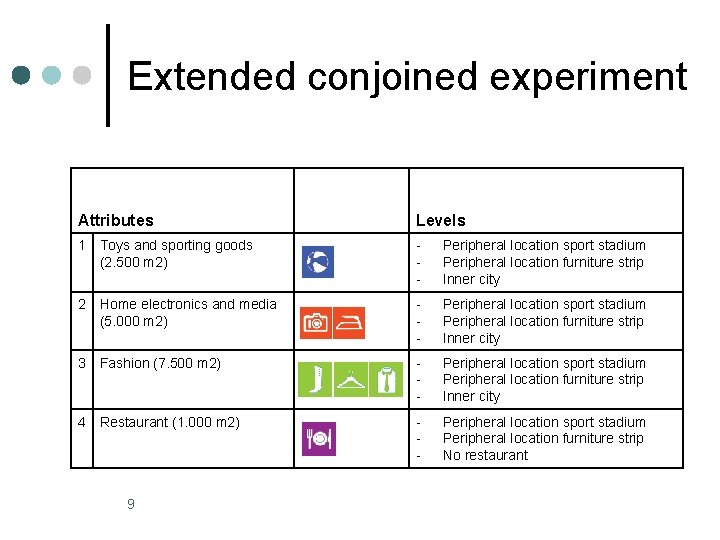
Extended conjoined experiment Attributes Levels 1 Toys and sporting goods (2. 500 m 2) - Peripheral location sport stadium Peripheral location furniture strip Inner city 2 Home electronics and media (5. 000 m 2) - Peripheral location sport stadium Peripheral location furniture strip Inner city 3 Fashion (7. 500 m 2) - Peripheral location sport stadium Peripheral location furniture strip Inner city 4 Restaurant (1. 000 m 2) - Peripheral location sport stadium Peripheral location furniture strip No restaurant 9
Research approach (part II) 10
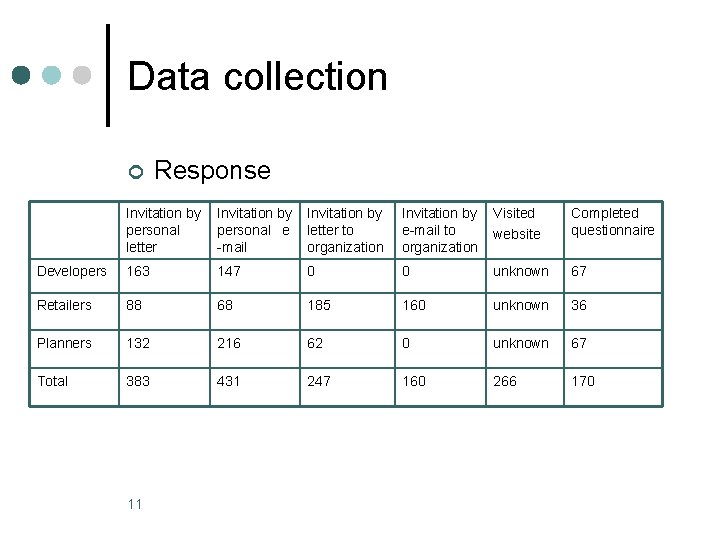
Data collection ¢ Response Invitation by personal letter Invitation by personal e -mail Invitation by letter to organization Invitation by e-mail to organization Visited website Completed questionnaire Developers 163 147 0 0 unknown 67 Retailers 88 68 185 160 unknown 36 Planners 132 216 62 0 unknown 67 Total 383 431 247 160 266 170 11
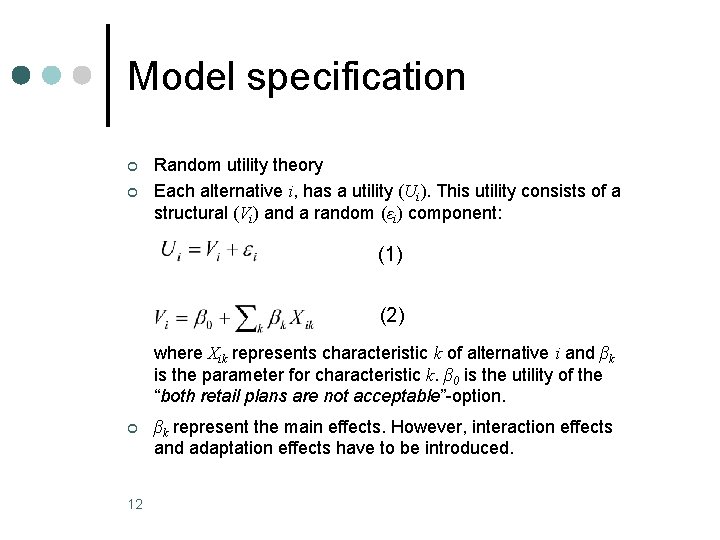
Model specification ¢ ¢ Random utility theory Each alternative i, has a utility (Ui). This utility consists of a structural (Vi) and a random (εi) component: (1) (2) where Xik represents characteristic k of alternative i and βk is the parameter for characteristic k. β 0 is the utility of the “both retail plans are not acceptable”-option. ¢ 12 βk represent the main effects. However, interaction effects and adaptation effects have to be introduced.
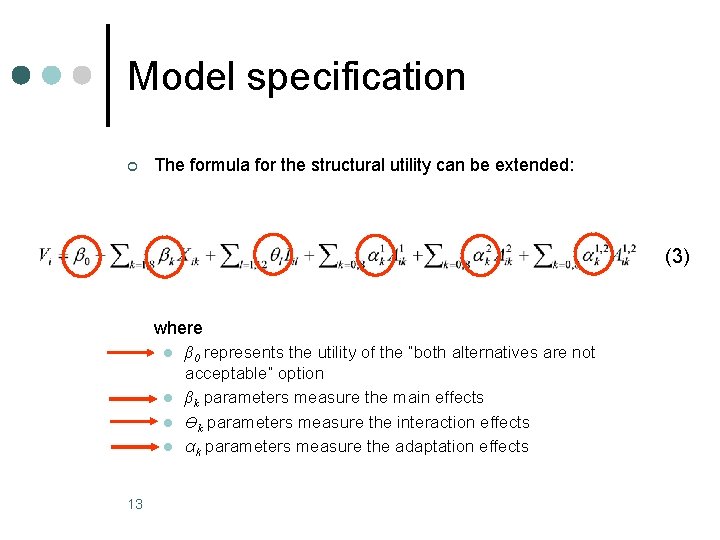
Model specification ¢ The formula for the structural utility can be extended: (3) where l l 13 β 0 represents the utility of the “both alternatives are not acceptable” option βk parameters measure the main effects Өk parameters measure the interaction effects αk parameters measure the adaptation effects
Model estimation ¢ ¢ ¢ 14 Multinimial Logit models were estimated using maximum likelihood procedures. Only parameters at the 5% significance level were included. For each stakeholder group (developer, retailer, planner) separate models were estimated.
Estimated parameters MNL-model 15
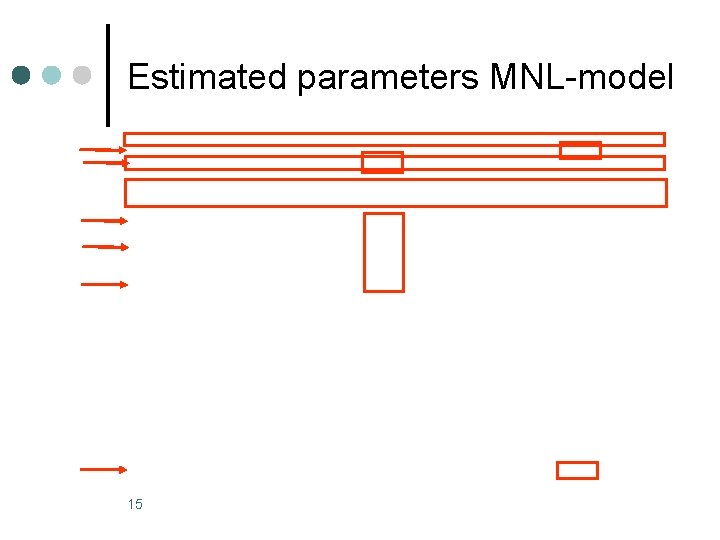
Findings ¢ ¢ ¢ ¢ 16 All stakeholders do not prefer to locate fashion on a peripheral retail location. Since X 0 is significant but negative for all stakeholders, respondents are really willing to make a choice. Different type of interaction variables are of significant importance. Developer is most willing to adapt his preference to the opinion of other stakeholders. The retailer is the least sensitive for the opinion of other stakeholders Planners’ utility of the location of toys&sport on a furniture strip turns positive when both other stakeholders are in favour. Goodness-of-fit (Rho 2) is satisfying for developers and planners.
Conclusions ¢ ¢ 17 The experiment showed that adaptive behaviour in retail planning decision plays an important role. By extending the traditional random utility model with parameters that measure adaptive behaviour, this behavioural aspect can be incorporated. Applying Mixed Logit models will lead to even more valid models (the Rho 2 will increase). Further research: estimating for heterogeneity within each group of stakeholders based on respondent characteristics.
- Slides: 17