
Measures of effect relative risks odds ratios risk

- Slides: 9
Measures of effect: relative risks, odds ratios, risk difference and “number needed to treat” • • Giovanni Tripepi, Kitty J. Jager 1, Friedo W. Dekker 1, 2, Christoph Wanner 3, Carmine Zoccali • CNR-IBIM, Clinical Epidemiology and Physiopathology of Renal Diseases and Hypertension of Reggio Calabria, Italy 1 ERA–EDTA Registry, Department of Medical Informatics, Academic Medical Center, University of Amsterdam, The Netherlands. 2 Department of Clinical Epidemiology, Leiden University Medical Centre, Leiden, The Netherlands 3 University of Würzburg, Division of Nephrology, University Clinic, Würzburg, Germany • • Kidney International: Series on epidemiology
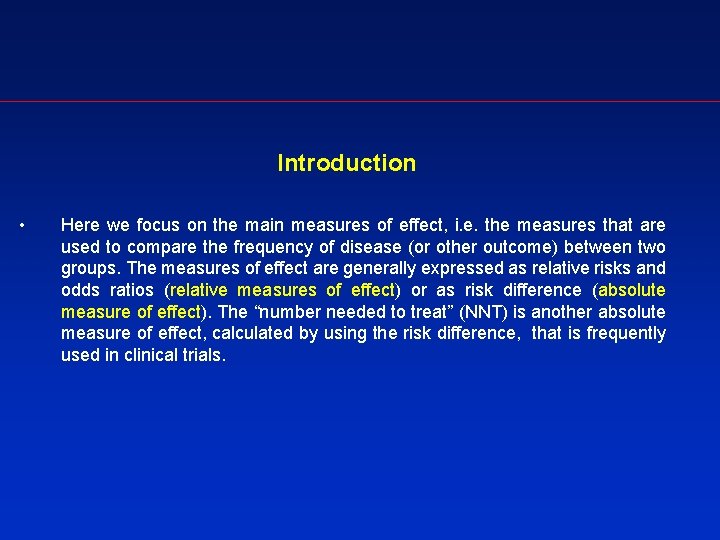
Introduction • Here we focus on the main measures of effect, i. e. the measures that are used to compare the frequency of disease (or other outcome) between two groups. The measures of effect are generally expressed as relative risks and odds ratios (relative measures of effect) or as risk difference (absolute measure of effect). The “number needed to treat” (NNT) is another absolute measure of effect, calculated by using the risk difference, that is frequently used in clinical trials.
Relative measures of effect • The relative risk can be calculated as ratio between two incidence proportions (risk ratio, see Example 1) or two incidence rates (incidence ratio, see Example 2). Example 1 (Risk Ratio) In the randomized prospective Heart Outcomes Prevention Evaluation (HOPE) study (1) the effect of Ramipril on the risk of cardiovascular (CV) events was investigated by calculating the ratio between the incidence proportions of CV events in Ramipril treated and in placebo treated patients. With CV events Without CV events Ramipril group (n=4645) 651 3994 Placebo group (n=4652) 826 3826 - Proportion of patients with CV events in the Ramipril group: 651/ 4645=0. 14 (14%). - Proportion of patients with CV events in the placebo group : 826/ 4652=0. 18 (18%). The risk ratio is: 0. 14/0. 18= 0. 78 The Heart Outcomes Prevention Evaluation Study Investigators. Effects of an angiotensin-converting-enzyme inhibitor, ramipril, on cardiovascular events in high-risk patients. N Engl J Med 2000; 342: 145 -153 1
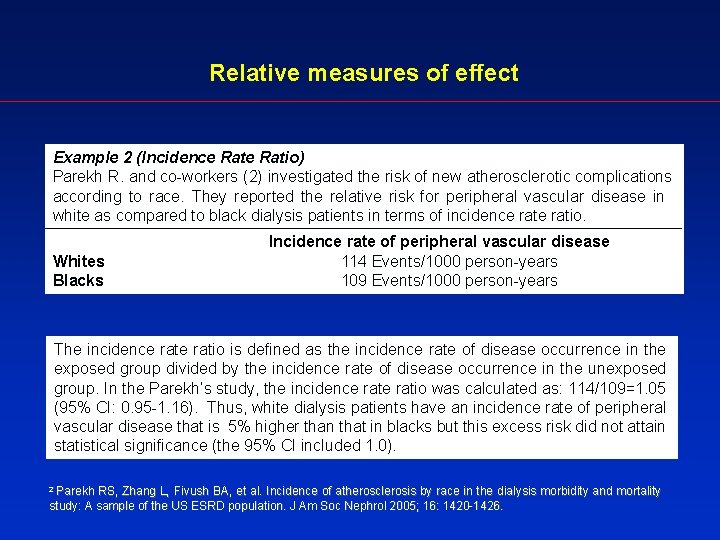
Relative measures of effect Example 2 (Incidence Ratio) Parekh R. and co-workers (2) investigated the risk of new atherosclerotic complications according to race. They reported the relative risk for peripheral vascular disease in white as compared to black dialysis patients in terms of incidence ratio. Whites Blacks Incidence rate of peripheral vascular disease 114 Events/1000 person-years 109 Events/1000 person-years The incidence ratio is defined as the incidence rate of disease occurrence in the exposed group divided by the incidence rate of disease occurrence in the unexposed group. In the Parekh’s study, the incidence ratio was calculated as: 114/109=1. 05 (95% CI: 0. 95 -1. 16). Thus, white dialysis patients have an incidence rate of peripheral vascular disease that is 5% higher than that in blacks but this excess risk did not attain statistical significance (the 95% CI included 1. 0). Parekh RS, Zhang L, Fivush BA, et al. Incidence of atherosclerosis by race in the dialysis morbidity and mortality study: A sample of the US ESRD population. J Am Soc Nephrol 2005; 16: 1420 -1426. 2
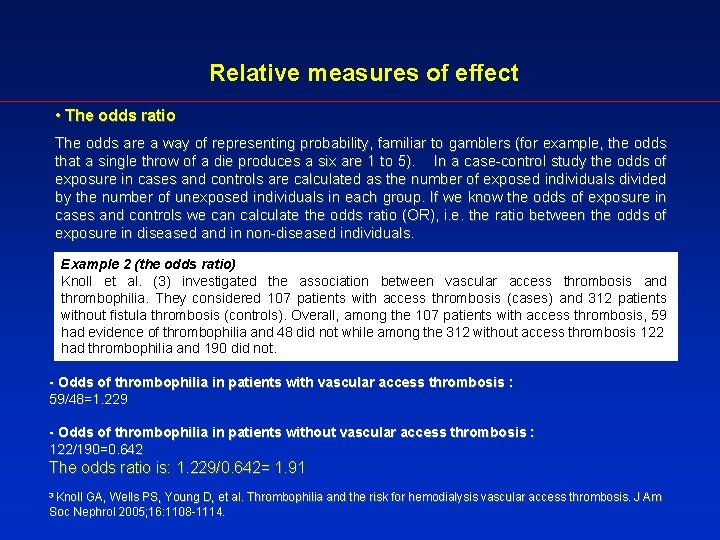
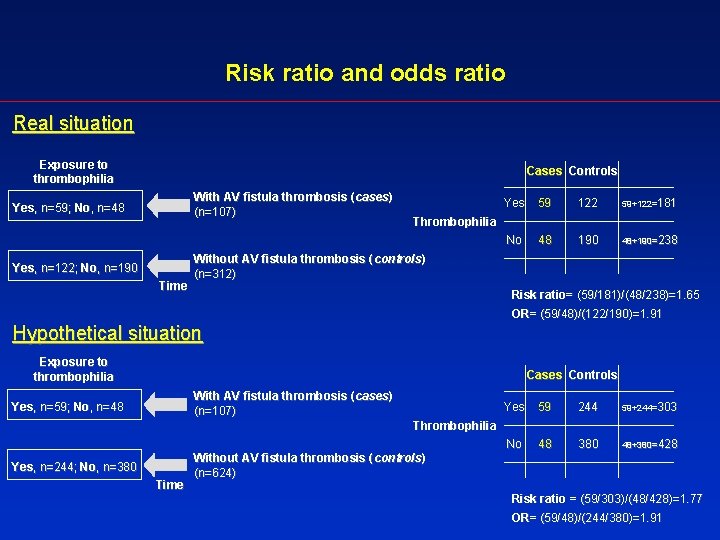
Relative measures of effect • The odds ratio The odds are a way of representing probability, familiar to gamblers (for example, the odds that a single throw of a die produces a six are 1 to 5). In a case-control study the odds of exposure in cases and controls are calculated as the number of exposed individuals divided by the number of unexposed individuals in each group. If we know the odds of exposure in cases and controls we can calculate the odds ratio (OR), i. e. the ratio between the odds of exposure in diseased and in non-diseased individuals. Example 2 (the odds ratio) Knoll et al. (3) investigated the association between vascular access thrombosis and thrombophilia. They considered 107 patients with access thrombosis (cases) and 312 patients without fistula thrombosis (controls). Overall, among the 107 patients with access thrombosis, 59 had evidence of thrombophilia and 48 did not while among the 312 without access thrombosis 122 had thrombophilia and 190 did not. - Odds of thrombophilia in patients with vascular access thrombosis : 59/48=1. 229 - Odds of thrombophilia in patients without vascular access thrombosis : 122/190=0. 642 The odds ratio is: 1. 229/0. 642= 1. 91 3 Knoll GA, Wells PS, Young D, et al. Thrombophilia and the risk for hemodialysis vascular access thrombosis. J Am Soc Nephrol 2005; 16: 1108 -1114.
Risk ratio and odds ratio Real situation Exposure to thrombophilia Cases Controls With AV fistula thrombosis (cases)) (n=107) Yes, n=59; No, n=48 Yes, n=122; No, n=190 Time Yes 59 122 59+122=181 No 48 190 48+190=238 Thrombophilia Without AV fistula thrombosis (controls)) (n=312) Risk ratio= (59/181)/(48/238)=1. 65 OR= (59/48)/(122/190)=1. 91 Hypothetical situation Exposure to thrombophilia Cases Controls With AV fistula thrombosis (cases)) (n=107) Yes, n=59; No, n=48 Yes 59 244 59+244=303 No 48 380 48+380=428 Thrombophilia Yes, n=244; No, n=380 Time Without AV fistula thrombosis (controls)) (n=624) Risk ratio = (59/303)/(48/428)=1. 77 OR= (59/48)/(244/380)=1. 91
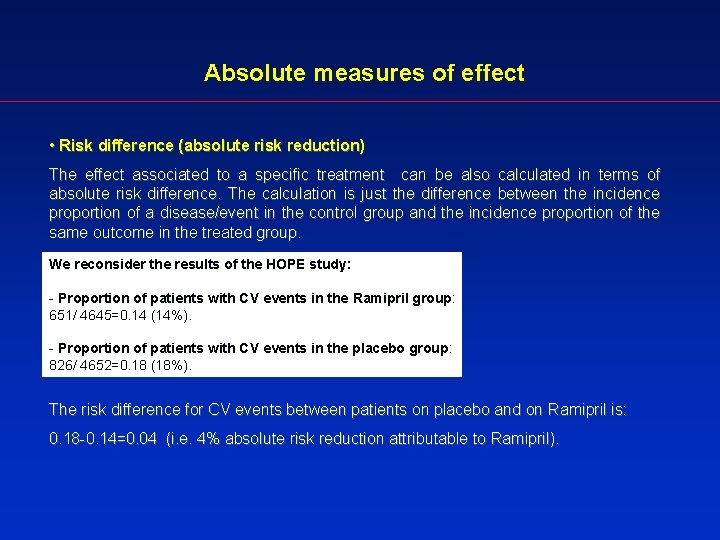
Absolute measures of effect • Risk difference (absolute risk reduction) The effect associated to a specific treatment can be also calculated in terms of absolute risk difference. The calculation is just the difference between the incidence proportion of a disease/event in the control group and the incidence proportion of the same outcome in the treated group. We reconsider the results of the HOPE study: - Proportion of patients with CV events in the Ramipril group: 651/ 4645=0. 14 (14%). - Proportion of patients with CV events in the placebo group: 826/ 4652=0. 18 (18%). The risk difference for CV events between patients on placebo and on Ramipril is: 0. 18 -0. 14=0. 04 (i. e. 4% absolute risk reduction attributable to Ramipril).
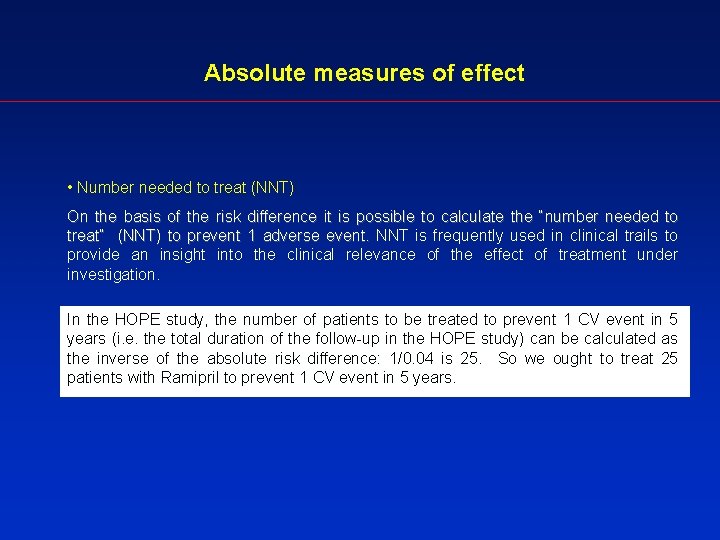
Absolute measures of effect • Number needed to treat (NNT) On the basis of the risk difference it is possible to calculate the “number needed to treat” (NNT) to prevent 1 adverse event. NNT is frequently used in clinical trails to provide an insight into the clinical relevance of the effect of treatment under investigation. In the HOPE study, the number of patients to be treated to prevent 1 CV event in 5 years (i. e. the total duration of the follow-up in the HOPE study) can be calculated as the inverse of the absolute risk difference: 1/0. 04 is 25. So we ought to treat 25 patients with Ramipril to prevent 1 CV event in 5 years.
Conclusions • To estimate the magnitude of the association between exposure and outcomes we can use relative and absolute measures of effect. Relative measures of effect are: risk ratio (i. e. the ratio between two incidence proportions), incidence ratio (the ratio between two incidence rates) and odds ratio (the ratio between two odds). • The risk difference is an absolute measure of effect (i. e. the risk of the outcome in exposed individuals minus the risk of the same outcome in unexposed). The risk difference is frequently used in clinical trials to calculate the “number needed to treat” (NNT), i. e. the number of individuals that is needed to treat to prevent 1 adverse event in a given time period.