
Measures of Dispersion The Standard Normal Distribution 91306
Measures of Dispersion & The Standard Normal Distribution 9/13/06
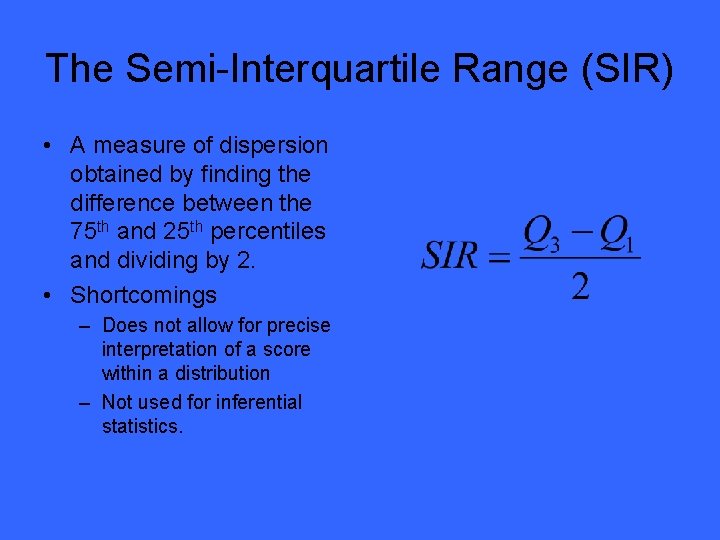
The Semi-Interquartile Range (SIR) • A measure of dispersion obtained by finding the difference between the 75 th and 25 th percentiles and dividing by 2. • Shortcomings – Does not allow for precise interpretation of a score within a distribution – Not used for inferential statistics.
Calculate the SIR 6, 7, 8, 9, 9, 9, 10, 11, 12 • Remember the steps for finding quartiles – First, order the scores from least to greatest. – Second, Add 1 to the sample size. – Third, Multiply sample size by percentile to find location. – Q 1 = (10 + 1) *. 25 – Q 2 = (10 + 1) *. 50 – Q 3 = (10 + 1) *. 75 » If the value obtained is a fraction take the average of the two adjacent X values.
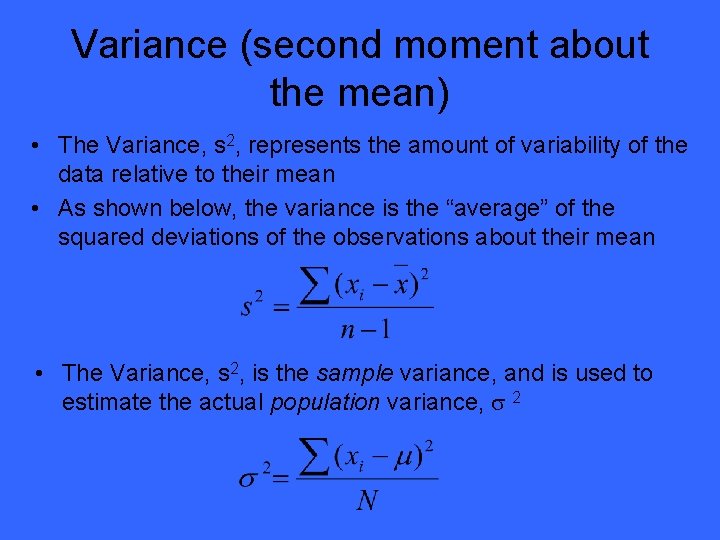
Variance (second moment about the mean) • The Variance, s 2, represents the amount of variability of the data relative to their mean • As shown below, the variance is the “average” of the squared deviations of the observations about their mean • The Variance, s 2, is the sample variance, and is used to estimate the actual population variance, s 2
Standard Deviation • Considered the most useful index of variability. • It is a single number that represents the spread of a distribution. • If a distribution is normal, then the mean plus or minus 3 SD will encompass about 99% of all scores in the distribution.
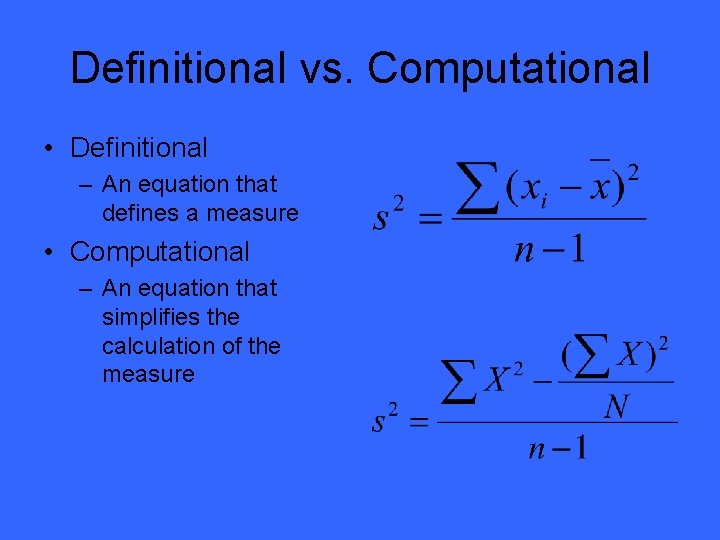
Definitional vs. Computational • Definitional – An equation that defines a measure • Computational – An equation that simplifies the calculation of the measure
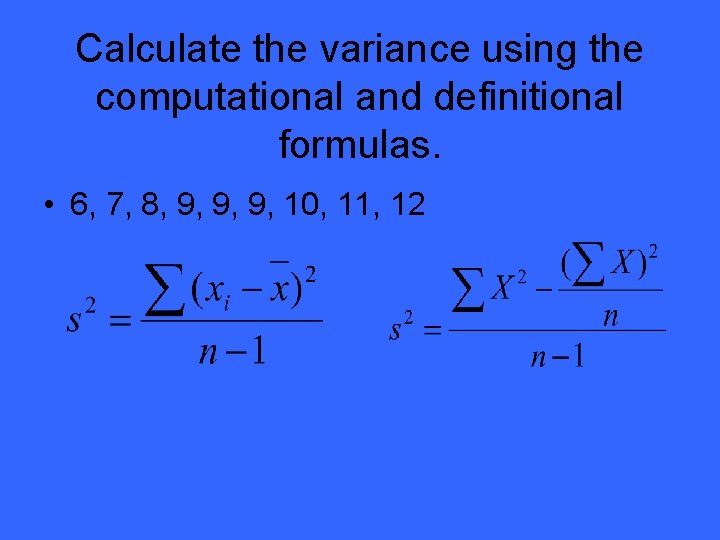
Calculate the variance using the computational and definitional formulas. • 6, 7, 8, 9, 9, 9, 10, 11, 12
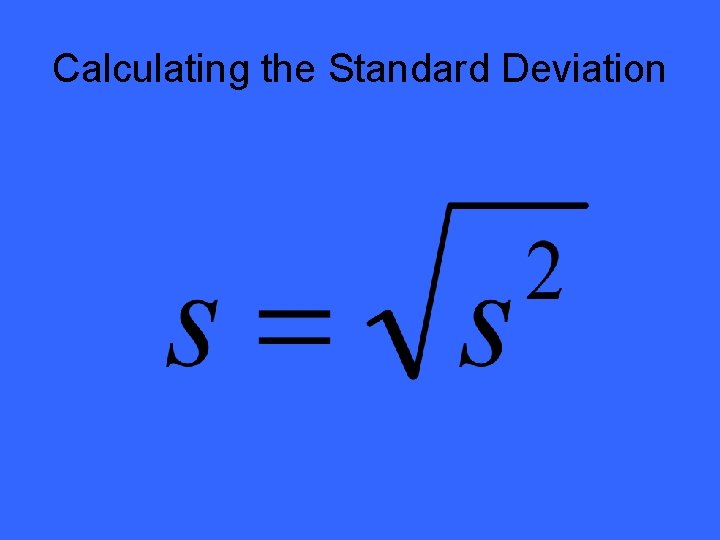
Calculating the Standard Deviation
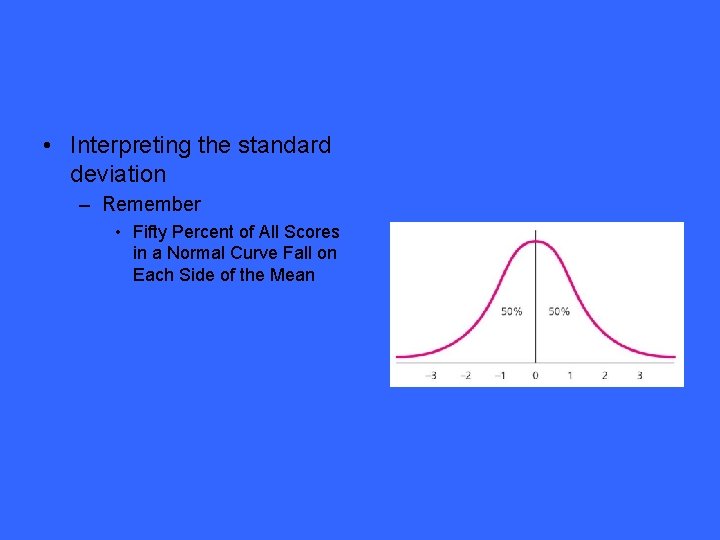
• Interpreting the standard deviation – Remember • Fifty Percent of All Scores in a Normal Curve Fall on Each Side of the Mean
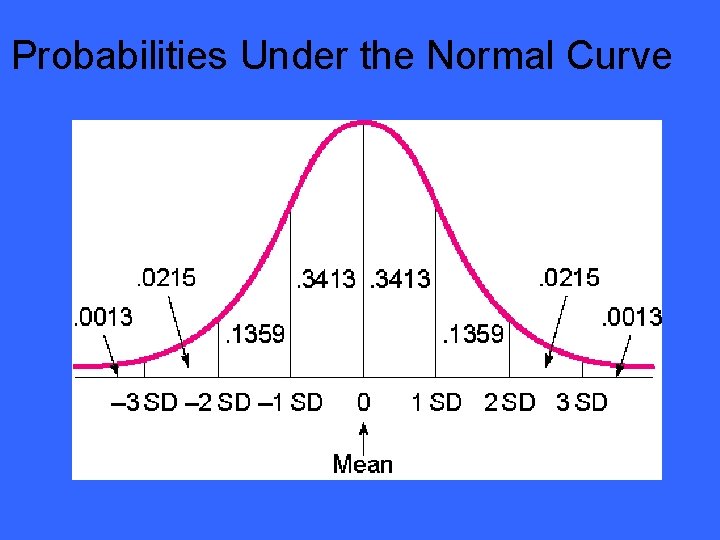
Probabilities Under the Normal Curve
With our previous scores • What score is one standard deviation above the mean? – Two standard deviations? – Three standard deviations? • What score is one standard deviation below the mean? – Two standard deviations? – Three standard deviations?
Interpreting the standard deviation • We can compare the standard deviations of different samples to determine which has the greatest dispersion. – Example • A spelling test given to third-grader children 10, 12, 12, 13, 14 xbar = 12. 28 s = 1. 25 • The same test given to second- through fourthgrade children. 2, 8, 9, 11, 15, 17, 20 xbar = 11. 71 s = 6. 10
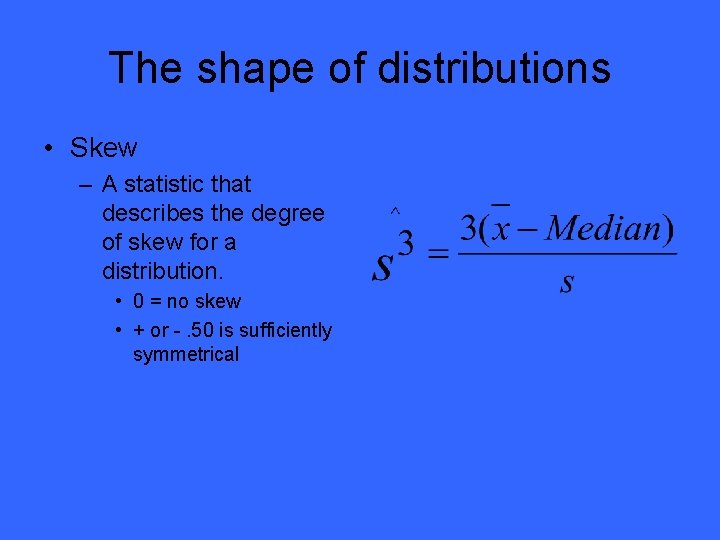
The shape of distributions • Skew – A statistic that describes the degree of skew for a distribution. • 0 = no skew • + or -. 50 is sufficiently symmetrical

Kurtosis • Mesokurtic (normal) – Around 3. 00 • Platykurtic (flat) – Less than 3. 00 • Leptokurtic (peaked) – Greater than 3. 00
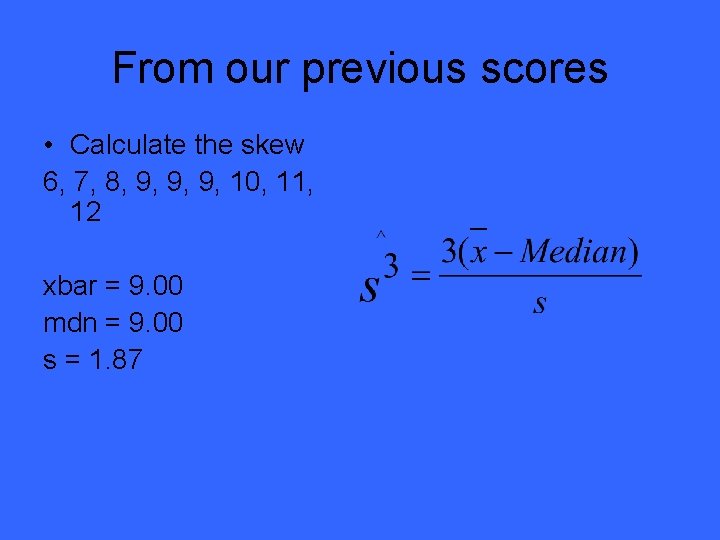
From our previous scores • Calculate the skew 6, 7, 8, 9, 9, 9, 10, 11, 12 xbar = 9. 00 mdn = 9. 00 s = 1. 87
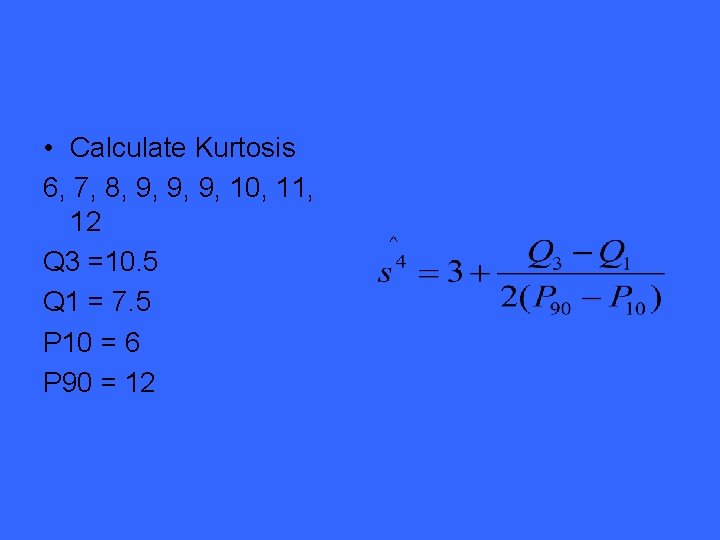
• Calculate Kurtosis 6, 7, 8, 9, 9, 9, 10, 11, 12 Q 3 =10. 5 Q 1 = 7. 5 P 10 = 6 P 90 = 12
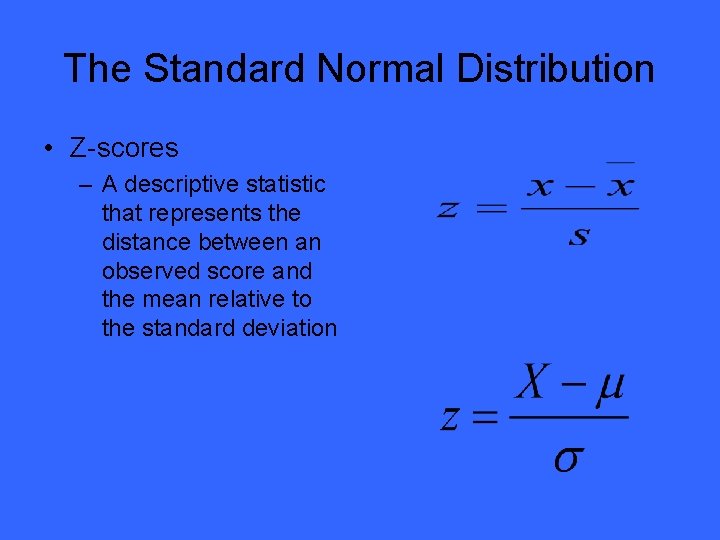
The Standard Normal Distribution • Z-scores – A descriptive statistic that represents the distance between an observed score and the mean relative to the standard deviation
Standard Normal Distribution • Z-scores – Convert and distribution to: • Have a mean = 0 • Have standard deviation = 1 – However, if the parent distribution is not normal the calculated z-scores will not be normally distributed.
Why do we calculate z-scores? • To compare two different measures – e. g. , Math score to reading score, weight to height. – Area under the curve • Can be used to calculate what proportion of scores are between different scores or to calculate what proportion of scores are greater than or less than a particular score.
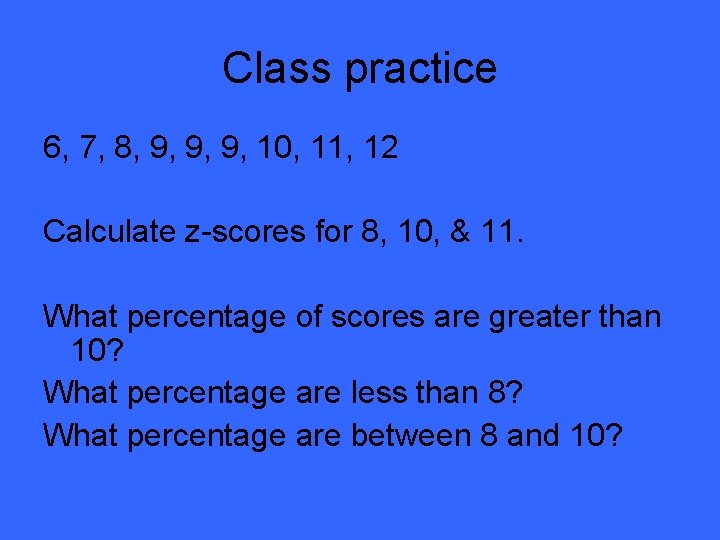
Class practice 6, 7, 8, 9, 9, 9, 10, 11, 12 Calculate z-scores for 8, 10, & 11. What percentage of scores are greater than 10? What percentage are less than 8? What percentage are between 8 and 10?
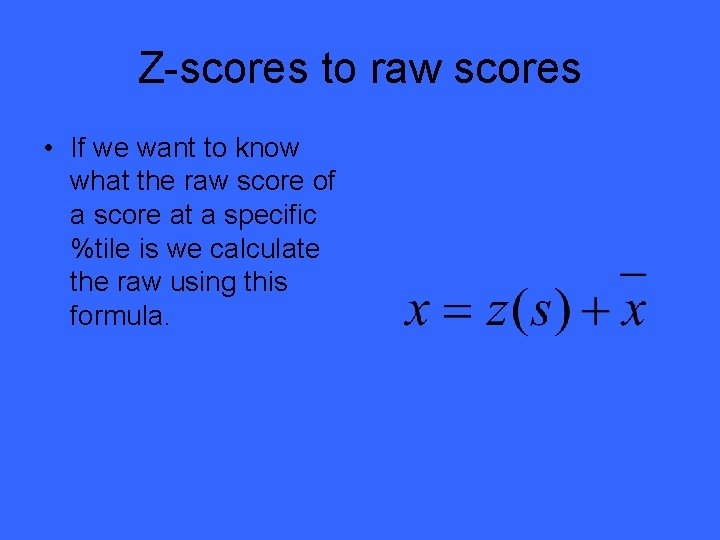
Z-scores to raw scores • If we want to know what the raw score of a score at a specific %tile is we calculate the raw using this formula.
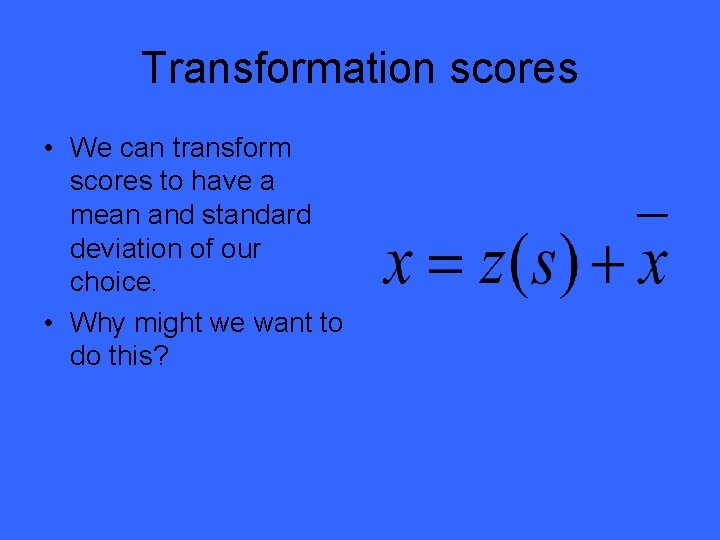
Transformation scores • We can transform scores to have a mean and standard deviation of our choice. • Why might we want to do this?
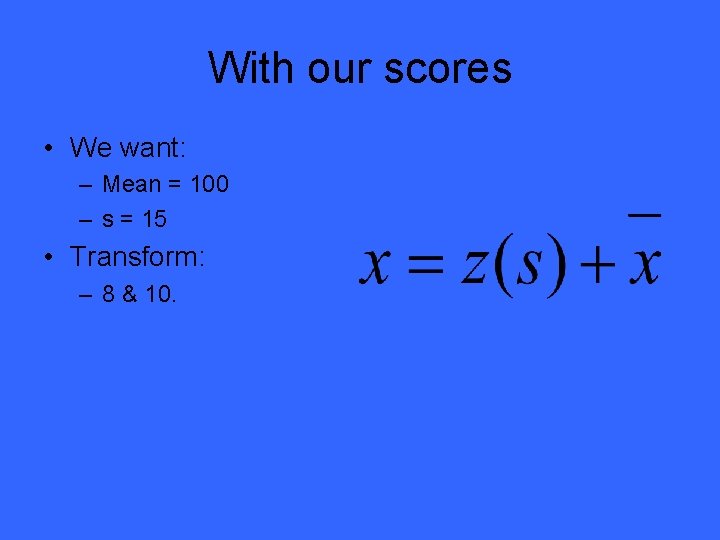
With our scores • We want: – Mean = 100 – s = 15 • Transform: – 8 & 10.
- Slides: 23