
MEASURES OF DISPERSION Lecture 4 1 Objectives Explain
MEASURES OF DISPERSION Lecture 4 1
Objectives • Explain the importance of measures of dispersion. • Compute and interpret the range, the mean deviation, the variance and the standard deviation of ungrouped data and of grouped data. • Discuss the characteristics and uses of each measure. 2
Importance of measures of Dispersions • Measures of central tendency tell us only part of what we need to know about the characteristics of the data collected. They do not provide enough information to describe a set of data since variability or spread of the values in the data is ignored. �When the spread of data around the central item is high, the mean or median is less significant; low spread enhances the meaningfulness of the median or mean. Thus to increase our understanding of the pattern of the data, we must also measure its dispersion. 3
Types of Measures of Dispersion 1. Range 2. Variance 3. Standard deviation 4
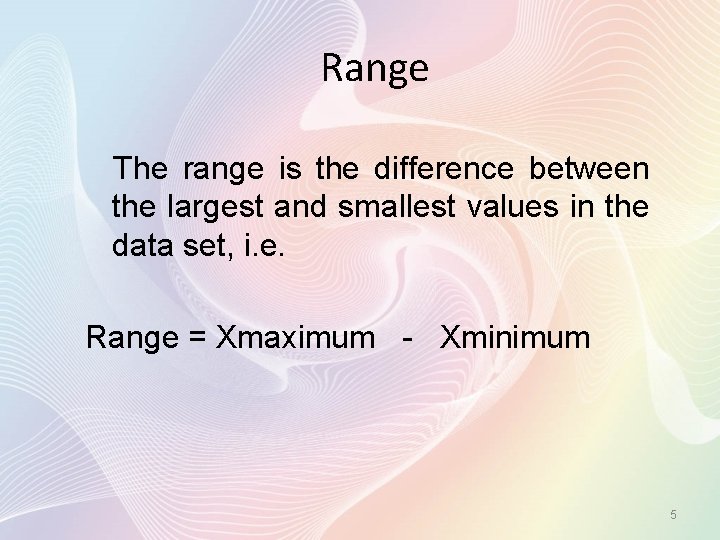
Range The range is the difference between the largest and smallest values in the data set, i. e. Range = Xmaximum - Xminimum 5
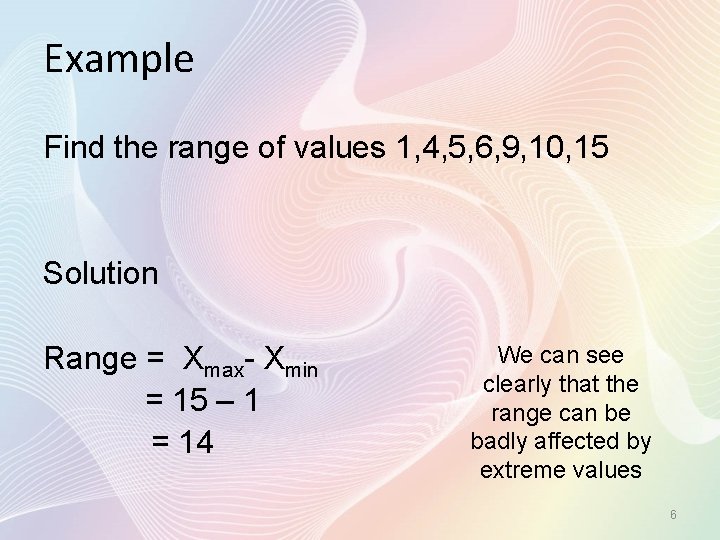
Example Find the range of values 1, 4, 5, 6, 9, 10, 15 Solution Range = Xmax- Xmin = 15 – 1 = 14 We can see clearly that the range can be badly affected by extreme values 6
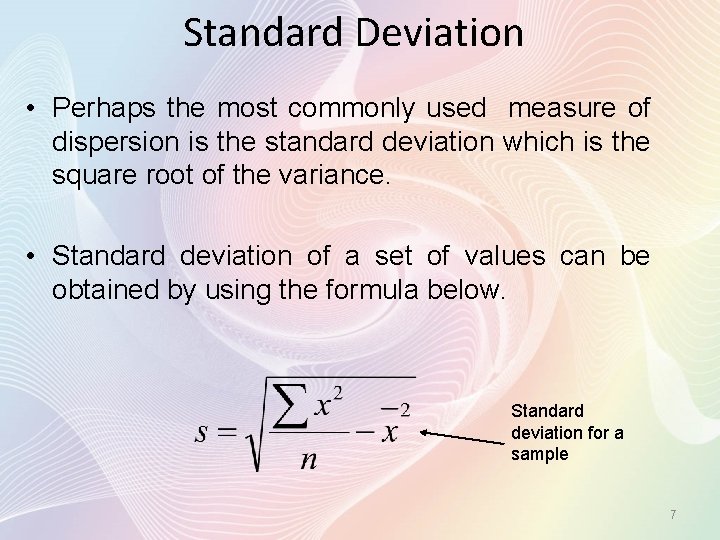
Standard Deviation • Perhaps the most commonly used measure of dispersion is the standard deviation which is the square root of the variance. • Standard deviation of a set of values can be obtained by using the formula below. Standard deviation for a sample 7
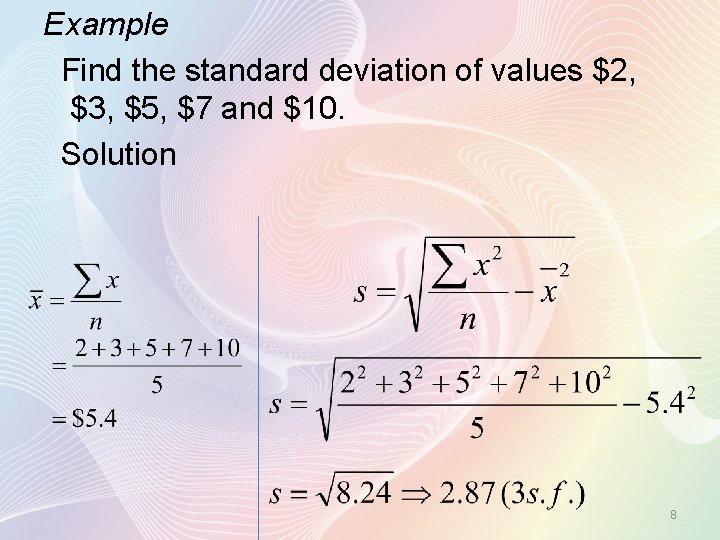
Example Find the standard deviation of values $2, $3, $5, $7 and $10. Solution 8
Variance • Variance, = square of standard deviation 9
Uses of the variance and standard deviation • Can be used to determine the spread of data ie the larger the value, the more dispersed the data. • Can be used to determine the consistency of a variable. • Can be used to determine the number of data values that fall within a specified interval in a distribution, 75% of the data values will fall within 2 standard deviations of the mean. • They are used quite often in inferential statistics. 10

Recapitulate Importance of measures of dispersions √ Range √ Variance √ Standard Deviation √ 11

References : Lecture & Tutorial Notes from Department of Business & Management, Institute Technology Brunei, Brunei Darussalam. 12
- Slides: 12