
MEASURES OF DISEASE OCCURRENCE The relationship between prevalence
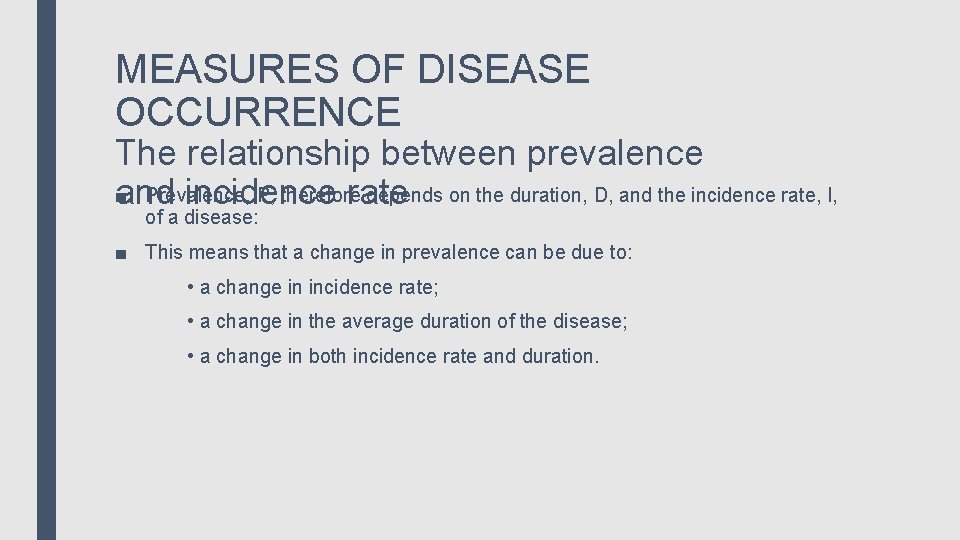
MEASURES OF DISEASE OCCURRENCE The relationship between prevalence ■ Prevalence, P, therefore depends on the duration, D, and the incidence rate, I, and incidence rate of a disease: ■ This means that a change in prevalence can be due to: • a change in incidence rate; • a change in the average duration of the disease; • a change in both incidence rate and duration.
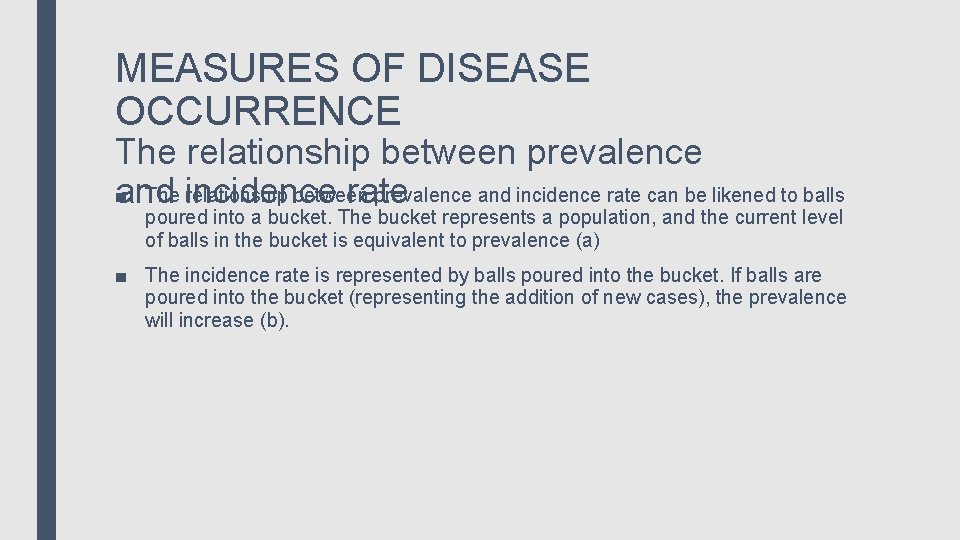
MEASURES OF DISEASE OCCURRENCE The relationship between prevalence ■ The incidence relationship between prevalence and incidence rate can be likened to balls and rate poured into a bucket. The bucket represents a population, and the current level of balls in the bucket is equivalent to prevalence (a) ■ The incidence rate is represented by balls poured into the bucket. If balls are poured into the bucket (representing the addition of new cases), the prevalence will increase (b).
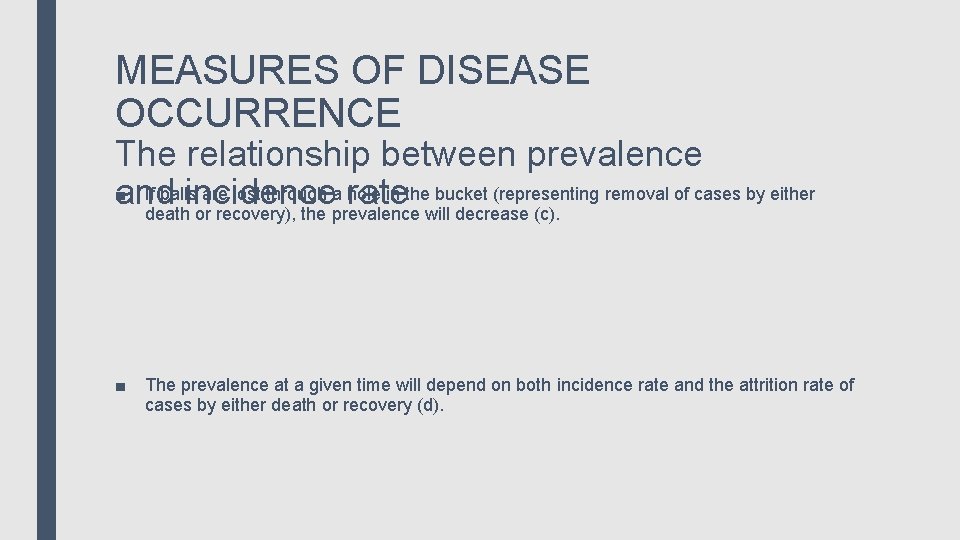
MEASURES OF DISEASE OCCURRENCE The relationship between prevalence ■ If balls are lost through a rate hole in the bucket (representing removal of cases by either and incidence death or recovery), the prevalence will decrease (c). ■ The prevalence at a given time will depend on both incidence rate and the attrition rate of cases by either death or recovery (d).
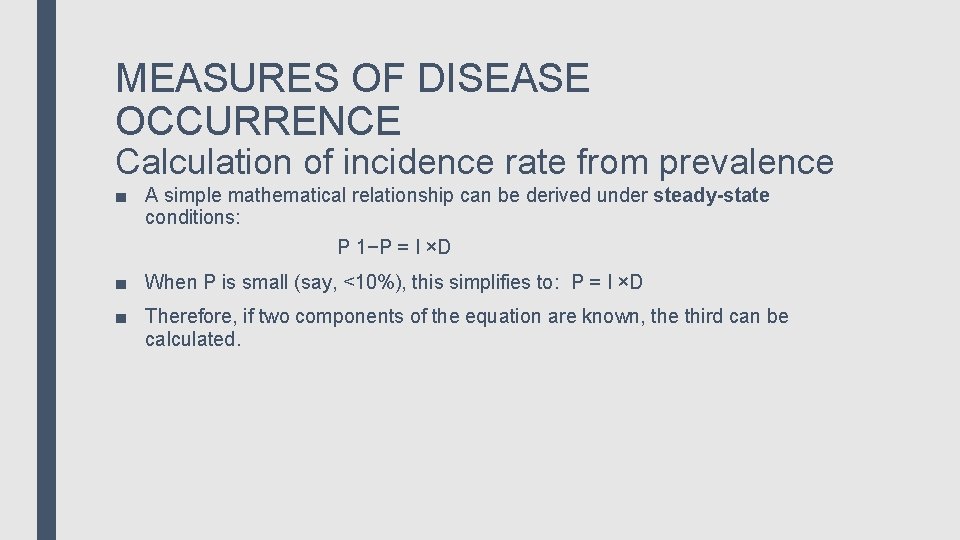
MEASURES OF DISEASE OCCURRENCE Calculation of incidence rate from prevalence ■ A simple mathematical relationship can be derived under steady-state conditions: P 1−P = I ×D ■ When P is small (say, <10%), this simplifies to: P = I ×D ■ Therefore, if two components of the equation are known, the third can be calculated.
MEASURES OF DISEASE OCCURRENCE Application of prevalence and incidence ■ Prevalence and incidence have different applications. values ■ Prevalence is useful if interest is focussed on existing cases; – for example, in identifying disease problems for administrative purposes and for defining research priorities and long-term disease-control strategies, and in evaluating diagnostic tests ■ Cumulative incidence is used to predict an individual’s change in health status because it indicates the probability of an individual becoming ill over a specified period of time. ■ An incidence rate can not be directly interpreted at the individual level, but is appropriate when the speed of development of new cases in a population needs to be known. Reference: Veterinary Epidemiology, 4 ed. Michael Thrusfield with Robert Christley, Brown H, Diggle PJ, French N, Howe K, Kelly L, O’Connor A, Sargeant J, Wood H.
- Slides: 5