
MEASURES OF DISEASE OCCURRENCE Prevalence is the number
MEASURES OF DISEASE OCCURRENCE ■ Prevalence: is the number of instances of disease or related attributes (e. g. , infection or presence of antibodies) in a known population, at a designated time, without distinction between old and new cases. ■ When the time is not specified, prevalence usually refers to point prevalence; that is, the amount of disease in a population at a particular point in time. ■ Period prevalence refers to the number of cases that are known to have occurred during a specified period of time; for example, a year. ■ Lifetime prevalence is the number of individuals known to have had disease for at least part of their life.
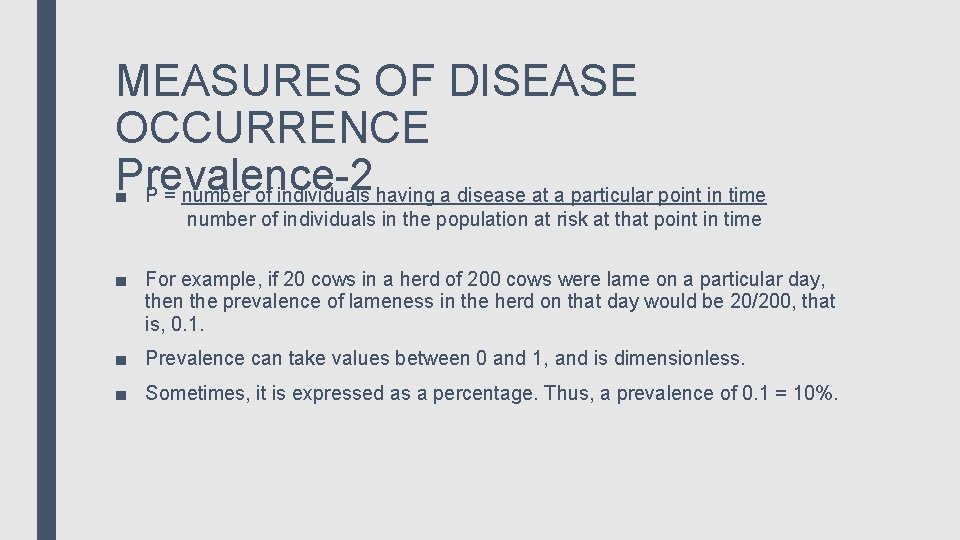
MEASURES OF DISEASE OCCURRENCE Prevalence-2 ■ P = number of individuals having a disease at a particular point in time number of individuals in the population at risk at that point in time ■ For example, if 20 cows in a herd of 200 cows were lame on a particular day, then the prevalence of lameness in the herd on that day would be 20/200, that is, 0. 1. ■ Prevalence can take values between 0 and 1, and is dimensionless. ■ Sometimes, it is expressed as a percentage. Thus, a prevalence of 0. 1 = 10%.
MEASURES OF DISEASE OCCURRENCE ■ Incidence: is the number of new cases that occur in a known population over a specified period of time. ■ The two essential components of an incidence value are: 1. the number of new cases; 2. the period of time over which the new cases occur ■ Incidence, like prevalence, can be defined simply in terms of the number of affected animals, but again is usually expressed in relation to the population at risk.
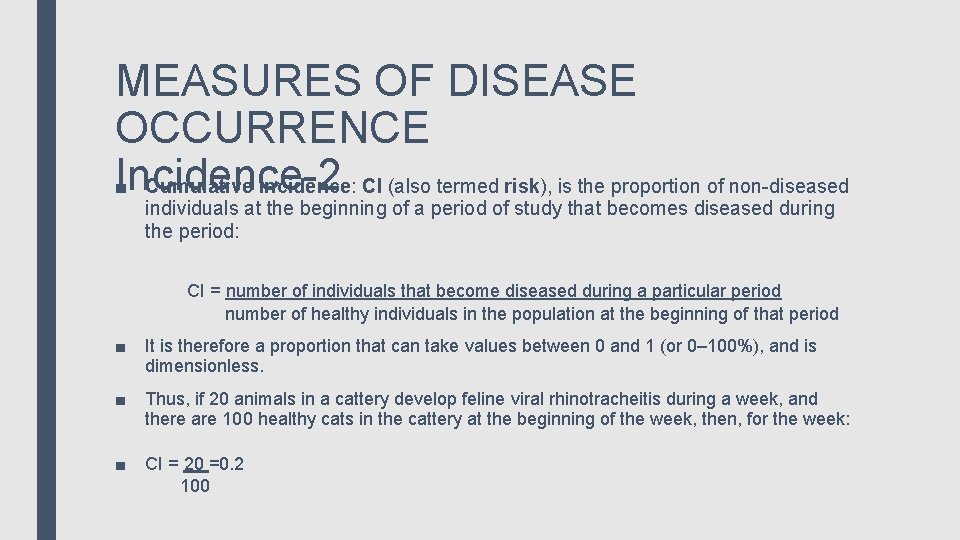
MEASURES OF DISEASE OCCURRENCE Incidence-2 ■ Cumulative incidence: CI (also termed risk), is the proportion of non-diseased individuals at the beginning of a period of study that becomes diseased during the period: CI = number of individuals that become diseased during a particular period number of healthy individuals in the population at the beginning of that period ■ It is therefore a proportion that can take values between 0 and 1 (or 0– 100%), and is dimensionless. ■ Thus, if 20 animals in a cattery develop feline viral rhinotracheitis during a week, and there are 100 healthy cats in the cattery at the beginning of the week, then, for the week: ■ CI = 20 =0. 2 100
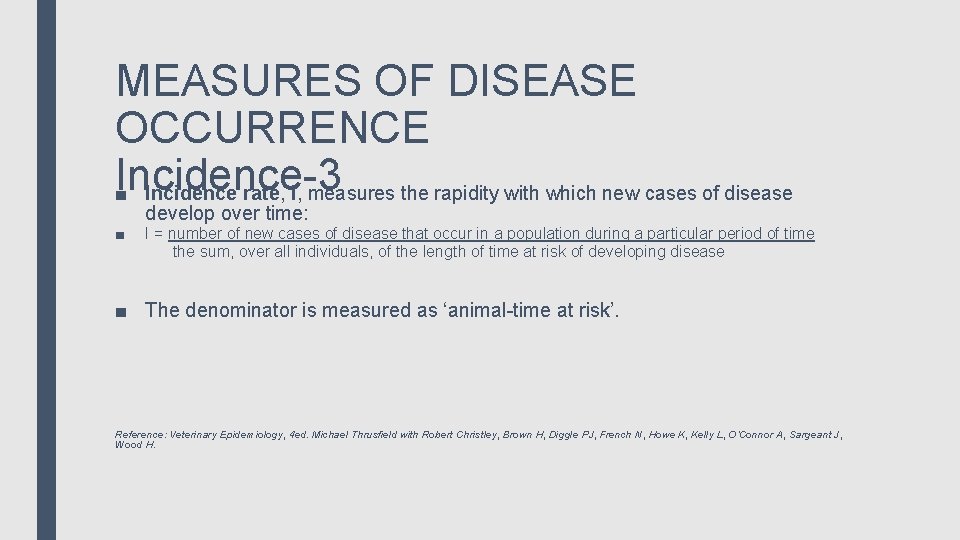
MEASURES OF DISEASE OCCURRENCE Incidence-3 ■ Incidence rate, I, measures the rapidity with which new cases of disease ■ develop over time: I = number of new cases of disease that occur in a population during a particular period of time the sum, over all individuals, of the length of time at risk of developing disease ■ The denominator is measured as ‘animal-time at risk’. Reference: Veterinary Epidemiology, 4 ed. Michael Thrusfield with Robert Christley, Brown H, Diggle PJ, French N, Howe K, Kelly L, O’Connor A, Sargeant J, Wood H.
- Slides: 5