
Measures of Center and Spread Comparing and Contrasting


- Slides: 21
Measures of Center and Spread Comparing and Contrasting Data Sets
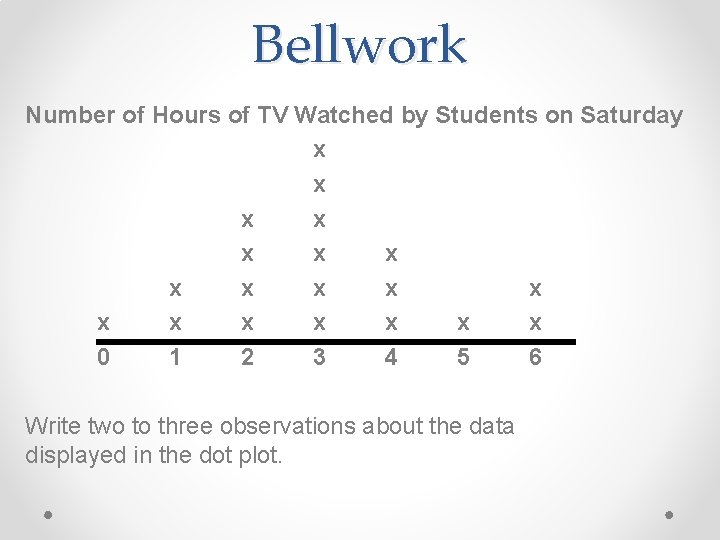
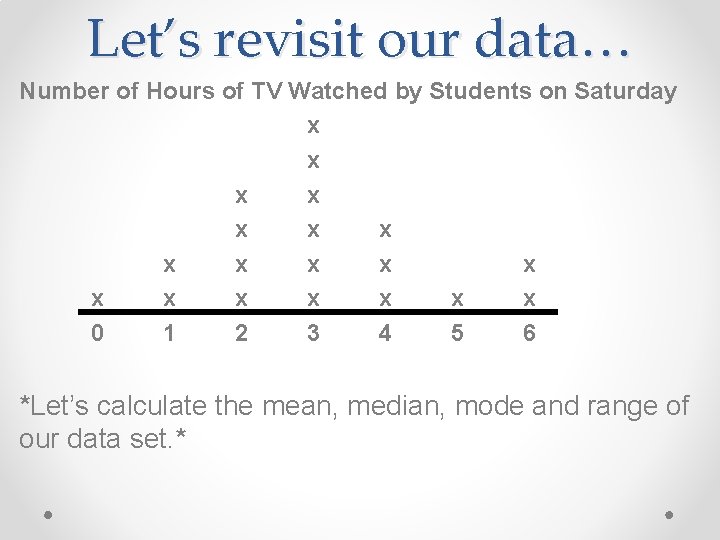
Bellwork Number of Hours of TV Watched by Students on Saturday x x x x x 0 1 2 3 4 5 6 Write two to three observations about the data displayed in the dot plot.
Observations What conclusions can be drawn by observing/ examining this dot plot?
Vocabulary Review • On the board you will find six key words: • Mean, Median, Mode, Range, Outlier, Distribution • On your white boards, write the word from the word bank that corresponds to the following definitions. • When I say “Go” hold up your white boards so we can compare and discuss our answers.
Number 1 A measure of center, it is the value that occurs most frequently in a data set.
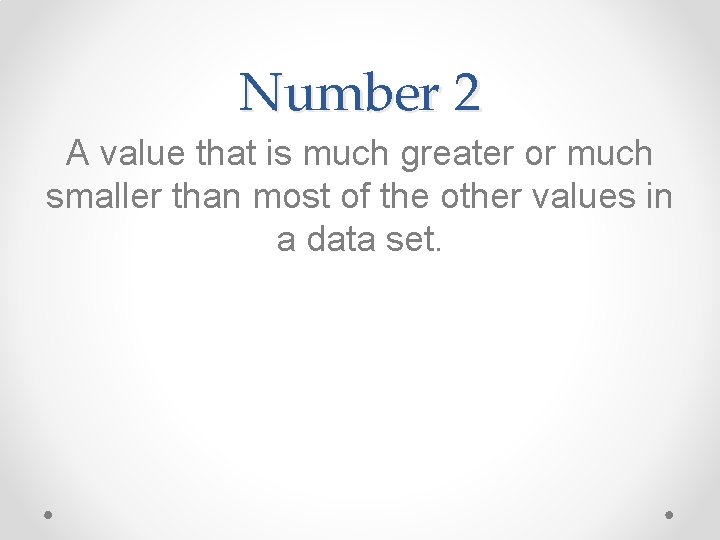
Number 2 A value that is much greater or much smaller than most of the other values in a data set.
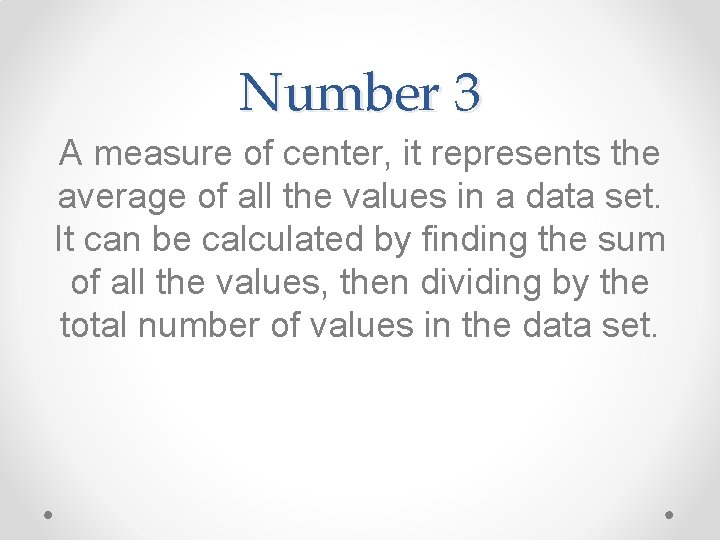
Number 3 A measure of center, it represents the average of all the values in a data set. It can be calculated by finding the sum of all the values, then dividing by the total number of values in the data set.
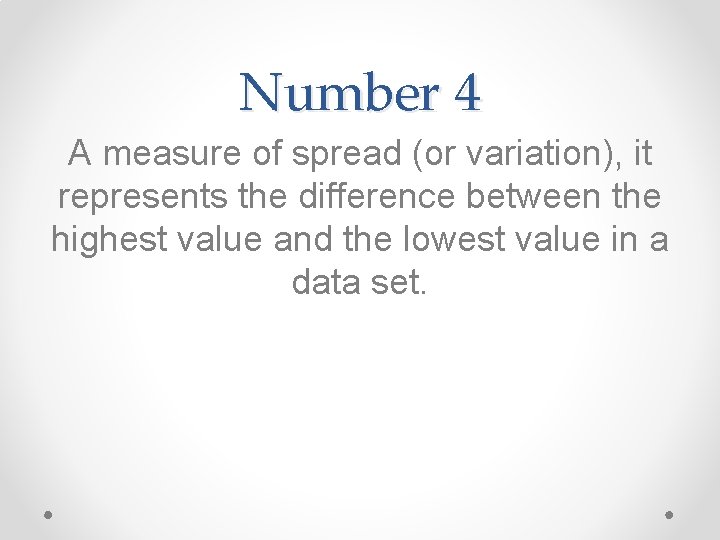
Number 4 A measure of spread (or variation), it represents the difference between the highest value and the lowest value in a data set.
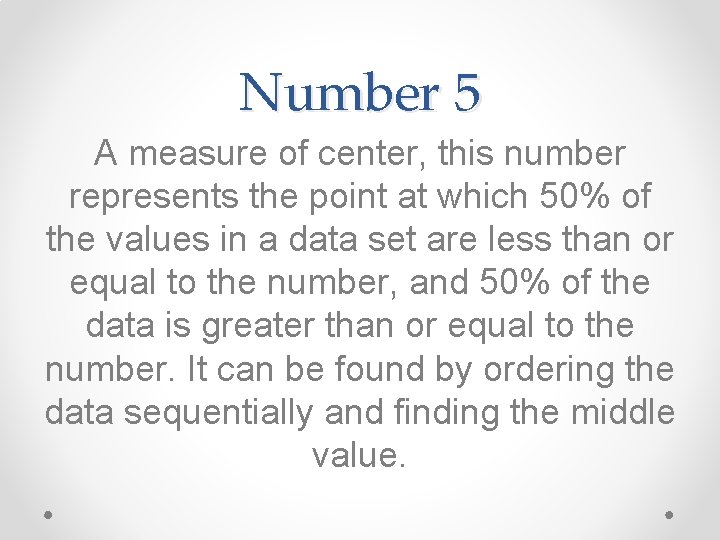
Number 5 A measure of center, this number represents the point at which 50% of the values in a data set are less than or equal to the number, and 50% of the data is greater than or equal to the number. It can be found by ordering the data sequentially and finding the middle value.
Number 6 The arrangement of the values of a data set, this can be described using a measure of center or spread.
Let’s revisit our data… Number of Hours of TV Watched by Students on Saturday x x x x x 0 1 2 3 4 5 6 *Let’s calculate the mean, median, mode and range of our data set. *
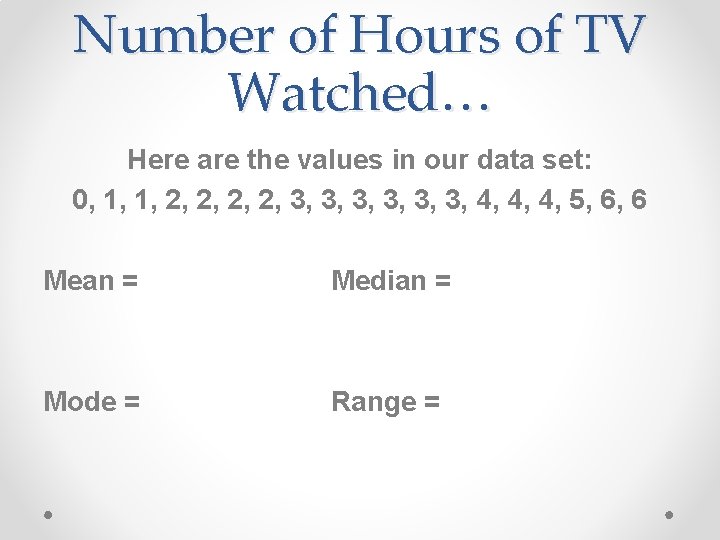
Number of Hours of TV Watched… Here are the values in our data set: 0, 1, 1, 2, 2, 3, 3, 3, 4, 4, 4, 5, 6, 6 Mean = Median = Mode = Range =
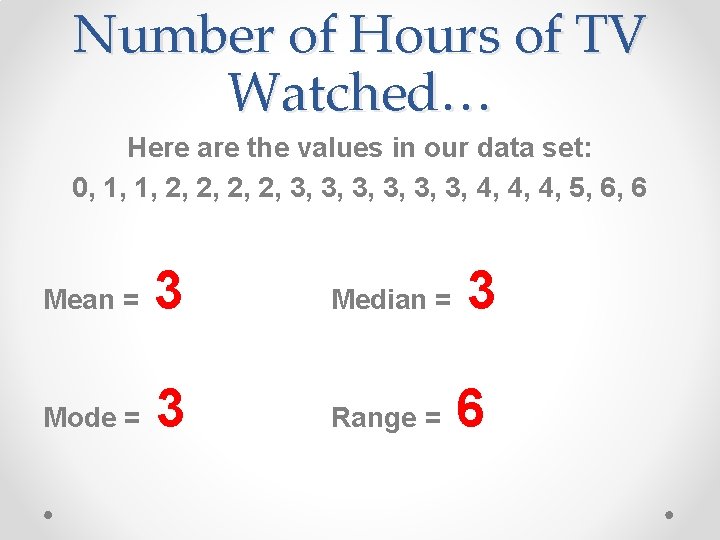
Number of Hours of TV Watched… Here are the values in our data set: 0, 1, 1, 2, 2, 3, 3, 3, 4, 4, 4, 5, 6, 6 Mean = 3 Median = Mode = 3 Range = 3 6
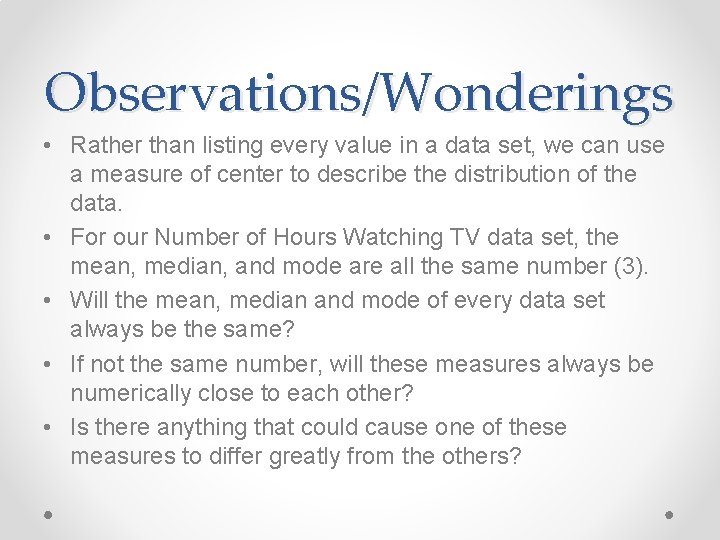
Observations/Wonderings • Rather than listing every value in a data set, we can use a measure of center to describe the distribution of the data. • For our Number of Hours Watching TV data set, the mean, median, and mode are all the same number (3). • Will the mean, median and mode of every data set always be the same? • If not the same number, will these measures always be numerically close to each other? • Is there anything that could cause one of these measures to differ greatly from the others?
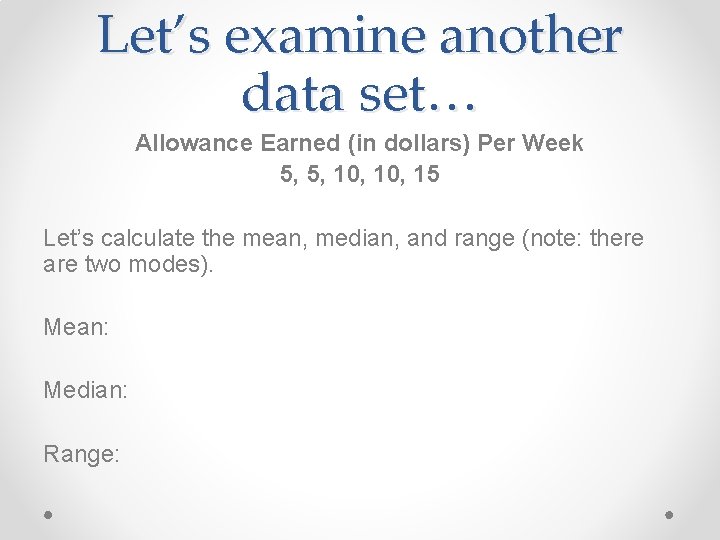
Let’s examine another data set… Allowance Earned (in dollars) Per Week 5, 5, 10, 15 Let’s calculate the mean, median, and range (note: there are two modes). Mean: Median: Range:
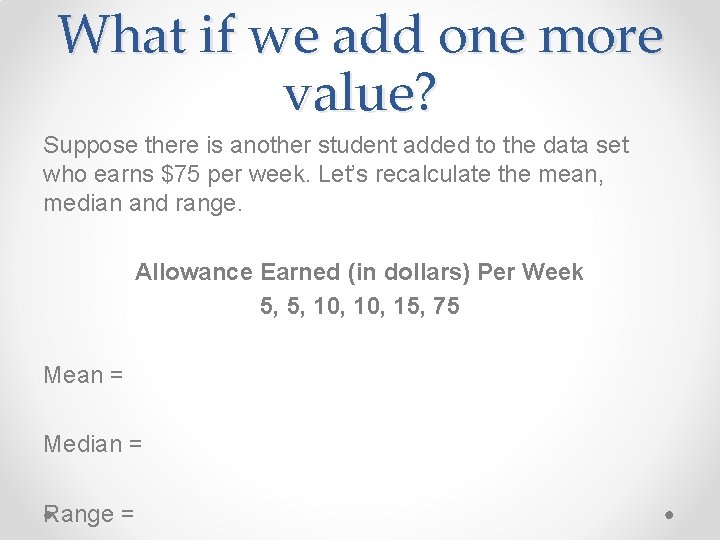
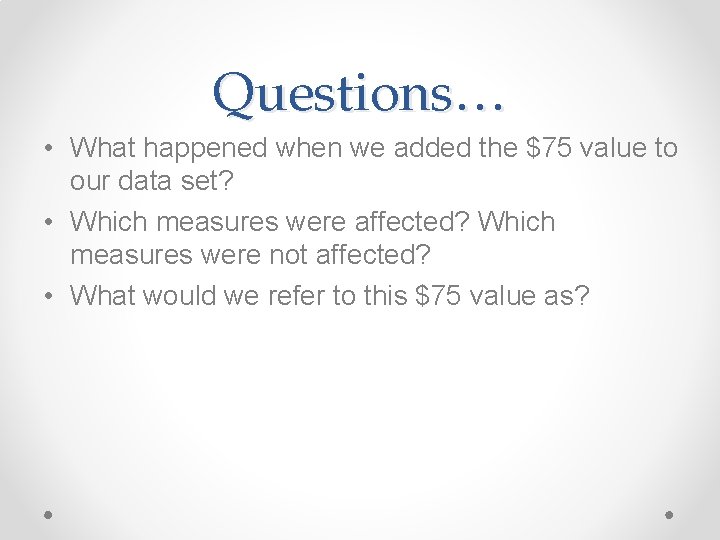
What if we add one more value? Suppose there is another student added to the data set who earns $75 per week. Let’s recalculate the mean, median and range. Allowance Earned (in dollars) Per Week 5, 5, 10, 15, 75 Mean = Median = Range =
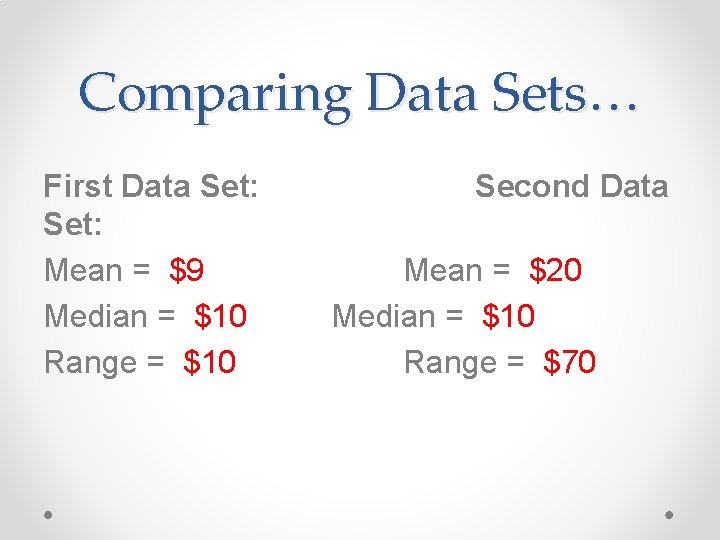
Comparing Data Sets… First Data Set: Mean = $9 Median = $10 Range = $10 Second Data Mean = $20 Median = $10 Range = $70
Questions… • What happened when we added the $75 value to our data set? • Which measures were affected? Which measures were not affected? • What would we refer to this $75 value as?
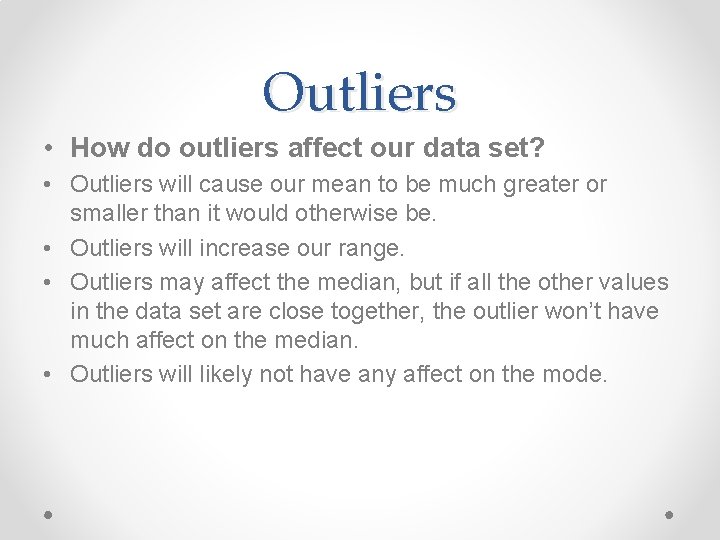
Outliers • How do outliers affect our data set? • Outliers will cause our mean to be much greater or smaller than it would otherwise be. • Outliers will increase our range. • Outliers may affect the median, but if all the other values in the data set are close together, the outlier won’t have much affect on the median. • Outliers will likely not have any affect on the mode.
Homework Complete the Homework Worksheet tonight. We will review the answers at the beginning of our next class.
Measures of Center and Spread: Day 2 Agenda • Review and discuss Homework Answers • In groups, complete Data Gathering and Analysis Worksheet • Take Measures of Center and Spread Summative Assessment