
Measures and data Understand metric and imperial units
- Slides: 23
Measures and data Understand metric and imperial units Objectives Day 1 Convert between grams and kilograms, millilitres and litres (mainly to 1 decimal place). Day 2 Convert between metres and kilometres; Know approximate conversion between miles and km; Begin to draw line graphs & read intermediate points. Day 3 Know regularly used imperial units and approximate metric equivalents. © hamilton-trust. org. uk 1 Year 5
Measures and data Understand metric and imperial units Starters Day 1 Reading scales (weight) (pre-requisite skills) Day 2 Multiply and divide by 10 and 100 (pre-requisite skills) Suggested for Day 3 Reading scales (capacity) (simmering skills) © hamilton-trust. org. uk 2 Year 5
Measures and data Understand metric and imperial units Starter Reading scales (weight) Click HERE to open Measuring Scales ITP © hamilton-trust. org. uk 3 Year 5
Measures and data Understand metric and imperial units Starter Multiply and divide by 10 and 100 © hamilton-trust. org. uk 4 Year 5
Measures and data Understand metric and imperial units Starter Reading scales (capacity) Click HERE to open Measuring Cylinder ITP © hamilton-trust. org. uk 5 Year 5
Measures and data Understand metric and imperial units Objectives Day 1 Convert between grams and kilograms, millilitres and litres (mainly to 1 decimal place). © hamilton-trust. org. uk 6 Year 5
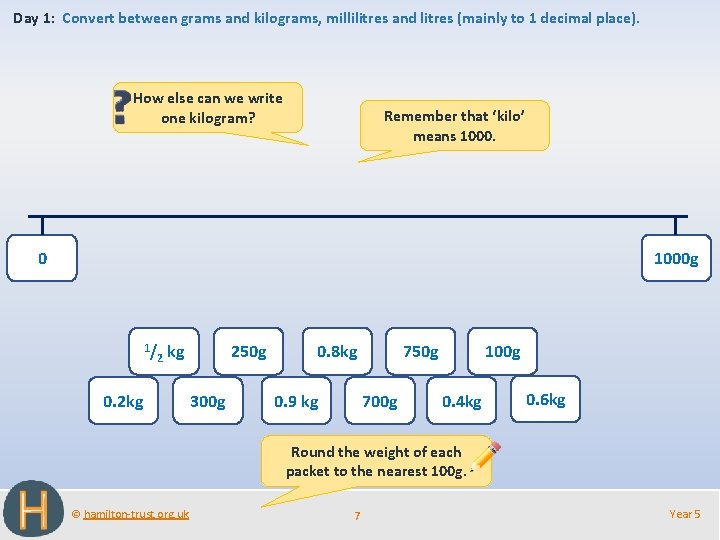
Day 1: Convert between grams and kilograms, millilitres and litres (mainly to 1 decimal place). How else can we write one kilogram? Remember that ‘kilo’ means 1000. 0 1000 g 1/ 2 kg 0. 2 kg 250 g 300 g 0. 8 kg 0. 9 kg 750 g 700 g 100 g 0. 4 kg 0. 6 kg Round the weight of each packet to the nearest 100 g. © hamilton-trust. org. uk 7 Year 5
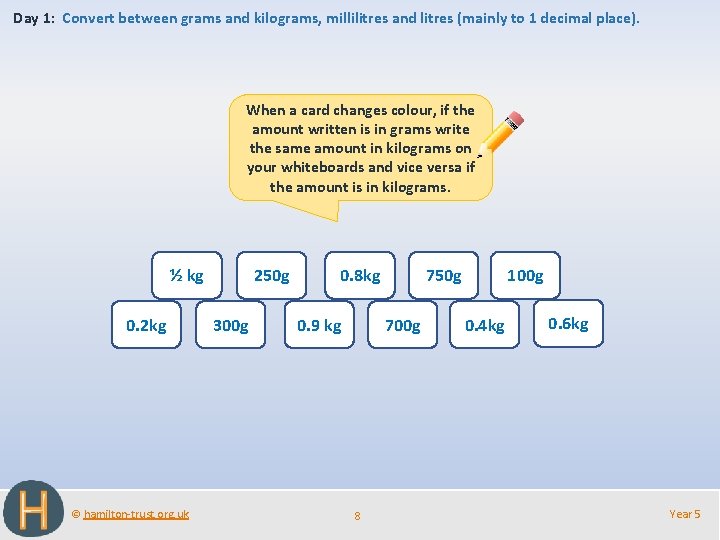
Day 1: Convert between grams and kilograms, millilitres and litres (mainly to 1 decimal place). When a card changes colour, if the amount written is in grams write the same amount in kilograms on your whiteboards and vice versa if the amount is in kilograms. ½ kg 0. 2 kg © hamilton-trust. org. uk 250 g 300 g 0. 8 kg 0. 9 kg 750 g 700 g 8 100 g 0. 4 kg 0. 6 kg Year 5
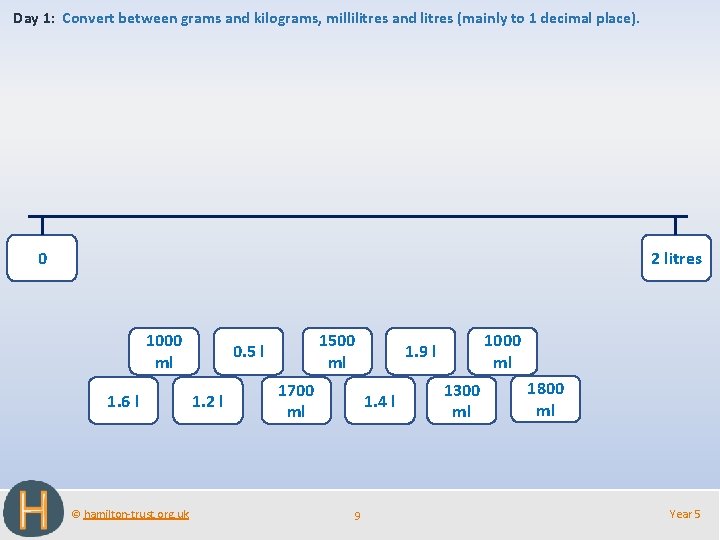
Day 1: Convert between grams and kilograms, millilitres and litres (mainly to 1 decimal place). 0 2 litres 1000 ml 1. 6 l © hamilton-trust. org. uk 1500 ml 0. 5 l 1. 2 l 1700 ml 1. 4 l 9 1000 ml 1. 9 l 1300 ml 1800 ml Year 5
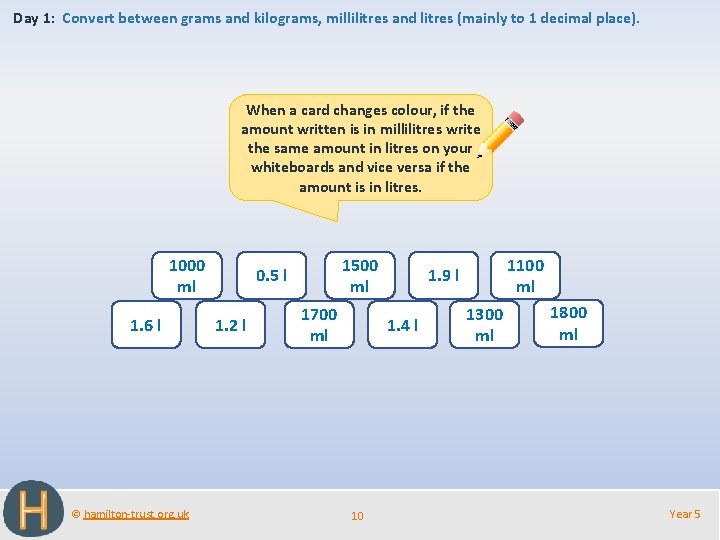
Day 1: Convert between grams and kilograms, millilitres and litres (mainly to 1 decimal place). When a card changes colour, if the amount written is in millilitres write the same amount in litres on your whiteboards and vice versa if the amount is in litres. 1000 ml 1. 6 l © hamilton-trust. org. uk 1500 ml 0. 5 l 1. 2 l 1700 ml 1. 4 l 10 1100 ml 1. 9 l 1300 ml 1800 ml Year 5
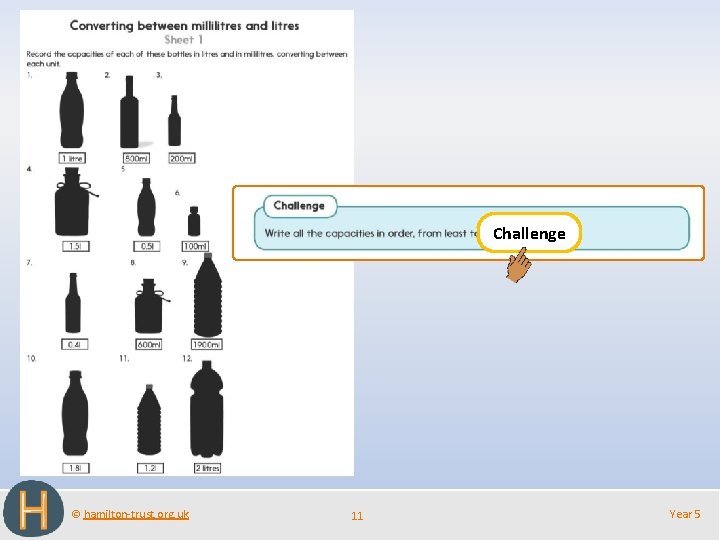
Challenge © hamilton-trust. org. uk 11 Year 5
Measures and data Understand metric and imperial units Objectives Day 2 Convert between metres and kilometres; Know approximate conversion between miles and km; Begin to draw line graphs & read intermediate points. © hamilton-trust. org. uk 12 Year 5
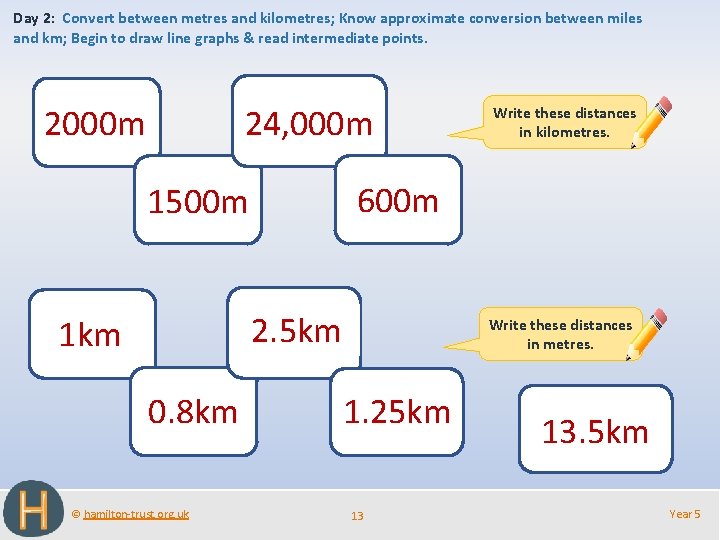
Day 2: Convert between metres and kilometres; Know approximate conversion between miles and km; Begin to draw line graphs & read intermediate points. 24 km 24, 000 m 2 km 2000 m 600 m 0. 6 km 1. 5 km 1500 m 2. 5 km 2500 m 1 km 1000 m 0. 8 km 800 m © hamilton-trust. org. uk Write these distances in kilometres. Write these distances in metres. 1. 25 km 1250 m 13 13, 500 m 13. 5 km Year 5
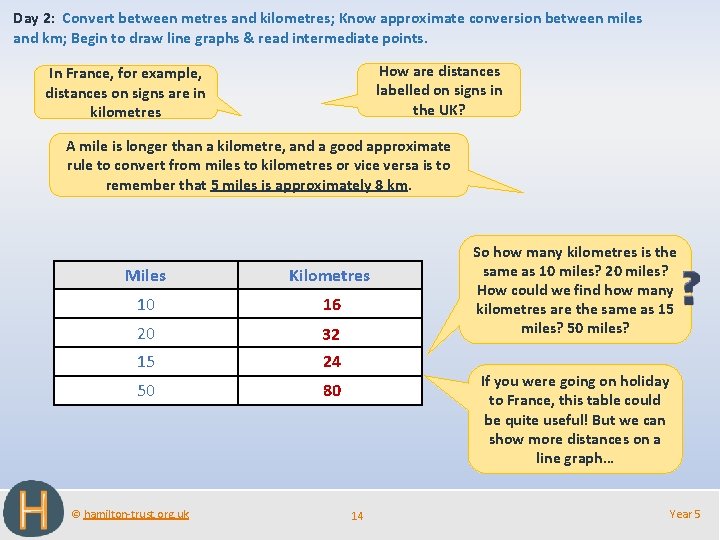
Day 2: Convert between metres and kilometres; Know approximate conversion between miles and km; Begin to draw line graphs & read intermediate points. How are distances labelled on signs in the UK? In France, for example, distances on signs are in kilometres A mile is longer than a kilometre, and a good approximate rule to convert from miles to kilometres or vice versa is to remember that 5 miles is approximately 8 km. Miles Kilometres 10 16 20 32 15 24 50 80 © hamilton-trust. org. uk So how many kilometres is the same as 10 miles? 20 miles? How could we find how many kilometres are the same as 15 miles? 50 miles? If you were going on holiday to France, this table could be quite useful! But we can show more distances on a line graph… 14 Year 5
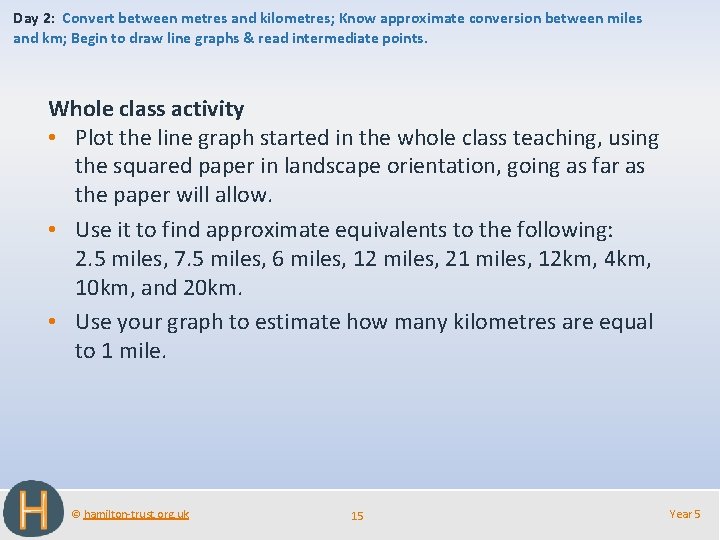
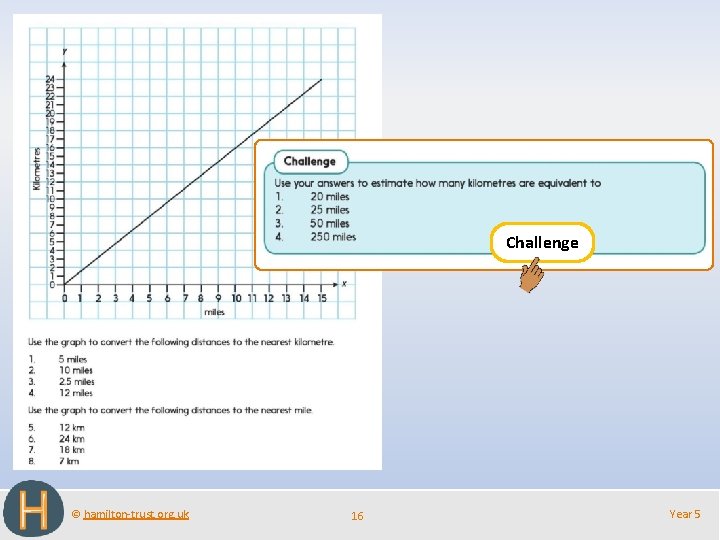
Day 2: Convert between metres and kilometres; Know approximate conversion between miles and km; Begin to draw line graphs & read intermediate points. Whole class activity • Plot the line graph started in the whole class teaching, using the squared paper in landscape orientation, going as far as the paper will allow. • Use it to find approximate equivalents to the following: 2. 5 miles, 7. 5 miles, 6 miles, 12 miles, 21 miles, 12 km, 4 km, 10 km, and 20 km. • Use your graph to estimate how many kilometres are equal to 1 mile. © hamilton-trust. org. uk 15 Year 5
Challenge © hamilton-trust. org. uk 16 Year 5
Measures and data Understand metric and imperial units Objectives Day 3 Know regularly used imperial units and approximate metric equivalents. © hamilton-trust. org. uk 17 Year 5
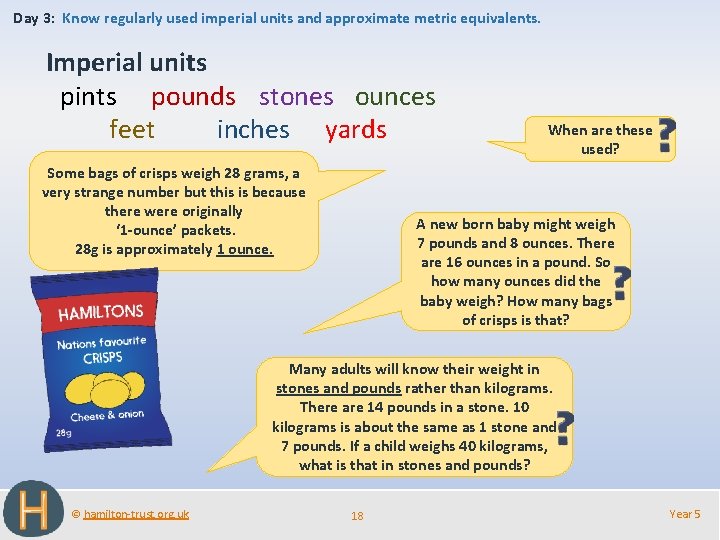
Day 3: Know regularly used imperial units and approximate metric equivalents. Imperial units pints pounds stones ounces feet inches yards Some bags of crisps weigh 28 grams, a very strange number but this is because there were originally ‘ 1 -ounce’ packets. 28 g is approximately 1 ounce. When are these used? A new born baby might weigh 7 pounds and 8 ounces. There are 16 ounces in a pound. So how many ounces did the baby weigh? How many bags of crisps is that? Many adults will know their weight in stones and pounds rather than kilograms. There are 14 pounds in a stone. 10 kilograms is about the same as 1 stone and 7 pounds. If a child weighs 40 kilograms, what is that in stones and pounds? © hamilton-trust. org. uk 18 Year 5
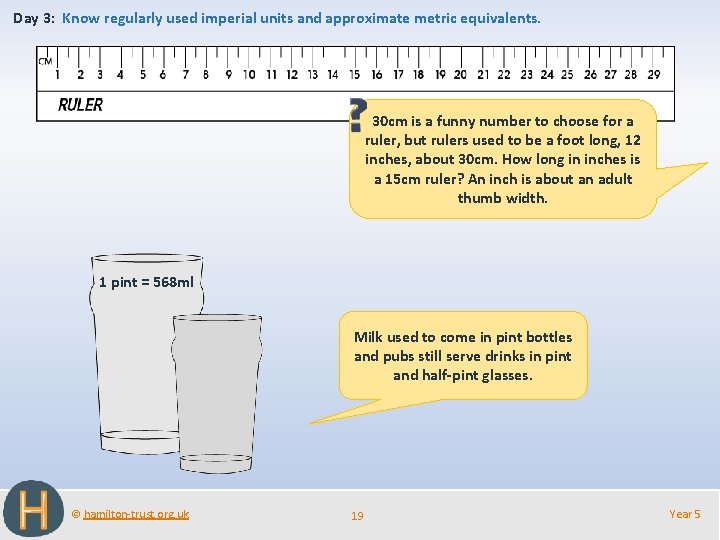
Day 3: Know regularly used imperial units and approximate metric equivalents. 30 cm is a funny number to choose for a ruler, but rulers used to be a foot long, 12 inches, about 30 cm. How long in inches is a 15 cm ruler? An inch is about an adult thumb width. 1 pint = 568 ml Milk used to come in pint bottles and pubs still serve drinks in pint and half-pint glasses. © hamilton-trust. org. uk 19 Year 5
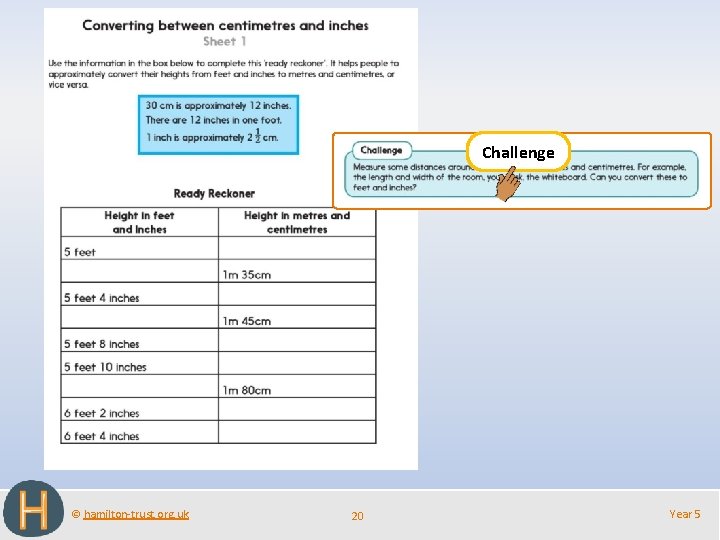
Challenge © hamilton-trust. org. uk 20 Year 5
Measures and data Understand metric and imperial units Well Done! You’ve completed this unit. Objectives Day 1 Convert between grams and kilograms, millilitres and litres (mainly to 1 decimal place). Day 2 Convert between metres and kilometres; Know approximate conversion between miles and km; Begin to draw line graphs & read intermediate points. Day 3 Know regularly used imperial units and approximate metric equivalents. © hamilton-trust. org. uk 21 Year 5
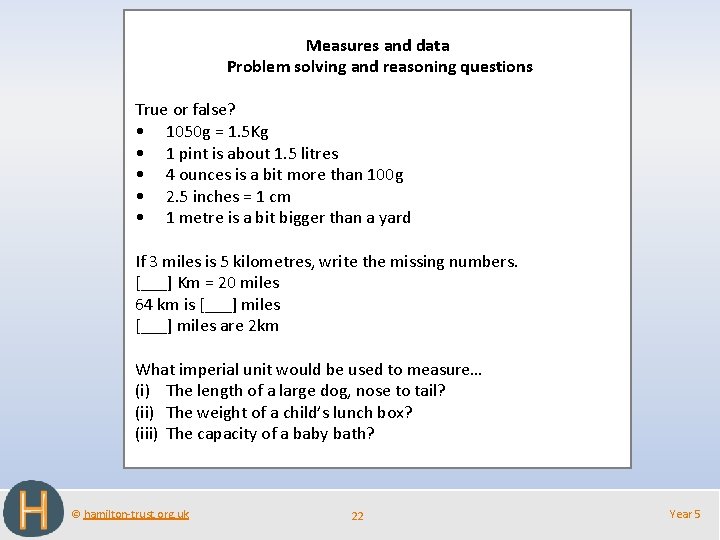
Measures and data Problem solving and reasoning questions True or false? • 1050 g = 1. 5 Kg • 1 pint is about 1. 5 litres • 4 ounces is a bit more than 100 g • 2. 5 inches = 1 cm • 1 metre is a bit bigger than a yard If 3 miles is 5 kilometres, write the missing numbers. [___] Km = 20 miles 64 km is [___] miles are 2 km What imperial unit would be used to measure… (i) The length of a large dog, nose to tail? (ii) The weight of a child’s lunch box? (iii) The capacity of a baby bath? © hamilton-trust. org. uk 22 Year 5
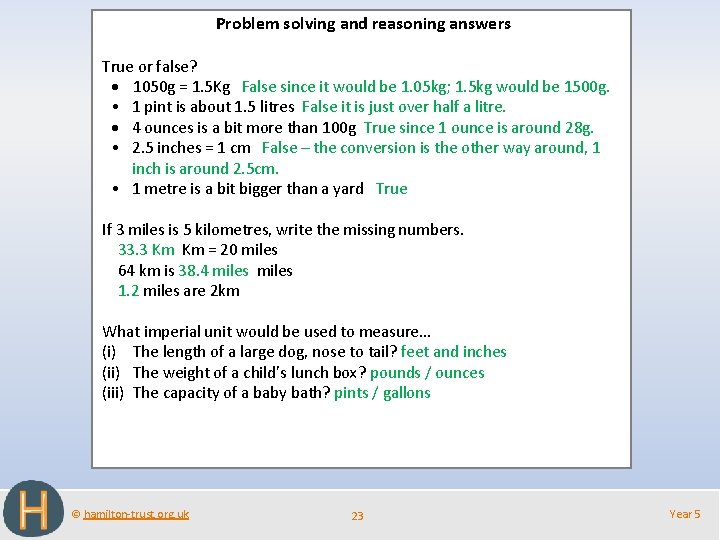
Problem solving and reasoning answers True or false? 1050 g = 1. 5 Kg False since it would be 1. 05 kg; 1. 5 kg would be 1500 g. • 1 pint is about 1. 5 litres False it is just over half a litre. 4 ounces is a bit more than 100 g True since 1 ounce is around 28 g. • 2. 5 inches = 1 cm False – the conversion is the other way around, 1 inch is around 2. 5 cm. • 1 metre is a bit bigger than a yard True If 3 miles is 5 kilometres, write the missing numbers. 33. 3 Km Km = 20 miles 64 km is 38. 4 miles 1. 2 miles are 2 km What imperial unit would be used to measure… (i) The length of a large dog, nose to tail? feet and inches (ii) The weight of a child’s lunch box? pounds / ounces (iii) The capacity of a baby bath? pints / gallons © hamilton-trust. org. uk 23 Year 5