
Measures and Data Telling time to nearest minute
- Slides: 27
Measures and Data Telling time to nearest minute am and pm Objectives Day 1 Revise telling the time, am and pm, to the nearest minute on both analogue and digital clocks; convert between analogue and digital clocks. Day 2 Work out time intervals crossing the hour, on both analogue and digital clocks. Day 3 Calculate time intervals, crossing the hour, using both analogue and digital clocks. © hamilton-trust. org. uk 1 Year 4
Measures and Data Telling time to nearest minute am and pm Starters Day 1 Pairs that make 60 (pre-requisite skills) Day 2 Roman numeral clock (pre-requisite skills) Day 3 Order months (simmering skills) or Units of time (simmering skills) © hamilton-trust. org. uk 2 Year 4
Measures and Data Telling time to nearest minute am and pm Starter Pairs that make 60 © hamilton-trust. org. uk 3 Year 4
Measures and Data Telling time to nearest minute am and pm Starter Roman numeral clock © hamilton-trust. org. uk 4 Year 4
Measures and Data Telling time to nearest minute am and pm Starter Order months © hamilton-trust. org. uk 5 Year 4
Measures and Data Telling time to nearest minute am and pm Starter Units of time © hamilton-trust. org. uk 6 Year 4
Measures and Data Telling time to nearest minute am and pm Objectives Day 1 Revise telling the time, am and pm, to the nearest minute on both analogue and digital clocks; convert between analogue and digital clocks. © hamilton-trust. org. uk 7 Year 4
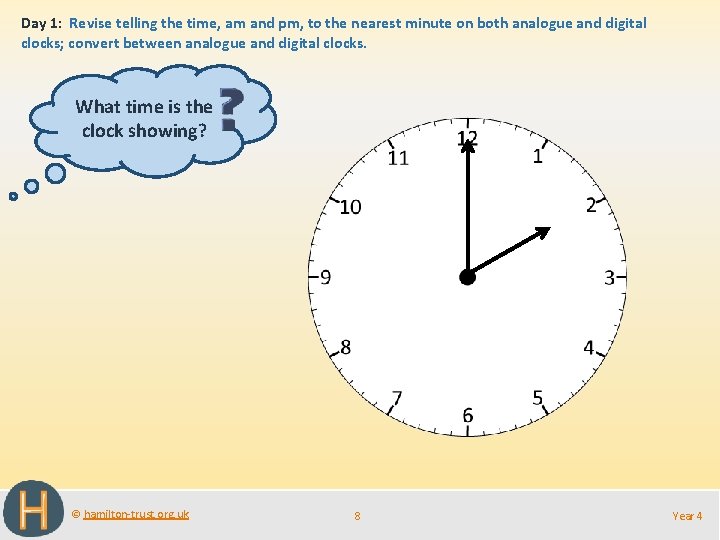
Day 1: Revise telling the time, am and pm, to the nearest minute on both analogue and digital clocks; convert between analogue and digital clocks. What time is the clock showing? © hamilton-trust. org. uk 8 Year 4
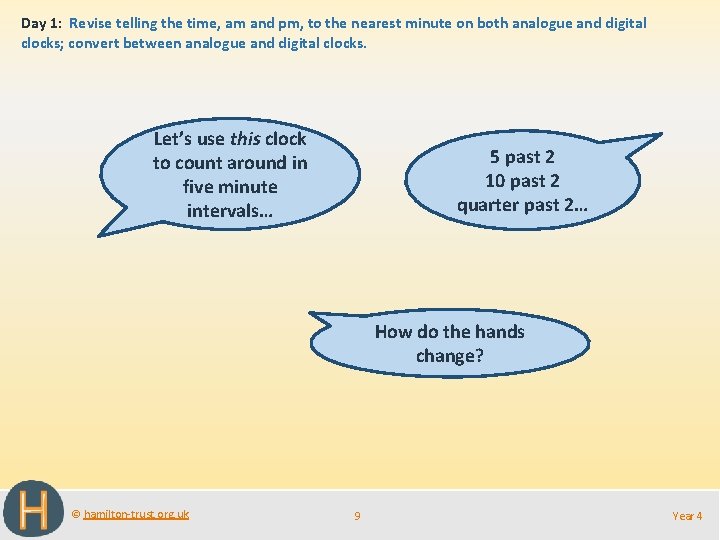
Day 1: Revise telling the time, am and pm, to the nearest minute on both analogue and digital clocks; convert between analogue and digital clocks. Let’s use this clock to count around in five minute intervals… 5 past 2 10 past 2 quarter past 2… How do the hands change? © hamilton-trust. org. uk 9 Year 4
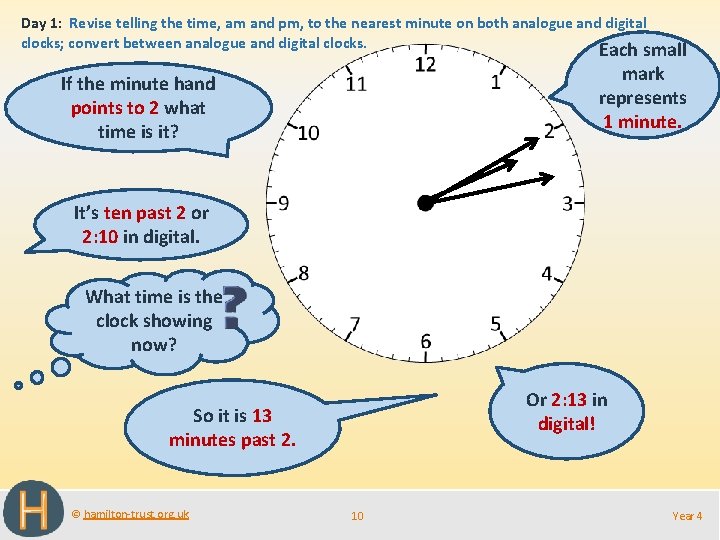
Day 1: Revise telling the time, am and pm, to the nearest minute on both analogue and digital clocks; convert between analogue and digital clocks. Each small mark represents 1 minute. If the minute hand points to 2 what time is it? It’s ten past 2 or 2: 10 in digital. What time is the clock showing now? Or 2: 13 in digital! So it is 13 minutes past 2. © hamilton-trust. org. uk 10 Year 4
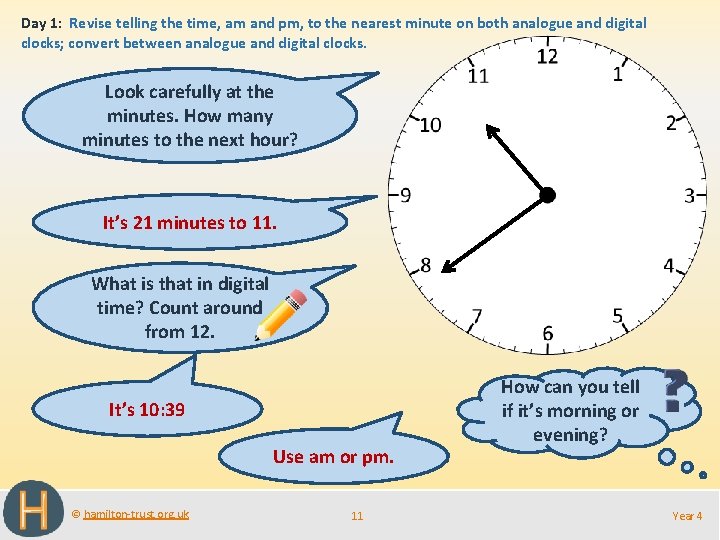
Day 1: Revise telling the time, am and pm, to the nearest minute on both analogue and digital clocks; convert between analogue and digital clocks. Look carefully at the minutes. How many minutes to the next hour? It’s 21 minutes to 11. What is that in digital time? Count around from 12. It’s 10: 39 Use am or pm. © hamilton-trust. org. uk 11 How can you tell if it’s morning or evening? Year 4
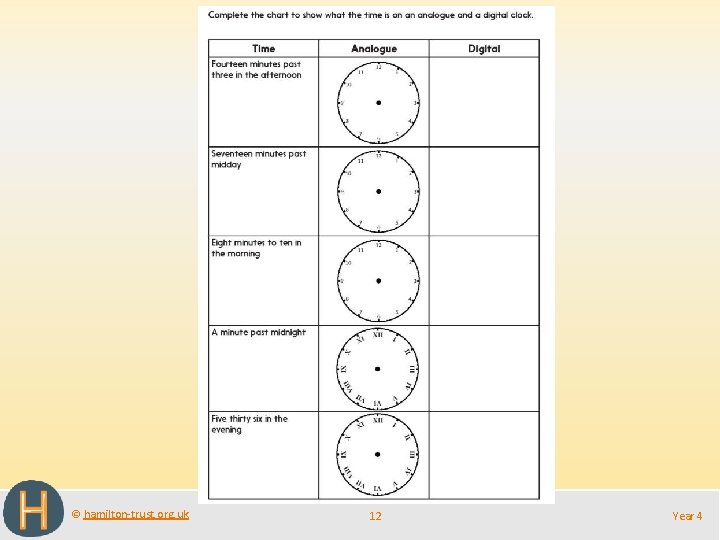
© hamilton-trust. org. uk 12 Year 4
Measures and Data Telling time to nearest minute am and pm Objectives Day 2 Work out time intervals crossing the hour, on both analogue and digital clocks. © hamilton-trust. org. uk 13 Year 4
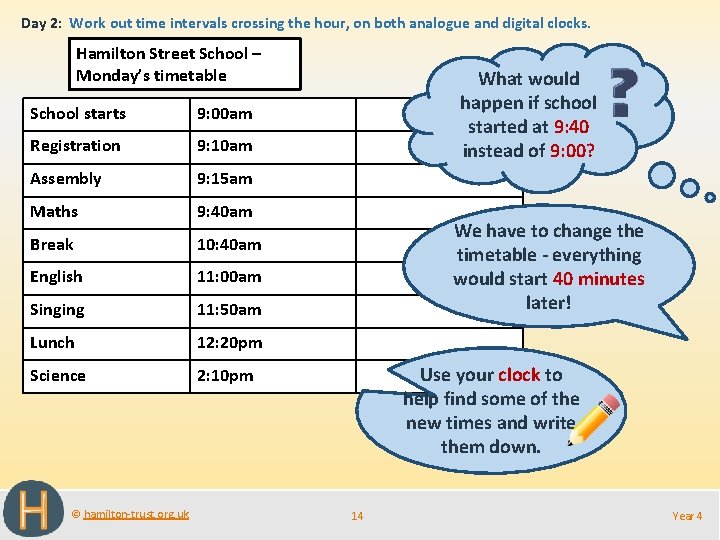
Day 2: Work out time intervals crossing the hour, on both analogue and digital clocks. Hamilton Street School – Monday’s timetable School starts 9: 00 am Registration 9: 10 am Assembly 9: 15 am Maths 9: 40 am Break 10: 40 am English 11: 00 am Singing 11: 50 am Lunch 12: 20 pm Science 2: 10 pm © hamilton-trust. org. uk What would happen if school started at 9: 40 instead of 9: 00? We have to change the timetable - everything would start 40 minutes later! Use your clock to help find some of the new times and write them down. 14 Year 4
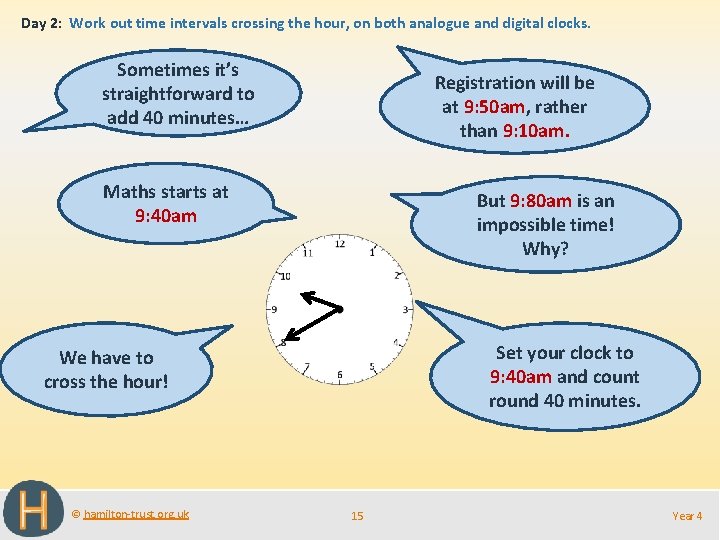
Day 2: Work out time intervals crossing the hour, on both analogue and digital clocks. Sometimes it’s straightforward to add 40 minutes… Registration will be at 9: 50 am, rather than 9: 10 am. Maths starts at 9: 40 am But 9: 80 am is an impossible time! Why? Set your clock to 9: 40 am and count round 40 minutes. We have to cross the hour! © hamilton-trust. org. uk 15 Year 4
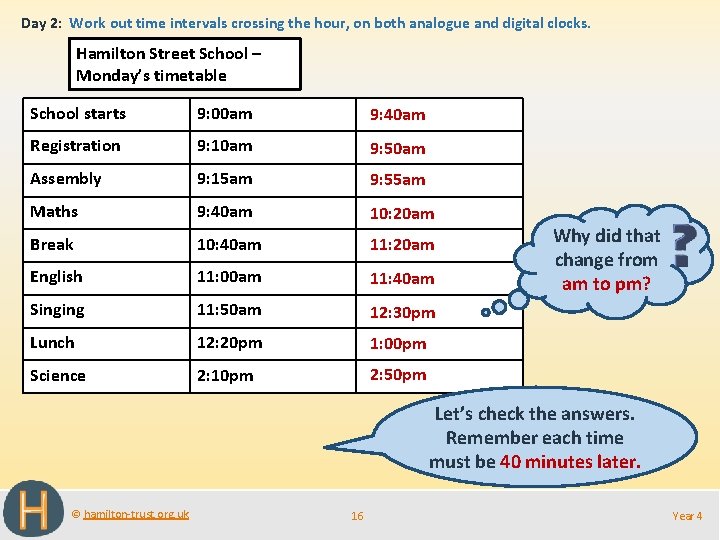
Day 2: Work out time intervals crossing the hour, on both analogue and digital clocks. Hamilton Street School – Monday’s timetable School starts 9: 00 am 9: 40 am Registration 9: 10 am 9: 50 am Assembly 9: 15 am 9: 55 am Maths 9: 40 am 10: 20 am Break 10: 40 am 11: 20 am English 11: 00 am 11: 40 am Singing 11: 50 am 12: 30 pm Lunch 12: 20 pm 1: 00 pm Science 2: 10 pm 2: 50 pm Why did that change from am to pm? Let’s check the answers. Remember each time must be 40 minutes later. © hamilton-trust. org. uk 16 Year 4
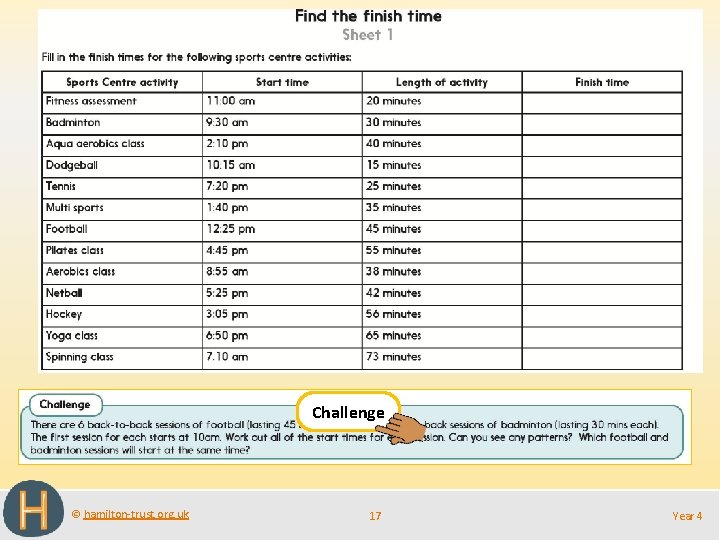
Challenge © hamilton-trust. org. uk 17 Year 4
Measures and Data Telling time to nearest minute am and pm Objectives Day 3 Calculate time intervals, crossing the hour, using both analogue and digital clocks. © hamilton-trust. org. uk 18 Year 4
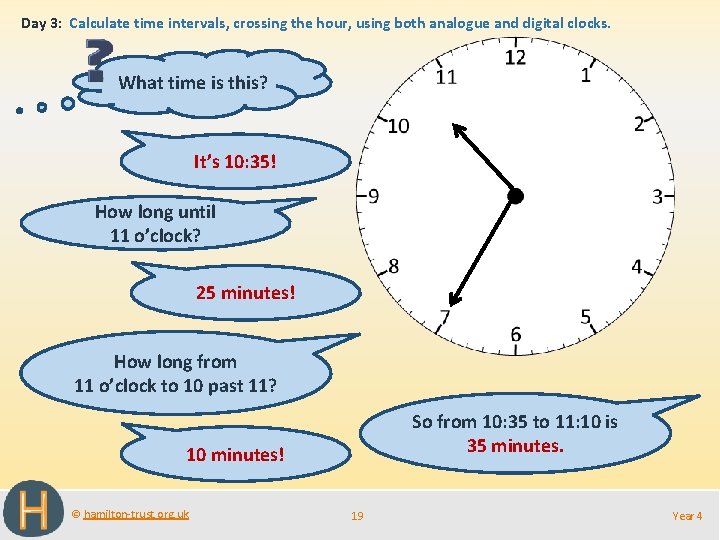
Day 3: Calculate time intervals, crossing the hour, using both analogue and digital clocks. What time is this? It’s 10: 35! How long until 11 o’clock? 25 minutes! How long from 11 o’clock to 10 past 11? So from 10: 35 to 11: 10 is 35 minutes. 10 minutes! © hamilton-trust. org. uk 19 Year 4
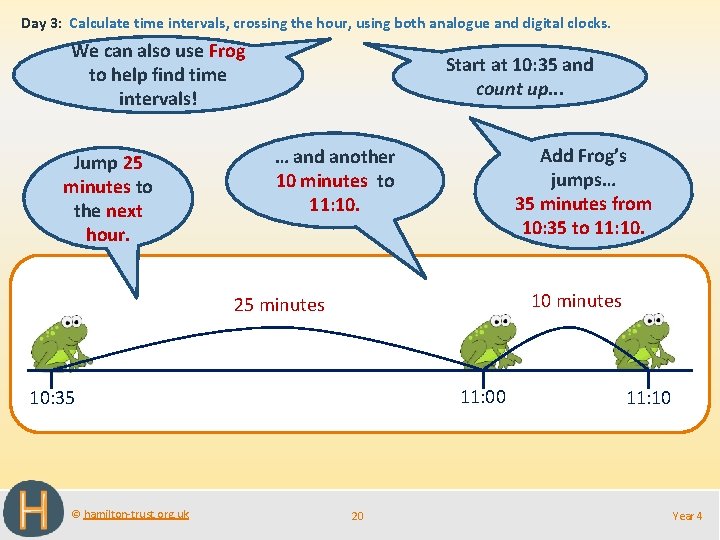
Day 3: Calculate time intervals, crossing the hour, using both analogue and digital clocks. We can also use Frog to help find time intervals! Jump 25 minutes to the next hour. Start at 10: 35 and count up. . . Add Frog’s jumps… 35 minutes from 10: 35 to 11: 10. … and another 10 minutes to 11: 10. 10 minutes 25 minutes 11: 00 10: 35 © hamilton-trust. org. uk 20 11: 10 Year 4
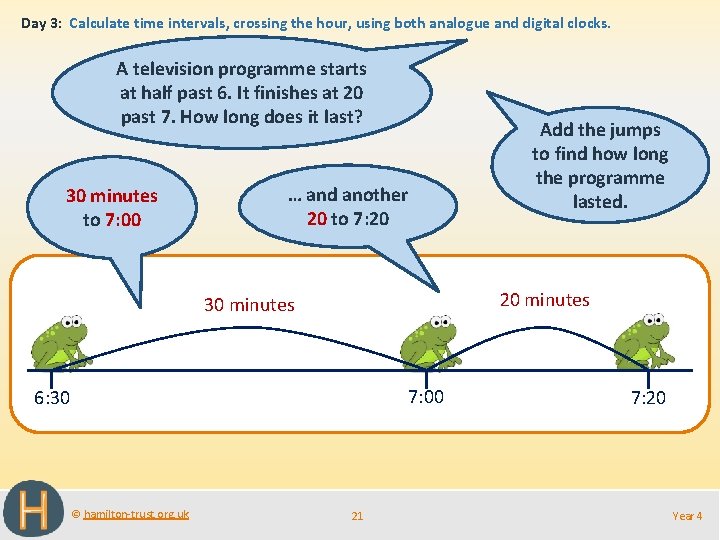
Day 3: Calculate time intervals, crossing the hour, using both analogue and digital clocks. A television programme starts at half past 6. It finishes at 20 past 7. How long does it last? 30 minutes to 7: 00 Add the jumps to find how long the programme lasted. … and another 20 to 7: 20 20 minutes 30 minutes 7: 00 6: 30 © hamilton-trust. org. uk 21 7: 20 Year 4
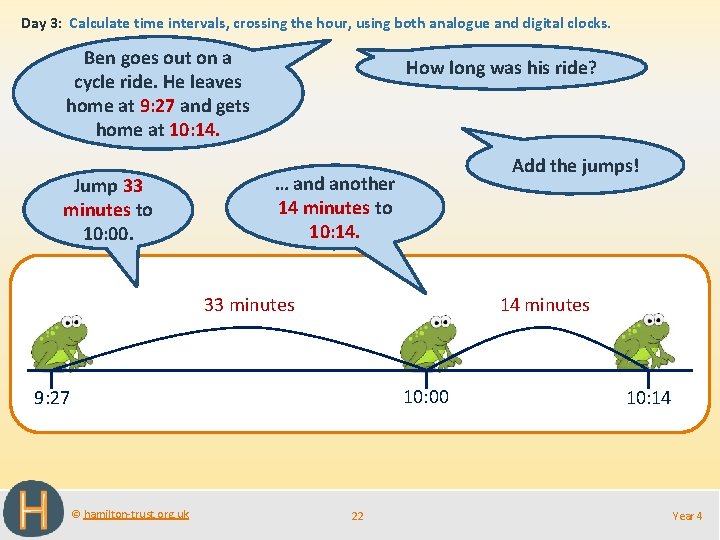
Day 3: Calculate time intervals, crossing the hour, using both analogue and digital clocks. Ben goes out on a cycle ride. He leaves home at 9: 27 and gets home at 10: 14. Jump 33 minutes to 10: 00. How long was his ride? Add the jumps! … and another 14 minutes to 10: 14. 33 minutes 14 minutes 10: 00 9: 27 © hamilton-trust. org. uk 22 10: 14 Year 4
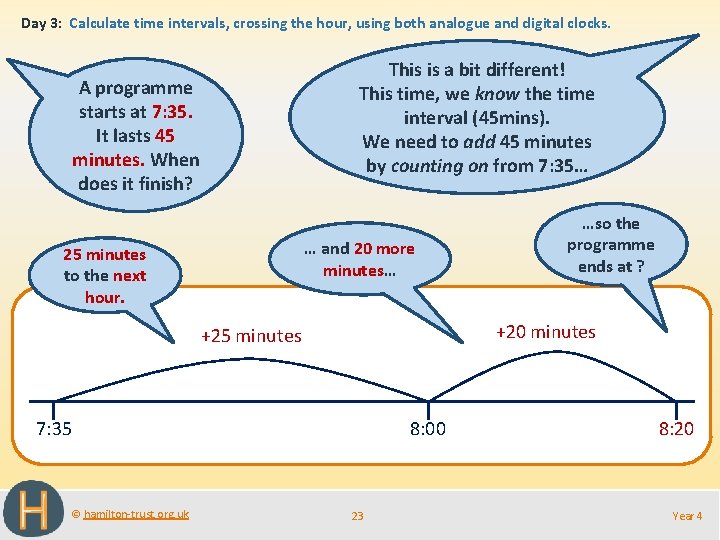
Day 3: Calculate time intervals, crossing the hour, using both analogue and digital clocks. This is a bit different! This time, we know the time interval (45 mins). We need to add 45 minutes by counting on from 7: 35… A programme starts at 7: 35. It lasts 45 minutes. When does it finish? … and 20 more minutes… 25 minutes to the next hour. +20 minutes +25 minutes 8: 00 7: 35 © hamilton-trust. org. uk …so the programme ends at ? 23 8: 20 Year 4
© hamilton-trust. org. uk 24 Year 4
Measures and Data Telling time to nearest minute am and pm Well Done! You’ve completed this unit. Objectives Day 1 Revise telling the time, am and pm, to the nearest minute on both analogue and digital clocks; convert between analogue and digital clocks. Day 2 Work out time intervals crossing the hour, on both analogue and digital clocks. Day 3 Calculate time intervals, crossing the hour, using both analogue and digital clocks. © hamilton-trust. org. uk 25 Year 4
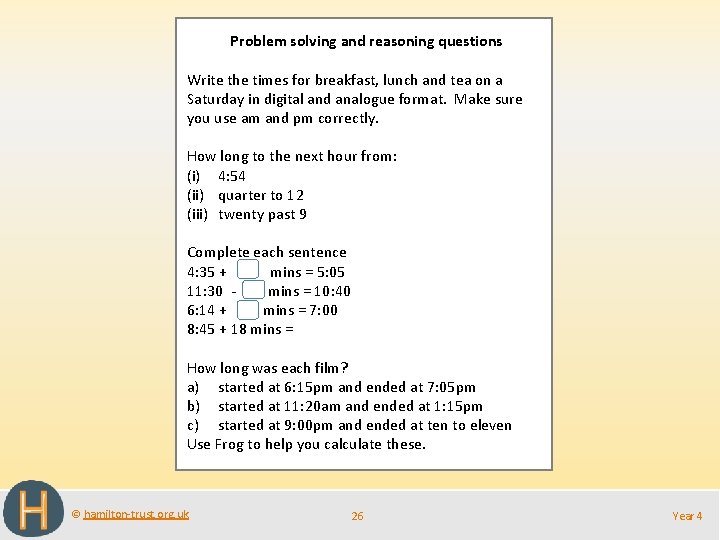
Problem solving and reasoning questions Write the times for breakfast, lunch and tea on a Saturday in digital and analogue format. Make sure you use am and pm correctly. How long to the next hour from: (i) 4: 54 (ii) quarter to 12 (iii) twenty past 9 Complete each sentence 4: 35 + mins = 5: 05 11: 30 mins = 10: 40 6: 14 + mins = 7: 00 8: 45 + 18 mins = How long was each film? a) started at 6: 15 pm and ended at 7: 05 pm b) started at 11: 20 am and ended at 1: 15 pm c) started at 9: 00 pm and ended at ten to eleven Use Frog to help you calculate these. © hamilton-trust. org. uk 26 Year 4
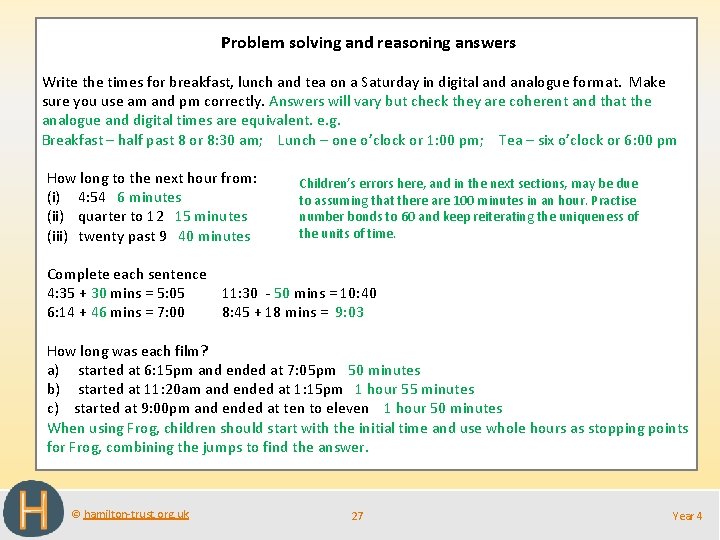
Problem solving and reasoning answers Write the times for breakfast, lunch and tea on a Saturday in digital and analogue format. Make sure you use am and pm correctly. Answers will vary but check they are coherent and that the analogue and digital times are equivalent. e. g. Breakfast – half past 8 or 8: 30 am; Lunch – one o’clock or 1: 00 pm; Tea – six o’clock or 6: 00 pm How long to the next hour from: (i) 4: 54 6 minutes (ii) quarter to 12 15 minutes (iii) twenty past 9 40 minutes Children’s errors here, and in the next sections, may be due to assuming that there are 100 minutes in an hour. Practise number bonds to 60 and keep reiterating the uniqueness of the units of time. Complete each sentence 4: 35 + 30 mins = 5: 05 11: 30 - 50 mins = 10: 40 6: 14 + 46 mins = 7: 00 8: 45 + 18 mins = 9: 03 How long was each film? a) started at 6: 15 pm and ended at 7: 05 pm 50 minutes b) started at 11: 20 am and ended at 1: 15 pm 1 hour 55 minutes c) started at 9: 00 pm and ended at ten to eleven 1 hour 50 minutes When using Frog, children should start with the initial time and use whole hours as stopping points for Frog, combining the jumps to find the answer. © hamilton-trust. org. uk 27 Year 4