
Measurements of Wake Vortex Separation at High Arrival


- Slides: 37
Measurements of Wake Vortex Separation at High Arrival Rates: Proposal for a New WV Separation Philosophy 5 th Eurocontrol/FAA ATM R&D Conference 23 -27 June 2003, Budapest, Hungary G. L. Donohue and R. C. Haynie Dept. of Systems Engineering & Operations Research George Mason University Fairfax, VA David Rutishauser NASA Langley Research Center Hampton, VA
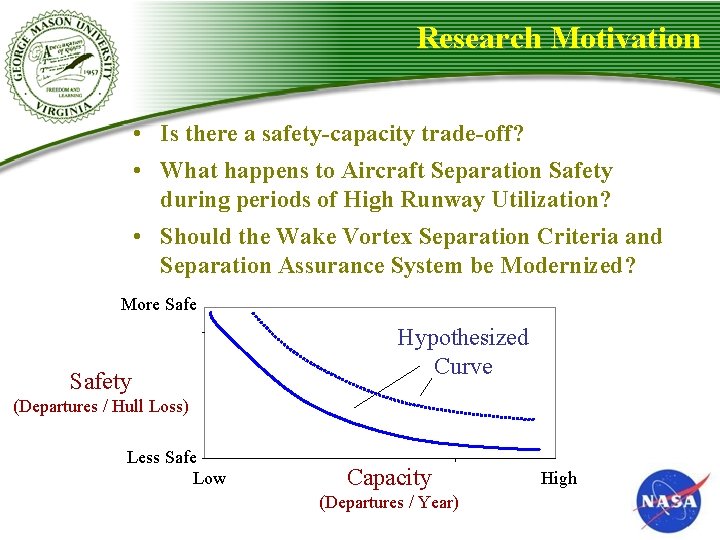
Research Motivation • Is there a safety-capacity trade-off? • What happens to Aircraft Separation Safety during periods of High Runway Utilization? • Should the Wake Vortex Separation Criteria and Separation Assurance System be Modernized? More Safety Hypothesized Curve (Departures / Hull Loss) Less Safe Low Capacity (Departures / Year) High
Outline • Current Static WV Separation Standards • Data collection process • Results from data collection • Observations on Current Operations • Proposed Future Dynamic WV Separation Architecture • Summary and Proposed Work to Be Done
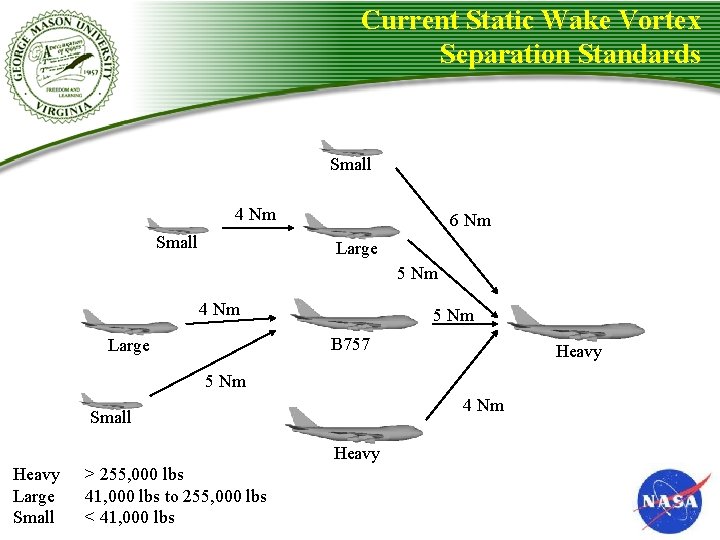
Current Static Wake Vortex Separation Standards Small 4 Nm Small 6 Nm Large 5 Nm 4 Nm 5 Nm B 757 Large Heavy 5 Nm 4 Nm Small Heavy Large Small > 255, 000 lbs 41, 000 lbs to 255, 000 lbs < 41, 000 lbs
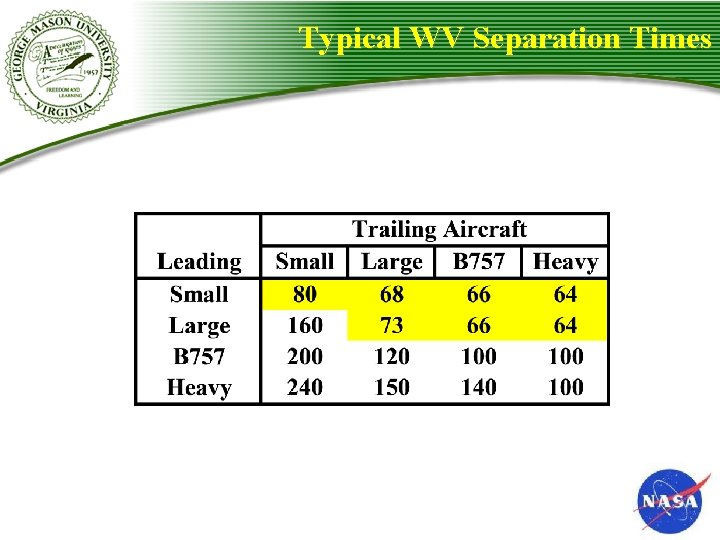
Typical WV Separation Times
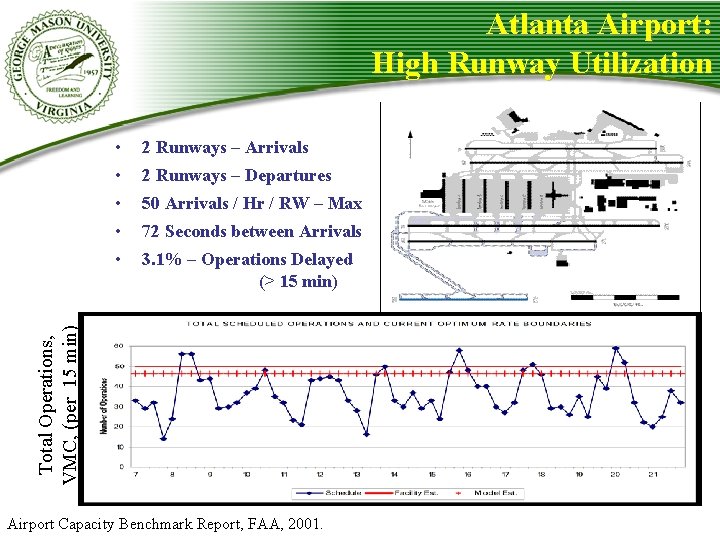
Atlanta Airport: High Runway Utilization 2 Runways – Arrivals • 2 Runways – Departures • 50 Arrivals / Hr / RW – Max • 72 Seconds between Arrivals • 3. 1% – Operations Delayed (> 15 min) Total Operations, VMC, (per 15 min) • Airport Capacity Benchmark Report, FAA, 2001.
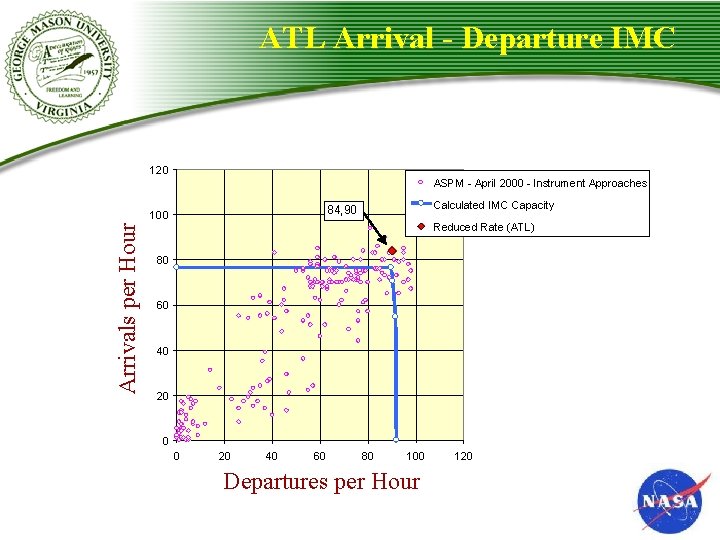
ATL Arrival - Departure IMC 120 ASPM - April 2000 - Instrument Approaches Arrivals per Hour Calculated IMC Capacity 84, 90 100 Reduced Rate (ATL) 80 60 40 20 0 0 20 40 60 80 100 Departures per Hour 120
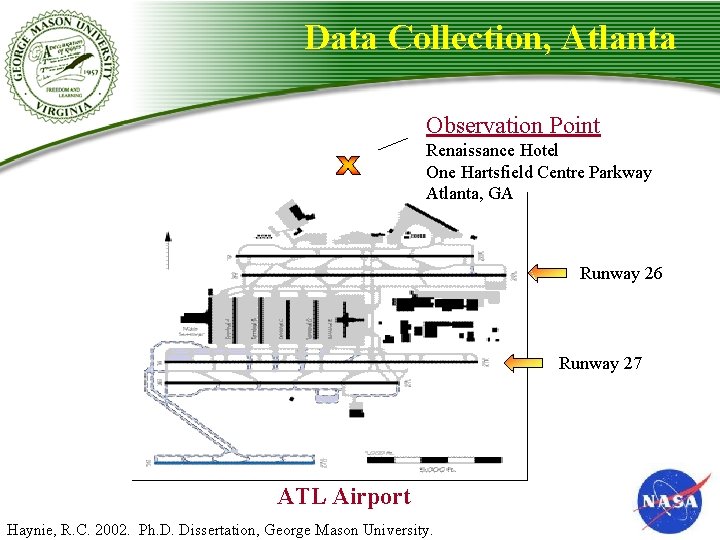
Data Collection, Atlanta Observation Point Renaissance Hotel One Hartsfield Centre Parkway Atlanta, GA Runway 26 Runway 27 ATL Airport Haynie, R. C. 2002. Ph. D. Dissertation, George Mason University.
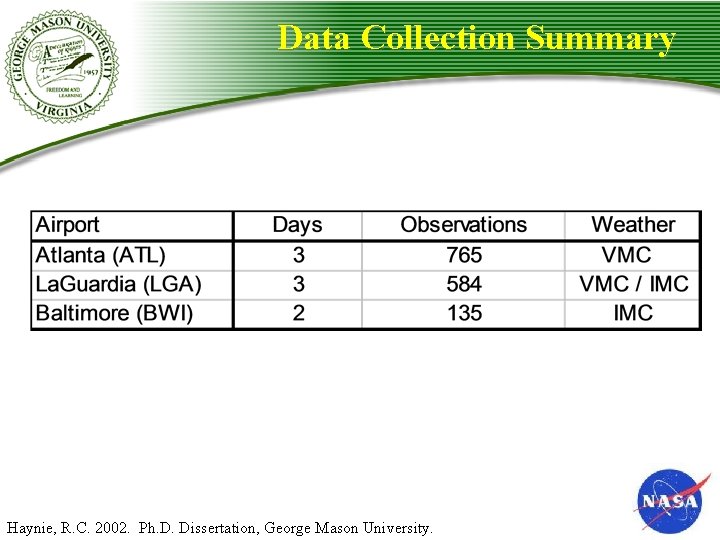
Data Collection Summary Haynie, R. C. 2002. Ph. D. Dissertation, George Mason University.
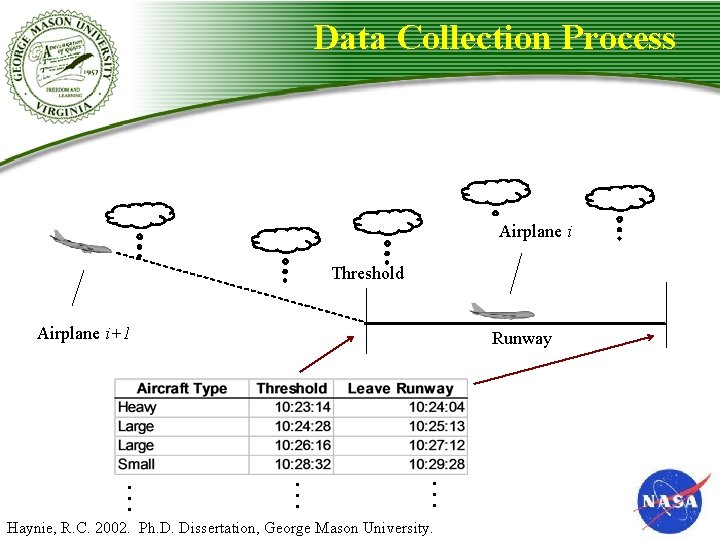
Data Collection Process Airplane i Threshold Airplane i+1 Runway . . Haynie, R. C. 2002. Ph. D. Dissertation, George Mason University.
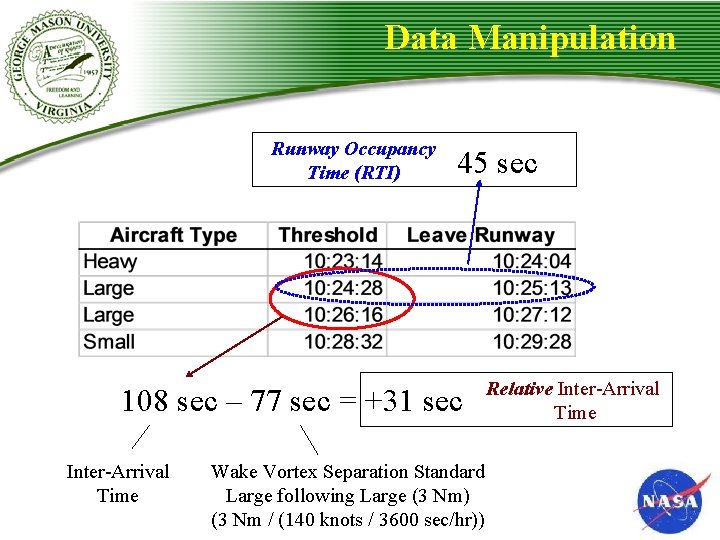
Data Manipulation Runway Occupancy Time (RTI) 45 sec 108 sec – 77 sec = +31 sec Inter-Arrival Time Wake Vortex Separation Standard Large following Large (3 Nm) (3 Nm / (140 knots / 3600 sec/hr)) Relative Inter-Arrival Time
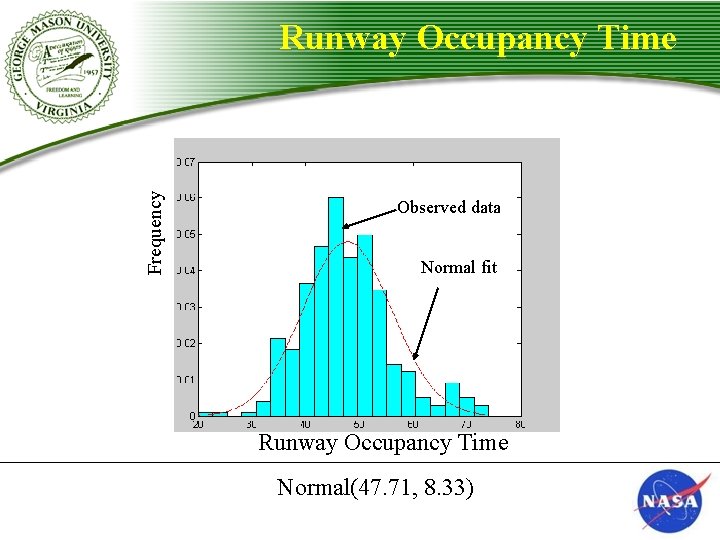
Frequency Runway Occupancy Time Observed data Normal fit Runway Occupancy Time Normal(47. 71, 8. 33)
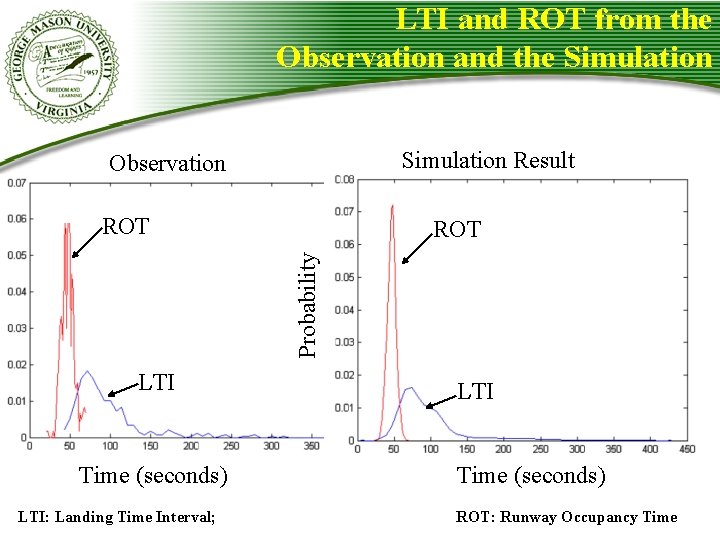
LTI and ROT from the Observation and the Simulation Result Observation ROT Probability ROT LTI Time (seconds) LTI: Landing Time Interval; ROT: Runway Occupancy Time
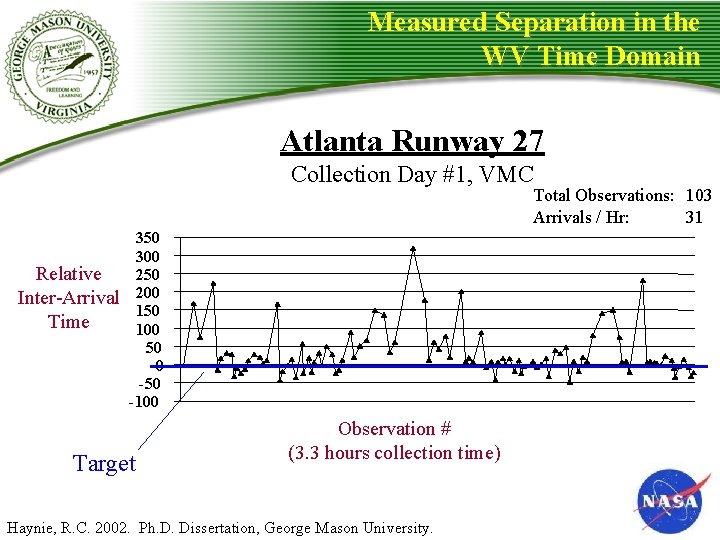
Measured Separation in the WV Time Domain Atlanta Runway 27 Collection Day #1, VMC Total Observations: 103 Arrivals / Hr: 31 Relative Inter-Arrival Time 350 300 250 200 150 100 50 0 -50 -100 Target Observation # (3. 3 hours collection time) Haynie, R. C. 2002. Ph. D. Dissertation, George Mason University.
Histogram of WV Time Domain Separation Atlanta Runway 27 All Collection Days, VMC Lost Capacity # Occurrences Lost Safety Relative Inter-arrival Time (sec) Haynie, R. C. 2002. Ph. D. Dissertation, George Mason University.
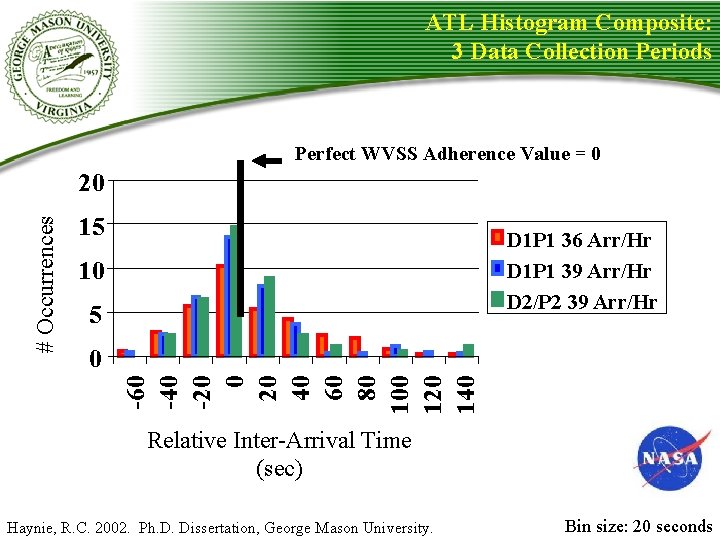
ATL Histogram Composite: 3 Data Collection Periods Perfect WVSS Adherence Value = 0 15 D 1 P 1 36 Arr/Hr D 1 P 1 39 Arr/Hr D 2/P 2 39 Arr/Hr 10 5 0 -60 -40 -20 0 20 40 60 80 100 120 140 # Occurrences 20 Relative Inter-Arrival Time (sec) Haynie, R. C. 2002. Ph. D. Dissertation, George Mason University. Bin size: 20 seconds
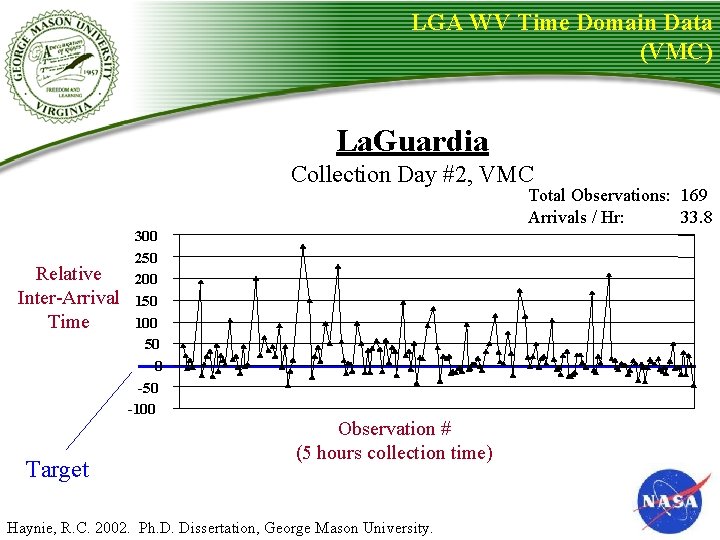
LGA WV Time Domain Data (VMC) La. Guardia Collection Day #2, VMC Total Observations: 169 Arrivals / Hr: 33. 8 Relative Inter-Arrival Time Target 300 250 200 150 100 50 0 -50 -100 Observation # (5 hours collection time) Haynie, R. C. 2002. Ph. D. Dissertation, George Mason University.
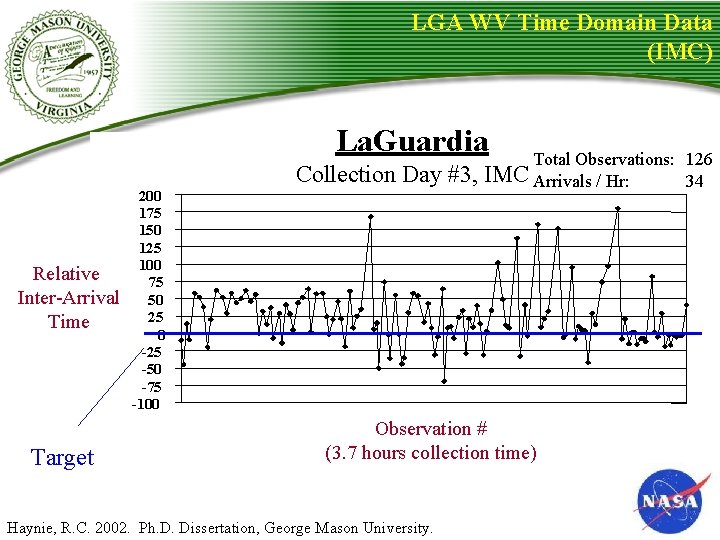
LGA WV Time Domain Data (IMC) La. Guardia Collection Day #3, Relative Inter-Arrival Time Target 200 175 150 125 100 75 50 25 0 -25 -50 -75 -100 Total Observations: 126 IMC Arrivals / Hr: 34 Observation # (3. 7 hours collection time) Haynie, R. C. 2002. Ph. D. Dissertation, George Mason University.
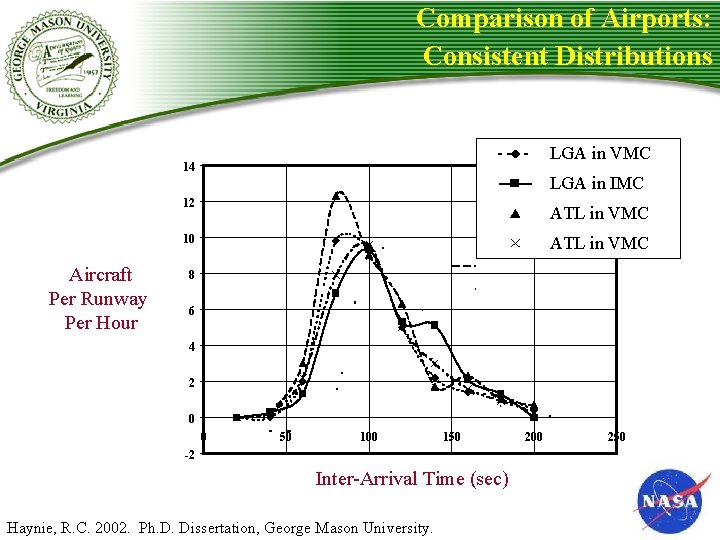
Comparison of Airports: Consistent Distributions LGA in VMC 14 LGA in IMC 12 ATL in VMC 10 Aircraft Per Runway Per Hour ATL in VMC 8 6 4 2 0 0 50 100 150 -2 Inter-Arrival Time (sec) Haynie, R. C. 2002. Ph. D. Dissertation, George Mason University. 200 250
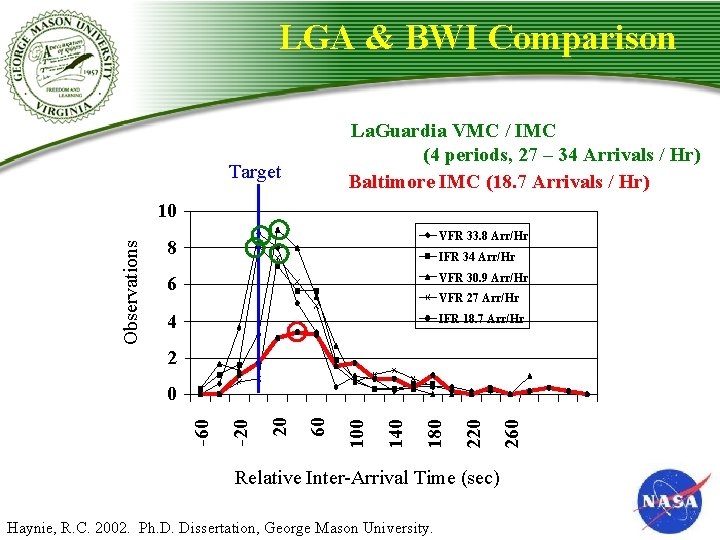
LGA & BWI Comparison La. Guardia VMC / IMC (4 periods, 27 – 34 Arrivals / Hr) Baltimore IMC (18. 7 Arrivals / Hr) Target Observations 10 VFR 33. 8 Arr/Hr 8 IFR 34 Arr/Hr 6 VFR 30. 9 Arr/Hr 4 IFR 18. 7 Arr/Hr VFR 27 Arr/Hr 2 Relative Inter-Arrival Time (sec) Haynie, R. C. 2002. Ph. D. Dissertation, George Mason University. 260 220 180 140 100 60 20 -60 0
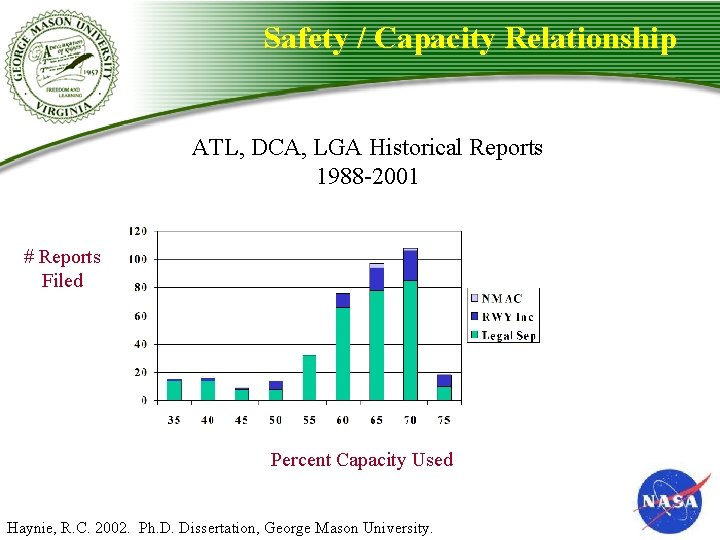
Safety / Capacity Relationship ATL, DCA, LGA Historical Reports 1988 -2001 # Reports Filed Percent Capacity Used Haynie, R. C. 2002. Ph. D. Dissertation, George Mason University.
Observations on Current Operations • Inter-arrival times indicate frequent loss of WV separation • Shape of inter-arrival distributions similar – For different airports – For IMC / VMC • Some evidence for decline in safety for higher arrival rates – Are Current Static Separation Criteria Correct for Capacity Constrained Airports? • Small data set (~ 1, 500 points) – more needed • Data can be used as input to more sophisticated safety models (TOPAZ)
Is It Time to Change the WV Separation Philosophy? • Wake separation rules are static – Based on empirical measurements – represent a response to worst-case persistence of wake hazard • Over 30 years of wake research have produced the potential for a dramatic increase in knowledge about the persistence of wake hazard – New Data and technologies demonstrated in both the European and NASA Programs • Introduction of systems and procedures that utilize this improved knowledge of wake hazard durations Could allow for Increases in Capacity at a Specified Level of Safety!
Proposed Changes to Current Standards and Operations • Utilize a hybrid of ground-based and airborne systems – integrated to produce increased (and dynamic) knowledge and prediction of wake hazards • Develop and Deploy a System to provide accurate wake hazard durations for Arrival Rate Prediction – Controllers use hazard information to set Arrival Rate – Information also provided to pilots of appropriately equipped aircraft to enhance situational awareness – Aircraft Equipped to Maintain Time-Based Separation have Separation Responsibility – Separation responsibility remains with controller during instrument operations for Non-Equipped Aircraft
Proposed Changes to Current Responsibilities • Roles/responsibilities – System provides wake hazard durations/wakesafe spacing recommendations – Approach and Tower Controllers responsible for safe spacing/separation Arrival or Departure Rate based on system recommendations – Airport arrival/departure rate changes communicated to the appropriate traffic flow management entities (e. g. Air Traffic Control System Command Center (ATCSCC) and Traffic Management Units (TMUs)
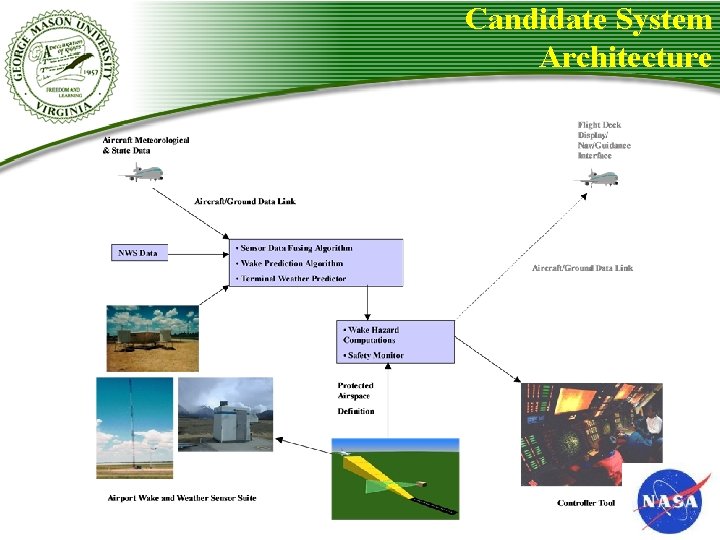
Candidate System Architecture
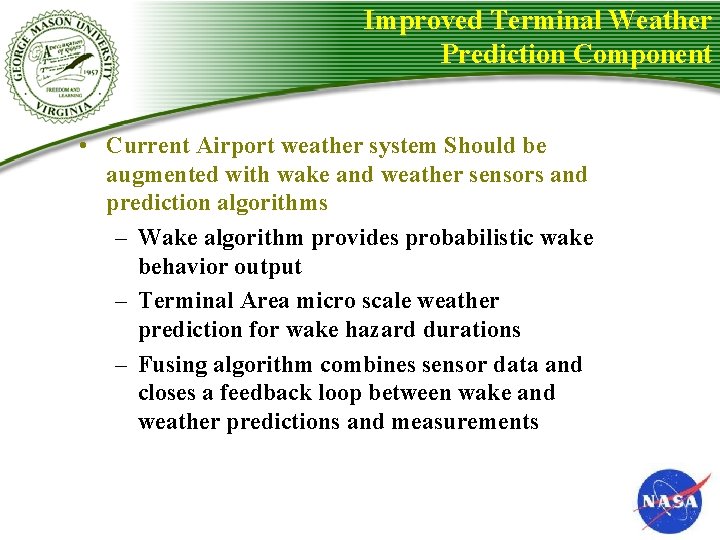
Improved Terminal Weather Prediction Component • Current Airport weather system Should be augmented with wake and weather sensors and prediction algorithms – Wake algorithm provides probabilistic wake behavior output – Terminal Area micro scale weather prediction for wake hazard durations – Fusing algorithm combines sensor data and closes a feedback loop between wake and weather predictions and measurements
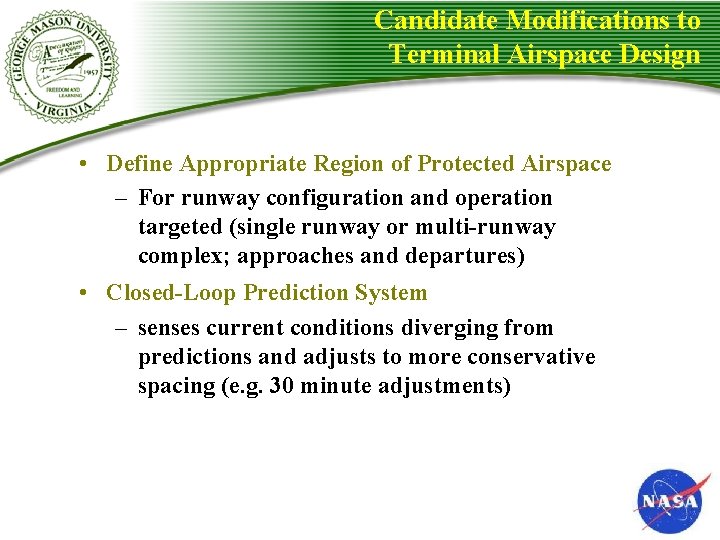
Candidate Modifications to Terminal Airspace Design • Define Appropriate Region of Protected Airspace – For runway configuration and operation targeted (single runway or multi-runway complex; approaches and departures) • Closed-Loop Prediction System – senses current conditions diverging from predictions and adjusts to more conservative spacing (e. g. 30 minute adjustments)
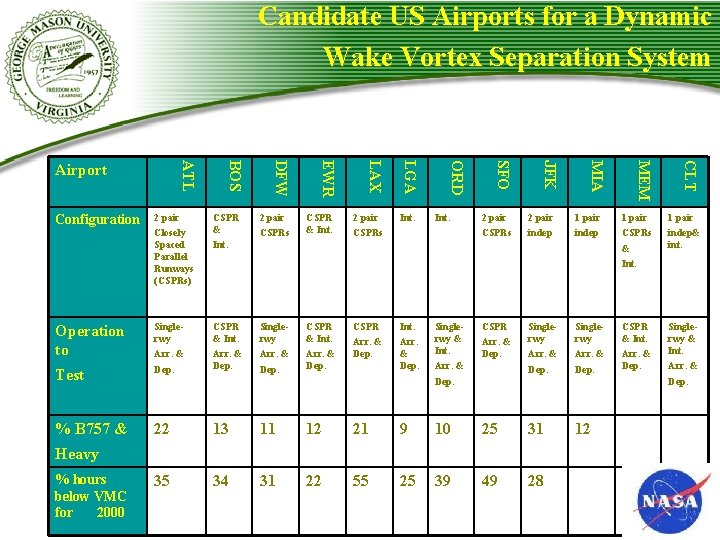
Candidate US Airports for a Dynamic Wake Vortex Separation System CLT 2 pair 1 pair CSPRs indep CSPRs indep& int. Int. & Int. Singlerwy CSPR & Int. Arr. & Dep. CSPR Int. Arr. & Dep. Arr. & Dep. Singlerwy & Int. CSPR Arr. & Dep. Arr. & Single- rwy CSPR & Int. Arr. & Dep. Test Dep. % B 757 & 22 13 11 12 21 9 10 25 31 35 34 31 22 55 25 39 49 28 Dep. Singlerwy & Int. Arr. & Dep. Heavy % hours below VMC for CY 2000 MEM CSPRs MIA Int. JFK Int. SFO 2 pair ORD CSPRs CSPR & Int. LGA 2 pair LAX Closely Spaced Parallel Runways (CSPRs) CSPR & EWR Operation to 2 pair DFW Configuration BOS ATL Airport 12
Summary • Policy Change Requirements – Develop Consensus on Wake Hazard Definition and Target Level of Safety Desired – Amend Current wake separation rules to incorporate Dynamic, Weather-Dependent Spacing • System Development Requirements – Standards for aircraft weather data, and data links – Wake and weather sensor maturation/FSD – Closed-Loop, probabilistic wake predictor design/PSD – Interface design/PSD • CONOPS Ref: – http: //ntrs. nasa. gov – NASA/TM-2003 -212176, April 2003
Specific Work Areas • Quantify accuracy/performance of all subsystems (wake/weather sensors) • Development of probabilistic wake predictor • Quantify temporal and spatial variation of relevant weather parameters (impacts weather sensor placement and coverage) • Performal safety analysis; rare event quantification • Define and acquire consensus on wake hazard specification • Quantify system valid prediction durations • Quantify dynamic spacing impacts on NAS • Quantify pilot/controller workload issues • Display design • Define data link requirements • Obtain required resolution weather data
Backup Slides
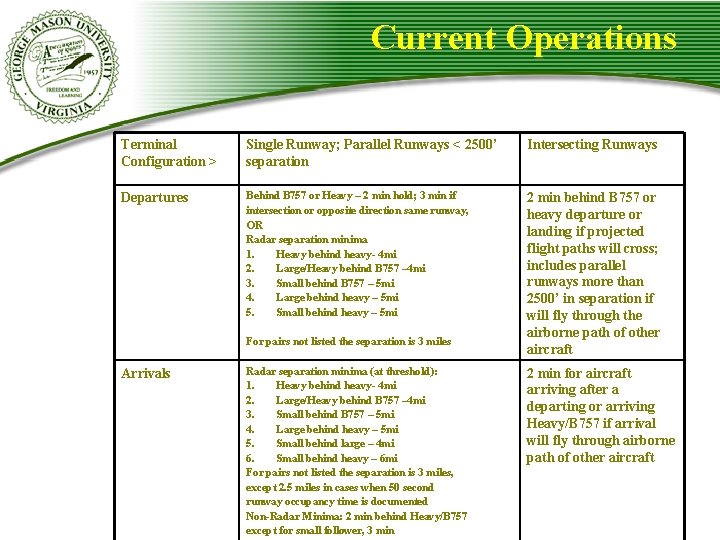
Current Operations Terminal Configuration > Single Runway; Parallel Runways < 2500’ separation Intersecting Runways Departures Behind B 757 or Heavy – 2 min hold; 3 min if intersection or opposite direction same runway, OR Radar separation minima 1. Heavy behind heavy- 4 mi 2. Large/Heavy behind B 757 – 4 mi 3. Small behind B 757 – 5 mi 4. Large behind heavy – 5 mi 5. Small behind heavy – 5 mi 2 min behind B 757 or heavy departure or landing if projected flight paths will cross; includes parallel runways more than 2500’ in separation if will fly through the airborne path of other aircraft For pairs not listed the separation is 3 miles Arrivals Radar separation minima (at threshold): 1. Heavy behind heavy- 4 mi 2. Large/Heavy behind B 757 – 4 mi 3. Small behind B 757 – 5 mi 4. Large behind heavy – 5 mi 5. Small behind large – 4 mi 6. Small behind heavy – 6 mi For pairs not listed the separation is 3 miles, except 2. 5 miles in cases when 50 second runway occupancy time is documented Non-Radar Minima: 2 min behind Heavy/B 757 except for small follower, 3 min 2 min for aircraft arriving after a departing or arriving Heavy/B 757 if arrival will fly through airborne path of other aircraft
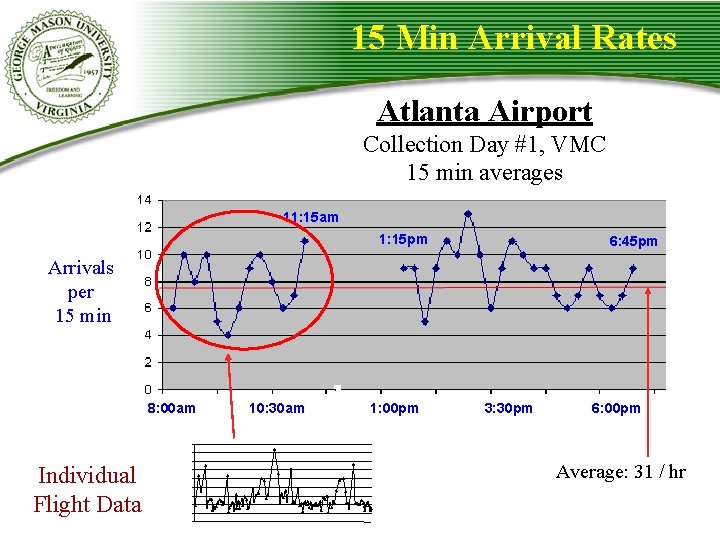
15 Min Arrival Rates Atlanta Airport Collection Day #1, VMC 15 min averages 11: 15 am 1: 15 pm 6: 45 pm Arrivals per 15 min 8: 00 am Individual Flight Data 10: 30 am 1: 00 pm 3: 30 pm 6: 00 pm Average: 31 / hr
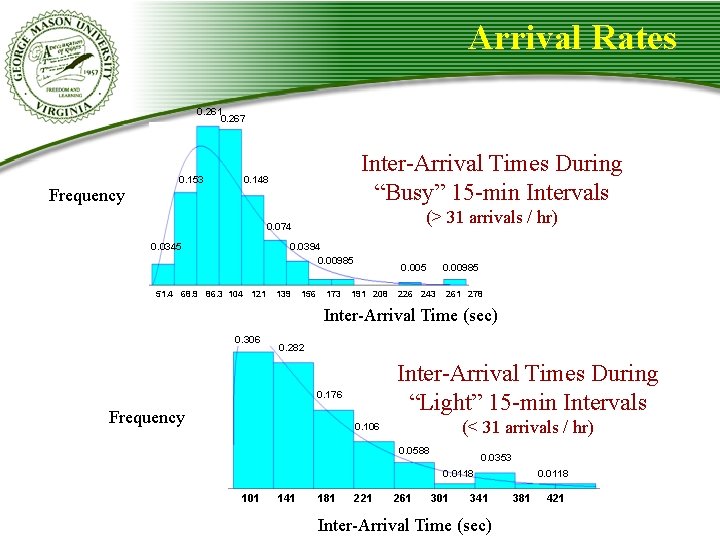
Arrival Rates 0. 261 0. 267 0. 153 Inter-Arrival Times During “Busy” 15 -min Intervals 0. 148 Frequency (> 31 arrivals / hr) 0. 074 0. 0345 0. 0394 0. 00985 51. 4 68. 9 86. 3 104 121 139 156 173 0. 005 191 208 0. 00985 226 243 261 278 Inter-Arrival Time (sec) 0. 306 0. 282 Inter-Arrival Times During “Light” 15 -min Intervals 0. 176 Frequency (< 31 arrivals / hr) 0. 106 0. 0588 0. 0353 0. 0118 101 141 181 221 261 301 341 Inter-Arrival Time (sec) 0. 0118 381 421
Modeling Implications • Typical Modeling Approach – Safety is a constraint (Maximum rate through node in network) – Capacity is metric of interest Queueing Constraints (Minimum Times Between Operations) • New Approach – Safety is a function of capacity / demand
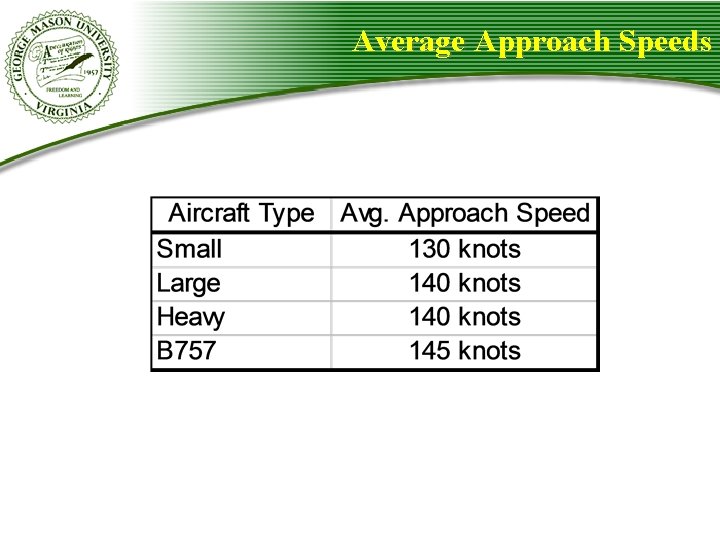
Average Approach Speeds