
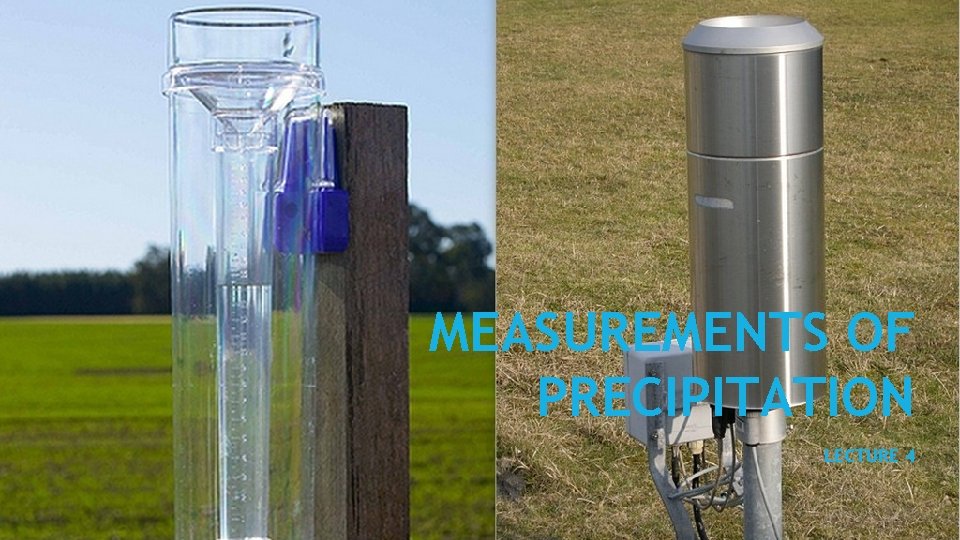
MEASUREMENTS OF PRECIPITATION LECTURE 4 MEASUREMENTS OF PRECIPITATION







- Slides: 31
MEASUREMENTS OF PRECIPITATION LECTURE 4
MEASUREMENTS OF PRECIPITATION It includes I. Amount of precipitation II. Duration of precipitation III. Intensity of precipitation IV. Areal extent of precipitation
MEASUREMENTS OF PRECIPITATION 1. AMOUNT OF PRECIPITATION Total depth of rain water (or Snow) assuming that there is no evaporation, transpiration, surface water losses or infiltration Units of measurements : mm or in 2. DURATION OF PRECIPITATION Difference between start time and ending time of the rain storm Units of measurements: hours or minutes
MEASUREMENTS OF PRECIPITATION 3. INTENSITY OF PRECIPITATION Amount of precipitation per unit time at a place, also known as “Rain Rate” Intensity depicts how fast or slow the rain storm is Units of measurements: mm/hour 4. AREAL EXTENT OF PRECIPITATION The area over which rainfall occurs Units of Measurements: miles 2 or km 2
MAIN APPROACHES TO MEASURE RAINFALL Rain gauges Ground Measurements Using radars Atmospheric Measurements Satellite measurements Ground measurements being the accurate most as it is closest to actual rain that falls on the adjacent ground That is why is the reliable most method of measurement Remote sensing
RAIN GAUGES Types of rain gauges Non-recording type rain gauges Recording type rain gauges Non-Recording Gauges Gives total amount of precipitation in the interval e. g. , 24 hors for daily observation Doesn’t provide continuous record Observer visits at prescribed time and measures rain e. g. , 8 O’clock in the morning for daily observation Examples : Standard Rain Gauge or US national weather bureau Rain gauge
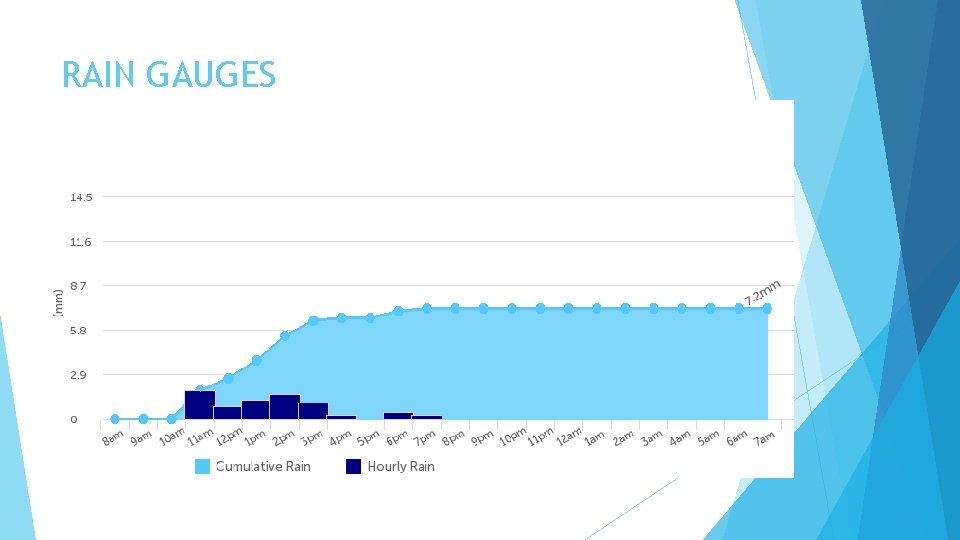
RAIN GAUGES Recording type Rain gauges: They give continuous record of amount of precipitation for interval on a graph paper attached called “Rain Chart” Examples: Tipping Bucket type Rain Gauge, Weighing type rain gauge, float type rain gauge , etc.
RAIN GAUGES
RAIN GAUGES What information is obtained from rain chart? No. of Rain storms Amount of precipitation in each rain storm Duration of precipitation in each rain storm Intensity of precipitation Total daily amounts Observer visits the recording rain gauge after fixed intervals and removes the older rain chart and replaces with a new one
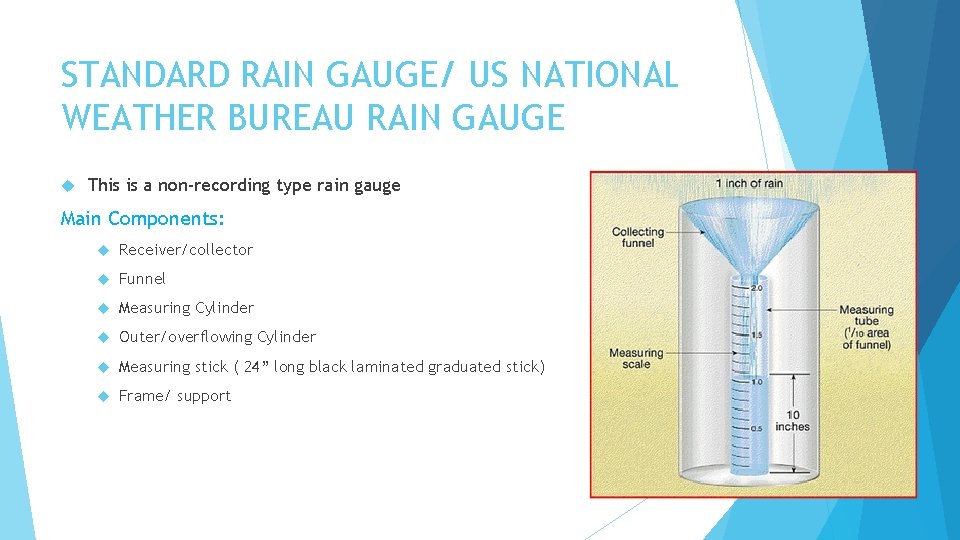
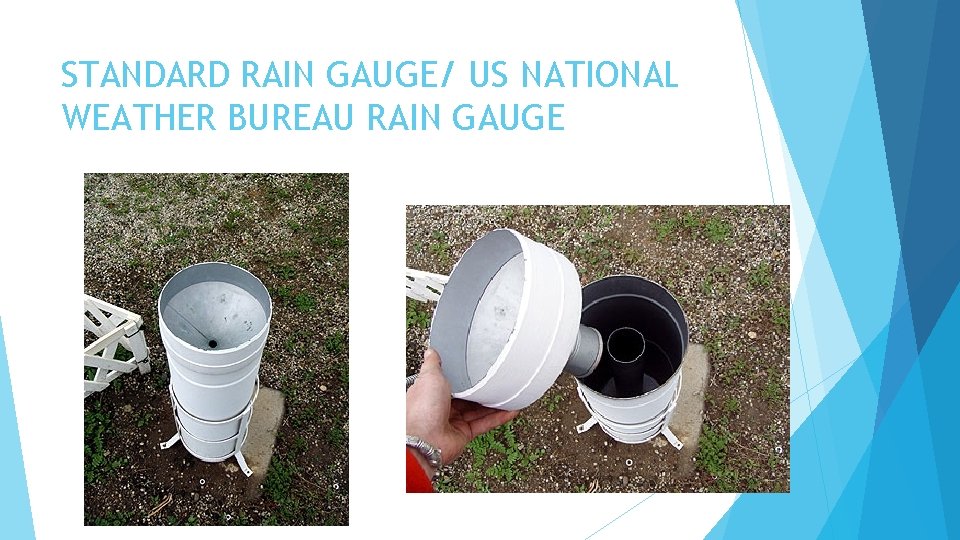
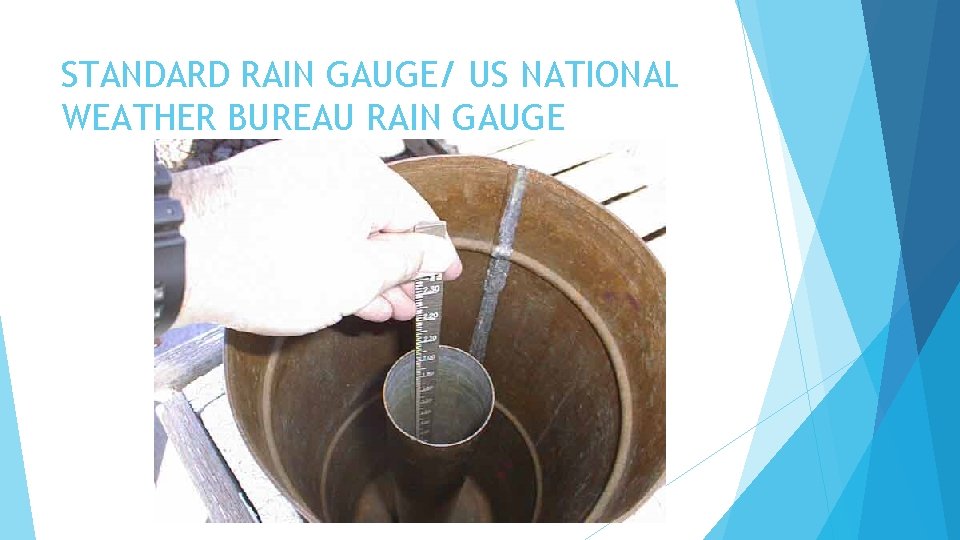
STANDARD RAIN GAUGE/ US NATIONAL WEATHER BUREAU RAIN GAUGE This is a non-recording type rain gauge Main Components: Receiver/collector Funnel Measuring Cylinder Outer/overflowing Cylinder Measuring stick ( 24” long black laminated graduated stick) Frame/ support
STANDARD RAIN GAUGE/ US NATIONAL WEATHER BUREAU RAIN GAUGE
STANDARD RAIN GAUGE/ US NATIONAL WEATHER BUREAU RAIN GAUGE
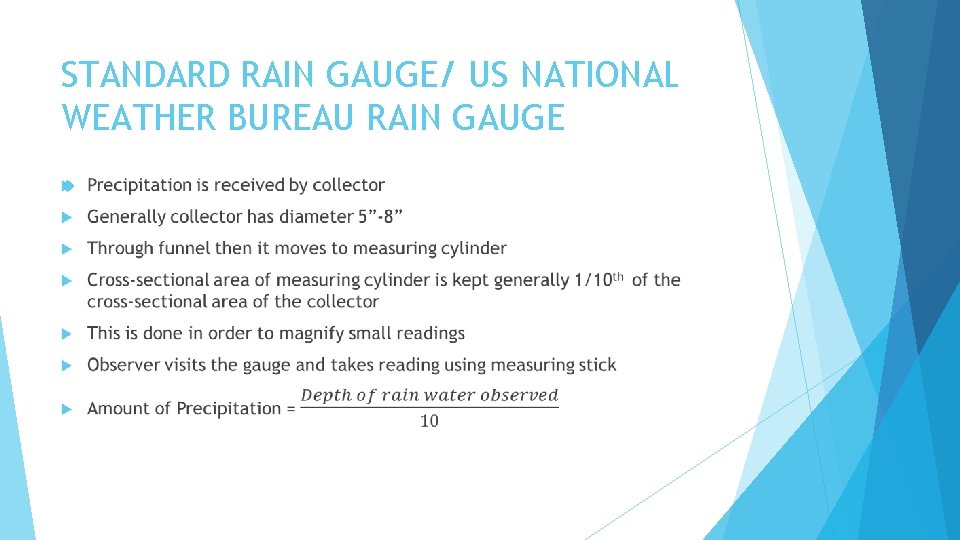
STANDARD RAIN GAUGE/ US NATIONAL WEATHER BUREAU RAIN GAUGE
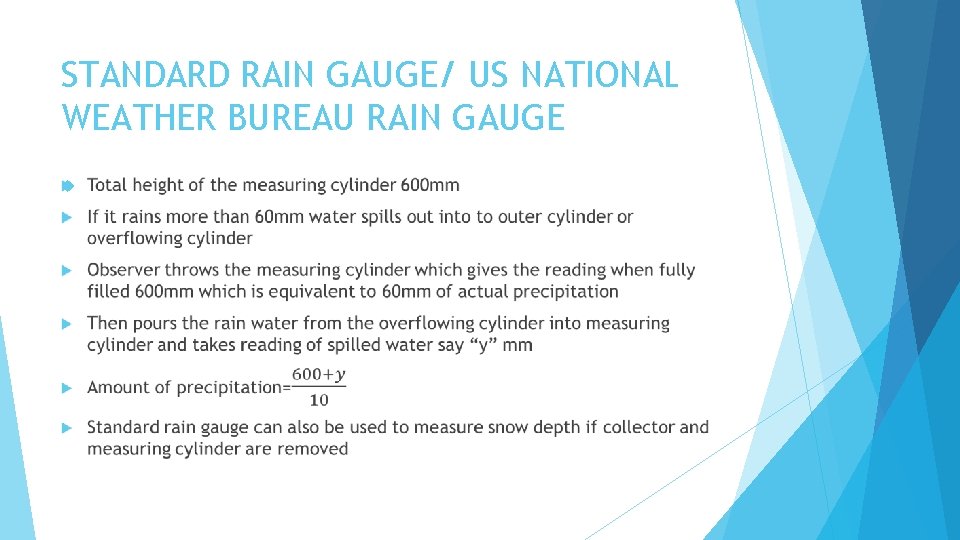
STANDARD RAIN GAUGE/ US NATIONAL WEATHER BUREAU RAIN GAUGE
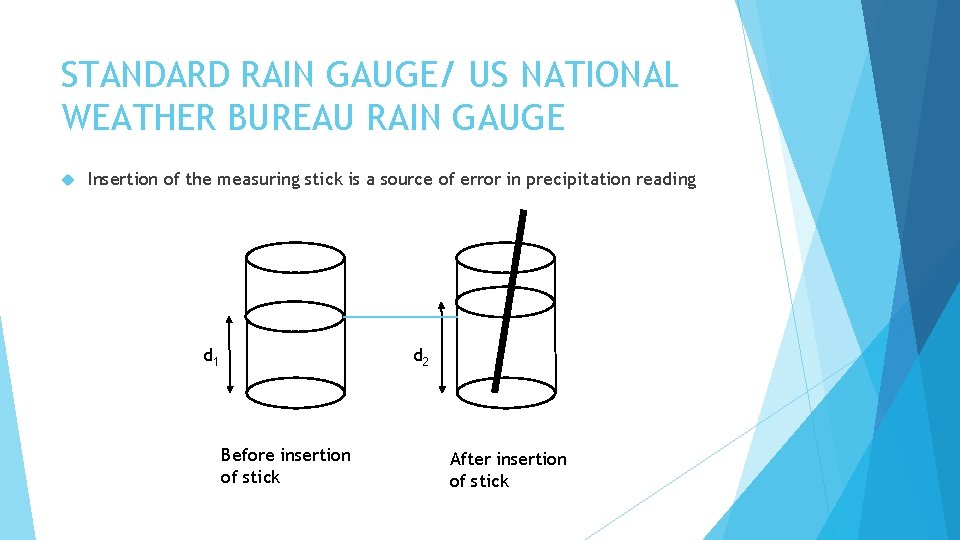
STANDARD RAIN GAUGE/ US NATIONAL WEATHER BUREAU RAIN GAUGE Insertion of the measuring stick is a source of error in precipitation reading d 1 d 2 Before insertion of stick After insertion of stick
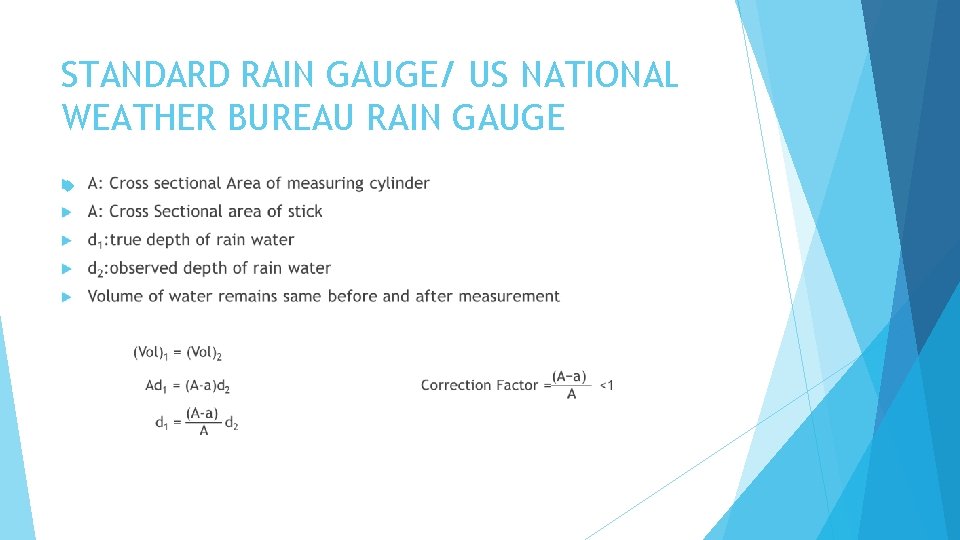
STANDARD RAIN GAUGE/ US NATIONAL WEATHER BUREAU RAIN GAUGE
RECORDING TYPE RAIN GAUGES They give continuous record of amount of precipitation for interval on a graph paper attached called “Rain Chart” Following are the examples of recording rain gauges: Tipping Bucket Rain Gauge Weighing Bucket type Rain Gauge Float Type Rain Gauge
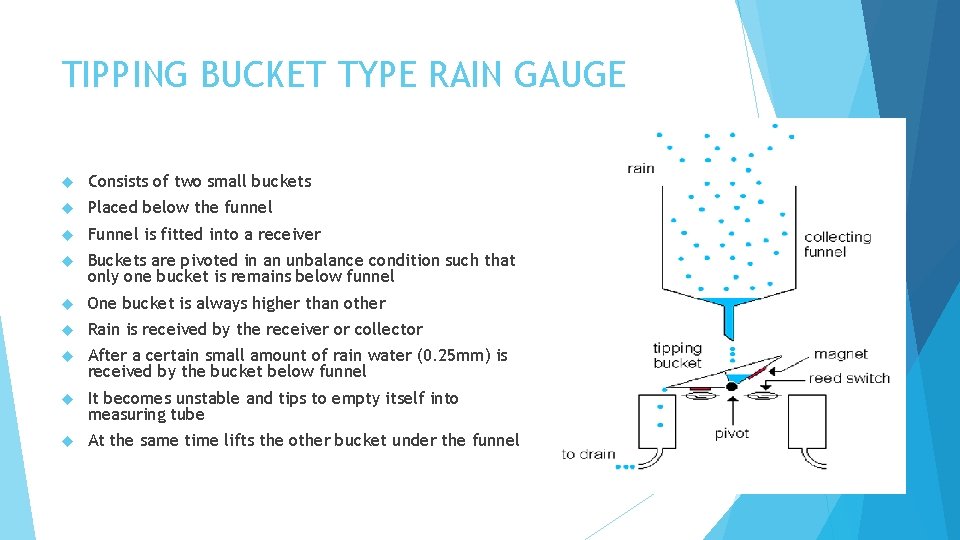
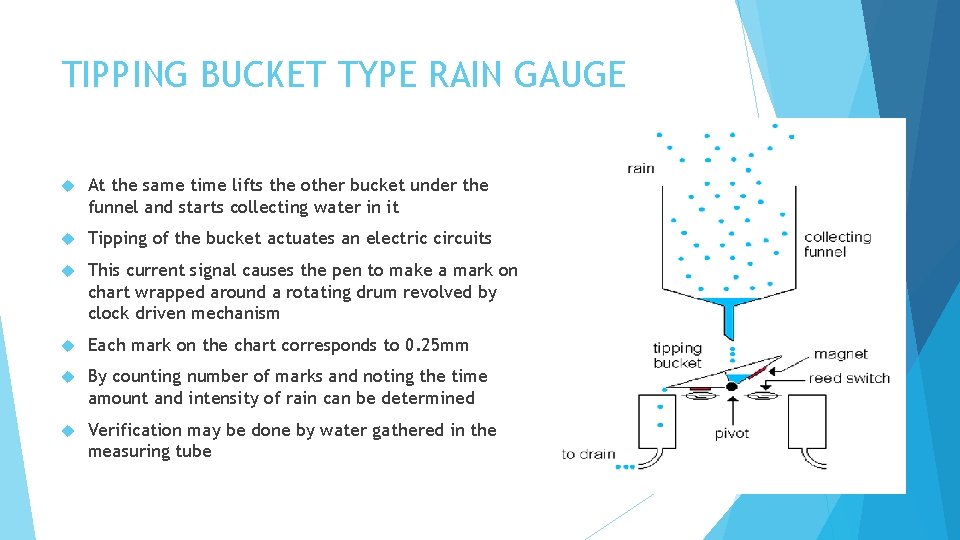
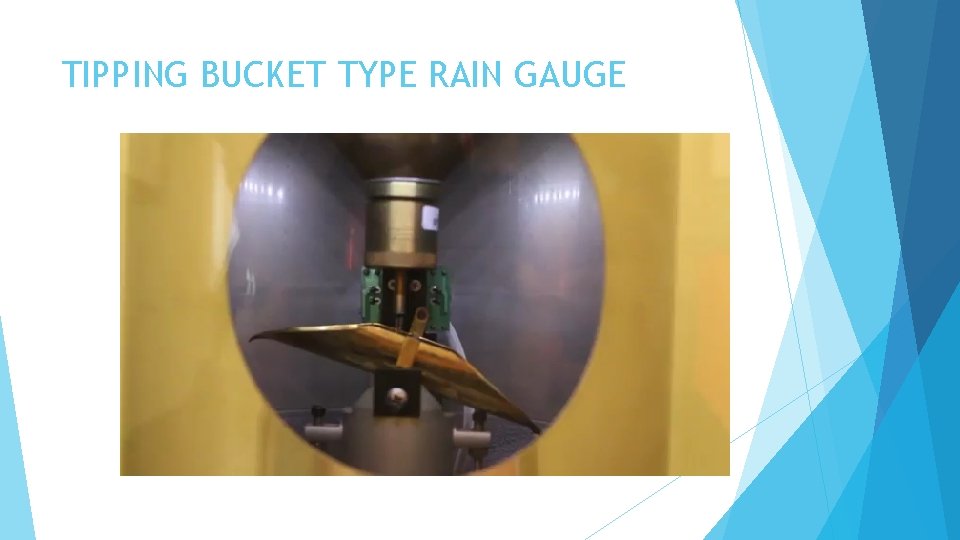
TIPPING BUCKET TYPE RAIN GAUGE Consists of two small buckets Placed below the funnel Funnel is fitted into a receiver Buckets are pivoted in an unbalance condition such that only one bucket is remains below funnel One bucket is always higher than other Rain is received by the receiver or collector After a certain small amount of rain water (0. 25 mm) is received by the bucket below funnel It becomes unstable and tips to empty itself into measuring tube At the same time lifts the other bucket under the funnel
TIPPING BUCKET TYPE RAIN GAUGE At the same time lifts the other bucket under the funnel and starts collecting water in it Tipping of the bucket actuates an electric circuits This current signal causes the pen to make a mark on chart wrapped around a rotating drum revolved by clock driven mechanism Each mark on the chart corresponds to 0. 25 mm By counting number of marks and noting the time amount and intensity of rain can be determined Verification may be done by water gathered in the measuring tube
TIPPING BUCKET TYPE RAIN GAUGE
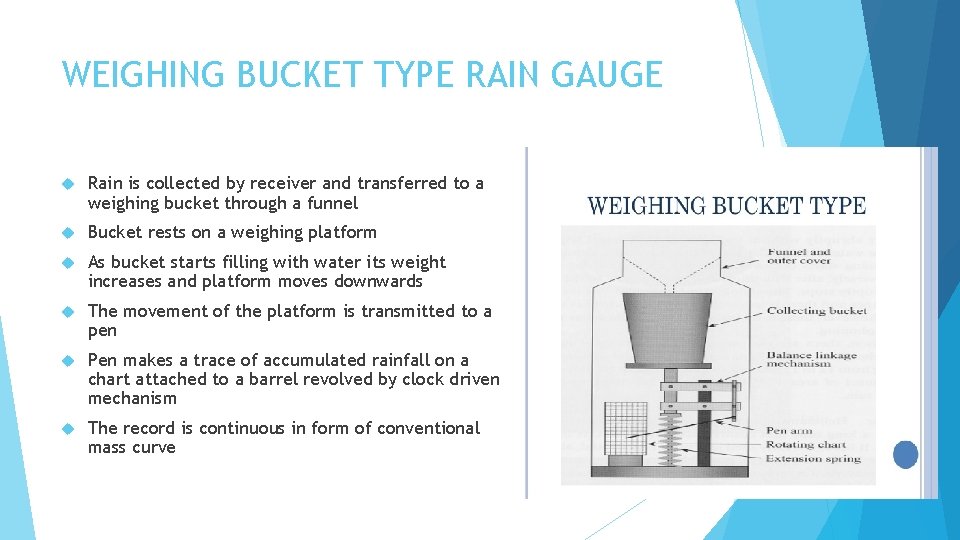
WEIGHING BUCKET TYPE RAIN GAUGE Rain is collected by receiver and transferred to a weighing bucket through a funnel Bucket rests on a weighing platform As bucket starts filling with water its weight increases and platform moves downwards The movement of the platform is transmitted to a pen Pen makes a trace of accumulated rainfall on a chart attached to a barrel revolved by clock driven mechanism The record is continuous in form of conventional mass curve
WEIGHING BUCKET TYPE RAIN GAUGE
WEIGHING BUCKET TYPE RAIN GAUGE The gauge must be serviced about once a week Clock is re-wound and the chart is replaced For high rainfall in a few gauges recording mechanism is reverses the direction of record immediately on reaching the upper edge of the recording chart
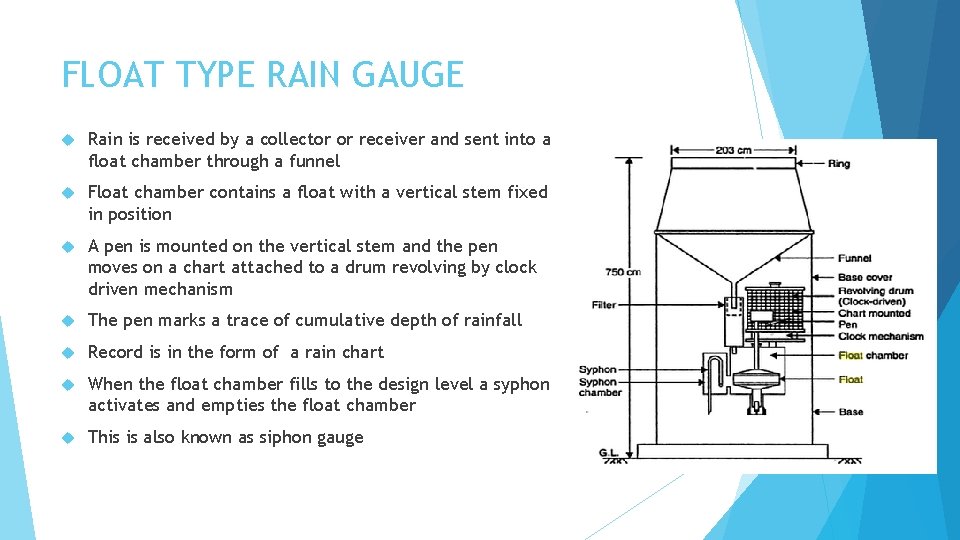
FLOAT TYPE RAIN GAUGE Rain is received by a collector or receiver and sent into a float chamber through a funnel Float chamber contains a float with a vertical stem fixed in position A pen is mounted on the vertical stem and the pen moves on a chart attached to a drum revolving by clock driven mechanism The pen marks a trace of cumulative depth of rainfall Record is in the form of a rain chart When the float chamber fills to the design level a syphon activates and empties the float chamber This is also known as siphon gauge
SNOWFALL MEASUREMENTS It may be measured in two ways: 1. Amount of snowfall 2. Equivalent amount of water Ø Equipment used: 1. Standard rain gauge without measuring cylinder 2. Weighing bucket type rain gauge 3. Snow gauge 4. By scratching snow pack
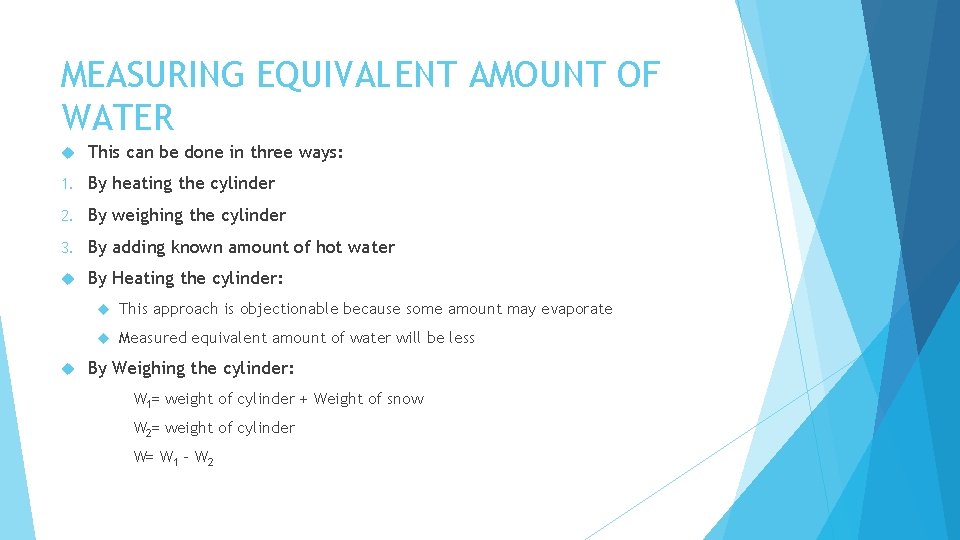
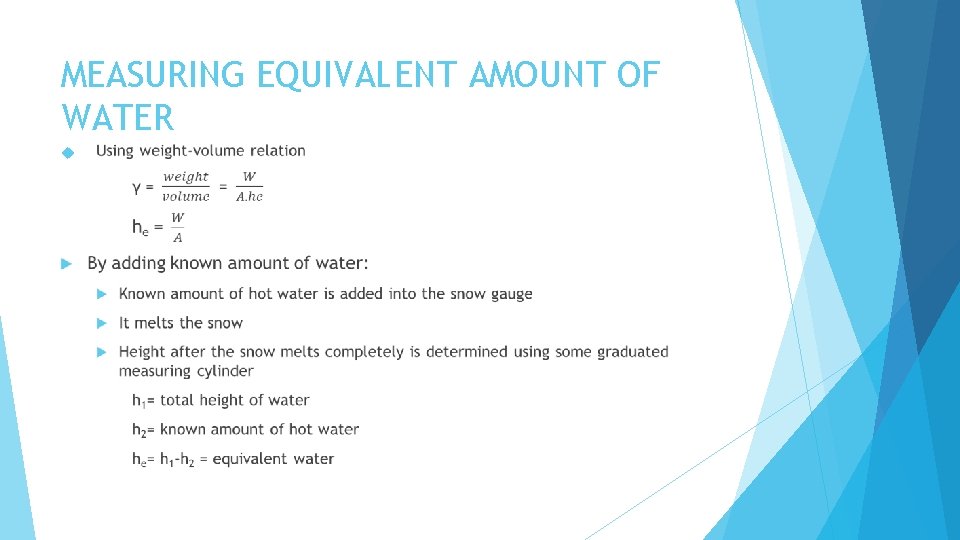
MEASURING EQUIVALENT AMOUNT OF WATER This can be done in three ways: 1. By heating the cylinder 2. By weighing the cylinder 3. By adding known amount of hot water By Heating the cylinder: This approach is objectionable because some amount may evaporate Measured equivalent amount of water will be less By Weighing the cylinder: W 1= weight of cylinder + Weight of snow W 2= weight of cylinder W= W 1 – W 2
MEASURING EQUIVALENT AMOUNT OF WATER
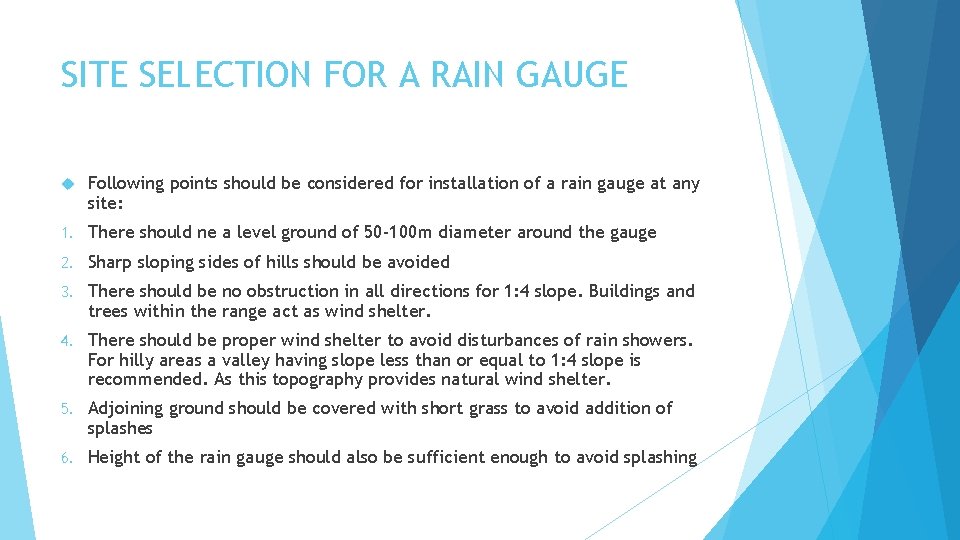
SITE SELECTION FOR A RAIN GAUGE Following points should be considered for installation of a rain gauge at any site: 1. There should ne a level ground of 50 -100 m diameter around the gauge 2. Sharp sloping sides of hills should be avoided 3. There should be no obstruction in all directions for 1: 4 slope. Buildings and trees within the range act as wind shelter. 4. There should be proper wind shelter to avoid disturbances of rain showers. For hilly areas a valley having slope less than or equal to 1: 4 slope is recommended. As this topography provides natural wind shelter. 5. Adjoining ground should be covered with short grass to avoid addition of splashes 6. Height of the rain gauge should also be sufficient enough to avoid splashing
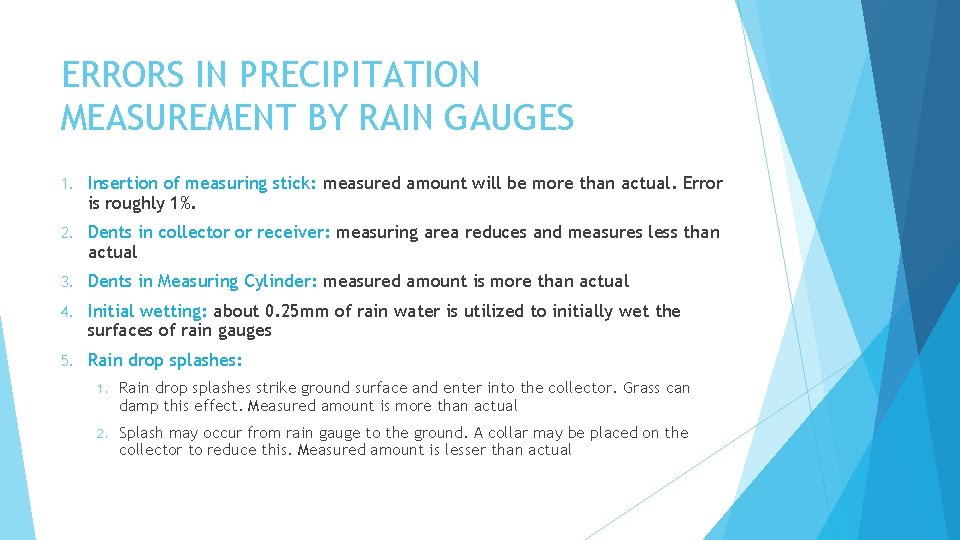
ERRORS IN PRECIPITATION MEASUREMENT BY RAIN GAUGES 1. Insertion of measuring stick: measured amount will be more than actual. Error is roughly 1%. 2. Dents in collector or receiver: measuring area reduces and measures less than actual 3. Dents in Measuring Cylinder: measured amount is more than actual 4. Initial wetting: about 0. 25 mm of rain water is utilized to initially wet the surfaces of rain gauges 5. Rain drop splashes: 1. Rain drop splashes strike ground surface and enter into the collector. Grass can damp this effect. Measured amount is more than actual 2. Splash may occur from rain gauge to the ground. A collar may be placed on the collector to reduce this. Measured amount is lesser than actual
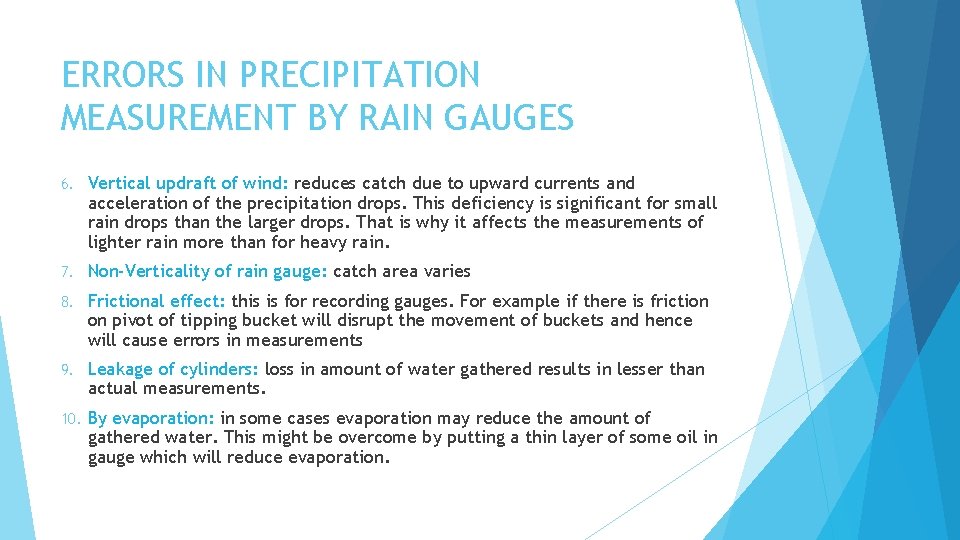
ERRORS IN PRECIPITATION MEASUREMENT BY RAIN GAUGES 6. Vertical updraft of wind: reduces catch due to upward currents and acceleration of the precipitation drops. This deficiency is significant for small rain drops than the larger drops. That is why it affects the measurements of lighter rain more than for heavy rain. 7. Non-Verticality of rain gauge: catch area varies 8. Frictional effect: this is for recording gauges. For example if there is friction on pivot of tipping bucket will disrupt the movement of buckets and hence will cause errors in measurements 9. Leakage of cylinders: loss in amount of water gathered results in lesser than actual measurements. 10. By evaporation: in some cases evaporation may reduce the amount of gathered water. This might be overcome by putting a thin layer of some oil in gauge which will reduce evaporation.
THANK YOU ANY QUESTIONS? ?