
Measurements of Photocathode Operational Lifetime at Beam Currents
Measurements of Photocathode Operational Lifetime at Beam Currents up to 10 m. A using an Improved DC High Voltage Ga. As Photogun J. Grames, M. Poelker, P. Adderley, J. Brittian, J. Clark, J. Hansknecht, M. Stutzman, K. Surles-Law BNL C-A Department February 9, 2007
Purpose & Overview Goal: Deliver high average current (> 1 m. A) and high polarization (> 80%) with long photocathode operational lifetime in support of new accelerator initiatives. Enhance our understanding of photocathode decay mechanism. This will undoubtedly allow us to improve existing polarized guns operating at lower average current and unpolarized guns at milli. Amp beam currents (e. g. , Lightsources). • Background • R&D Program • New DC HV Load Lock Gun • Low-P Ga. As Studies • High-P Ga. As Studies
CEBAF Polarized e- Source • CEBAF’s first polarized e-beam experiment 1997 • Now polarized beam experiments comprise ~ 80% of our physics program, in fact, we only deliver polarized electrons • All beam originates via photoemission from a Gallium Arsenside crystal inside a 100 k. V photogun • 35 weeks of beam delivery per year • 100 m. A at 85% polarization is fairly routine • Three experimental areas may simultaneously receive: – high polarization (~85%) => large asymmetry/ figure of merit – continuous wave (499 MHz) => high statistics/ low couting rates – independent intensity (50 p. A to 200 m. A) => target / acceptance – energy selection (multiples of linac energy) => flexibility
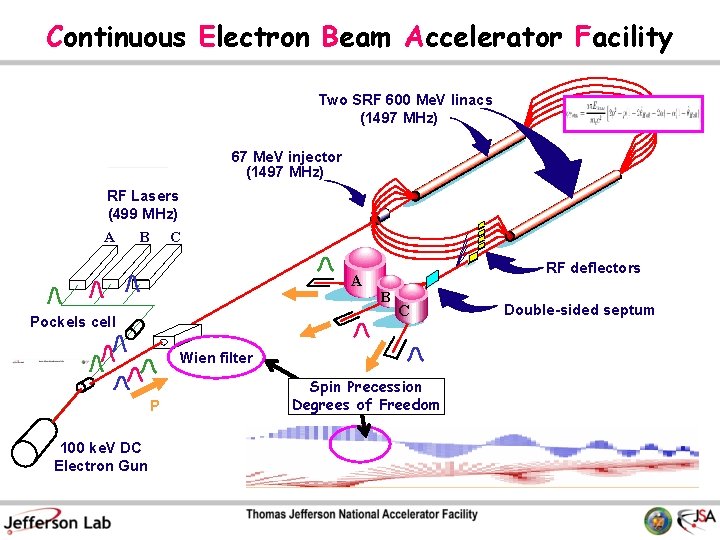
Continuous Electron Beam Accelerator Facility Two SRF 600 Me. V linacs (1497 MHz) 67 Me. V injector (1497 MHz) RF Lasers (499 MHz) A B C A Pockels cell RF deflectors B C Wien filter P 100 ke. V DC Electron Gun Spin Precession Degrees of Freedom Double-sided septum
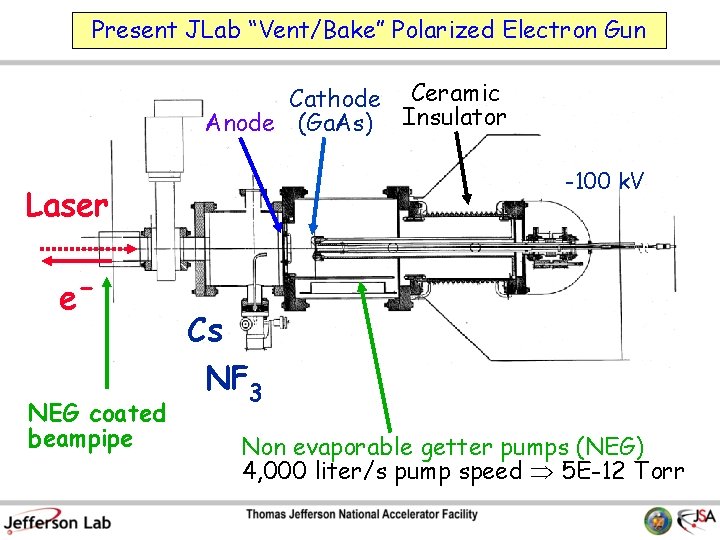
Present JLab “Vent/Bake” Polarized Electron Gun Cathode Ceramic Anode (Ga. As) Insulator -100 k. V Laser e. NEG coated beampipe Cs NF 3 Non evaporable getter pumps (NEG) 4, 000 liter/s pump speed 5 E-12 Torr
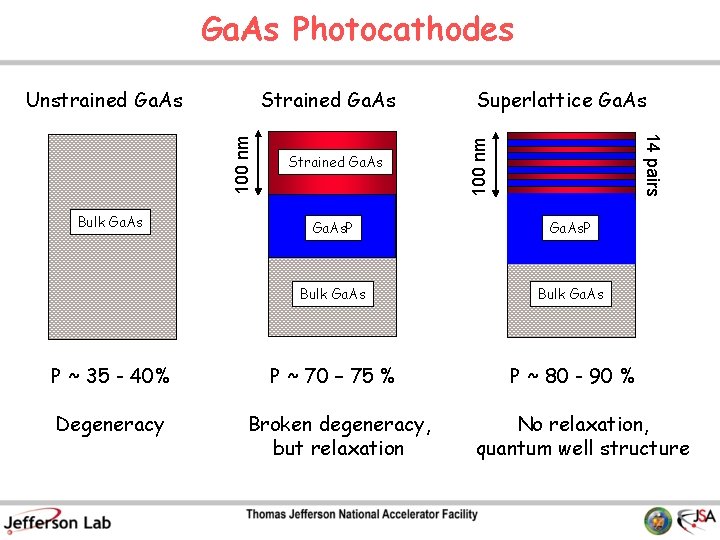
Ga. As Photocathodes 14 pairs Bulk Ga. As Strained Ga. As Superlattice Ga. As 100 nm Strained Ga. As 100 nm Unstrained Ga. As. P Bulk Ga. As P ~ 35 - 40% P ~ 70 – 75 % P ~ 80 - 90 % Degeneracy Broken degeneracy, but relaxation No relaxation, quantum well structure
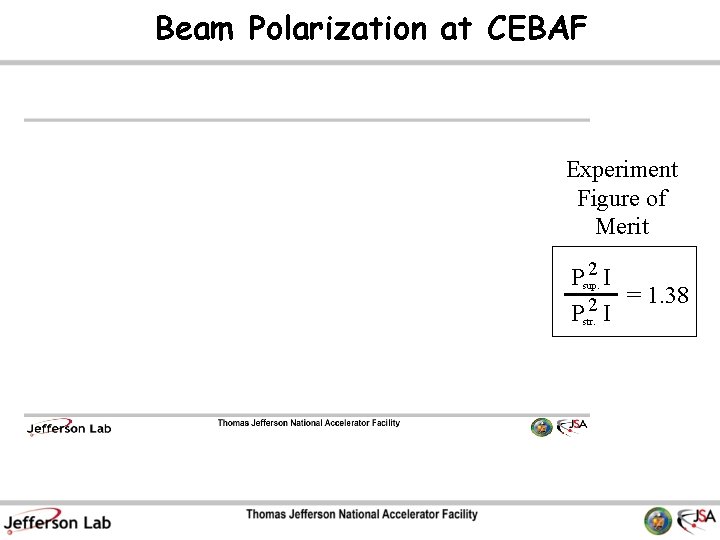
Beam Polarization at CEBAF Experiment Figure of Merit Psup. 2 I = 1. 38 2 Pstr. I
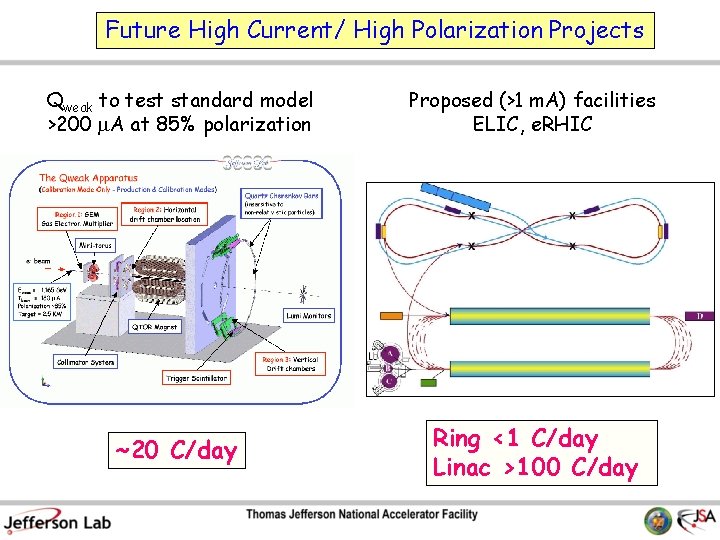
Future High Current/ High Polarization Projects Qweak to test standard model >200 m. A at 85% polarization Proposed (>1 m. A) facilities ELIC, e. RHIC ~20 C/day Ring <1 C/day Linac >100 C/day
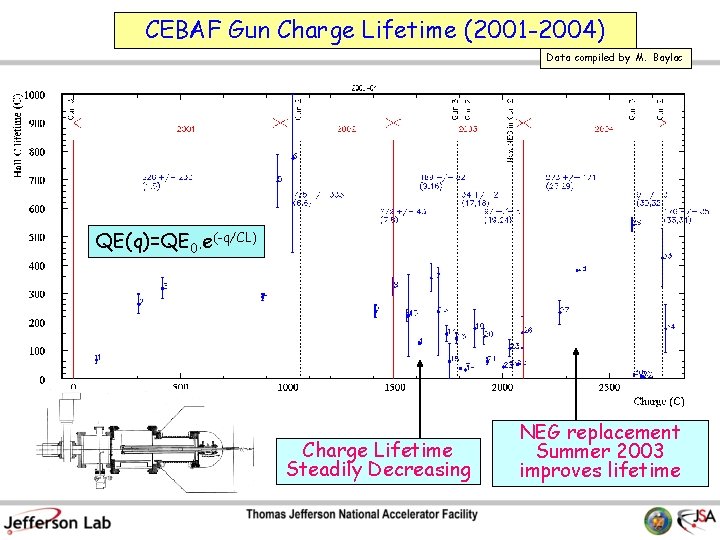
CEBAF Gun Charge Lifetime (2001 -2004) Data compiled by M. Baylac QE(q)=QE 0∙e(-q/CL) Charge Lifetime Steadily Decreasing NEG replacement Summer 2003 improves lifetime
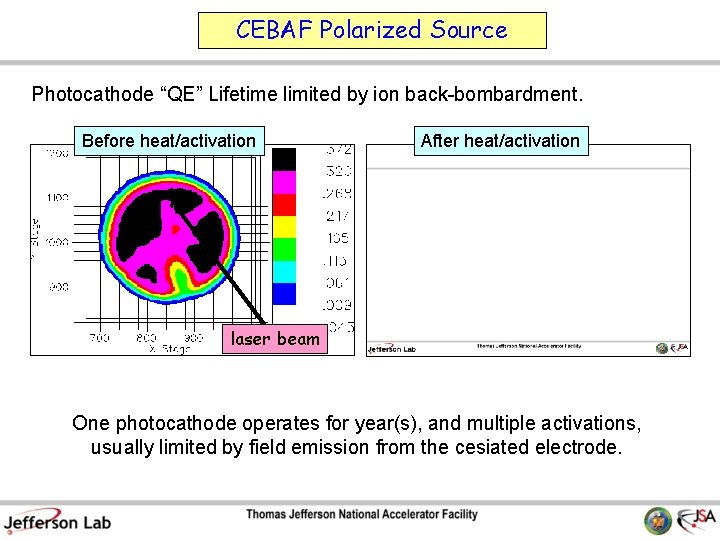
CEBAF Polarized Source Photocathode “QE” Lifetime limited by ion back-bombardment. Before heat/activation After heat/activation laser beam One photocathode operates for year(s), and multiple activations, usually limited by field emission from the cesiated electrode.

Ion Back-Bombardment Ions accelerated & focused to electrostatic center We don’t run beam from electrostatic center laser light IN electron beam OUT anode residual gas cathode Which ions more problematic? QE trough to electrostatic center
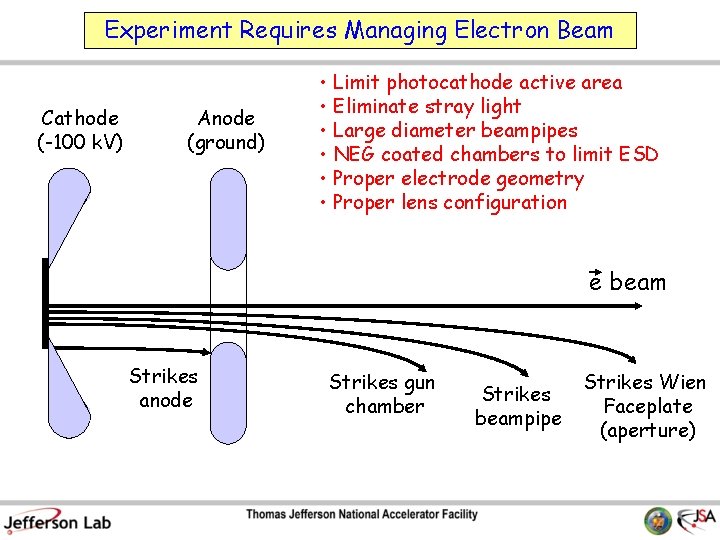
Experiment Requires Managing Electron Beam Cathode (-100 k. V) Anode (ground) • Limit photocathode active area • Eliminate stray light • Large diameter beampipes • NEG coated chambers to limit ESD • Proper electrode geometry • Proper lens configuration e beam Strikes anode Strikes gun chamber Strikes beampipe Strikes Wien Faceplate (aperture)
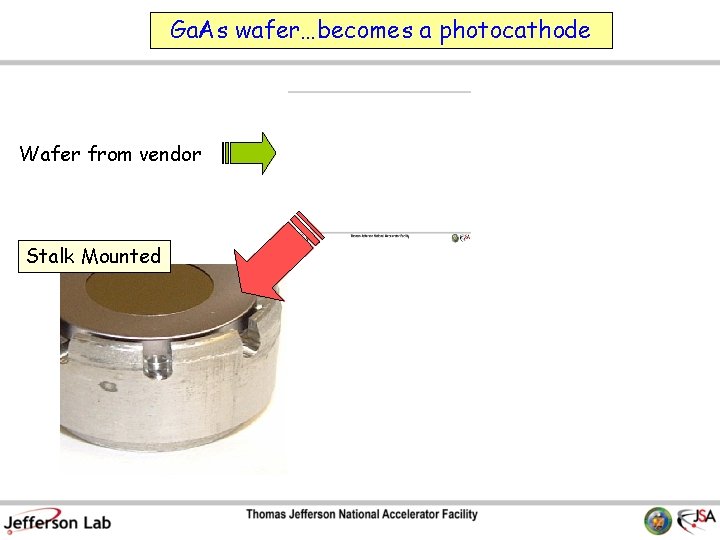
Ga. As wafer…becomes a photocathode Wafer from vendor Stalk Mounted
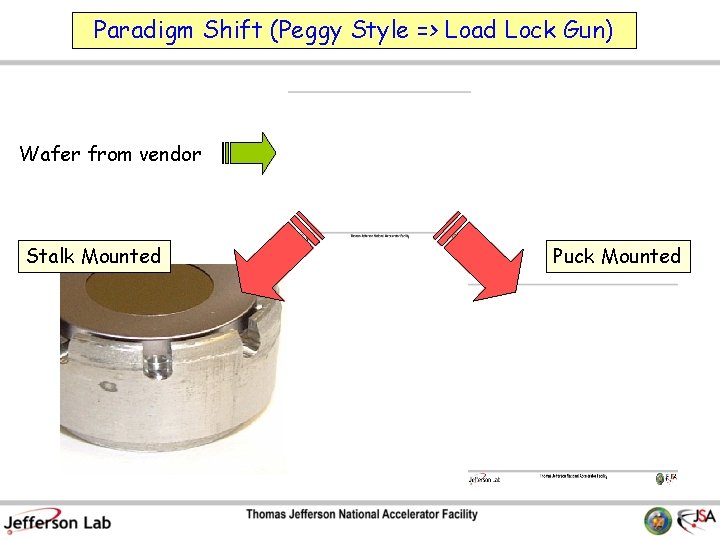
Paradigm Shift (Peggy Style => Load Lock Gun) Wafer from vendor Stalk Mounted Puck Mounted
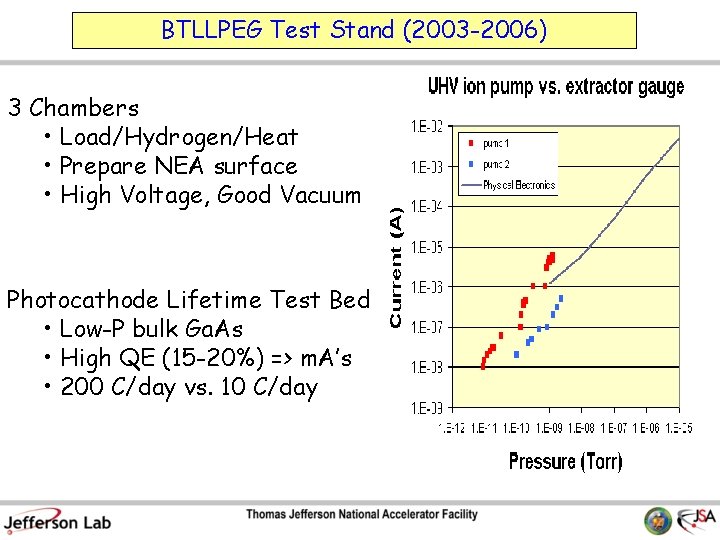
BTLLPEG Test Stand (2003 -2006) 3 Chambers • Load/Hydrogen/Heat • Prepare NEA surface • High Voltage, Good Vacuum Photocathode Lifetime Test Bed • Low-P bulk Ga. As • High QE (15 -20%) => m. A’s • 200 C/day vs. 10 C/day
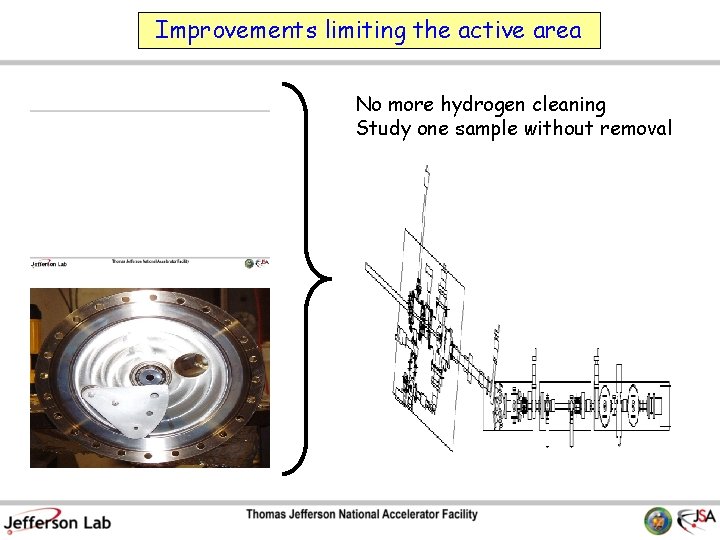
Improvements limiting the active area No more hydrogen cleaning Study one sample without removal
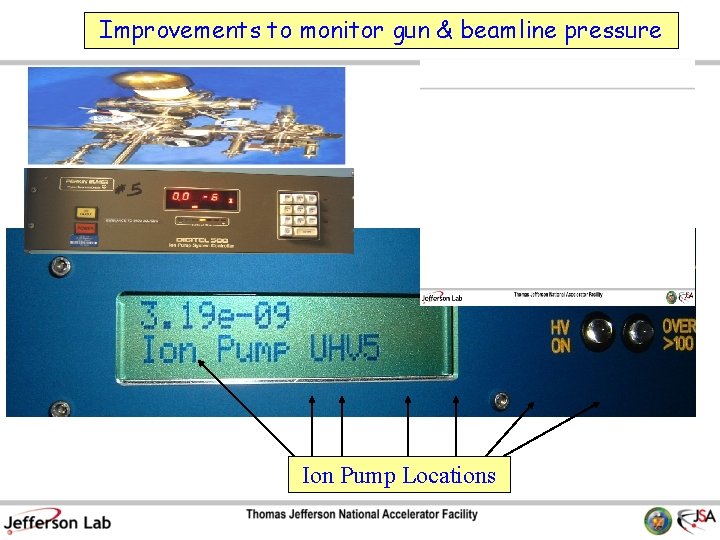
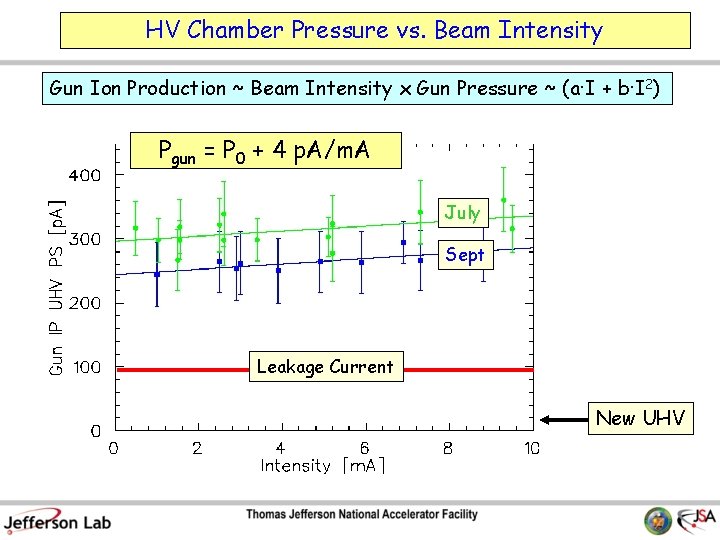
Improvements to monitor gun & beamline pressure Ion Pump Locations
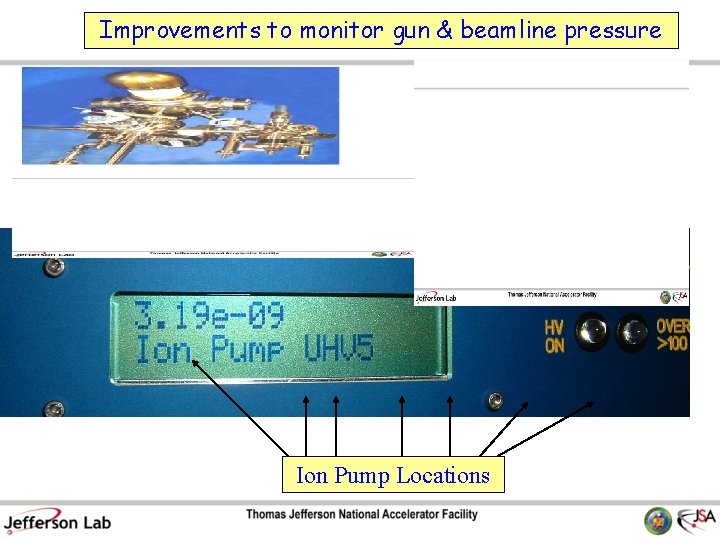
Improvements to monitor gun & beamline pressure Ion Pump Locations
Photocathode Lifetime Studies & Operation (2003 -2006) We’ve learned about photocathode lifetime… • vs. gun & beamline pressure (leaks, pumping, gauging) • vs. laser (spot size, position, reflections, power levels) • vs. Ga. As preparation (active area, cleaning) • vs. beam handling (optics, orbits, beam losses) We’ve learned about functionality of a Load Lock gun… • Round pucks + gravity = rolling • Manipulator alignment + bake-outs • Activation, heating, cooling • Sensitivity of manipulators to bake temperature • Multiple photocathodes > 1 photocathode Work mainly presented at workshops & recorded in proceedings…
NEW Load Lock Photo. Gun for CEBAF What’s next (really, now!)… • Improve gun vacuum, photocathode lifetime • Load multiple photocathodes with the “suitcase” • Evolve the technology, i. e. , design-out “features” • Transfer the technology to the CEBAF program
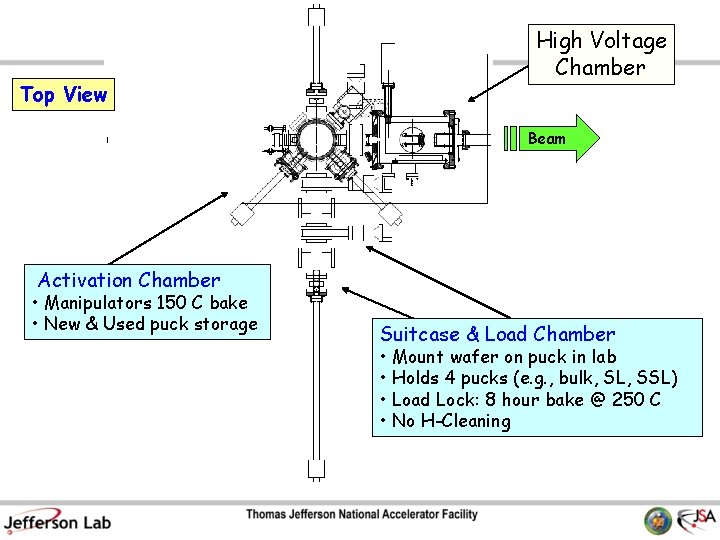
Top View High Voltage Chamber Beam Activation Chamber • Manipulators 150 C bake • New & Used puck storage Suitcase & Load Chamber • Mount wafer on puck in lab • Holds 4 pucks (e. g. , bulk, SL, SSL) • Load Lock: 8 hour bake @ 250 C • No H-Cleaning
Docking Chamber & “Suitcase”
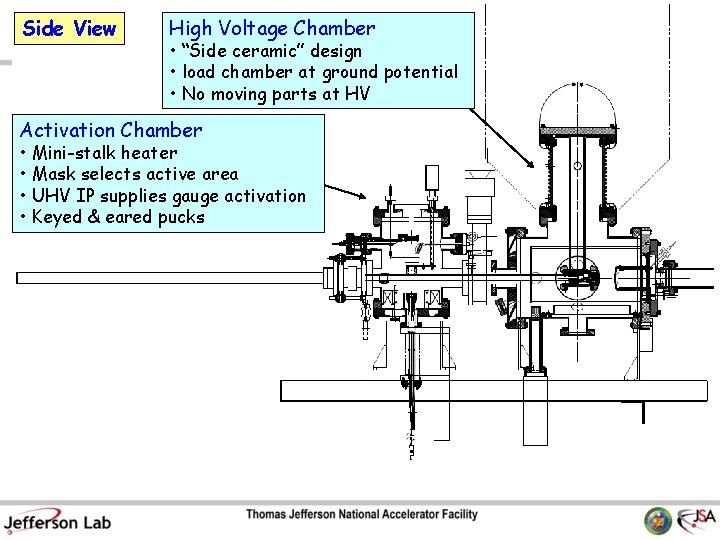
Side View High Voltage Chamber • “Side ceramic” design • load chamber at ground potential • No moving parts at HV Activation Chamber • Mini-stalk heater • Mask selects active area • UHV IP supplies gauge activation • Keyed & eared pucks
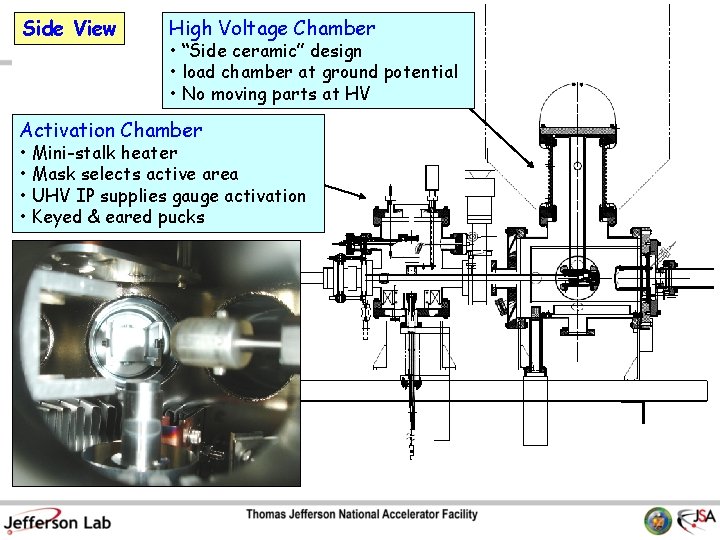
Side View High Voltage Chamber • “Side ceramic” design • load chamber at ground potential • No moving parts at HV Activation Chamber • Mini-stalk heater • Mask selects active area • UHV IP supplies gauge activation • Keyed & eared pucks
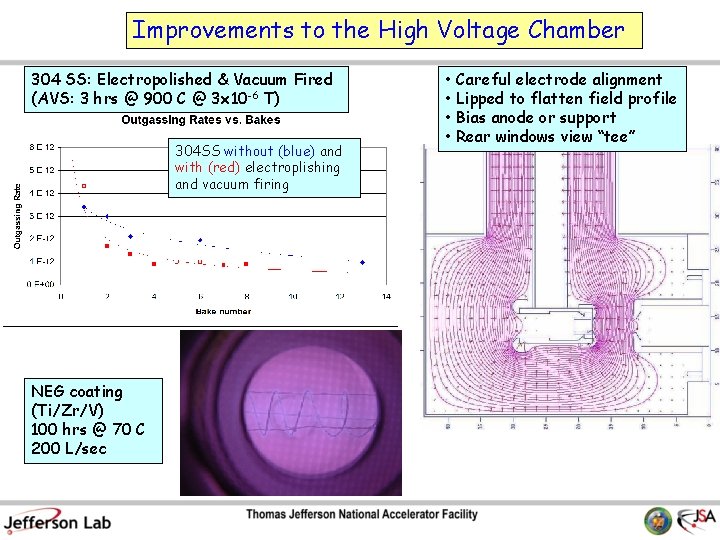
Improvements to the High Voltage Chamber 304 SS: Electropolished & Vacuum Fired (AVS: 3 hrs @ 900 C @ 3 x 10 -6 T) 304 SS without (blue) and with (red) electroplishing and vacuum firing NEG coating (Ti/Zr/V) 100 hrs @ 70 C 200 L/sec • Careful electrode alignment • Lipped to flatten field profile • Bias anode or support • Rear windows view “tee”
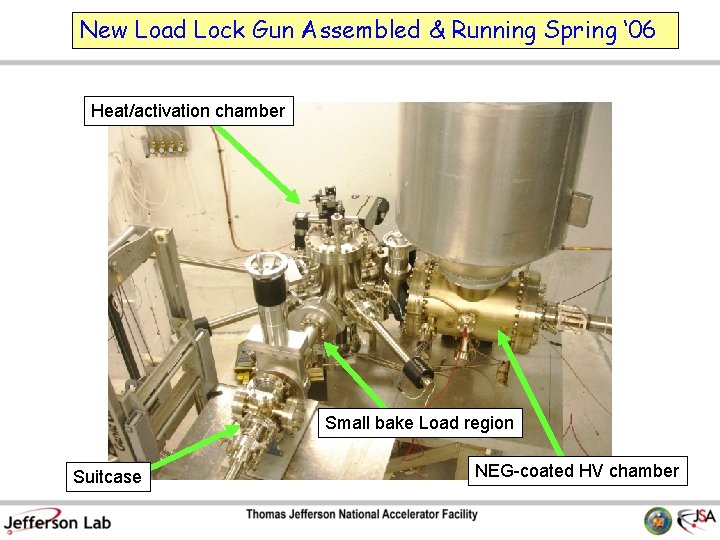
New Load Lock Gun Assembled & Running Spring ‘ 06 Heat/activation chamber Small bake Load region Suitcase NEG-coated HV chamber
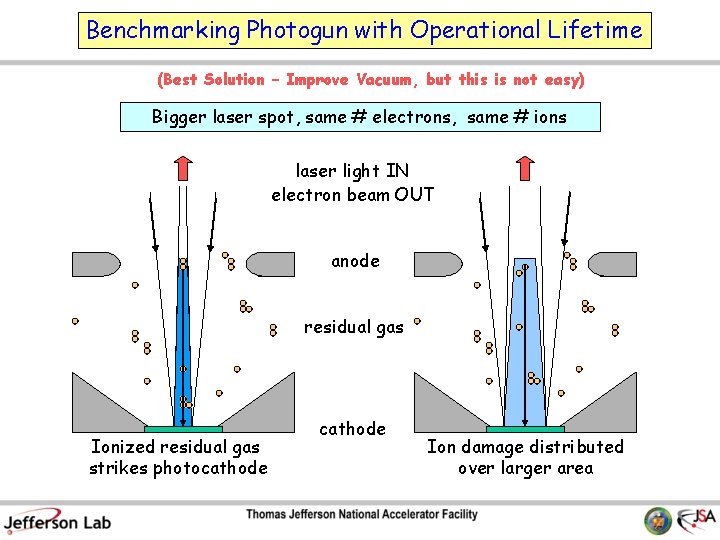
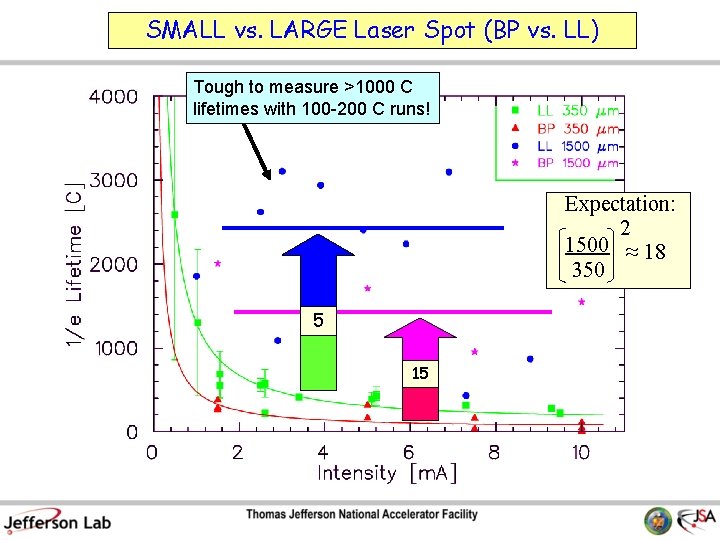
Benchmarking Photogun with Operational Lifetime (Best Solution – Improve Vacuum, but this is not easy) Bigger laser spot, same # electrons, same # ions laser light IN electron beam OUT anode residual gas Ionized residual gas strikes photocathode Ion damage distributed over larger area
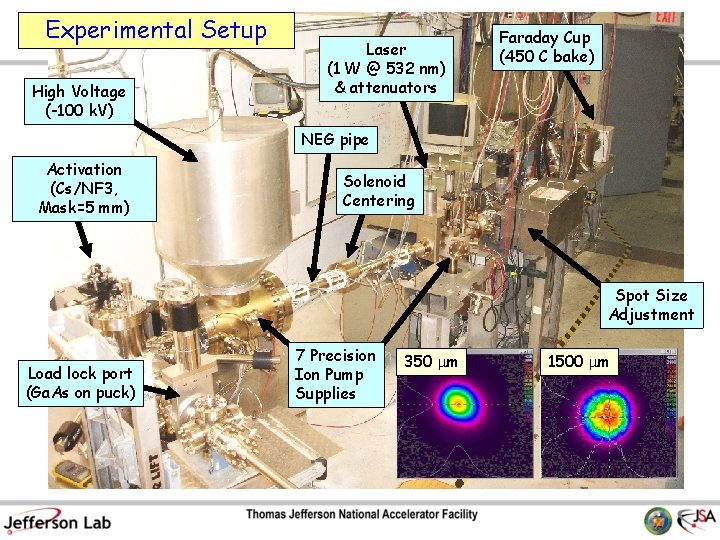
Experimental Setup High Voltage (-100 k. V) Laser (1 W @ 532 nm) & attenuators Faraday Cup (450 C bake) NEG pipe Activation (Cs/NF 3, Mask=5 mm) Solenoid Centering Spot Size Adjustment Load lock port (Ga. As on puck) 7 Precision Ion Pump Supplies 350 mm 1500 mm
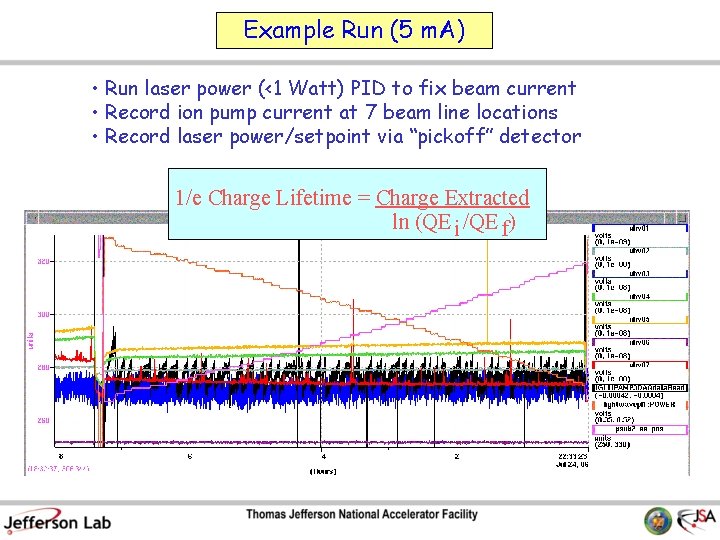
Example Run (5 m. A) • Run laser power (<1 Watt) PID to fix beam current • Record ion pump current at 7 beam line locations • Record laser power/setpoint via “pickoff” detector 1/e Charge Lifetime = Charge Extracted ln (QE i /QE f)
Measurements Limited by HV Power Supply 13 m. A!
NEW vs. OLD Load Lock Design (small laser spot) Damage ~ (a∙I + b∙I 2) NEW OLD
HV Chamber Pressure vs. Beam Intensity Gun Ion Production ~ Beam Intensity x Gun Pressure ~ (a∙I + b∙I 2) Pgun = P 0 + 4 p. A/m. A July Sept Leakage Current New UHV
SMALL vs. LARGE Laser Spot (BP vs. LL) Tough to measure >1000 C lifetimes with 100 -200 C runs! Expectation: 2 1500 ≈ 18 350 5 15
Side-by-Side Comparison of Original/Improved Guns
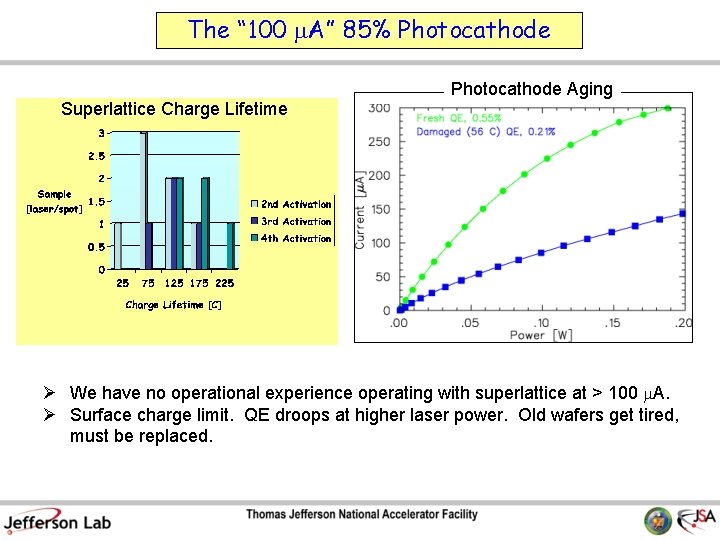
The “ 100 m. A” 85% Photocathode Superlattice Charge Lifetime Photocathode Aging Ø We have no operational experience operating with superlattice at > 100 m. A. Ø Surface charge limit. QE droops at higher laser power. Old wafers get tired, must be replaced.
High Surface Charge Density Superlattice Photocathodes (M. Yamamoto, Nagoya University) Superlattice photocathode: • Surface <100 nm is Ga. As • Similar doping, e. g. , Zinc • Concern: heat => diffuses dopant
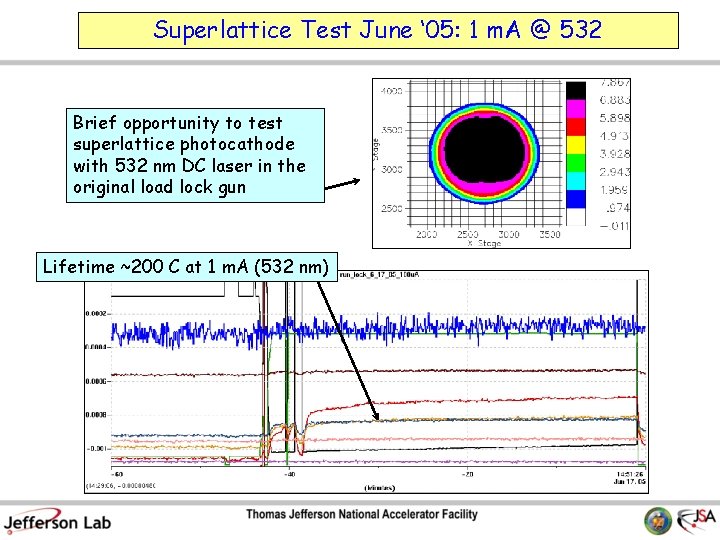
Superlattice Test June ‘ 05: 1 m. A @ 532 Brief opportunity to test superlattice photocathode with 532 nm DC laser in the original load lock gun Lifetime ~200 C at 1 m. A (532 nm)
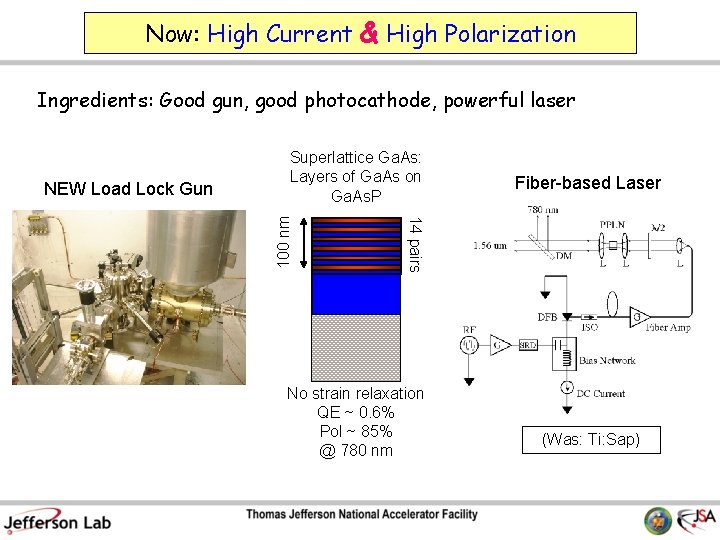
Now: High Current & High Polarization Ingredients: Good gun, good photocathode, powerful laser Fiber-based Laser 14 pairs 100 nm NEW Load Lock Gun Superlattice Ga. As: Layers of Ga. As on Ga. As. P chekc No strain relaxation QE ~ 0. 6% Pol ~ 85% @ 780 nm (Was: Ti: Sap)
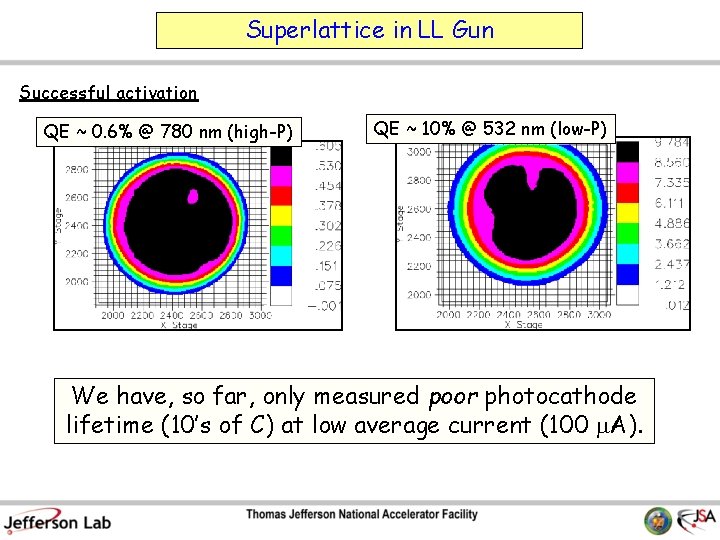
Superlattice in LL Gun Successful activation QE ~ 0. 6% @ 780 nm (high-P) QE ~ 10% @ 532 nm (low-P) We have, so far, only measured poor photocathode lifetime (10’s of C) at low average current (100 m. A).
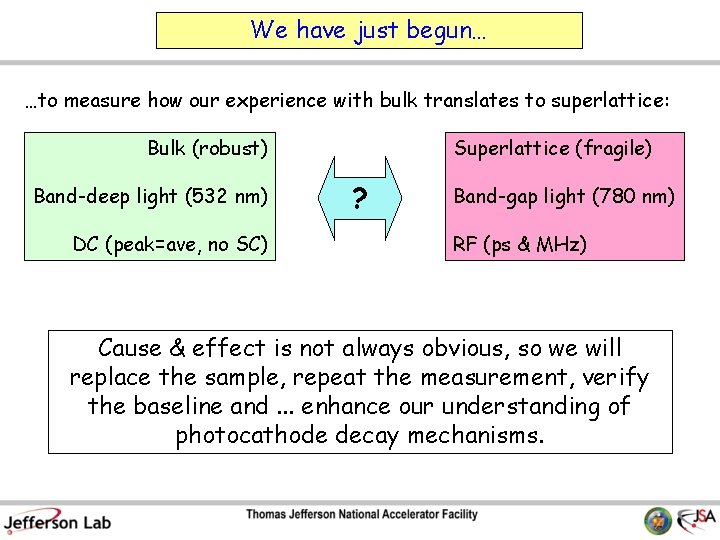
We have just begun… …to measure how our experience with bulk translates to superlattice: Bulk (robust) Band-deep light (532 nm) DC (peak=ave, no SC) Superlattice (fragile) ? Band-gap light (780 nm) RF (ps & MHz) Cause & effect is not always obvious, so we will replace the sample, repeat the measurement, verify the baseline and. . . enhance our understanding of photocathode decay mechanisms.
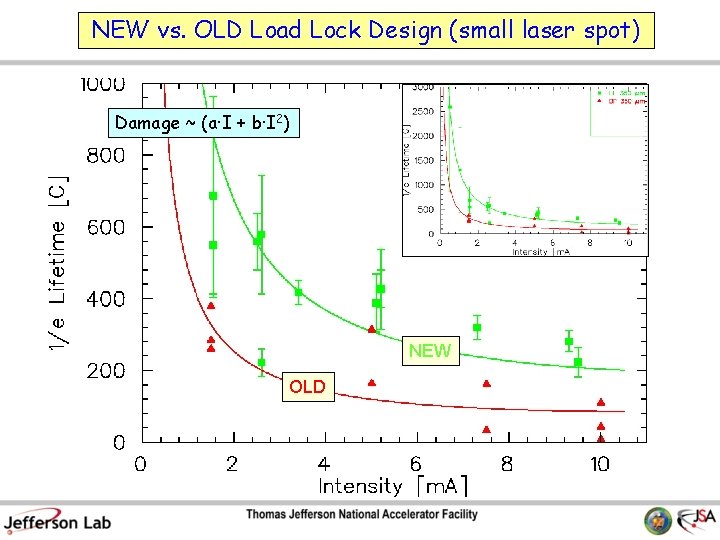
Conclusions => NEW gun charge lifetime 2 -3 x better; likely vacuum, electrode improvements. => Larger laser spot improves charge lifetime, but not simple model prediction. => Exceptionally good Charge Lifetime >1000 C at high currents >1 m. A; in fact, difficult to measure when using large laser spot. => Photocathode lifetime measurements at higher (>1 m. A) currents using Ga. As/Ga. As. P superlattice, but so far poor lifetime. => Install load lock in tunnel in July 2007.
- Slides: 41