
Measurements of NN correlations in nuclei Damir Bosnar
Measurements of NN correlations in nuclei Damir Bosnar Department of Physics Faculty of Science University of Zagreb, Croatia • What are and why NN-correlations ? • Overview of NN measurements • NN correlations and neutron stars • Measurements of pp correlations at MAMI and future plans ISU 2015 Quest for visible and invisible strange stuff in the Universe, Frascati, 27 November 2015
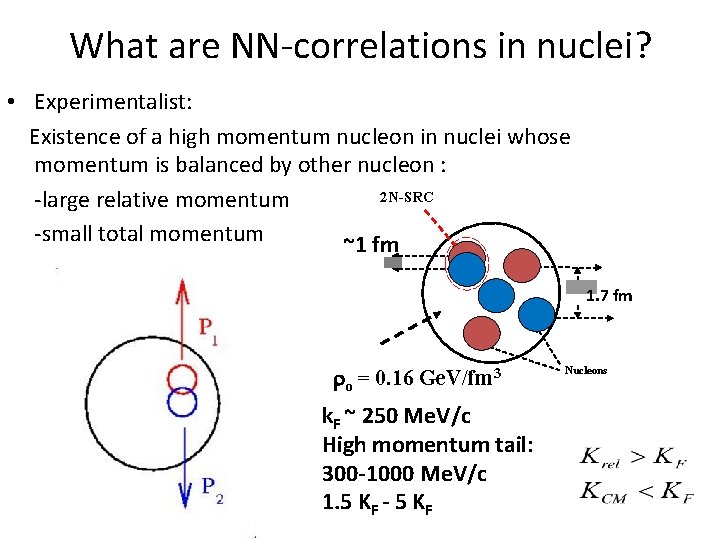
What are NN-correlations in nuclei? • Experimentalist: Existence of a high momentum nucleon in nuclei whose momentum is balanced by other nucleon : 2 N-SRC -large relative momentum -small total momentum ~1 fm 1. f 1. 7 f o = 0. 16 Ge. V/fm 3 k. F ~ 250 Me. V/c High momentum tail: 300 -1000 Me. V/c 1. 5 KF - 5 KF 1. 7 fm Nucleons
Why NN correlations ? • Since early fifties nuclei have been successfully described by the nuclear shell model. • However, descriptions of some of nuclear properties (e. g. binding energies) require inclusion of interactions beyond mean-field approximation. • In eighties and nineties electron scattering experiments showed that approx. 2/3 protons participate in the independent particle motion correlated pairs – evidences of existence of NN correlations • Consequences of NN correlations on neutron stars
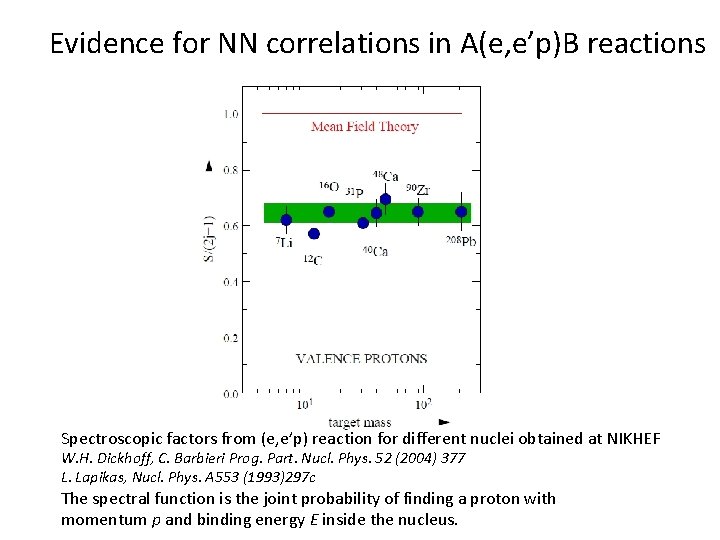
Evidence for NN correlations in A(e, e’p)B reactions Spectroscopic factors from (e, e’p) reaction for different nuclei obtained at NIKHEF W. H. Dickhoff, C. Barbieri Prog. Part. Nucl. Phys. 52 (2004) 377 L. Lapikas, Nucl. Phys. A 553 (1993)297 c The spectral function is the joint probability of finding a proton with momentum p and binding energy E inside the nucleus.
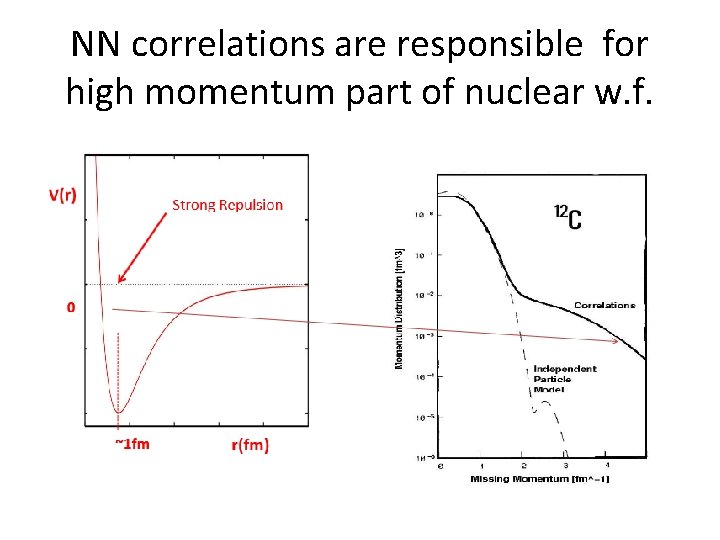
NN correlations are responsible for high momentum part of nuclear w. f.
Investigations of NN correlations in A(e, e’p. N)B reactions • Powerful tool for investigations of NN correlations: one can investigate isospin structure and content of NN correlations. • Different kinds of correlations: SRC (potential at short distances is dominated by strong repulsion) and tensor correlations (depends on spin and spatial orientation of nucleons), LRC • A(e, e’pp)B or A(e, e’pn) in different kinematicssuppression of other possible processes: IC, MEC, FSI (one has to study other reactions: (γ, pp), (γ, pn), (p, pp. N). . )
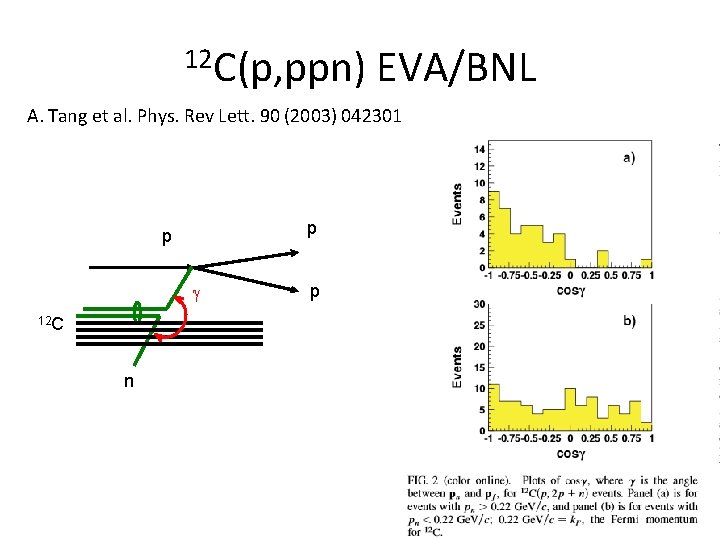
12 C(p, ppn) EVA/BNL A. Tang et al. Phys. Rev Lett. 90 (2003) 042301 p p 12 C n p
Investigations of NN correlations at JLAB (electron beam 6, 12 Ge. V) • A(e, e’), 12 C(e, e’pp), 12 C(e, epn)3 He(e, e’p)pn, 3 He(e, e’pp)n, A(e, e’p. N)B • Reactions at high energy and momentum transfer, selecting different four-momentum and energy transfer different aspects of nucleus can be focused: nucleon charge distribution, nuclear quark distribution, SRC in nucleus. confirmed evidences for NN correlations. Isospin content of NN correlations • Overview, e. g. : D. W. Higinbotham, E. Piasetzky, S. A. Wood J. Phys. Conf. Ser. 299 (2011) 012010
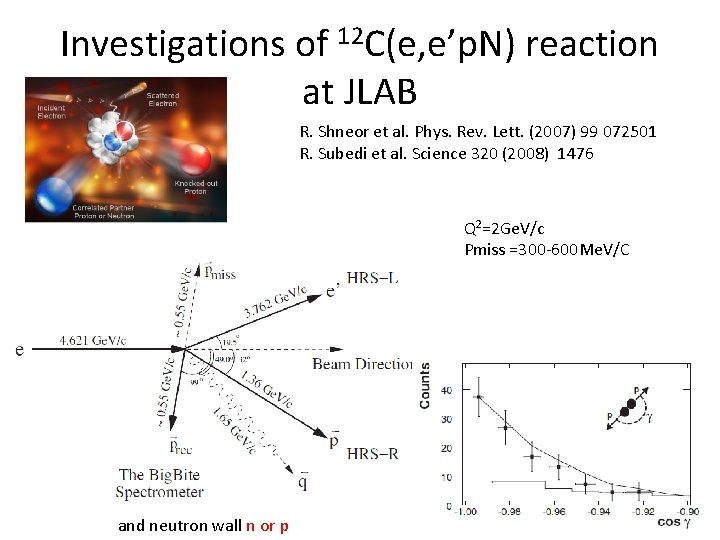
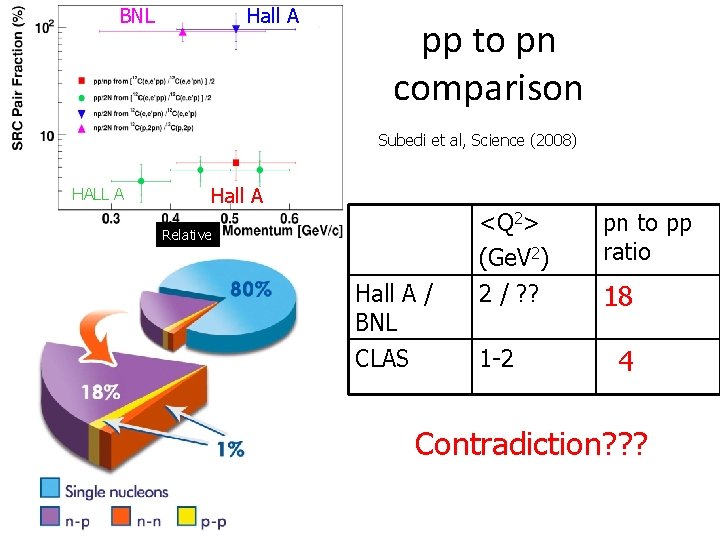
Investigations of 12 C(e, e’p. N) reaction at JLAB R. Shneor et al. Phys. Rev. Lett. (2007) 99 072501 R. Subedi et al. Science 320 (2008) 1476 Q 2=2 Ge. V/c Pmiss =300 -600 Me. V/C and neutron wall n or p
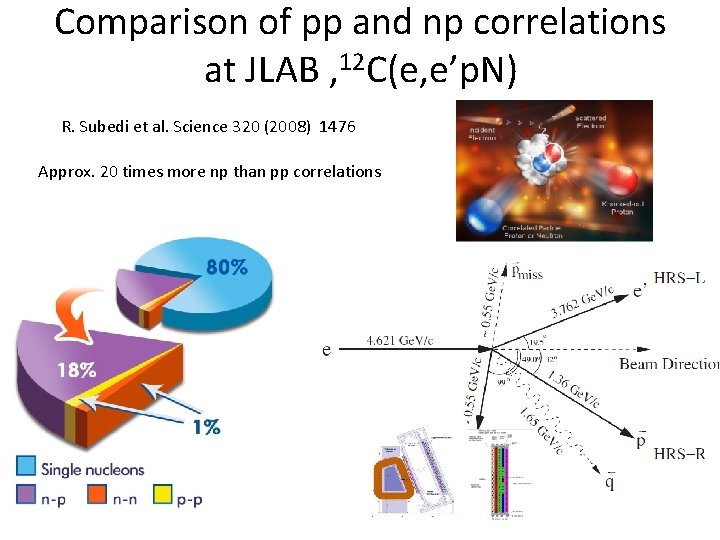
Comparison of pp and np correlations at JLAB , 12 C(e, e’p. N) R. Subedi et al. Science 320 (2008) 1476 Approx. 20 times more np than pp correlations
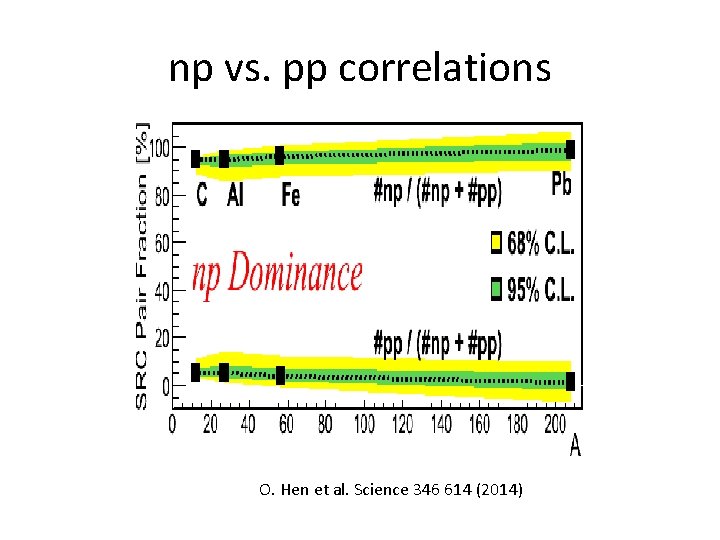
np vs. pp correlations O. Hen et al. Science 346 614 (2014)
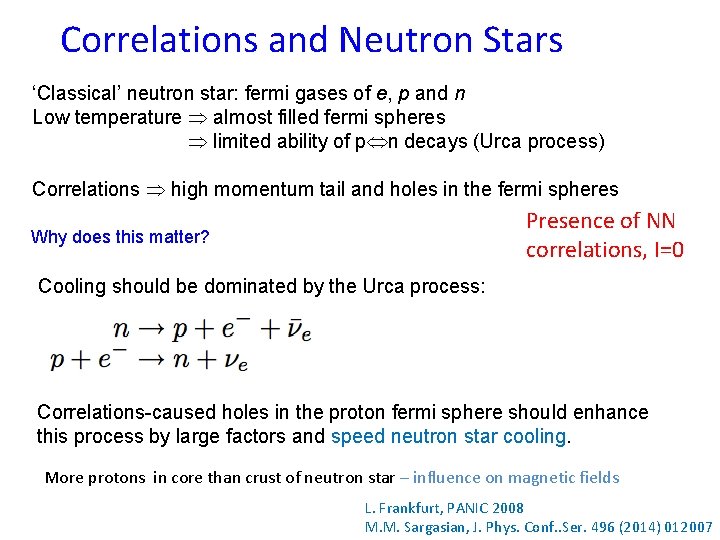
Correlations and Neutron Stars ‘Classical’ neutron star: fermi gases of e, p and n Low temperature almost filled fermi spheres limited ability of p n decays (Urca process) Correlations high momentum tail and holes in the fermi spheres Presence of NN correlations, I=0 Why does this matter? Cooling should be dominated by the Urca process: Correlations-caused holes in the proton fermi sphere should enhance this process by large factors and speed neutron star cooling. More protons in core than crust of neutron star – influence on magnetic fields L. Frankfurt, PANIC 2008 M. M. Sargasian, J. Phys. Conf. . Ser. 496 (2014) 012007
Consequences for neutron stars A. Subedi et al. Science 320 (2008) 1476 • If neutron stars consisted only of neutrons, the relatively weak n-n short-range interaction would mean that they could be reasonably well approximated as an ideal Fermi gas, with only perturbative corrections. • However, theoretical analysis of neutrino cooling data indicates that neutron stars contain about 5 to 10% protons and electrons in the first central layers [J. M. Lattimer M. Parkas, Science 304 536 (2004), G. Baym, Nucl. Phys. A 702 3 (2002)] • The strong p-n short-range interactions suggests that momentum distribution for the protons and neutrons in neutron stars will be substantially different from that characteristic of an ideal Fermi gas. • A theoretical calculation that takes into account the p-n correlation effect at relevant neutron star densities and realistic proton concentration shows the correlation effect on the momentum distribution of the protons and the neutrons [T. Frick et al. PRC 71 014313 (2005)] • The small concentration of protons inside neutron stars might have a disproportionately large effect that needs to be addressed in realistic descriptions of neutron stars
Investigations of NN correlations in A(e, e’p. N)B reactions on lower Q 2 at MAMI • Lower energies, but more precise measurement of different variables • Differential cross section measurements, defined final states – nature of NN correlations • A(e, e’pp)B or A(e, e’pn) in different kinematicssuppression of other possible processes: IC, MEC, FSI.
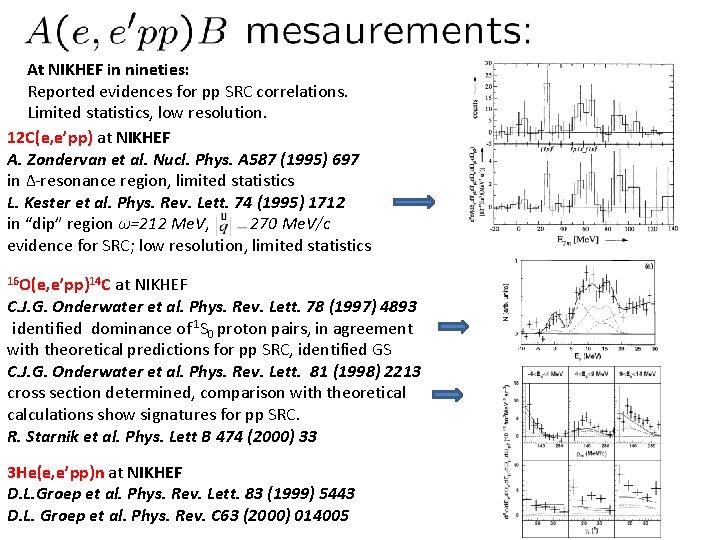
At NIKHEF in nineties: Reported evidences for pp SRC correlations. Limited statistics, low resolution. 12 C(e, e’pp) at NIKHEF A. Zondervan et al. Nucl. Phys. A 587 (1995) 697 in Δ-resonance region, limited statistics L. Kester et al. Phys. Rev. Lett. 74 (1995) 1712 in “dip” region ω=212 Me. V, 270 Me. V/c evidence for SRC; low resolution, limited statistics 16 O(e, e’pp)14 C at NIKHEF C. J. G. Onderwater et al. Phys. Rev. Lett. 78 (1997) 4893 identified dominance of 1 S 0 proton pairs, in agreement with theoretical predictions for pp SRC, identified GS C. J. G. Onderwater et al. Phys. Rev. Lett. 81 (1998) 2213 cross section determined, comparison with theoretical calculations show signatures for pp SRC. R. Starnik et al. Phys. Lett B 474 (2000) 33 3 He(e, e’pp)n at NIKHEF D. L. Groep et al. Phys. Rev. Lett. 83 (1999) 5443 D. L. Groep et al. Phys. Rev. C 63 (2000) 014005
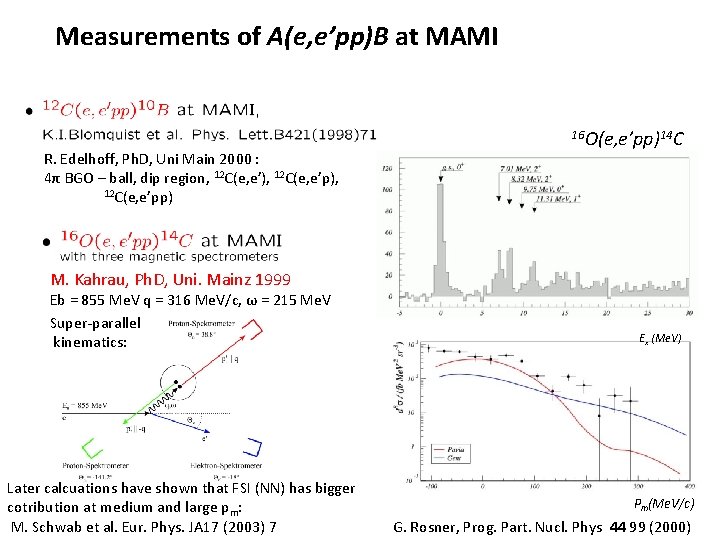
Measurements of A(e, e’pp)B at MAMI R. Edelhoff, Ph. D, Uni Main 2000 : 4π BGO – ball, dip region, 12 C(e, e’), 12 C(e, e’pp) 16 O(e, e’pp)14 C M. Kahrau, Ph. D, Uni. Mainz 1999 Eb = 855 Me. V q = 316 Me. V/c, ω = 215 Me. V Super-parallel kinematics: Later calcuations have shown that FSI (NN) has bigger cotribution at medium and large pm: M. Schwab et al. Eur. Phys. JA 17 (2003) 7 Ex (Me. V) Pm(Me. V/c) G. Rosner, Prog. Part. Nucl. Phys 44 99 (2000)
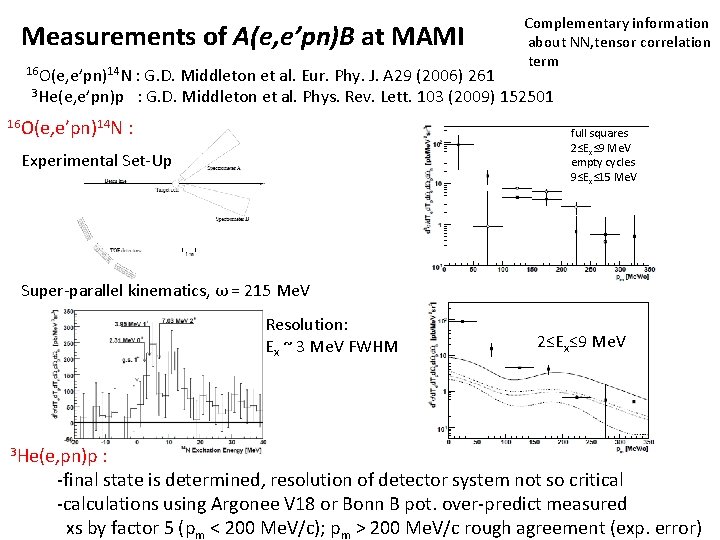
Measurements of A(e, e’pn)B at MAMI 16 O(e, e’pn)14 N Complementary information about NN, tensor correlation term : G. D. Middleton et al. Eur. Phy. J. A 29 (2006) 261 3 He(e, e’pn)p : G. D. Middleton et al. Phys. Rev. Lett. 103 (2009) 152501 16 O(e, e’pn)14 N : full squares 2≤Ex≤ 9 Me. V empty cycles 9≤Ex≤ 15 Me. V Experimental Set-Up Super-parallel kinematics, ω = 215 Me. V Resolution: Ex ~ 3 Me. V FWHM 3 He(e, pn)p 2≤Ex≤ 9 Me. V : -final state is determined, resolution of detector system not so critical -calculations using Argonee V 18 or Bonn B pot. over-predict measured xs by factor 5 (pm < 200 Me. V/c); pm > 200 Me. V/c rough agreement (exp. error)
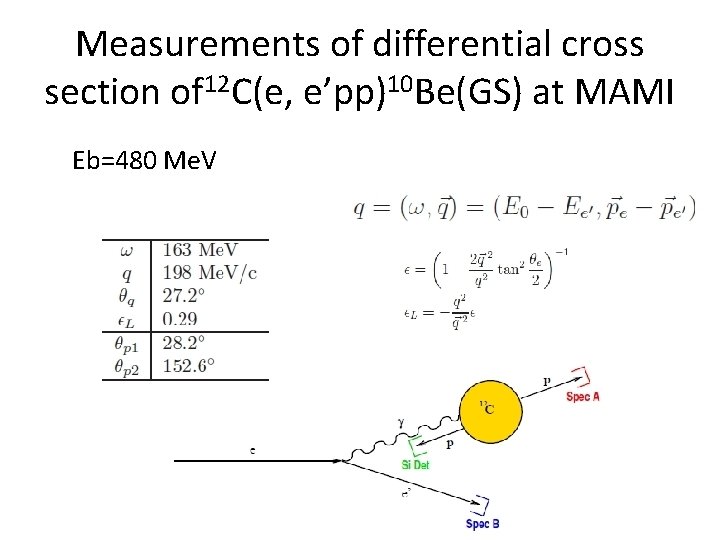
Measurements of differential cross section of 12 C(e, e’pp)10 Be(GS) at MAMI Eb=480 Me. V
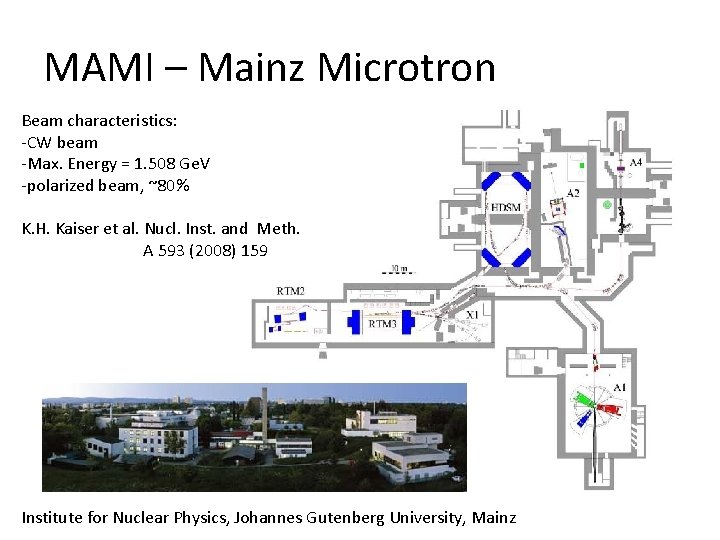
MAMI – Mainz Microtron Beam characteristics: -CW beam -Max. Energy = 1. 508 Ge. V -polarized beam, ~80% K. H. Kaiser et al. Nucl. Inst. and Meth. A 593 (2008) 159 Institute for Nuclear Physics, Johannes Gutenberg University, Mainz
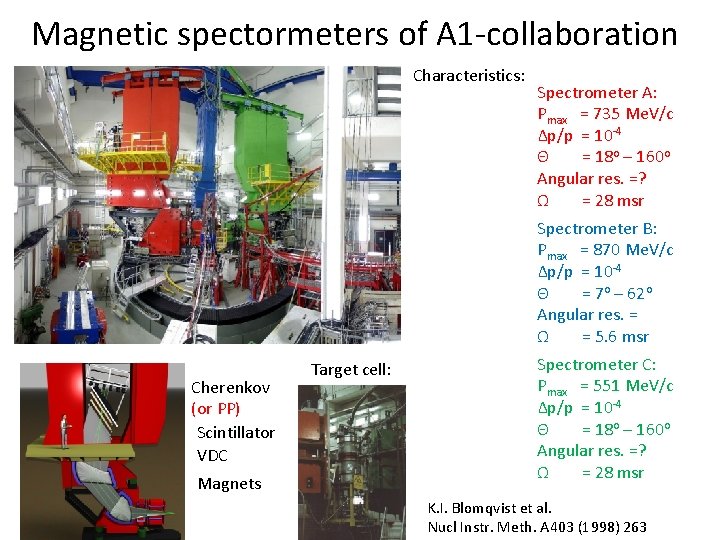
Magnetic spectormeters of A 1 -collaboration Characteristics: Spectrometer A: Pmax = 735 Me. V/c Δp/p = 10 -4 Θ = 18 o – 160 o Angular res. =? Ω = 28 msr Spectrometer B: Pmax = 870 Me. V/c Δp/p = 10 -4 Θ = 7 o – 62 o Angular res. = Ω = 5. 6 msr Cherenkov (or PP) Scintillator VDC Magnets Target cell: Spectrometer C: Pmax = 551 Me. V/c Δp/p = 10 -4 Θ = 18 o – 160 o Angular res. =? Ω = 28 msr K. I. Blomqvist et al. Nucl Instr. Meth. A 403 (1998) 263
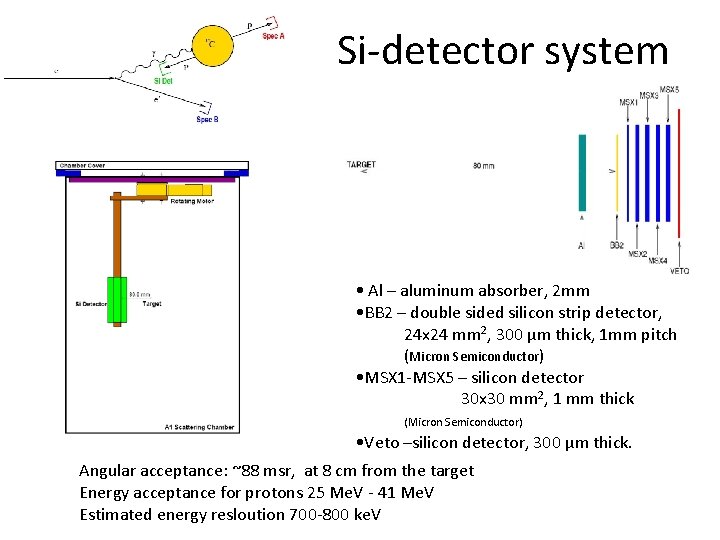
Si-detector system • Al – aluminum absorber, 2 mm • BB 2 – double sided silicon strip detector, 24 x 24 mm 2, 300 μm thick, 1 mm pitch (Micron Semiconductor) • MSX 1 -MSX 5 – silicon detector 30 x 30 mm 2, 1 mm thick (Micron Semiconductor) • Veto –silicon detector, 300 μm thick. Angular acceptance: ~88 msr, at 8 cm from the target Energy acceptance for protons 25 Me. V - 41 Me. V Estimated energy resloution 700 -800 ke. V
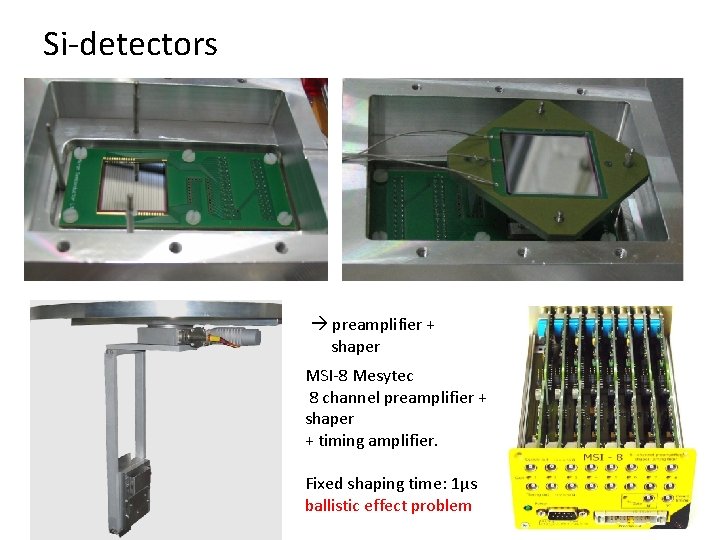
Si-detectors preamplifier + shaper MSI-8 Mesytec 8 channel preamplifier + shaper + timing amplifier. Fixed shaping time: 1μs ballistic effect problem
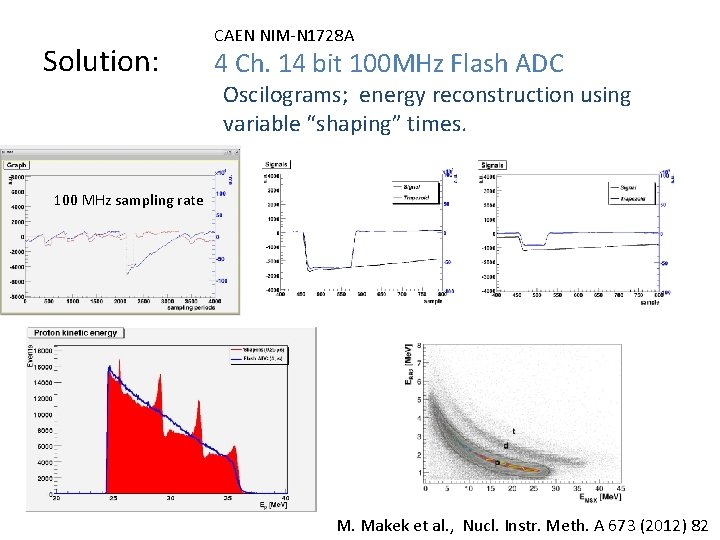
Solution: CAEN NIM-N 1728 A 4 Ch. 14 bit 100 MHz Flash ADC Oscilograms; energy reconstruction using variable “shaping” times. 100 MHz sampling rate M. Makek et al. , Nucl. Instr. Meth. A 673 (2012) 82
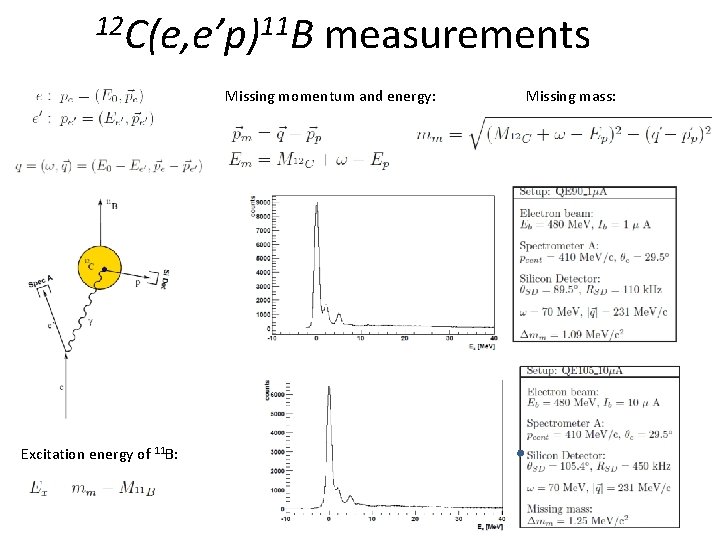
12 C(e, e’p)11 B measurements Missing momentum and energy: Excitation energy of 11 B: Missing mass:
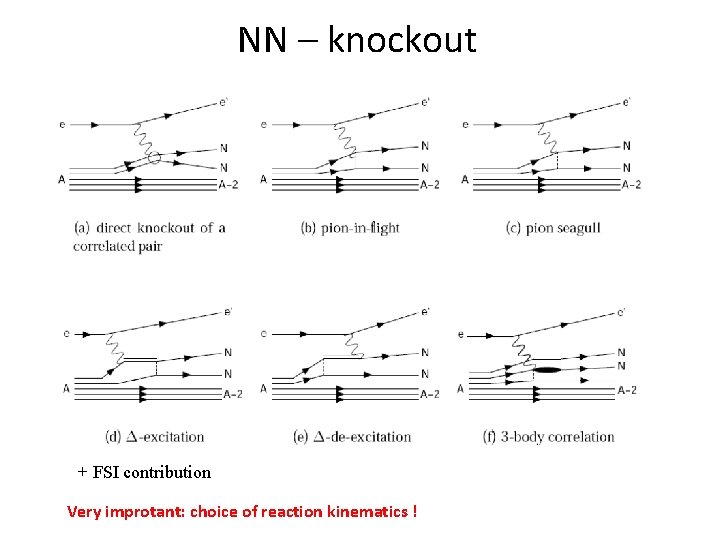
NN – knockout + FSI contribution Very improtant: choice of reaction kinematics !
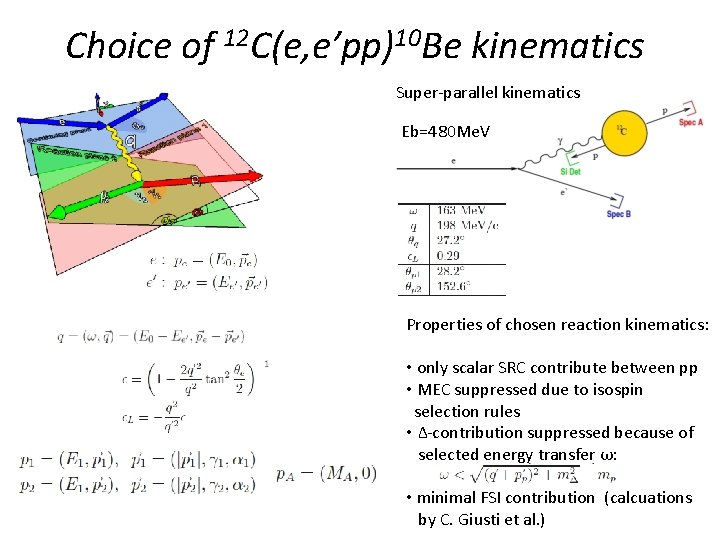
Choice of 12 C(e, e’pp)10 Be kinematics Super-parallel kinematics Eb=480 Me. V Properties of chosen reaction kinematics: • only scalar SRC contribute between pp • MEC suppressed due to isospin selection rules • Δ-contribution suppressed because of selected energy transfer ω: • minimal FSI contribution (calcuations by C. Giusti et al. )
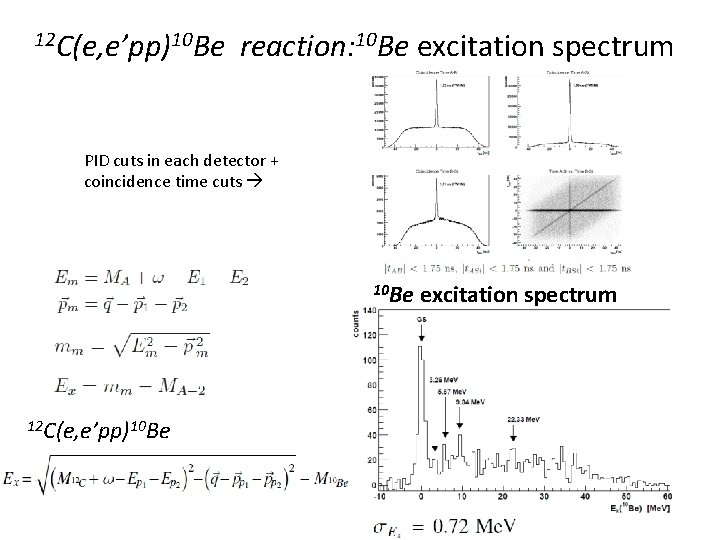
12 C(e, e’pp)10 Be reaction: 10 Be excitation spectrum PID cuts in each detector + coincidence time cuts 10 Be 12 C(e, e’pp)10 Be excitation spectrum
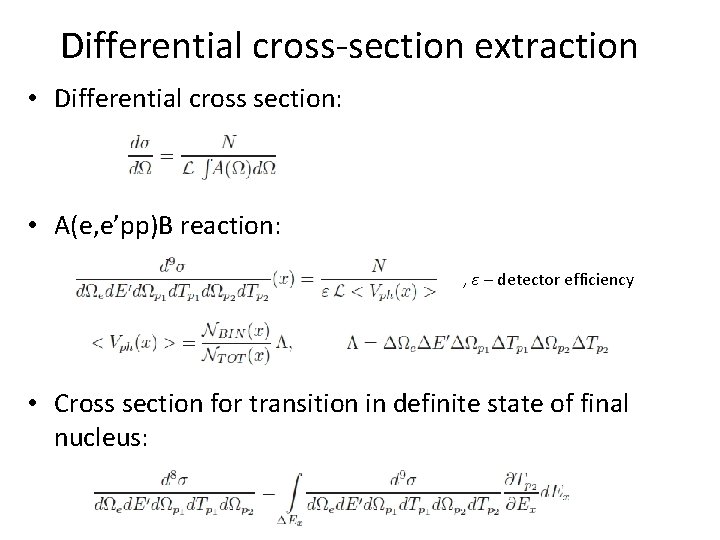
Differential cross-section extraction • Differential cross section: • A(e, e’pp)B reaction: , ε – detector efficiency • Cross section for transition in definite state of final nucleus:
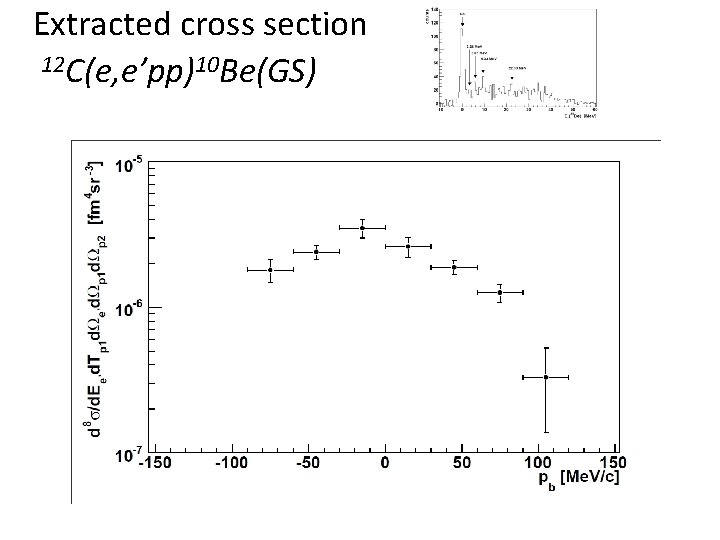
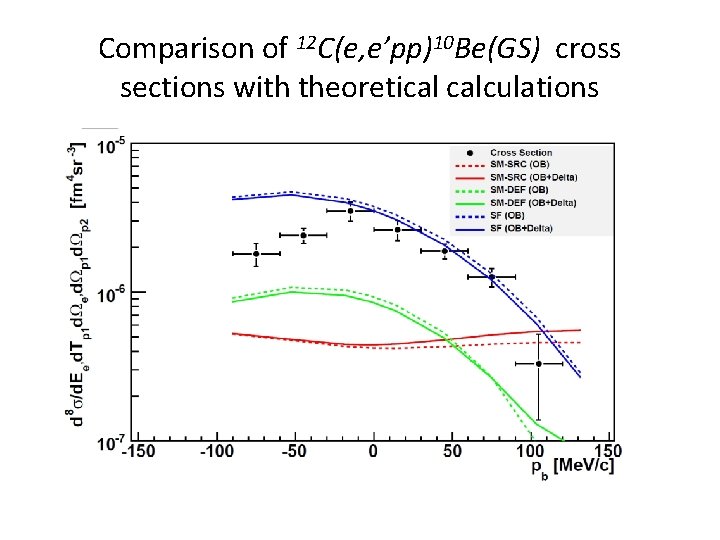
Extracted cross section 12 C(e, e’pp)10 Be(GS)
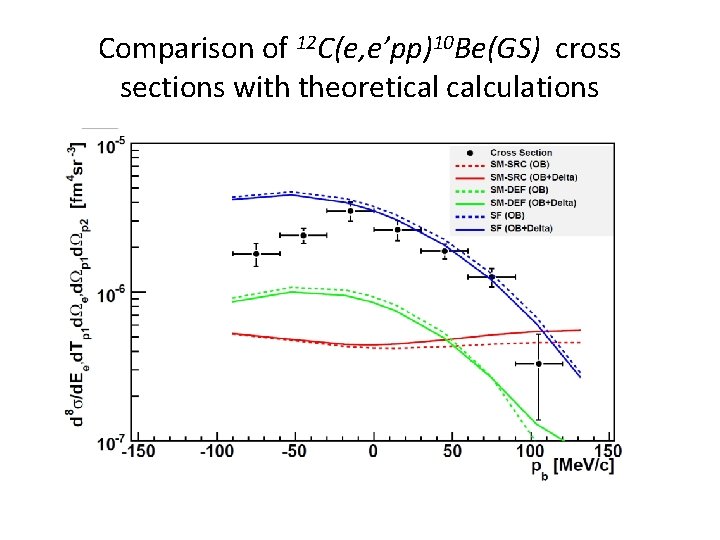
Comparison of 12 C(e, e’pp)10 Be(GS) cross sections with theoretical calculations
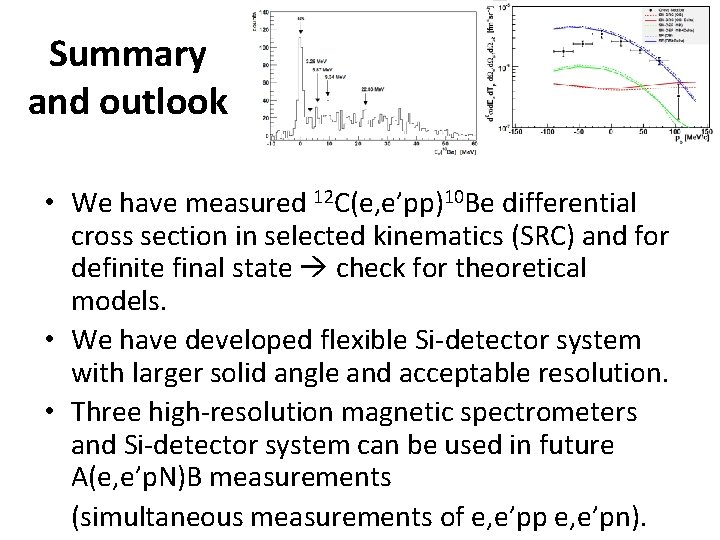
Summary and outlook • We have measured 12 C(e, e’pp)10 Be differential cross section in selected kinematics (SRC) and for definite final state check for theoretical models. • We have developed flexible Si-detector system with larger solid angle and acceptable resolution. • Three high-resolution magnetic spectrometers and Si-detector system can be used in future A(e, e’p. N)B measurements (simultaneous measurements of e, e’pp e, e’pn).

Thank you!
Backup slides
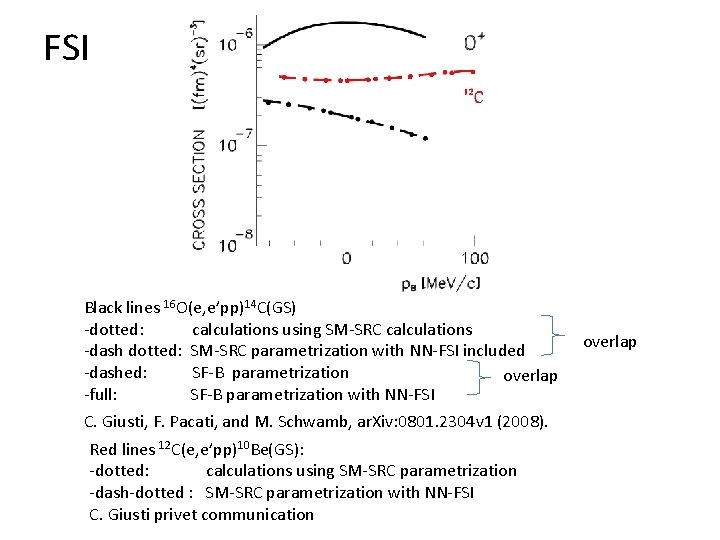
FSI Black lines 16 O(e, e’pp)14 C(GS) -dotted: calculations using SM-SRC calculations -dash dotted: SM-SRC parametrization with NN-FSI included -dashed: SF-B parametrization overlap -full: SF-B parametrization with NN-FSI C. Giusti, F. Pacati, and M. Schwamb, ar. Xiv: 0801. 2304 v 1 (2008). Red lines 12 C(e, e’pp)10 Be(GS): -dotted: calculations using SM-SRC parametrization -dash-dotted : SM-SRC parametrization with NN-FSI C. Giusti privet communication overlap
Comparison of 12 C(e, e’pp)10 Be(GS) cross sections with theoretical calculations
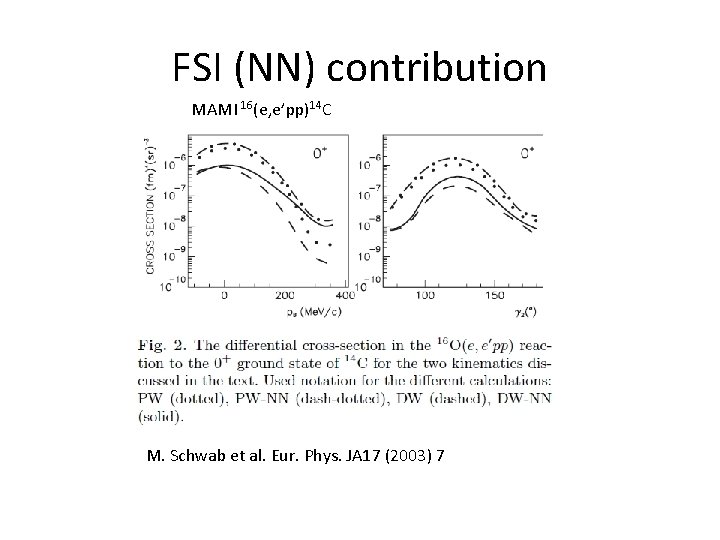
FSI (NN) contribution MAMI 16(e, e’pp)14 C M. Schwab et al. Eur. Phys. JA 17 (2003) 7
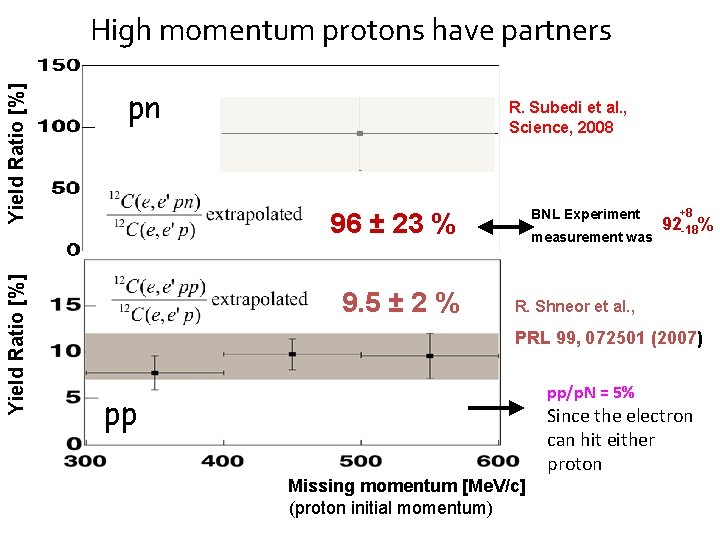
Yield Ratio [%] High momentum protons have partners pn R. Subedi et al. , Science, 2008 BNL Experiment 96 ± 23 % 9. 5 ± 2 % measurement was +8 92 -18% R. Shneor et al. , PRL 99, 072501 (2007) pp/p. N = 5% pp Since the electron can hit either proton Missing momentum [Me. V/c] (proton initial momentum)
BNL Hall A np/2 N pp/2 N 12 C HALL A pp to pn comparison Subedi et al, Science (2008) Hall A Relative Hall A / BNL CLAS <Q 2> (Ge. V 2) 2 / ? ? 1 -2 pn to pp ratio 18 4 Contradiction? ? ?
A 1 -kolaboracija wwwa 1. kph. uni-mainz. de • Zagrebačka grupa član od 1998. godine • Neutronski form-faktori; Produkcija piona na pragu, Produkcija η-mezona na pragu; NN korelacije; Struktura 3 He; Potraga za tamnom materijom, • Razvoj sustava silicijevih detektora za detekciju protona: Mihael Makek c, Patrick Achenbach a, Carlos Ayerbe Gayoso a, Dagmar Baumann a, Jan C. Bernauer a, Ralph Bohm a, Damir Bosnar c , Achim Denig a, Mathias Ding a, Michael O. Distler a, Luca Doria a, Jorg Friedrich a, Ivica Friscic c, Mar Gomez a, Harald Merkel a, Ulrich Muller a, Lars Nungesser a, Josef Pochodzalla a, Milan Potokar b, Michael Seimetz a, Salvador Sanchez Majos a, Bjorn Soren Schlimme a, Simon Sirca b, Thomas Walcher a, Markus Weinriefer a a Institut fur Kernphysik, Johannes Gutenberg-Universitat Mainz, Germany University of Ljubljana and Institut ”Jozef Stefan” Ljubljana, Slovenia c Physics Department, Faculty of Science, University of Zagreb, Croatia b
- Slides: 39