
Measurements Lesson 2 Converting Lengths Volumes and Weights
- Slides: 35
Measurements Lesson 2
Converting Lengths, Volumes and Weights Success Criteria ü I am able to convert between different units of metric measure ü I can give my answers to question using the correct or specified unit of metric measure ü I can use my knowledge and conversion look up tables to calculate conversions correctly. DNA You would measure this in m. L or litres what might the question be ?
Converting Lengths, Volumes and Weights Success Criteria ü I am able to convert between different units of metric measure ü I can give my answers to question using the correct or specified unit of metric measure ü I can use my knowledge and conversion look up tables to calculate conversions correctly. DNA You would measure this in m. L or litres what might the question be ? What might you measure the volume of a bottle of coke in?
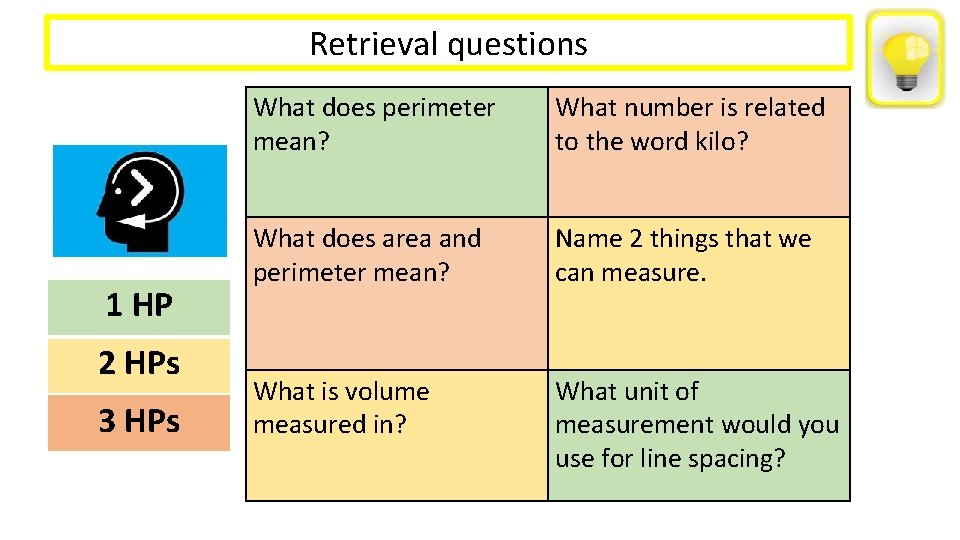
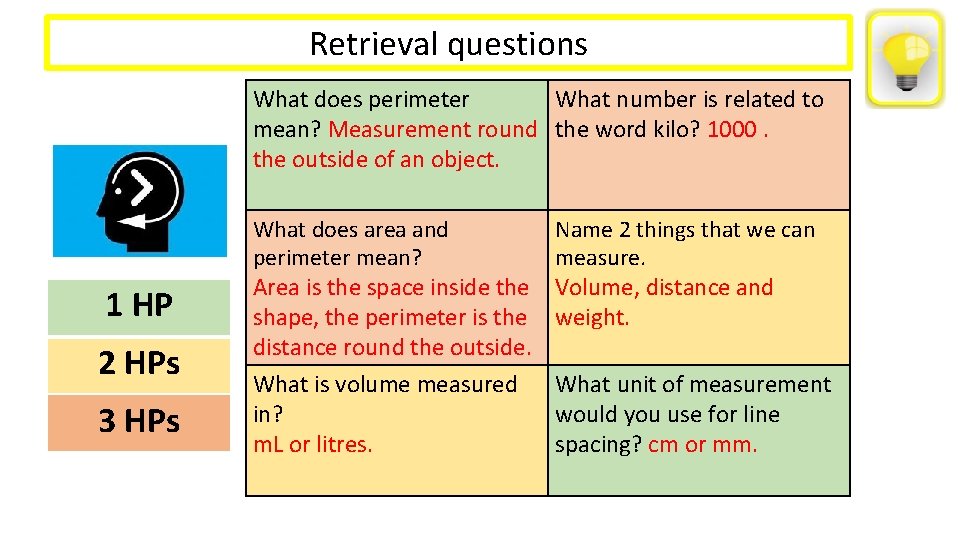
Retrieval questions 1 HP 2 HPs 3 HPs What does perimeter mean? What number is related to the word kilo? What does area and perimeter mean? Name 2 things that we can measure. What is volume measured in? What unit of measurement would you use for line spacing?
Retrieval questions What does perimeter What number is related to mean? Measurement round the word kilo? 1000. the outside of an object. 1 HP 2 HPs 3 HPs What does area and perimeter mean? Area is the space inside the shape, the perimeter is the distance round the outside. Name 2 things that we can measure. Volume, distance and weight. What is volume measured in? m. L or litres. What unit of measurement would you use for line spacing? cm or mm.
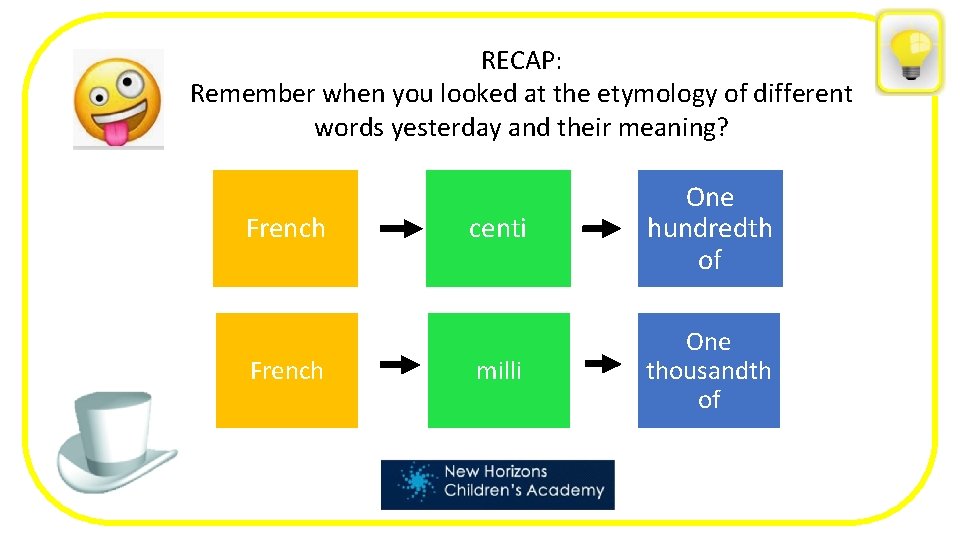
RECAP: Remember when you looked at the etymology of different words yesterday and their meaning? French centi One hundredth of milli One thousandth of
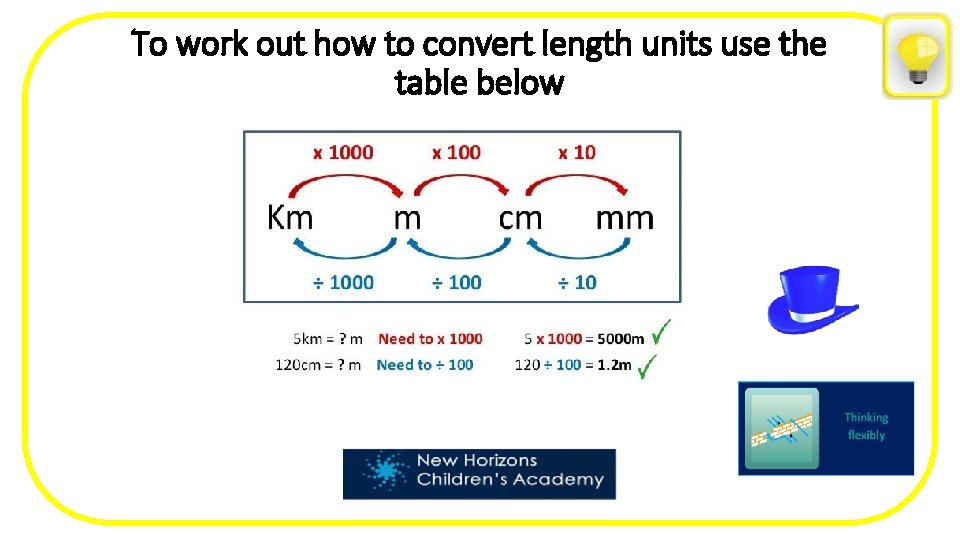
To work out how to convert length units use the table below
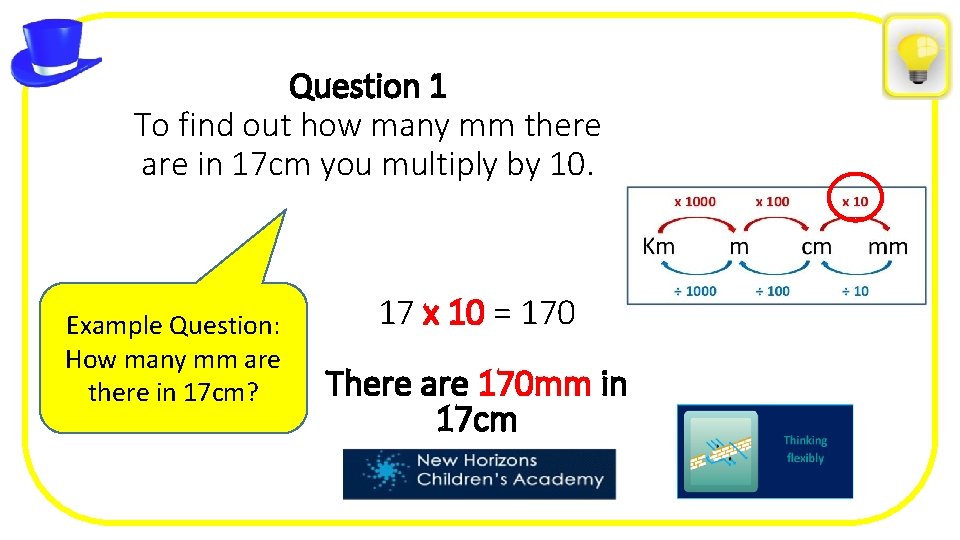
Question 1 To find out how many mm there are in 17 cm you multiply by 10. Example Question: How many mm are there in 17 cm? 17 x 10 = 170 There are 170 mm in 17 cm
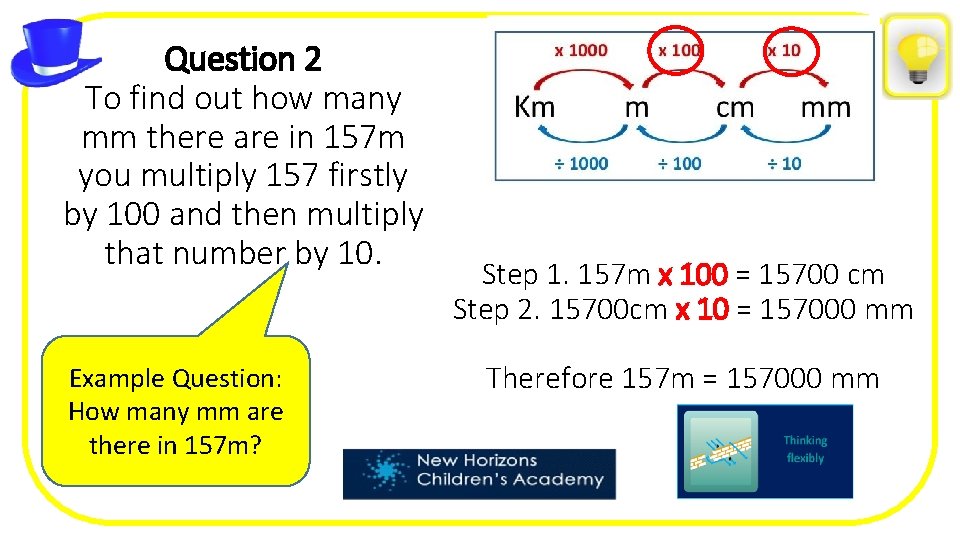
Question 2 To find out how many mm there are in 157 m you multiply 157 firstly by 100 and then multiply that number by 10. Example Question: How many mm are there in 157 m? Step 1. 157 m x 100 = 15700 cm Step 2. 15700 cm x 10 = 157000 mm Therefore 157 m = 157000 mm
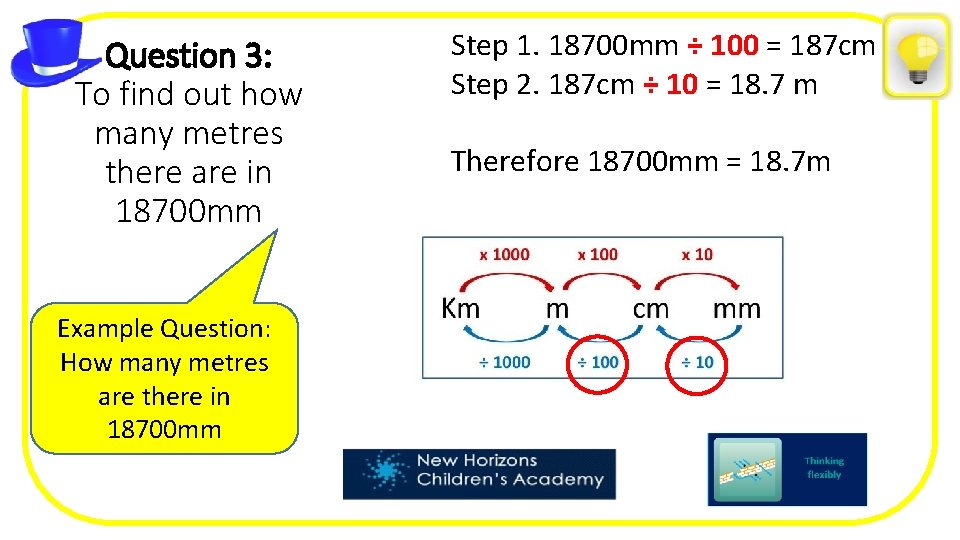
Question 3: To find out how many metres there are in 18700 mm Example Question: How many metres are there in 18700 mm Step 1. 18700 mm ÷ 100 = 187 cm Step 2. 187 cm ÷ 10 = 18. 7 m Therefore 18700 mm = 18. 7 m
Quick tester How many km are there in 300000 cm?
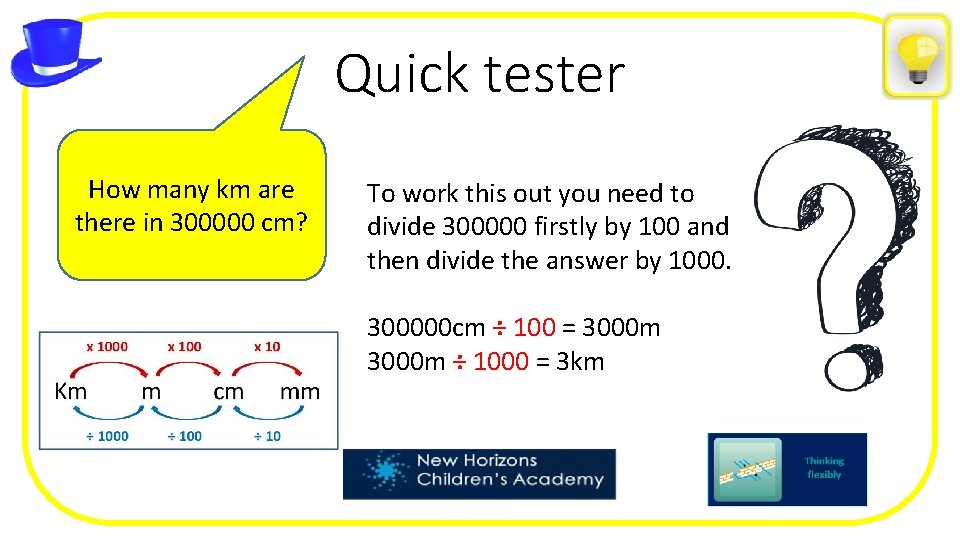
Quick tester How many km are there in 300000 cm? To work this out you need to divide 300000 firstly by 100 and then divide the answer by 1000. 300000 cm ÷ 100 = 3000 m ÷ 1000 = 3 km
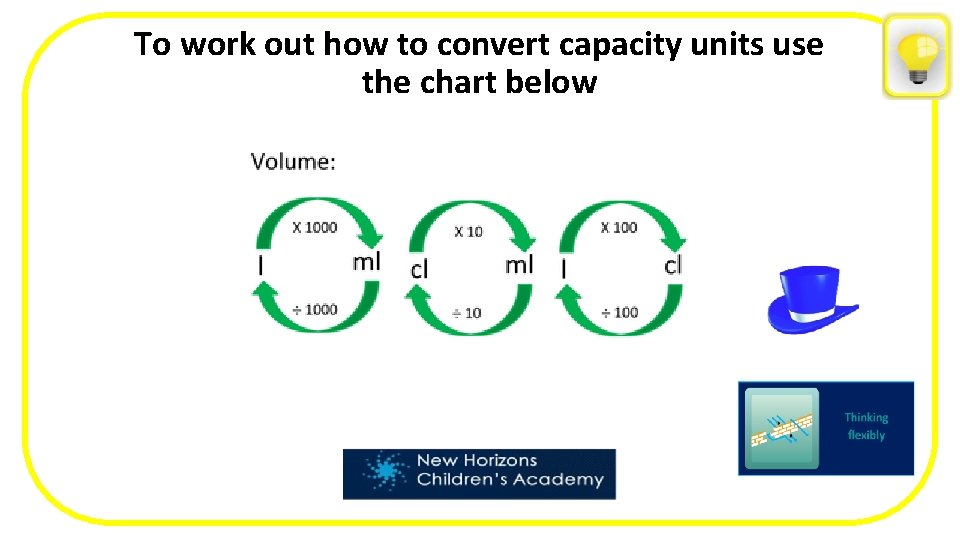
To work out how to convert capacity units use the chart below
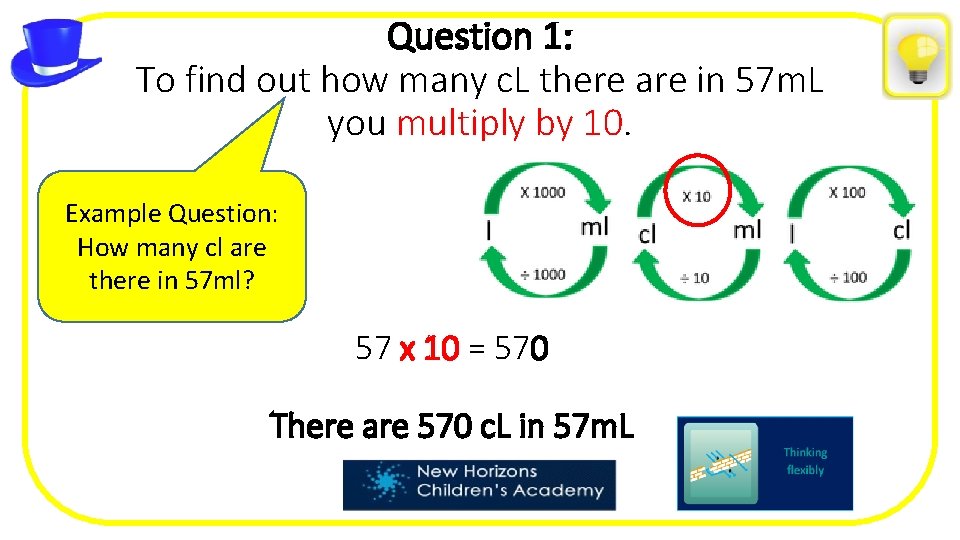
Question 1: To find out how many c. L there are in 57 m. L you multiply by 10. Example Question: How many cl are there in 57 ml? 57 x 10 = 570 There are 570 c. L in 57 m. L
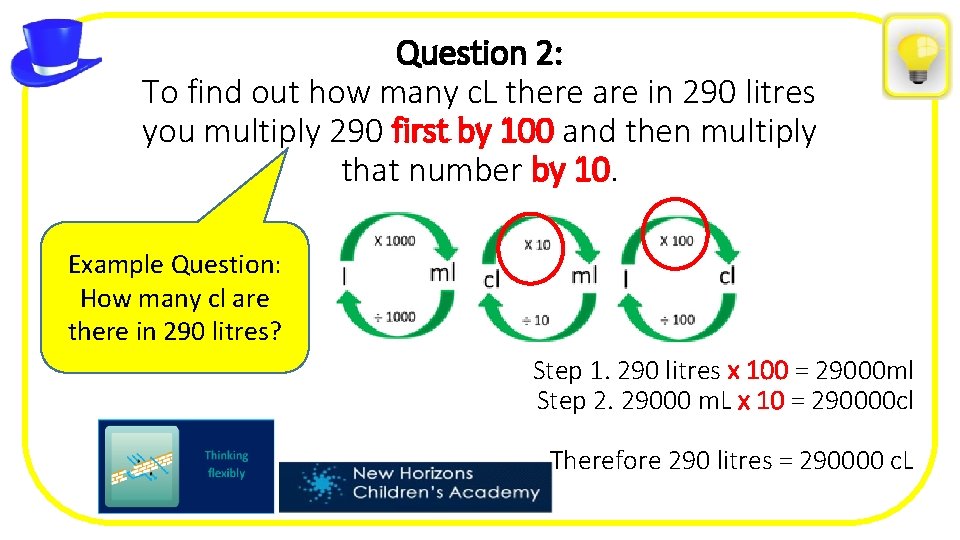
Question 2: To find out how many c. L there are in 290 litres you multiply 290 first by 100 and then multiply that number by 10. Example Question: How many cl are there in 290 litres? Step 1. 290 litres x 100 = 29000 ml Step 2. 29000 m. L x 10 = 290000 cl Therefore 290 litres = 290000 c. L
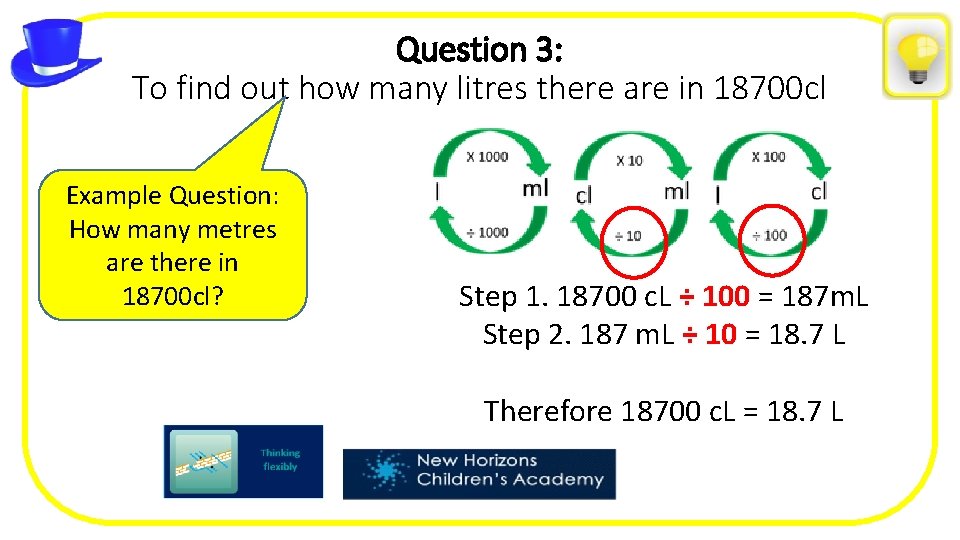
Question 3: To find out how many litres there are in 18700 cl Example Question: How many metres are there in 18700 cl? Step 1. 18700 c. L ÷ 100 = 187 m. L Step 2. 187 m. L ÷ 10 = 18. 7 L Therefore 18700 c. L = 18. 7 L
Quick tester How many litres are there in 49000 c. L?
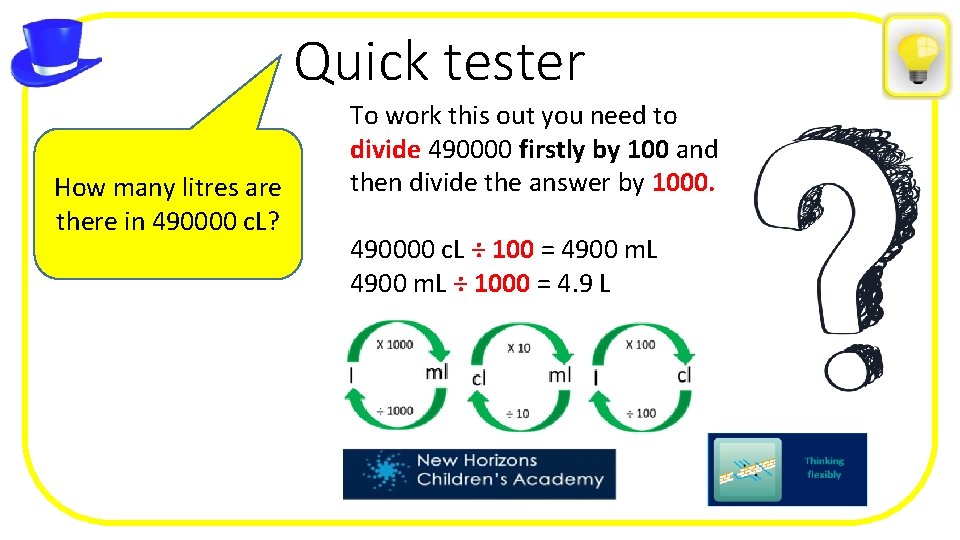
Quick tester How many litres are there in 490000 c. L? To work this out you need to divide 490000 firstly by 100 and then divide the answer by 1000. 490000 c. L ÷ 100 = 4900 m. L ÷ 1000 = 4. 9 L
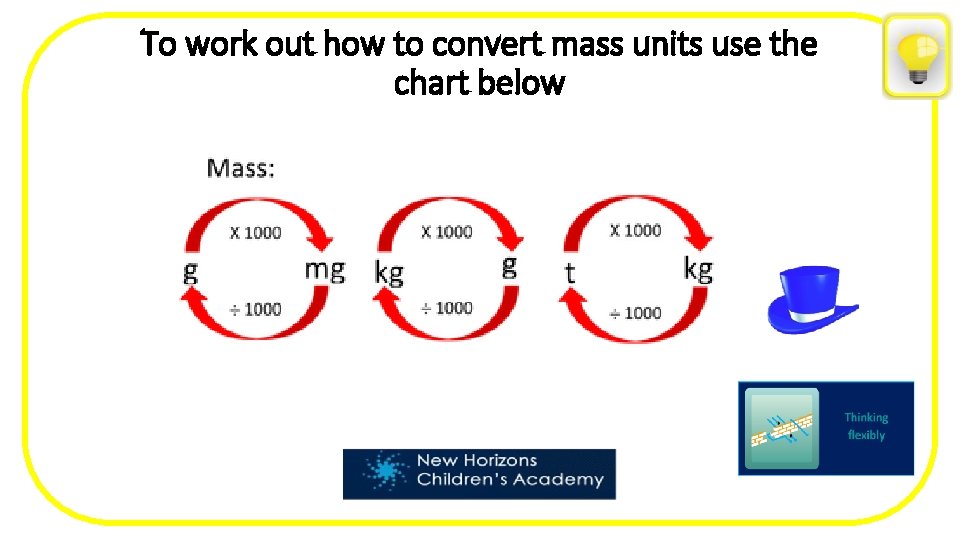
To work out how to convert mass units use the chart below
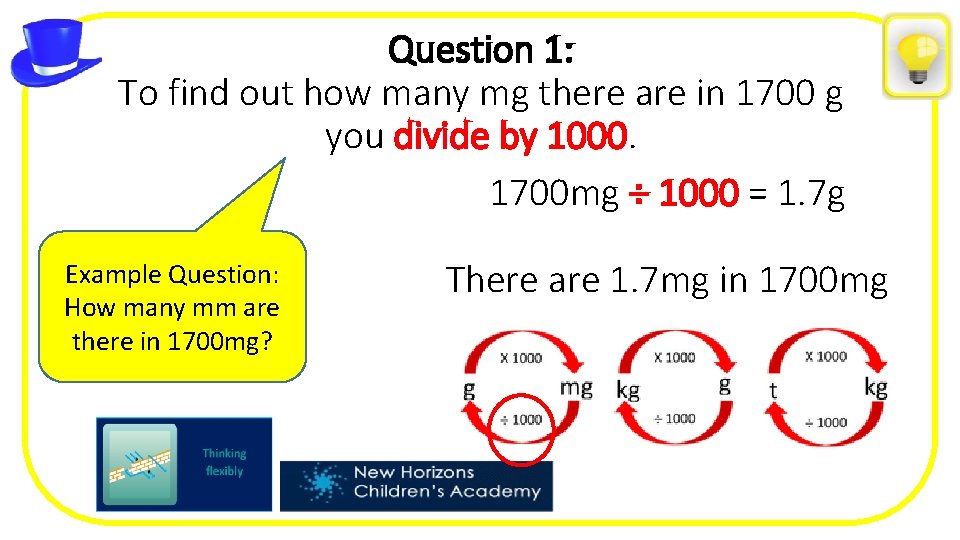
Question 1: To find out how many mg there are in 1700 g you divide by 1000. 1700 mg ÷ 1000 = 1. 7 g Example Question: How many mm are there in 1700 mg? There are 1. 7 mg in 1700 mg
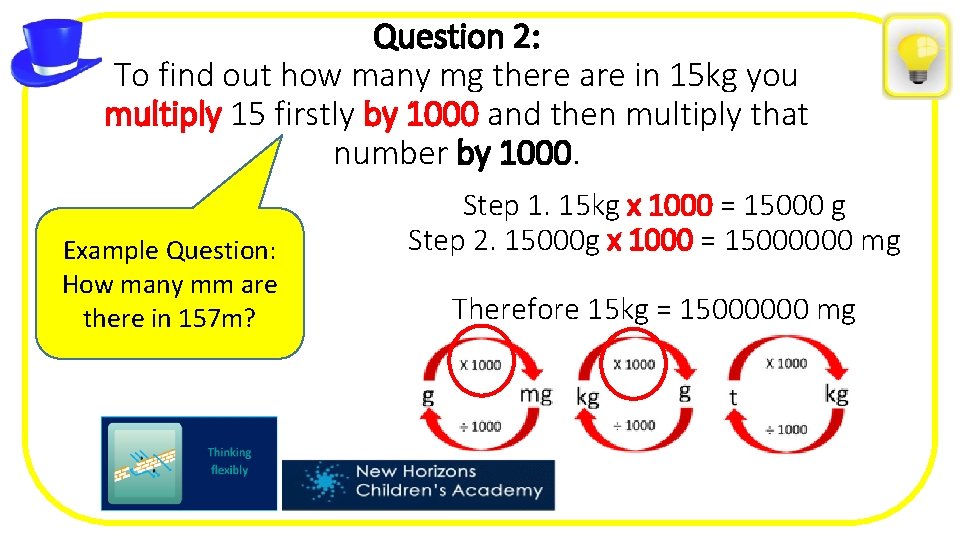
Question 2: To find out how many mg there are in 15 kg you multiply 15 firstly by 1000 and then multiply that number by 1000. Example Question: How many mm are there in 157 m? Step 1. 15 kg x 1000 = 15000 g Step 2. 15000 g x 1000 = 15000000 mg Therefore 15 kg = 15000000 mg
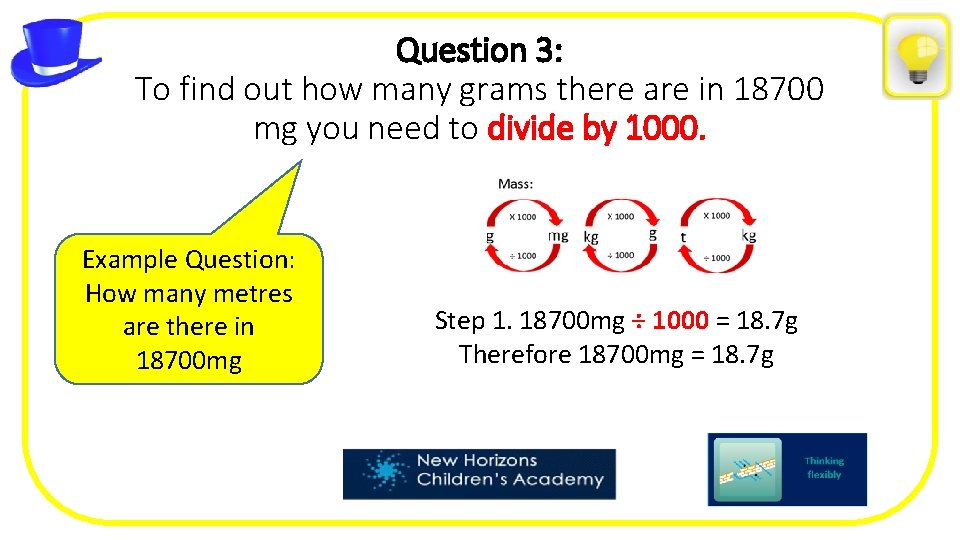
Question 3: To find out how many grams there are in 18700 mg you need to divide by 1000. Example Question: How many metres are there in 18700 mg Step 1. 18700 mg ÷ 1000 = 18. 7 g Therefore 18700 mg = 18. 7 g
Quick tester How many kg are there in 3850000 mg?
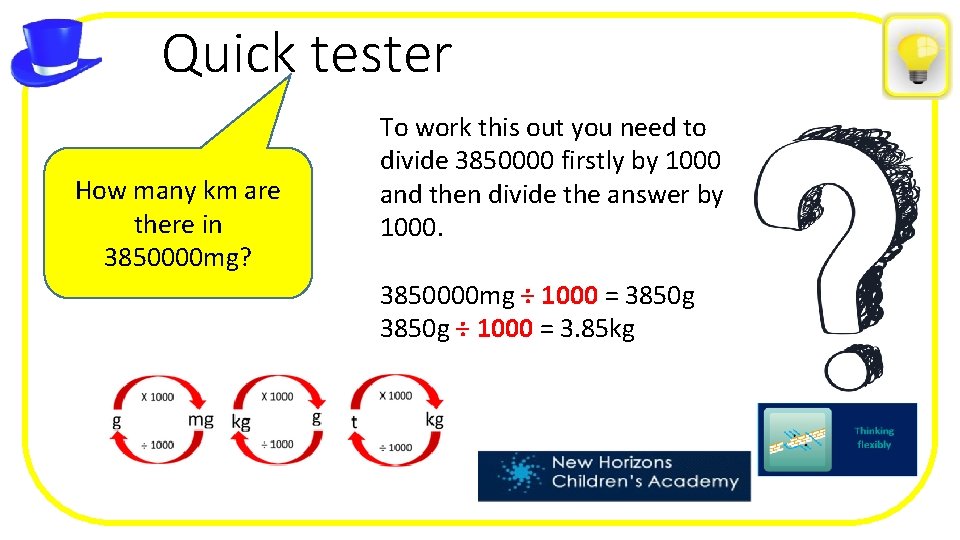
Quick tester How many km are there in 3850000 mg? To work this out you need to divide 3850000 firstly by 1000 and then divide the answer by 1000. 3850000 mg ÷ 1000 = 3850 g ÷ 1000 = 3. 85 kg
Please choose a column from the following resources. They are labelled with the chilli challenge. Remember – if you find it too easy, move on to the next challenge. Use your wobble moment! (Answers follow).
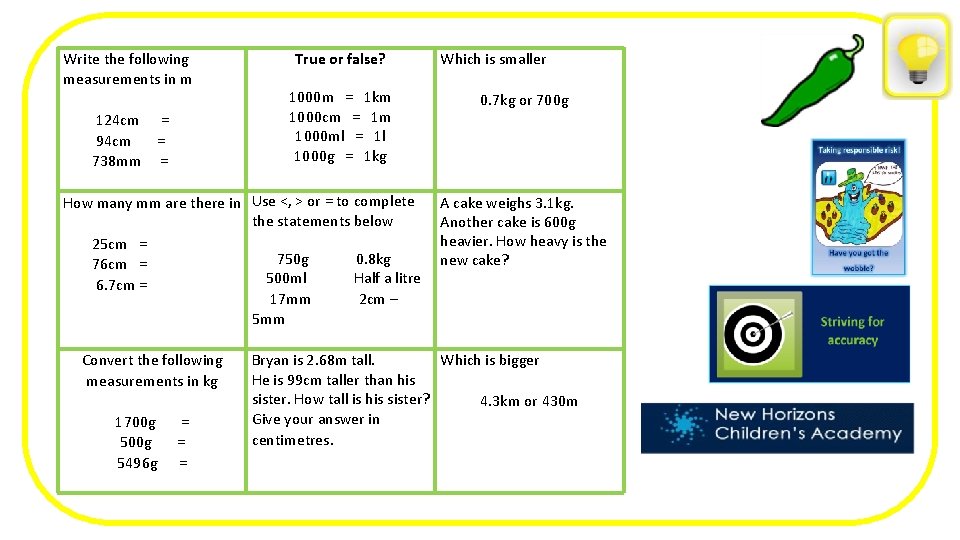
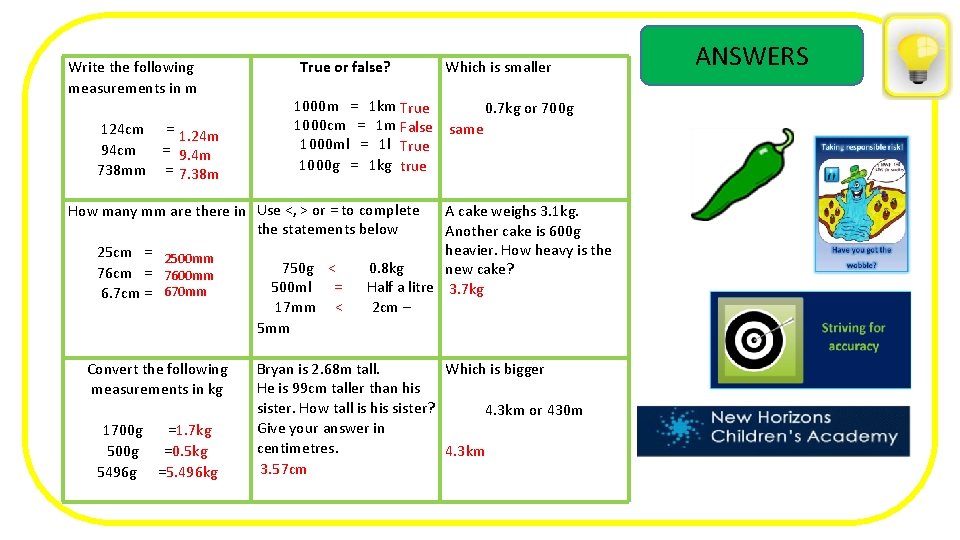
Write the following measurements in m 124 cm = 94 cm = 738 mm = True or false? 1000 m = 1 km 1000 cm = 1 m 1000 ml = 1 l 1000 g = 1 kg How many mm are there in Use <, > or = to complete the statements below 25 cm = 750 g 0. 8 kg 76 cm = 500 ml Half a litre 6. 7 cm = 17 mm 2 cm – 5 mm Convert the following measurements in kg 1700 g 5496 g = = = Which is smaller 0. 7 kg or 700 g A cake weighs 3. 1 kg. Another cake is 600 g heavier. How heavy is the new cake? Bryan is 2. 68 m tall. Which is bigger He is 99 cm taller than his sister. How tall is his sister? 4. 3 km or 430 m Give your answer in centimetres.
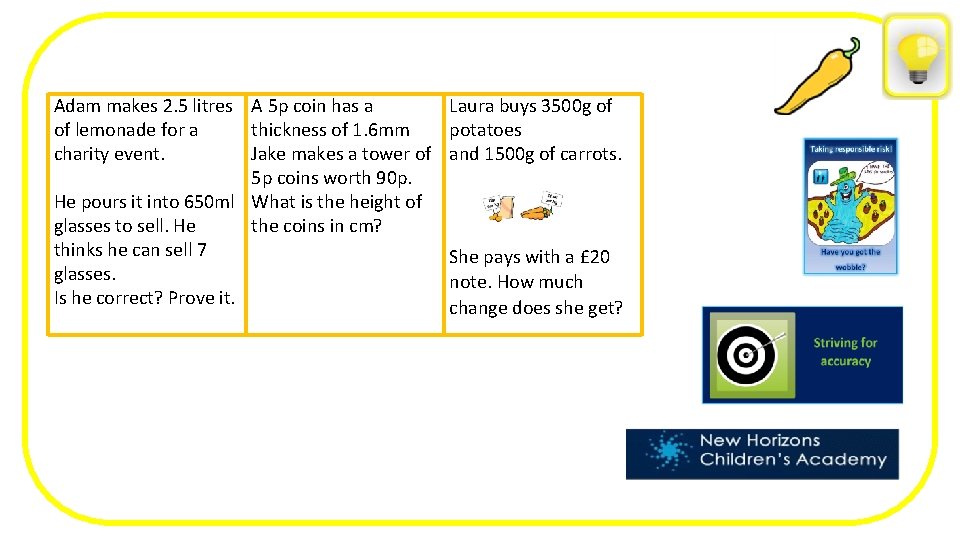
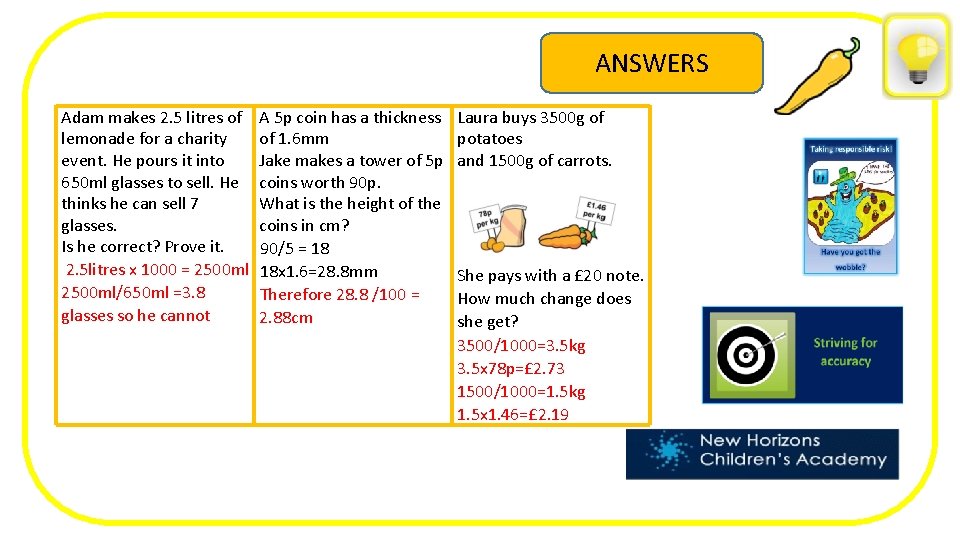
Adam makes 2. 5 litres A 5 p coin has a of lemonade for a thickness of 1. 6 mm charity event. Jake makes a tower of 5 p coins worth 90 p. He pours it into 650 ml What is the height of glasses to sell. He the coins in cm? thinks he can sell 7 glasses. Is he correct? Prove it. Laura buys 3500 g of potatoes and 1500 g of carrots. She pays with a £ 20 note. How much change does she get?
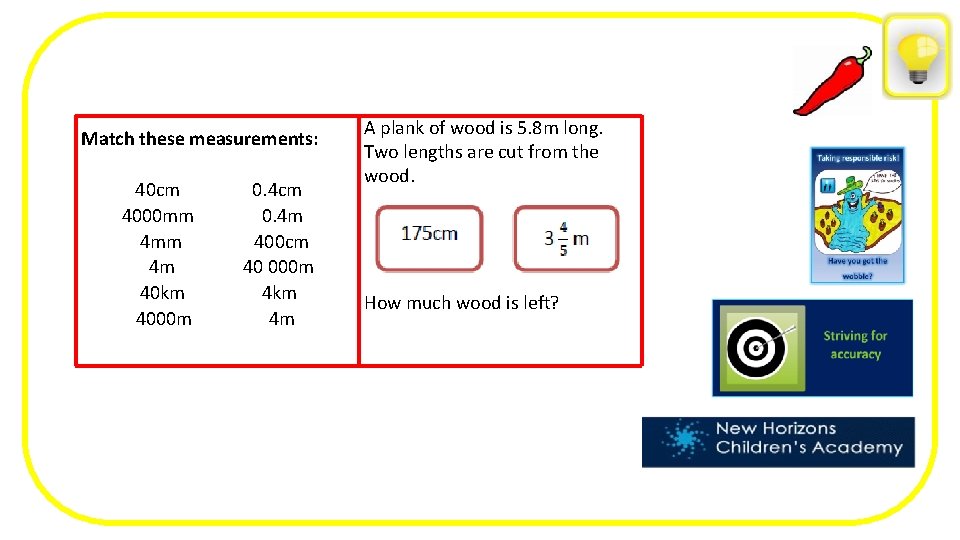
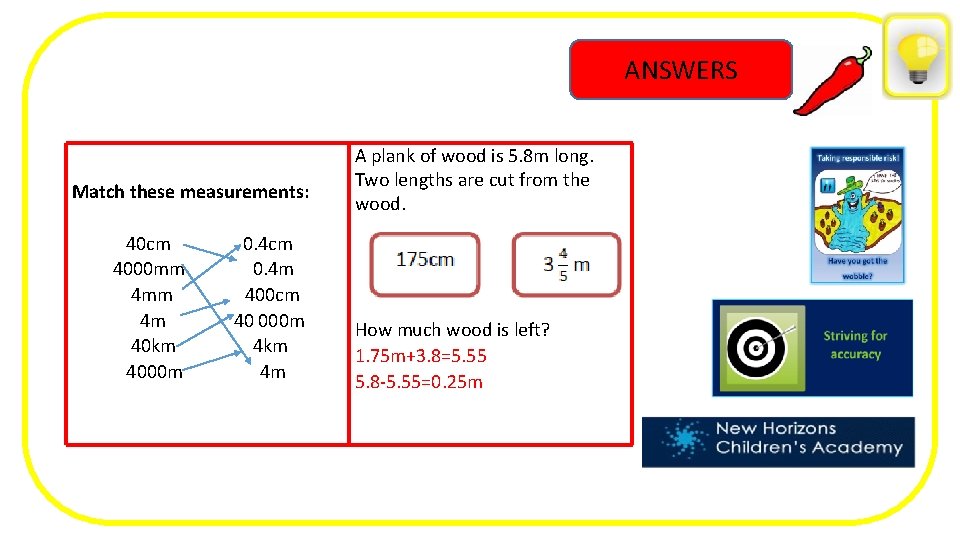
Match these measurements: 40 cm 4000 mm 4 m 40 km 4000 m 0. 4 cm 0. 4 m 400 cm 40 000 m 4 km 4 m A plank of wood is 5. 8 m long. Two lengths are cut from the wood. How much wood is left?
Write the following measurements in m 124 cm = 1. 24 m 94 cm = 9. 4 m 738 mm = 7. 38 m True or false? 1000 m = 1 km True 0. 7 kg or 700 g 1000 cm = 1 m False same 1000 ml = 1 l True 1000 g = 1 kg true How many mm are there in Use <, > or = to complete the statements below 25 cm = 2500 mm 750 g < 0. 8 kg 76 cm = 7600 mm 500 ml = Half a litre 6. 7 cm = 670 mm 17 mm < 2 cm – 5 mm Convert the following measurements in kg 1700 g =1. 7 kg 500 g =0. 5 kg 5496 g =5. 496 kg Which is smaller A cake weighs 3. 1 kg. Another cake is 600 g heavier. How heavy is the new cake? 3. 7 kg Bryan is 2. 68 m tall. Which is bigger He is 99 cm taller than his sister. How tall is his sister? 4. 3 km or 430 m Give your answer in centimetres. 4. 3 km 3. 57 cm ANSWERS
ANSWERS Adam makes 2. 5 litres of lemonade for a charity event. He pours it into 650 ml glasses to sell. He thinks he can sell 7 glasses. Is he correct? Prove it. 2. 5 litres x 1000 = 2500 ml/650 ml =3. 8 glasses so he cannot A 5 p coin has a thickness of 1. 6 mm Jake makes a tower of 5 p coins worth 90 p. What is the height of the coins in cm? 90/5 = 18 18 x 1. 6=28. 8 mm Therefore 28. 8 /100 = 2. 88 cm Laura buys 3500 g of potatoes and 1500 g of carrots. She pays with a £ 20 note. How much change does she get? 3500/1000=3. 5 kg 3. 5 x 78 p=£ 2. 73 1500/1000=1. 5 kg 1. 5 x 1. 46=£ 2. 19
ANSWERS Match these measurements: 40 cm 4000 mm 4 m 40 km 4000 m 0. 4 cm 0. 4 m 400 cm 40 000 m 4 km 4 m A plank of wood is 5. 8 m long. Two lengths are cut from the wood. How much wood is left? 1. 75 m+3. 8=5. 55 5. 8 -5. 55=0. 25 m
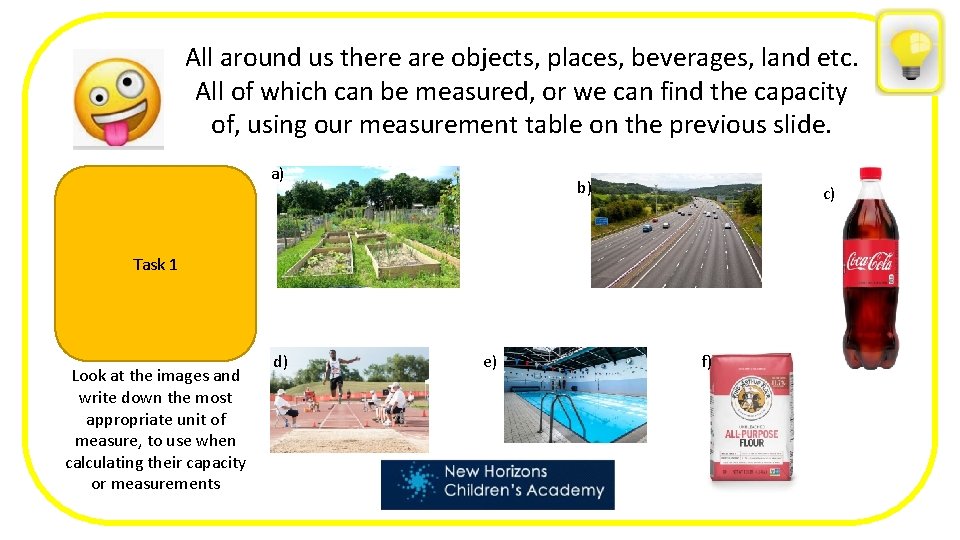
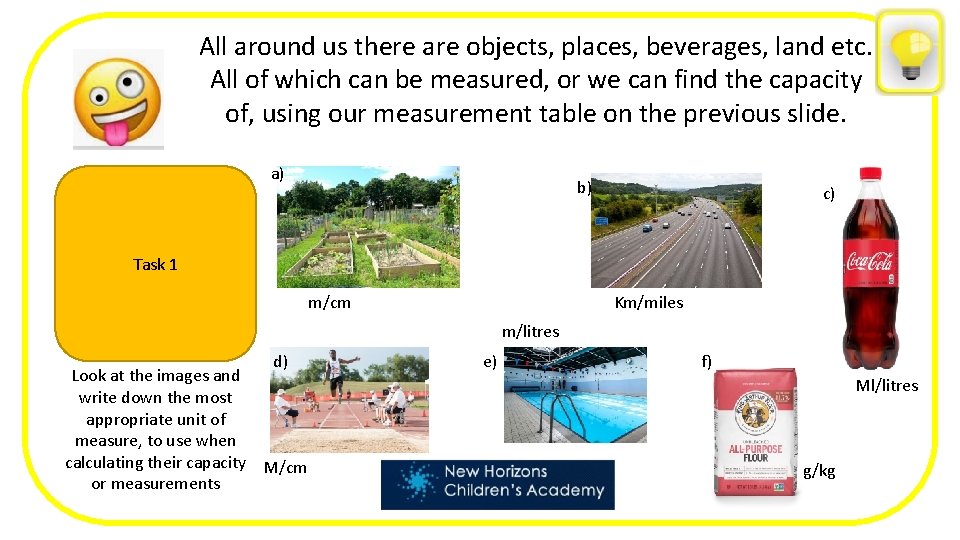
All around us there are objects, places, beverages, land etc. All of which can be measured, or we can find the capacity of, using our measurement table on the previous slide. a) b) c) Task 1 Look at the images and write down the most appropriate unit of measure, to use when calculating their capacity or measurements d) e) f)
All around us there are objects, places, beverages, land etc. All of which can be measured, or we can find the capacity of, using our measurement table on the previous slide. a) b) c) Task 1 m/cm Km/miles m/litres d) Look at the images and write down the most appropriate unit of measure, to use when calculating their capacity M/cm or measurements e) f) Ml/litres g/kg
Next Step: Tomorrow we will be looking at perimeter.
Time to self-assess I am really proud I was able to: My next step will be to: