
Measurements and Errors Definition of a Measurement The
- Slides: 21
Measurements and Errors
Definition of a Measurement • The application of a device or apparatus for the purpose of ascertaining an unknown quantity. • An observation made to determine an unknown quantity • (Usually read from a graduated scale on the device) • Excludes counting which can be exact
Kinds of Measurements • Direct (e. g. taped distance, angles measured by theodolite, …) • Indirect (e. g. coordinate inverse to determine distance, coordinate measurement by GPS • What about an EDM distance? Direct or indirect?
Characteristics of Measurements • No measurements are exact. • All measurements contain errors. • The true value of a quantity being measured is never known • The exact sizes of errors are unknown
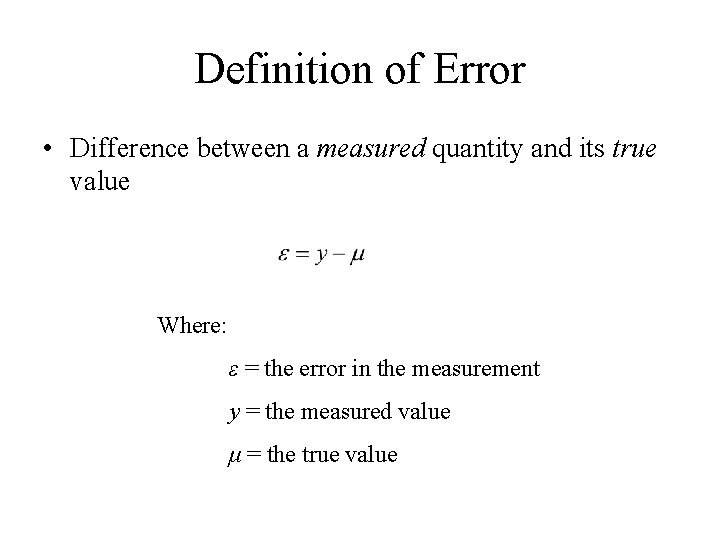
Definition of Error • Difference between a measured quantity and its true value Where: ε = the error in the measurement y = the measured value μ = the true value
Error Sources • Instrumental errors • Natural errors • Personal errors
Instrumental Errors • Caused by imperfections in instrument construction or adjustment • Examples – imperfect spacing of graduations, nominally perpendicular axes not at exactly 90°, level bubbles or crosshairs misadjusted … • Fundamental principle – keep instrument in adjustment to the extent feasible, but use field procedures that assume misadjustment
Natural Errors • Errors caused by conditions in the environment that are not nominal • Examples – temperature different from standard when taping, atmospheric pressure variation, gravity variation, magnetic fields, wind
Personal Errors • Errors due to limitations in human senses or dexterity • Examples – ability to center a bubble, read a micrometer or vernier, steadiness of the hand, estimate between graduations, … • These factors may be influenced by conditions such as weather, insects, hazards, …
Some of the afore-mentioned errors (instrumental, natural, and personal) occur in a systematic manner and others behave with apparent randomness. They are therefore referred to as systematic and random errors.
Mistakes or Blunders • These are generally caused by carelessness • They are not classified as errors in the same sense as systematic or random errors • Examples – not setting the proper PPM correction in an EDM, misreading a scale, misidentifying a point, … • Mistakes need to be identified and eliminated • This is difficult when their effect is small
Systematic Errors • These follow physical laws and can be corrected as long as they are identified and the proper mathematical model is available • Lack of correction of a fundamental systematic error is often considered a mistake • Temperature correction in taping is a typical example
Random Errors • These are the remaining errors which can not be avoided • They tend to be small and are equally likely to be positive as negative • They can be analyzed using the concepts of probability and statistics • They are sometimes referred to as accidental errors
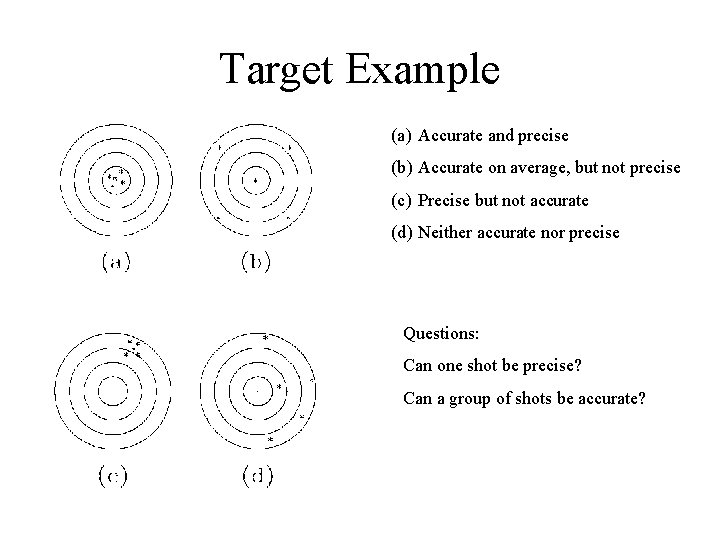
Precision • Due to errors, repeated measurements will often vary • Precision is the degree to which measurements are consistent – measurements with a smaller variation are more precise • Good precision generally requires much skill • Precision is directly related to random error
Accuracy • Accuracy is the nearness to the true value • Since the true value is unknown, true accuracy is unknown • It is generally accepted practice to assess accuracy by comparison with measurements taken with superior equipment and procedures (the so-called test against a higher-accuracy standard)
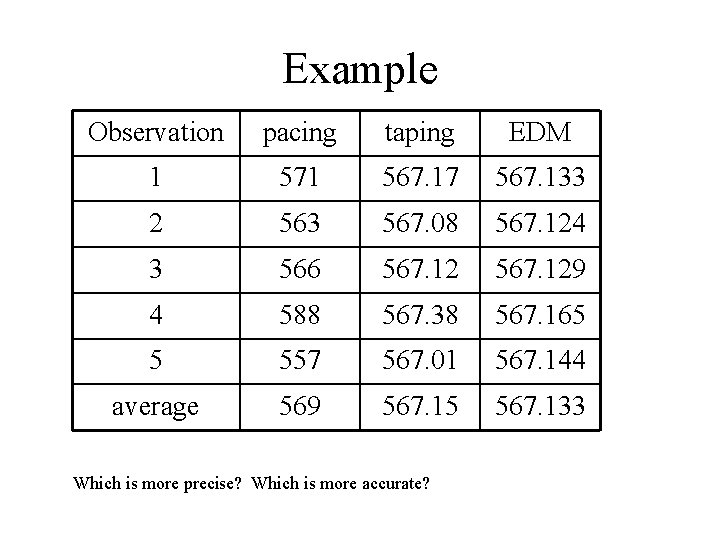
Example Observation pacing taping EDM 1 571 567. 17 567. 133 2 563 567. 08 567. 124 3 566 567. 129 4 588 567. 38 567. 165 5 557 567. 01 567. 144 average 569 567. 15 567. 133 Which is more precise? Which is more accurate?
Target Example (a) Accurate and precise (b) Accurate on average, but not precise (c) Precise but not accurate (d) Neither accurate nor precise Questions: Can one shot be precise? Can a group of shots be accurate?
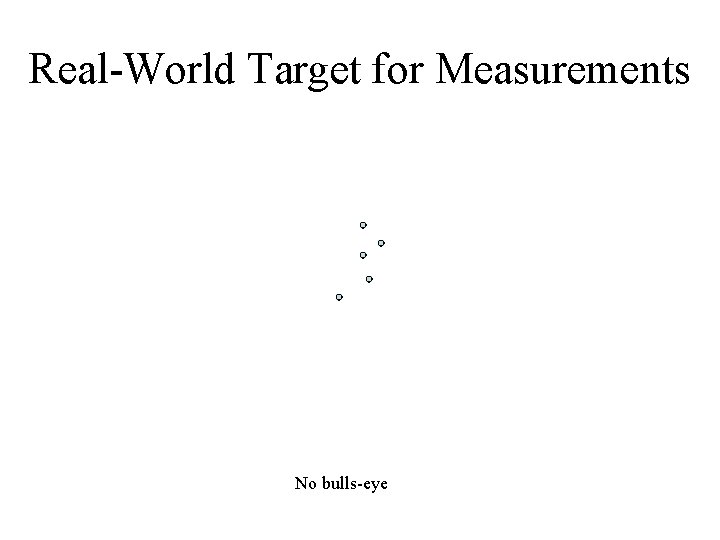
Real-World Target for Measurements No bulls-eye
Redundant Measurements • Redundant measurements are those taken in excess of the minimum required • A prudent professional always takes redundant measurements • Mathematical conditions can be applied to redundant measurements • Examples – sum of angles of a plane triangle = 180°, sum of latitudes and departures in a plane traverse equal zero, averaging measurements of the length of a line
Benefits of Redundancy • Can apply least squares adjustment which is a mathematically superior method • Often disclose mistakes • Better results through averaging (adjustment) • Allows one to assign a plus/minus tolerance to the answer
Advantages of Least Squares Adjustment • • Most rigorous of all adjustment procedures Enables post-adjustment analysis Gives most probable values Can be used to perform survey design for a specified level of precision • Can handle any network configuration (not limited to traverse, for example)