
Measurement Techniques Strategies and Pitfalls Nick Feamster CS



- Slides: 48
Measurement: Techniques, Strategies, and Pitfalls Nick Feamster CS 6250 Fall 2011
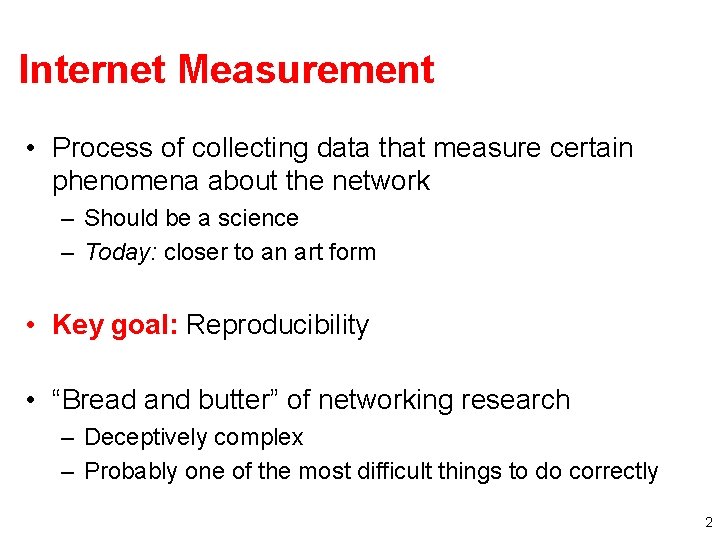
Internet Measurement • Process of collecting data that measure certain phenomena about the network – Should be a science – Today: closer to an art form • Key goal: Reproducibility • “Bread and butter” of networking research – Deceptively complex – Probably one of the most difficult things to do correctly 2
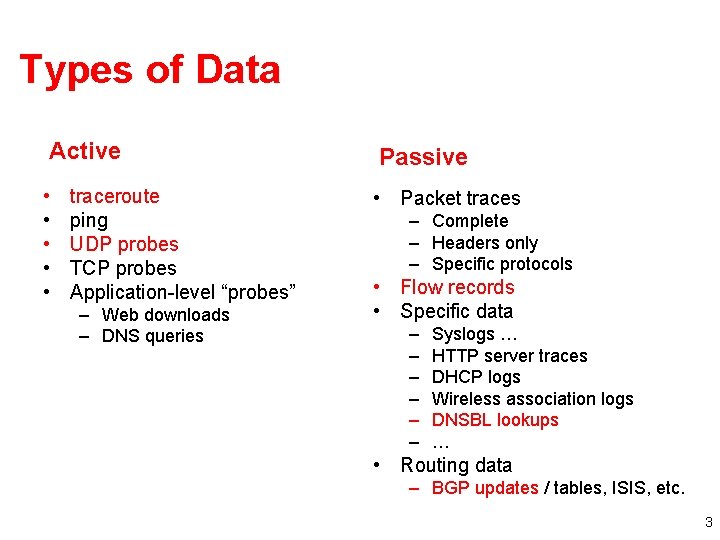
Types of Data Active Passive • • • Packet traces traceroute ping UDP probes TCP probes Application-level “probes” – Web downloads – DNS queries – Complete – Headers only – Specific protocols • Flow records • Specific data – – – Syslogs … HTTP server traces DHCP logs Wireless association logs DNSBL lookups … • Routing data – BGP updates / tables, ISIS, etc. 3
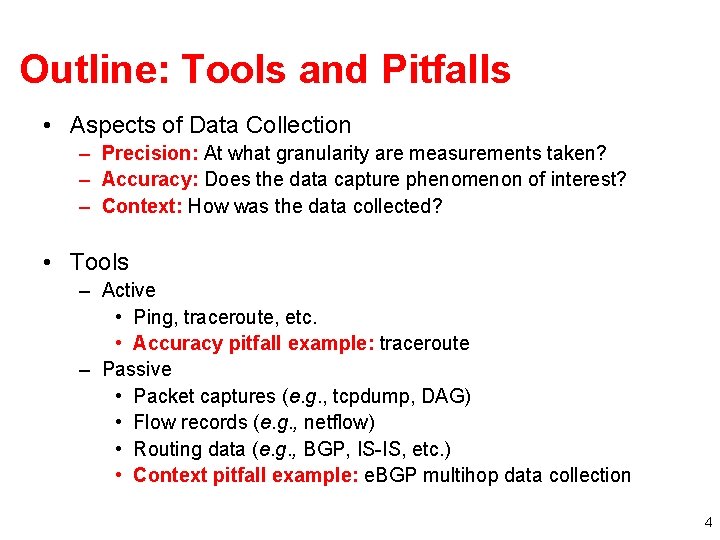
Outline: Tools and Pitfalls • Aspects of Data Collection – Precision: At what granularity are measurements taken? – Accuracy: Does the data capture phenomenon of interest? – Context: How was the data collected? • Tools – Active • Ping, traceroute, etc. • Accuracy pitfall example: traceroute – Passive • Packet captures (e. g. , tcpdump, DAG) • Flow records (e. g. , netflow) • Routing data (e. g. , BGP, IS-IS, etc. ) • Context pitfall example: e. BGP multihop data collection 4
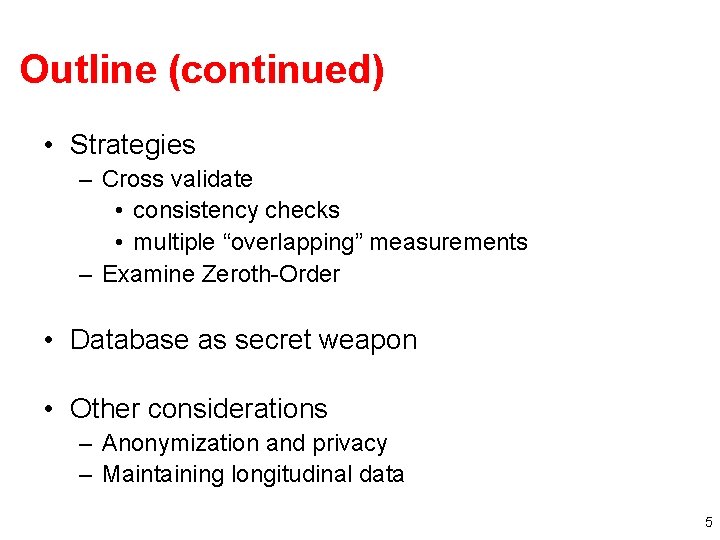
Outline (continued) • Strategies – Cross validate • consistency checks • multiple “overlapping” measurements – Examine Zeroth-Order • Database as secret weapon • Other considerations – Anonymization and privacy – Maintaining longitudinal data 5
Active Measurement 6
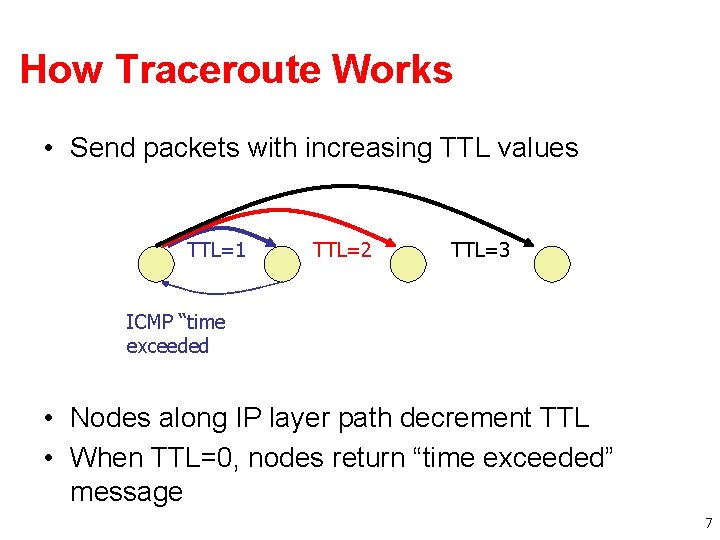
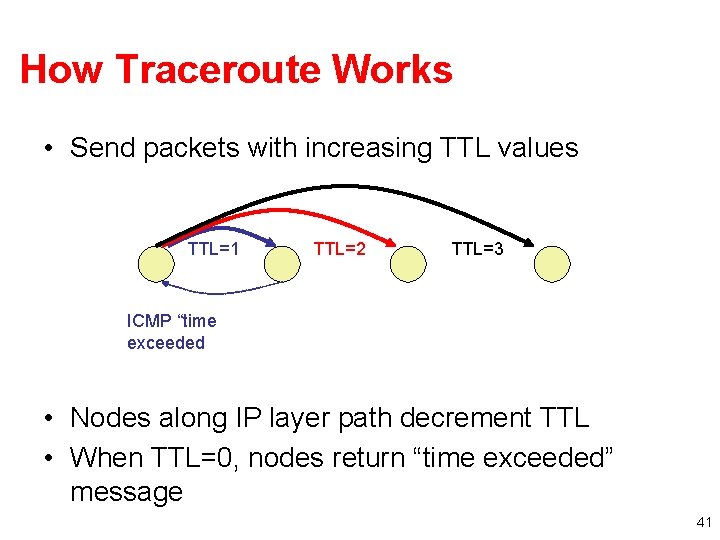
How Traceroute Works • Send packets with increasing TTL values TTL=1 TTL=2 TTL=3 ICMP “time exceeded • Nodes along IP layer path decrement TTL • When TTL=0, nodes return “time exceeded” message 7
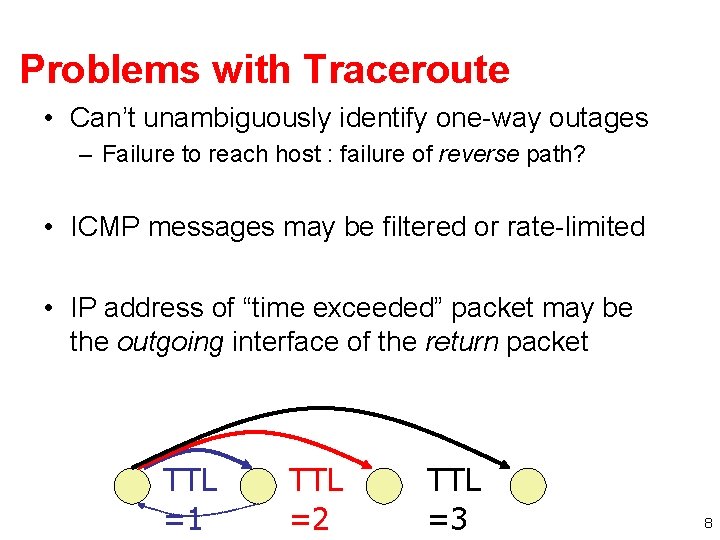
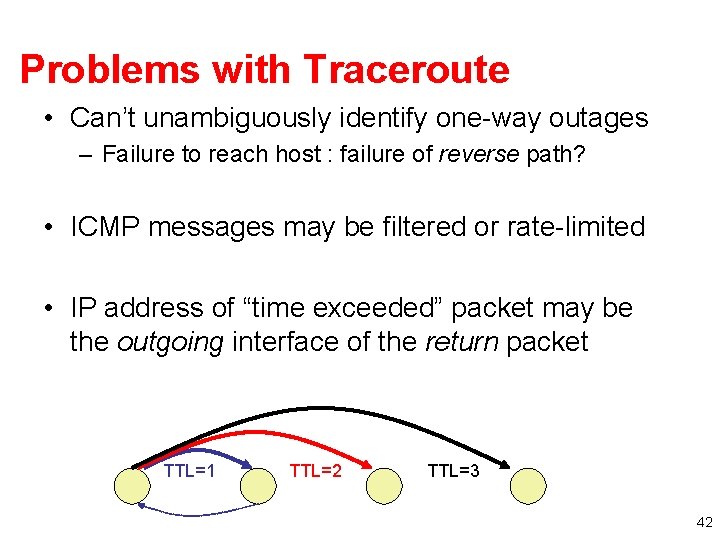
Problems with Traceroute • Can’t unambiguously identify one-way outages – Failure to reach host : failure of reverse path? • ICMP messages may be filtered or rate-limited • IP address of “time exceeded” packet may be the outgoing interface of the return packet TTL =1 TTL =2 TTL =3 8
Famous Traceroute Pitfall • Question: What ASes does traffic traverse? • Strawman approach – Run traceroute to destination – Collect IP addresses – Use “whois” to map IP addresses to AS numbers • Thought Questions – What IP address is used to send “time exceeded” messages from routers? – How are interfaces numbered? – How accurate is whois data? 9
More Caveats: Topology Measurement • Routers have multiple interfaces • Measured topology is a function of vantage points • Example: Node degree – Must “alias” all interfaces to a single node (PS 2) – Is topology a function of vantage point? • Each vantage point forms a tree • See Lakhina et al. 10
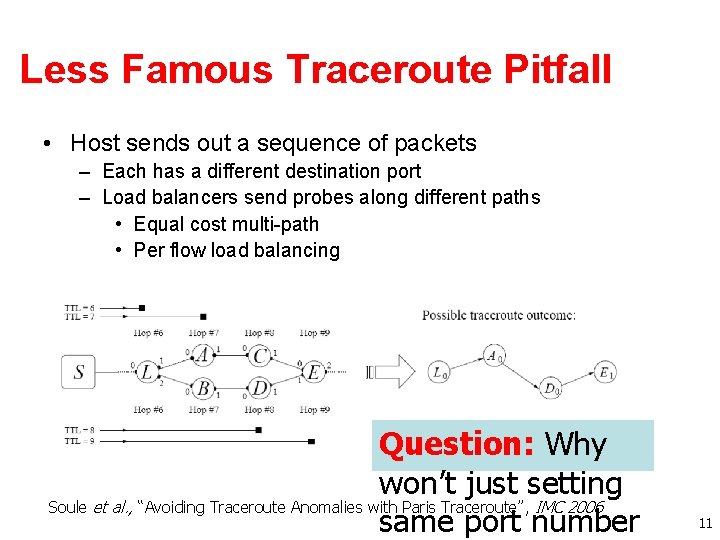
Less Famous Traceroute Pitfall • Host sends out a sequence of packets – Each has a different destination port – Load balancers send probes along different paths • Equal cost multi-path • Per flow load balancing Question: Why won’t just setting Soule et al. , “Avoiding Traceroute Anomalies with Paris Traceroute”, IMC 2006 same port number 11
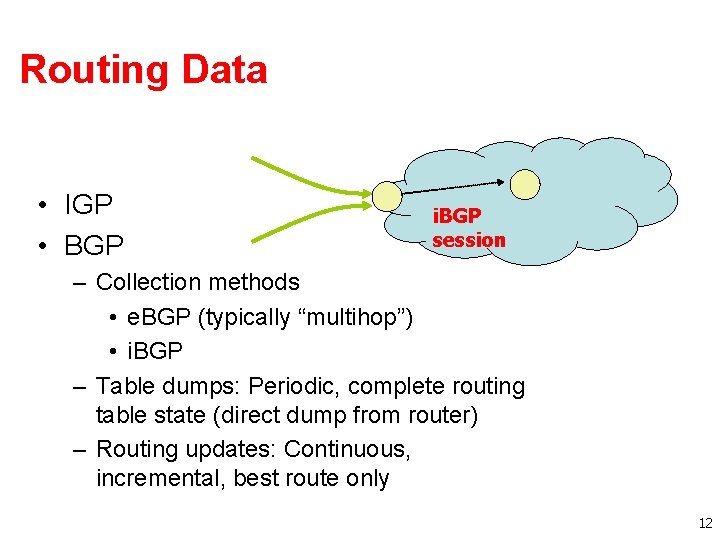
Routing Data • IGP • BGP i. BGP session – Collection methods • e. BGP (typically “multihop”) • i. BGP – Table dumps: Periodic, complete routing table state (direct dump from router) – Routing updates: Continuous, incremental, best route only 12
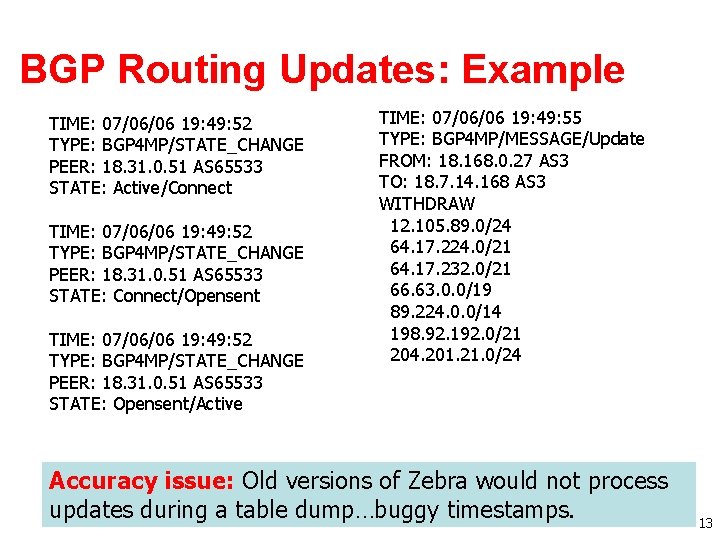
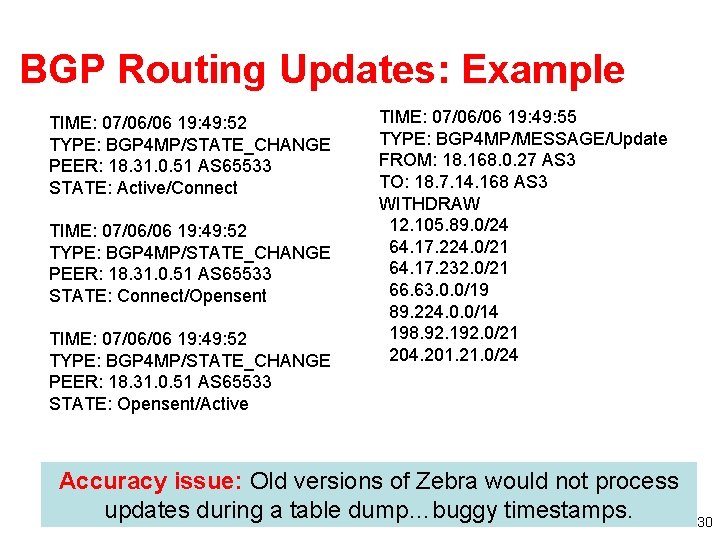
BGP Routing Updates: Example TIME: 07/06/06 19: 49: 52 TYPE: BGP 4 MP/STATE_CHANGE PEER: 18. 31. 0. 51 AS 65533 STATE: Active/Connect TIME: 07/06/06 19: 49: 52 TYPE: BGP 4 MP/STATE_CHANGE PEER: 18. 31. 0. 51 AS 65533 STATE: Connect/Opensent TIME: 07/06/06 19: 49: 52 TYPE: BGP 4 MP/STATE_CHANGE PEER: 18. 31. 0. 51 AS 65533 STATE: Opensent/Active TIME: 07/06/06 19: 49: 55 TYPE: BGP 4 MP/MESSAGE/Update FROM: 18. 168. 0. 27 AS 3 TO: 18. 7. 14. 168 AS 3 WITHDRAW 12. 105. 89. 0/24 64. 17. 224. 0/21 64. 17. 232. 0/21 66. 63. 0. 0/19 89. 224. 0. 0/14 198. 92. 192. 0/21 204. 201. 21. 0/24 Accuracy issue: Old versions of Zebra would not process updates during a table dump…buggy timestamps. 13
Passive Measurement 14
Two Main Approaches • Packet-level Monitoring – Keep packet-level statistics – Examine (and potentially, log) variety of packet-level statistics. Essentially, anything in the packet. – Timing • Flow-level Monitoring – Monitor packet-by-packet (though sometimes sampled) – Keep aggregate statistics on a flow 15
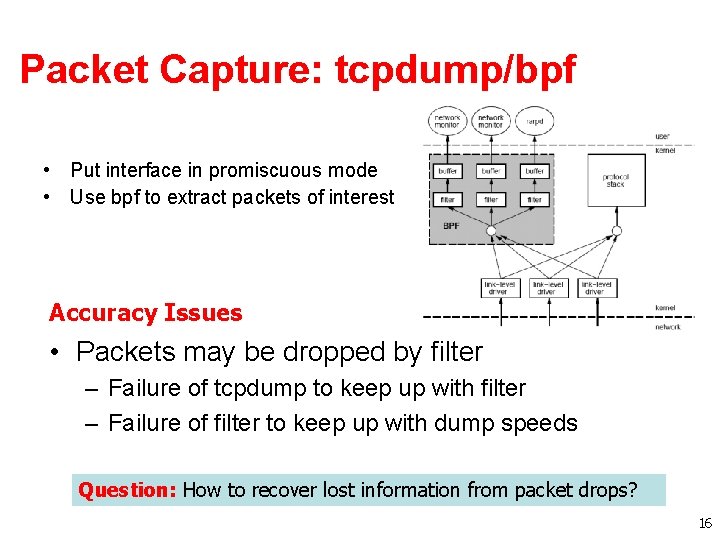
Packet Capture: tcpdump/bpf • Put interface in promiscuous mode • Use bpf to extract packets of interest Accuracy Issues • Packets may be dropped by filter – Failure of tcpdump to keep up with filter – Failure of filter to keep up with dump speeds Question: How to recover lost information from packet drops? 16
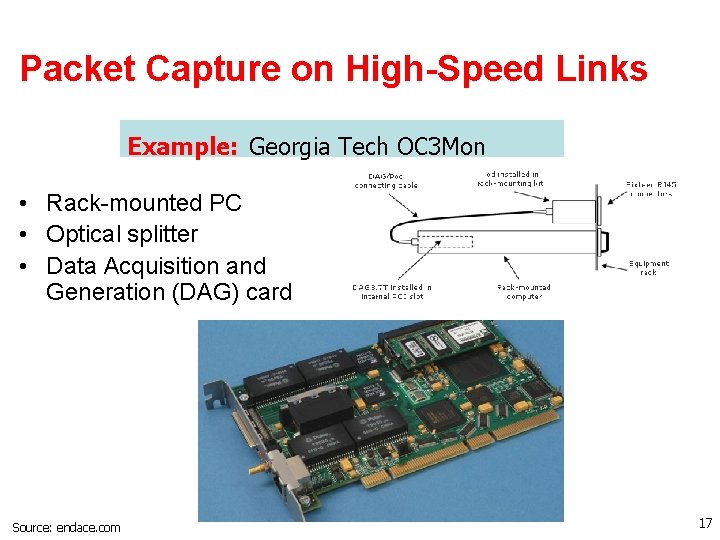
Packet Capture on High-Speed Links Example: Georgia Tech OC 3 Mon • Rack-mounted PC • Optical splitter • Data Acquisition and Generation (DAG) card Source: endace. com 17
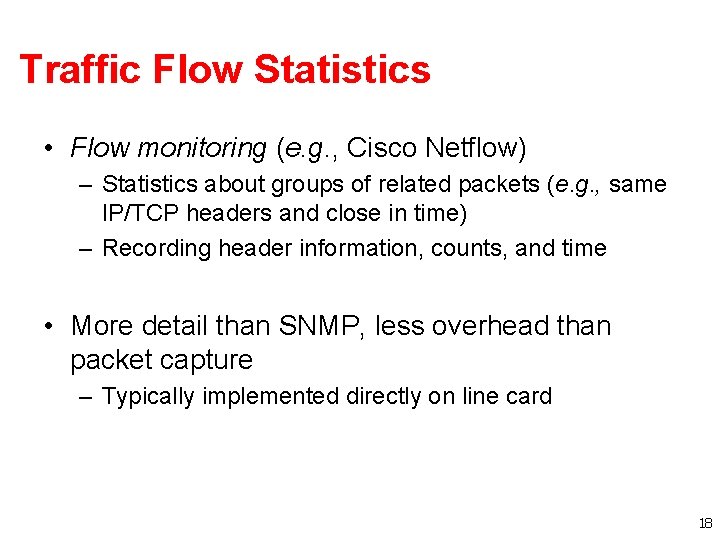
Traffic Flow Statistics • Flow monitoring (e. g. , Cisco Netflow) – Statistics about groups of related packets (e. g. , same IP/TCP headers and close in time) – Recording header information, counts, and time • More detail than SNMP, less overhead than packet capture – Typically implemented directly on line card 18
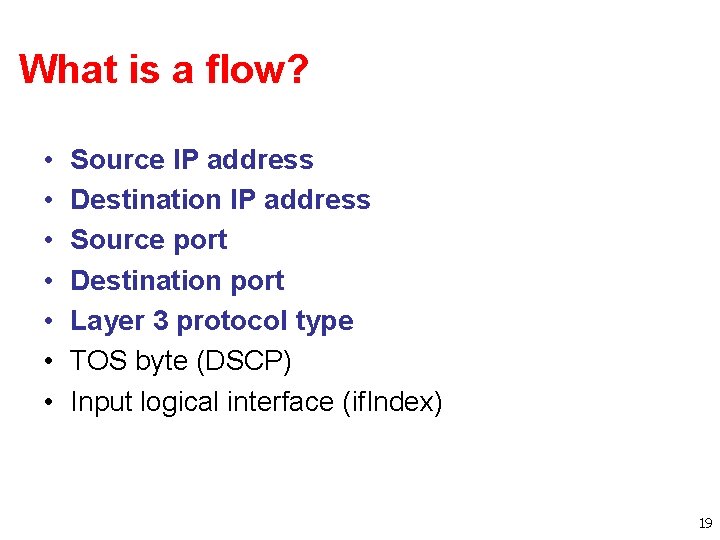
What is a flow? • • Source IP address Destination IP address Source port Destination port Layer 3 protocol type TOS byte (DSCP) Input logical interface (if. Index) 19
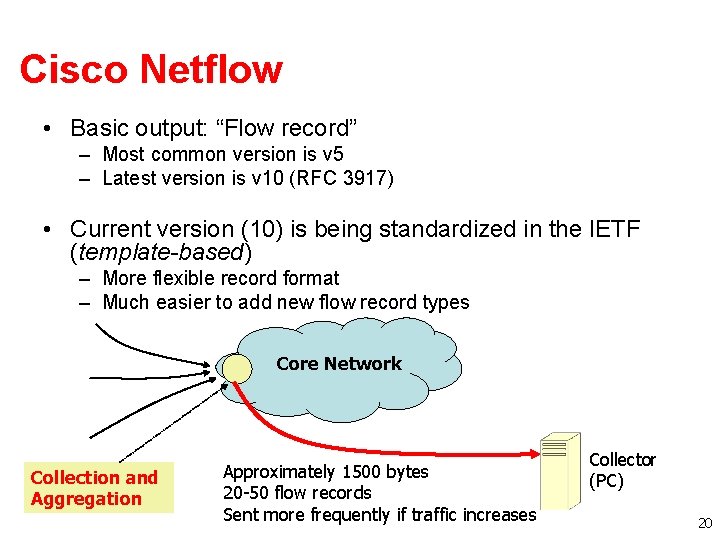
Cisco Netflow • Basic output: “Flow record” – Most common version is v 5 – Latest version is v 10 (RFC 3917) • Current version (10) is being standardized in the IETF (template-based) – More flexible record format – Much easier to add new flow record types Core Network Collection and Aggregation Approximately 1500 bytes 20 -50 flow records Sent more frequently if traffic increases Collector (PC) 20
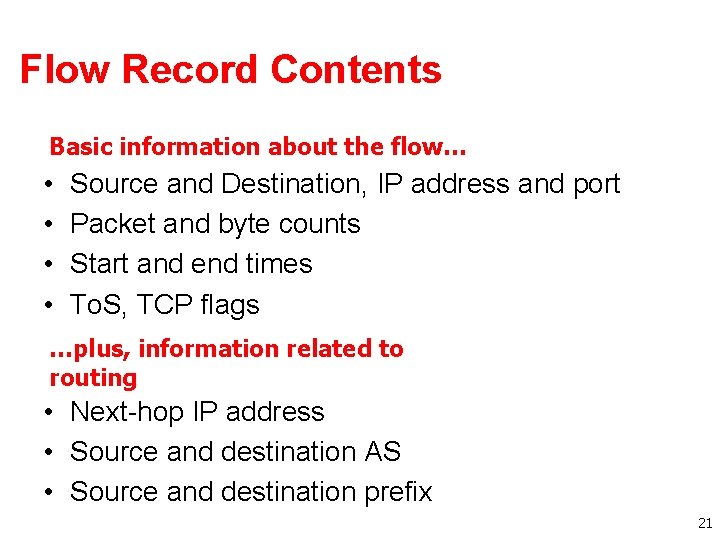
Flow Record Contents Basic information about the flow… • • Source and Destination, IP address and port Packet and byte counts Start and end times To. S, TCP flags …plus, information related to routing • Next-hop IP address • Source and destination AS • Source and destination prefix 21
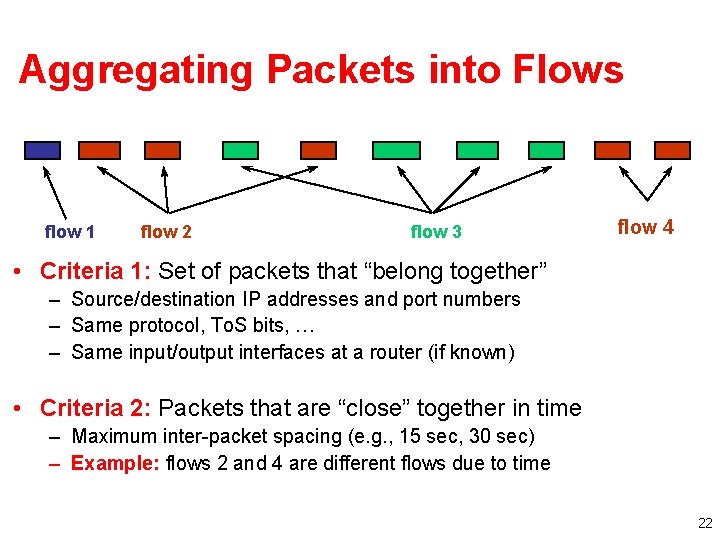
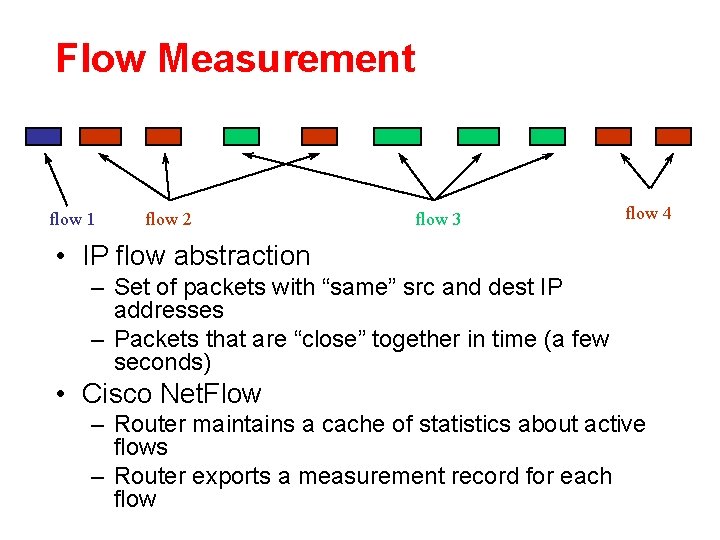
Aggregating Packets into Flows flow 1 flow 2 flow 3 flow 4 • Criteria 1: Set of packets that “belong together” – Source/destination IP addresses and port numbers – Same protocol, To. S bits, … – Same input/output interfaces at a router (if known) • Criteria 2: Packets that are “close” together in time – Maximum inter-packet spacing (e. g. , 15 sec, 30 sec) – Example: flows 2 and 4 are different flows due to time 22
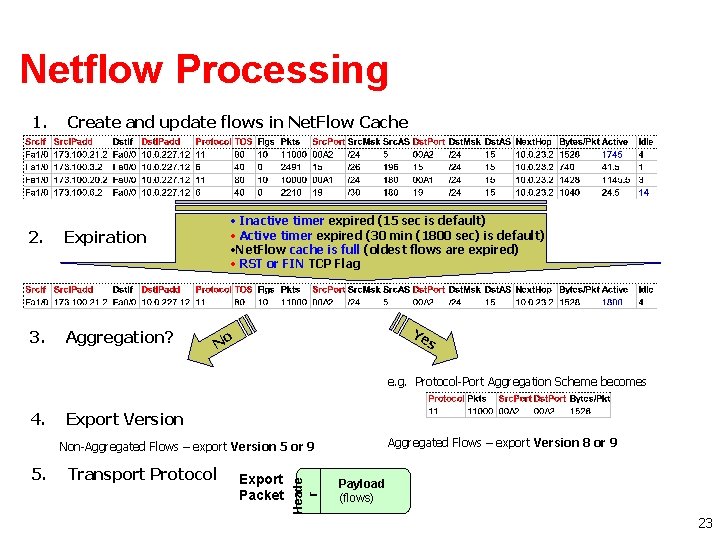
Netflow Processing 1. Create and update flows in Net. Flow Cache 2. Expiration 3. Aggregation? • Inactive timer expired (15 sec is default) • Active timer expired (30 min (1800 sec) is default) • Net. Flow cache is full (oldest flows are expired) • RST or FIN TCP Flag Ye No s e. g. Protocol-Port Aggregation Scheme becomes 4. Export Version Aggregated Flows – export Version 8 or 9 5. Transport Protocol Export Packet Heade r Non-Aggregated Flows – export Version 5 or 9 Payload (flows) 23
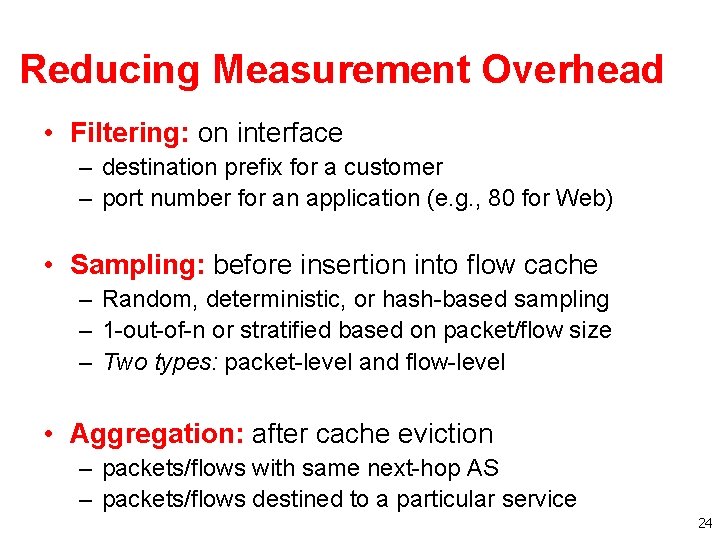
Reducing Measurement Overhead • Filtering: on interface – destination prefix for a customer – port number for an application (e. g. , 80 for Web) • Sampling: before insertion into flow cache – Random, deterministic, or hash-based sampling – 1 -out-of-n or stratified based on packet/flow size – Two types: packet-level and flow-level • Aggregation: after cache eviction – packets/flows with same next-hop AS – packets/flows destined to a particular service 24
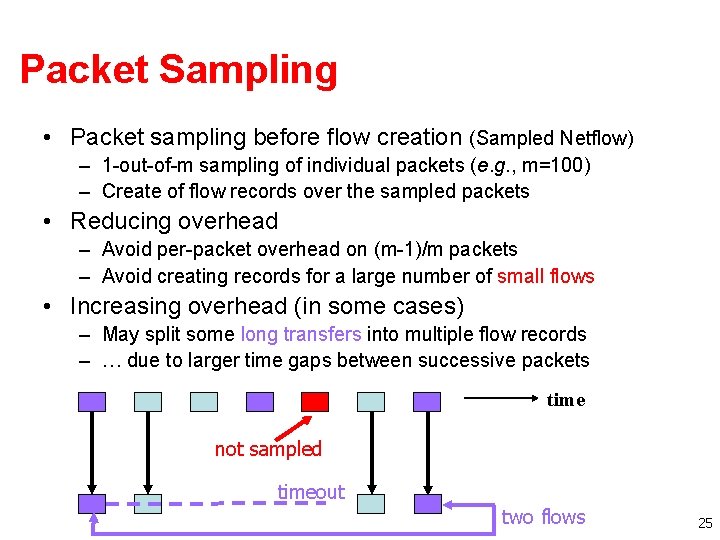
Packet Sampling • Packet sampling before flow creation (Sampled Netflow) – 1 -out-of-m sampling of individual packets (e. g. , m=100) – Create of flow records over the sampled packets • Reducing overhead – Avoid per-packet overhead on (m-1)/m packets – Avoid creating records for a large number of small flows • Increasing overhead (in some cases) – May split some long transfers into multiple flow records – … due to larger time gaps between successive packets time not sampled timeout two flows 25
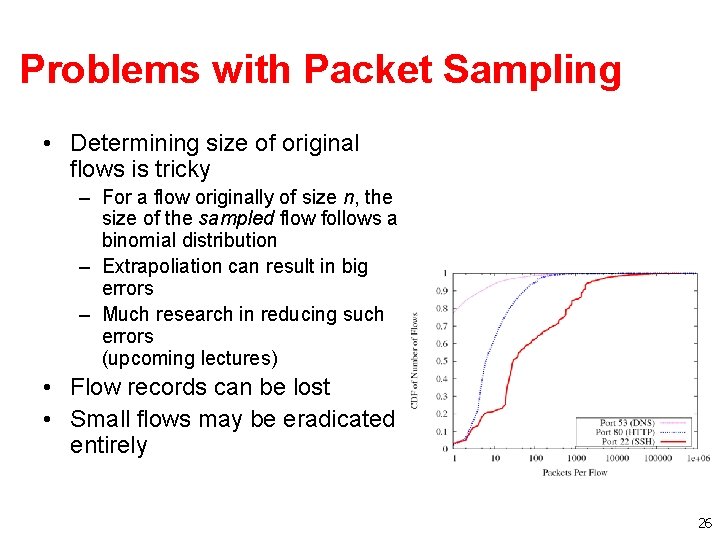
Problems with Packet Sampling • Determining size of original flows is tricky – For a flow originally of size n, the size of the sampled flow follows a binomial distribution – Extrapoliation can result in big errors – Much research in reducing such errors (upcoming lectures) • Flow records can be lost • Small flows may be eradicated entirely 26
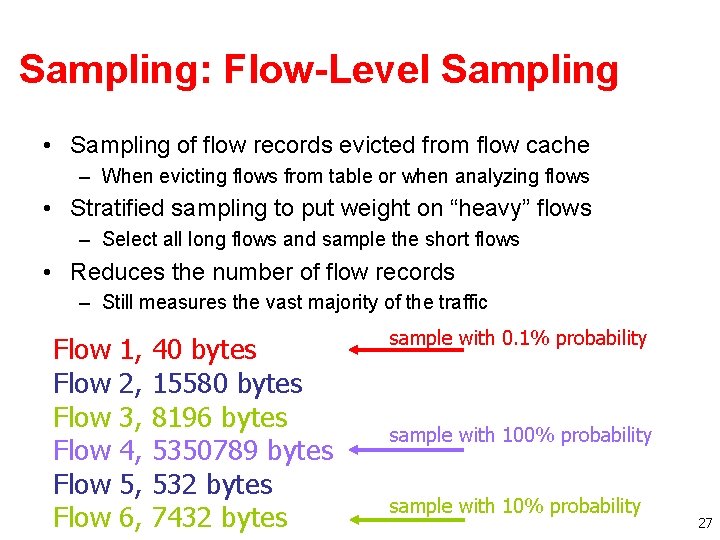
Sampling: Flow-Level Sampling • Sampling of flow records evicted from flow cache – When evicting flows from table or when analyzing flows • Stratified sampling to put weight on “heavy” flows – Select all long flows and sample the short flows • Reduces the number of flow records – Still measures the vast majority of the traffic Flow Flow 1, 2, 3, 4, 5, 6, 40 bytes 15580 bytes 8196 bytes 5350789 bytes 532 bytes 7432 bytes sample with 0. 1% probability sample with 100% probability sample with 10% probability 27
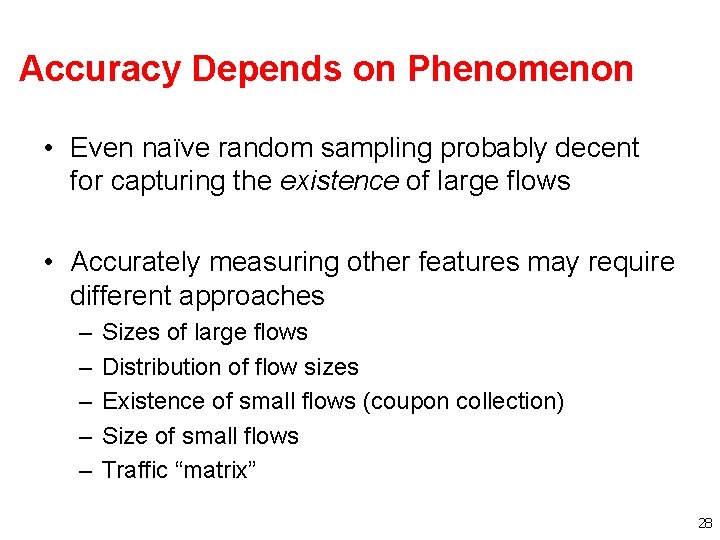
Accuracy Depends on Phenomenon • Even naïve random sampling probably decent for capturing the existence of large flows • Accurately measuring other features may require different approaches – – – Sizes of large flows Distribution of flow sizes Existence of small flows (coupon collection) Size of small flows Traffic “matrix” 28
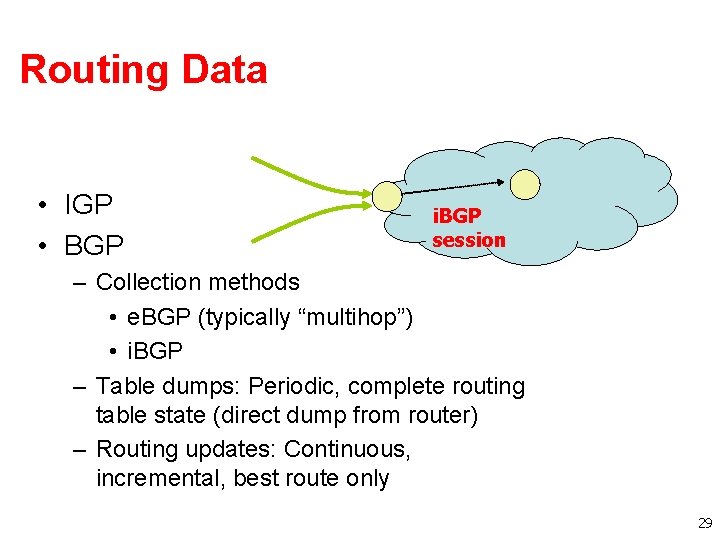
Routing Data • IGP • BGP i. BGP session – Collection methods • e. BGP (typically “multihop”) • i. BGP – Table dumps: Periodic, complete routing table state (direct dump from router) – Routing updates: Continuous, incremental, best route only 29
BGP Routing Updates: Example TIME: 07/06/06 19: 49: 52 TYPE: BGP 4 MP/STATE_CHANGE PEER: 18. 31. 0. 51 AS 65533 STATE: Active/Connect TIME: 07/06/06 19: 49: 52 TYPE: BGP 4 MP/STATE_CHANGE PEER: 18. 31. 0. 51 AS 65533 STATE: Connect/Opensent TIME: 07/06/06 19: 49: 52 TYPE: BGP 4 MP/STATE_CHANGE PEER: 18. 31. 0. 51 AS 65533 STATE: Opensent/Active TIME: 07/06/06 19: 49: 55 TYPE: BGP 4 MP/MESSAGE/Update FROM: 18. 168. 0. 27 AS 3 TO: 18. 7. 14. 168 AS 3 WITHDRAW 12. 105. 89. 0/24 64. 17. 224. 0/21 64. 17. 232. 0/21 66. 63. 0. 0/19 89. 224. 0. 0/14 198. 92. 192. 0/21 204. 201. 21. 0/24 Accuracy issue: Old versions of Zebra would not process updates during a table dump…buggy timestamps. 30
Flow Measurement flow 1 flow 2 flow 3 flow 4 • IP flow abstraction – Set of packets with “same” src and dest IP addresses – Packets that are “close” together in time (a few seconds) • Cisco Net. Flow – Router maintains a cache of statistics about active flows – Router exports a measurement record for each flow
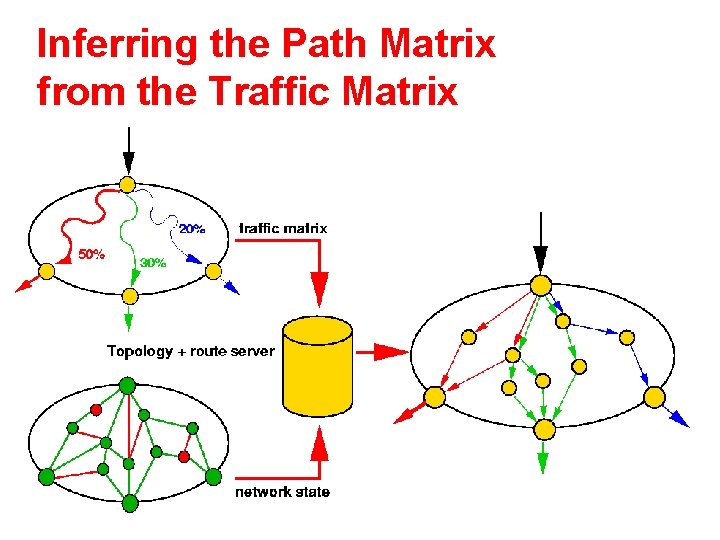
Inferring the Path Matrix from the Traffic Matrix
Strategies for Sound Internet Measurement 33
Paxson’s Suggestions • Maintain comprehensive meta-data. • Calibrate measurements by investigating spikes and outliers, testing for self-consistency, and comparing different mea- surements when the opportunity presents itself. • Structure the analysis process to make it amenable to reproducibility. • For large datasets, work initially on small subsets and assess variability across different subsets. • When making long-running measurements, institute peri- odic, automated analysis of new measurements as a means of detecting when the process breaks, and also to ensure that the process includes the recording of adequate meta-data. • The need to gain access to traces by sending data reduction programs to data gatherers can be used as an opportunity to develop data analysis tools that lend themselves to repro- ducibility and sharing. 34
Motivation • Conducting a sound Internet measurement study is difficult • Paper presents various strategies for coping with these difficulties • A worthwhile read for anyone considering undertaking a measurement study… 35
Dealing with Errors & Imperfections • Precision: The maximum exactness that a tool’s design permits • Accuracy: How well does the measurement abstraction match the phenomenon? • Examples concerning precision: – Filtering: Can misconstrue intent (e. g. , in security monitoring) – Time: Many popular tools don’t attempt to assess precision, but simply report according to format 36
Metadata • Preserving information about precision over the course of a measurement is important • Good data can have a lifetime beyond what the researcher initially envisions – Datasets can be revisited in new contexts 37
Techniques for Calibration • Examining outliers and spikes – Might be genuine – Might also reflect errors or misconceptions • Employing self-consistency checks – Example: Using TCP ACKs to test for completeness • Comparing multiple measurements • Evaluating synthetic data 38
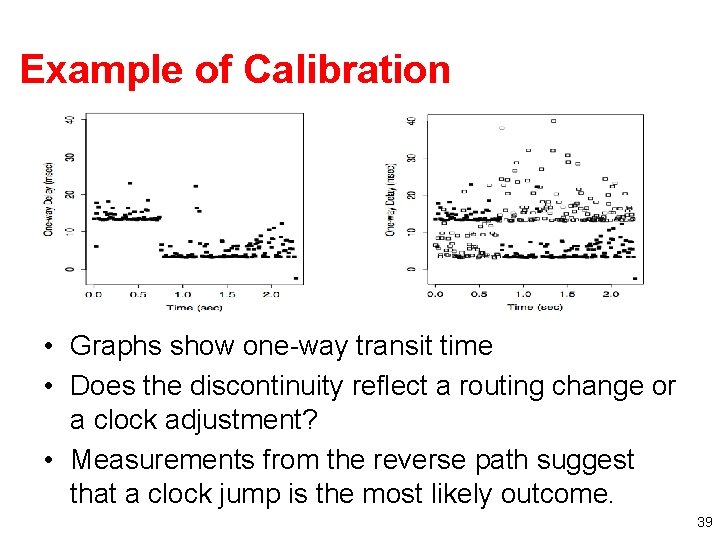
Example of Calibration • Graphs show one-way transit time • Does the discontinuity reflect a routing change or a clock adjustment? • Measurements from the reverse path suggest that a clock jump is the most likely outcome. 39
The Importance of Context: Case Studies 40
How Traceroute Works • Send packets with increasing TTL values TTL=1 TTL=2 TTL=3 ICMP “time exceeded • Nodes along IP layer path decrement TTL • When TTL=0, nodes return “time exceeded” message 41
Problems with Traceroute • Can’t unambiguously identify one-way outages – Failure to reach host : failure of reverse path? • ICMP messages may be filtered or rate-limited • IP address of “time exceeded” packet may be the outgoing interface of the return packet TTL=1 TTL=2 TTL=3 42
Famous Traceroute Pitfall • Question: What ASes does traffic traverse? • Strawman approach – Run traceroute to destination – Collect IP addresses – Use “whois” to map IP addresses to AS numbers • Thought Questions – What IP address is used to send “time exceeded” messages from routers? – How are interfaces numbered? – How accurate is whois data? 43
More Caveats: Topology Measurement • Routers have multiple interfaces • Measured topology is a function of vantage points • Example: Node degree – Must “alias” all interfaces to a single node (PS 2) – Is topology a function of vantage point? • Each vantage point forms a tree • See Lakhina et al. 44
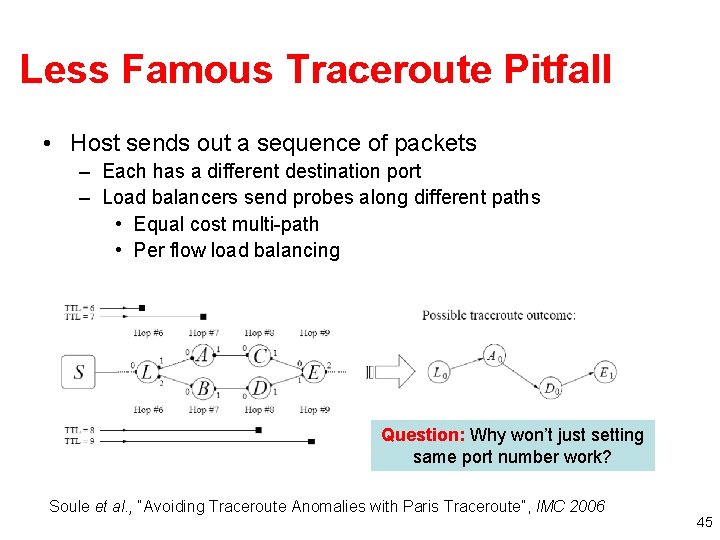
Less Famous Traceroute Pitfall • Host sends out a sequence of packets – Each has a different destination port – Load balancers send probes along different paths • Equal cost multi-path • Per flow load balancing Question: Why won’t just setting same port number work? Soule et al. , “Avoiding Traceroute Anomalies with Paris Traceroute”, IMC 2006 45
Context Pitfall: AS-Level Topologies • Question: What is the Internet’s AS-level topology? • Strawman approach – Routeviews routing table dumps – Adjacency for each pair of ASes in the AS path • Problems with the approach? – Completeness: Many edges could be missing. Why? • Single-path routing • Policy: ranking and filtering • Limited vantage points – Accuracy – Coarseness 46
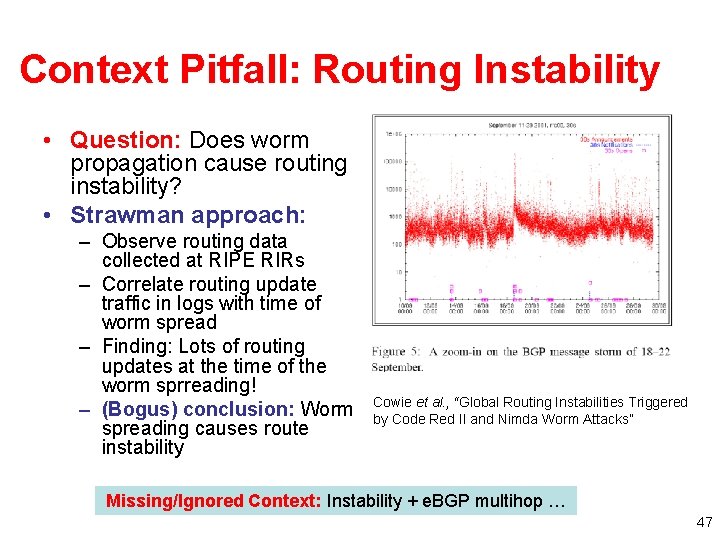
Context Pitfall: Routing Instability • Question: Does worm propagation cause routing instability? • Strawman approach: – Observe routing data collected at RIPE RIRs – Correlate routing update traffic in logs with time of worm spread – Finding: Lots of routing updates at the time of the worm sprreading! – (Bogus) conclusion: Worm spreading causes route instability Cowie et al. , “Global Routing Instabilities Triggered by Code Red II and Nimda Worm Attacks” Missing/Ignored Context: Instability + e. BGP multihop … 47
Designing for Measurement • What mechanisms should routers incorporate to make traceroutes more useful? – Source IP address to “loopback” interface – AS number in time-exceeded message – ? ? 48