
Measurement techniques for energy rating of PV modules







- Slides: 17
Measurement techniques for energy rating of PV modules at TÜV Rheinland PV test laboratories 7 th Energy Rating and Module Performance Modelling Workshop 30/31 March 2017, Lugano, Switzerland Werner Herrmann, Markus Schweiger TÜV Rheinland Energy Gmb. H
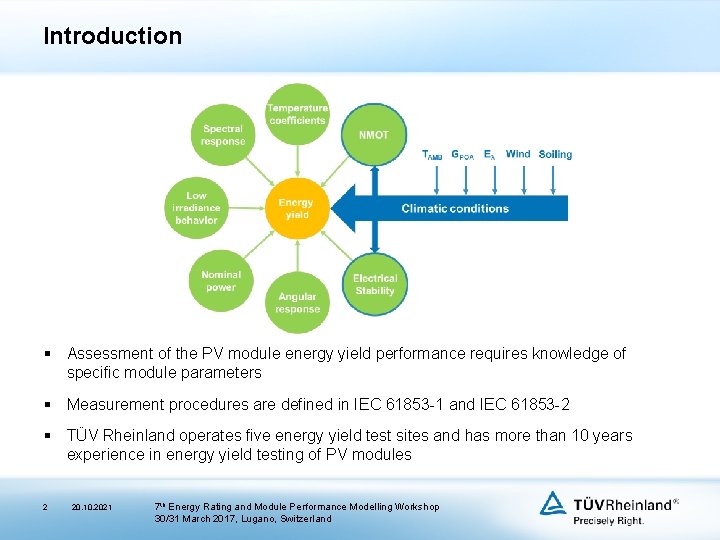
Introduction § Assessment of the PV module energy yield performance requires knowledge of specific module parameters § Measurement procedures are defined in IEC 61853 -1 and IEC 61853 -2 § TÜV Rheinland operates five energy yield test sites and has more than 10 years experience in energy yield testing of PV modules 2 20. 10. 2021 7 th Energy Rating and Module Performance Modelling Workshop 30/31 March 2017, Lugano, Switzerland
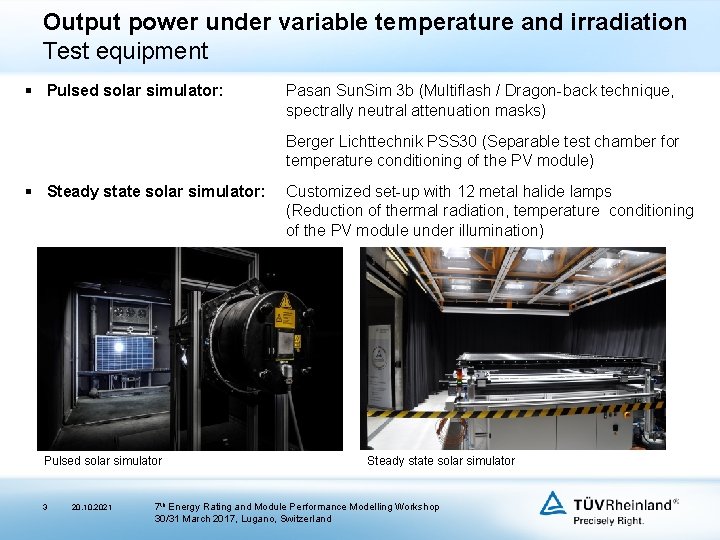
Output power under variable temperature and irradiation Test equipment § Pulsed solar simulator: Pasan Sun. Sim 3 b (Multiflash / Dragon-back technique, spectrally neutral attenuation masks) Berger Lichttechnik PSS 30 (Separable test chamber for temperature conditioning of the PV module) § Steady state solar simulator: Pulsed solar simulator 3 20. 10. 2021 Customized set-up with 12 metal halide lamps (Reduction of thermal radiation, temperature conditioning of the PV module under illumination) Steady state solar simulator 7 th Energy Rating and Module Performance Modelling Workshop 30/31 March 2017, Lugano, Switzerland
Output power under variable temperature and irradiation PV Module I-V correction parameters (IEC 60891) Two options to cover the range of test conditions: a) Measurement of performance matrix in accordance with IEC 61853 -1 Legend: 4 Module parameters: I 1, I 2: V 1, V 2: T 1, T 2: G 1, G 2: Module current Module voltage Module temperature Irradiance Index 1: Index 2: Measurement conditions Target conditions (i. e. STC) 20. 10. 2021 Procedure 2 IEC 60891 b) I-V reference curve + Determination of I-V correction parameters in accordance with IEC 60891 : brel : RS’: ’ : a: arel Temperature coefficient ISC [1/K] Temperature coefficient VOC [1/K] Internal series resistance [ ] Temperature coefficient RS [ /K] Irradiance correction factor of VOC Note: Temperature coefficients are typically related to STC 7 th Energy Rating and Module Performance Modelling Workshop 30/31 March 2017, Lugano, Switzerland
Output power under variable temperature and irradiation Determination of I-V correction parameters (IEC 60891) Variable temperature Module I-V correction parameters (Module type: multi c-Si, 60 cells) Matrix measurements @ 1000 W/m², 25 – 65°C Variable irradiance Matrix measurements @ 25°C, 450 – 1000 W/m² 5 20. 10. 2021 IEC 60891 Parameter Optimierung α REL = -0. 042% K-1 β REL = -0. 46% K-1 ‘ = -0. 004% K-1 RS’ a = 460 m. Ohm = 0. 054 Translated I-V curves at STC Note: I-V correction parameters may be subject to production tolerances 7 th Energy Rating and Module Performance Modelling Workshop 30/31 March 2017, Lugano, Switzerland
Output power under variable temperature and irradiation Spread of I-V correction parameters 6 20. 10. 2021 7 th Energy Rating and Module Performance Modelling Workshop 30/31 March 2017, Lugano, Switzerland
Output power under variable temperature and irradiation Low irradiance behavior of different PV modules PV module performance under variable irradiation is important for locations with high low irradiance contribution to annual insolated solar radiation (i. e. Cologne: 19%) Drop of module efficiency in the low irradiance range <200 W/m² § § c-Si PV technologies: CIGS thin-film: Cd. Te thin-film: a-Si thin-film: -2% to -4% -5% to -10% 0% to -3% -2% to -8% No generalization possible ! References: M. Schweiger et al. : Understanding the energy yield of photovoltaic modules in different climates by linear performance loss analysis of the module performance ratio, IET Renewable Power Generation, ISSN 1752 -1416, 2017 Schweiger et al. : Performance Stability of Photovoltaic Modules in Different Climates, Paper submitted to Progress in PV 7 20. 10. 2021 7 th Energy Rating and Module Performance Modelling Workshop 30/31 March 2017, Lugano, Switzerland
Output power under variable temperature and irradiation Improvement of IEC 61853 -1 Cologne Test program: 3 x 23 x 3 207 Test samples Test conditions I-V measurements § Number of test conditions shall be reduced: - Temperature coefficients at 200 /1000 W/m² - Variable irradiation at 25°C § Other data points can be extrapolated (IEC 60891) 8 20. 10. 2021 7 th Energy Rating and Module Performance Modelling Workshop 30/31 March 2017, Lugano, Switzerland Saudi-Arabia
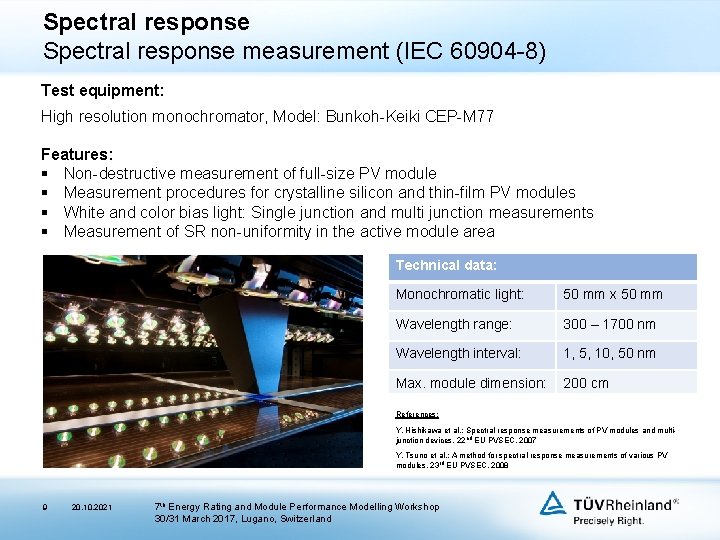
Spectral response measurement (IEC 60904 -8) Test equipment: High resolution monochromator, Model: Bunkoh-Keiki CEP-M 77 Features: § Non-destructive measurement of full-size PV module § Measurement procedures for crystalline silicon and thin-film PV modules § White and color bias light: Single junction and multi junction measurements § Measurement of SR non-uniformity in the active module area Technical data: Monochromatic light: 50 mm x 50 mm Wavelength range: 300 – 1700 nm Wavelength interval: 1, 5, 10, 50 nm Max. module dimension: 200 cm References: Y. Hishikawa et al. : Spectral response measurements of PV modules and multijunction devices, 22 nd EU PVSEC, 2007 Y. Tsuno et al. : A method for spectral response measurements of various PV modules, 23 rd EU PVSEC, 2008 9 20. 10. 2021 7 th Energy Rating and Module Performance Modelling Workshop 30/31 March 2017, Lugano, Switzerland
Spectral response Spread of SR curves for different PV technologies § Spread of SR curves is observed for all PV technologies § Future advances in cell technology will increase the spread 10 20. 10. 2021 7 th Energy Rating and Module Performance Modelling Workshop 30/31 March 2017, Lugano, Switzerland
Angular response Concepts for angular response measurement on cell level Manufacture of a mini Destructive test method: -module: § Identical optical construction compared to PV module § Test cell = center cell 11 20. 10. 2021 TUV non-destructive test method: § PV module § Test cell is electrically contacted through backsheet § Isc of test cell is concluded from PV module I-V curve under partially shading 7 th Energy Rating and Module Performance Modelling Workshop 30/31 March 2017, Lugano, Switzerland
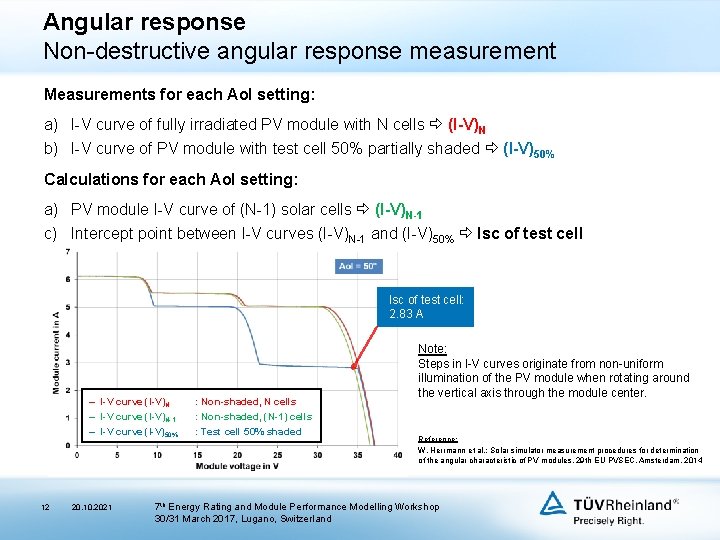
Angular response Non-destructive angular response measurement Measurements for each Ao. I setting: a) I-V curve of fully irradiated PV module with N cells (I-V)N b) I-V curve of PV module with test cell 50% partially shaded (I-V)50% Calculations for each Ao. I setting: a) PV module I-V curve of (N-1) solar cells (I-V)N-1 c) Intercept point between I-V curves (I-V)N-1 and (I-V)50% Isc of test cell: 2. 83 A – I-V curve (I-V)N-1 – I-V curve (I-V)50% 12 20. 10. 2021 : Non-shaded, N cells : Non-shaded, (N-1) cells : Test cell 50% shaded Note: Steps in I-V curves originate from non-uniform illumination of the PV module when rotating around the vertical axis through the module center. Reference: W. Herrmann et al. : Solar simulator measurement procedures for determination of the angular characteristic of PV modules, 29 th EU PVSEC, Amsterdam, 2014 7 th Energy Rating and Module Performance Modelling Workshop 30/31 March 2017, Lugano, Switzerland
Angular response Non-destructive angular response measurement Angular response (AR) curve /Incident angle modifier (IAM) c-Si PV module 13 20. 10. 2021 7 th Energy Rating and Module Performance Modelling Workshop 30/31 March 2017, Lugano, Switzerland
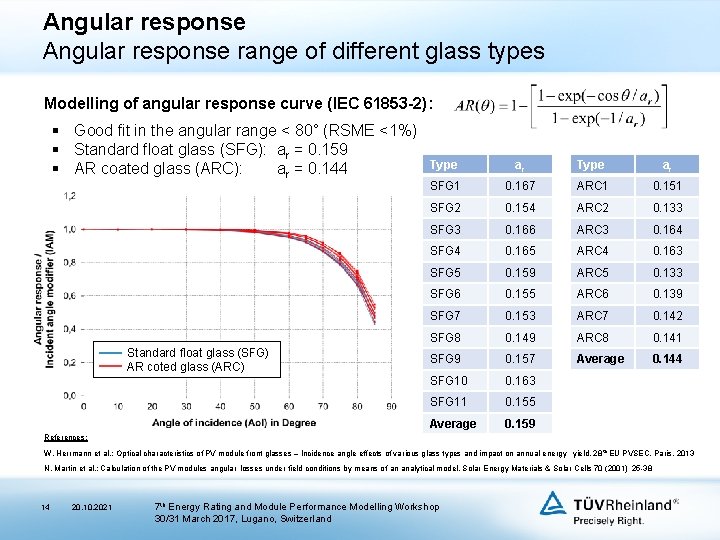
Angular response range of different glass types Modelling of angular response curve (IEC 61853 -2): § Good fit in the angular range < 80° (RSME <1%) § Standard float glass (SFG): ar = 0. 159 § AR coated glass (ARC): ar = 0. 144 Standard float glass (SFG) AR coted glass (ARC) Type ar SFG 1 0. 167 ARC 1 0. 151 SFG 2 0. 154 ARC 2 0. 133 SFG 3 0. 166 ARC 3 0. 164 SFG 4 0. 165 ARC 4 0. 163 SFG 5 0. 159 ARC 5 0. 133 SFG 6 0. 155 ARC 6 0. 139 SFG 7 0. 153 ARC 7 0. 142 SFG 8 0. 149 ARC 8 0. 141 SFG 9 0. 157 Average 0. 144 SFG 10 0. 163 SFG 11 0. 155 Average 0. 159 References: W. Herrmann et al. : Optical characteristics of PV module front glasses – Incidence angle effects of various glass types and impact on annual energy yield, 28 th EU PVSEC, Paris, 2013 N. Martin et al. : Calculation of the PV modules angular losses under field conditions by means of an analytical model, Solar Energy Materials & Solar Cells 70 (2001) 25 -38 14 20. 10. 2021 7 th Energy Rating and Module Performance Modelling Workshop 30/31 March 2017, Lugano, Switzerland
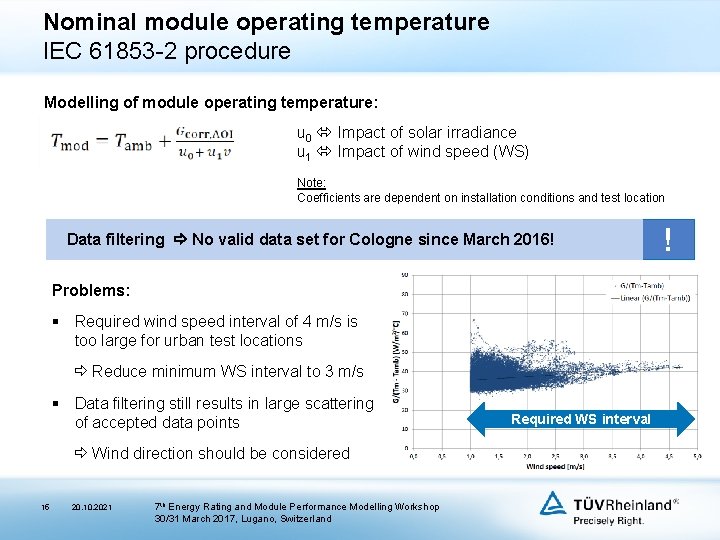
Nominal module operating temperature IEC 61853 -2 procedure Modelling of module operating temperature: u 0 Impact of solar irradiance u 1 Impact of wind speed (WS) Note: Coefficients are dependent on installation conditions and test location Data filtering No valid data set for Cologne since March 2016! Problems: § Required wind speed interval of 4 m/s is too large for urban test locations Reduce minimum WS interval to 3 m/s § Data filtering still results in large scattering of accepted data points Wind direction should be considered 15 20. 10. 2021 7 th Energy Rating and Module Performance Modelling Workshop 30/31 March 2017, Lugano, Switzerland Required WS interval !
Conclusions § Within all PV technologies (thin-film and c-Si) significant scattering of energy yield performance was observed § Individual performance characterization of a module type is required § Data sheet information of PV modules does not cover the needs for energy rating § Test requirements of IEC 61853 -1 and IEC 61853 -2 shall be improved to perform measurements with reasonable constrains of costs and time § IEC 60891 shall be applied to reduce test work in the laboratory 16 20. 10. 2021 7 th Energy Rating and Module Performance Modelling Workshop 30/31 March 2017, Lugano, Switzerland
Thank you for your attention! Dr. Werner Herrmann TÜV Rheinland Energy Gmb. H werner. herrmann@de. tuv. com http: //www. tuv. com/solarpower 17 7 th Energy Rating and Module Performance Modelling Workshop 30/31 March 2017, Lugano, Switzerland