
Measurement Standards Units Chapter 1 OBJECTIVES 1 Explain
Measurement Standards & Units Chapter 1
OBJECTIVES 1. Explain the static and dynamic characteristics of an instrument. 2. Calculate and analyze the measurement error, accuracy, precision and limiting error. 3. Describe the basic elements of electronic instrument.
INTRODUCTION v Instrumentation is a technology of measurement which serves sciences, engineering, medicine and etc. v Measurement is the process of determining the amount, degree or capacity by comparison with the accepted standards of the system units being used. v Instrument is a device for determining the value or magnitude of a quantity or variable. v. Electronic instrument is based on electrical or electronic principles for its measurement functions.

TYPE OF INSTRUMENTS Absolute instruments q The quantity to be measured in terms of the deflection and physical constant of the instrument. q No calibration needed Secondary instruments q The quantity to be measured will be indicated in term of the deflection of the pointer which indicates the value on the calibrated dial from the observation of the output from instrument. q Most commonly used.
Effect used in the secondary Instruments Whenever current flows through a circuit, it produces a number of effects. When current flows through a wire, it produces a magnetic field as well as heating effect. When current flows through a battery, it produces an electrostatic field and EMF in a nearby circuit due to EM induction. That effect is used to produce the deflecting torque…magnetic effect
CLASSIFICATION OF INSTRUMENTS Indicating Type - visualize the process/operation The quantity measured is indicated on a graduated scale Recording Type - observe and save the measurement reading The variation in the quantity to be measured during a specified period is recorded continuously on a graph. Controlling Type - to control measurement and process
Indicating Operation Type Deflection Ø Only one source of input required. i)Output reading is based on the deflection from the initial condition of the instrument. ii) The measured value of the quantity depends on the calibration of the instrument. Null Ø Require two input – measured and balance input. Ø Must have feedback operation that compare the measured with standard value. Ø More accurate and sensitive compared to deflection type instrument.
Signal Type Analog Ø Produce the signal that vary in continuous way. Ø Infinite range of value in any given range. Digital Ø Produce the signal that vary in discrete steps. Ø Finite different values in a given range.
Advantages of Electronic Measurement Results high sensitivity rating – the use of amplifier Increase the input impedance – thus lower loading effects Ability to monitor remote signal
PERFORMANCE CHARACTERISTICS q Performance Characteristics - characteristics that show the performance of an instrument. q Eg: accuracy, precision, resolution, sensitivity. q Allows users to select the most suitable instrument for a specific measuring jobs. q Two basic characteristics : ü Static – measuring a constant process condition. ü Dynamic - measuring a varying process condition.

Cont’… q Accuracy – the degree of exactness (closeness) of measurement compared to the expected (desired) value. q Resolution – the smallest change in a measurement variable to which an instrument will respond. q Precision – a measure of consistency or repeatability of measurement, i. e successive reading do not differ. q Sensitivity – ratio of change in the output (response) of instrument to a change of input or measured variable. q Expected value – the design value or the most probable value that expect to obtain. q Error – the deviation of the true value from the desired value.
Dynamic Characteristics q Dynamic – measuring a varying process condition. q Instruments rarely respond instantaneously to changes in the measured variables due to such things as mass, thermal capacitance, fluid capacitance or electrical capacitance. q Pure delay in time is often encountered where the instrument waits for some reaction to take place. q Such industrial instruments are nearly always used for measuring quantities that fluctuate with time. q Therefore, the dynamic and transient behavior of the instrument is important.
Dynamic Behavior Characteristics q. The dynamic behavior of an instrument is determined by subjecting its primary element (sensing element) to some unknown and predetermined variations in the measured quantity. � The three most common variations in the measured quantity: • Step change • Linear change • Sinusoidal change
Dynamic Variation Characteristics q Step change - in which the primary element is subjected to an instantaneous and finite change in measured variable. q Linear change - in which the primary element is following the measured variable, changing linearly with time. q Sinusoidal change - in which the primary element follows a measured variable, the magnitude of which changes in accordance with a sinusoidal function of constant amplitude.
Dynamic Performance Characteristics q The dynamic performance characteristics of an instrument are: Speed of response - The rapidity with which an instrument responds changes in measured quantity. Dynamic error -The difference between the true and measured value with no static error. Lag – delay in the response of an instrument to changes in the measured variable. Fidelity – the degree to which an instrument indicates the changes in the measured variable without dynamic error (faithful reproduction).

Standard v. A standard is a known accurate measure of physical quantity. v Standards are used to determine the values of other physical quantities by the comparison method. v All standards are preserved at the International Bureau of Weight and Measures (BIMP), Paris. v Four categories of standard: 1) International Standard 2) Primary Standard 3) Secondary Standard 4) Working Standard
1) International Standard Defined by International Agreement Represent the closest possible accuracy attainable by the current science and technology 2) Primary Standard Maintained at the National Standard Lab (different for every country) Function: the calibration and verification of secondary Standard Each lab has its own secondary Standard which are periodically checked and certified by the National Standard Lab. For example, in Malaysia, this function is carried out by SIRIM.
Secondary Standard Secondary standards are basic reference standards used by measurement and calibration laboratories in industries. Each industry has its own secondary standard. Each laboratory periodically sends its secondary standard to the National standards laboratory for calibration and comparison against the primary standard. After comparison and calibration, the National Standards Laboratory returns the secondary standards to particular industrial laboratory with a certification of measuring accuracy in terms of a primary standard. 3) 4) Working Standard Used to check and calibrate lab instrument for accuracy and performance. For example, manufacturers of electronic components such as capacitors, resistors and many more use a standard called a working standard for checking the component values being manufactured.
Measurement Errors are always introduced when using instruments to measure electrical quantities. The errors most likely to occur in measurements are those due to: i) The limitations of the instrument; ii) The operator; iii) The instrument disturbing the circuit.
Errors in the limitations of the instrument v The calibration accuracy of an instrument depends on the precision with which it is constructed. v Every instrument has a margin of error which is expressed as a percentage of the instruments full scale deflection (fsd). v For example industrial grade instruments have an accuracy of ± 2% of fsd. Thus if a voltmeter has a fsd of 100 V and it indicates 40 V say, then the actual voltage may be anywhere between 40±(2% of 100), or 40 ± 2, i. e. between 38 V and 42 V. v When an instrument is calibrated, it is compared against a standard instrument.
Errors by the operator q It is easy for an operator to misread an instrument. q With linear scales the values of the sub-divisions are reasonably easy to determine; non-linear scale graduations are more difficult to estimate. q Also, scales differ from instrument to instrument and some meters have more than one scale (as with multimeters) and mistakes in reading indications are easily made. q When reading a meter scale it should be viewed from an angle perpendicular to the surface of the scale at the location of the pointer; a meter scale should not be viewed ‘at an angle’.
Errors due to the instrument disturbing the circuit q. Any instrument connected into a circuit will affect that circuit to some extent. q. Meters require some power to operate, but provided this power is small compared with the power in the measured circuit, then little error will result. q. Incorrect positioning of instruments in a circuit can be a source of errors.
Ø Example q Assuming ‘perfect’ instruments, the resistance should be given by the voltmeter reading divided by the ammeter reading (i. e. R = V/I). q However, for R serial with Ammeter, V/I = R + ra and for the current through the ammeter is that through the resistor plus that through the voltmeter. q Hence the voltmeter reading divided by the ammeter reading will not give the true value of the resistance R for either method of connection.
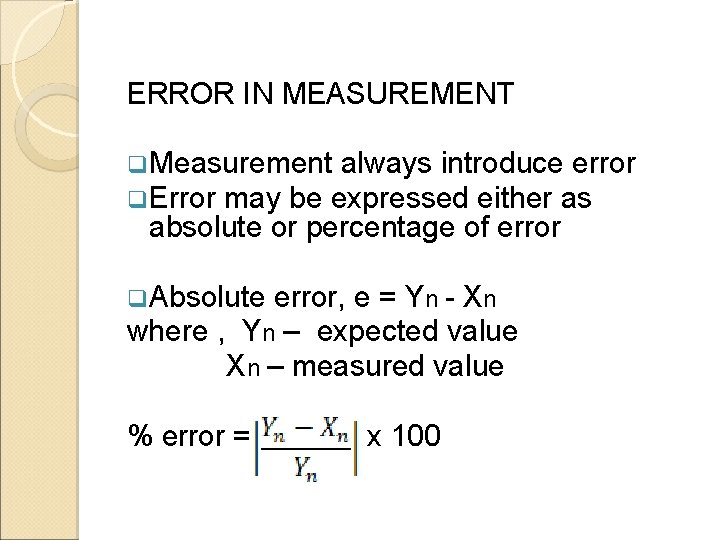
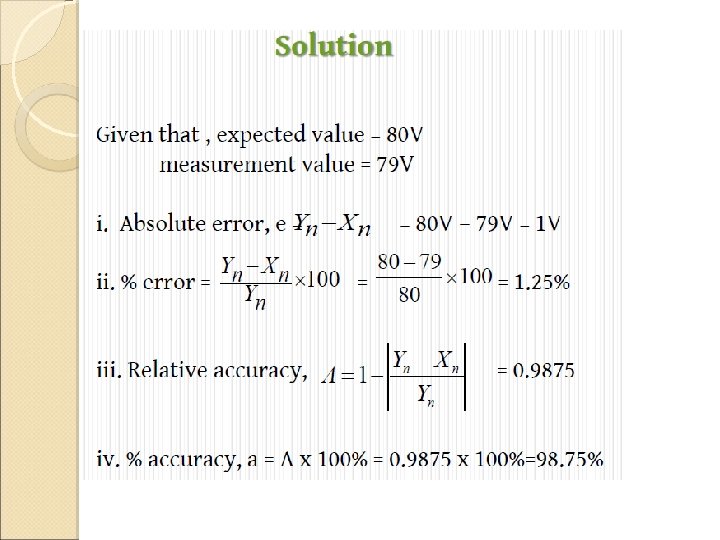
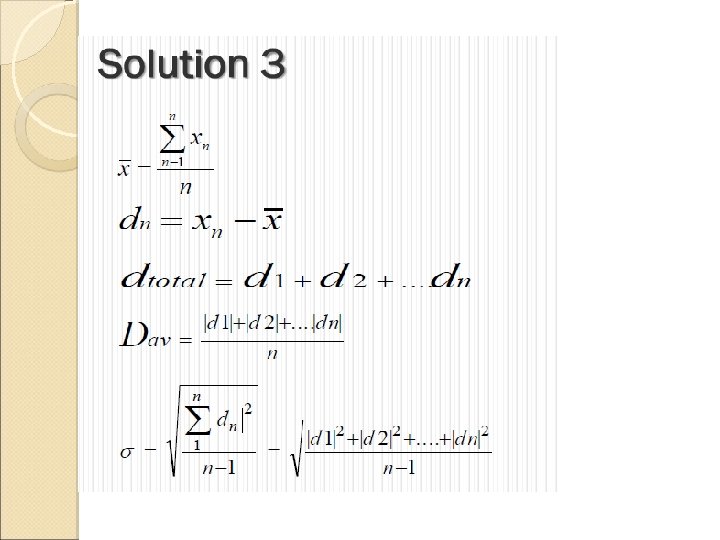
ERROR IN MEASUREMENT q. Measurement always introduce error q. Error may be expressed either as absolute or percentage of error q. Absolute error, e = Yn - Xn where , Yn – expected value Xn – measured value % error = x 100
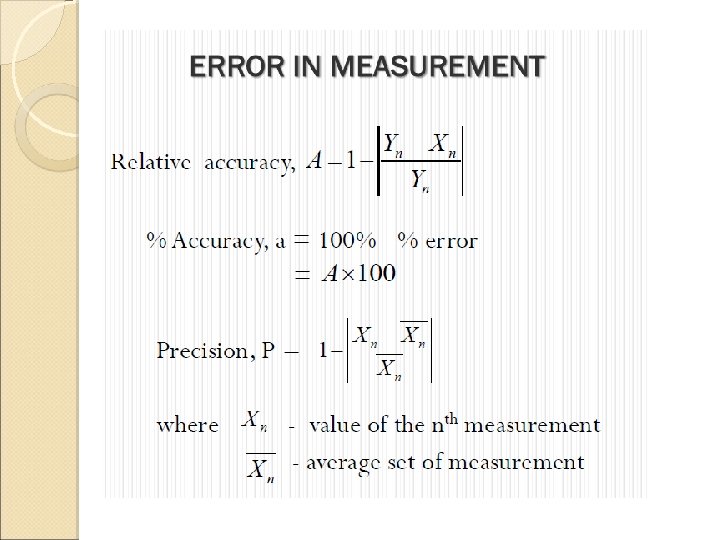
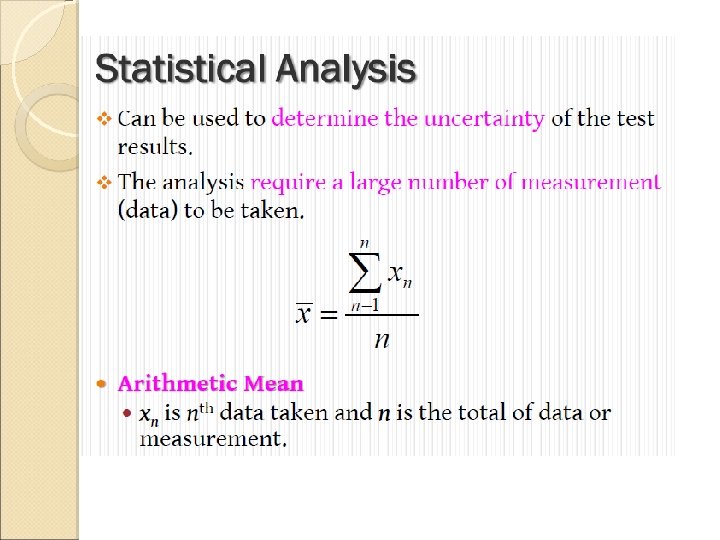
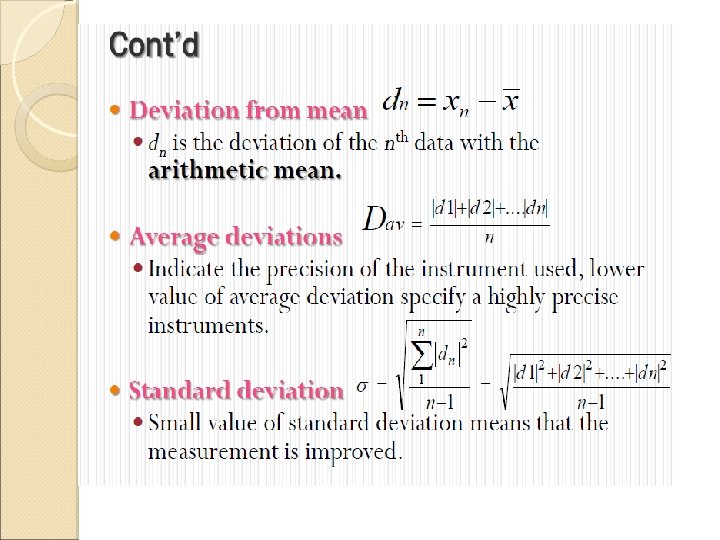
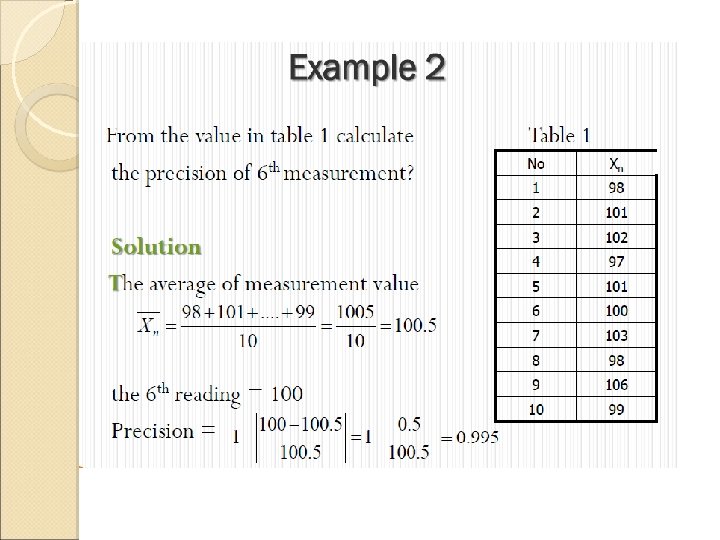
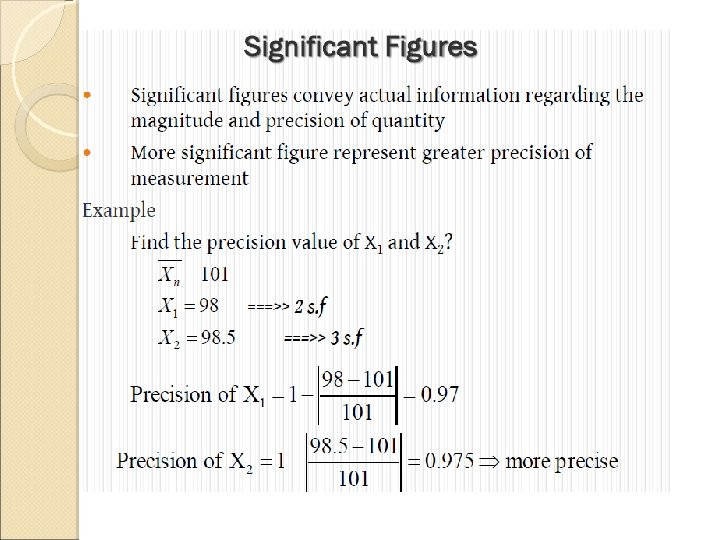
q. The precision of a measurement is a quantitative or numerical indication of the closeness with which a repeated set of measurement of the same variable agree with the average set of measurements.
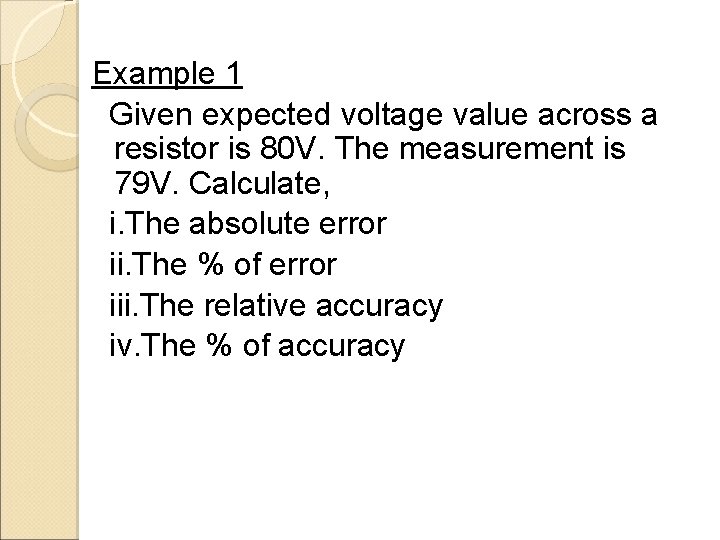
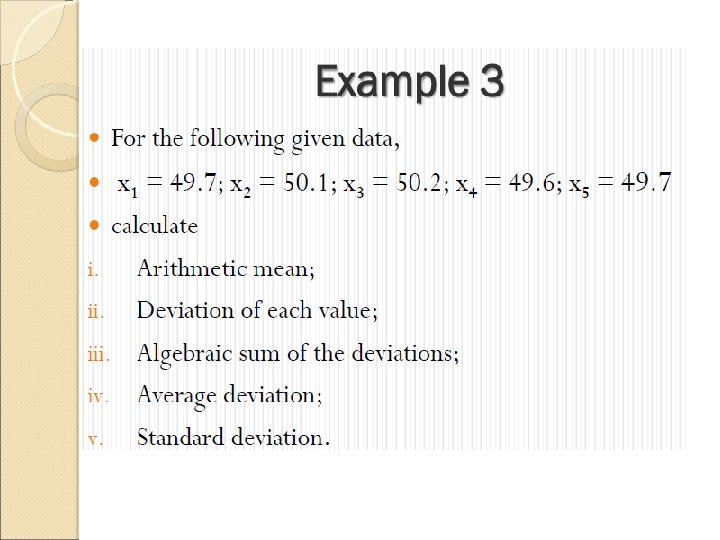
Example 1 Given expected voltage value across a resistor is 80 V. The measurement is 79 V. Calculate, i. The absolute error ii. The % of error iii. The relative accuracy iv. The % of accuracy
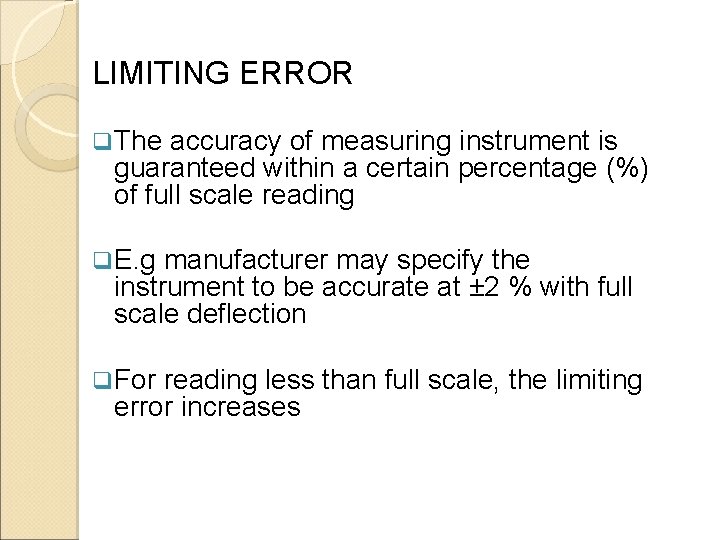
LIMITING ERROR q The accuracy of measuring instrument is guaranteed within a certain percentage (%) of full scale reading q E. g manufacturer may specify the instrument to be accurate at ± 2 % with full scale deflection q For reading less than full scale, the limiting error increases
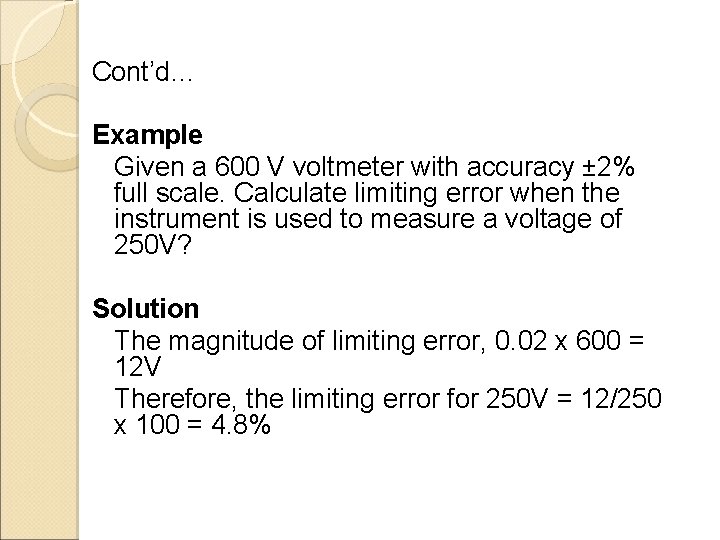
Cont’d… Example Given a 600 V voltmeter with accuracy ± 2% full scale. Calculate limiting error when the instrument is used to measure a voltage of 250 V? Solution The magnitude of limiting error, 0. 02 x 600 = 12 V Therefore, the limiting error for 250 V = 12/250 x 100 = 4. 8%
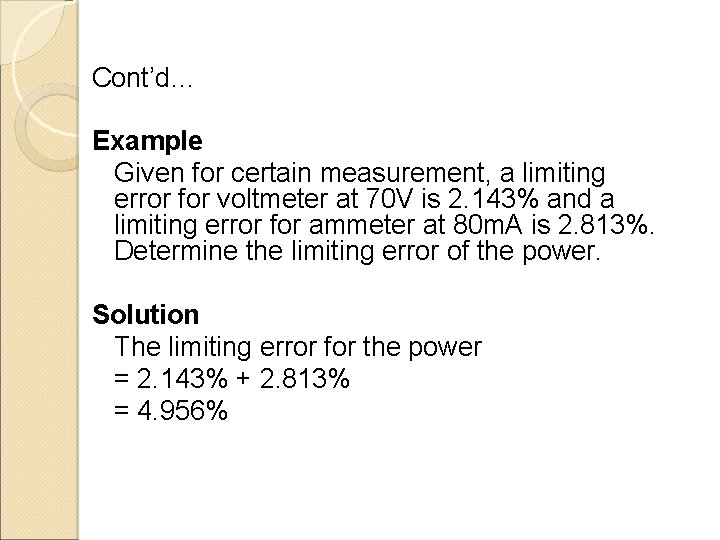
Cont’d… Example Given for certain measurement, a limiting error for voltmeter at 70 V is 2. 143% and a limiting error for ammeter at 80 m. A is 2. 813%. Determine the limiting error of the power. Solution The limiting error for the power = 2. 143% + 2. 813% = 4. 956%
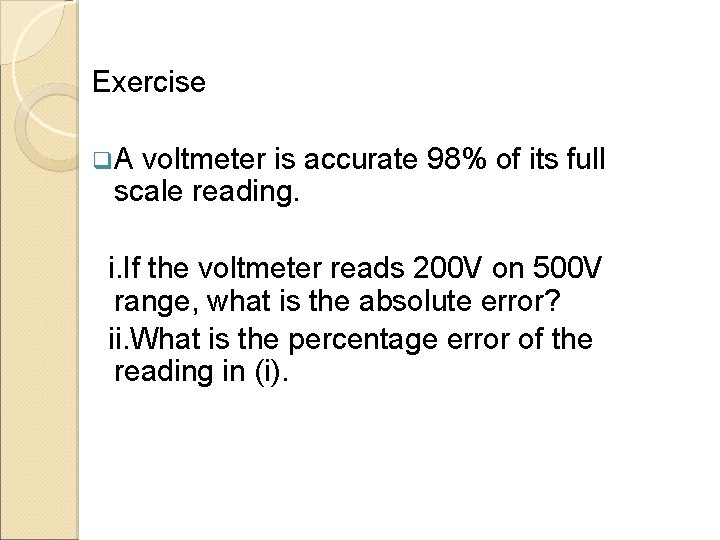
Exercise q. A voltmeter is accurate 98% of its full scale reading. i. If the voltmeter reads 200 V on 500 V range, what is the absolute error? ii. What is the percentage error of the reading in (i).
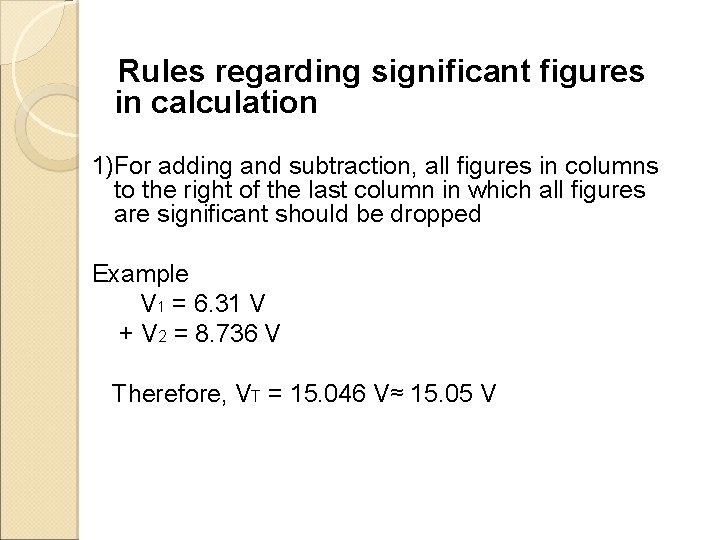
Rules regarding significant figures in calculation 1)For adding and subtraction, all figures in columns to the right of the last column in which all figures are significant should be dropped Example V 1 = 6. 31 V + V 2 = 8. 736 V Therefore, VT = 15. 046 V≈ 15. 05 V
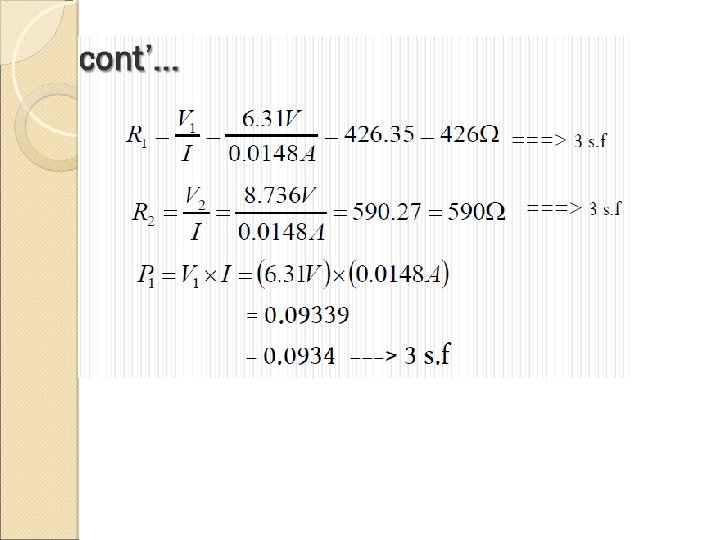
2)For multiplication and division, retain only as many significant figures as the least precise quantity contains Example From the value given below, calculate the value for R 1, R 2 and power for R 1? I = 0. 0148 A ===> 3 s. f V 1 = 6. 31 V ===> 3 s. f V 2 = 8. 736 V ===> 4 s. f 3)When dropping non-significant figures 0. 0148 ==> 0. 015 (2 s. f) ==> 0. 01 (1 s. f)
TYPES OF STATIC ERROR Types of static error 1)Gross error/human error 2)Systematic Error 3)Random Error
1. Gross Error Ø Cause by human mistakes in reading/using instruments Ø may also occur due to incorrect adjustment of the instrument and the computational mistakes Ø cannot be treated mathematically Ø cannot eliminate but can minimize eg: Improper use of an instrument. Ø This error can be minimized by taking proper care in reading and recording measurement parameter. Ø In general, indicating instruments change ambient conditions to some extent when connected into a complete circuit. Ø Therefore, several readings (at three readings) must be taken to minimize the effect of ambient condition changes.
2. Systematic Error Ø due to shortcomings of the instrument (such as defective or worn parts, ageing or effects of the environment on the instrument) Ø In general, systematic errors can be subdivided into static and dynamic errors. q Static – caused by limitations of the measuring device or the physical laws governing its behavior. q Dynamic – caused by the instrument not responding very fast enough to follow the changes in a measured variable.
Types of Systematic Error (cont) Three (3) types of systematic error : (i) Instrumental error (ii) Environmental error (iii) Observational error
(i) Instrumental Error (cont…) q inherent while measuring instrument because of their mechanical structure (eg: in a D’Arsonval meter, friction in the bearings of various moving component, irregular spring tension, stretching of spring, etc) q error can be avoid by: (a) selecting a suitable instrument for the particular measurement application (b) apply correction factor by determining instrumental error (c) calibrate the instrument against standard
(ii) Environmental Error (cont. . . ) q due to external condition effecting the measurement including surrounding area condition q such as change in temperature, humidity, barometer pressure, etc v to avoid the error : v use air conditioner v sealing certain component in the instruments v use magnetic shields
(iii) Observational Error (cont…) vintroduce by the observer vmost common : parallax error and estimation error (while reading the scale) eg: an observer who tend to hold his head too far to the left while reading the position of the needle on the scale. v
3. Random Error q due to unknown causes, occur when all systematic error has accounted q accumulation of small effect, require at high degree of accuracy q can be avoid by vincreasing number of reading vuse statistical means to obtain approximation of true value best
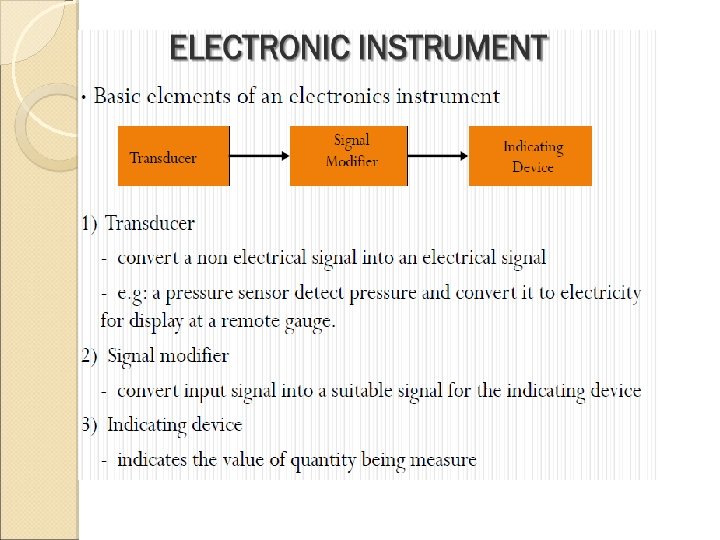
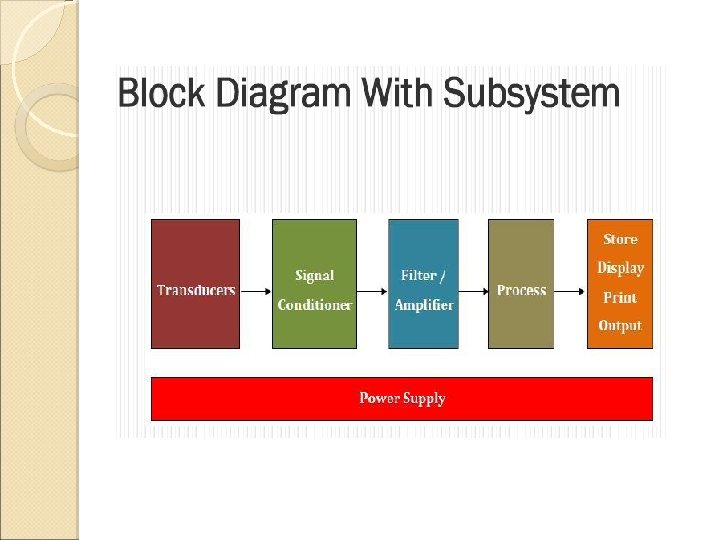
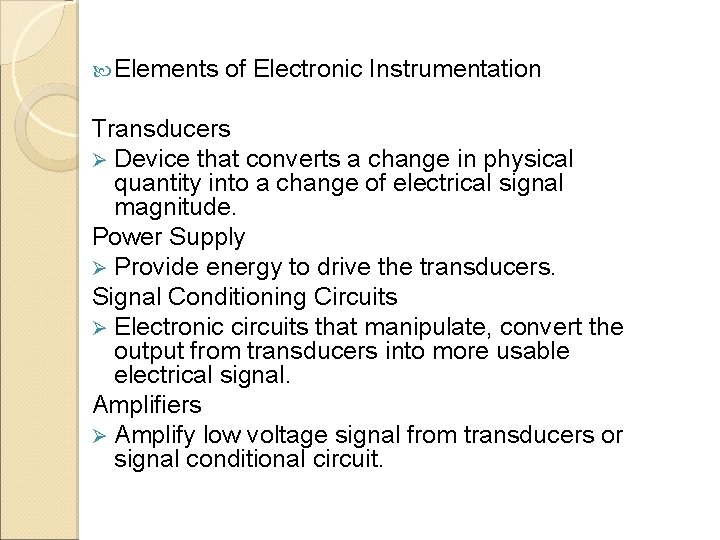
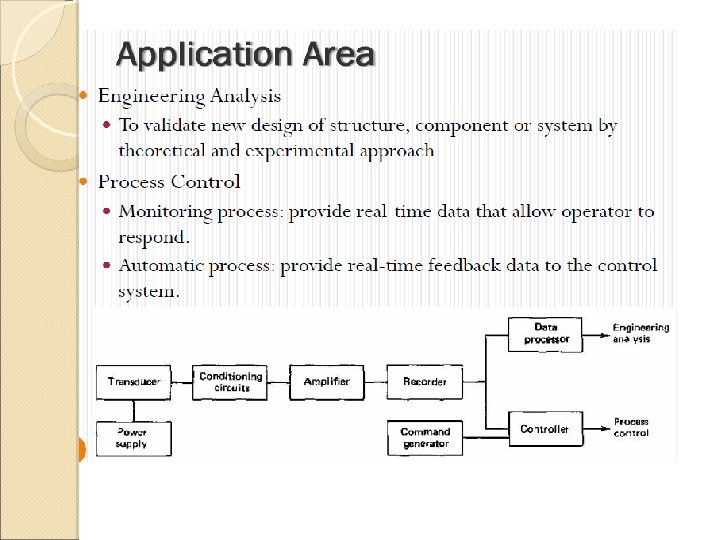
Elements of Electronic Instrumentation Transducers Ø Device that converts a change in physical quantity into a change of electrical signal magnitude. Power Supply Ø Provide energy to drive the transducers. Signal Conditioning Circuits Ø Electronic circuits that manipulate, convert the output from transducers into more usable electrical signal. Amplifiers Ø Amplify low voltage signal from transducers or signal conditional circuit.
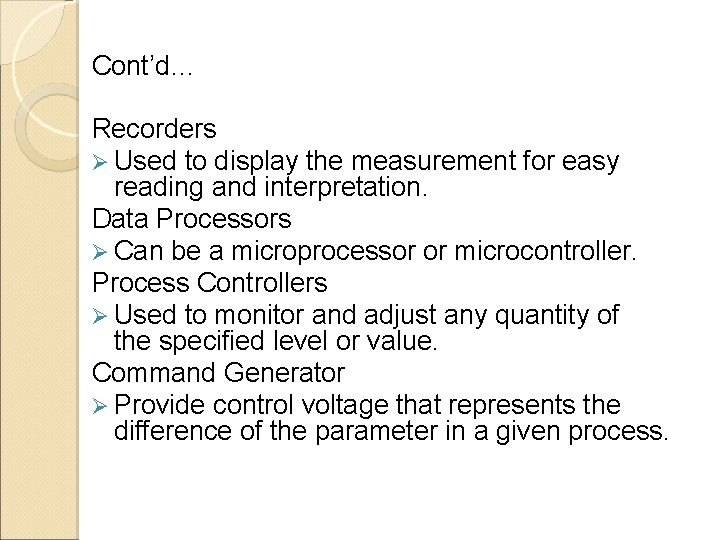
Cont’d… Recorders Ø Used to display the measurement for easy reading and interpretation. Data Processors Ø Can be a microprocessor or microcontroller. Process Controllers Ø Used to monitor and adjust any quantity of the specified level or value. Command Generator Ø Provide control voltage that represents the difference of the parameter in a given process.
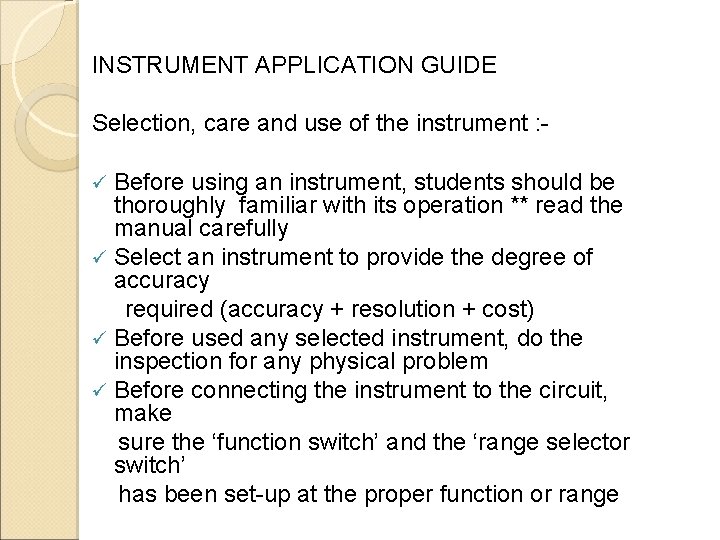
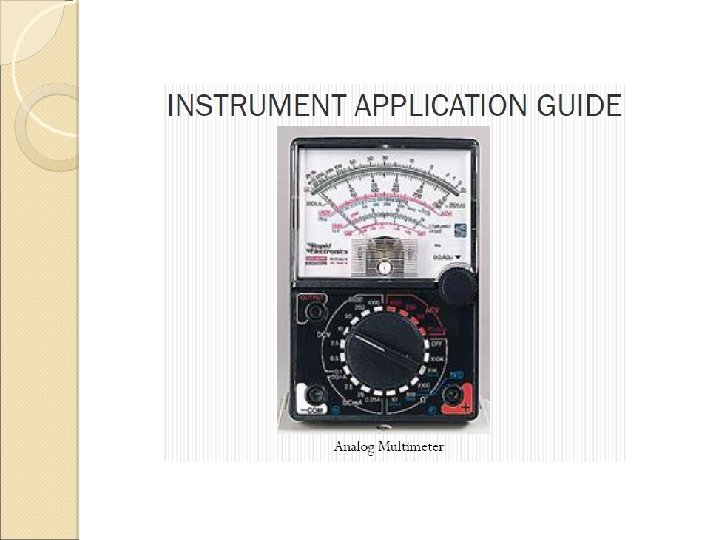
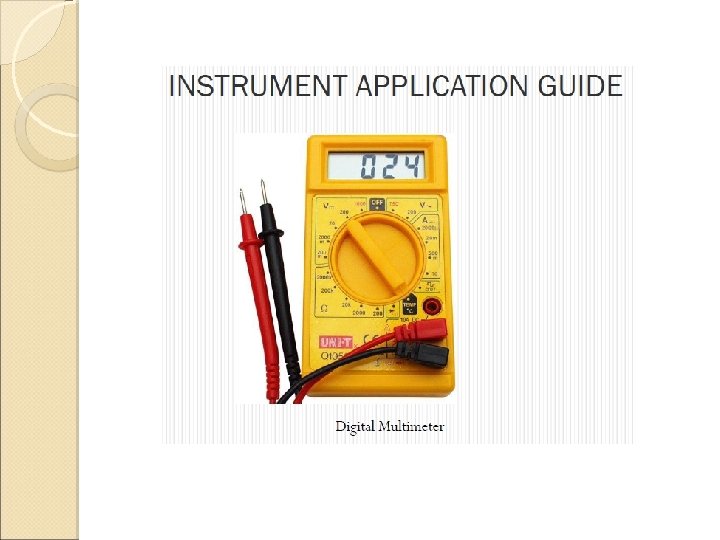
INSTRUMENT APPLICATION GUIDE Selection, care and use of the instrument : Before using an instrument, students should be thoroughly familiar with its operation ** read the manual carefully ü Select an instrument to provide the degree of accuracy required (accuracy + resolution + cost) ü Before used any selected instrument, do the inspection for any physical problem ü Before connecting the instrument to the circuit, make sure the ‘function switch’ and the ‘range selector switch’ has been set-up at the proper function or range ü
- Slides: 57