
Measurement Query Languages for SoftwareDefined Networks Jennifer Rexford
![Evaluation: Let’s write queries! • Switch-level traffic matrix: in_group(ingress(), [switch]) ^ in_atom(true)* ^ out_group(egress(),](https://slidetodoc.com/presentation_image_h2/94202a567988a425a3ca2ef9bc268cef/image-18.jpg "Evaluation: Let’s write queries! • Switch-level traffic matrix: in_group(ingress(), [switch]) ^ in_atom(true)* ^ out_group(egress(),")
- Slides: 54
Measurement Query Languages for Software-Defined Networks Jennifer Rexford Princeton University http: //www. cs. princeton. edu/~jrex Joint work with Srinivas Narayana, Mina Tahmasbi, and David Walker To appear in NSDI’ 16: http: //www. cs. princeton. edu/~narayana/pathqueries/
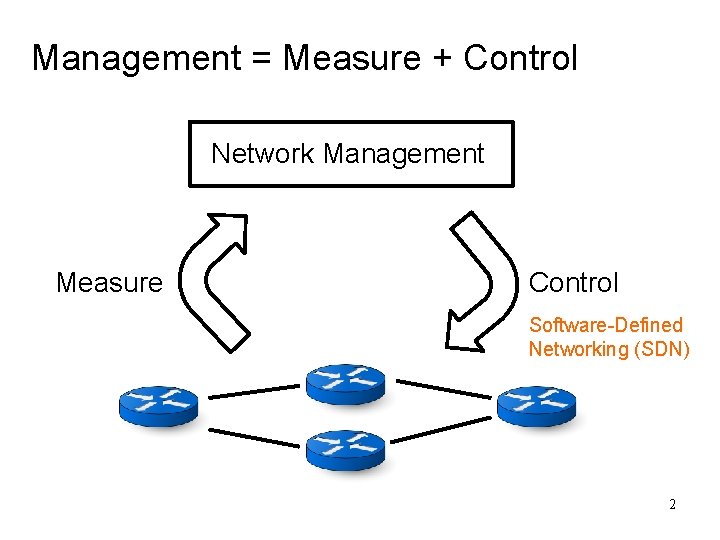
Management = Measure + Control Network Management Measure Control Software-Defined Networking (SDN) 2
Measuring is a Hard (Big-Data) Problem • A few standard tools: • Ping, traceroute, SNMP, Net. Flow, tcpdump • Global state of the network is complex & dynamic: • Switches: rules, counters, buffers • Packets: in flight, rewritten, dropped • An operator must “join” multiple data streams: • Forwarding: protocol, controller, topology updates • Traffic: packet samples, counters, etc. • Result: inaccurate or high overhead 3
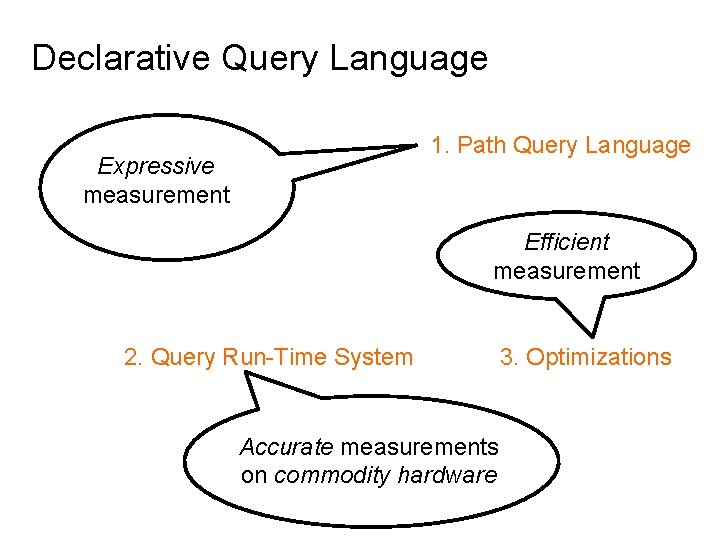
Declarative Query Language 1. Path Query Language Expressive measurement Efficient measurement 2. Query Run-Time System Accurate measurements on commodity hardware 3. Optimizations
I. Path Query Language 5
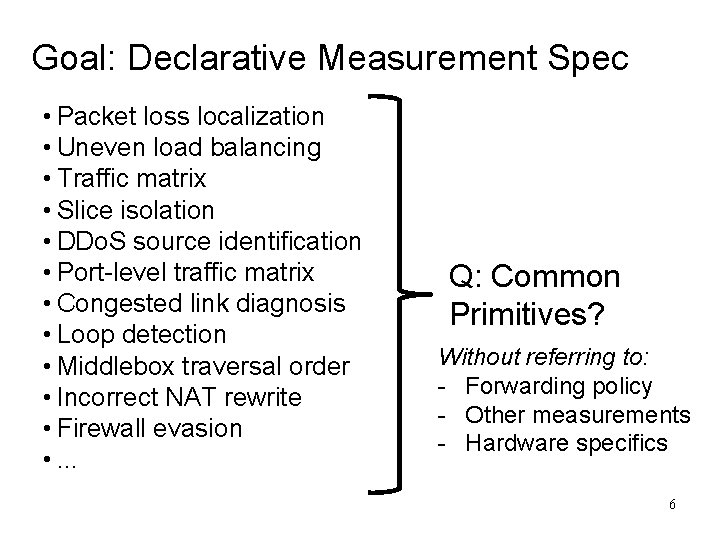
Goal: Declarative Measurement Spec • Packet loss localization • Uneven load balancing • Traffic matrix • Slice isolation • DDo. S source identification • Port-level traffic matrix • Congested link diagnosis • Loop detection • Middlebox traversal order • Incorrect NAT rewrite • Firewall evasion • . . . Q: Common Primitives? Without referring to: - Forwarding policy - Other measurements - Hardware specifics 6
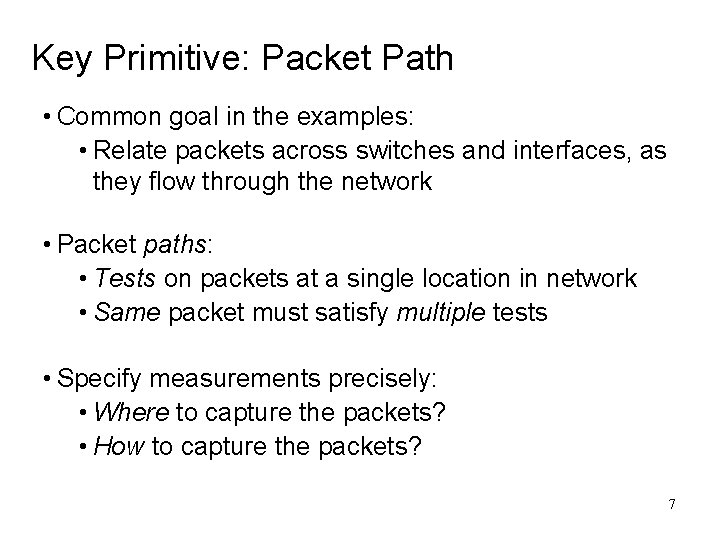
Key Primitive: Packet Path • Common goal in the examples: • Relate packets across switches and interfaces, as they flow through the network • Packet paths: • Tests on packets at a single location in network • Same packet must satisfy multiple tests • Specify measurements precisely: • Where to capture the packets? • How to capture the packets? 7
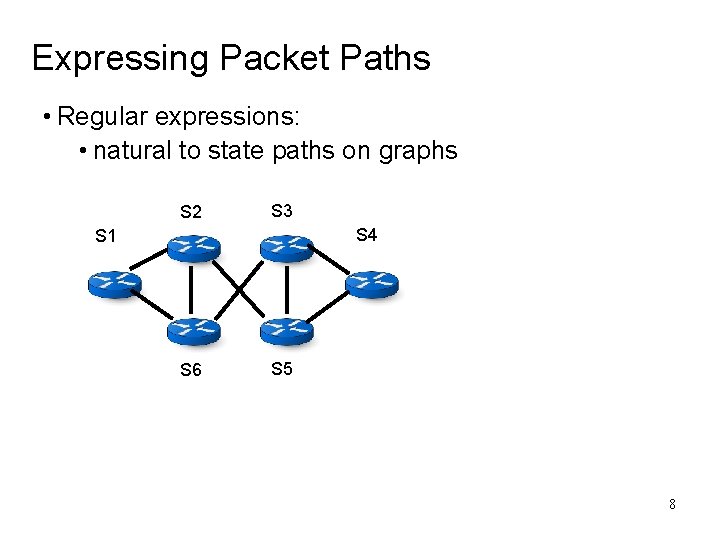
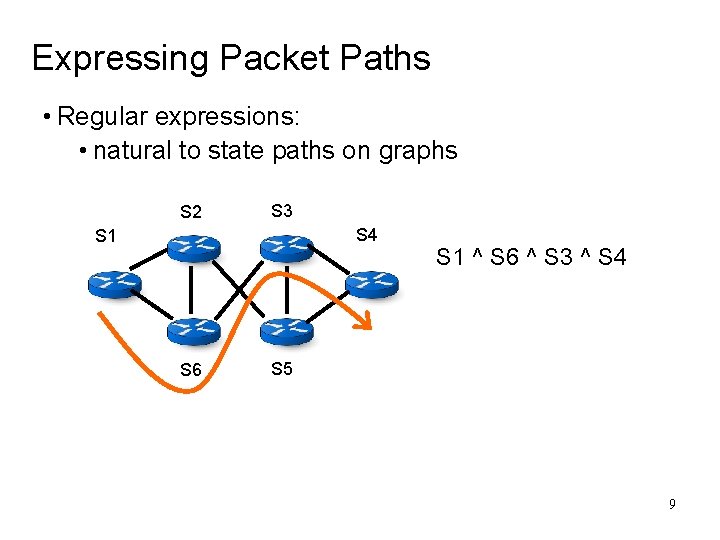
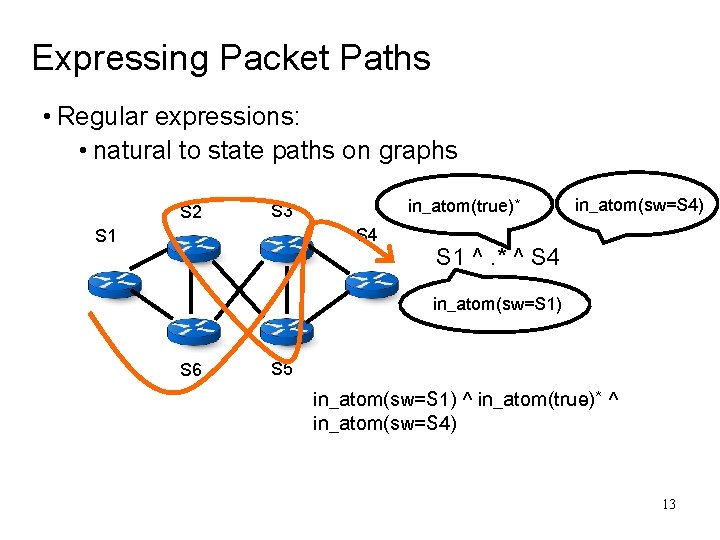
Expressing Packet Paths • Regular expressions: • natural to state paths on graphs S 2 S 3 S 4 S 1 S 6 S 5 8
Expressing Packet Paths • Regular expressions: • natural to state paths on graphs S 2 S 3 S 4 S 1 S 6 S 1 ^ S 6 ^ S 3 ^ S 4 S 5 9
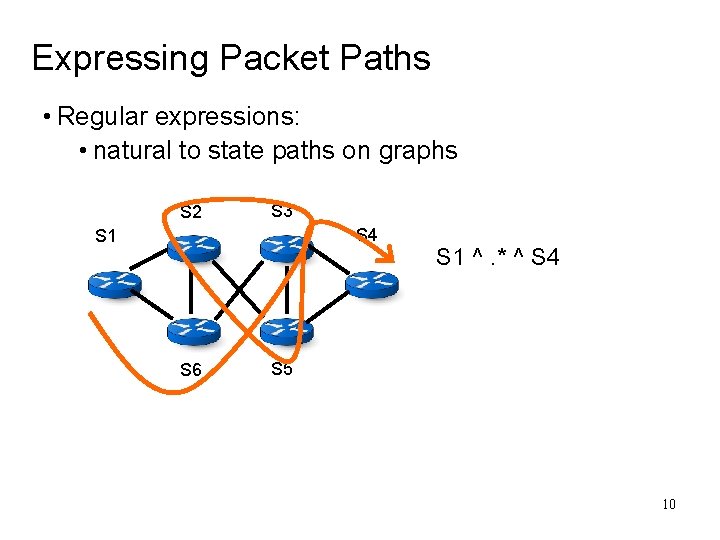
Expressing Packet Paths • Regular expressions: • natural to state paths on graphs S 2 S 3 S 4 S 1 S 6 S 1 ^. * ^ S 4 S 5 10
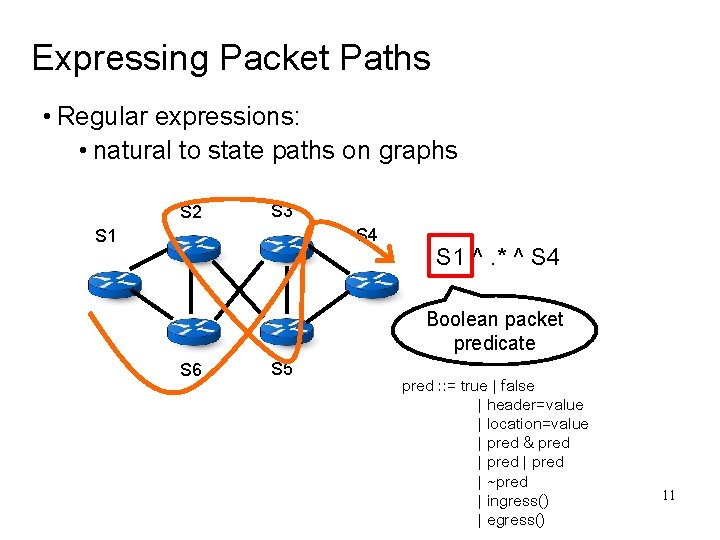
Expressing Packet Paths • Regular expressions: • natural to state paths on graphs S 2 S 3 S 4 S 1 ^. * ^ S 4 Boolean packet predicate S 6 S 5 pred : : = true | false | header=value | location=value | pred & pred | ~pred | ingress() | egress() 11
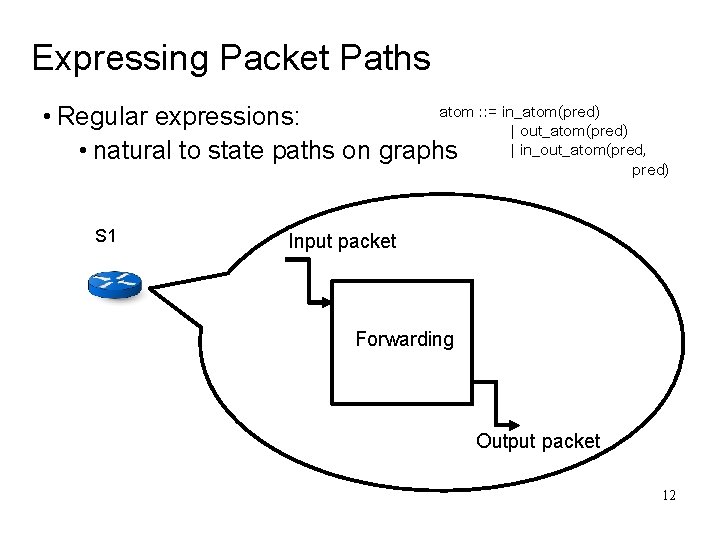
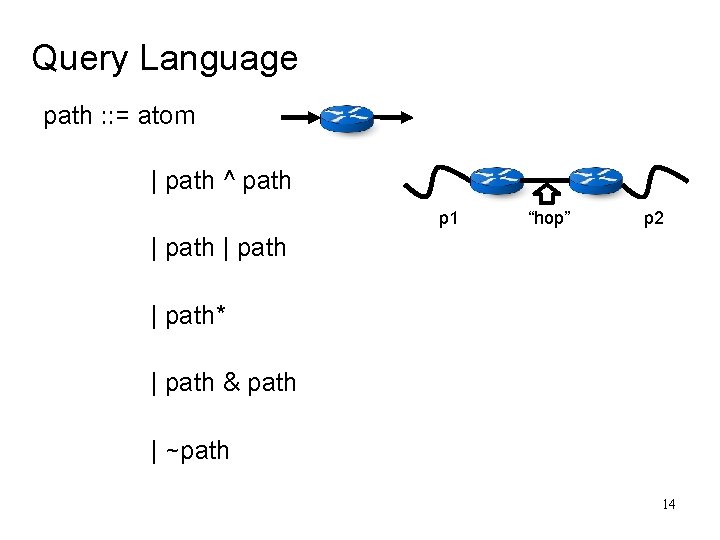
Expressing Packet Paths atom : : = in_atom(pred) • Regular expressions: | out_atom(pred) | in_out_atom(pred, • natural to state paths on graphs pred) S 1 Input packet Forwarding Output packet 12
Expressing Packet Paths • Regular expressions: • natural to state paths on graphs S 2 in_atom(true)* S 3 S 4 S 1 in_atom(sw=S 4) S 1 ^. * ^ S 4 in_atom(sw=S 1) S 6 S 5 in_atom(sw=S 1) ^ in_atom(true)* ^ in_atom(sw=S 4) 13
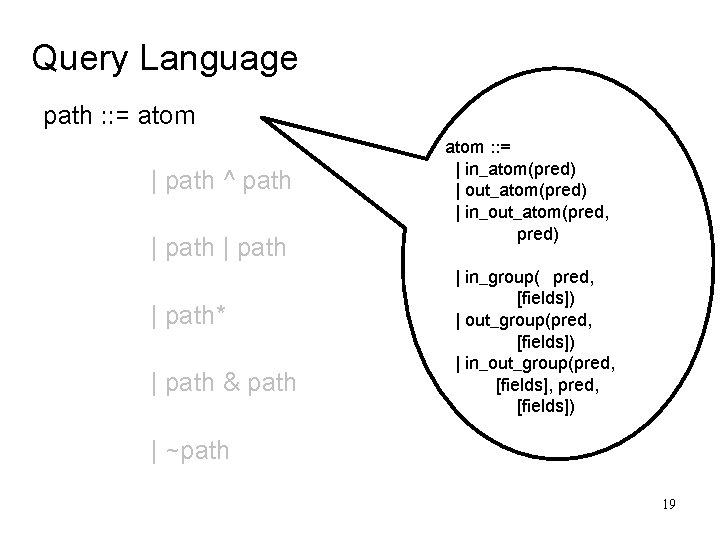
Query Language path : : = atom | path ^ path p 1 “hop” p 2 | path* | path & path | ~path 14
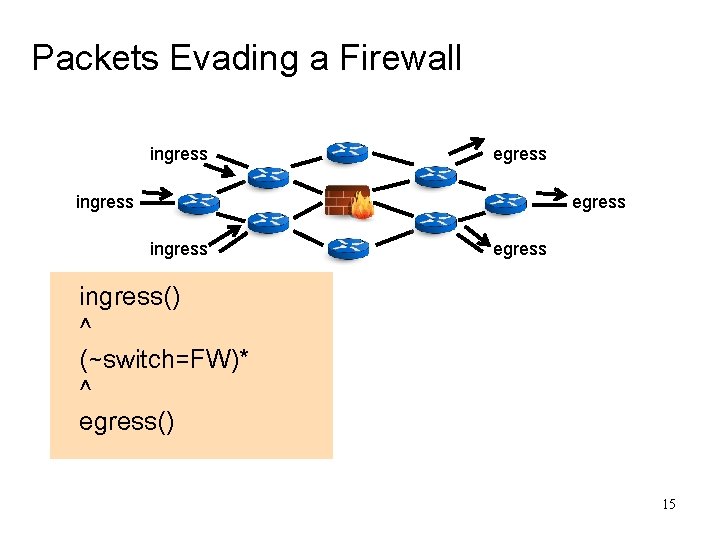
Packets Evading a Firewall ingress egress ingress() ^ (~switch=FW)* ^ egress() 15
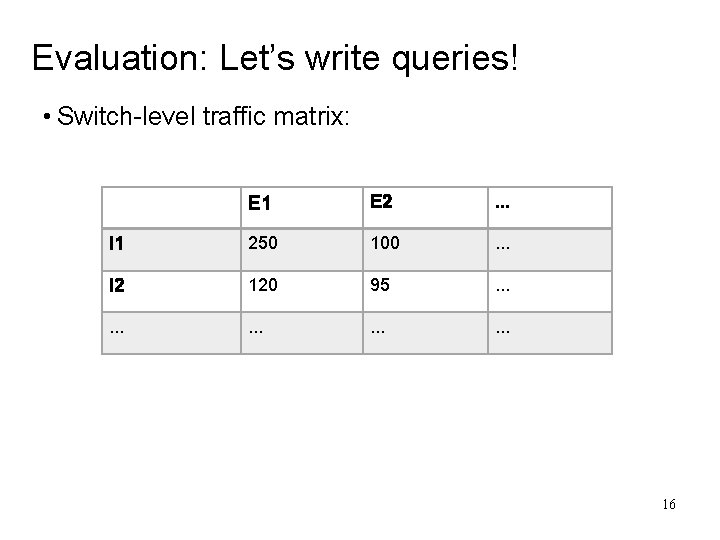
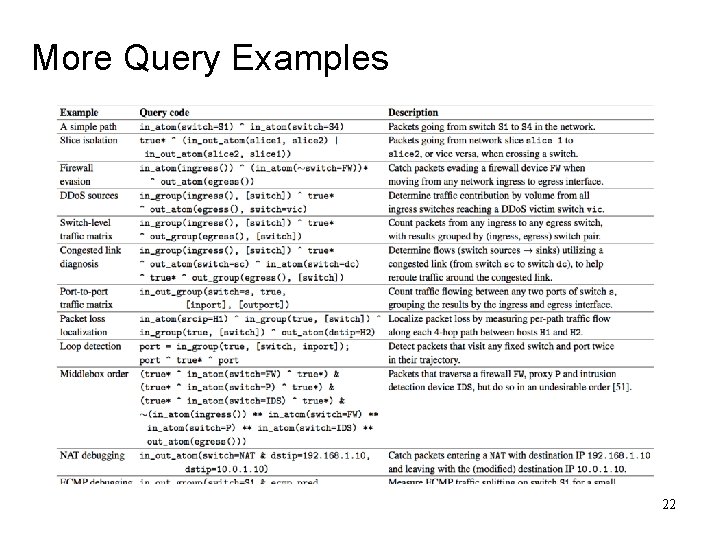
Evaluation: Let’s write queries! • Switch-level traffic matrix: E 1 E 2 . . . I 1 250 100 . . . I 2 120 95 . . . . 16
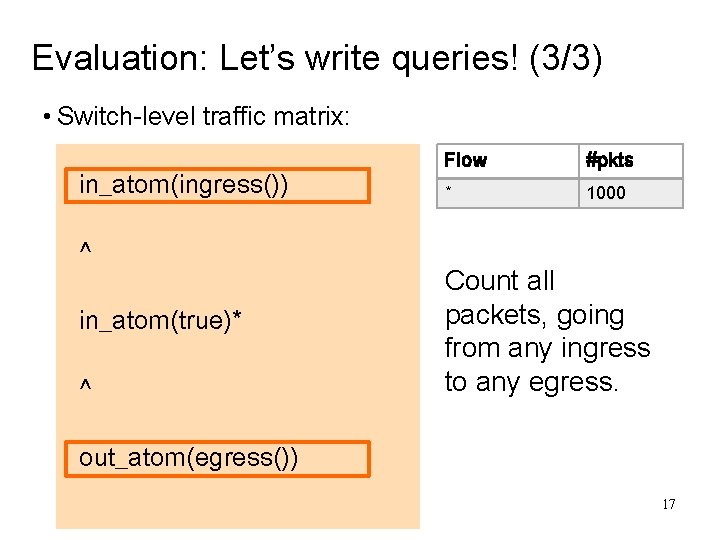
Evaluation: Let’s write queries! (3/3) • Switch-level traffic matrix: in_atom(ingress()) ^ in_atom(true)* ^ Flow #pkts * 1000 Count all packets, going from any ingress to any egress. out_atom(egress()) 17
Evaluation: Let’s write queries! • Switch-level traffic matrix: in_group(ingress(), [switch]) ^ in_atom(true)* ^ out_group(egress(), [switch]) Flow #pkts sw=I 1, sw=E 1 250 sw=I 1, sw=E 2 100 . . . Group counts by packet’s ingress and egress switch! Traffic matrix! 18
Query Language path : : = atom | path ^ path | path* | path & path atom : : = | in_atom(pred) | out_atom(pred) | in_out_atom(pred, pred) | in_group( pred, [fields]) | out_group(pred, [fields]) | in_out_group(pred, [fields], pred, [fields]) | ~path 19
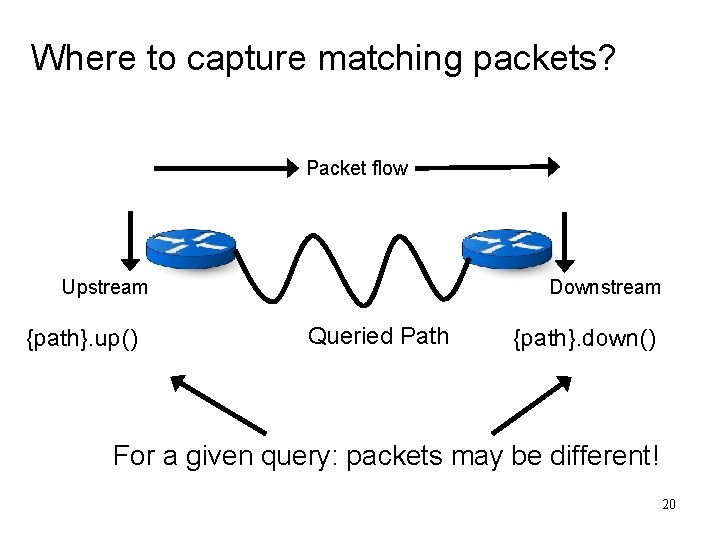
Where to capture matching packets? Packet flow Upstream {path}. up() Downstream Queried Path {path}. down() For a given query: packets may be different! 20
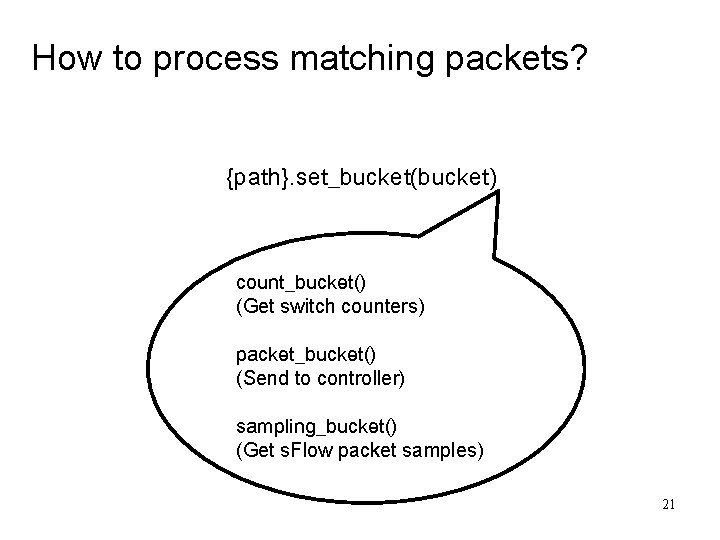
How to process matching packets? {path}. set_bucket(bucket) count_bucket() (Get switch counters) packet_bucket() (Send to controller) sampling_bucket() (Get s. Flow packet samples) 21
More Query Examples 22
II. The Run-Time System 23
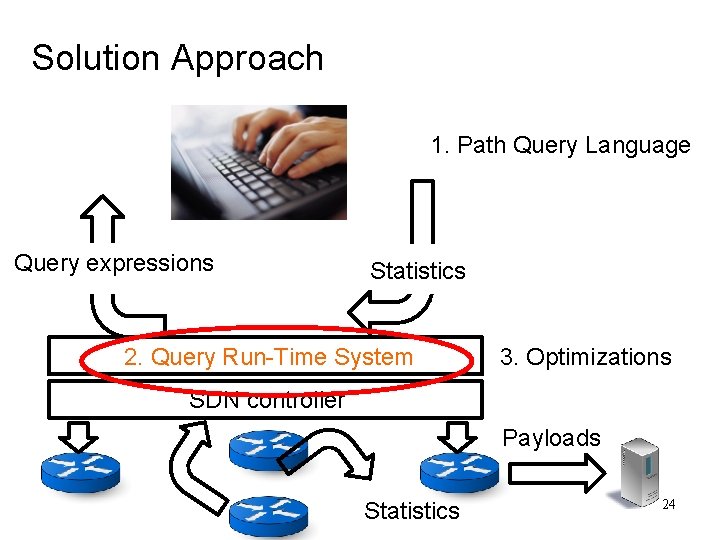
Solution Approach 1. Path Query Language Query expressions Statistics 2. Query Run-Time System 3. Optimizations SDN controller Payloads Statistics 24
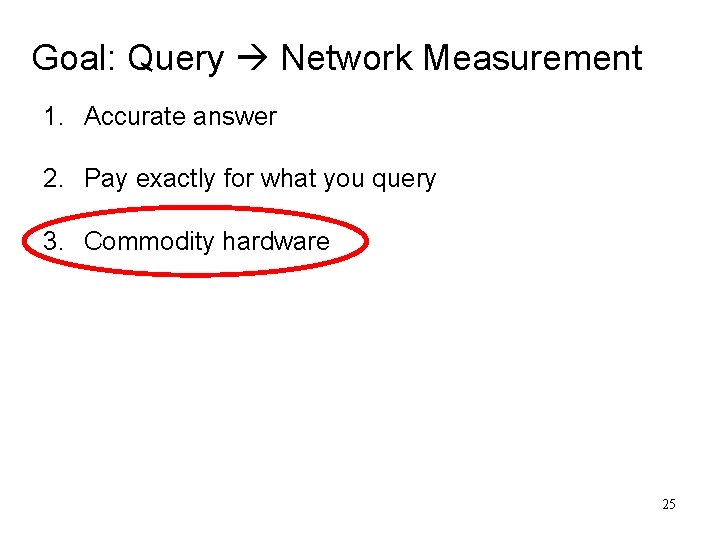
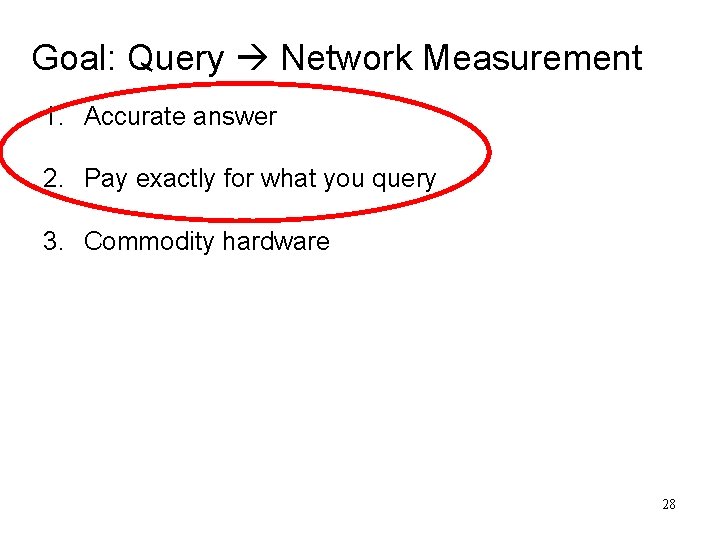
Goal: Query Network Measurement 1. Accurate answer 2. Pay exactly for what you query 3. Commodity hardware 25
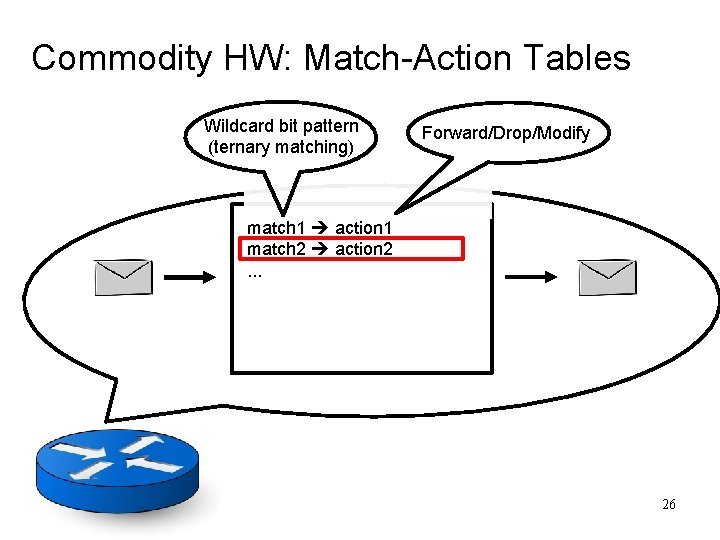
Commodity HW: Match-Action Tables Wildcard bit pattern (ternary matching) Forward/Drop/Modify match 1 action 1 match 2 action 2. . . 26
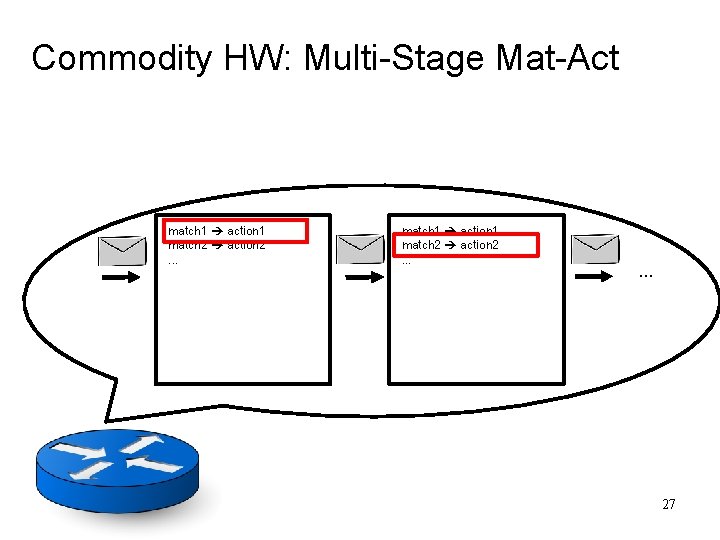
Commodity HW: Multi-Stage Mat-Act match 1 action 1 match 2 action 2. . . 27
Goal: Query Network Measurement 1. Accurate answer 2. Pay exactly for what you query 3. Commodity hardware 28
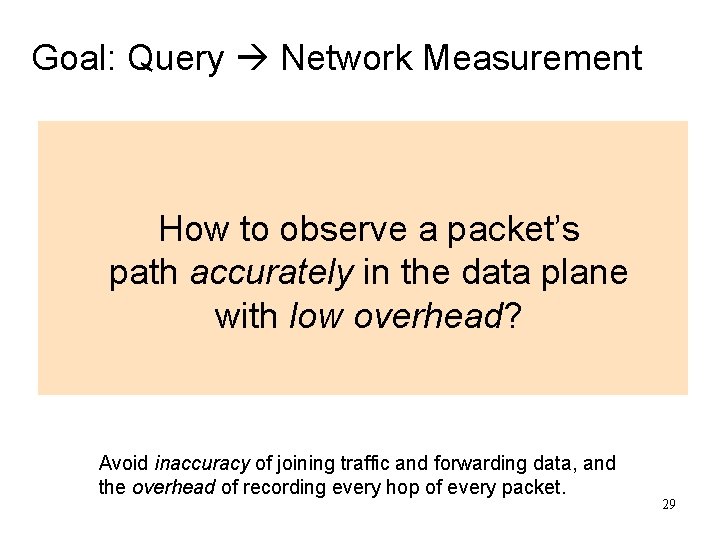
Goal: Query Network Measurement 1. Accurate answer 2. Pay for what you query Howhardware to observe 3. Commodity a packet’s path accurately in the data plane with low overhead? Avoid inaccuracy of joining traffic and forwarding data, and the overhead of recording every hop of every packet. 29
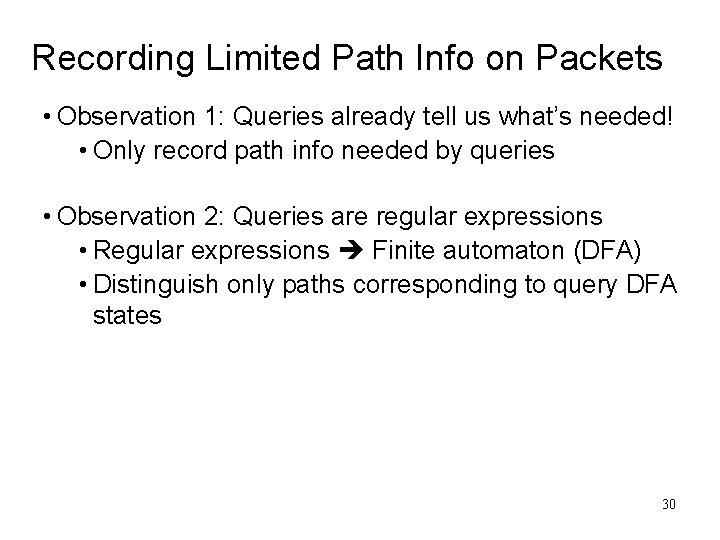
Recording Limited Path Info on Packets • Observation 1: Queries already tell us what’s needed! • Only record path info needed by queries • Observation 2: Queries are regular expressions • Regular expressions Finite automaton (DFA) • Distinguish only paths corresponding to query DFA states 30
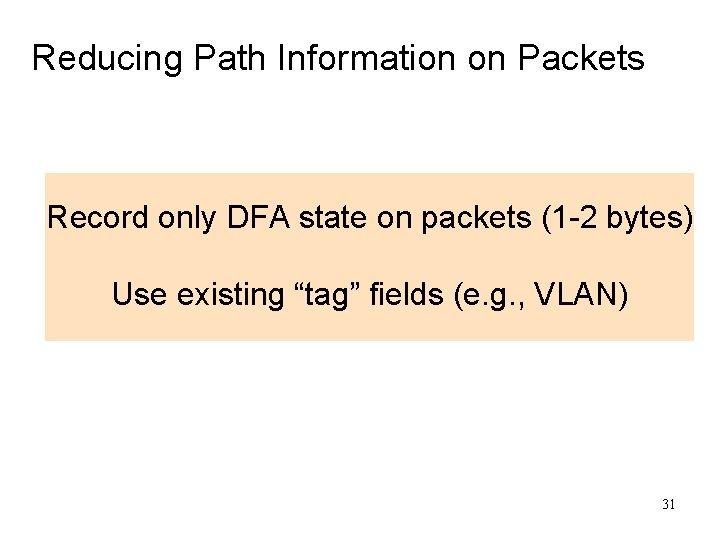
Reducing Path Information on Packets • Observation 1: Queries already tell us what’s needed! • Only record path state needed by queries • Record Observation Queries are regular expressions only 2: DFA state on packets (1 -2 bytes) • Regular expressions Finite automaton (DFA) • Distinguish only paths DFA states Use existing “tag”corresponding fields (e. g. , to. VLAN) 31
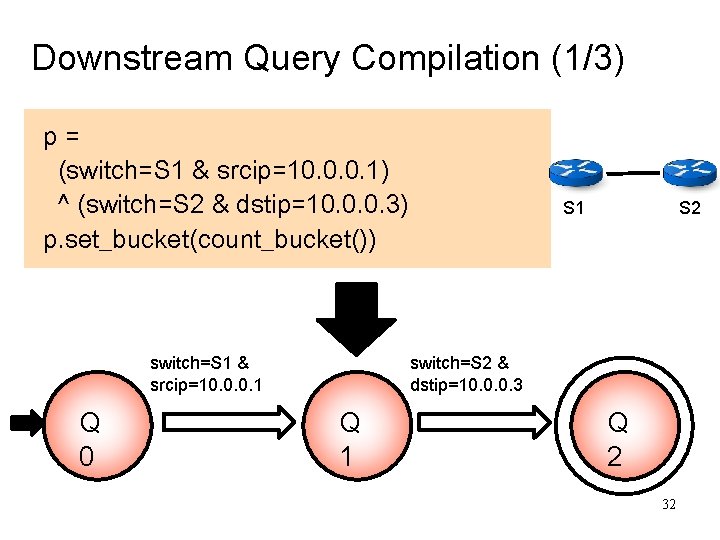
Downstream Query Compilation (1/3) p= (switch=S 1 & srcip=10. 0. 0. 1) ^ (switch=S 2 & dstip=10. 0. 0. 3) p. set_bucket(count_bucket()) switch=S 1 & srcip=10. 0. 0. 1 Q 0 S 1 S 2 switch=S 2 & dstip=10. 0. 0. 3 Q 1 Q 2 32
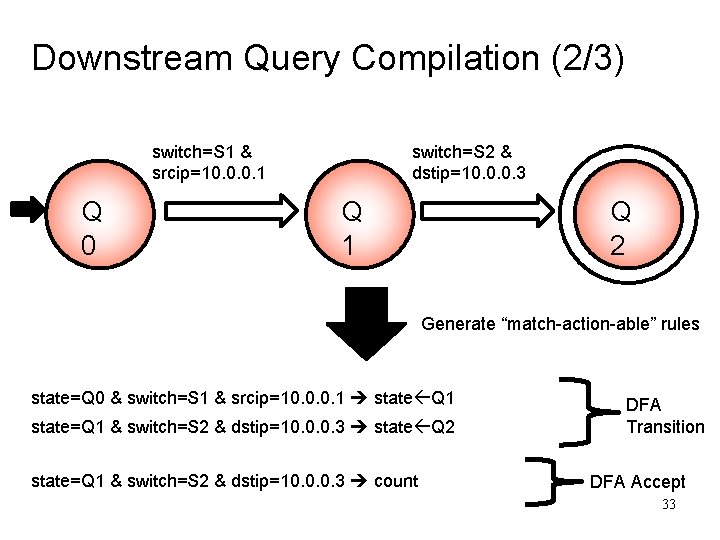
Downstream Query Compilation (2/3) switch=S 1 & srcip=10. 0. 0. 1 Q 0 switch=S 2 & dstip=10. 0. 0. 3 Q 1 Q 2 Generate “match-action-able” rules state=Q 0 & switch=S 1 & srcip=10. 0. 0. 1 state Q 1 state=Q 1 & switch=S 2 & dstip=10. 0. 0. 3 state Q 2 state=Q 1 & switch=S 2 & dstip=10. 0. 0. 3 count DFA Transition DFA Accept 33
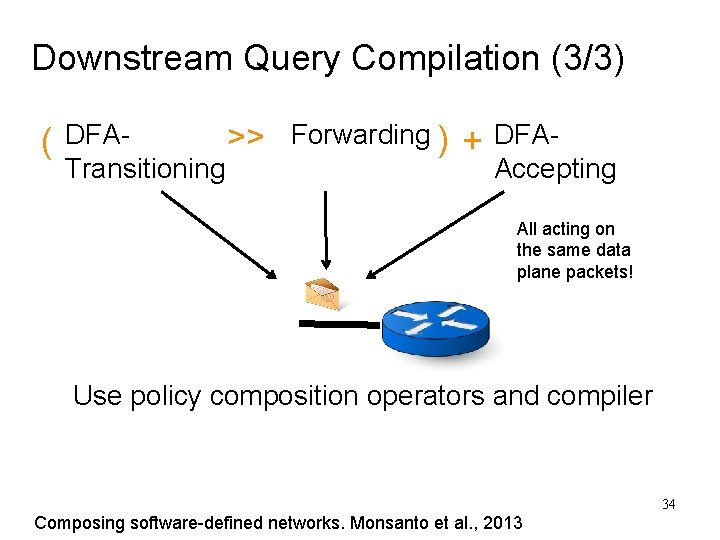
Downstream Query Compilation (3/3) ( DFA>> Forwarding ) Transitioning + DFA- Accepting All acting on the same data plane packets! Use policy composition operators and compiler 34 Composing software-defined networks. Monsanto et al. , 2013
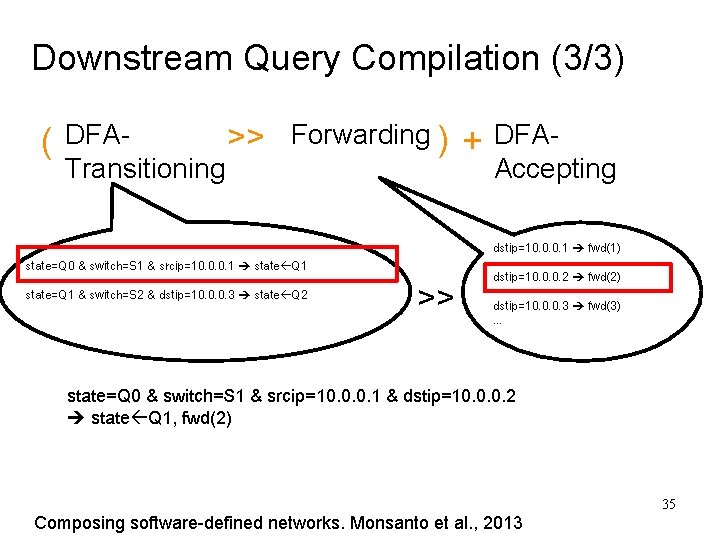
Downstream Query Compilation (3/3) ( DFA>> Forwarding ) Transitioning + DFA- Accepting dstip=10. 0. 0. 1 fwd(1) state=Q 0 & switch=S 1 & srcip=10. 0. 0. 1 state Q 1 state=Q 1 & switch=S 2 & dstip=10. 0. 0. 3 state Q 2 >> dstip=10. 0. 0. 2 fwd(2) dstip=10. 0. 0. 3 fwd(3). . . state=Q 0 & switch=S 1 & srcip=10. 0. 0. 1 & dstip=10. 0. 0. 2 state Q 1, fwd(2) 35 Composing software-defined networks. Monsanto et al. , 2013
III. Optimizations 36
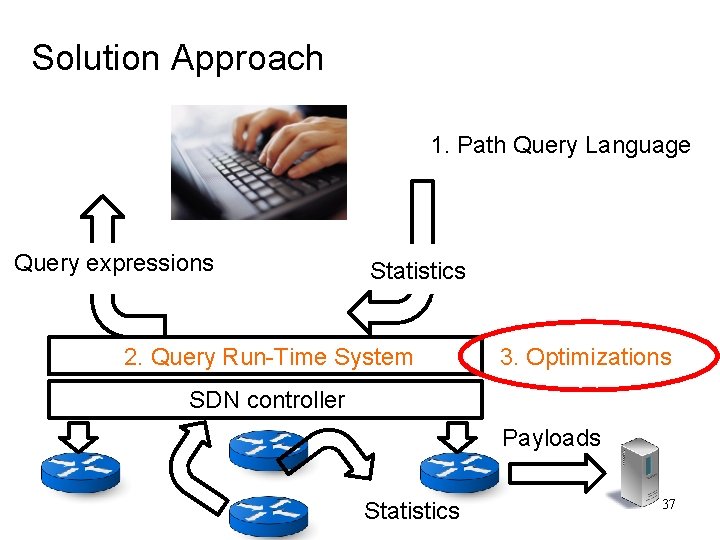
Solution Approach 1. Path Query Language Query expressions Statistics 2. Query Run-Time System 3. Optimizations SDN controller Payloads Statistics 37
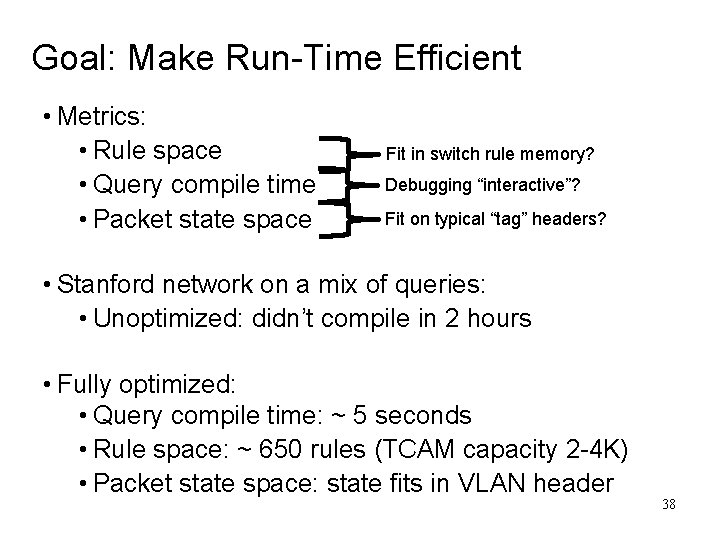
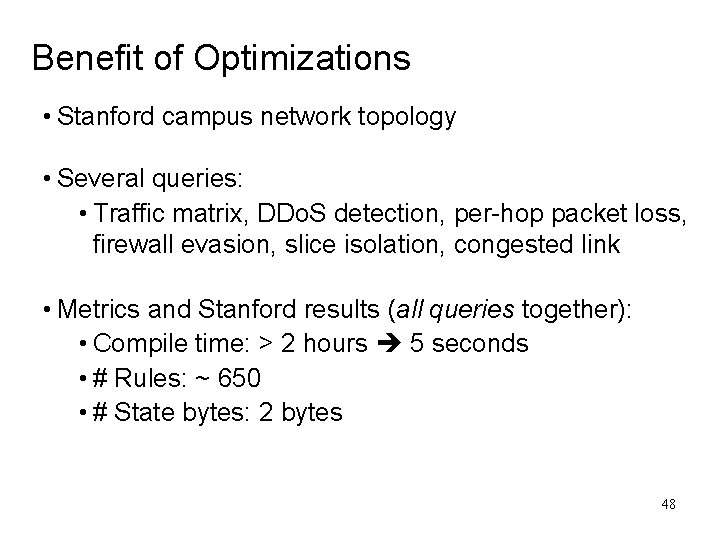
Goal: Make Run-Time Efficient • Metrics: • Rule space • Query compile time • Packet state space Fit in switch rule memory? Debugging “interactive”? Fit on typical “tag” headers? • Stanford network on a mix of queries: • Unoptimized: didn’t compile in 2 hours • Fully optimized: • Query compile time: ~ 5 seconds • Rule space: ~ 650 rules (TCAM capacity 2 -4 K) • Packet state space: state fits in VLAN header 38
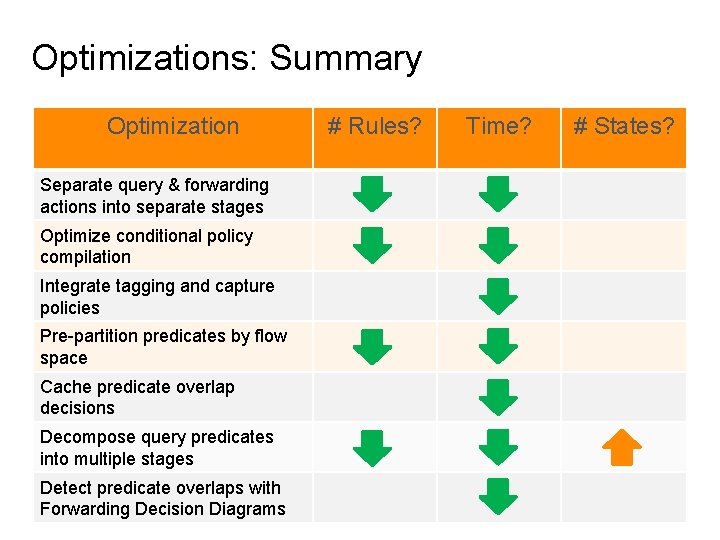
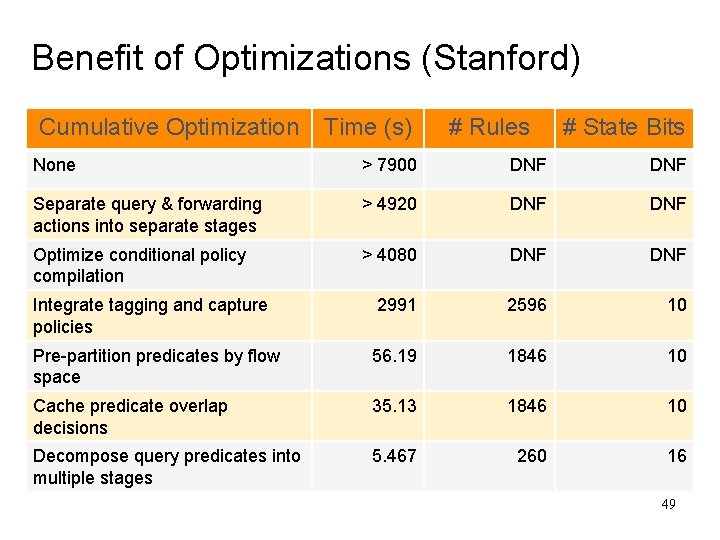
Optimizations: Summary Optimization # Rules? Time? # States? Separate query & forwarding actions into separate stages Optimize conditional policy compilation Integrate tagging and capture policies Pre-partition predicates by flow space Cache predicate overlap decisions Decompose query predicates into multiple stages Detect predicate overlaps with Forwarding Decision Diagrams 39
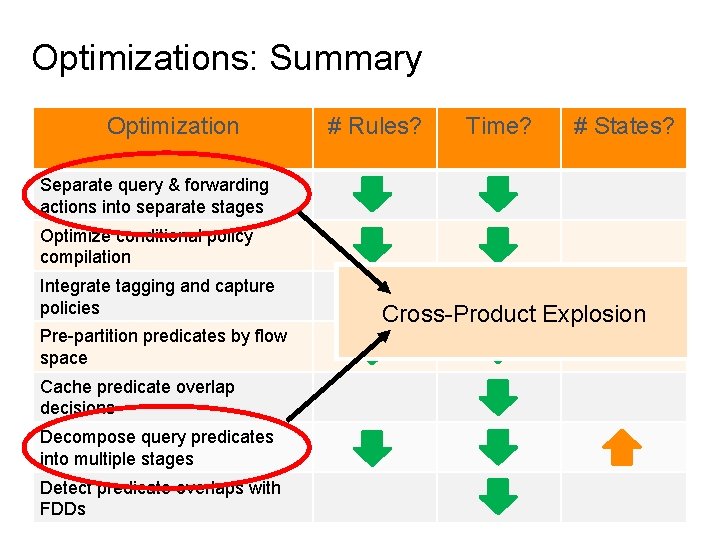
Optimizations: Summary Optimization # Rules? Time? # States? Separate query & forwarding actions into separate stages Optimize conditional policy compilation Integrate tagging and capture policies Pre-partition predicates by flow space Cross-Product Explosion Cache predicate overlap decisions Decompose query predicates into multiple stages Detect predicate overlaps with FDDs 40
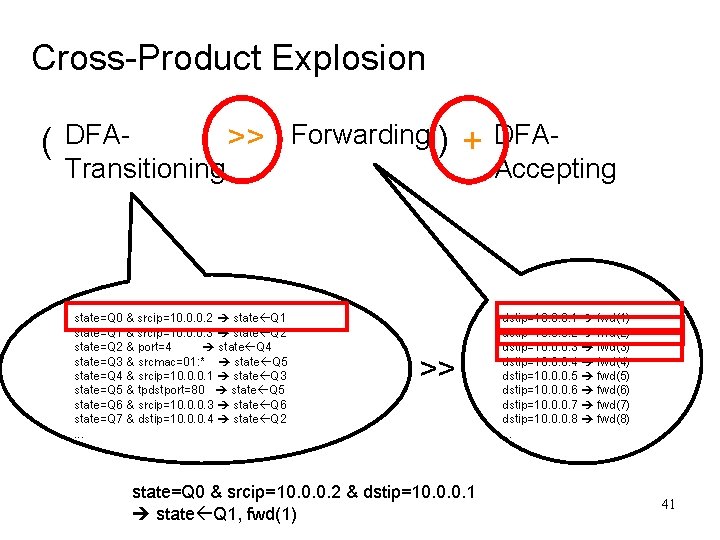
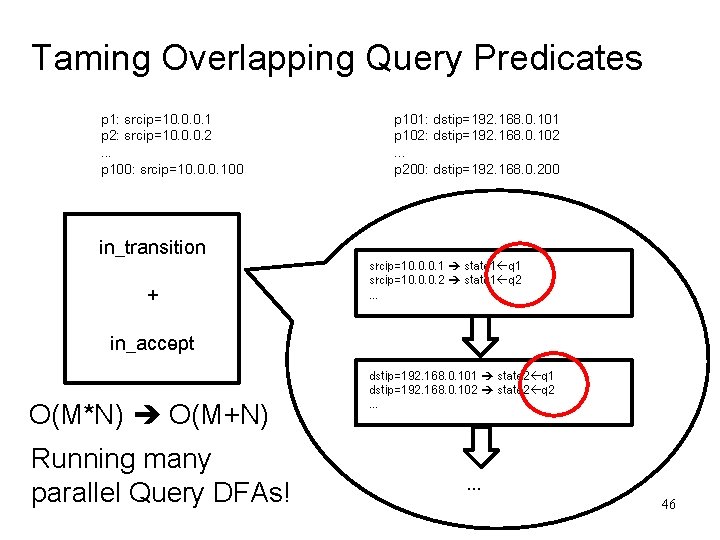
Cross-Product Explosion ( DFA>> Forwarding ) Transitioning state=Q 0 & srcip=10. 0. 0. 2 state Q 1 state=Q 1 & srcip=10. 0. 0. 3 state Q 2 state=Q 2 & port=4 state Q 4 state=Q 3 & srcmac=01: * state Q 5 state=Q 4 & srcip=10. 0. 0. 1 state Q 3 state=Q 5 & tpdstport=80 state Q 5 state=Q 6 & srcip=10. 0. 0. 3 state Q 6 state=Q 7 & dstip=10. 0. 0. 4 state Q 2. . . + DFA- >> state=Q 0 & srcip=10. 0. 0. 2 & dstip=10. 0. 0. 1 state Q 1, fwd(1) Accepting dstip=10. 0. 0. 1 fwd(1) dstip=10. 0. 0. 2 fwd(2) dstip=10. 0. 0. 3 fwd(3) dstip=10. 0. 0. 4 fwd(4) dstip=10. 0. 0. 5 fwd(5) dstip=10. 0. 0. 6 fwd(6) dstip=10. 0. 0. 7 fwd(7) dstip=10. 0. 0. 8 fwd(8). . . 41
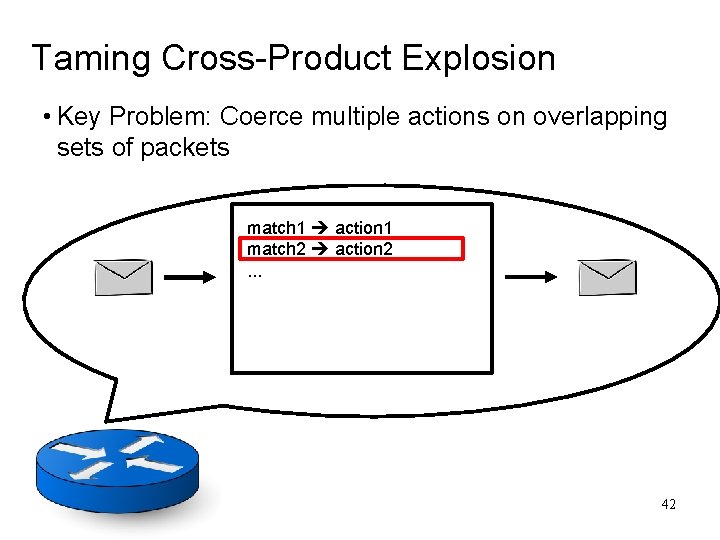
Taming Cross-Product Explosion • Key Problem: Coerce multiple actions on overlapping sets of packets match 1 action 1 match 2 action 2. . . 42
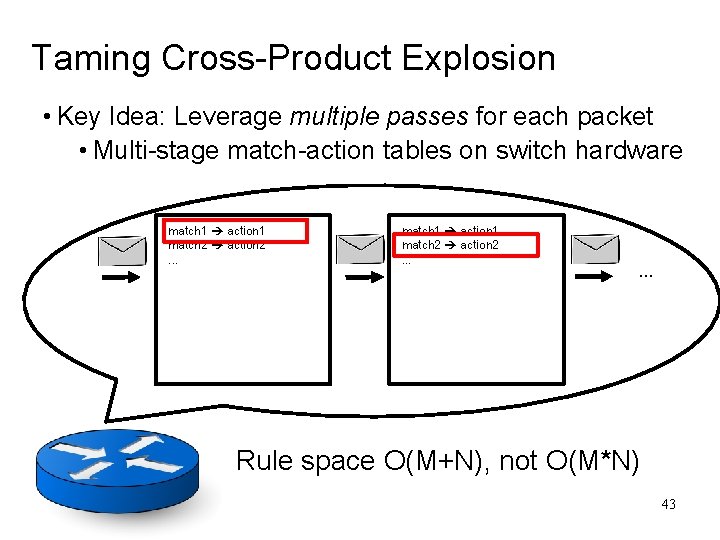
Taming Cross-Product Explosion • Key Idea: Leverage multiple passes for each packet • Multi-stage match-action tables on switch hardware match 1 action 1 match 2 action 2. . . Rule space O(M+N), not O(M*N) 43
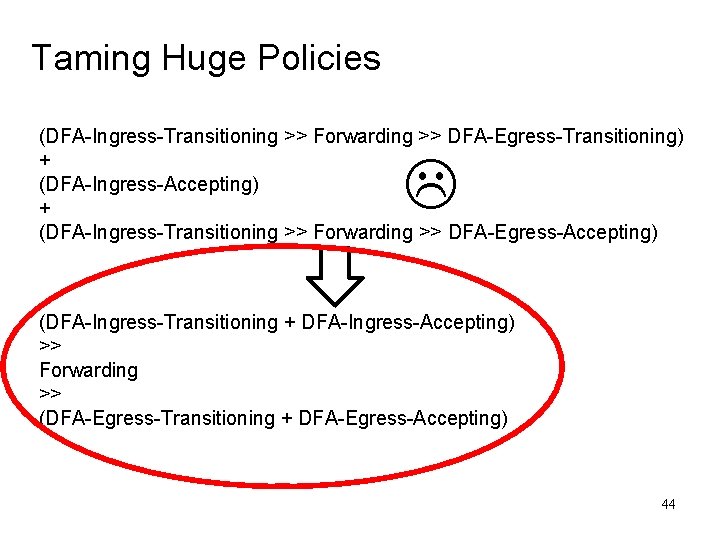
Taming Huge Policies (DFA-Ingress-Transitioning >> Forwarding >> DFA-Egress-Transitioning) + (DFA-Ingress-Accepting) + (DFA-Ingress-Transitioning >> Forwarding >> DFA-Egress-Accepting) (DFA-Ingress-Transitioning + DFA-Ingress-Accepting) >> Forwarding >> (DFA-Egress-Transitioning + DFA-Egress-Accepting) 44
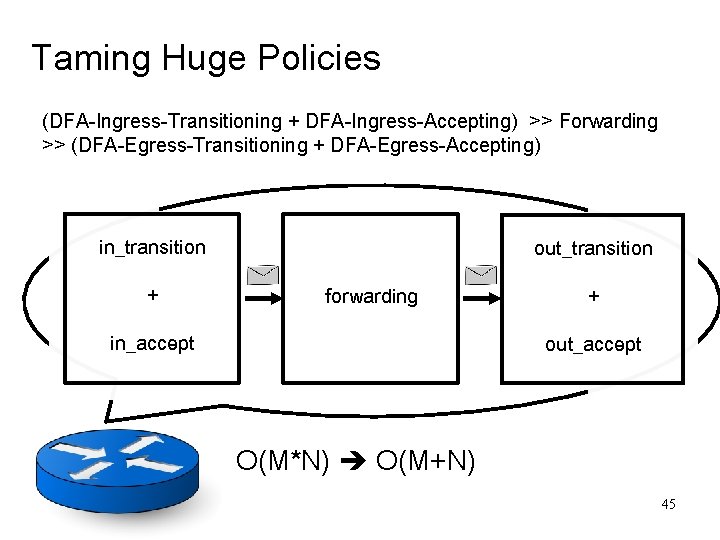
Taming Huge Policies (DFA-Ingress-Transitioning + DFA-Ingress-Accepting) >> Forwarding >> (DFA-Egress-Transitioning + DFA-Egress-Accepting) in_transition + out_transition forwarding in_accept + out_accept O(M*N) O(M+N) 45
Taming Overlapping Query Predicates p 1: srcip=10. 0. 0. 1 p 2: srcip=10. 0. 0. 2. . . p 100: srcip=10. 0. 0. 100 in_transition + p 101: dstip=192. 168. 0. 101 p 102: dstip=192. 168. 0. 102. . . p 200: dstip=192. 168. 0. 200 srcip=10. 0. 0. 1 state 1 q 1 srcip=10. 0. 0. 2 state 1 q 2. . . in_accept O(M*N) O(M+N) Running many parallel Query DFAs! dstip=192. 168. 0. 101 state 2 q 1 dstip=192. 168. 0. 102 state 2 q 2. . . 46
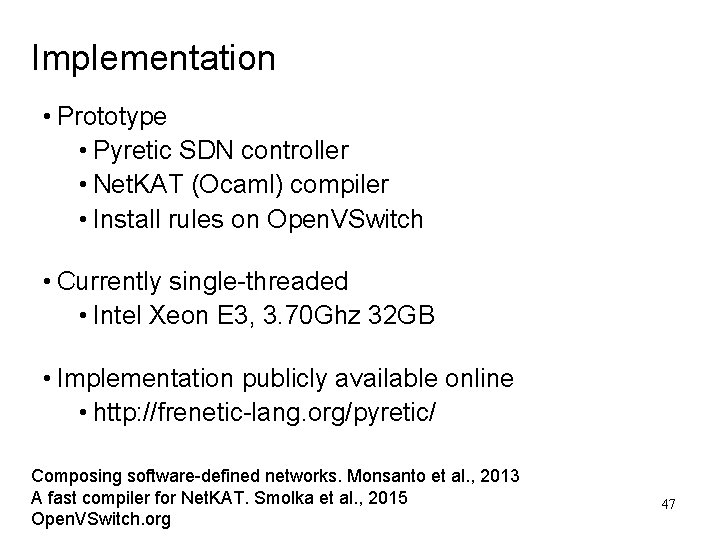
Implementation • Prototype • Pyretic SDN controller • Net. KAT (Ocaml) compiler • Install rules on Open. VSwitch • Currently single-threaded • Intel Xeon E 3, 3. 70 Ghz 32 GB • Implementation publicly available online • http: //frenetic-lang. org/pyretic/ Composing software-defined networks. Monsanto et al. , 2013 A fast compiler for Net. KAT. Smolka et al. , 2015 Open. VSwitch. org 47
Benefit of Optimizations • Stanford campus network topology • Several queries: • Traffic matrix, DDo. S detection, per-hop packet loss, firewall evasion, slice isolation, congested link • Metrics and Stanford results (all queries together): • Compile time: > 2 hours 5 seconds • # Rules: ~ 650 • # State bytes: 2 bytes 48
Benefit of Optimizations (Stanford) Cumulative Optimization Time (s) # Rules # State Bits None > 7900 DNF Separate query & forwarding actions into separate stages > 4920 DNF Optimize conditional policy compilation > 4080 DNF Integrate tagging and capture policies 2991 2596 10 Pre-partition predicates by flow space 56. 19 1846 10 Cache predicate overlap decisions 35. 13 1846 10 Decompose query predicates into multiple stages 5. 467 260 16 49
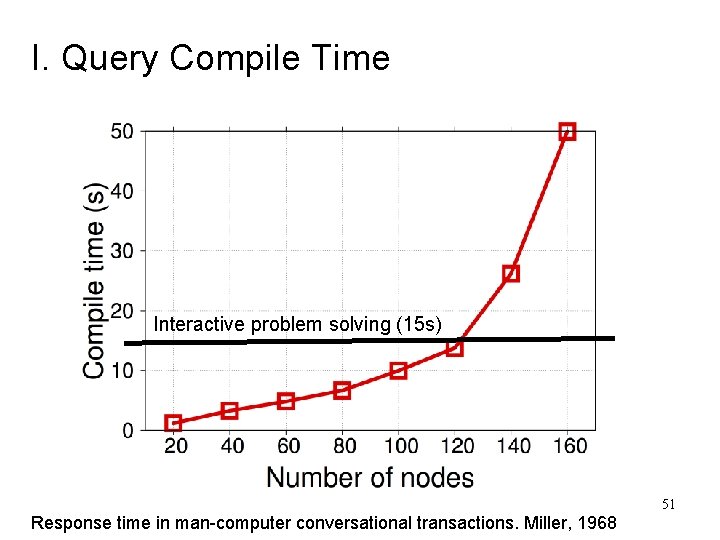
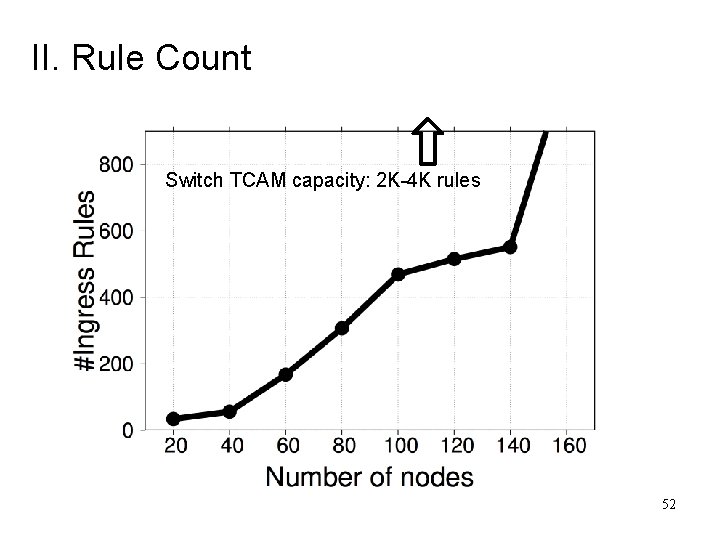
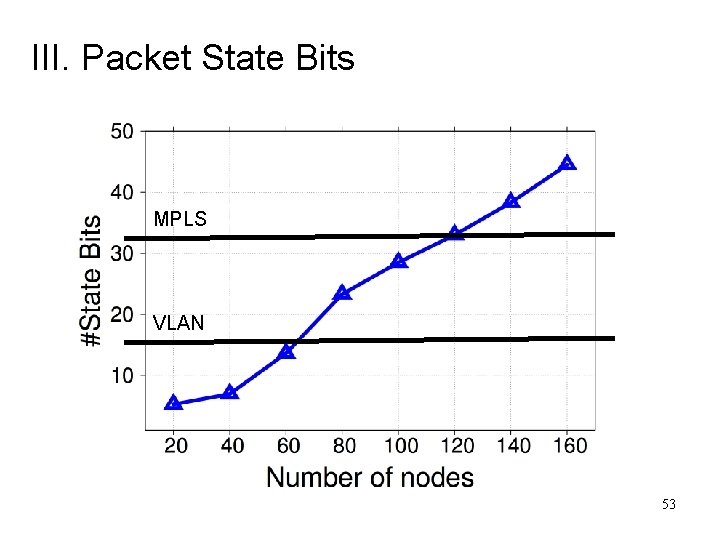
Scalability Trends • Five synthetic ISP (Waxman) topologies at various network sizes • At each network size, run mix of queries from before • Averaged metrics across queries & topologies 50
I. Query Compile Time Interactive problem solving (15 s) 51 Response time in man-computer conversational transactions. Miller, 1968
II. Rule Count Switch TCAM capacity: 2 K-4 K rules 52
III. Packet State Bits MPLS VLAN 53
Summary • Declarative path query language • Regular expressions, grouping • Capture locations, capture actions • Compositional run-time system • Query-DFA packet state • Key optimizations for a practical system • Addressing cross-product explosion • Paper and more info at http: //www. cs. princeton. edu/~narayana/pathqueries 54