
MEASUREMENT PART 1 Overview What are scales of

- Slides: 12
MEASUREMENT: PART 1
Overview What are “scales of measurement” and why does anyone care? What are “psychometrics”? What are the types of reliability? (validity is next time)
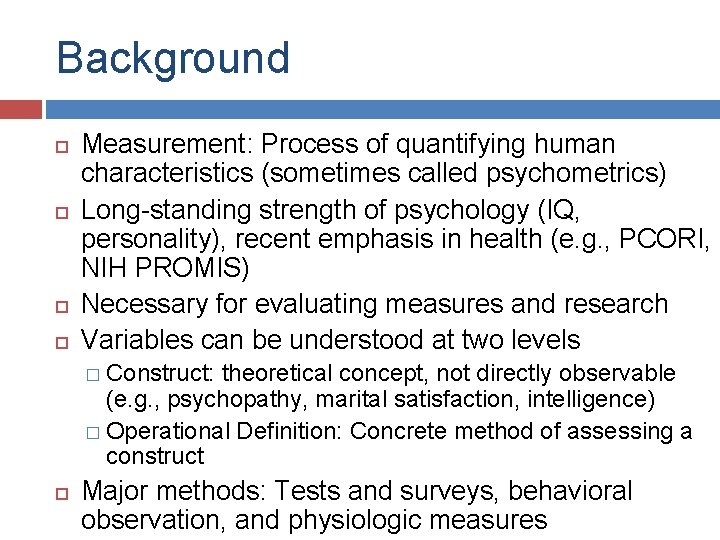
Background Measurement: Process of quantifying human characteristics (sometimes called psychometrics) Long-standing strength of psychology (IQ, personality), recent emphasis in health (e. g. , PCORI, NIH PROMIS) Necessary for evaluating measures and research Variables can be understood at two levels � Construct: theoretical concept, not directly observable (e. g. , psychopathy, marital satisfaction, intelligence) � Operational Definition: Concrete method of assessing a construct Major methods: Tests and surveys, behavioral observation, and physiologic measures
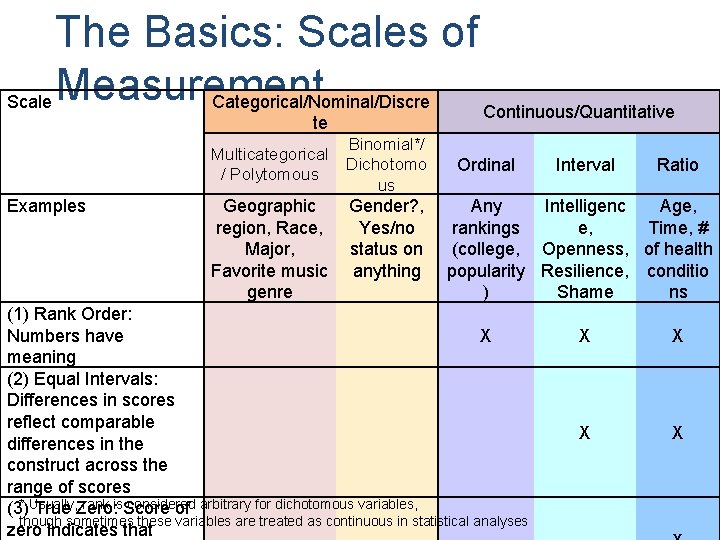
The Basics: Scales of Scale Measurement Categorical/Nominal/Discre Continuous/Quantitative te Multicategorical / Polytomous Examples Geographic region, Race, Major, Favorite music genre Binomial*/ Dichotomo us Gender? , Yes/no status on anything Ordinal Interval Ratio Any Intelligenc Age, rankings e, Time, # (college, Openness, of health popularity Resilience, conditio ) Shame ns (1) Rank Order: Numbers have X meaning (2) Equal Intervals: Differences in scores reflect comparable differences in the construct across the range of scores * Usually, rank is. Score considered (3) True Zero: of arbitrary for dichotomous variables, though sometimes these variables are treated as continuous in statistical analyses zero indicates that X X
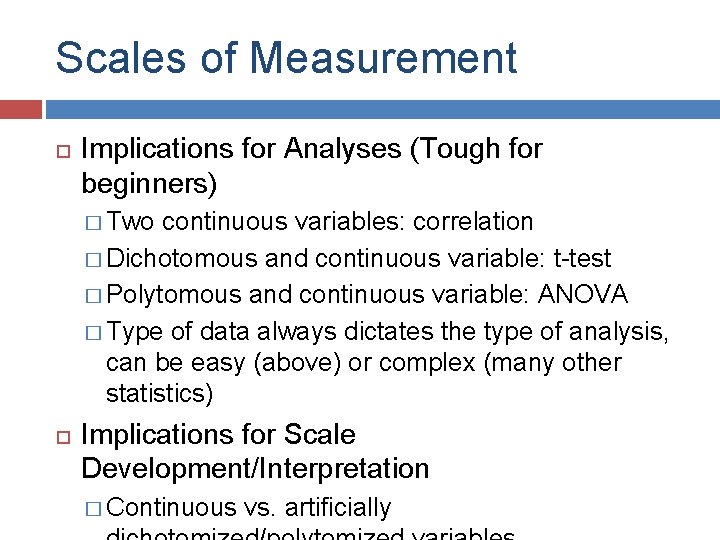
Scales of Measurement Implications for Analyses (Tough for beginners) � Two continuous variables: correlation � Dichotomous and continuous variable: t-test � Polytomous and continuous variable: ANOVA � Type of data always dictates the type of analysis, can be easy (above) or complex (many other statistics) Implications for Scale Development/Interpretation � Continuous vs. artificially
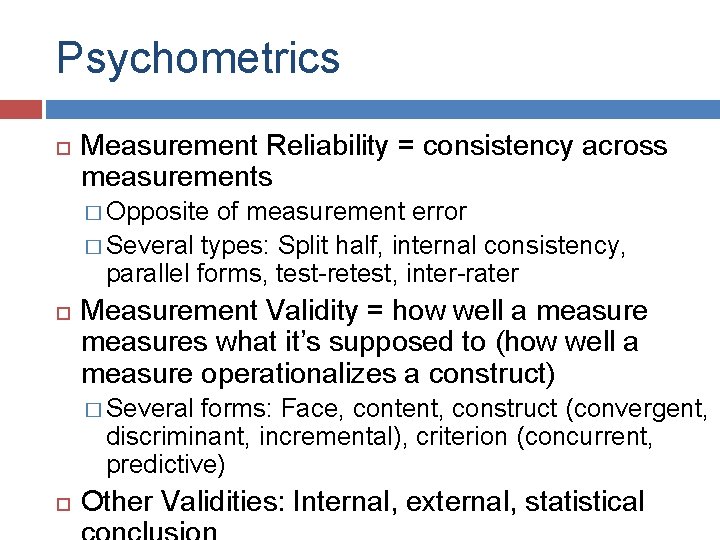
Psychometrics Measurement Reliability = consistency across measurements � Opposite of measurement error � Several types: Split half, internal consistency, parallel forms, test-retest, inter-rater Measurement Validity = how well a measures what it’s supposed to (how well a measure operationalizes a construct) � Several forms: Face, content, construct (convergent, discriminant, incremental), criterion (concurrent, predictive) Other Validities: Internal, external, statistical
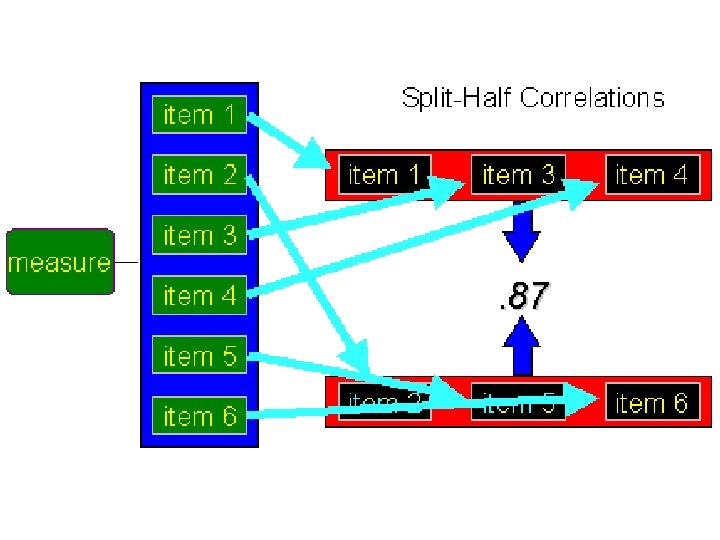
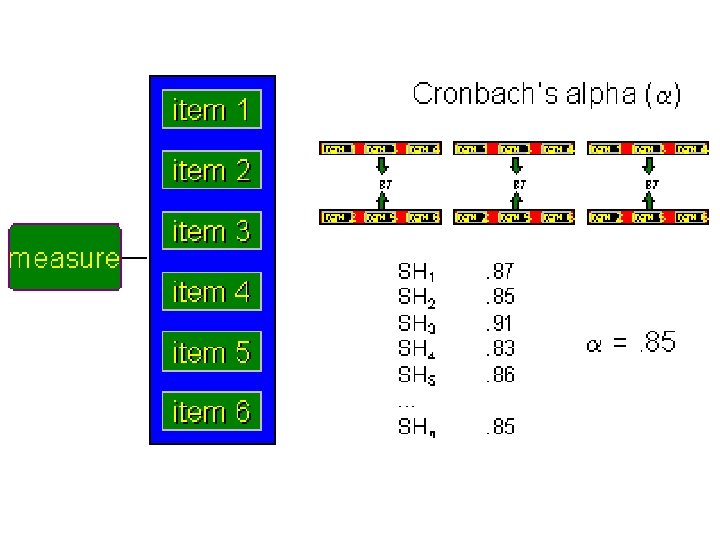
Split-half Reliability How well scores on one half of the test correlate with scores on the other First half correlated with second half; odds with evens, etc. Problem: Many ways to split a test in two, and different splits yield different correlations
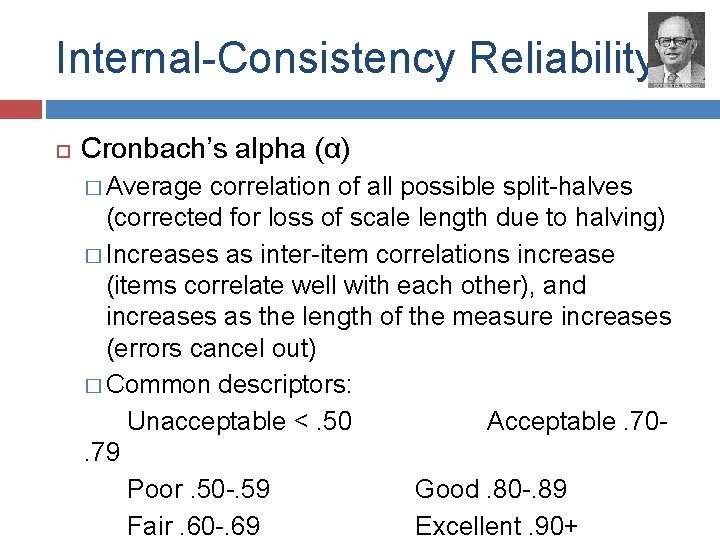
Internal-Consistency Reliability Cronbach’s alpha (α) � Average correlation of all possible split-halves (corrected for loss of scale length due to halving) � Increases as inter-item correlations increase (items correlate well with each other), and increases as the length of the measure increases (errors cancel out) � Common descriptors: Unacceptable <. 50 Acceptable. 70. 79 Poor. 50 -. 59 Good. 80 -. 89 Fair. 60 -. 69 Excellent. 90+
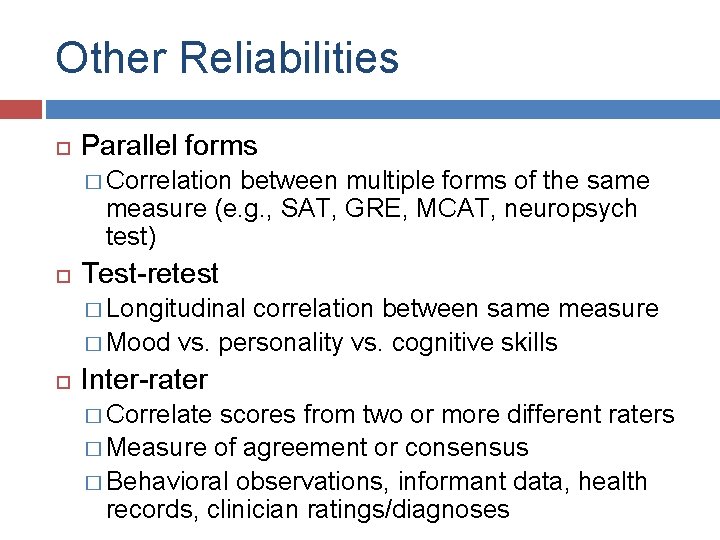
Other Reliabilities Parallel forms � Correlation between multiple forms of the same measure (e. g. , SAT, GRE, MCAT, neuropsych test) Test-retest � Longitudinal correlation between same measure � Mood vs. personality vs. cognitive skills Inter-rater � Correlate scores from two or more different raters � Measure of agreement or consensus � Behavioral observations, informant data, health records, clinician ratings/diagnoses