
MEASUREMENT OF VISIBILITY TURKEY AWOS TRAINING 1 0
MEASUREMENT OF VISIBILITY TURKEY AWOS TRAINING 1. 0 / ALANYA 2005
• Visibility was first defined for meteorological purposes as a quantity to be estimated by a human observer, and observations made in that way are widely used. However, the estimation of visibility is affected by many subjective and physical factors; the essential meteorological quantity, Which is the transparency of the atmosphere, can be measured objected, and is represented by the meteorological optical range (MOR). The meteorological optical range or MOR is expressed in meters or kilometers. TURKEY AWOS TRAINING 1. 0 / ALANYA 2005
Instruments measuring the extinction coefficient • Telephotometric instruments • Visual extinction meters • Transmissometers TURKEY AWOS TRAINING 1. 0 / ALANYA 2005
• The method most commonly used for measuring the mean extinction coefficient in a horizontal cylinder of air between a transmitter, which provides a modulated flux light source of constant mean power, and receiver incorporating a photodetector (generally a photodiode at the focal point of a parabolic mirror or a lens) is by using a transmissometer. TURKEY AWOS TRAINING 1. 0 / ALANYA 2005

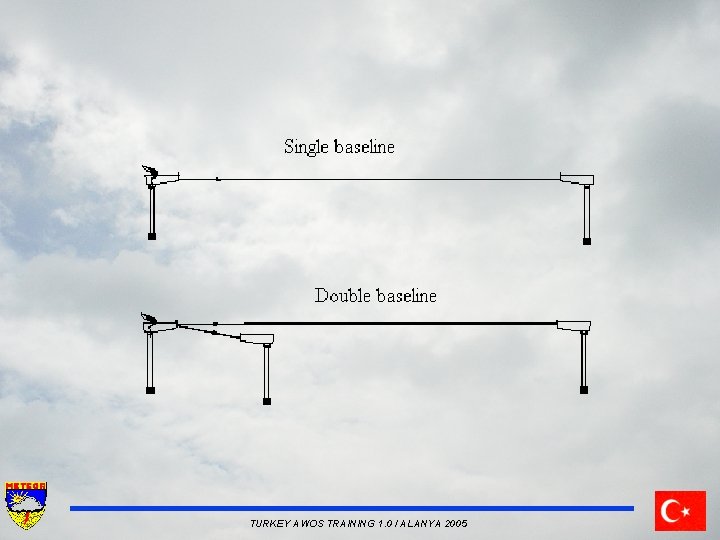
There are two type of transmissometer: A. Those with a transmitter and a receiver in different units and at a known distance from each other. TURKEY AWOS TRAINING 1. 0 / ALANYA 2005
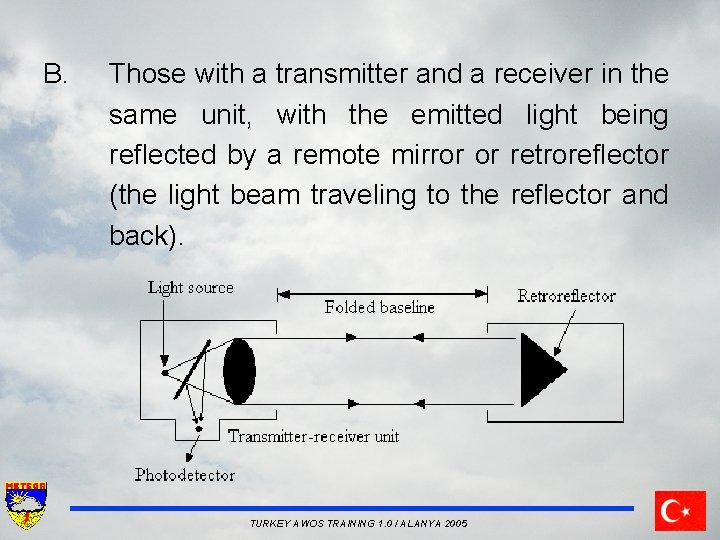
B. Those with a transmitter and a receiver in the same unit, with the emitted light being reflected by a remote mirror or retroreflector (the light beam traveling to the reflector and back). TURKEY AWOS TRAINING 1. 0 / ALANYA 2005
Instruments measuring the scatter coefficient • Back scatter • Forward scatter • Scatter over a wide angle TURKEY AWOS TRAINING 1. 0 / ALANYA 2005
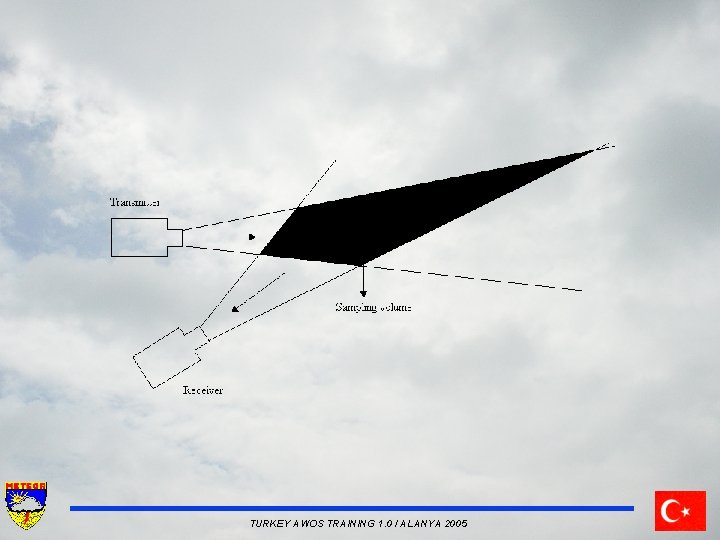
Back scatter • In these instruments, a light beam is concentrated on a small volume of air in front of the transmitter, the receiver being located in the same housing and below the light source where it receives the light back scattered by the volume of air sample. TURKEY AWOS TRAINING 1. 0 / ALANYA 2005
TURKEY AWOS TRAINING 1. 0 / ALANYA 2005
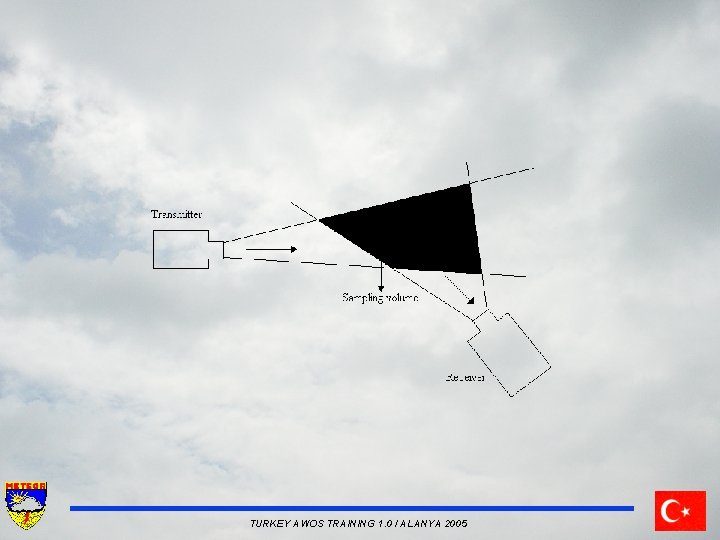
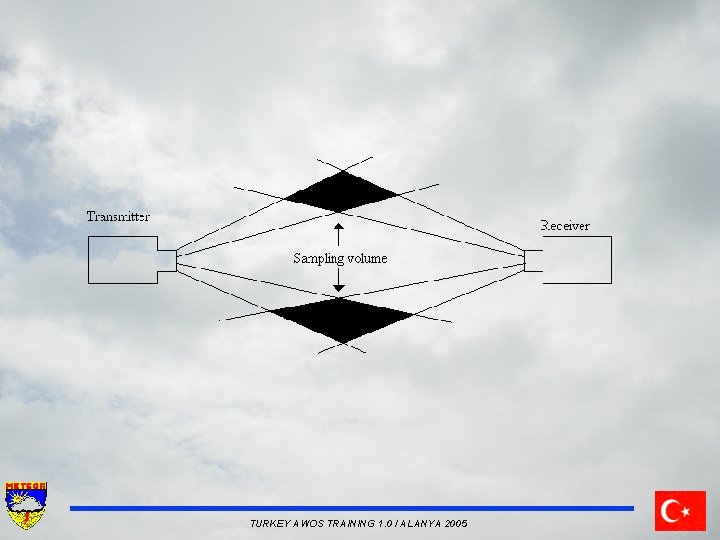
Forward scatter • The instruments, comprise a transmitter and a receiver, the angle between the beam being 20 to 50°. Another arrangement involves placing either a single diaphragm half-way between a transmitter and a receiver or two diaphragms each a short distance from either a transmitter or receiver. TURKEY AWOS TRAINING 1. 0 / ALANYA 2005
TURKEY AWOS TRAINING 1. 0 / ALANYA 2005
TURKEY AWOS TRAINING 1. 0 / ALANYA 2005
Scatter over a wide angle • It is usually known as an integrating nephelometer, is based on the principle of measuring scatter over as wide an angle as possible, ideally 0 to 180°, byt in practice about 0 to 120°. TURKEY AWOS TRAINING 1. 0 / ALANYA 2005
TRANSMISSOMETER TURKEY AWOS TRAINING 1. 0 / ALANYA 2005
TURKEY AWOS TRAINING 1. 0 / ALANYA 2005
– The assessment of visibility ranges from 2/3 times the short baseline up to 50 times long baseline. – With 10 m and 200 m base lines visibility from 7 m upto 10 000 m TURKEY AWOS TRAINING 1. 0 / ALANYA 2005
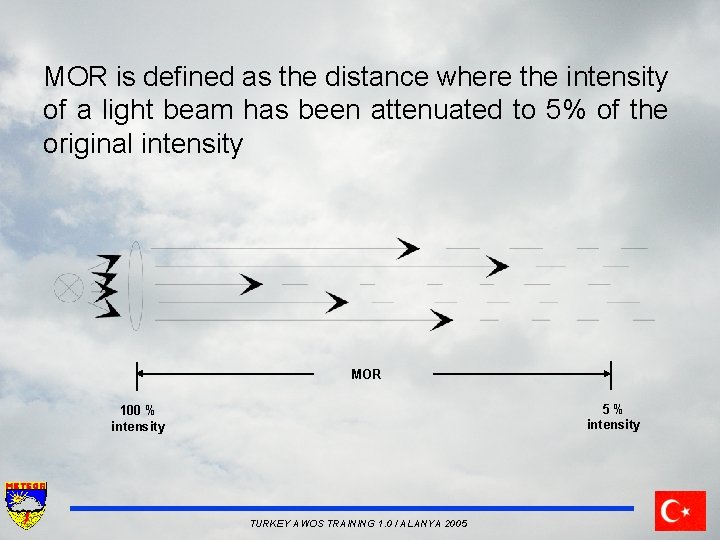
MOR is defined as the distance where the intensity of a light beam has been attenuated to 5% of the original intensity MOR 5% intensity 100 % intensity TURKEY AWOS TRAINING 1. 0 / ALANYA 2005
– MOR can be measured by measuring the attenuation of light – Attenuation is mainly caused by scattering, to a small degree also by absorption (in smoke, dust, …) TURKEY AWOS TRAINING 1. 0 / ALANYA 2005
What is Runway Visual Range? – Runway Visual Range (RVR) = Range over which the pilot on the center line of the runway can see: Runway markings, or Edge lights of the runway, or Center line lights. – RVR is neither an observation nor a measurement. TURKEY AWOS TRAINING 1. 0 / ALANYA 2005
– RVR assessment calculation follows Allard’s law which takes into account: Visibility (m) Background luminance (cd/m 2) Airfield lighting intensity percentage Airfield lighting characteristics (cd) – For RVR calculations 5 m is used as the average eye level of a pilot in an aircraft. TURKEY AWOS TRAINING 1. 0 / ALANYA 2005
• Traditionally RVR has been assessed by counting edge light lamps by the runway. The lamps are at 60 m distance from each other. At CAT I airport at least 14 lamps should be seen and 7 lamps at CAT II airport. TURKEY AWOS TRAINING 1. 0 / ALANYA 2005
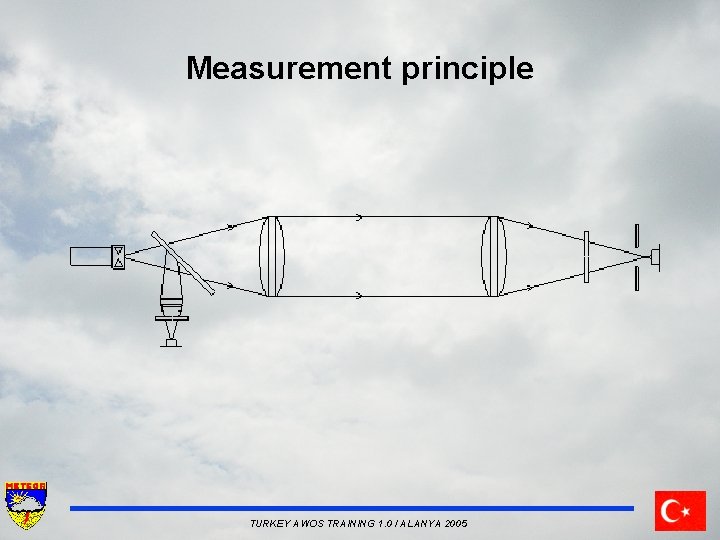
Measurement principle TURKEY AWOS TRAINING 1. 0 / ALANYA 2005
• Light source - Xenon flash lamp - Represents the spectrums of sunlight and runway lights - Very stable, expected lifetime 55000 h - Light intensity can be controlled TURKEY AWOS TRAINING 1. 0 / ALANYA 2005
• Benefits of reference measurement (transmitted intensity) - Short-term long-term variations are compensated very accurately - Transmissometer stability better than ± 0. 3% - Unusual situation detected immediately • When visibility is over 5 km, system automatically decreases flash frequency - Longer life time of the flash lamp TURKEY AWOS TRAINING 1. 0 / ALANYA 2005
Contamination detector • The amount of contamination is measured – transmittance measurement is compensated – warning is generated if contamination exceeds limits • Automatic compensation corrects the errors caused by window contamination – cleaning is required less often – accuracy is maintained throughout the cleaning interval • The user is warned if the windows become too dirty – measurement results can always be trusted TURKEY AWOS TRAINING 1. 0 / ALANYA 2005
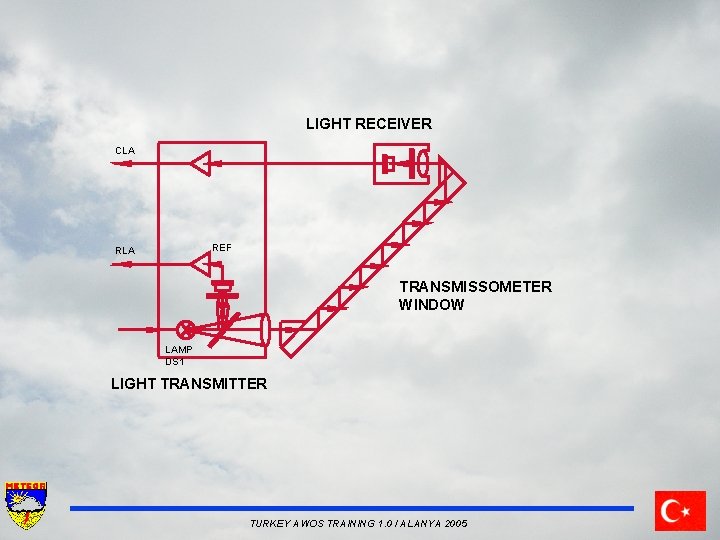
LIGHT RECEIVER CLA REF RLA TRANSMISSOMETER WINDOW LAMP DS 1 LIGHT TRANSMITTER TURKEY AWOS TRAINING 1. 0 / ALANYA 2005
– Averaging time Normal operation 30 s or 60 s In alignment mode 15 s – Pulse measurement principle Light pulse duration 1. 5 µs (half-width) Continuous light doesn’t interfere: A 75000 W lamp at 30 m distance has no influence TURKEY AWOS TRAINING 1. 0 / ALANYA 2005
– Representative spectral response Green optical filters are used to approximate the specral response of the human eye – Economy mode The flashing interval automatically changes according to the visibility. TURKEY AWOS TRAINING 1. 0 / ALANYA 2005
- Slides: 28