
Measurement of the particle production properties with the

- Slides: 30
Measurement of the particle production properties with the ATLAS Detector S. Tokar, Comenius University, Bratislava On behalf of the ATLAS collaboration 6/6/2017 S. Tokar, EDS 2017, Prague 1
Outline of the talk q Motivation for underlying event and Bose-Einstein correlations q ATLAS detector q Charged-particle distributions sensitive to the underlying event in s = 13 Te. V proton–proton collisions with ATLAS/LHC q Bose-Einstein correlations in s = 0. 9 and 7 Te. V pp collisions with ATLAS/LHC q Conclusions 6/6/2017 S. Tokar, EDS 2017, Prague 2
Motivation for underlying events and BEC Underlying event: Searches for new physics, for any deep inelastic process at hadron colliders need: ü a good understanding of the primary short-distance hard scattering process; ü to understand the accompanying interactions of the rest of the proton– proton collision – the underlying event (UE); ü the UE is an intrinsic part of the same pp collision as any “signal” partonic interaction, accurate description of its properties by MC event generators is important. Bose-Einstein correlations: important for understanding of nonperturbative aspects of hadronization processes. ü The space-time characteristics of hadronization process can be extracted; ü It can lead to an advancement in understanding of quark confinement. 6/6/2017 S. Tokar, EDS 2017, Prague 3
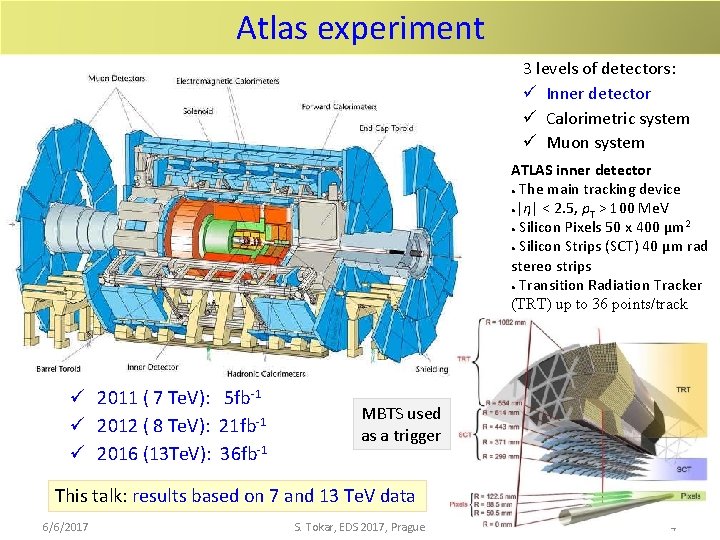
Atlas experiment 3 levels of detectors: ü Inner detector ü Calorimetric system ü Muon system ATLAS inner detector ● The main tracking device ●|η| < 2. 5, p > 100 Me. V T 2 ● Silicon Pixels 50 x 400 μm ● Silicon Strips (SCT) 40 μm rad stereo strips ● Transition Radiation Tracker (TRT) up to 36 points/track ated luminosity: ü 2011 ( 7 Te. V): 5 fb-1 ü 2012 ( 8 Te. V): 21 fb-1 ü 2016 (13 Te. V): 36 fb-1 MBTS used as a trigger This talk: results based on 7 and 13 Te. V data 6/6/2017 S. Tokar, EDS 2017, Prague 4
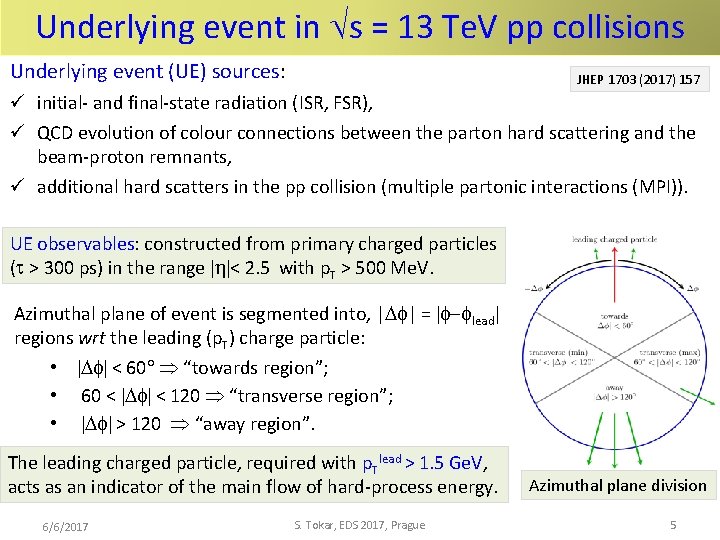
Underlying event in s = 13 Te. V pp collisions Underlying event (UE) sources: JHEP 1703 (2017) 157 ü initial- and final-state radiation (ISR, FSR), ü QCD evolution of colour connections between the parton hard scattering and the beam-proton remnants, ü additional hard scatters in the pp collision (multiple partonic interactions (MPI)). UE observables: constructed from primary charged particles ( > 300 ps) in the range < 2. 5 with p. T > 500 Me. V. Azimuthal plane of event is segmented into, | | = lead regions wrt the leading (p. T) charge particle: • < 60 “towards region”; • 60 < < 120 “transverse region”; • > 120 “away region”. The leading charged particle, required with p. Tlead > 1. 5 Ge. V, acts as an indicator of the main flow of hard-process energy. 6/6/2017 S. Tokar, EDS 2017, Prague Azimuthal plane division 5
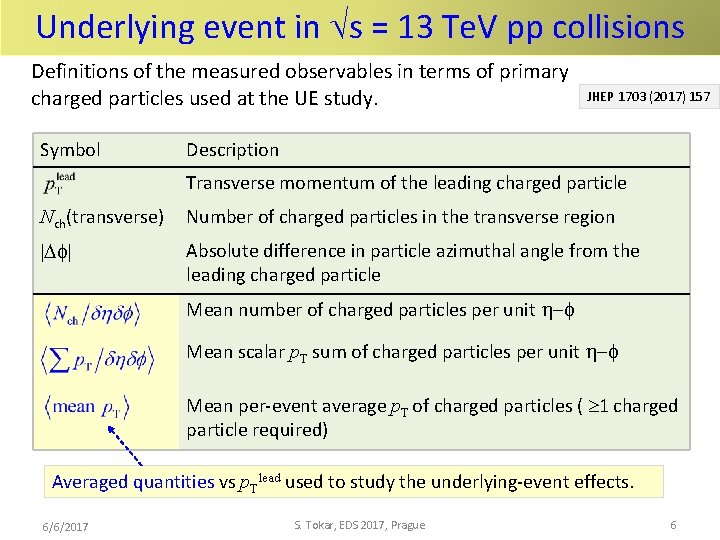
Underlying event in s = 13 Te. V pp collisions Definitions of the measured observables in terms of primary charged particles used at the UE study. Symbol JHEP 1703 (2017) 157 Description Transverse momentum of the leading charged particle Nch(transverse) Number of charged particles in the transverse region Absolute difference in particle azimuthal angle from the leading charged particle Mean number of charged particles per unit Mean scalar p. T sum of charged particles per unit Mean per-event average p. T of charged particles ( 1 charged particle required) Averaged quantities vs p. Tlead used to study the underlying-event effects. 6/6/2017 S. Tokar, EDS 2017, Prague 6
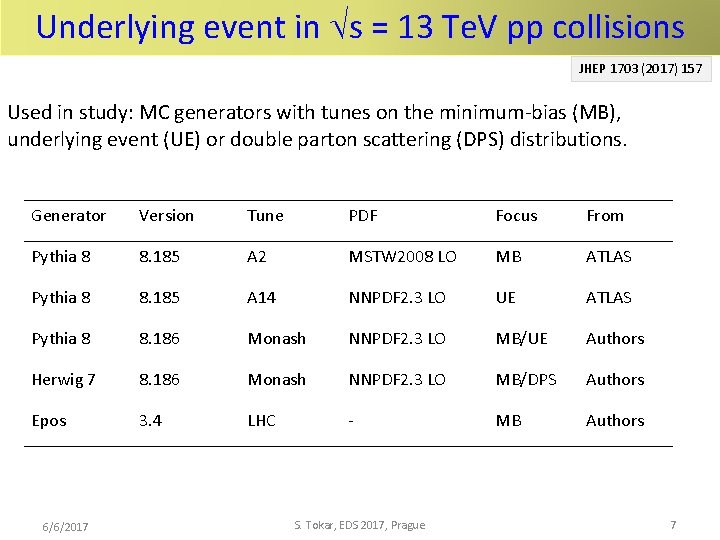
Underlying event in s = 13 Te. V pp collisions JHEP 1703 (2017) 157 Used in study: MC generators with tunes on the minimum-bias (MB), underlying event (UE) or double parton scattering (DPS) distributions. Generator Version Tune PDF Focus From Pythia 8 8. 185 A 2 MSTW 2008 LO MB ATLAS Pythia 8 8. 185 A 14 NNPDF 2. 3 LO UE ATLAS Pythia 8 8. 186 Monash NNPDF 2. 3 LO MB/UE Authors Herwig 7 8. 186 Monash NNPDF 2. 3 LO MB/DPS Authors Epos 3. 4 LHC - MB Authors 6/6/2017 S. Tokar, EDS 2017, Prague 7
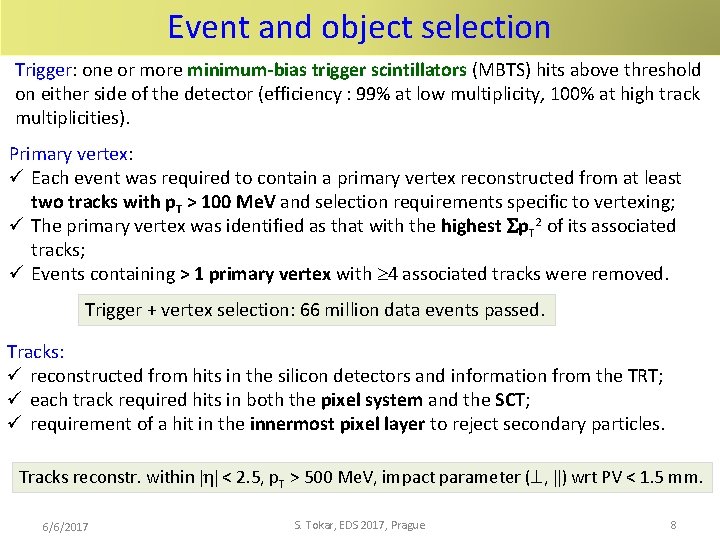
Event and object selection Trigger: one or more minimum-bias trigger scintillators (MBTS) hits above threshold on either side of the detector (efficiency : 99% at low multiplicity, 100% at high track multiplicities). Primary vertex: ü Each event was required to contain a primary vertex reconstructed from at least two tracks with p. T > 100 Me. V and selection requirements specific to vertexing; ü The primary vertex was identified as that with the highest p. T 2 of its associated tracks; ü Events containing > 1 primary vertex with 4 associated tracks were removed. Trigger + vertex selection: 66 million data events passed. Tracks: ü reconstructed from hits in the silicon detectors and information from the TRT; ü each track required hits in both the pixel system and the SCT; ü requirement of a hit in the innermost pixel layer to reject secondary particles. Tracks reconstr. within < 2. 5, p. T > 500 Me. V, impact parameter ( , ) wrt PV < 1. 5 mm. 6/6/2017 S. Tokar, EDS 2017, Prague 8
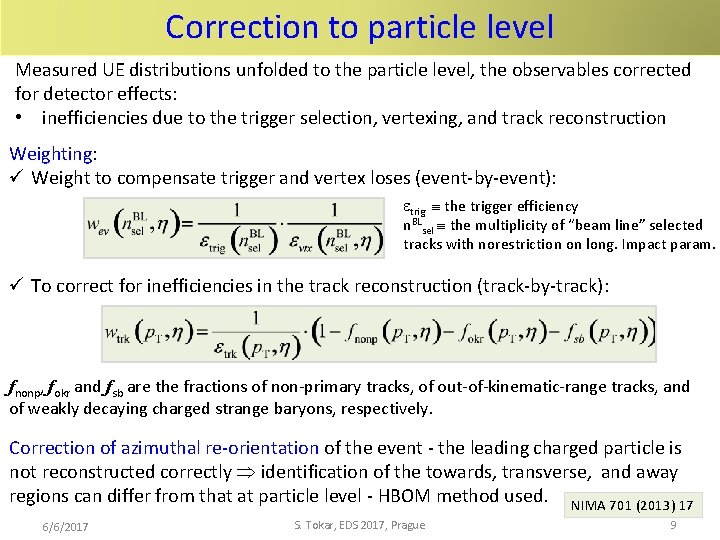
Correction to particle level Measured UE distributions unfolded to the particle level, the observables corrected for detector effects: • inefficiencies due to the trigger selection, vertexing, and track reconstruction Weighting: ü Weight to compensate trigger and vertex loses (event-by-event): trig the trigger efficiency n. BLsel the multiplicity of “beam line” selected tracks with norestriction on long. Impact param. ü To correct for inefficiencies in the track reconstruction (track-by-track): fnonp, fokr and fsb are the fractions of non-primary tracks, of out-of-kinematic-range tracks, and of weakly decaying charged strange baryons, respectively. Correction of azimuthal re-orientation of the event - the leading charged particle is not reconstructed correctly identification of the towards, transverse, and away regions can differ from that at particle level - HBOM method used. NIMA 701 (2013) 17 6/6/2017 S. Tokar, EDS 2017, Prague 9
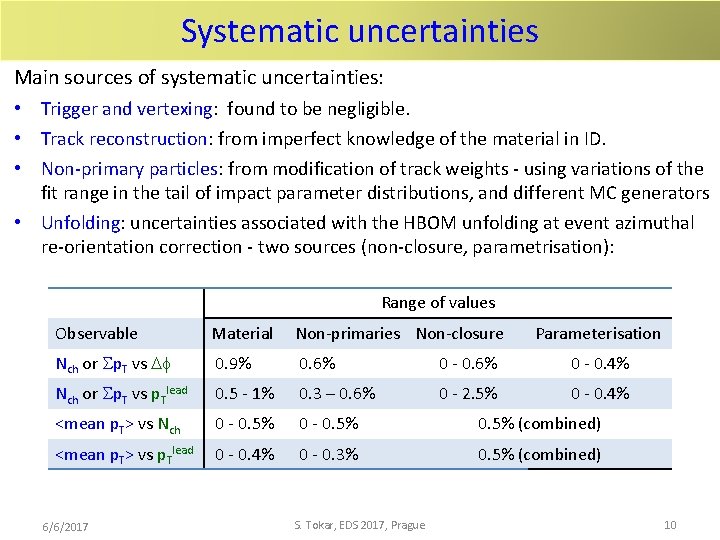
Systematic uncertainties Main sources of systematic uncertainties: • Trigger and vertexing: found to be negligible. • Track reconstruction: from imperfect knowledge of the material in ID. • Non-primary particles: from modification of track weights - using variations of the fit range in the tail of impact parameter distributions, and different MC generators • Unfolding: uncertainties associated with the HBOM unfolding at event azimuthal re-orientation correction - two sources (non-closure, parametrisation): Range of values Observable Material Non-primaries Non-closure Nch or p. T vs 0. 9% 0. 6% 0 - 0. 4% Nch or p. T vs p. Tlead 0. 5 - 1% 0. 3 – 0. 6% 0 - 2. 5% 0 - 0. 4% <mean p. T> vs Nch 0 - 0. 5% (combined) <mean p. T> vs p. Tlead 0 - 0. 4% 0 - 0. 3% 0. 5% (combined) 6/6/2017 S. Tokar, EDS 2017, Prague Parameterisation 10
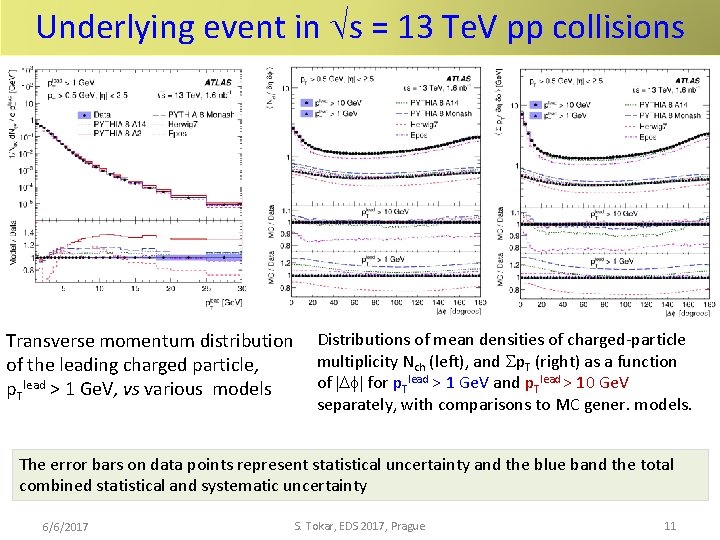
Underlying event in s = 13 Te. V pp collisions Transverse momentum distribution of the leading charged particle, p. Tlead > 1 Ge. V, vs various models Distributions of mean densities of charged-particle multiplicity Nch (left), and p. T (right) as a function of for p. Tlead > 1 Ge. V and p. Tlead > 10 Ge. V separately, with comparisons to MC gener. models. The error bars on data points represent statistical uncertainty and the blue band the total combined statistical and systematic uncertainty 6/6/2017 S. Tokar, EDS 2017, Prague 11
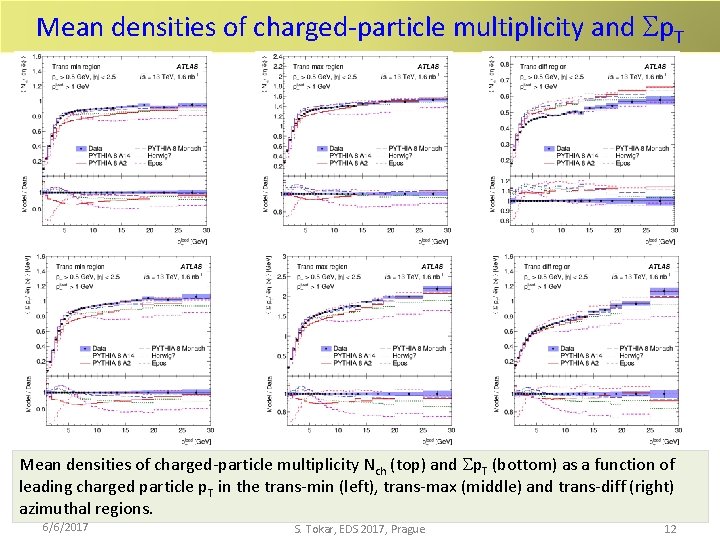
Mean densities of charged-particle multiplicity and p. T Mean densities of charged-particle multiplicity Nch (top) and p. T (bottom) as a function of leading charged particle p. T in the trans-min (left), trans-max (middle) and trans-diff (right) azimuthal regions. 6/6/2017 S. Tokar, EDS 2017, Prague 12
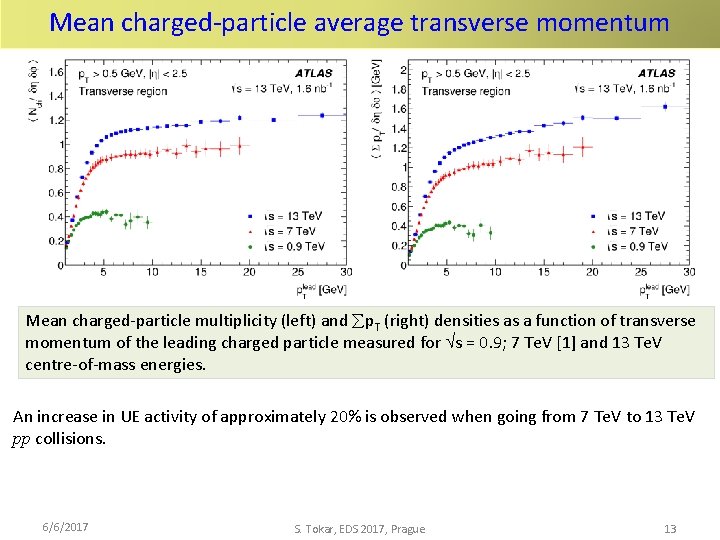
Mean charged-particle average transverse momentum Mean charged-particle multiplicity (left) and p. T (right) densities as a function of transverse momentum of the leading charged particle measured for s = 0. 9; 7 Te. V [1] and 13 Te. V centre-of-mass energies. An increase in UE activity of approximately 20% is observed when going from 7 Te. V to 13 Te. V pp collisions. 6/6/2017 S. Tokar, EDS 2017, Prague 13
Bose-Einstein Correlations EPJC 75 (2015) 466 pp collisions at s = 0. 9 and 7 Te. V • 0. 9 Te. V 7 b • 7 Te. V 190 b • 7 Te. V 12. 4 nb (high multiplicity) 6/6/2017 S. Tokar, EDS 2017, Prague 14
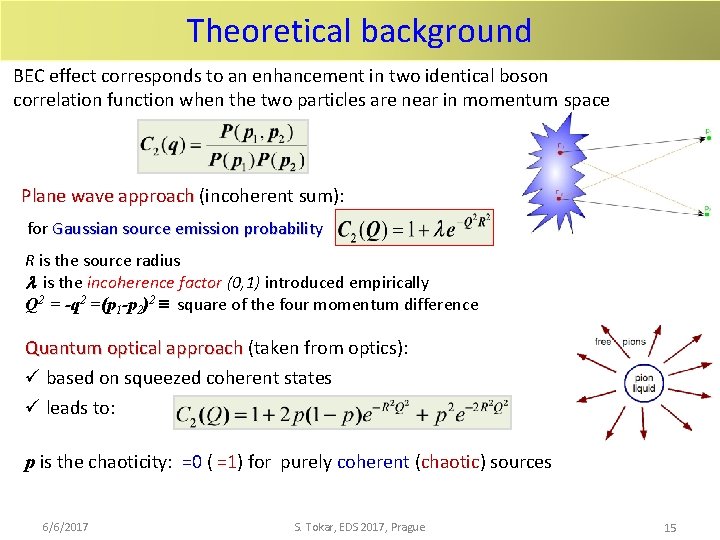
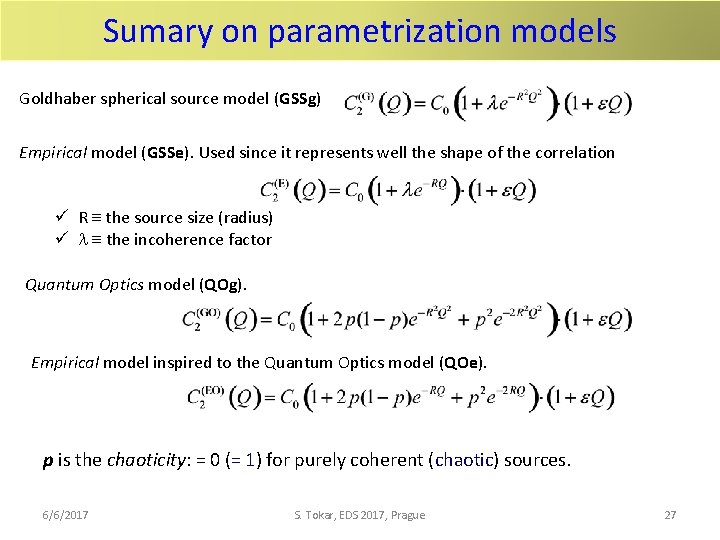
Theoretical background BEC effect corresponds to an enhancement in two identical boson correlation function when the two particles are near in momentum space Plane wave approach (incoherent sum): for Gaussian source emission probability R is the source radius is the incoherence factor (0, 1) introduced empirically Q 2 = -q 2 =(p 1 -p 2)2 square of the four momentum difference Quantum optical approach (taken from optics): ü based on squeezed coherent states ü leads to: p is the chaoticity: =0 ( =1) for purely coherent (chaotic) sources 6/6/2017 S. Tokar, EDS 2017, Prague 15
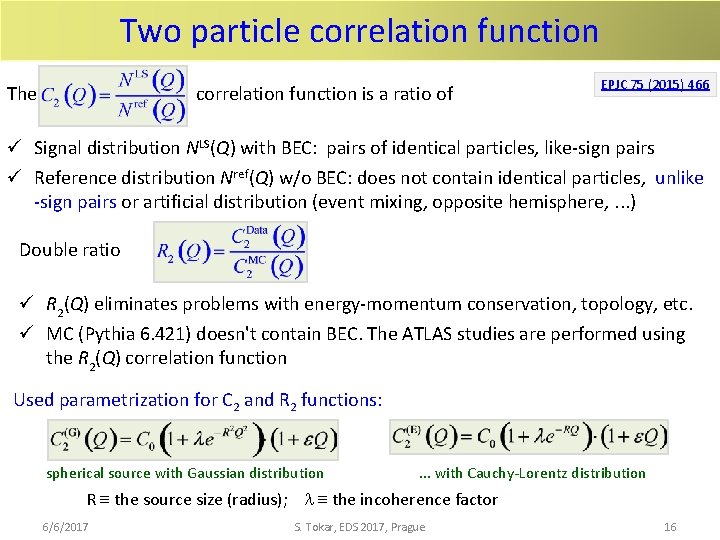
Two particle correlation function The correlation function is a ratio of EPJC 75 (2015) 466 ü Signal distribution NLS(Q) with BEC: pairs of identical particles, like-sign pairs ü Reference distribution Nref(Q) w/o BEC: does not contain identical particles, unlike -sign pairs or artificial distribution (event mixing, opposite hemisphere, . . . ) Double ratio ü R 2(Q) eliminates problems with energy-momentum conservation, topology, etc. ü MC (Pythia 6. 421) doesn't contain BEC. The ATLAS studies are performed using the R 2(Q) correlation function Used parametrization for C 2 and R 2 functions: spherical source with Gaussian distribution . . . with Cauchy-Lorentz distribution R the source size (radius); the incoherence factor 6/6/2017 S. Tokar, EDS 2017, Prague 16
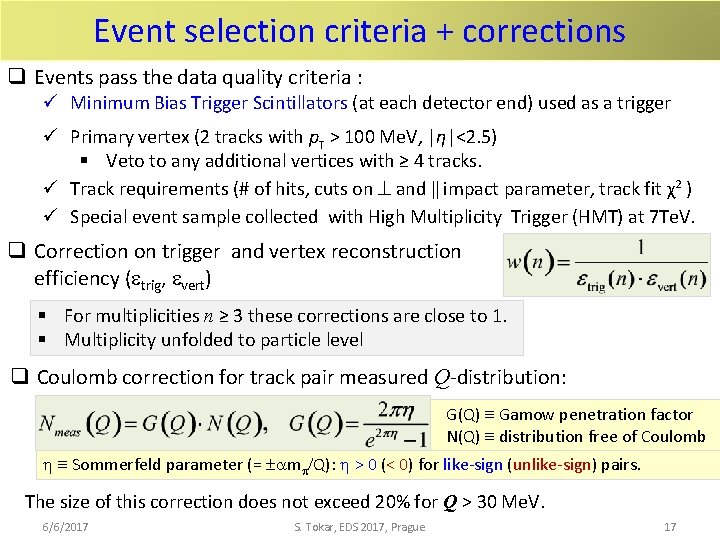
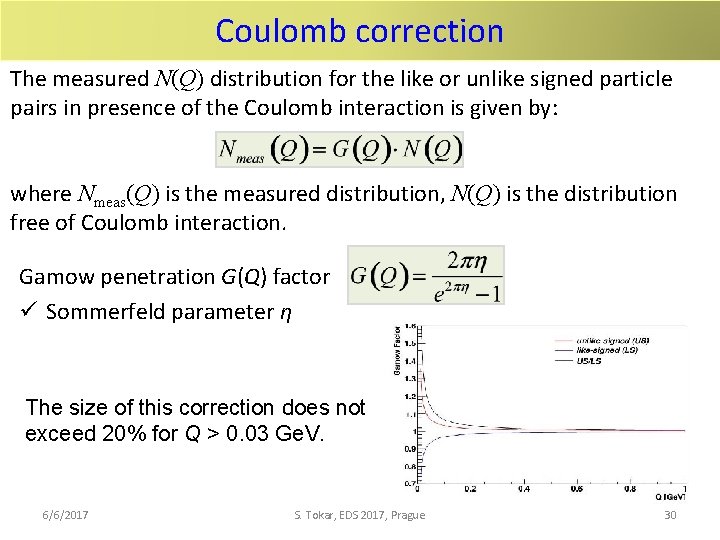
Event selection criteria + corrections q Events pass the data quality criteria : ü Minimum Bias Trigger Scintillators (at each detector end) used as a trigger ü Primary vertex (2 tracks with p. T > 100 Me. V, |η|<2. 5) § Veto to any additional vertices with ≥ 4 tracks. ü Track requirements (# of hits, cuts on and impact parameter, track fit χ2 ) ü Special event sample collected with High Multiplicity Trigger (HMT) at 7 Te. V. q Correction on trigger and vertex reconstruction efficiency ( trig, vert) § For multiplicities n ≥ 3 these corrections are close to 1. § Multiplicity unfolded to particle level q Coulomb correction for track pair measured Q-distribution: G(Q) Gamow penetration factor N(Q) distribution free of Coulomb Sommerfeld parameter (= m Q): > 0 (< 0) for like-sign (unlike-sign) pairs. The size of this correction does not exceed 20% for Q > 30 Me. V. 6/6/2017 S. Tokar, EDS 2017, Prague 17
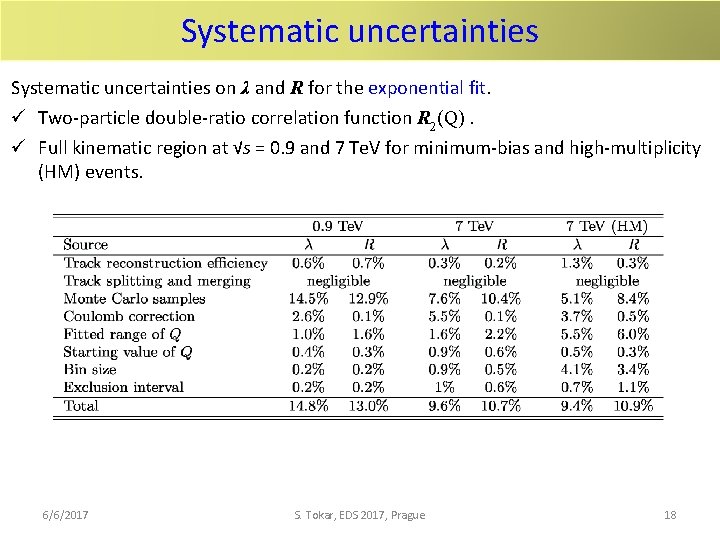
Systematic uncertainties on λ and R for the exponential fit. ü Two-particle double-ratio correlation function R 2(Q). ü Full kinematic region at √s = 0. 9 and 7 Te. V for minimum-bias and high-multiplicity (HM) events. 6/6/2017 S. Tokar, EDS 2017, Prague 18
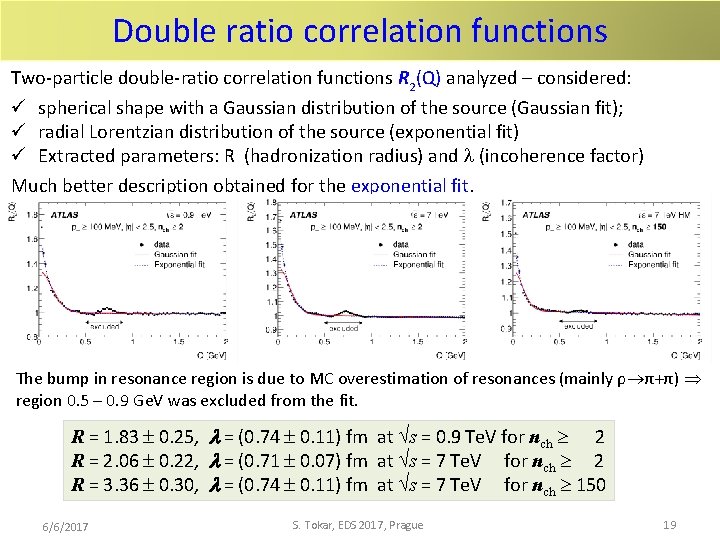
Double ratio correlation functions Two-particle double-ratio correlation functions R 2(Q) analyzed – considered: ü spherical shape with a Gaussian distribution of the source (Gaussian fit); ü radial Lorentzian distribution of the source (exponential fit) ü Extracted parameters: R (hadronization radius) and (incoherence factor) Much better description obtained for the exponential fit. The bump in resonance region is due to MC overestimation of resonances (mainly ρ π π) region 0. 5 – 0. 9 Ge. V was excluded from the fit. R = 1. 83 0. 25, = (0. 74 0. 11) fm at s = 0. 9 Te. V for nch 2 R = 2. 06 0. 22, = (0. 71 0. 07) fm at s = 7 Te. V for nch 2 R = 3. 36 0. 30, = (0. 74 0. 11) fm at s = 7 Te. V for nch 150 6/6/2017 S. Tokar, EDS 2017, Prague 19
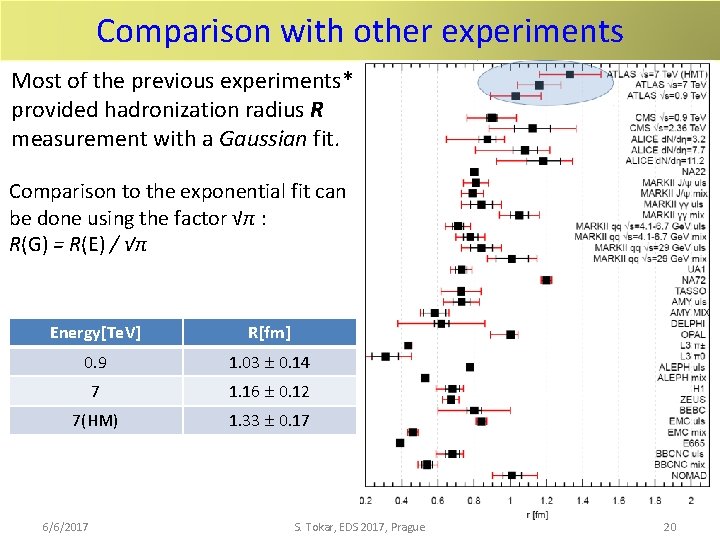
Comparison with other experiments Most of the previous experiments* provided hadronization radius R measurement with a Gaussian fit. Comparison to the exponential fit can be done using the factor √π : R(G) = R(E) / √π Energy[Te. V] R[fm] 0. 9 1. 03 0. 14 7 1. 16 0. 12 7(HM) 1. 33 0. 17 6/6/2017 S. Tokar, EDS 2017, Prague 20
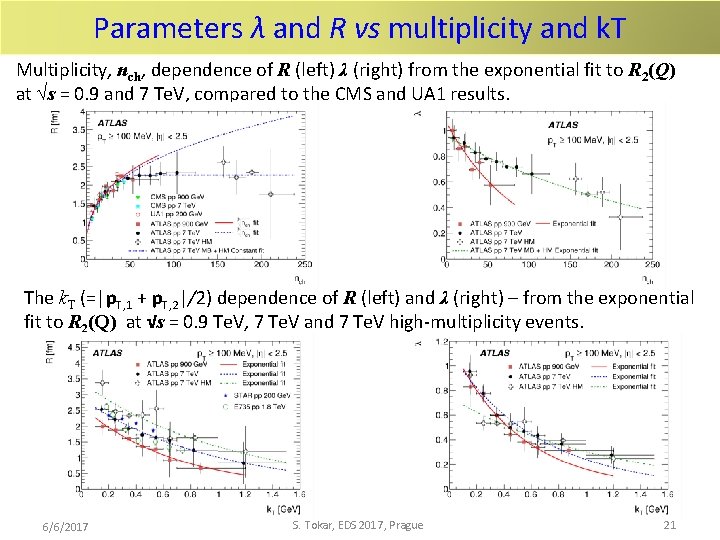
Parameters λ and R vs multiplicity and k. T Multiplicity, nch, dependence of R (left) λ (right) from the exponential fit to R 2(Q) at √s = 0. 9 and 7 Te. V, compared to the CMS and UA 1 results. The k. T (=|p. T, 1 + p. T, 2|/2) dependence of R (left) and λ (right) – from the exponential fit to R 2(Q) at √s = 0. 9 Te. V, 7 Te. V and 7 Te. V high-multiplicity events. 6/6/2017 S. Tokar, EDS 2017, Prague 21
Conclusions q Several distributions sensitive to UE measured for 13 Te. V pp collisions (region’s mean p. T and mean Nch densities with p. Tlead , . . . ) q An improvement upon previous ATLAS measurements of UE using leading-track alignment achieved. q An increase in UE activity by 20% is observed when going from 7 Te. V to 13 Te. V pp collisions. q MC generators: for most observables the models describe the UE data to < 5% accuracy, but it is greater than experimental uncertainty. q BEC of the pairs of identical charged particles measured within |η| < 2. 5 and p. T > 100 Me. V in pp collisions at 0. 9 and 7 Te. V. q Multiplicity dependence of the BEC parameters was investigated up to high multiplicities (≈ 240). A saturation effect seen in multiplicity q Dependence of the BEC parameters on track pair k. T and on particle p. T was investigated. 6/6/2017 S. Tokar, EDS 2017, Prague 22
Appendix An alternative interpretation of two-particle correlations - preliminary but yet public analysis on the hadronic chains at ATLAS: https: //atlas. web. cern. ch/Atlas/GROUPS/PHYSICS/PAPERS/STDM-2014 -08/ 6/6/2017 S. Tokar, EDS 2017, Prague 23
Back up 6/6/2017 S. Tokar, EDS 2017, Prague 24
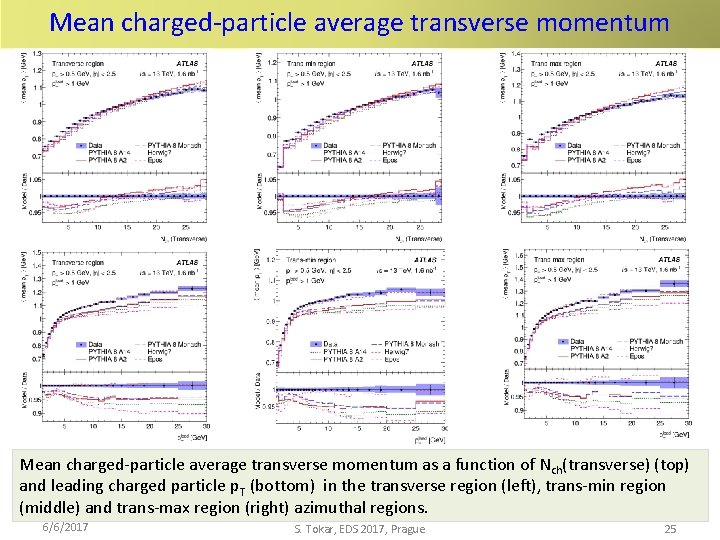
Mean charged-particle average transverse momentum as a function of Nch(transverse) (top) and leading charged particle p. T (bottom) in the transverse region (left), trans-min region (middle) and trans-max region (right) azimuthal regions. 6/6/2017 S. Tokar, EDS 2017, Prague 25
Bose-Einstein correlations in pp at 7 Te. V EPJC 75 (2015) 466 Ø Bose-Einstein correlations (BEC) represent a unique probe of the space-time characteristics of the hadronization region and allow the determination of the size and shape of the source from which particles are emitted. Ø BEC effect corresponds to an enhancement in two identical boson correlation function when the two particles are near in momentum space it is a consequence of their wave function symmetry. Ø Studies of the dependence of BEC on particle multiplicity and transverse momentum are of special interest. They help in the understanding of multiparticle production mechanisms. 6/6/2017 S. Tokar, EDS 2017, Prague 26
Sumary on parametrization models Goldhaber spherical source model (GSSg) Empirical model (GSSe). Used since it represents well the shape of the correlation ü R the source size (radius) ü the incoherence factor Quantum Optics model (QOg). Empirical model inspired to the Quantum Optics model (QOe). p is the chaoticity: = 0 (= 1) for purely coherent (chaotic) sources. 6/6/2017 S. Tokar, EDS 2017, Prague 27
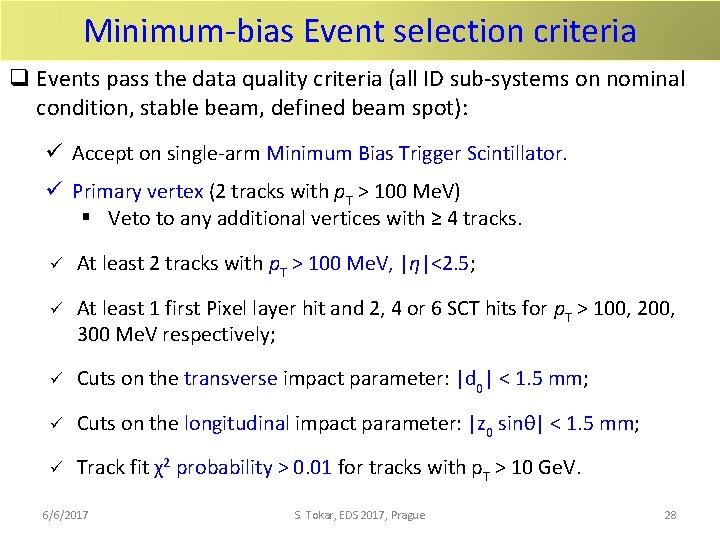
Minimum-bias Event selection criteria q Events pass the data quality criteria (all ID sub-systems on nominal condition, stable beam, defined beam spot): ü Accept on single-arm Minimum Bias Trigger Scintillator. ü Primary vertex (2 tracks with p. T > 100 Me. V) § Veto to any additional vertices with ≥ 4 tracks. ü At least 2 tracks with p. T > 100 Me. V, |η|<2. 5; ü At least 1 first Pixel layer hit and 2, 4 or 6 SCT hits for p. T > 100, 200, 300 Me. V respectively; ü Cuts on the transverse impact parameter: |d 0| < 1. 5 mm; ü Cuts on the longitudinal impact parameter: |z 0 sinθ| < 1. 5 mm; ü Track fit χ2 probability > 0. 01 for tracks with p. T > 10 Ge. V. 6/6/2017 S. Tokar, EDS 2017, Prague 28
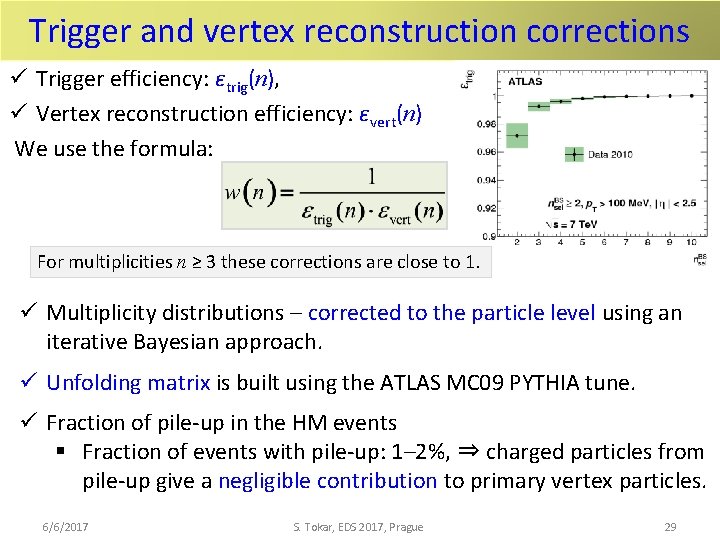
Trigger and vertex reconstruction corrections ü Trigger efficiency: εtrig(n), ü Vertex reconstruction efficiency: εvert(n) We use the formula: For multiplicities n ≥ 3 these corrections are close to 1. ü Multiplicity distributions – corrected to the particle level using an iterative Bayesian approach. ü Unfolding matrix is built using the ATLAS MC 09 PYTHIA tune. ü Fraction of pile-up in the HM events § Fraction of events with pile-up: 1– 2%, ⇒ charged particles from pile-up give a negligible contribution to primary vertex particles. 6/6/2017 S. Tokar, EDS 2017, Prague 29
Coulomb correction The measured N(Q) distribution for the like or unlike signed particle pairs in presence of the Coulomb interaction is given by: where Nmeas(Q) is the measured distribution, N(Q) is the distribution free of Coulomb interaction. Gamow penetration G(Q) factor ü Sommerfeld parameter η The size of this correction does not exceed 20% for Q > 0. 03 Ge. V. 6/6/2017 S. Tokar, EDS 2017, Prague 30