
Measurement of the Muon Charge Ratio in Cosmic

- Slides: 23
Measurement of the Muon Charge Ratio in Cosmic Ray Events with the CMS Experiment at the LHC S. Marcellini, INFN Bologna – Italy on behalf of the CMS collaboration Ricap 2011: 3° Roma International Conference on Astroparticle Physics, 25 -27 May 2011 1
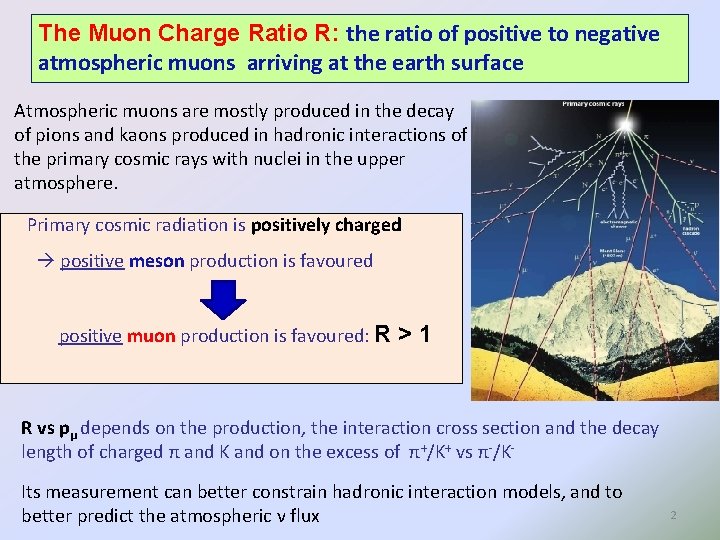
The Muon Charge Ratio R: the ratio of positive to negative atmospheric muons arriving at the earth surface Atmospheric muons are mostly produced in the decay of pions and kaons produced in hadronic interactions of the primary cosmic rays with nuclei in the upper atmosphere. Primary cosmic radiation is positively charged positive meson production is favoured positive muon production is favoured: R >1 R vs pµ depends on the production, the interaction cross section and the decay length of charged π and K and on the excess of π+/K+ vs π-/KIts measurement can better constrain hadronic interaction models, and to better predict the atmospheric ν flux 2
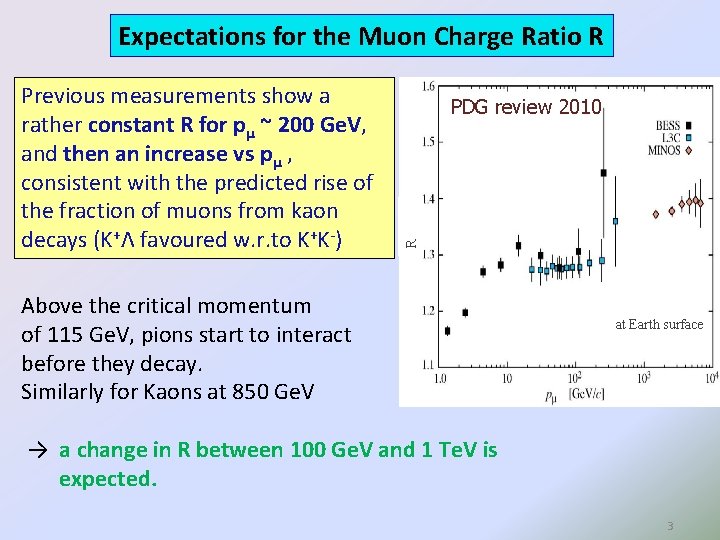
Expectations for the Muon Charge Ratio R PDG review 2010 R Previous measurements show a rather constant R for pµ ~ 200 Ge. V, and then an increase vs pµ , consistent with the predicted rise of the fraction of muons from kaon decays (K+Λ favoured w. r. to K+K-) Above the critical momentum of 115 Ge. V, pions start to interact before they decay. Similarly for Kaons at 850 Ge. V at Earth surface → a change in R between 100 Ge. V and 1 Te. V is expected. 3
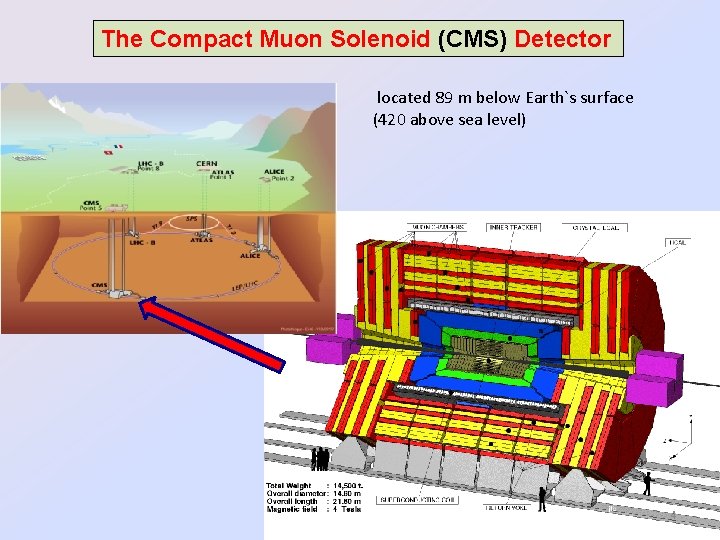
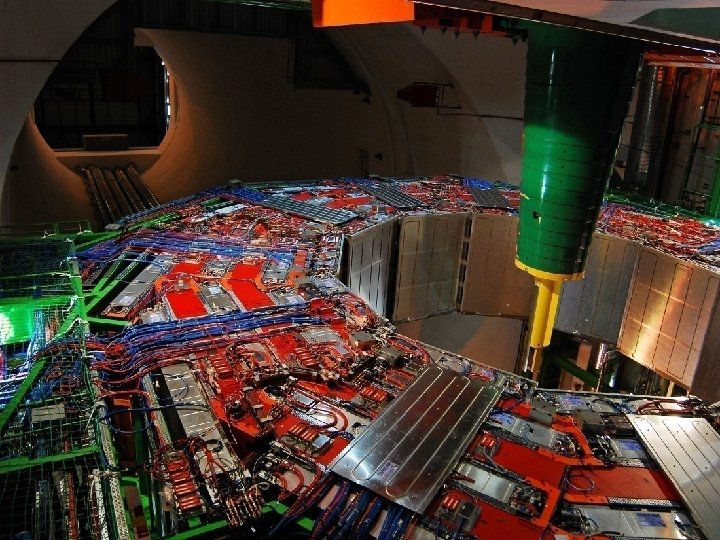
The Compact Muon Solenoid (CMS) Detector located 89 m below Earth`s surface (420 above sea level) 4
5
Measurement of the Muon Charge Ratio R Make use of the large number of cosmic ray muons collected by the CMS experiment during the commissioning of the detector. ~ 25 M events collected on earth surface ~ 270 M events collected underground Ø Using Muon Tracks Detected on Earth Surface Data collected during the detector assembly. Not the complete detector Ø Using Muon Tracks Detected Underground Two separate analyses, using two different muon samples 6
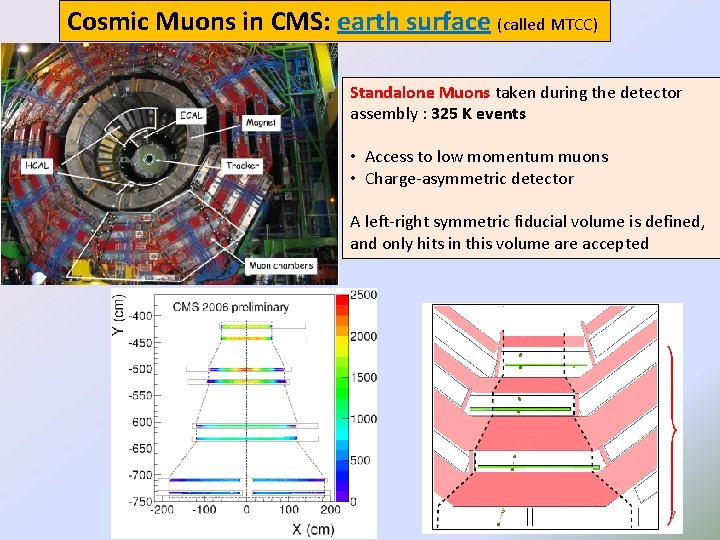
Cosmic Muons in CMS: earth surface (called MTCC) Standalone Muons taken during the detector assembly : 325 K events • Access to low momentum muons • Charge-asymmetric detector A left-right symmetric fiducial volume is defined, and only hits in this volume are accepted 7
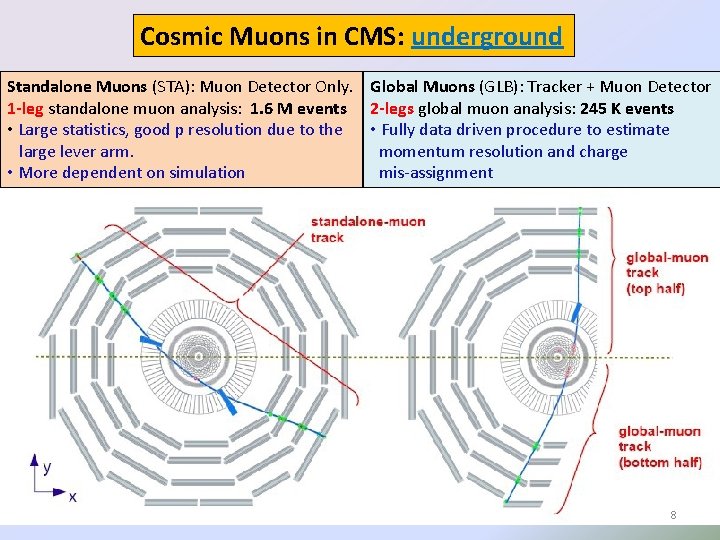
Cosmic Muons in CMS: underground Standalone Muons (STA): Muon Detector Only. Global Muons (GLB): Tracker + Muon Detector 1 -leg standalone muon analysis: 1. 6 M events 2 -legs global muon analysis: 245 K events • Large statistics, good p resolution due to the • Fully data driven procedure to estimate large lever arm. momentum resolution and charge • More dependent on simulation mis-assignment 8
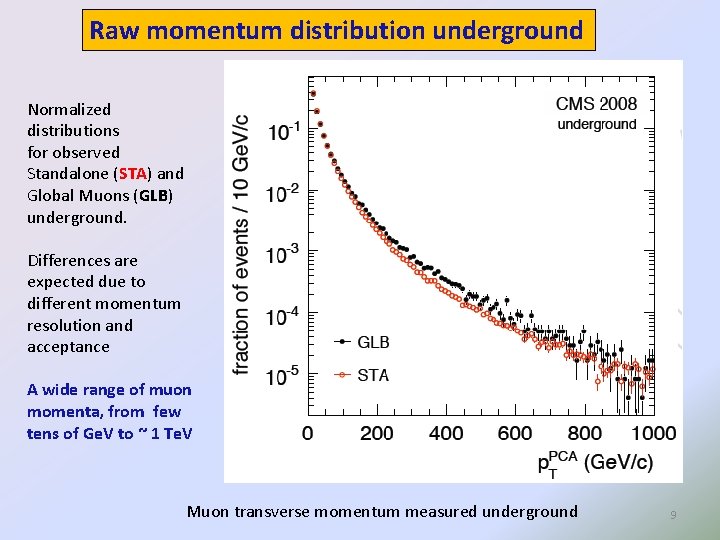
Raw momentum distribution underground Normalized distributions for observed Standalone (STA) and Global Muons (GLB) underground. Differences are expected due to different momentum resolution and acceptance A wide range of muon momenta, from few tens of Ge. V to ~ 1 Te. V Muon transverse momentum measured underground 9
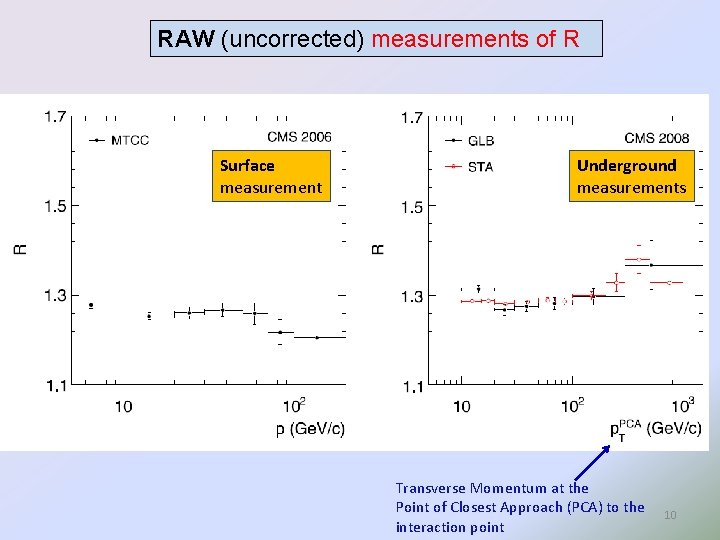
RAW (uncorrected) measurements of R Surface measurement Underground measurements Transverse Momentum at the Point of Closest Approach (PCA) to the interaction point 10
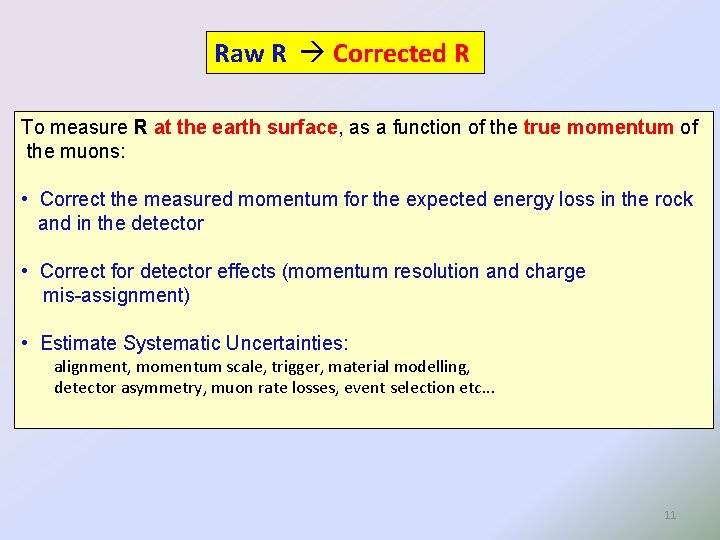
Raw R Corrected R To measure R at the earth surface, as a function of the true momentum of the muons: • Correct the measured momentum for the expected energy loss in the rock and in the detector • Correct for detector effects (momentum resolution and charge mis-assignment) • Estimate Systematic Uncertainties: alignment, momentum scale, trigger, material modelling, detector asymmetry, muon rate losses, event selection etc. . . 11
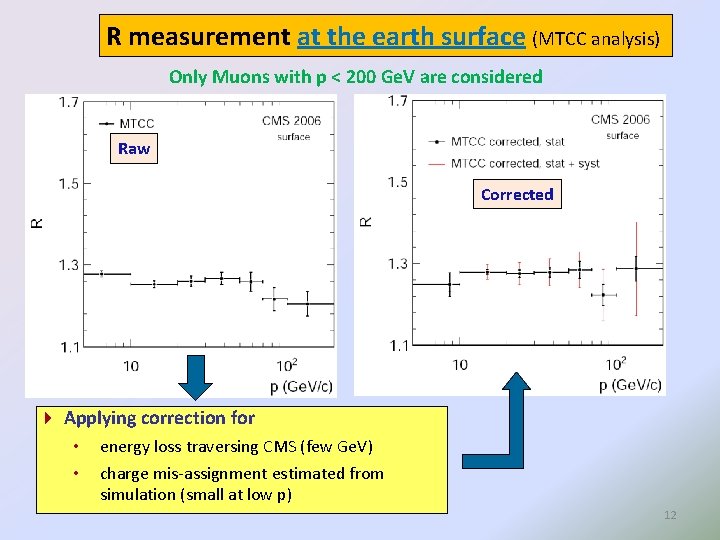
R measurement at the earth surface (MTCC analysis) Only Muons with p < 200 Ge. V are considered Raw Corrected Applying correction for • • energy loss traversing CMS (few Ge. V) charge mis-assignment estimated from simulation (small at low p) 12
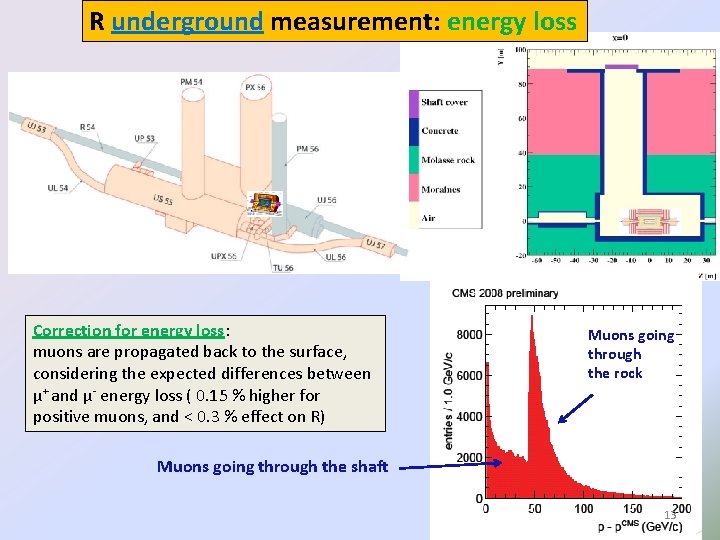
R underground measurement: energy loss Correction for energy loss: muons are propagated back to the surface, considering the expected differences between µ+ and µ- energy loss ( 0. 15 % higher for positive muons, and < 0. 3 % effect on R) Muons going through the rock Muons going through the shaft 13
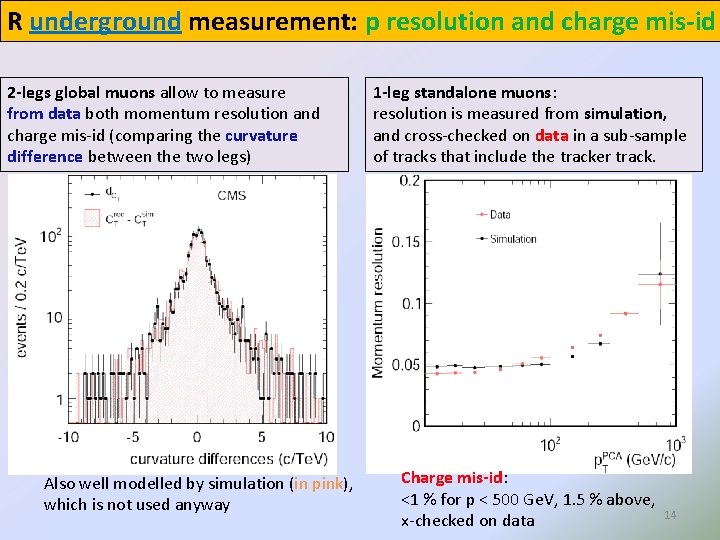
R underground measurement: p resolution and charge mis-id 2 -legs global muons allow to measure from data both momentum resolution and charge mis-id (comparing the curvature difference between the two legs) Also well modelled by simulation (in pink), which is not used anyway 1 -leg standalone muons: resolution is measured from simulation, and cross-checked on data in a sub-sample of tracks that include the tracker track. Charge mis-id: <1 % for p < 500 Ge. V, 1. 5 % above, x-checked on data 14
An unfolding technique is used to go from the measured momentum to the true momentum, after the tracks are propagated to the earth surface A resolution matrix Mij is built, in q/p bins, from data for Global Muons, and from simulation for Standalone Muons. The momentum binning was chosen to keep the spill-over between bins < 15 %. 15
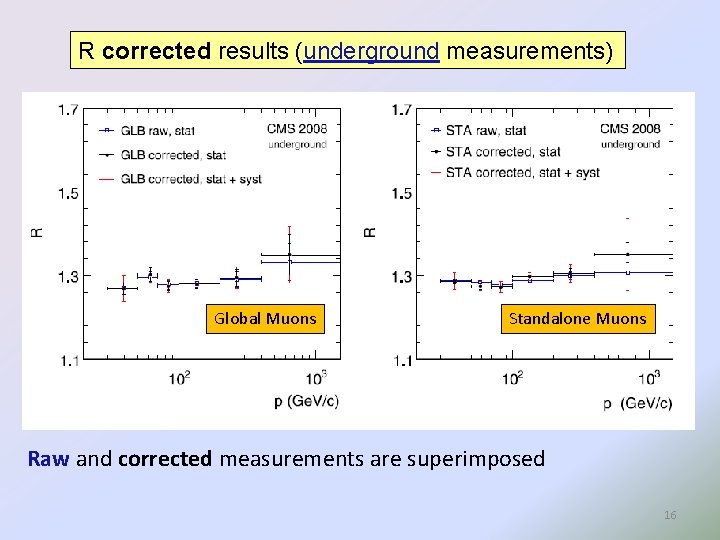
R corrected results (underground measurements) Global Muons Standalone Muons Raw and corrected measurements are superimposed 16
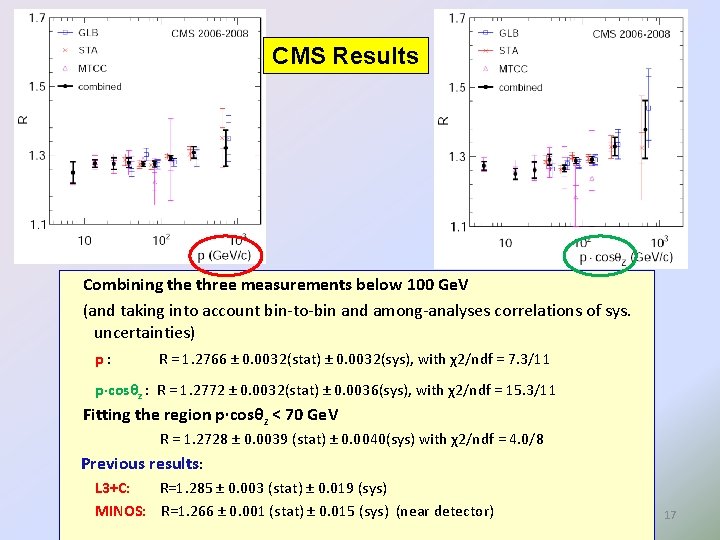
CMS Results Combining the three measurements below 100 Ge. V (and taking into account bin-to-bin and among-analyses correlations of sys. uncertainties) p: R = 1. 2766 ± 0. 0032(stat) ± 0. 0032(sys), with χ2/ndf = 7. 3/11 p·cosθz : R = 1. 2772 ± 0. 0032(stat) ± 0. 0036(sys), with χ2/ndf = 15. 3/11 Fitting the region p·cosθz < 70 Ge. V R = 1. 2728 ± 0. 0039 (stat) ± 0. 0040(sys) with χ2/ndf = 4. 0/8 Previous results: L 3+C: R=1. 285 ± 0. 003 (stat) ± 0. 019 (sys) MINOS: R=1. 266 ± 0. 001 (stat) ± 0. 015 (sys) (near detector) 17
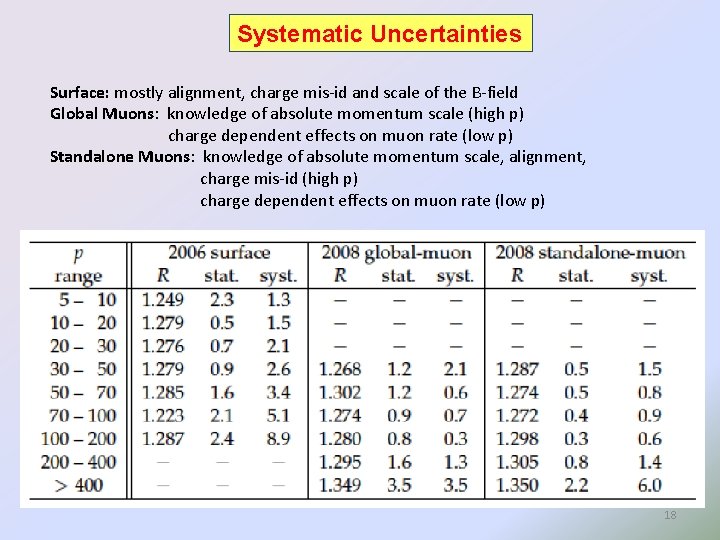
Systematic Uncertainties Surface: mostly alignment, charge mis-id and scale of the B-field Global Muons: knowledge of absolute momentum scale (high p) charge dependent effects on muon rate (low p) Standalone Muons: knowledge of absolute momentum scale, alignment, charge mis-id (high p) charge dependent effects on muon rate (low p) 18
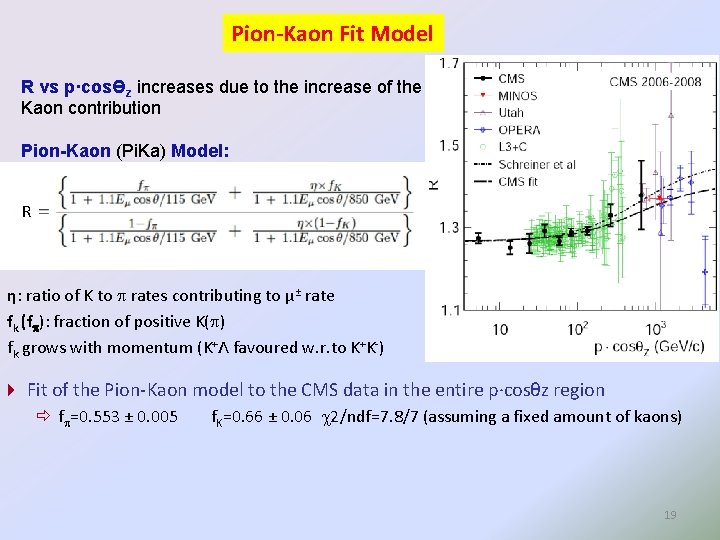
Pion-Kaon Fit Model R vs p·cosƟz increases due to the increase of the Kaon contribution Pion-Kaon (Pi. Ka) Model: R η: ratio of K to p rates contributing to μ± rate fk (fp): fraction of positive K(p) fk grows with momentum (K+Λ favoured w. r. to K+K-) Fit of the Pion-Kaon model to the CMS data in the entire p·cosθz region fp=0. 553 ± 0. 005 f. K=0. 66 ± 0. 06 c 2/ndf=7. 8/7 (assuming a fixed amount of kaons) 19
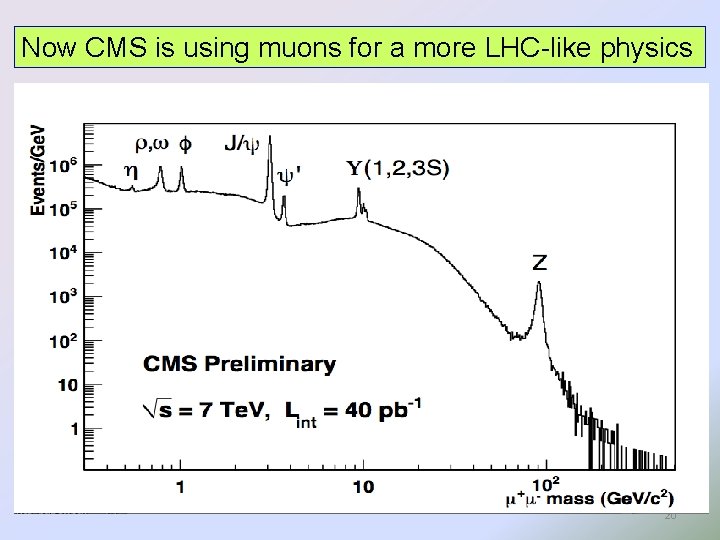
Now CMS is using muons for a more LHC-like physics 20
Back-up Slides 21
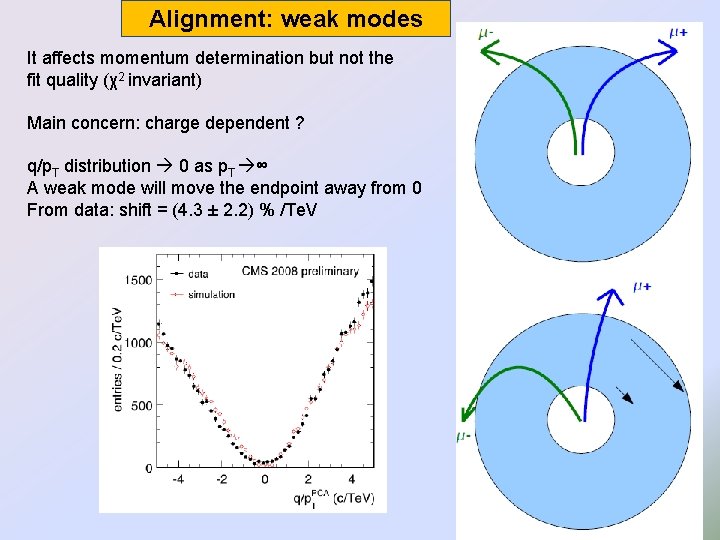
Alignment: weak modes It affects momentum determination but not the fit quality (χ2 invariant) Main concern: charge dependent ? q/p. T distribution 0 as p. T ∞ A weak mode will move the endpoint away from 0 From data: shift = (4. 3 ± 2. 2) % /Te. V 22
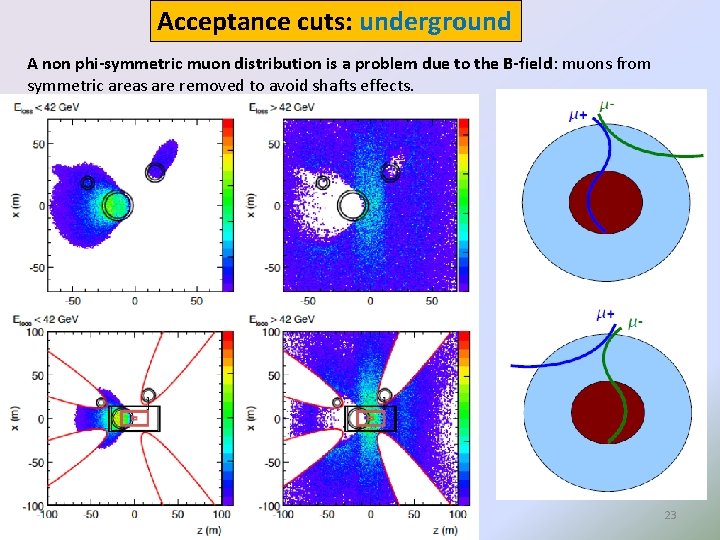
Acceptance cuts: underground A non phi-symmetric muon distribution is a problem due to the B-field: muons from symmetric areas are removed to avoid shafts effects. 23