
Measurement of the CP parameters in Bs Ds
Measurement of the CP parameters in Bs Ds. K and first observations of B(s)0 Ds. Kpp Steven Blusk Syracuse University on behalf of the LHCb Collaboration Time dependent Bs Ds. K analysis First observations of Bs Ds. Kpp and B 0 Ds. Kpp CKM Workshop, University of Cincinnati, Ohio, Sept 28 – Oct 2, 2012 1
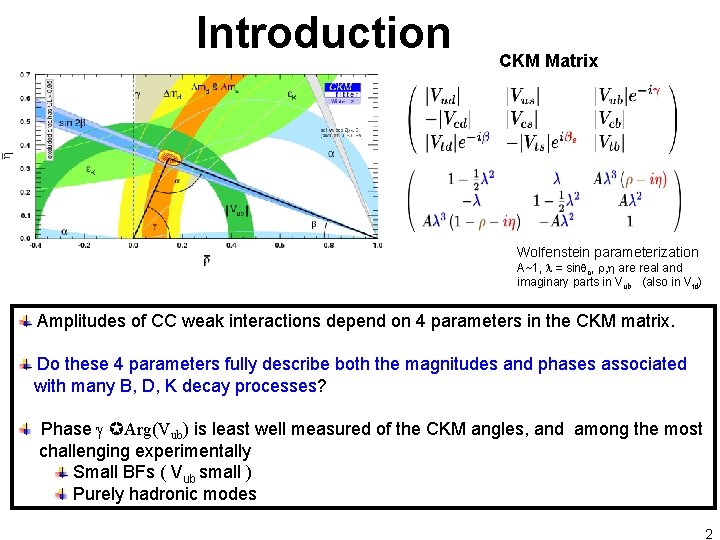
Introduction CKM Matrix Wolfenstein parameterization A~1, l = sinqc, r, h are real and imaginary parts in Vub (also in Vtd) Amplitudes of CC weak interactions depend on 4 parameters in the CKM matrix. Do these 4 parameters fully describe both the magnitudes and phases associated with many B, D, K decay processes? Phase g Arg(Vub) is least well measured of the CKM angles, and among the most challenging experimentally Small BFs ( Vub small ) Purely hadronic modes 2
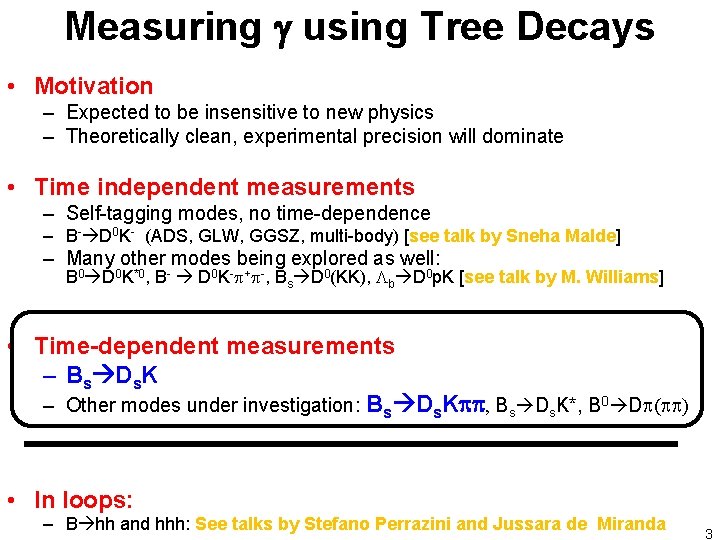
Measuring g using Tree Decays • Motivation – Expected to be insensitive to new physics – Theoretically clean, experimental precision will dominate • Time independent measurements – Self-tagging modes, no time-dependence – B- D 0 K- (ADS, GLW, GGSZ, multi-body) [see talk by Sneha Malde] – Many other modes being explored as well: B 0 D 0 K*0, B- D 0 K-p+p-, Bs D 0(KK), Lb D 0 p. K [see talk by M. Williams] • Time-dependent measurements – Bs Ds. K – Other modes under investigation: Bs Ds. Kpp, Bs Ds. K*, B 0 Dp(pp) • In loops: – B hh and hhh: See talks by Stefano Perrazini and Jussara de Miranda 3
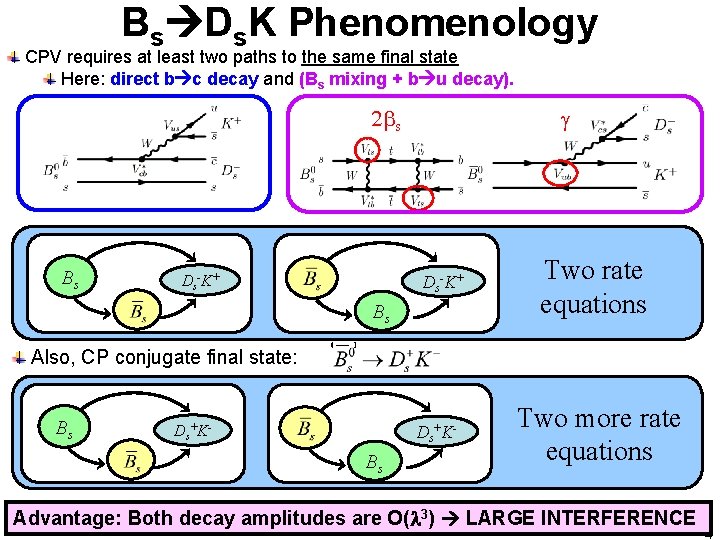
Bs Ds. K Phenomenology CPV requires at least two paths to the same final state Here: direct b c decay and (Bs mixing + b u decay). 2 bs Bs Ds-K+ g Ds- K + Bs Also, CP conjugate final state: Bs ( Two rate equations ) Ds + K - Ds+K- Bs Two more rate equations Advantage: Both decay amplitudes are O(l 3) LARGE INTERFERENCE 4
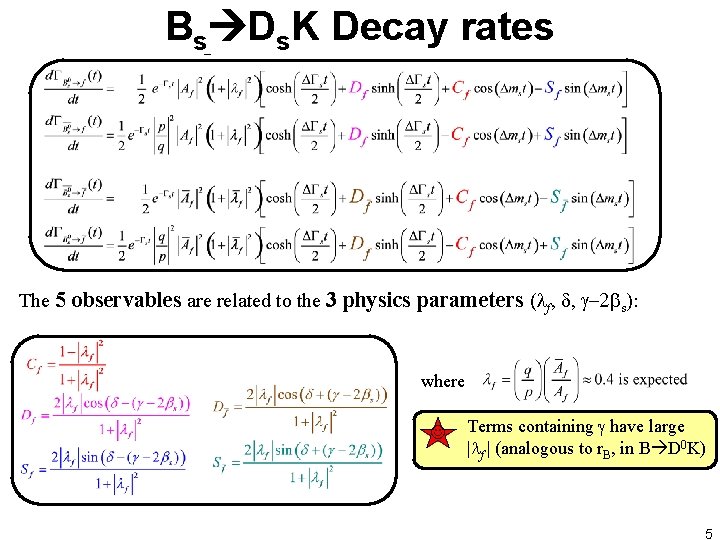
Bs Ds. K Decay rates The 5 observables are related to the 3 physics parameters (lf, d, g-2 bs): where Terms containing g have large |lf | (analogous to r. B, in B D 0 K) 5
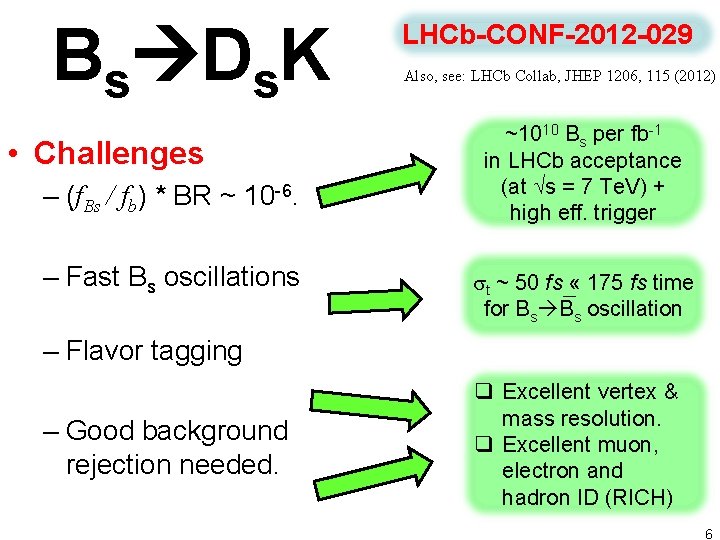
Bs Ds. K • Challenges – (f. Bs / fb) * BR ~ 10 -6. – Fast Bs oscillations LHCb-CONF-2012 -029 Also, see: LHCb Collab, JHEP 1206, 115 (2012) ~1010 Bs per fb-1 in LHCb acceptance (at s = 7 Te. V) + high eff. trigger st ~ 50 fs « 175 fs time for Bs Bs oscillation – Flavor tagging – Good background rejection needed. q Excellent vertex & mass resolution. q Excellent muon, electron and hadron ID (RICH) 6
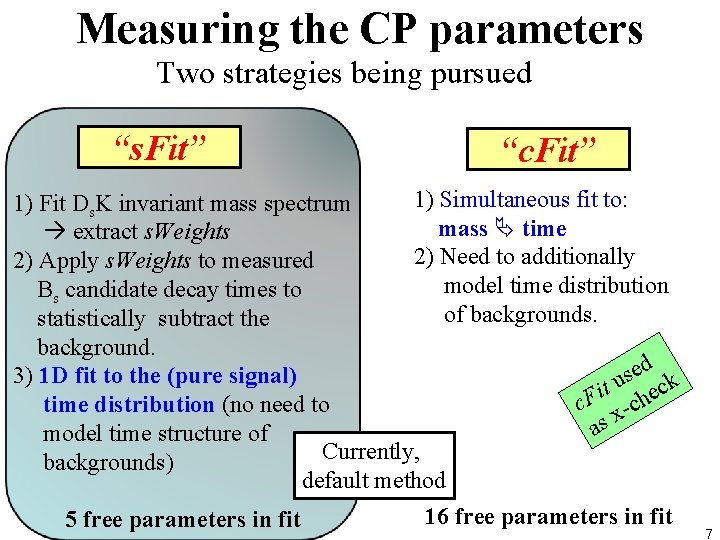
Measuring the CP parameters Two strategies being pursued “s. Fit” “c. Fit” 1) Simultaneous fit to: 1) Fit Ds. K invariant mass spectrum mass time extract s. Weights 2) Need to additionally 2) Apply s. Weights to measured model time distribution Bs candidate decay times to of backgrounds. statistically subtract the background. d e s 3) 1 D fit to the (pure signal) u ck t i c. F x-che time distribution (no need to as model time structure of Currently, backgrounds) default method 16 free parameters in fit 5 free parameters in fit 7
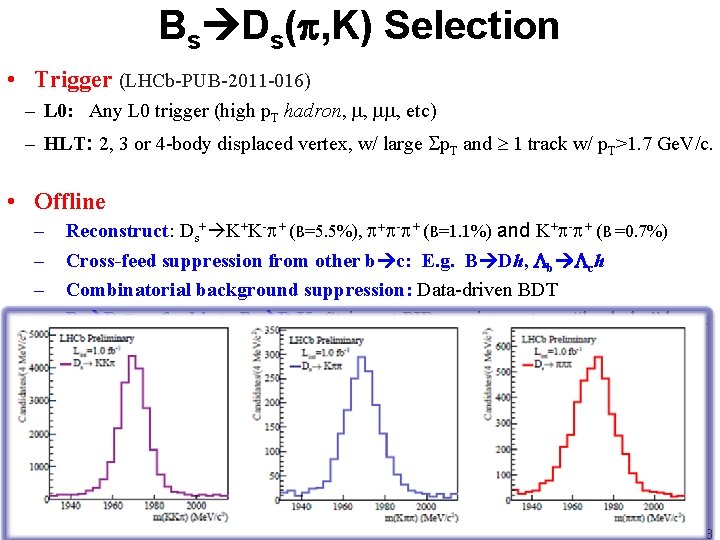
Bs Ds(p, K) Selection • Trigger (LHCb-PUB-2011 -016) – L 0: Any L 0 trigger (high p. T hadron, m, mm, etc) – HLT: 2, 3 or 4 -body displaced vertex, w/ large Sp. T and 1 track w/ p. T>1. 7 Ge. V/c. • Offline – – – Reconstruct: Ds+ K+K-p+ (B=5. 5%), p+p-p+ (B=1. 1%) and K+p-p+ (B =0. 7%) Cross-feed suppression from other b c: E. g. B Dh, Lb Lch Combinatorial background suppression: Data-driven BDT Bs Dsp x-feed into Bs Ds. K: Stringent PID requirements on “bachelor” kaon. Charmless: Require Ds to be significantly displaced from Bs decay point. • Ds mass sidebands show remaining charmless background negligible. 8
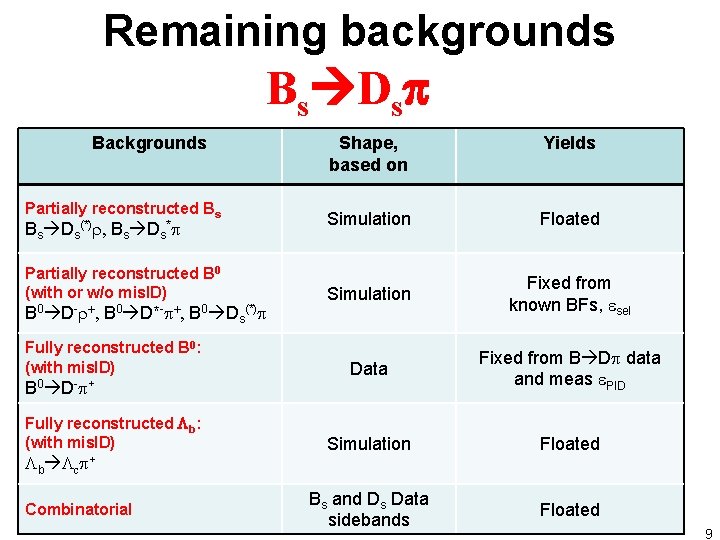
Remaining backgrounds Bs Dsp Backgrounds Shape, based on Yields Simulation Floated Simulation Fixed from known BFs, esel Fully reconstructed B 0: (with mis. ID) Data Fixed from B Dp data and meas e. PID Fully reconstructed Lb: (with mis. ID) Simulation Floated Bs and Ds Data sidebands Floated Partially reconstructed Bs Bs Ds(*)r, Bs Ds*p Partially reconstructed B 0 (with or w/o mis. ID) B 0 D-r+, B 0 D*-p+, B 0 Ds(*)p B 0 D-p+ Lb Lcp+ Combinatorial 9
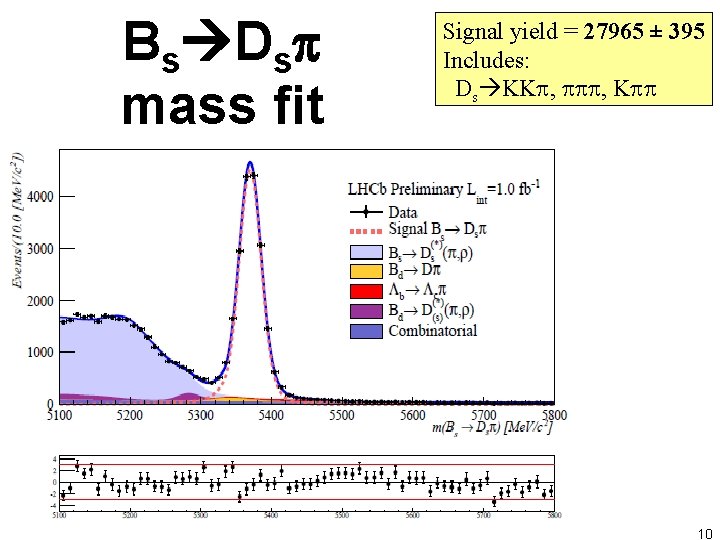
Bs Dsp mass fit Signal yield = 27965 ± 395 Includes: Ds KKp, ppp, Kpp 10
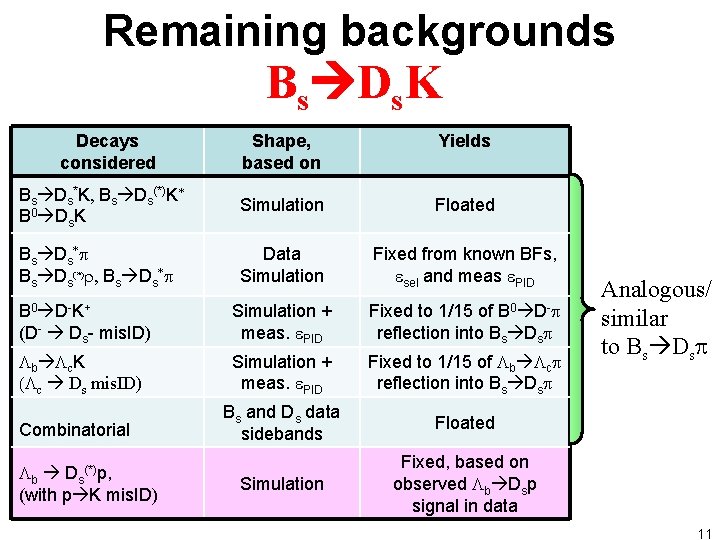
Remaining backgrounds Bs Ds. K Decays considered Shape, based on Yields Bs Ds*K, Bs Ds(*)K* B 0 Ds. K Simulation Floated Bs Ds*p Bs Ds(*)r, Bs Ds*p Data Simulation Fixed from known BFs, esel and meas e. PID B 0 D-K+ B 0 D-p (D- Ds- mis. ID) Simulation + meas. e. PID Fixed to 1/15 of reflection into Bs Dsp Lb Lc. K (Lc Ds mis. ID) Simulation + meas. e. PID Fixed to 1/15 of Lb Lcp reflection into Bs Dsp Bs and Ds data sidebands Floated Simulation Fixed, based on observed Lb Dsp signal in data Combinatorial Lb Ds(*)p, (with p K mis. ID) Analogous/ similar to Bs Dsp 11
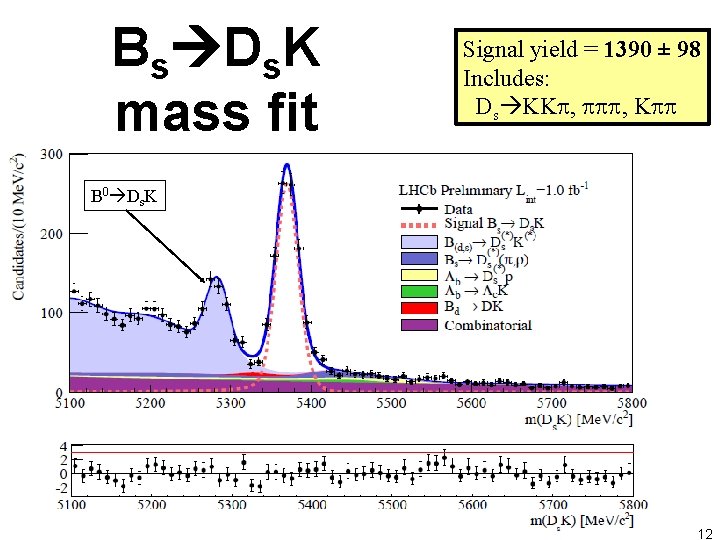
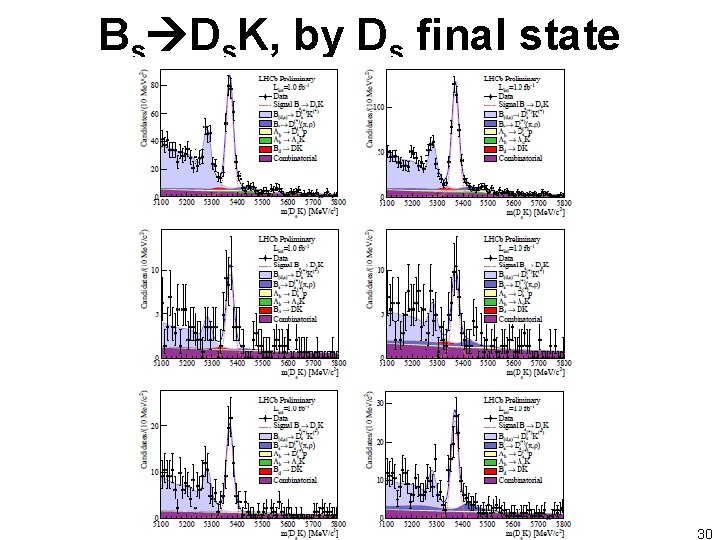
Bs Ds. K mass fit Signal yield = 1390 ± 98 Includes: Ds KKp, ppp, Kpp B 0 Ds. K 12
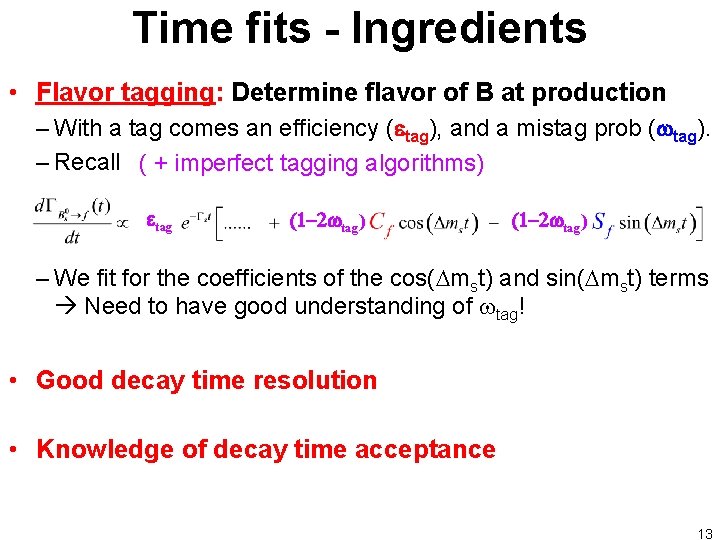
Time fits - Ingredients • Flavor tagging: Determine flavor of B at production – With a tag comes an efficiency (etag), and a mistag prob (wtag). – Recall ( + imperfect tagging algorithms) etag (1 -2 wtag) – We fit for the coefficients of the cos(Dmst) and sin(Dmst) terms Need to have good understanding of wtag! • Good decay time resolution • Knowledge of decay time acceptance 13
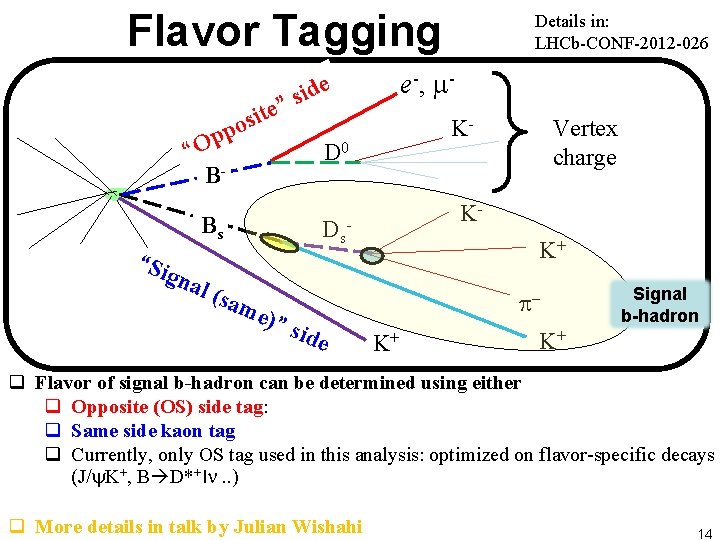
Flavor Tagging p p O “ ” e t i os BBs “Si gna e -, m - e sid K- D 0 am e)” side Vertex charge K- D s- l (s Details in: LHCb-CONF-2012 -026 K+ p. K+ Signal b-hadron K+ q Flavor of signal b-hadron can be determined using either q Opposite (OS) side tag: q Same side kaon tag q Currently, only OS tag used in this analysis: optimized on flavor-specific decays (J/y. K+, B D*+ln. . ) q More details in talk by Julian Wishahi 14
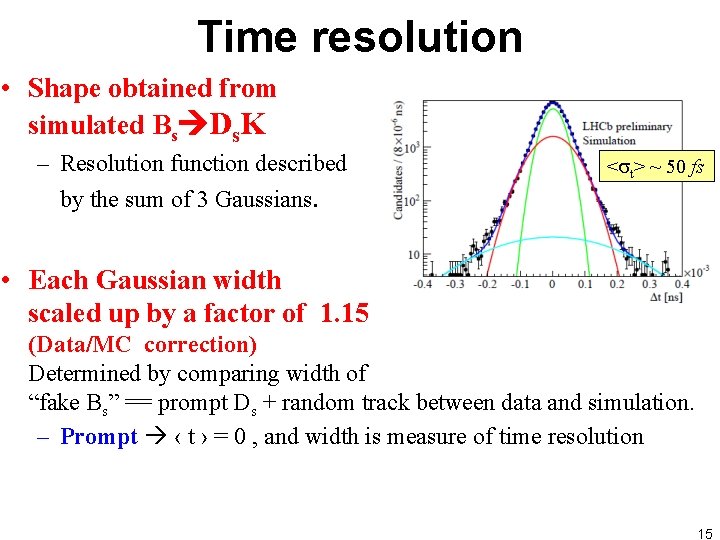
Time resolution • Shape obtained from simulated Bs Ds. K – Resolution function described by the sum of 3 Gaussians. <st> ~ 50 fs • Each Gaussian width scaled up by a factor of 1. 15 (Data/MC correction) Determined by comparing width of “fake Bs” == prompt Ds + random track between data and simulation. – Prompt ‹ t › = 0 , and width is measure of time resolution 15
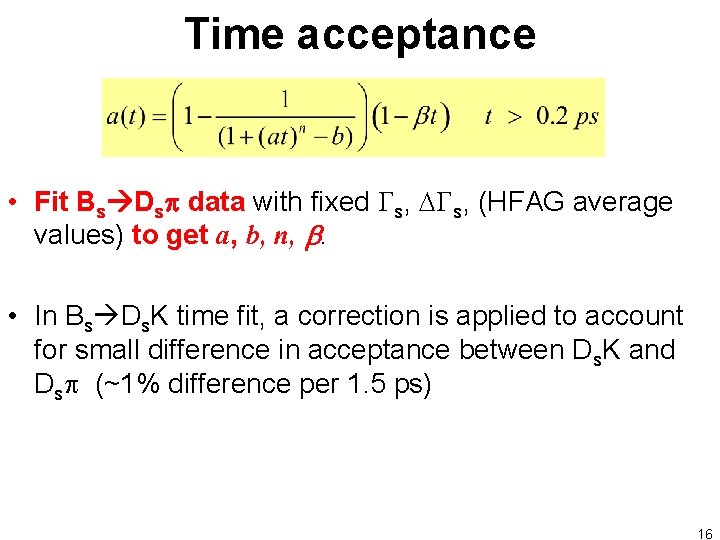
Time acceptance • Fit Bs Dsp data with fixed Gs, DGs, (HFAG average values) to get a, b, n, b. • In Bs Ds. K time fit, a correction is applied to account for small difference in acceptance between Ds. K and Dsp (~1% difference per 1. 5 ps) 16
Reconstruction effects on flavor-tagged Bs Dsp (toy) Assuming 80, 000 reconstructed Bs Dsp. 17
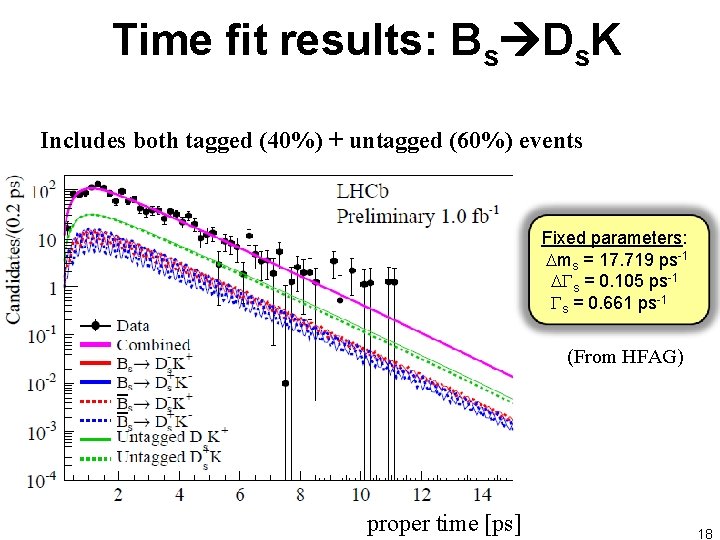
Time fit results: Bs Ds. K Includes both tagged (40%) + untagged (60%) events Fixed parameters: Dms = 17. 719 ps-1 DGs = 0. 105 ps-1 Gs = 0. 661 ps-1 (From HFAG) proper time [ps] 18
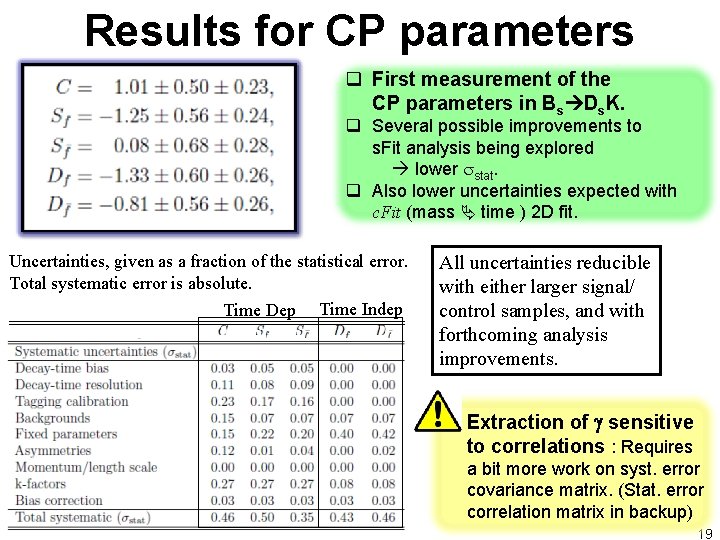
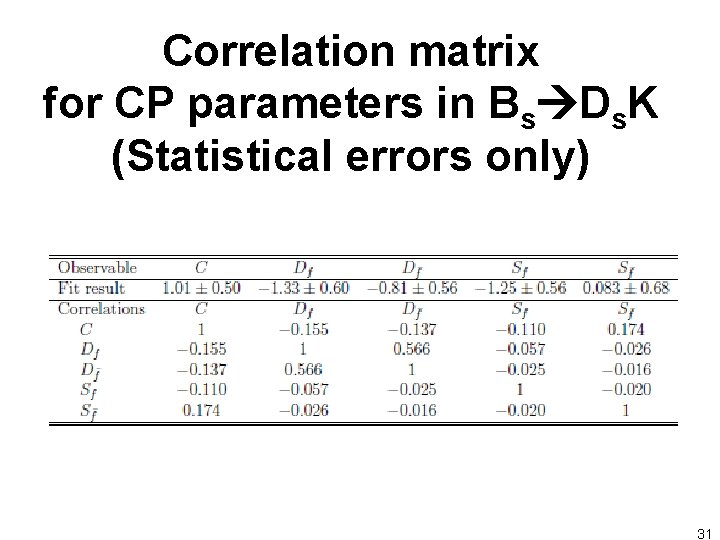
Results for CP parameters q First measurement of the CP parameters in Bs Ds. K. q Several possible improvements to s. Fit analysis being explored lower sstat. q Also lower uncertainties expected with c. Fit (mass time ) 2 D fit. Uncertainties, given as a fraction of the statistical error. Total systematic error is absolute. Time Dep Time Indep All uncertainties reducible with either larger signal/ control samples, and with forthcoming analysis improvements. q Extraction of g sensitive to correlations : Requires a bit more work on syst. error covariance matrix. (Stat. error correlation matrix in backup) 19
First observations of + + 0 + + Bs Ds K p p and B Ds K p p LHCb-PAPER-2012 -033 20
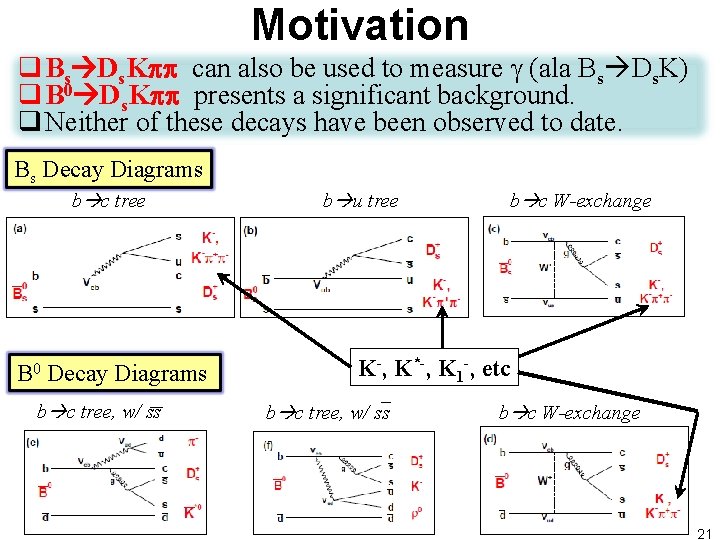
Motivation q Bs Ds. Kpp can also be used to measure g (ala Bs Ds. K) q B 0 Ds. Kpp presents a significant background. q Neither of these decays have been observed to date. Bs Decay Diagrams b c tree B 0 Decay Diagrams b c tree, w/ ss b u tree b c W-exchange K-, K*-, K 1 -, etc b c tree, w/ ss b c W-exchange 21
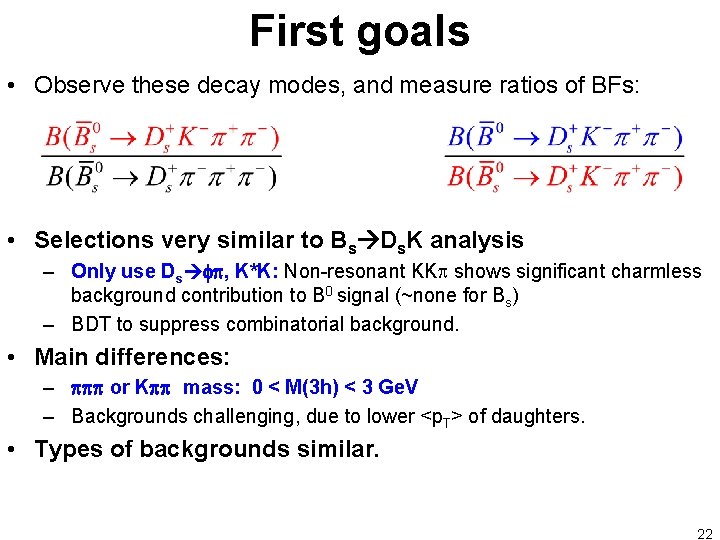
First goals • Observe these decay modes, and measure ratios of BFs: • Selections very similar to Bs Ds. K analysis – Only use Ds fp, K*K: Non-resonant KKp shows significant charmless background contribution to B 0 signal (~none for Bs) – BDT to suppress combinatorial background. • Main differences: – ppp or Kpp mass: 0 < M(3 h) < 3 Ge. V – Backgrounds challenging, due to lower <p. T> of daughters. • Types of backgrounds similar. 22
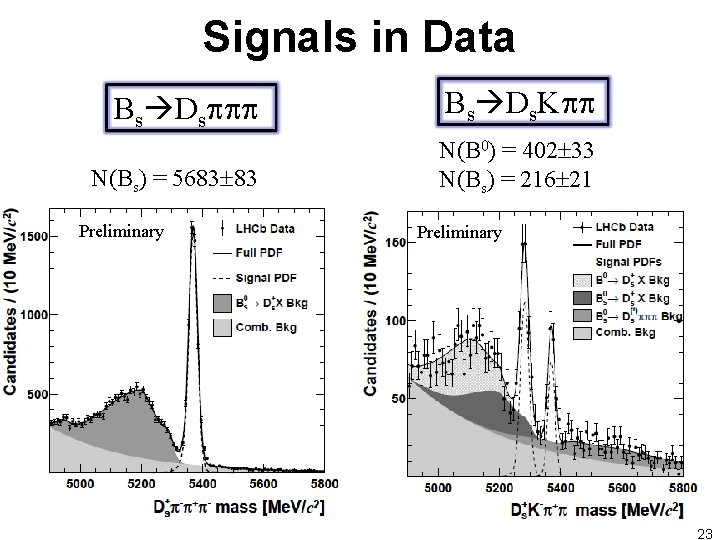
Signals in Data Bs Dsppp Bs Ds. Kpp N(Bs) = 5683 83 N(B 0) = 402 33 N(Bs) = 216 21 Preliminary 23
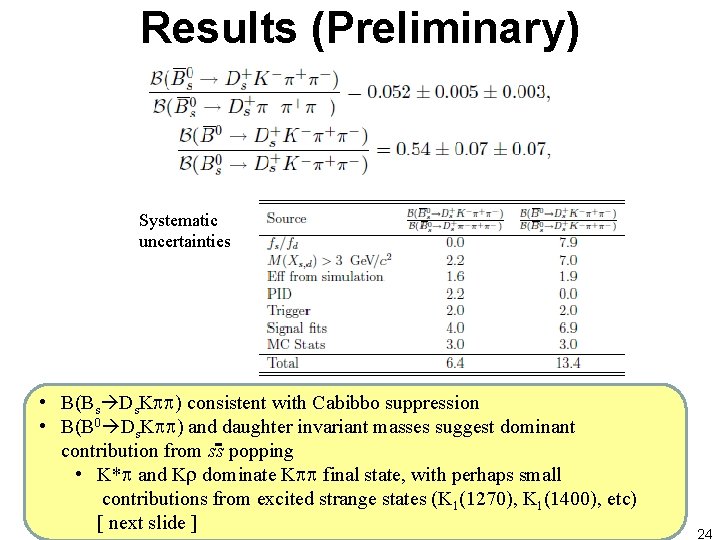
Results (Preliminary) Systematic uncertainties • B(Bs Ds. Kpp) consistent with Cabibbo suppression • B(B 0 Ds. Kpp) and daughter invariant masses suggest dominant contribution from ss popping • K*p and Kr dominate Kpp final state, with perhaps small contributions from excited strange states (K 1(1270), K 1(1400), etc) [ next slide ] 24
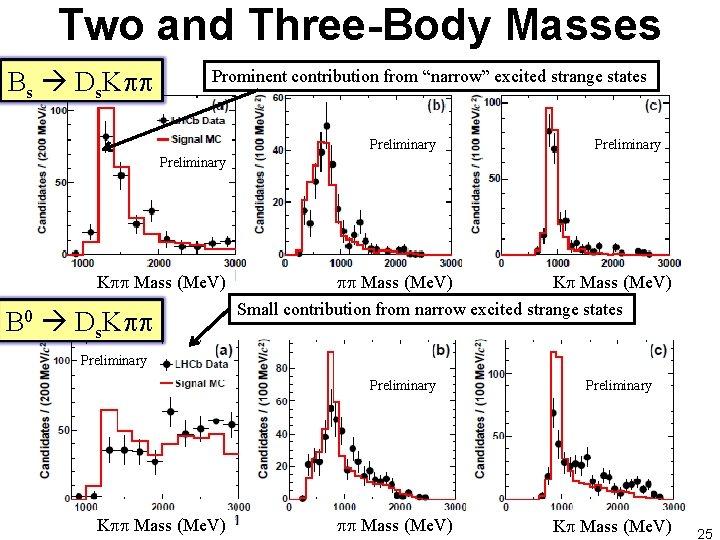
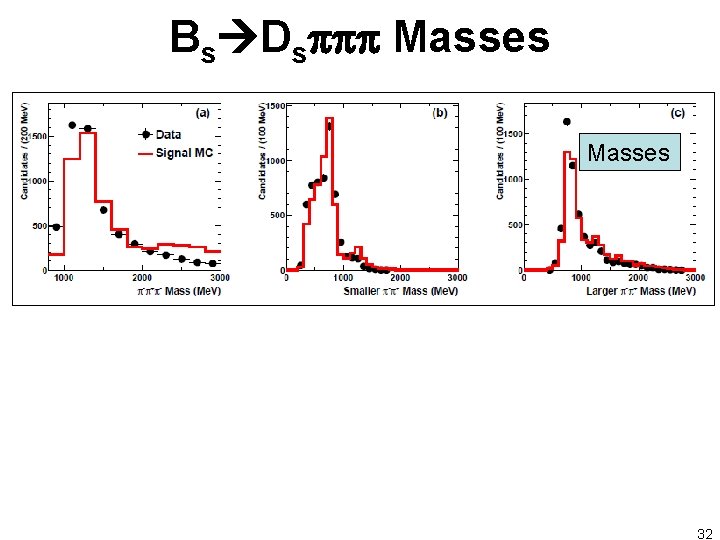
Two and Three-Body Masses Bs Ds. Kpp Prominent contribution from “narrow” excited strange states Preliminary Kpp Mass (Me. V) B 0 Ds. Kpp pp Mass (Me. V) Kp Mass (Me. V) Small contribution from narrow excited strange states Preliminary Kpp Mass (Me. V) Preliminary Kp Mass (Me. V) 25
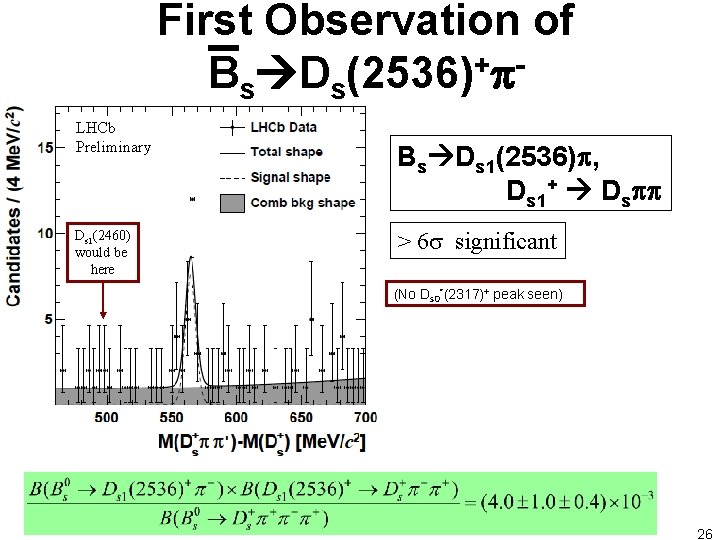
First Observation of Bs Ds(2536)+p. LHCb Preliminary Ds 1(2460) would be here Bs Ds 1(2536)p, Ds 1+ Dspp > 6 s significant (No Ds 0*(2317)+ peak seen) 26
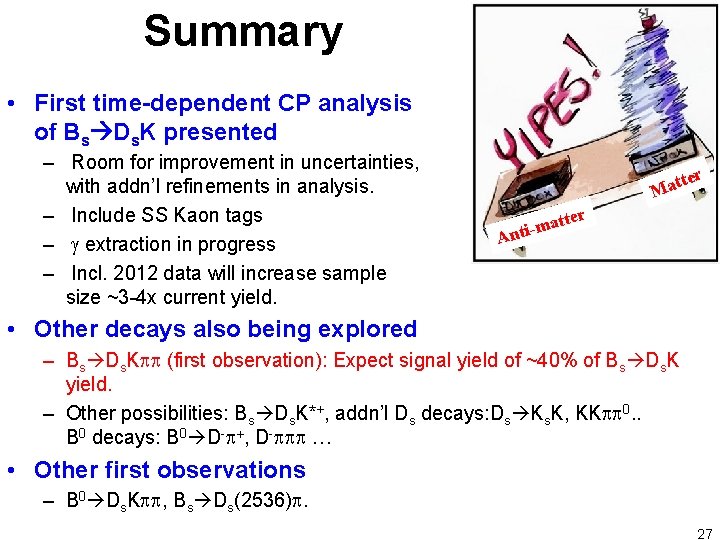
Summary • First time-dependent CP analysis of Bs Ds. K presented – Room for improvement in uncertainties, with addn’l refinements in analysis. – Include SS Kaon tags – g extraction in progress – Incl. 2012 data will increase sample size ~3 -4 x current yield. r tte a M ter A at m i t n • Other decays also being explored – Bs Ds. Kpp (first observation): Expect signal yield of ~40% of Bs Ds. K yield. – Other possibilities: Bs Ds. K*+, addn’l Ds decays: Ds Ks. K, KKpp 0. . B 0 decays: B 0 D-p+, D-ppp … • Other first observations – B 0 Ds. Kpp, Bs Ds(2536)p. 27
Summary • First time-dependent CP analysis of Bs Ds. K presented • – Room for improvement in uncertainties, with addn’l d n a refinements in analysis. s r e z i – Include SS Kaon tags n a g r o – g extraction in progress e s h r t i a to sample – Incl. 2012 data willsincrease h c size ~ 3 x current yield. k n n o i a s Other decays also ebeing explored h t s y s n a – Bs. M Ds. Kpp (first observation): Expect signal yield of ~40% of Bs Ds. K yield. – Other possibilities: Bs Ds. K*+, addn’l Ds decays: Ds Ks. K, KKpp 0. . B 0 decays: B 0 D-p+, D-ppp … • First observations: – B 0 Ds. Kpp, Bs Ds(2536)p. 28

Backup 29
Bs Ds. K, by Ds final state 30
Correlation matrix for CP parameters in Bs Ds. K (Statistical errors only) 31
Bs Dsppp Masses 32
- Slides: 32