
Measurement of surface radioactivity by AlphaBeta detection Pia
Measurement of surface radioactivity by Alpha/Beta detection Pia Loaiza LRT 2017, Seoul May 2017 Surface Alpha/Beta screening LRT 2017
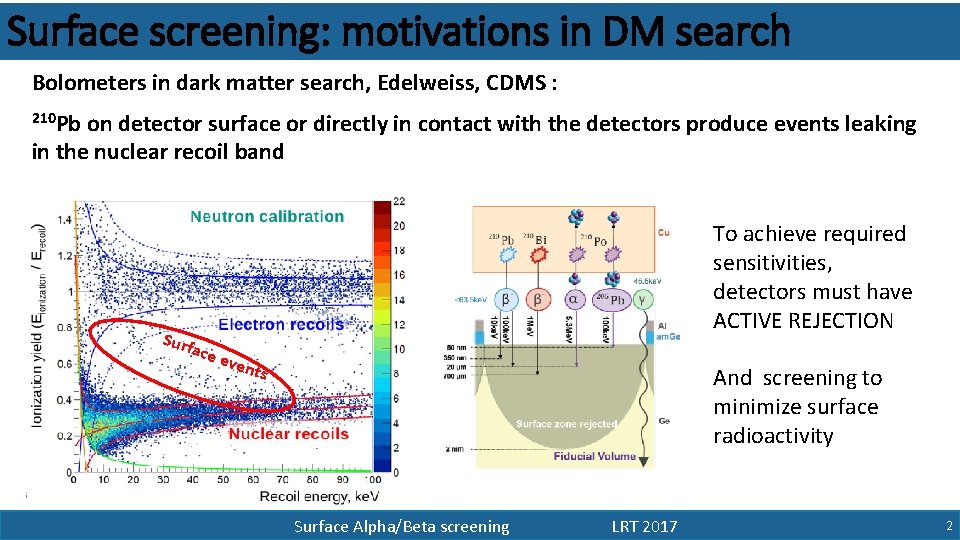
Surface screening: motivations in DM search Bolometers in dark matter search, Edelweiss, CDMS : 210 Pb on detector surface or directly in contact with the detectors produce events leaking in the nuclear recoil band Surf To achieve required sensitivities, detectors must have ACTIVE REJECTION ace even ts And screening to minimize surface radioactivity Surface Alpha/Beta screening LRT 2017 2
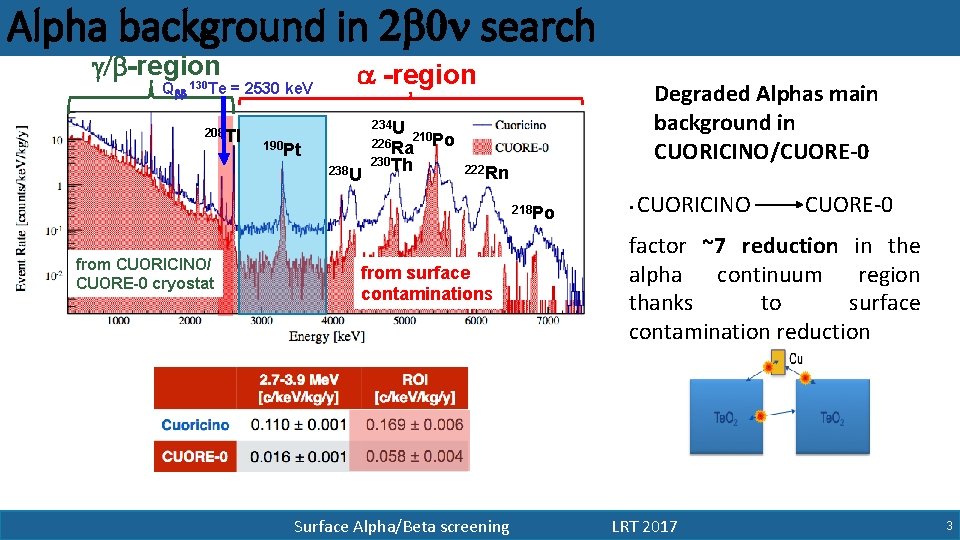
Alpha background in 2 b 0 n search g/b-region Qbb 130 Te = 2530 ke. V 208 Tl a -region Degraded Alphas main background in CUORICINO/CUORE-0 234 U 210 Po 226 Ra 190 Pt 238 U 230 Th 222 Rn 218 Po from CUORICINO/ CUORE-0 cryostat from surface contaminations Surface Alpha/Beta screening • CUORICINO CUORE-0 factor ~7 reduction in the alpha continuum region thanks to surface contamination reduction LRT 2017 3
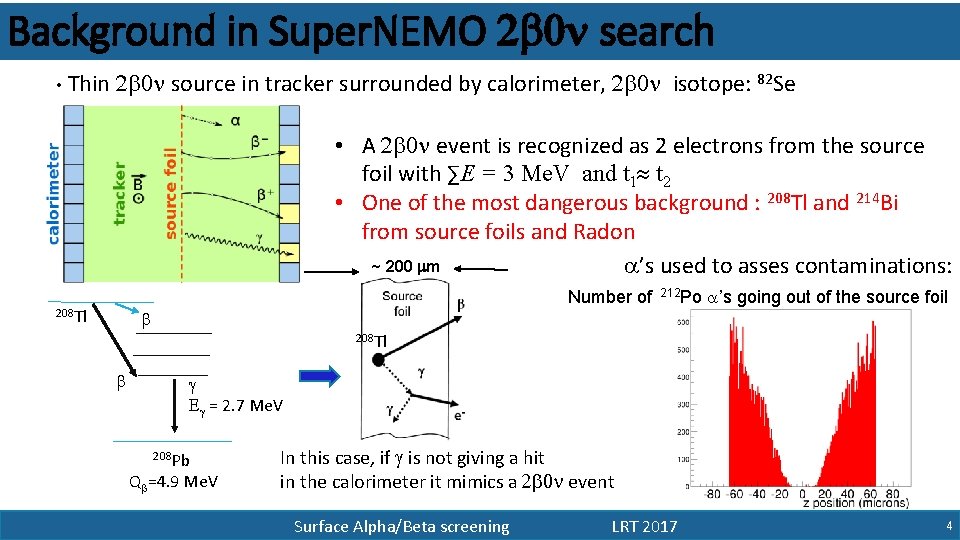
Background in Super. NEMO 2 b 0 n search • Thin 2 b 0 n source in tracker surrounded by calorimeter, 2 b 0 n isotope: 82 Se • A 2 b 0 n event is recognized as 2 electrons from the source foil with ∑E = 3 Me. V and t 1 t 2 • One of the most dangerous background : 208 Tl and 214 Bi from source foils and Radon ~ 200 mm a’s used to asses contaminations: Number of 212 Po a’s going out of the source foil 208 Tl b g Eg = 2. 7 Me. V 208 Pb Qb=4. 9 Me. V In this case, if g is not giving a hit in the calorimeter it mimics a 2 b 0 n event Surface Alpha/Beta screening LRT 2017 4
Alpha/Beta screening • This talk will be restricted to large surface detectors • Not inclusive of the many efforts and detectors existing • My sincere apologies if your favourite detector is not mentioned • Alpha screening: - XIA’s alpha counter Ultra. Lo-1800 - Surface alpha detector using m-TPC • Alphas and Betas - Beta. Cage • Alpha/Beta coincidence: - Bi. Po 3 Surface Alpha/Beta screening LRT 2017 5
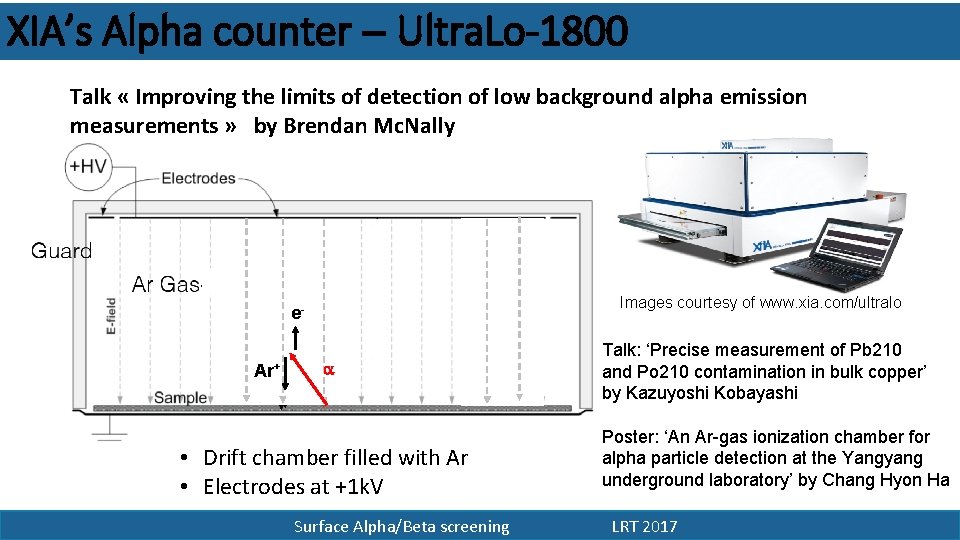
XIA’s Alpha counter – Ultra. Lo-1800 Talk « Improving the limits of detection of low background alpha emission measurements » by Brendan Mc. Nally Images courtesy of www. xia. com/ultralo e. Ar+ a a • Drift chamber filled with Ar • Electrodes at +1 k. V Surface Alpha/Beta screening Talk: ‘Precise measurement of Pb 210 and Po 210 contamination in bulk copper’ by Kazuyoshi Kobayashi Poster: ‘An Ar-gas ionization chamber for alpha particle detection at the Yangyang underground laboratory’ by Chang Hyon Ha LRT 2017

XIA’s Alpha counter – Ultra. Lo-1800 Alphas : • ≥ 2 Me. V • Discrimination of alphas from walls and ceiling • Alphas from sample : no guard signal amplitude • Total sample surface: 1800 or 707 cm 2 • Background sea-level, unshielded ~ 10 -3 a/cm 2/hr underground, shielded ~ 10 -4 a/cm 2/hr • Sensitivity < 0. 5 m. Bq/m 2 for 210 Po Images courtesy of www. xia. com/ultralo Surface Alpha/Beta screening LRT 2017 7
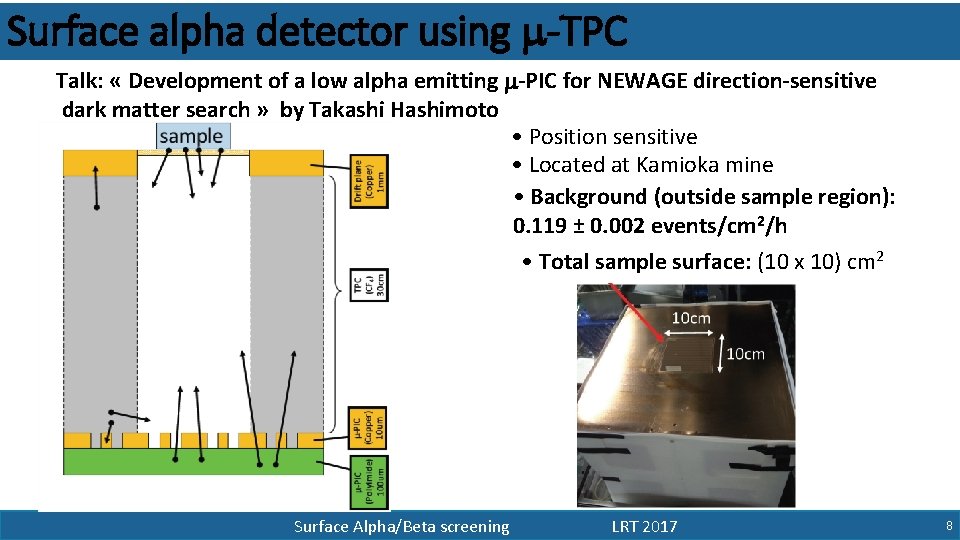
Surface alpha detector using m-TPC Talk: « Development of a low alpha emitting m-PIC for NEWAGE direction-sensitive dark matter search » by Takashi Hashimoto • Position sensitive • Located at Kamioka mine • Background (outside sample region): 0. 119 ± 0. 002 events/cm 2/h • Total sample surface: (10 x 10) cm 2 Surface Alpha/Beta screening LRT 2017 8

The Beta. Cage Poster: « The Beta. Cage: An Ultra-sensitive screener for surface contamination » by Eric Miller • Drift chamber with Multi-wire proportional counter • Sample in the gas (90 % Ne, 10% methane) • A ‘trigger’ MWPC creates the trigger region • Drift region contains all 200 ke. V e- and alphas • A ‘bulk’ MWPC collects the charges Total sample surface: 0. 45 m 2 = 4500 cm 2 Surface Alpha/Beta screening LRT 2017 9
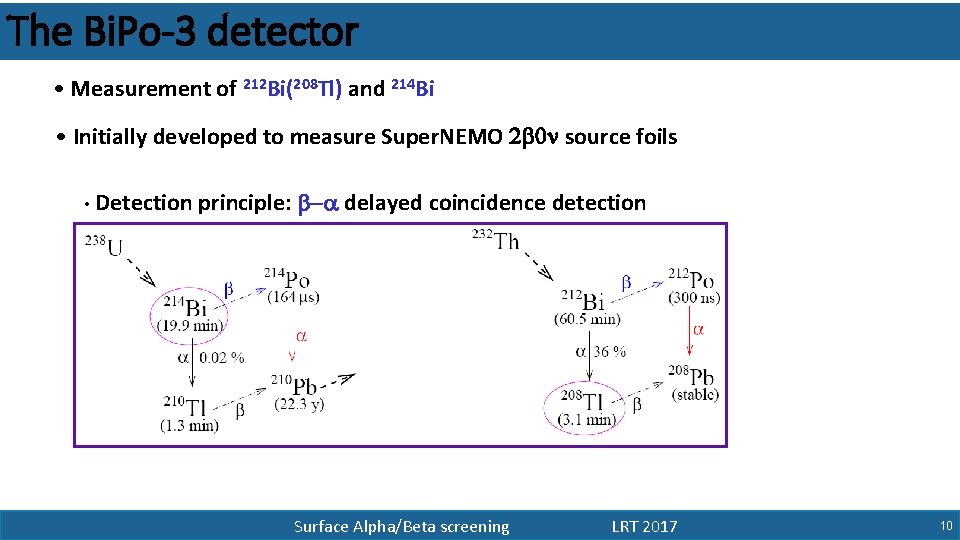
The Bi. Po-3 detector • Measurement of 212 Bi(208 Tl) and 214 Bi • Initially developed to measure Super. NEMO 2 b 0 n source foils • Detection principle: b-a delayed coincidence detection Surface Alpha/Beta screening LRT 2017 10
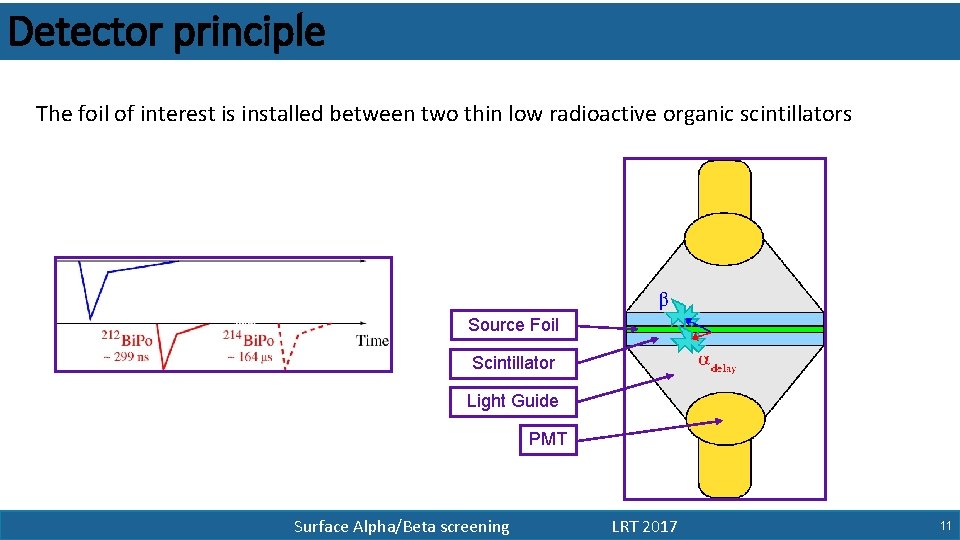
Detector principle The foil of interest is installed between two thin low radioactive organic scintillators Source Foil Scintillator Light Guide PMT Surface Alpha/Beta screening LRT 2017 11
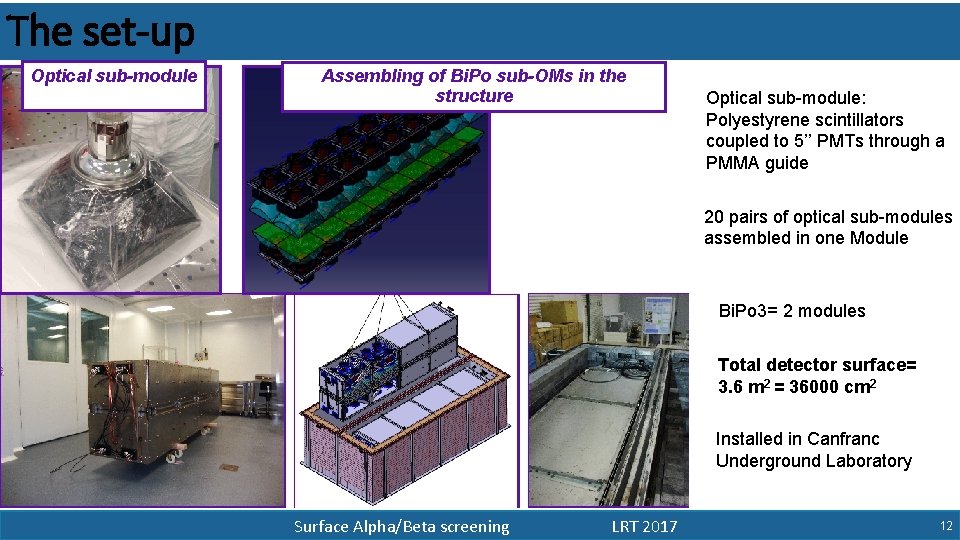
The set-up Optical sub-module Assembling of Bi. Po sub-OMs in the structure Optical sub-module: Polyestyrene scintillators coupled to 5’’ PMTs through a PMMA guide 20 pairs of optical sub-modules assembled in one Module Bi. Po 3= 2 modules Total detector surface= 3. 6 m 2 = 36000 cm 2 Installed in Canfranc Underground Laboratory Surface Alpha/Beta screening LRT 2017 12
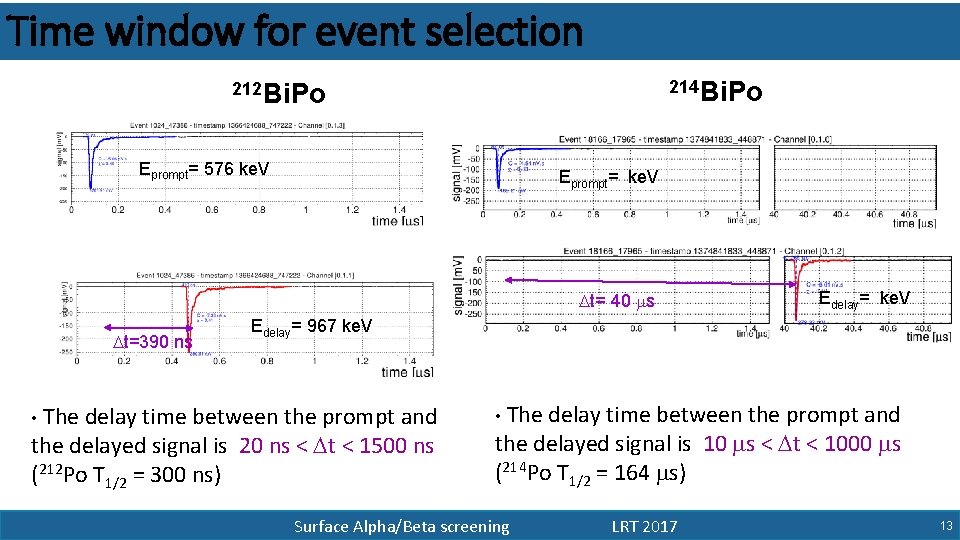
Time window for event selection 214 Bi. Po 212 Bi. Po Eprompt= 576 ke. V Eprompt= ke. V Dt= 40 ms Dt=390 ns Edelay= ke. V Edelay= 967 ke. V • The delay time between the prompt and the delayed signal is 20 ns < Dt < 1500 ns (212 Po T 1/2 = 300 ns) • The delay time between the prompt and the delayed signal is 10 ms < Dt < 1000 ms (214 Po T 1/2 = 164 ms) Surface Alpha/Beta screening LRT 2017 13
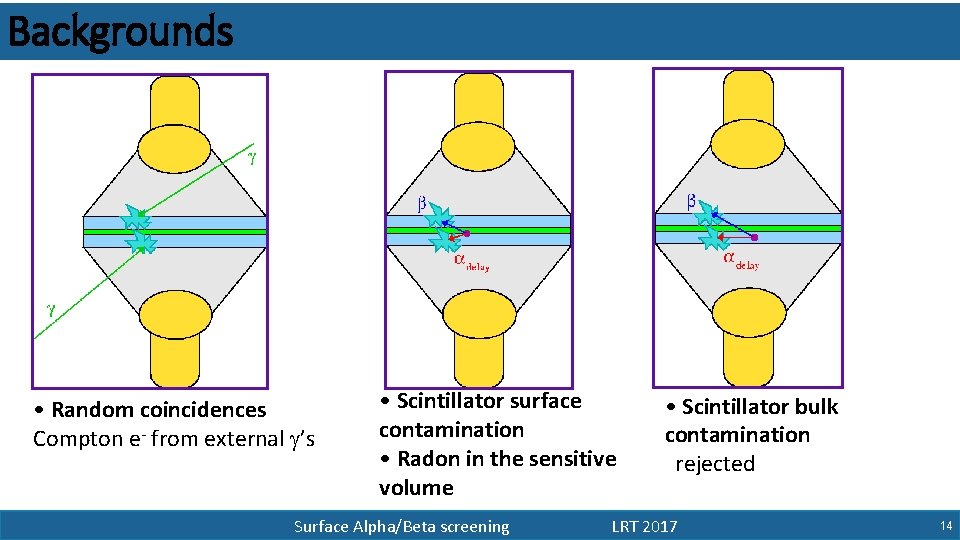
Backgrounds • Random coincidences Compton e- from external g’s • Scintillator surface contamination • Radon in the sensitive volume Surface Alpha/Beta screening • Scintillator bulk contamination rejected LRT 2017 14
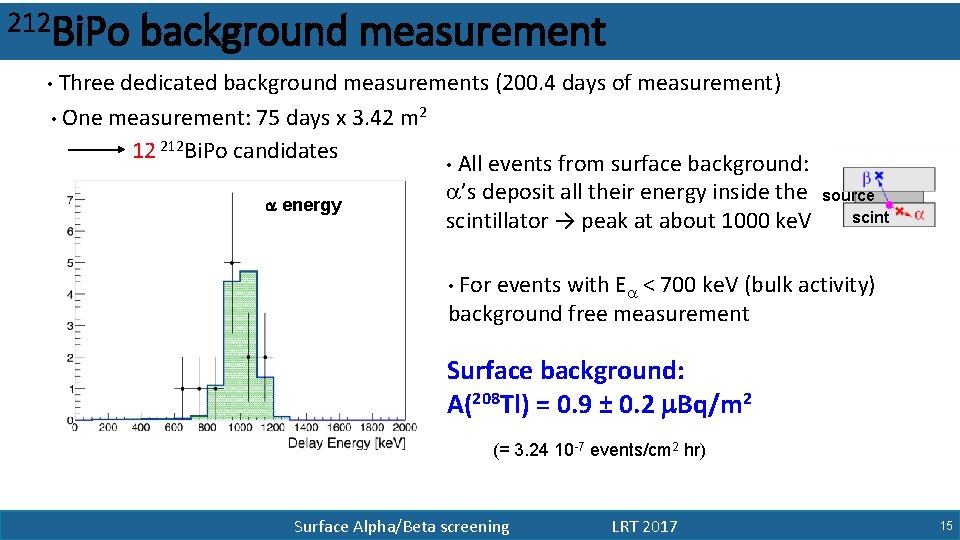
212 Bi. Po background measurement • Three dedicated background measurements (200. 4 days of measurement) • One measurement: 75 days x 3. 42 m 2 12 212 Bi. Po candidates a energy • All events from surface background: a’s deposit all their energy inside the scintillator → peak at about 1000 ke. V source scint • For events with Ea < 700 ke. V (bulk activity) background free measurement Surface background: A(208 Tl) = 0. 9 ± 0. 2 m. Bq/m 2 (= 3. 24 10 -7 events/cm 2 hr) Surface Alpha/Beta screening LRT 2017 15
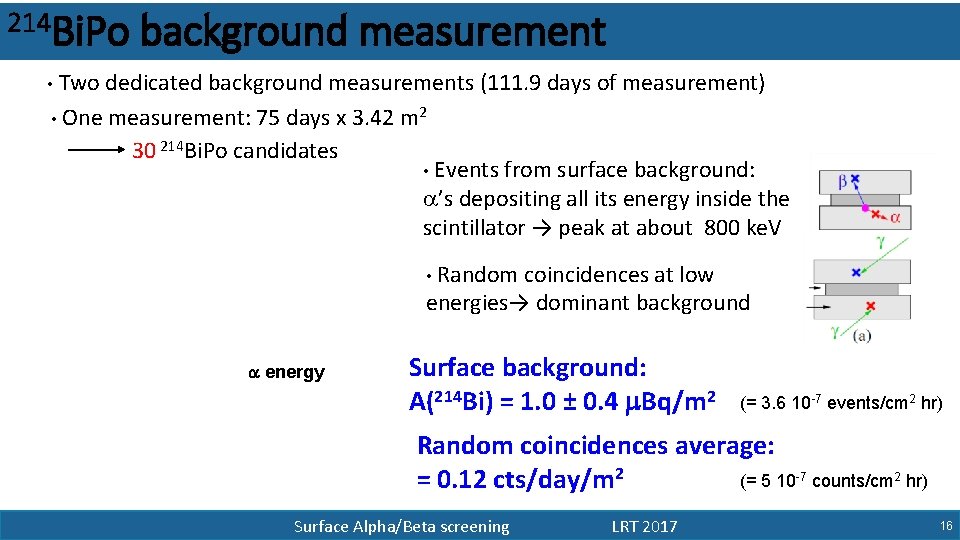
214 Bi. Po background measurement • Two dedicated background measurements (111. 9 days of measurement) • One measurement: 75 days x 3. 42 m 2 30 214 Bi. Po candidates • Events from surface background: a’s depositing all its energy inside the scintillator → peak at about 800 ke. V • Random coincidences at low energies→ dominant background a energy Surface background: A(214 Bi) = 1. 0 ± 0. 4 m. Bq/m 2 (= 3. 6 10 -7 events/cm 2 hr) Random coincidences average: (= 5 10 -7 counts/cm 2 hr) = 0. 12 cts/day/m 2 Surface Alpha/Beta screening LRT 2017 16
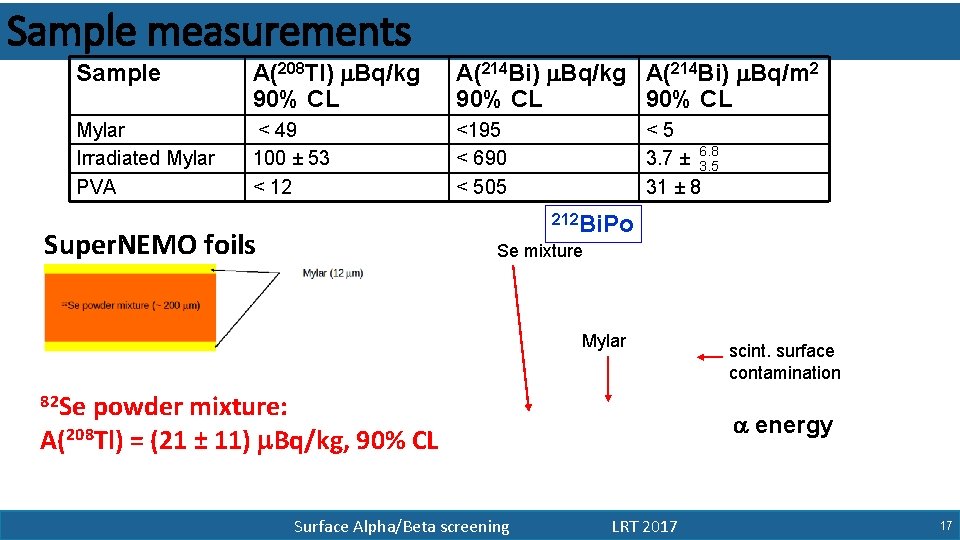
Sample measurements Sample A(208 Tl) m. Bq/kg 90% CL A(214 Bi) m. Bq/kg A(214 Bi) m. Bq/m 2 90% CL Mylar Irradiated Mylar PVA < 49 100 ± 53 < 12 <195 < 690 < 505 < 5 6. 8 3. 7 ± 3. 5 31 ± 8 212 Bi. Po Super. NEMO foils Se mixture Mylar 82 Se powder mixture: A(208 Tl) = (21 ± 11) a energy m. Bq/kg, 90% CL Surface Alpha/Beta screening scint. surface contamination LRT 2017 17
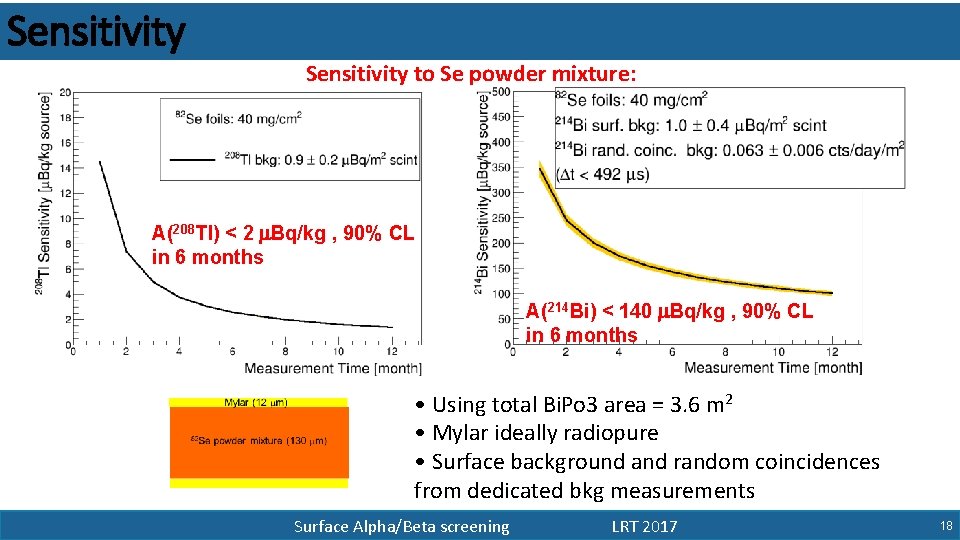
Sensitivity to Se powder mixture: A(208 Tl) < 2 m. Bq/kg , 90% CL in 6 months A(214 Bi) < 140 m. Bq/kg , 90% CL in 6 months • Using total Bi. Po 3 area = 3. 6 m 2 • Mylar ideally radiopure • Surface background and random coincidences from dedicated bkg measurements Surface Alpha/Beta screening LRT 2017 18
Summary • A number of dark matter and neutrino experiments are sensitive to surface contaminants • Surface screening is needed to control and reduce surface contaminants • Alpha detection used to asses surface and bulk radiopurity levels • Current background in alpha detectors ~ 10 -4 a/cm 2/hr. Sensitivities < 0. 5 m. Bq/m 2 for 210 Po • Beta/Alpha coincidence used to asses 212 Bi/214 Bi radioactivity levels. Sensitivity reached A(208 Tl) < 10 m. Bq/kg Surface Alpha/Beta screening LRT 2017
- Slides: 19