
MEASUREMENT OF SOUND ABSORPTION COEFFICIENT OF ROAD SURFACES

MEASUREMENT OF SOUND ABSORPTION COEFFICIENT OF ROAD SURFACES IN SITU MEASURING SURFACE CHARACTERISTICS R. Álvarez de Sotomayor, S. Yanguas, J. González & L. Parra Pavement Surface Characteristics Department Researchers, CEDEX, Spain Roberto. Alvarez@cedex. es Sixto. Yanguas@cedex. es Juan. Gonzalez@cedex. es Laura. Parra@cedex. es
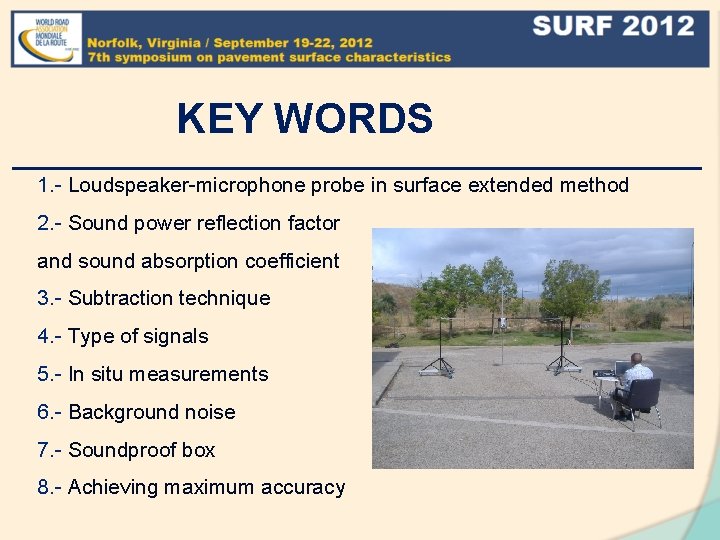
KEY WORDS 1. - Loudspeaker-microphone probe in surface extended method 2. - Sound power reflection factor and sound absorption coefficient 3. - Subtraction technique 4. - Type of signals 5. - In situ measurements 6. - Background noise 7. - Soundproof box 8. - Achieving maximum accuracy
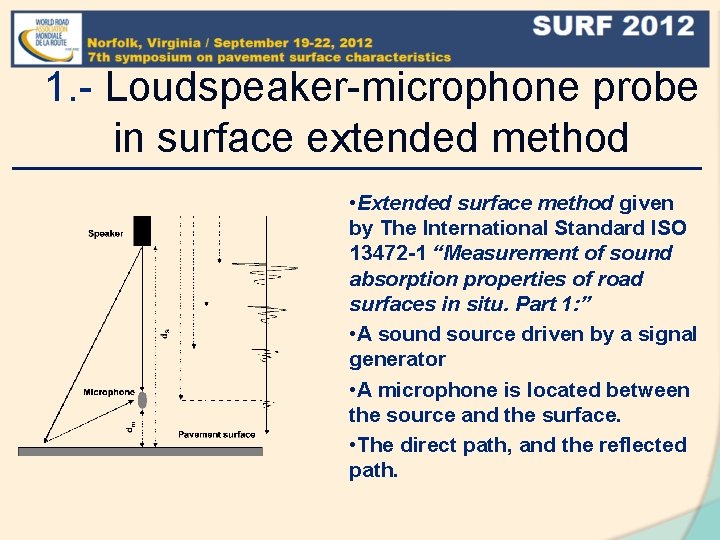
1. - Loudspeaker-microphone probe in surface extended method • Extended surface method given by The International Standard ISO 13472 -1 “Measurement of sound absorption properties of road surfaces in situ. Part 1: ” • A sound source driven by a signal generator • A microphone is located between the source and the surface. • The direct path, and the reflected path.
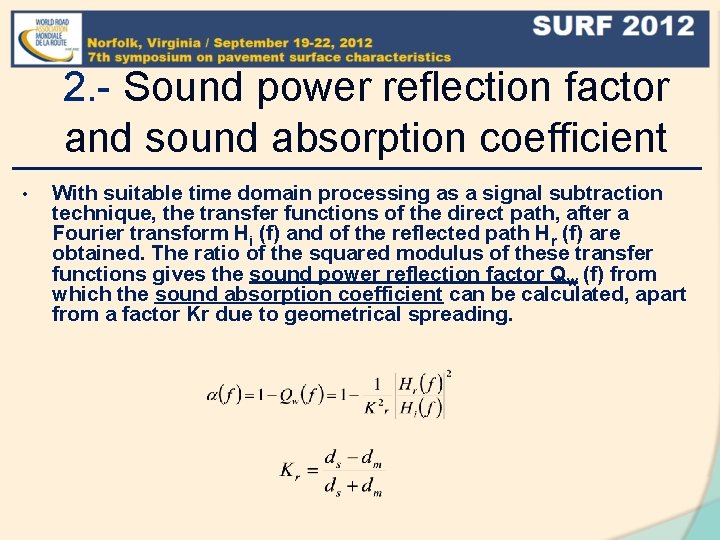
2. - Sound power reflection factor and sound absorption coefficient • With suitable time domain processing as a signal subtraction technique, the transfer functions of the direct path, after a Fourier transform Hi (f) and of the reflected path Hr (f) are obtained. The ratio of the squared modulus of these transfer functions gives the sound power reflection factor Qw (f) from which the sound absorption coefficient can be calculated, apart from a factor Kr due to geometrical spreading.
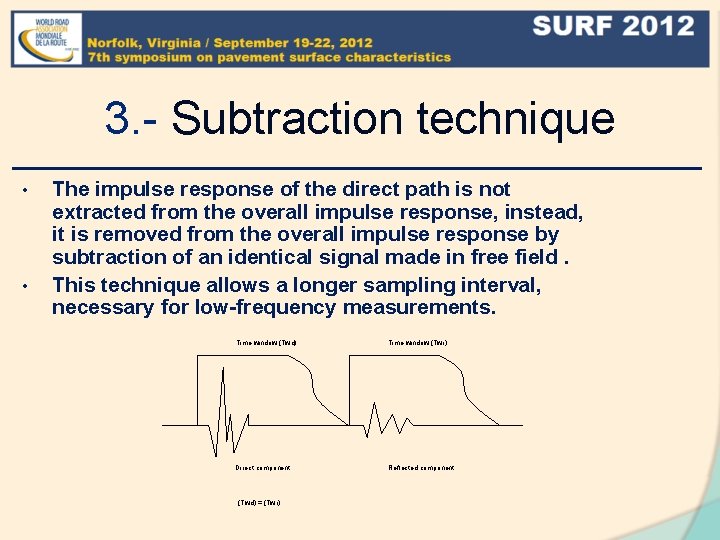
3. - Subtraction technique • • The impulse response of the direct path is not extracted from the overall impulse response, instead, it is removed from the overall impulse response by subtraction of an identical signal made in free field. This technique allows a longer sampling interval, necessary for low-frequency measurements. Time window (Twd) Time window (Twr) Direct component Reflected component (Twd) = (Twr)
4. - Type of signals • MLS or Maximum Length Sequence is a binary pseudo-random sequence with specific properties that make it a suitable excitation signal for deconvolution based on impulse response measurements. • Other internal sinusoidal test signals have been analyzed as well: The LIN-sweep and the Esweep. The frequency of the LIN-sweep increases proportionally with time, while the frequency of the E-sweep increases exponentially with time.
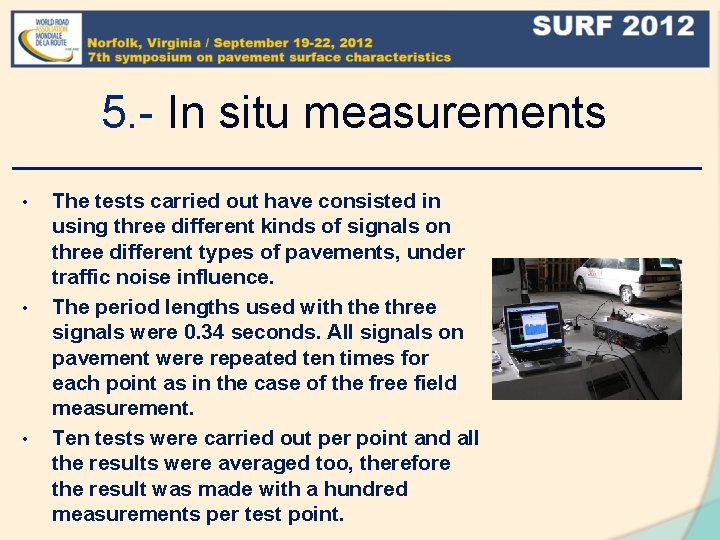
5. - In situ measurements • • • The tests carried out have consisted in using three different kinds of signals on three different types of pavements, under traffic noise influence. The period lengths used with the three signals were 0. 34 seconds. All signals on pavement were repeated ten times for each point as in the case of the free field measurement. Ten tests were carried out per point and all the results were averaged too, therefore the result was made with a hundred measurements per test point.
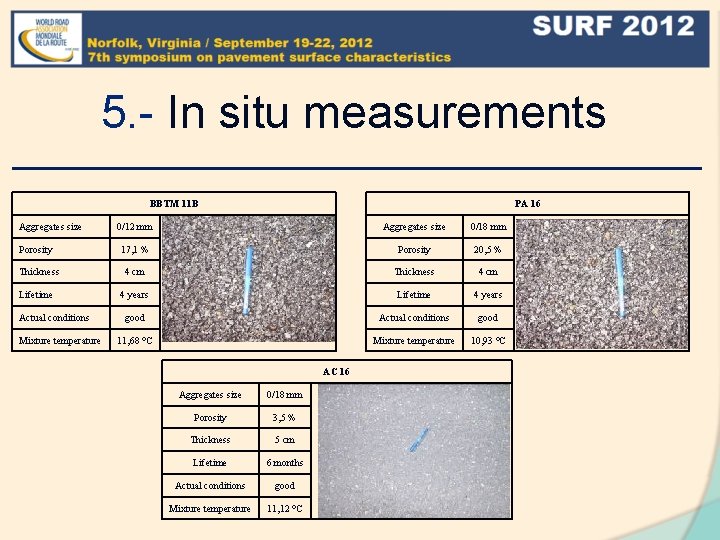
5. - In situ measurements BBTM 11 B Aggregates size Porosity Thickness Lifetime Actual conditions Mixture temperature PA 16 0/12 mm Aggregates size 0/18 mm 17, 1 % Porosity 20, 5 % 4 cm Thickness 4 cm 4 years Lifetime 4 years good Actual conditions good 11, 68 ºC Mixture temperature 10, 93 ºC AC 16 Aggregates size 0/18 mm Porosity 3, 5 % Thickness 5 cm Lifetime 6 months Actual conditions good Mixture temperature 11, 12 ºC
5. - In situ measurements
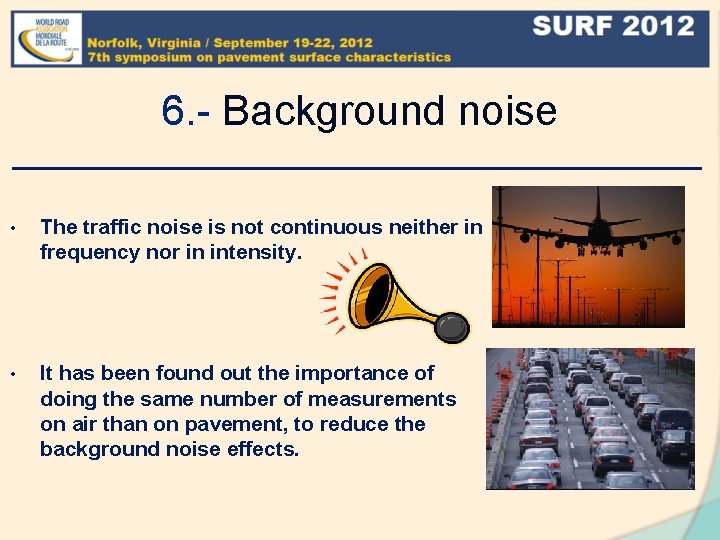
6. - Background noise • The traffic noise is not continuous neither in frequency nor in intensity. • It has been found out the importance of doing the same number of measurements on air than on pavement, to reduce the background noise effects.
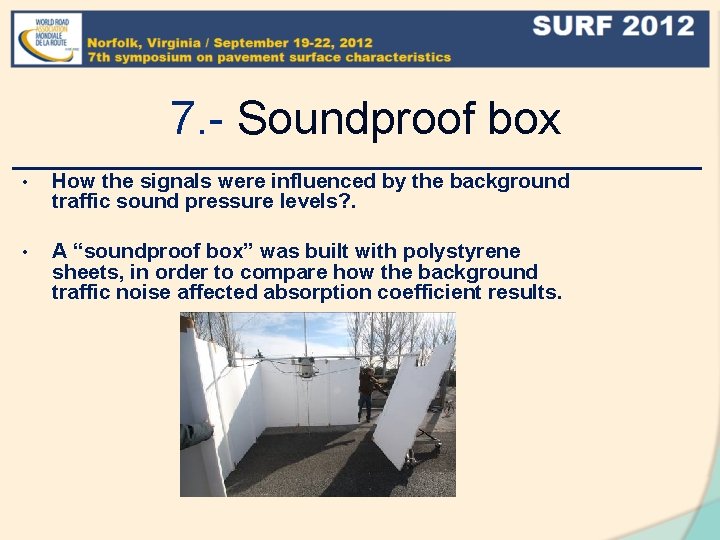
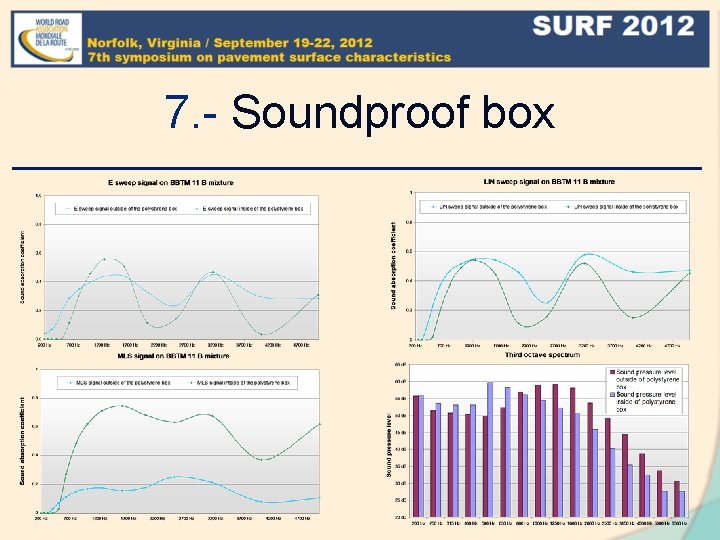
7. - Soundproof box • How the signals were influenced by the background traffic sound pressure levels? . • A “soundproof box” was built with polystyrene sheets, in order to compare how the background traffic noise affected absorption coefficient results.
7. - Soundproof box
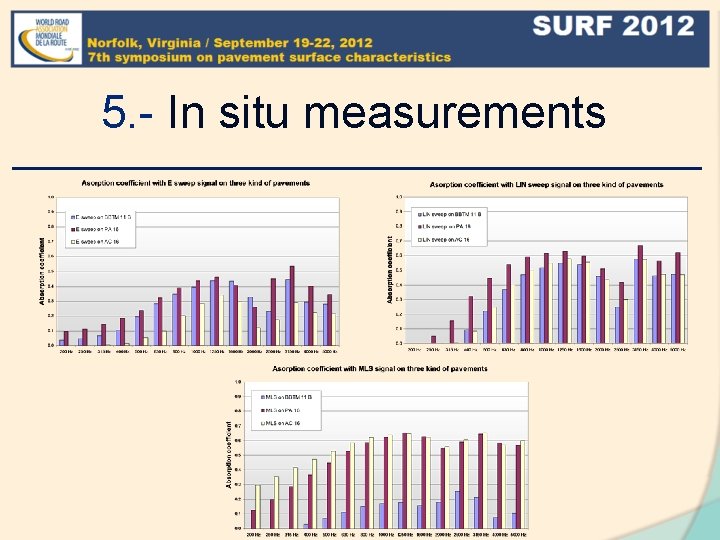
8. - Achieving maximum accuracy • As more measurements are made the deviation from the average could be minor. • When measuring under traffic conditions it is advisable for each shot to do a free field measurement. • All measures must have low period lengths, 0. 34 seconds in our case, to reduce the non continuous behaviour of background traffic noise. • The E-sweep signal was the unique signal able to detect different porosities offering coherent coefficient absorption values on three surfaces.
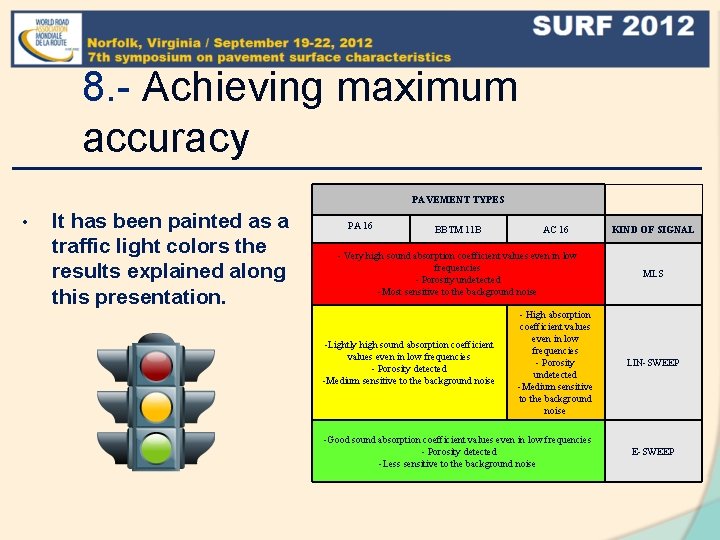
8. - Achieving maximum accuracy PAVEMENT TYPES • It has been painted as a traffic light colors the results explained along this presentation. PA 16 BBTM 11 B AC 16 - Very high sound absorption coefficient values even in low frequencies - Porosity undetected -Most sensitive to the background noise -Lightly high sound absorption coefficient values even in low frequencies - Porosity detected -Medium sensitive to the background noise - High absorption coefficient values even in low frequencies - Porosity undetected -Medium sensitive to the background noise -Good sound absorption coefficient values even in low frequencies - Porosity detected -Less sensitive to the background noise KIND OF SIGNAL MLS LIN-SWEEP E-SWEEP
MEASUREMENT OF SOUND ABSORPTION COEFFICIENT OF ROAD SURFACES IN SITU ¡Many thanks for your attention! It will be a pleasure to answer any question R. Álvarez de Sotomayor, S. Yanguas, J. González & L. Parra Pavement Surface Characteristics Department Researchers, CEDEX, Spain Roberto. Alvarez@cedex. es Sixto. Yanguas@cedex. es Juan. Gonzalez@cedex. es Laura. Parra@cedex. es
- Slides: 15