
Measurement of Sound Absorption Coefficient Measurement of sound
Measurement of Sound Absorption Coefficient Measurement of sound absorption coefficient Angelo Farina Dip. di Ingegneria Industriale - Università di Parma Parco Area delle Scienze 181/A, 43100 Parma – Italy angelo. farina@unipr. it 3 December 2012 Inverse filters, Absorption coeff. 1

Measurement of Sound Absorption Coefficient With regard to apparent acoustic absorption, IT DOES NOT MATTER That the energy is really absorbed, or just transmitted INTERESSA SOLO SAPERE QUANTA ENERGIA NON VIENE RIFLESSA 3 December 2012 Inverse filters, Absorption coeff. 2

Measurement of Sound Absorption Coefficient Measurmeent Methods • Reverberant room (ISO 354) • Standing Wave Tube (pressure measurements, ISO 10534) • Impulsive Method (EN 1793/5) • Sound Intensity Method (in tube or in free field) 3 December 2012 Inverse filters, Absorption coeff. 3

Measurement of Sound Absorption Coefficient Measuring in reverberant room According to ISO 354 Ts Te 10 mq The reverberation time is measured twice, the first time with the room empty (Te), the second after introducing a sample surface S of approximately 10 m 2 of absorbing material (Ts). Of course Ts is smaller than Te. 28 November 2014 Absorption coeff. 4
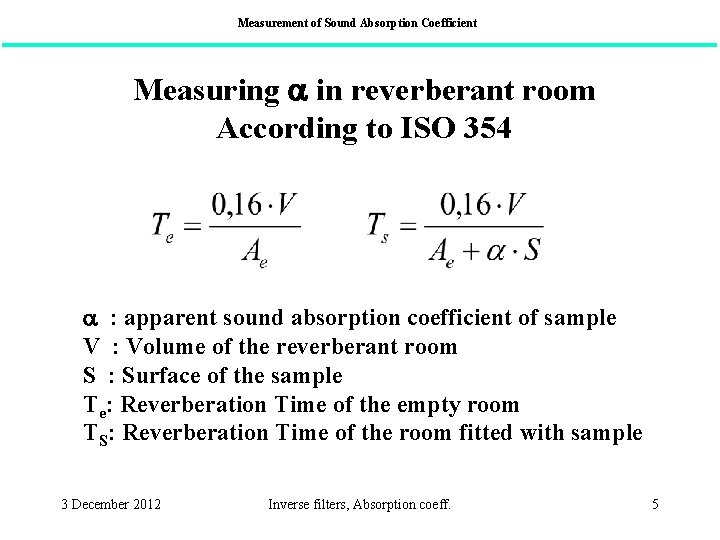
Measurement of Sound Absorption Coefficient Measuring in reverberant room According to ISO 354 : apparent sound absorption coefficient of sample V : Volume of the reverberant room S : Surface of the sample Te: Reverberation Time of the empty room TS: Reverberation Time of the room fitted with sample 3 December 2012 Inverse filters, Absorption coeff. 5

Measurement of Sound Absorption Coefficient Measuring in reverberant room According to ISO 354 : apparent sound absorption coefficient of sample V : Volume of the reverberant room S : Surface of the sample Te: Reverberation Time of the empty room TS: Reverberation Time of the room fitted with sample 3 December 2012 Inverse filters, Absorption coeff. 6

Measurement of Sound Absorption Coefficient Measuring in reverberant room according to ISO 354 Attention: The ISO 354 method easily results in values of exceeding 1. 00, up to 1. 20 !!! 3 December 2012 Inverse filters, Absorption coeff. 7
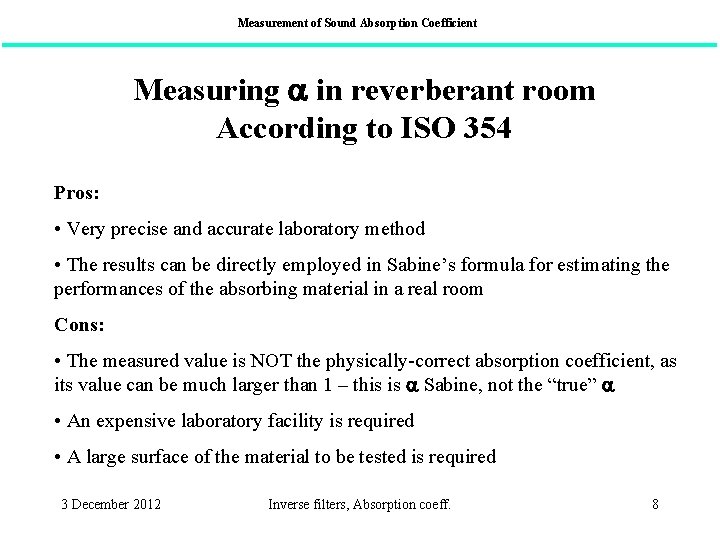
Measurement of Sound Absorption Coefficient Measuring in reverberant room According to ISO 354 Pros: • Very precise and accurate laboratory method • The results can be directly employed in Sabine’s formula for estimating the performances of the absorbing material in a real room Cons: • The measured value is NOT the physically-correct absorption coefficient, as its value can be much larger than 1 – this is Sabine, not the “true” • An expensive laboratory facility is required • A large surface of the material to be tested is required 3 December 2012 Inverse filters, Absorption coeff. 8
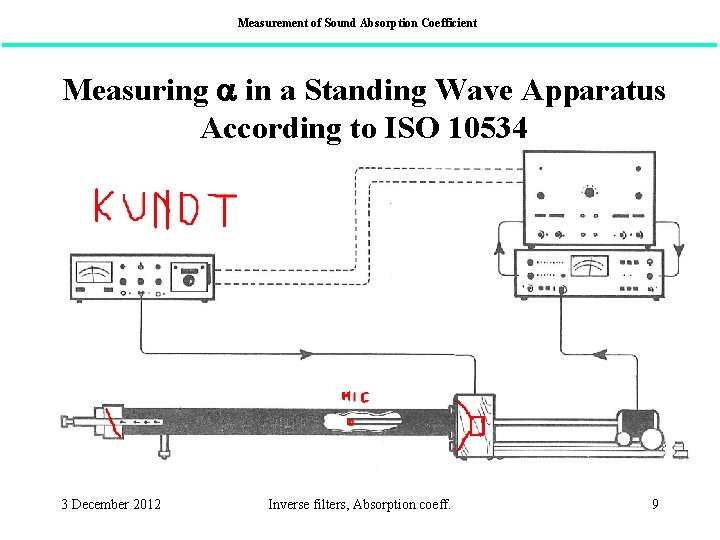
Measurement of Sound Absorption Coefficient Measuring in a Standing Wave Apparatus According to ISO 10534 3 December 2012 Inverse filters, Absorption coeff. 9

Measurement of Sound Absorption Coefficient Measuring in a Standing Wave Apparatus According to ISO 10534 3 December 2012 Inverse filters, Absorption coeff. 10
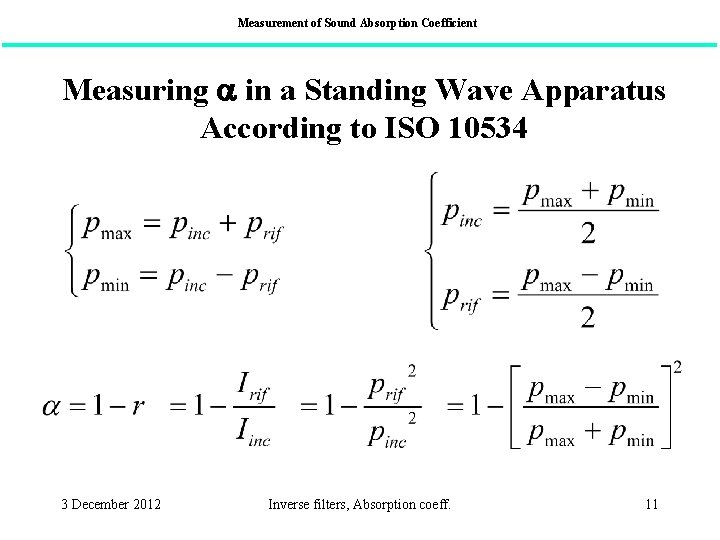
Measurement of Sound Absorption Coefficient Measuring in a Standing Wave Apparatus According to ISO 10534 3 December 2012 Inverse filters, Absorption coeff. 11
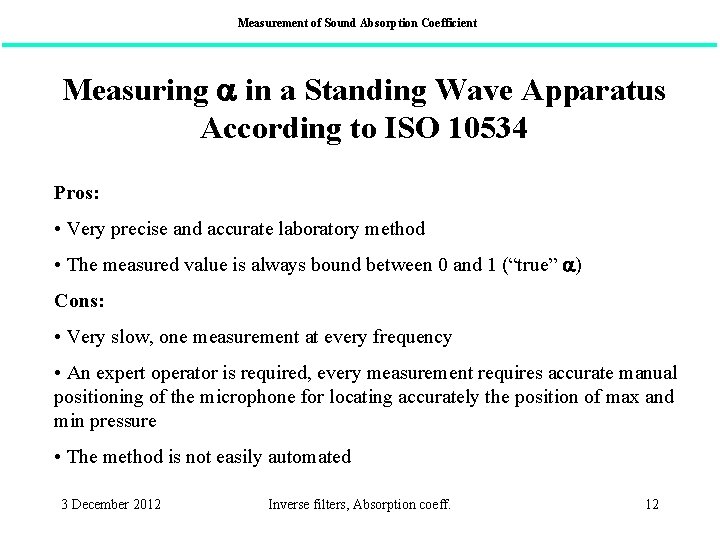
Measurement of Sound Absorption Coefficient Measuring in a Standing Wave Apparatus According to ISO 10534 Pros: • Very precise and accurate laboratory method • The measured value is always bound between 0 and 1 (“true” ) Cons: • Very slow, one measurement at every frequency • An expert operator is required, every measurement requires accurate manual positioning of the microphone for locating accurately the position of max and min pressure • The method is not easily automated 3 December 2012 Inverse filters, Absorption coeff. 12
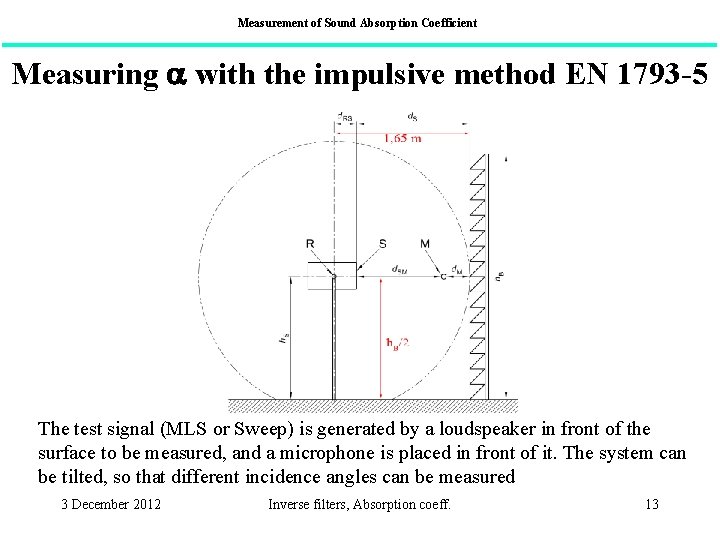
Measurement of Sound Absorption Coefficient Measuring with the impulsive method EN 1793 -5 The test signal (MLS or Sweep) is generated by a loudspeaker in front of the surface to be measured, and a microphone is placed in front of it. The system can be tilted, so that different incidence angles can be measured 3 December 2012 Inverse filters, Absorption coeff. 13

Measurement of Sound Absorption Coefficient Direct Sound Subraction Free Field Barrier response First the loudspeaker/microphone assembly is rotated toward sky, and a free field response is measured. Then the system is rotated towards the barrier, and its response is measured. Finally, the free field response is subrtacted by the barrier response, so that only the reflected signal remains. 3 December 2012 Inverse filters, Absorption coeff. 14
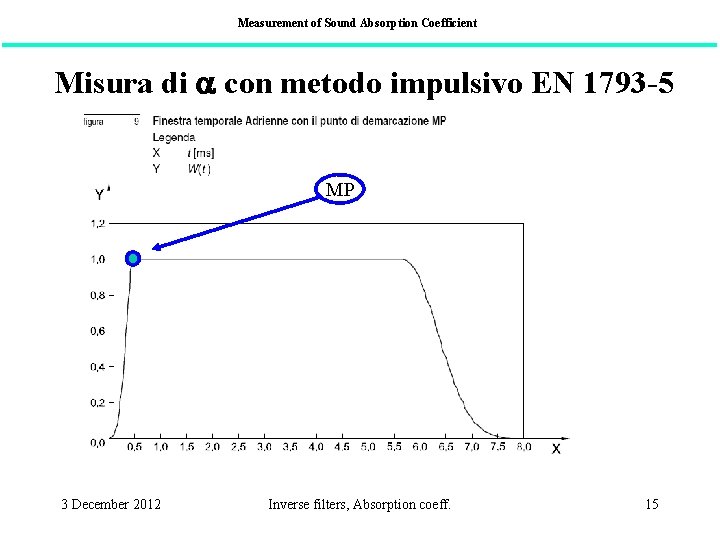
Measurement of Sound Absorption Coefficient Misura di con metodo impulsivo EN 1793 -5 MP 3 December 2012 Inverse filters, Absorption coeff. 15
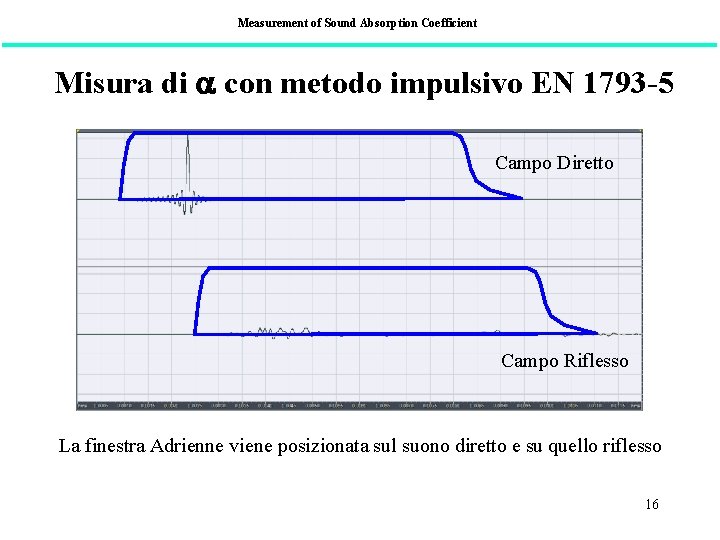
Measurement of Sound Absorption Coefficient Misura di con metodo impulsivo EN 1793 -5 Campo Diretto Campo Riflesso La finestra Adrienne viene posizionata sul suono diretto e su quello riflesso 16
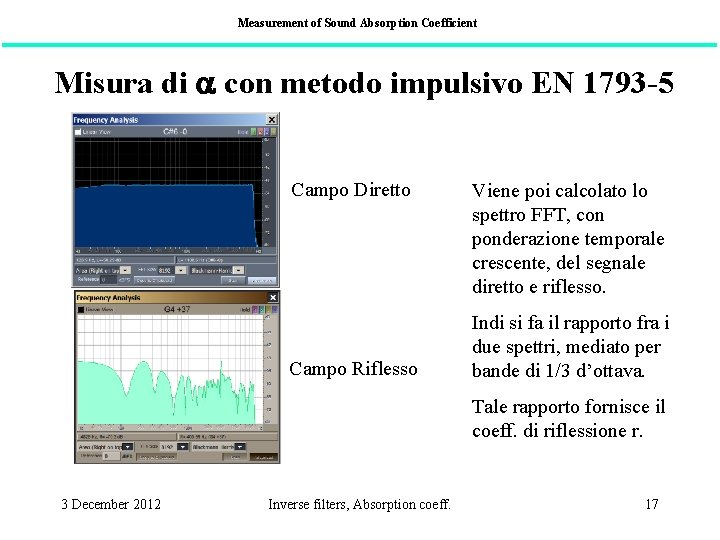
Measurement of Sound Absorption Coefficient Misura di con metodo impulsivo EN 1793 -5 Campo Diretto Campo Riflesso Viene poi calcolato lo spettro FFT, con ponderazione temporale crescente, del segnale diretto e riflesso. Indi si fa il rapporto fra i due spettri, mediato per bande di 1/3 d’ottava. Tale rapporto fornisce il coeff. di riflessione r. 3 December 2012 Inverse filters, Absorption coeff. 17
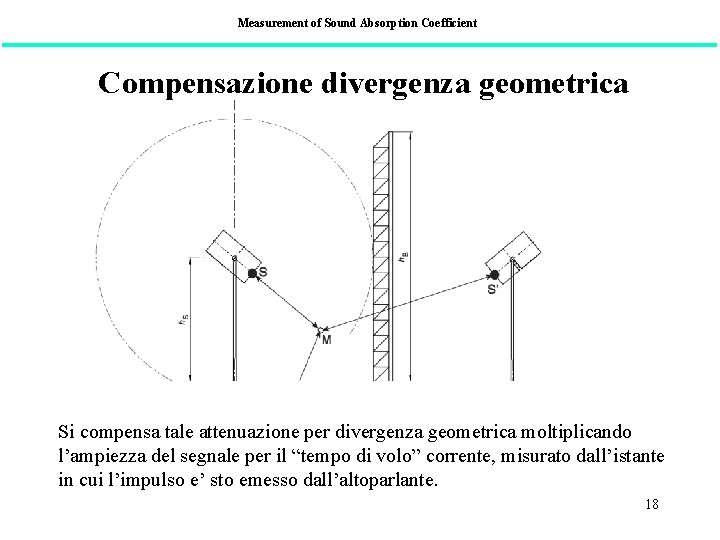
Measurement of Sound Absorption Coefficient Compensazione divergenza geometrica Sisegnale compensa tale attenuazione pertragitto divergenza geometrica moltiplicando Il riflesso ha percorso un piu’ lungo, e’ come se provenisse l’ampiezza del segnale per piu’ il “tempo di volo” corrente, misurato dall’istante da una sorgente-immagine lontana. Quindi e’ piu’ debole. in cui l’impulso e’ sto emesso dall’altoparlante. 3 December 2012 Inverse filters, Absorption coeff. 18
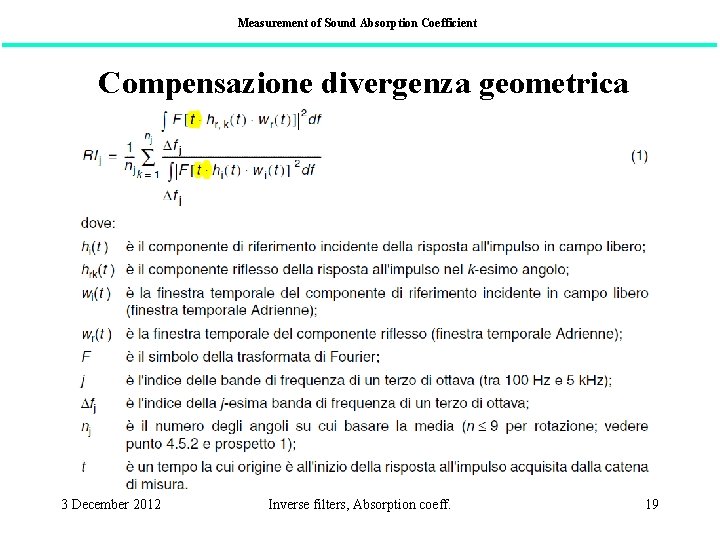
Measurement of Sound Absorption Coefficient Compensazione divergenza geometrica 3 December 2012 Inverse filters, Absorption coeff. 19
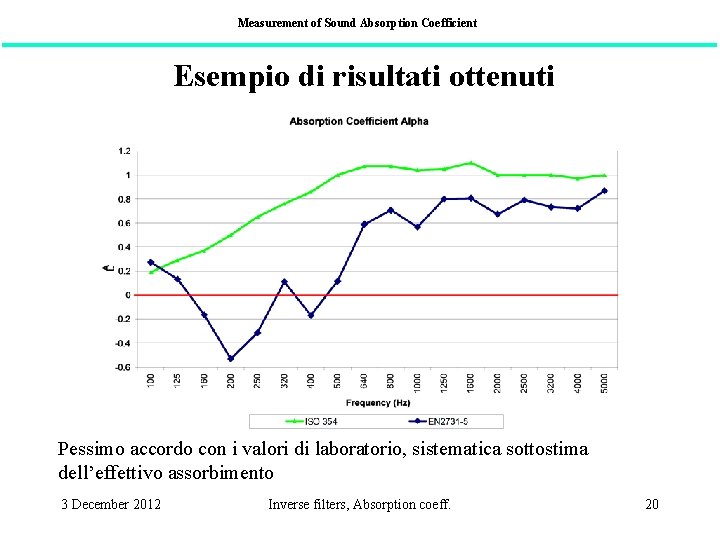
Measurement of Sound Absorption Coefficient Esempio di risultati ottenuti Pessimo accordo con i valori di laboratorio, sistematica sottostima dell’effettivo assorbimento 3 December 2012 Inverse filters, Absorption coeff. 20
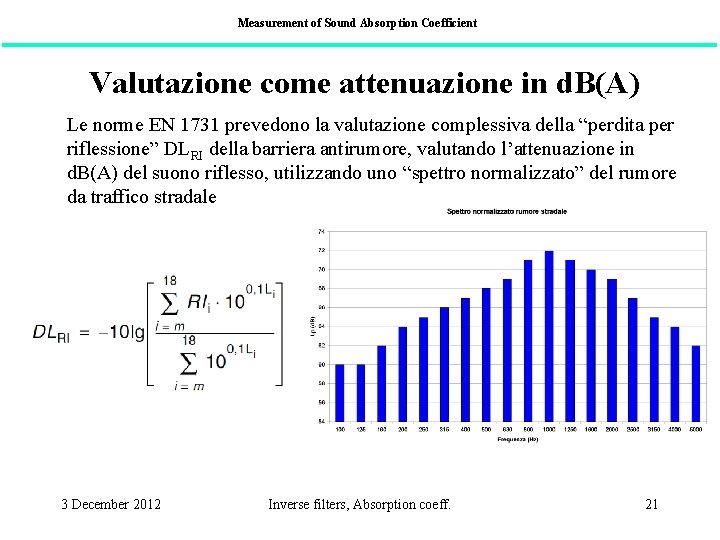
Measurement of Sound Absorption Coefficient Valutazione come attenuazione in d. B(A) Le norme EN 1731 prevedono la valutazione complessiva della “perdita per riflessione” DLRI della barriera antirumore, valutando l’attenuazione in d. B(A) del suono riflesso, utilizzando uno “spettro normalizzato” del rumore da traffico stradale 3 December 2012 Inverse filters, Absorption coeff. 21
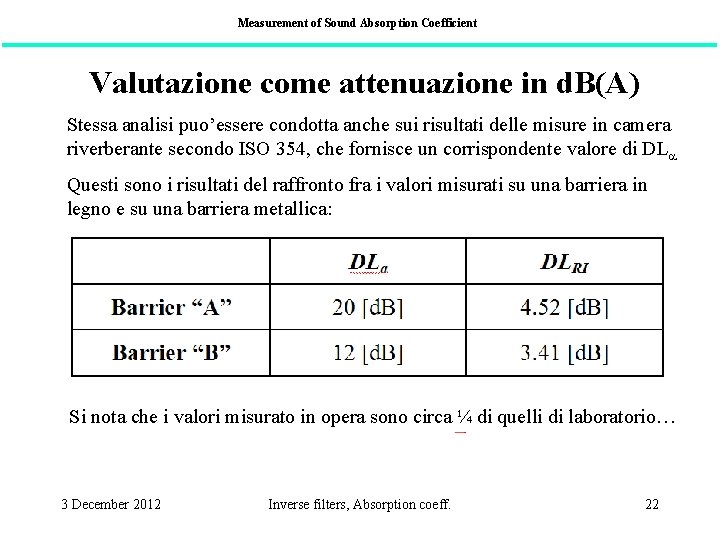
Measurement of Sound Absorption Coefficient Valutazione come attenuazione in d. B(A) Stessa analisi puo’essere condotta anche sui risultati delle misure in camera riverberante secondo ISO 354, che fornisce un corrispondente valore di DLa Questi sono i risultati del raffronto fra i valori misurati su una barriera in legno e su una barriera metallica: Si nota che i valori misurato in opera sono circa ¼ di quelli di laboratorio… 3 December 2012 Inverse filters, Absorption coeff. 22
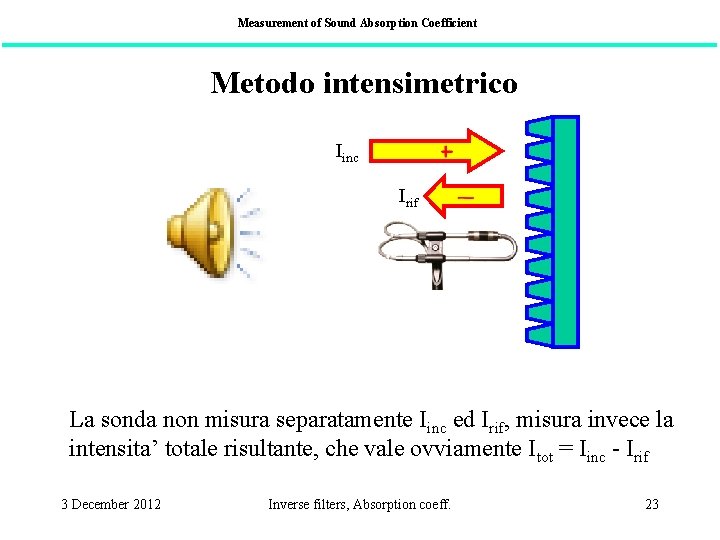
Measurement of Sound Absorption Coefficient Metodo intensimetrico Iinc Irif La sonda non misura separatamente Iinc ed Irif, misura invece la intensita’ totale risultante, che vale ovviamente Itot = Iinc - Irif 3 December 2012 Inverse filters, Absorption coeff. 23
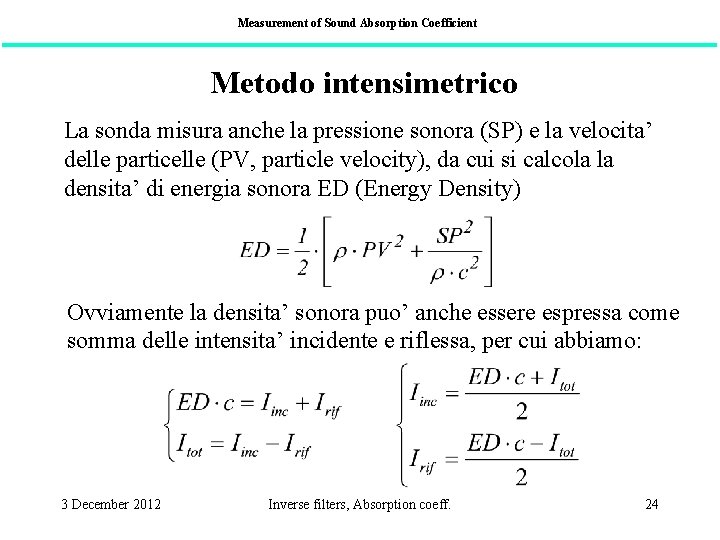
Measurement of Sound Absorption Coefficient Metodo intensimetrico La sonda misura anche la pressione sonora (SP) e la velocita’ delle particelle (PV, particle velocity), da cui si calcola la densita’ di energia sonora ED (Energy Density) Ovviamente la densita’ sonora puo’ anche essere espressa come somma delle intensita’ incidente e riflessa, per cui abbiamo: 3 December 2012 Inverse filters, Absorption coeff. 24
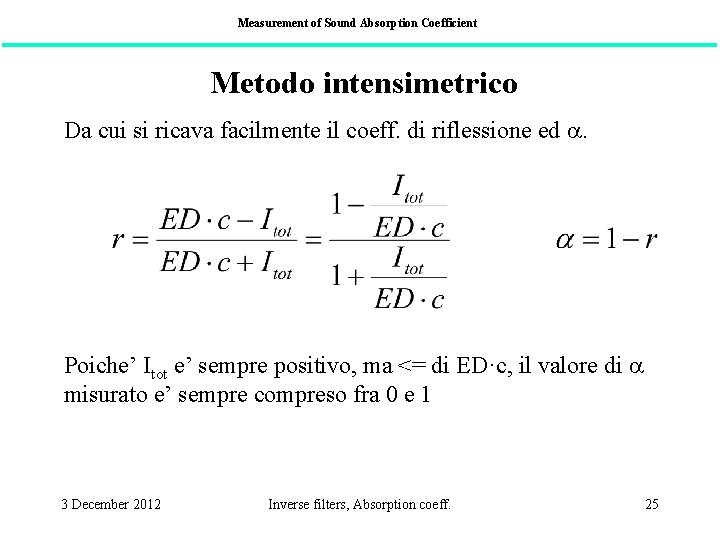
Measurement of Sound Absorption Coefficient Metodo intensimetrico Da cui si ricava facilmente il coeff. di riflessione ed a. Poiche’ Itot e’ sempre positivo, ma <= di ED·c, il valore di a misurato e’ sempre compreso fra 0 e 1 3 December 2012 Inverse filters, Absorption coeff. 25
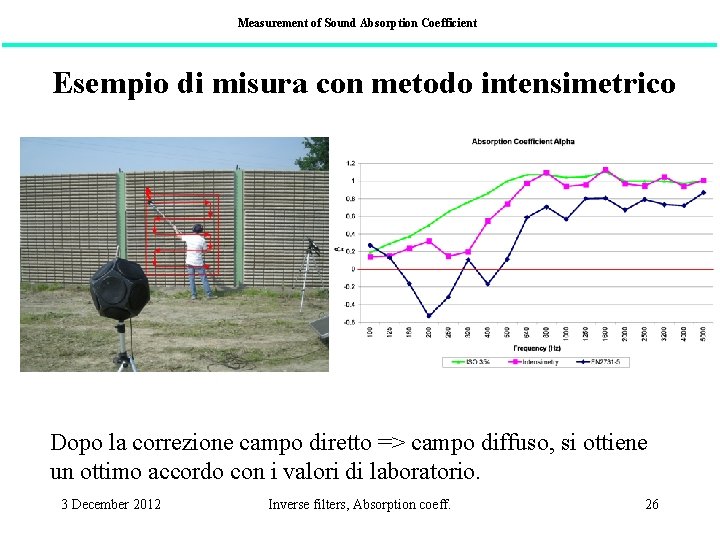
Measurement of Sound Absorption Coefficient Esempio di misura con metodo intensimetrico Dopo la correzione campo diretto => campo diffuso, si ottiene un ottimo accordo con i valori di laboratorio. 3 December 2012 Inverse filters, Absorption coeff. 26
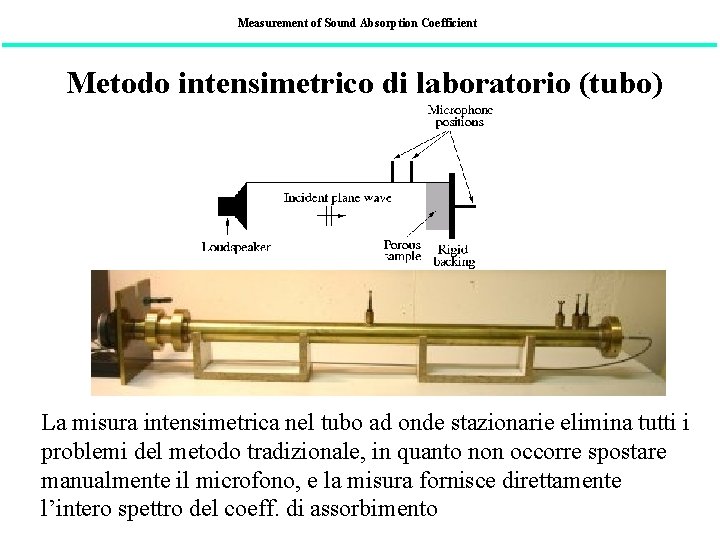
Measurement of Sound Absorption Coefficient Metodo intensimetrico di laboratorio (tubo) La misura intensimetrica nel tubo ad onde stazionarie elimina tutti i problemi del metodo tradizionale, in quanto non occorre spostare manualmente il microfono, e la misura fornisce direttamente 3 December 2012 filters, Absorption coeff. 27 l’intero spettro del coeff. Inverse di assorbimento
- Slides: 27