
Measurement of RealWorld Locomotive Engine Activity and Emissions



- Slides: 27
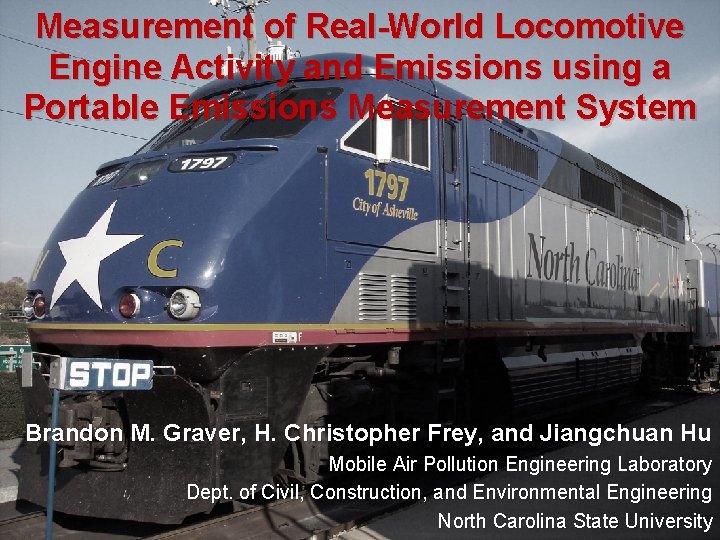
Measurement of Real-World Locomotive Engine Activity and Emissions using a Portable Emissions Measurement System Brandon M. Graver, H. Christopher Frey, and Jiangchuan Hu Mobile Air Pollution Engineering Laboratory Dept. of Civil, Construction, and Environmental Engineering North Carolina State University
RESEARCH MOTIVATION Is there an easier, more cost effective way of measuring locomotive engine activity and emissions? • North Carolina Department of Transportation (NCDOT) is interested in assessing overall environmental performance of their locomotive fleet. • Locomotive engine emission measurements are conducted on a dynamometer or in the rail yard – Controlled test setting – Not representative of real-world operating conditions 2
RESEARCH QUESTIONS • What are the real-world duty cycles for passenger rail service in North Carolina? • What are the real-world emission rates for the locomotives that operate the passenger rail service? 3
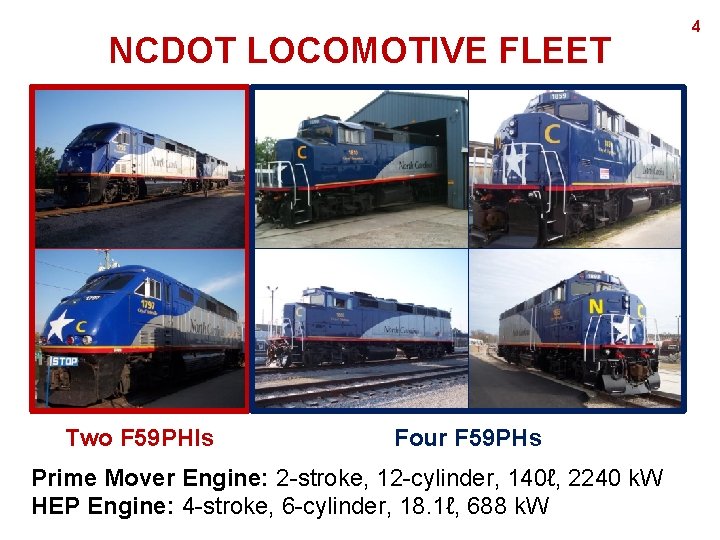
NCDOT LOCOMOTIVE FLEET Two F 59 PHIs Four F 59 PHs Prime Mover Engine: 2 -stroke, 12 -cylinder, 140ℓ, 2240 k. W HEP Engine: 4 -stroke, 6 -cylinder, 18. 1ℓ, 688 k. W 4
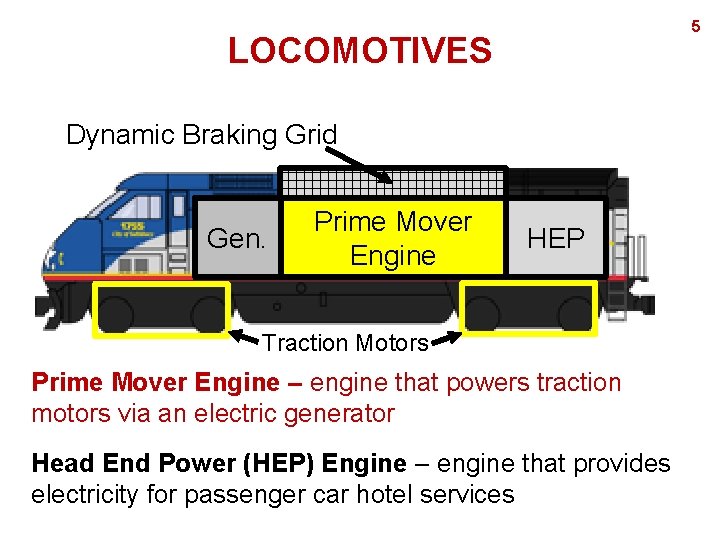
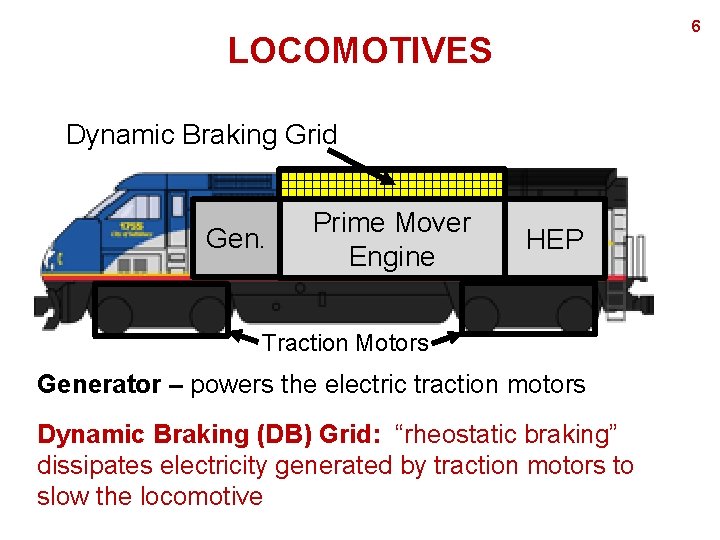
5 LOCOMOTIVES Dynamic Braking Grid Gen. Prime Mover Engine HEP Traction Motors Prime Mover Engine – engine that powers traction motors via an electric generator Head End Power (HEP) Engine – engine that provides electricity for passenger car hotel services
6 LOCOMOTIVES Dynamic Braking Grid Gen. Prime Mover Engine HEP Traction Motors Generator – powers the electric traction motors Dynamic Braking (DB) Grid: “rheostatic braking” dissipates electricity generated by traction motors to slow the locomotive
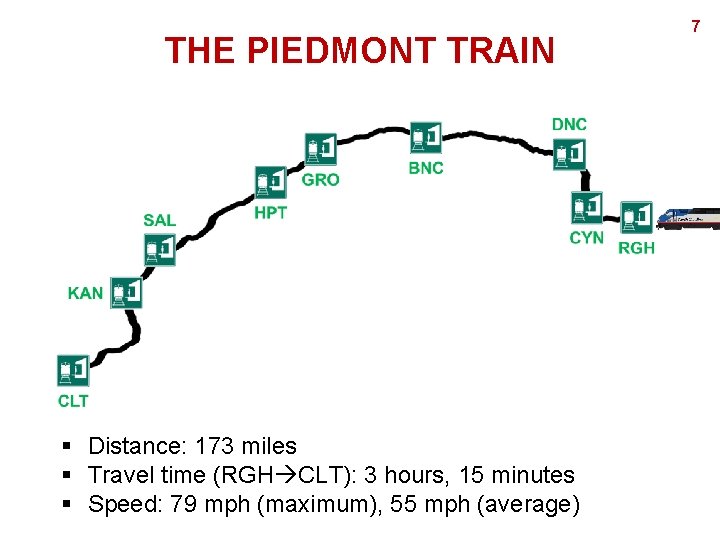
THE PIEDMONT TRAIN § Distance: 173 miles § Travel time (RGH CLT): 3 hours, 15 minutes § Speed: 79 mph (maximum), 55 mph (average) 7
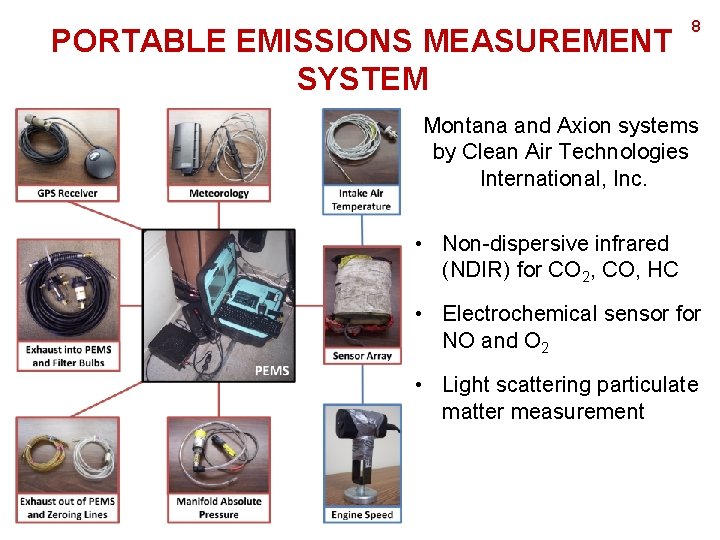
PORTABLE EMISSIONS MEASUREMENT SYSTEM 8 Montana and Axion systems by Clean Air Technologies International, Inc. • Non-dispersive infrared (NDIR) for CO 2, CO, HC • Electrochemical sensor for NO and O 2 • Light scattering particulate matter measurement
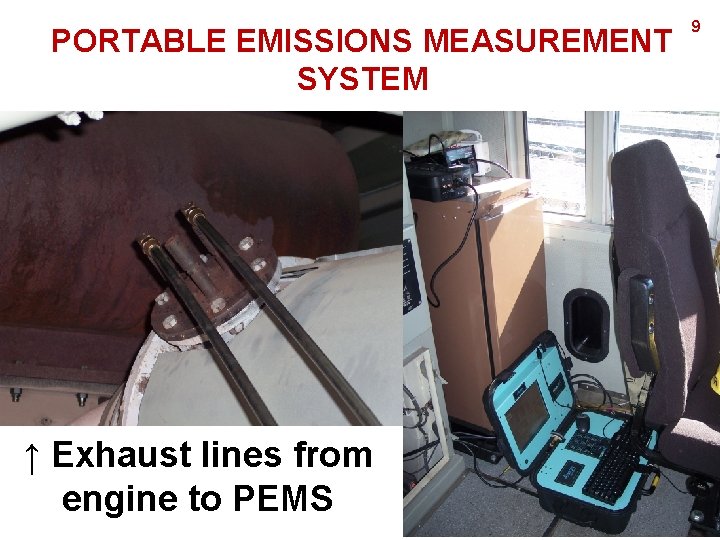
PORTABLE EMISSIONS MEASUREMENT SYSTEM ↑ Exhaust lines from engine to PEMS 9
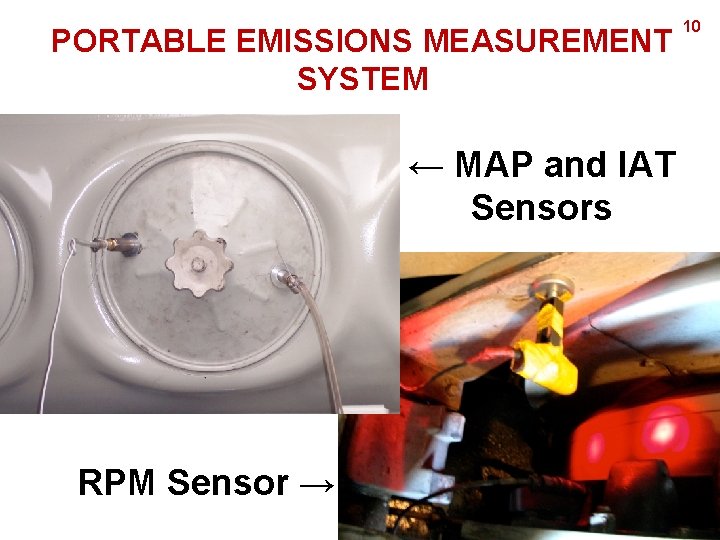
PORTABLE EMISSIONS MEASUREMENT SYSTEM 10 ← MAP and IAT Sensors RPM Sensor →
MEASUREMENT METHODS • Relatively inexpensive • Easily deployable for over-the-rail measurements • PM measurement uses a laser light scattering detection method that is useful for relative comparisons • Useful for comparative evaluations 11
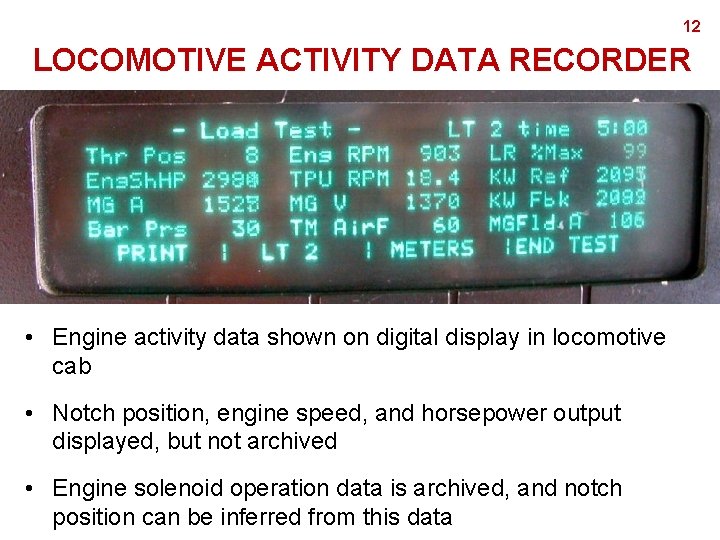
12 LOCOMOTIVE ACTIVITY DATA RECORDER • Engine activity data shown on digital display in locomotive cab • Notch position, engine speed, and horsepower output displayed, but not archived • Engine solenoid operation data is archived, and notch position can be inferred from this data
FUEL USE ESTIMATION • Not feasible to accurately measure over-the-rail fuel use • Fuel is taken from a 900 -1500 gallon onboard tank • Diesel engines return unspent fuel to the tank continuously • Exhaust flow rate is estimated based on calculation of mass air flow through the engine and inference of the air-to-fuel ratio from the measured exhaust composition 13
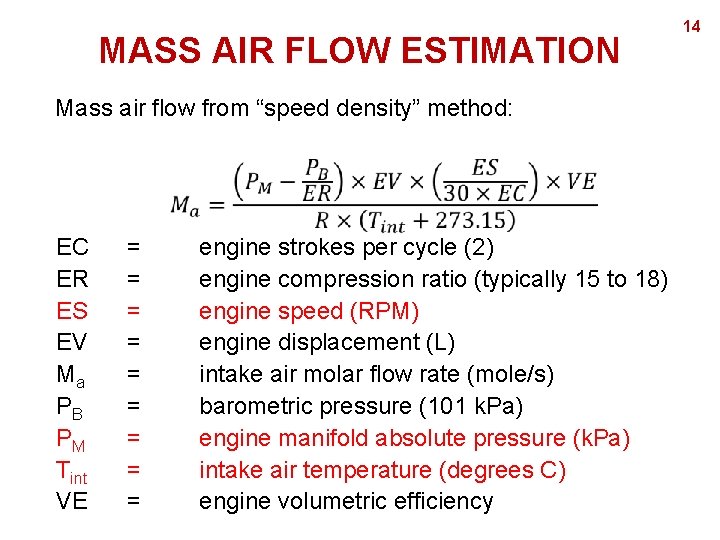
MASS AIR FLOW ESTIMATION Mass air flow from “speed density” method: EC ER ES EV Ma PB PM Tint VE = = = = = engine strokes per cycle (2) engine compression ratio (typically 15 to 18) engine speed (RPM) engine displacement (L) intake air molar flow rate (mole/s) barometric pressure (101 k. Pa) engine manifold absolute pressure (k. Pa) intake air temperature (degrees C) engine volumetric efficiency 14
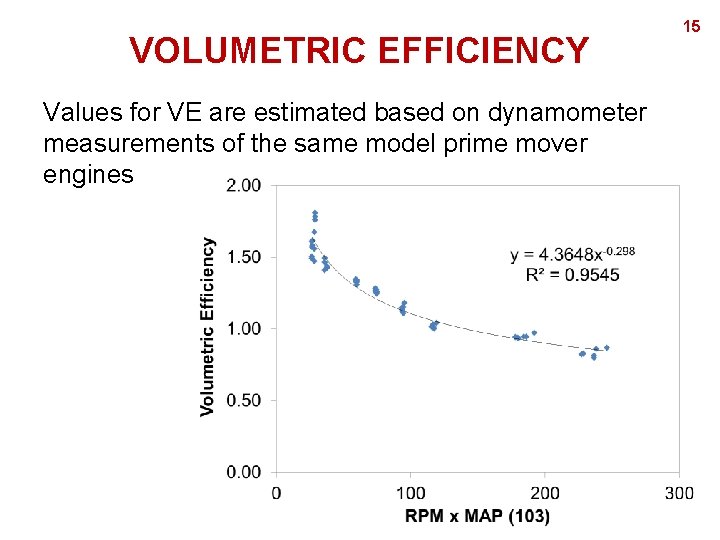
VOLUMETRIC EFFICIENCY Values for VE are estimated based on dynamometer measurements of the same model prime mover engines 15
FIELD STUDY DESIGN • Six locomotives were instrumented and measured • Three days of over-the-rail (OTR) in-use measurements • Ultra-low sulfur diesel (ULSD) This presentation – focus on NC 1797 16
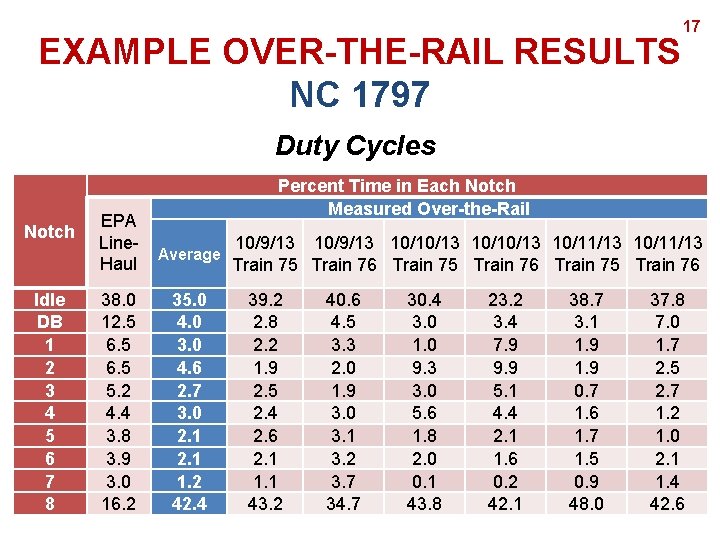
EXAMPLE OVER-THE-RAIL RESULTS NC 1797 17 Duty Cycles Notch Idle DB 1 2 3 4 5 6 7 8 EPA Line. Haul 38. 0 12. 5 6. 5 5. 2 4. 4 3. 8 3. 9 3. 0 16. 2 Percent Time in Each Notch Measured Over-the-Rail Average 35. 0 4. 0 3. 0 4. 6 2. 7 3. 0 2. 1 1. 2 42. 4 10/9/13 10/10/13 10/11/13 Train 75 Train 76 39. 2 2. 8 2. 2 1. 9 2. 5 2. 4 2. 6 2. 1 1. 1 43. 2 40. 6 4. 5 3. 3 2. 0 1. 9 3. 0 3. 1 3. 2 3. 7 34. 7 30. 4 3. 0 1. 0 9. 3 3. 0 5. 6 1. 8 2. 0 0. 1 43. 8 23. 2 3. 4 7. 9 9. 9 5. 1 4. 4 2. 1 1. 6 0. 2 42. 1 38. 7 3. 1 1. 9 0. 7 1. 6 1. 7 1. 5 0. 9 48. 0 37. 8 7. 0 1. 7 2. 5 2. 7 1. 2 1. 0 2. 1 1. 4 42. 6
VARIATIONS IN DUTY CYCLE • Engineer behavior • Weather conditions • Station delays • Rail traffic • Track maintenance 18
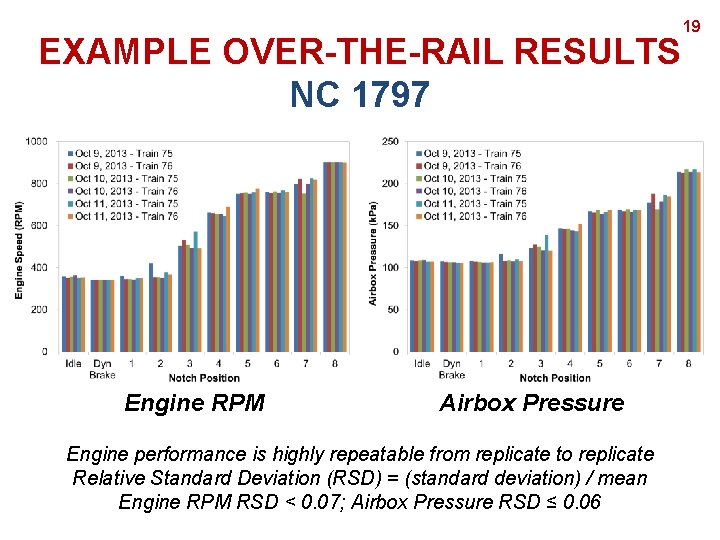
EXAMPLE OVER-THE-RAIL RESULTS NC 1797 Engine RPM Airbox Pressure Engine performance is highly repeatable from replicate to replicate Relative Standard Deviation (RSD) = (standard deviation) / mean Engine RPM RSD < 0. 07; Airbox Pressure RSD ≤ 0. 06 19
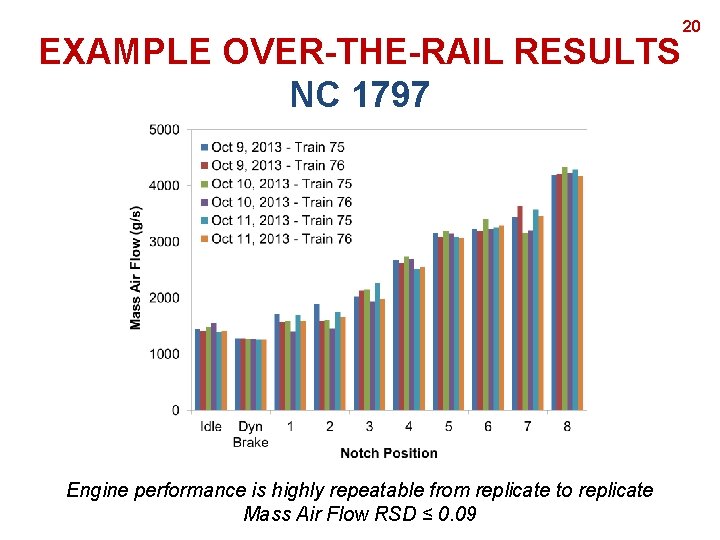
EXAMPLE OVER-THE-RAIL RESULTS NC 1797 Engine performance is highly repeatable from replicate to replicate Mass Air Flow RSD ≤ 0. 09 20
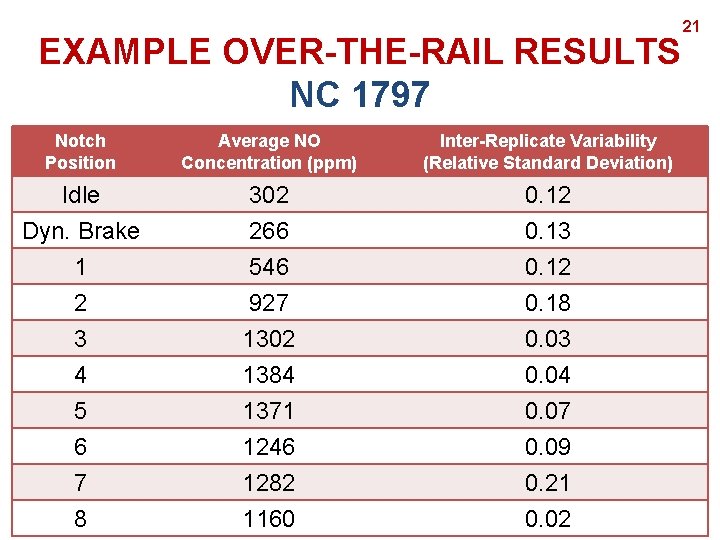
EXAMPLE OVER-THE-RAIL RESULTS NC 1797 Notch Position Average NO Concentration (ppm) Inter-Replicate Variability (Relative Standard Deviation) Idle Dyn. Brake 1 2 3 4 5 6 7 8 302 266 546 927 1302 1384 1371 1246 1282 1160 0. 12 0. 13 0. 12 0. 18 0. 03 0. 04 0. 07 0. 09 0. 21 0. 02 21
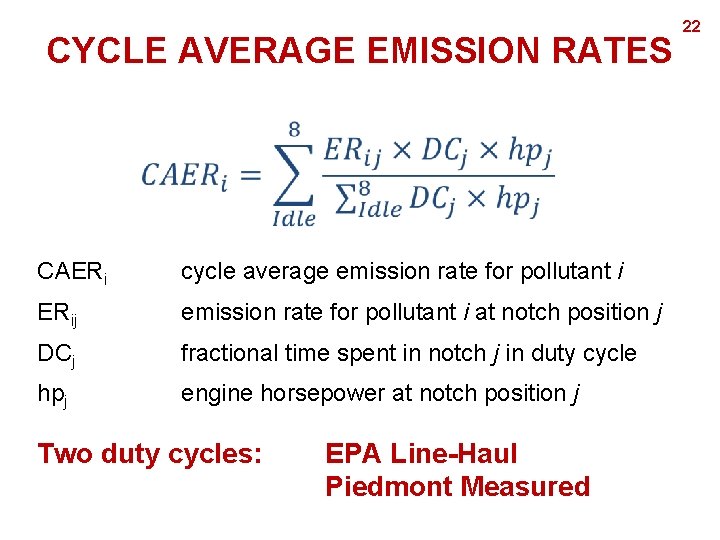
CYCLE AVERAGE EMISSION RATES CAERi cycle average emission rate for pollutant i ERij emission rate for pollutant i at notch position j DCj fractional time spent in notch j in duty cycle hpj engine horsepower at notch position j Two duty cycles: EPA Line-Haul Piedmont Measured 22
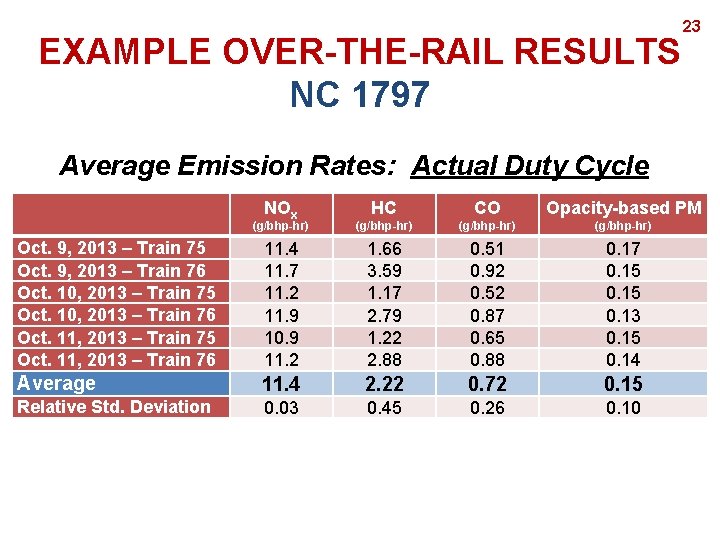
EXAMPLE OVER-THE-RAIL RESULTS NC 1797 23 Average Emission Rates: Actual Duty Cycle NOx HC CO Opacity-based PM (g/bhp-hr) Oct. 9, 2013 – Train 75 Oct. 9, 2013 – Train 76 Oct. 10, 2013 – Train 75 Oct. 10, 2013 – Train 76 Oct. 11, 2013 – Train 75 Oct. 11, 2013 – Train 76 11. 4 11. 7 11. 2 11. 9 10. 9 11. 2 1. 66 3. 59 1. 17 2. 79 1. 22 2. 88 0. 51 0. 92 0. 52 0. 87 0. 65 0. 88 0. 17 0. 15 0. 13 0. 15 0. 14 Average 11. 4 2. 22 0. 72 0. 15 Relative Std. Deviation 0. 03 0. 45 0. 26 0. 10
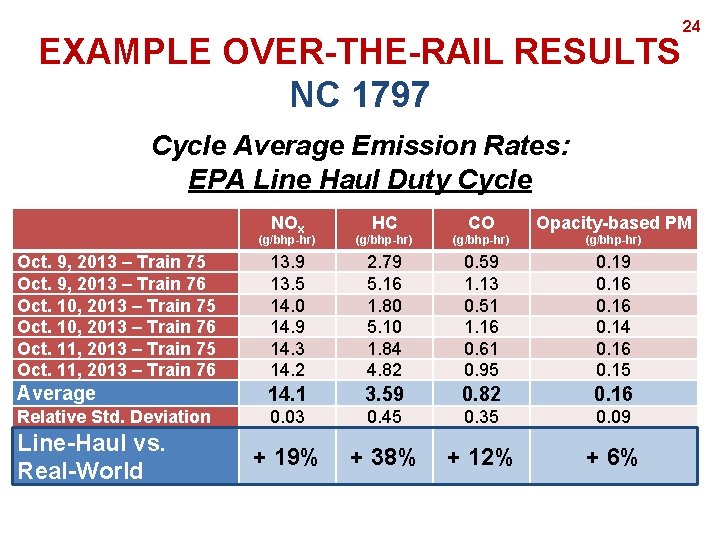
EXAMPLE OVER-THE-RAIL RESULTS NC 1797 24 Cycle Average Emission Rates: EPA Line Haul Duty Cycle HC CO Opacity-based PM (g/bhp-hr) Oct. 9, 2013 – Train 75 Oct. 9, 2013 – Train 76 Oct. 10, 2013 – Train 75 Oct. 10, 2013 – Train 76 Oct. 11, 2013 – Train 75 Oct. 11, 2013 – Train 76 13. 9 13. 5 14. 0 14. 9 14. 3 14. 2 2. 79 5. 16 1. 80 5. 10 1. 84 4. 82 0. 59 1. 13 0. 51 1. 16 0. 61 0. 95 0. 19 0. 16 0. 14 0. 16 0. 15 Average 14. 1 3. 59 0. 82 0. 16 Relative Std. Deviation 0. 03 0. 45 0. 35 0. 09 + 19% + 38% + 12% + 6% Line-Haul vs. Real-World NOx
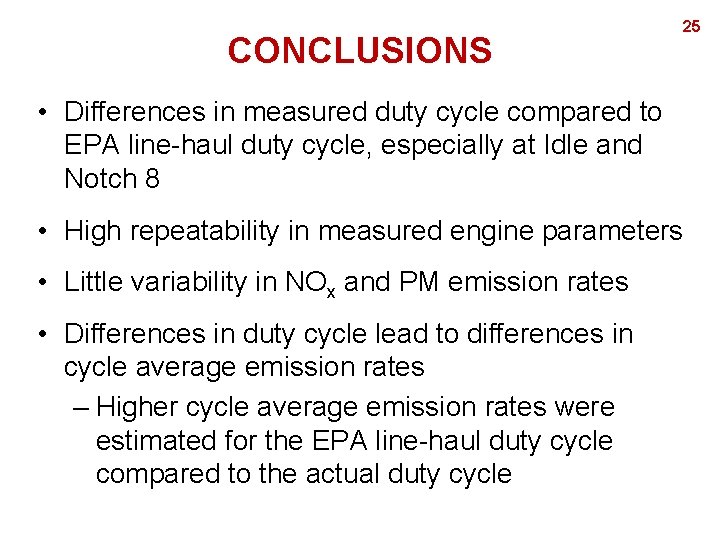
CONCLUSIONS 25 • Differences in measured duty cycle compared to EPA line-haul duty cycle, especially at Idle and Notch 8 • High repeatability in measured engine parameters • Little variability in NOx and PM emission rates • Differences in duty cycle lead to differences in cycle average emission rates – Higher cycle average emission rates were estimated for the EPA line-haul duty cycle compared to the actual duty cycle
ACKNOWLEDGEMENTS • Allan Paul of the North Carolina Department of Transportation Rail Division • Herzog Transit Services and Rail. Plan International, Inc. • Lynn Harris and Curtis Mc. Dowell of Mc. Dowell Engineers • AMTRAK Southern Division Engineers and Conductors, Raleigh Station Staff • Federal Railroad Administration of the U. S. Department of Transportation 26
Brandon M. Graver Department of Civil, Construction, and Environmental Engineering North Carolina State University Office: 919 -515 -4465 Email: bmgraver@ncsu. edu Website: www 4. ncsu. edu/~bmgraver