
Measurement of Poverty Concepts Measurements Measurement of Poverty
- Slides: 61
Measurement of Poverty: Concepts & Measurements Measurement of Poverty 1
Measurement of Poverty “The governments are very keen on amassing statistics. They collect them, add them, raise them to the nth power and take the cubed root and prepare wonderful diagrams. But you must never forget that every one of these figures comes in the first instance from the village watchman who just puts down whatever he damn well pleases. ” - Sir Josiah Stamp Measurement of Poverty 2
Measurement of Poverty Practical Concerns • Identification of Poverty Line • Defining the Unit of Measurement • Selecting the Indicator of Well-being Measurement of Poverty 3
Identification of Poverty Lines • The point at which the poor are separated from the non-poor – Relative Poverty Lines – Absolute Poverty Lines Measurement of Poverty 4
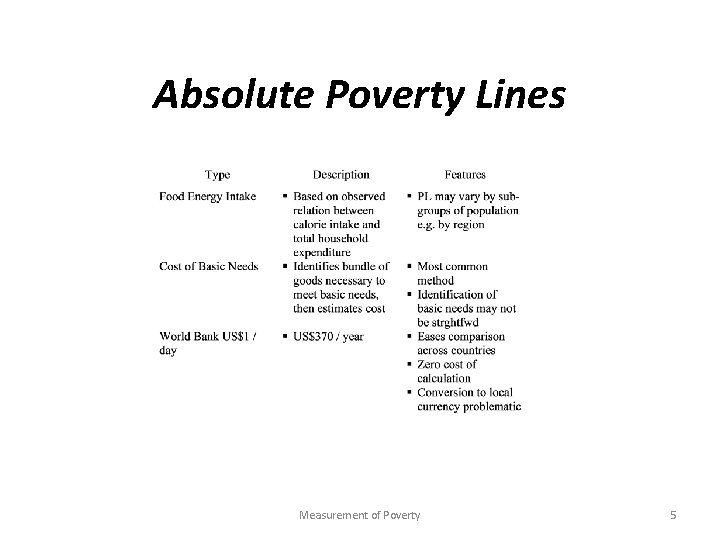
Absolute Poverty Lines Measurement of Poverty 5
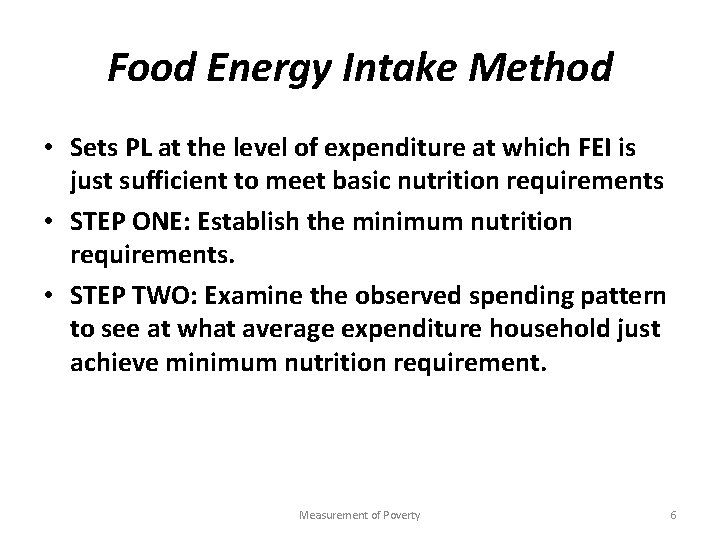
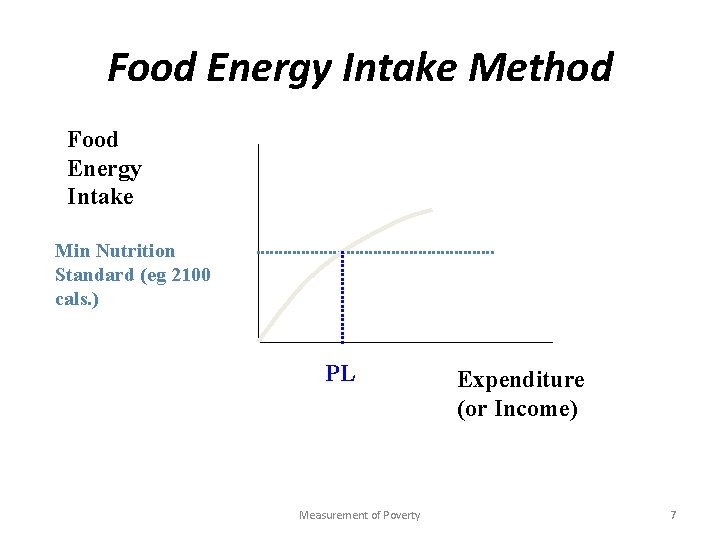
Food Energy Intake Method • Sets PL at the level of expenditure at which FEI is just sufficient to meet basic nutrition requirements • STEP ONE: Establish the minimum nutrition requirements. • STEP TWO: Examine the observed spending pattern to see at what average expenditure household just achieve minimum nutrition requirement. Measurement of Poverty 6
Food Energy Intake Method Food Energy Intake Min Nutrition Standard (eg 2100 cals. ) PL Measurement of Poverty Expenditure (or Income) 7
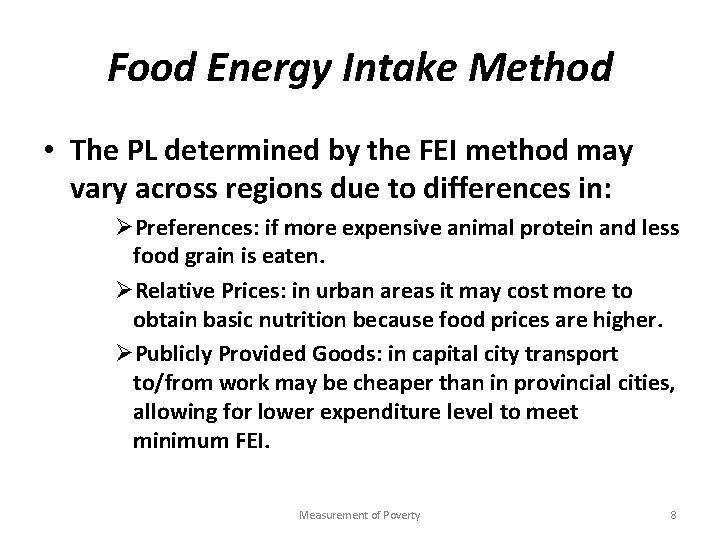
Food Energy Intake Method • The PL determined by the FEI method may vary across regions due to differences in: ØPreferences: if more expensive animal protein and less food grain is eaten. ØRelative Prices: in urban areas it may cost more to obtain basic nutrition because food prices are higher. ØPublicly Provided Goods: in capital city transport to/from work may be cheaper than in provincial cities, allowing for lower expenditure level to meet minimum FEI. Measurement of Poverty 8
Food Energy Intake Method • This method does take account of non-food purchases. Measurement of Poverty 9
Cost of Basic Needs • PL is equal to the value of a bundle of consumption goods necessary to meet basic needs ØMay include just food (extreme poverty) ØBut more commonly includes non-food items Measurement of Poverty 10
Cost of Basic Needs • STEP ONE: Establish the minimum consumption bundle necessary to meet basic needs Measurement of Poverty 11
Cost of Basic Needs • STEP TWO: Establish the cost for the items in the basic consumption bundle Measurement of Poverty 12
Additional Considerations in Setting Poverty Lines • Regional Poverty Lines ØSignificant regional price differences may exist ØUrban / Rural poverty lines common • Sensitivity Analysis ØTypically near mode of distribution ØMultiple poverty lines often tried Measurement of Poverty 13
Distribution of Expenditure Mexico, 1992 Measurement of Poverty 14
Cumulative Distribution of Expenditure Mexico, 1992 Measurement of Poverty 15
Measurement of Poverty Practical Concerns • Identification of Poverty Line • Defining the Unit of Measurement • Selecting the Indicator of Well-being Measurement of Poverty 16
Defining the Unit of Measurement Ø Household vs. Individual Ø Adjusting for differences among HH ØAdjusting for the age / gender of HH members ØAdjusting for HH size Measurement of Poverty 17
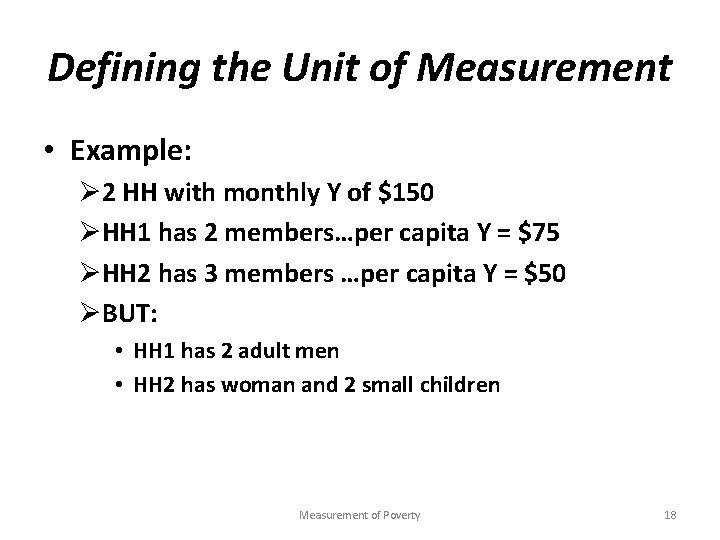
Defining the Unit of Measurement • Example: Ø 2 HH with monthly Y of $150 ØHH 1 has 2 members…per capita Y = $75 ØHH 2 has 3 members …per capita Y = $50 ØBUT: • HH 1 has 2 adult men • HH 2 has woman and 2 small children Measurement of Poverty 18
Equivalence Scales and Economies of Scale • HH size is often measured in “adult equivalent” units Øeach member of the HH counts as some fraction of an adult male ØEconomies of scales can then be accounted for by scaling the adult equivalent units Measurement of Poverty 19
Equivalence Scales and Economies of Scale • Many different methodologies are followed within two basic approaches ØFixed Scales ØEstimated Scales Measurement of Poverty 20
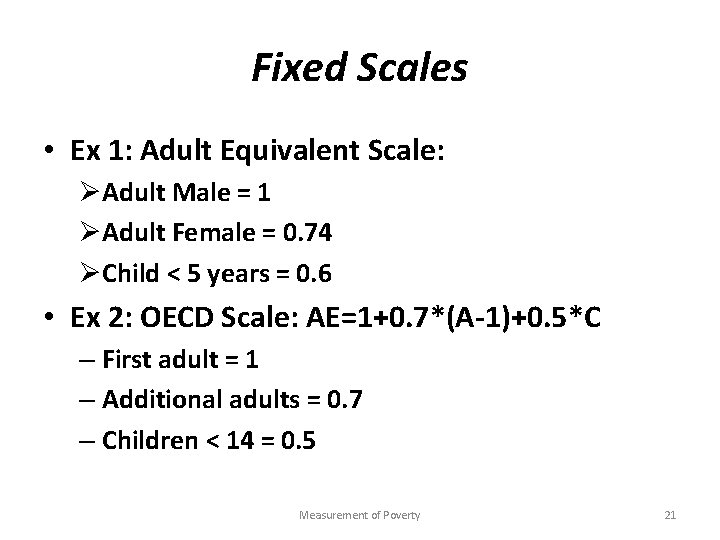
Fixed Scales • Ex 1: Adult Equivalent Scale: ØAdult Male = 1 ØAdult Female = 0. 74 ØChild < 5 years = 0. 6 • Ex 2: OECD Scale: AE=1+0. 7*(A-1)+0. 5*C – First adult = 1 – Additional adults = 0. 7 – Children < 14 = 0. 5 Measurement of Poverty 21
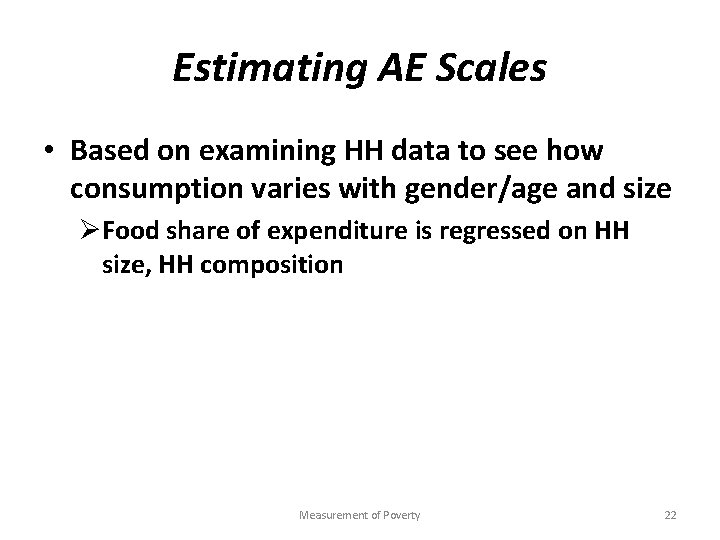
Estimating AE Scales • Based on examining HH data to see how consumption varies with gender/age and size ØFood share of expenditure is regressed on HH size, HH composition Measurement of Poverty 22
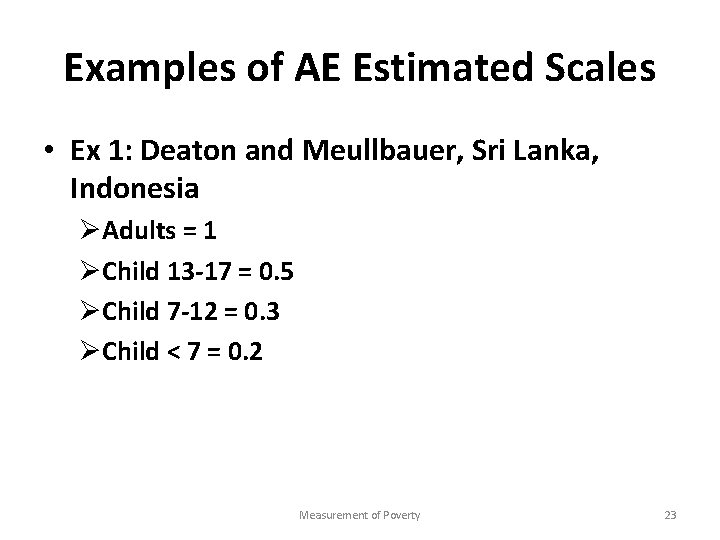
Examples of AE Estimated Scales • Ex 1: Deaton and Meullbauer, Sri Lanka, Indonesia ØAdults = 1 ØChild 13 -17 = 0. 5 ØChild 7 -12 = 0. 3 ØChild < 7 = 0. 2 Measurement of Poverty 23
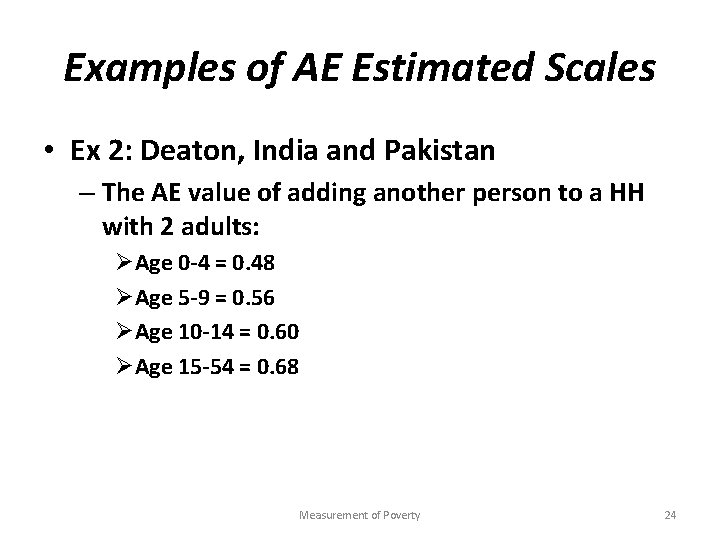
Examples of AE Estimated Scales • Ex 2: Deaton, India and Pakistan – The AE value of adding another person to a HH with 2 adults: ØAge 0 -4 = 0. 48 ØAge 5 -9 = 0. 56 ØAge 10 -14 = 0. 60 ØAge 15 -54 = 0. 68 Measurement of Poverty 24
What is a HH? • UN definition: – “Group of people who eat together” • But: how long must one be a resident to be counted as part of a HH – Students, migrant workers, etc. Measurement of Poverty 25
Measurement of Poverty Practical Concerns • Identification of Poverty Line • Defining the Unit of Measurement • Selecting the Indicator of Well-being Measurement of Poverty 26
Selecting the Indicator of Well-being • Monetary Measure of Welfare ØIncome ØExpenditure • Non-Monetary Measures of Welfare ØDirect Measures ØSubjective Measures Measurement of Poverty 27
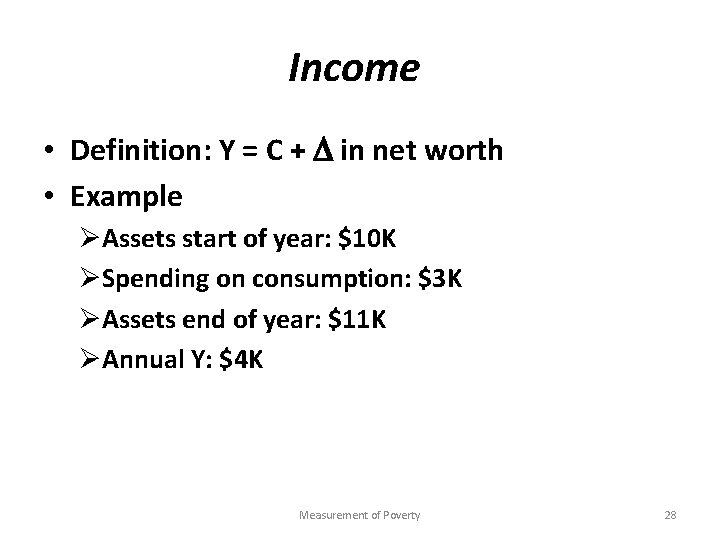
Income • Definition: Y = C + in net worth • Example ØAssets start of year: $10 K ØSpending on consumption: $3 K ØAssets end of year: $11 K ØAnnual Y: $4 K Measurement of Poverty 28
Problems with Income as Welfare Measure • Conceptual Problems – Goal is to measure HH ability to meet basic needs, but Y is just one factor • access to credit, public services, access, etc. are other factors that determine ability to meet basic needs Measurement of Poverty 29
Problems with Income as Welfare Measure • Measurement Problems – Understating of Y ØDifficult to recall of Y, especially when Y flow is erratic as in the informal sector ØFear of tax collector ØIllegally earned Y ØSeparating inputs from revenue in agriculture ØAccounting for own consumption of output Measurement of Poverty 30
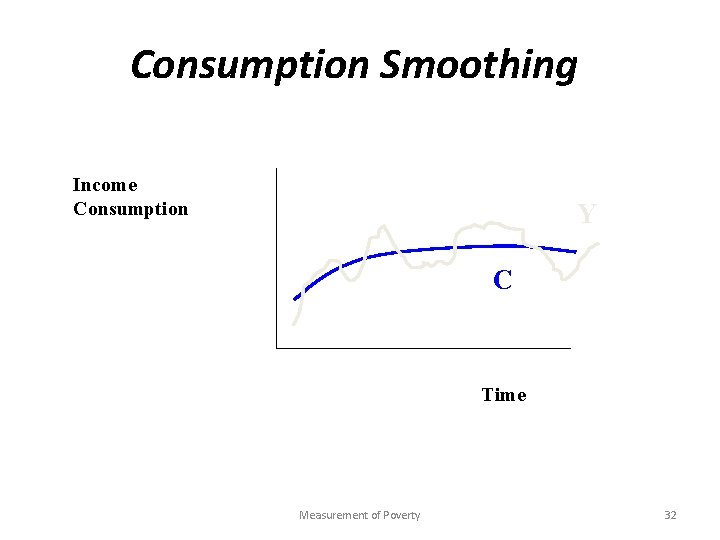
Expenditure • Generally preferred to Income – Is more direct measure of what is consumed – Less volatile than Y • Consumption smoothing. . . Measurement of Poverty 31
Consumption Smoothing Income Consumption Y C Time Measurement of Poverty 32
Calculating Y or Expenditure for HH • How do we measure Y / Expenditure? • What is included? • NB: HH may be both producers and consumers Measurement of Poverty 33
Measuring Y and Expenditure HH as Consumer Measurement of Poverty 34
Measuring Y and Expenditure Household as Producer Measurement of Poverty 35
Calculating Y and Expenditure • Must not include: ØInputs into HH production, like money spent on seeds, fertilizer ØExpenditure on investment, like purchase of tools Measurement of Poverty 36
Calculating Y and Expenditure • Should include: ØHousing for owner-occupied dwellings ØExpenditure on durable goods Measurement of Poverty 37
Non-Monetary Measure of Welfare • Direct Welfare Measures ØNutrition Poverty ØHealth Poverty ØEducation Poverty Measurement of Poverty 38
Nutrition Poverty • Input – Example: Calories per day • Outcomes – Example: Malnutrition Measurement of Poverty 39
Health Poverty • Outcomes – Ex: life expectancy, infection rates • Inputs – Ex: vaccination rates Measurement of Poverty 40
Education Poverty • Outcomes – Ex: Literacy rates • Inputs: – Ex: Enrolment numbers Measurement of Poverty 41
Subjective Measures • HH may be asked directly about their welfare • HH may be asked to establish minimum standards • Community indicators may be established Measurement of Poverty 42
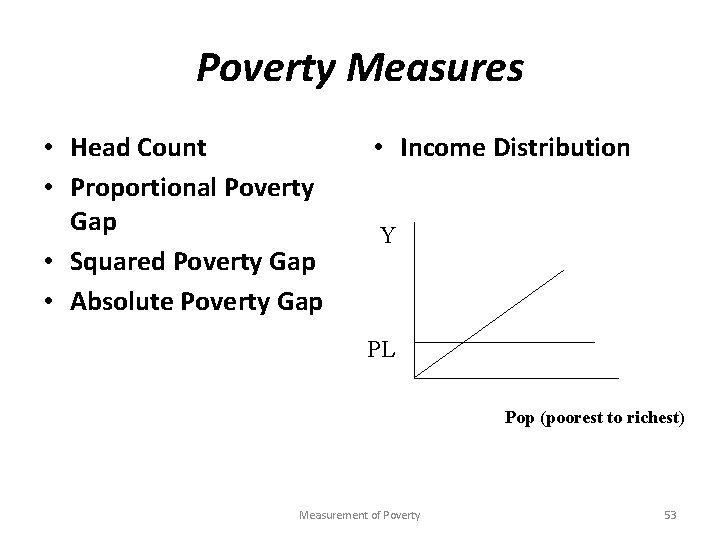
Poverty Measures • We may want to measure poverty directly instead of looking at Y and inequality together • The most commonly used poverty measures are: ØHead Count Index ØPoverty Gap ØProportional Poverty Gap ØSquared Poverty Gap Measurement of Poverty 43
Head Count Index • HCI = (# poor) / (population) • Measures the “incidence” of poverty – i. e. it tells us “How many poor” Measurement of Poverty 44
Head Count Index • Simplest and most commonly used measure • Limitations: ØDoes not account for depth of poverty; i. e. it does not tell us how far below the poverty line the poor are. • Advantages: ØSimple to understand, straightforward interpretation. ØAdditive across populations. Measurement of Poverty 45
Regional Head Count Estimates Extreme Poverty <$275/year Measurement of Poverty 46
Regional Head Count Estimates Moderate Poverty < $370/year Measurement of Poverty 47
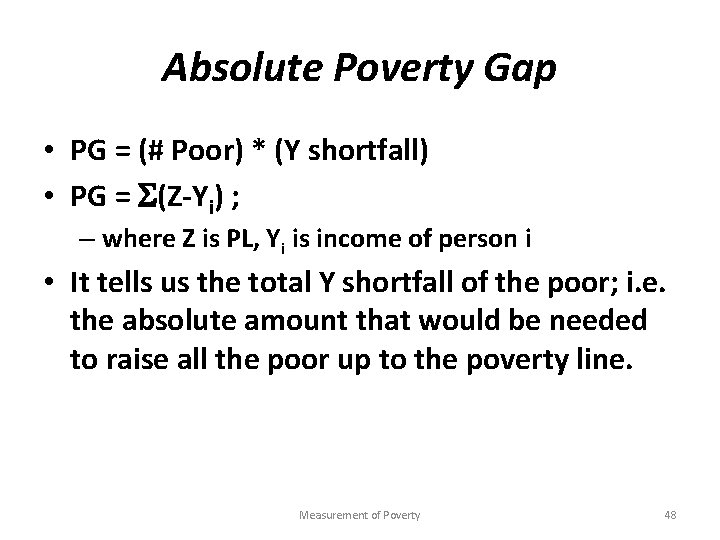
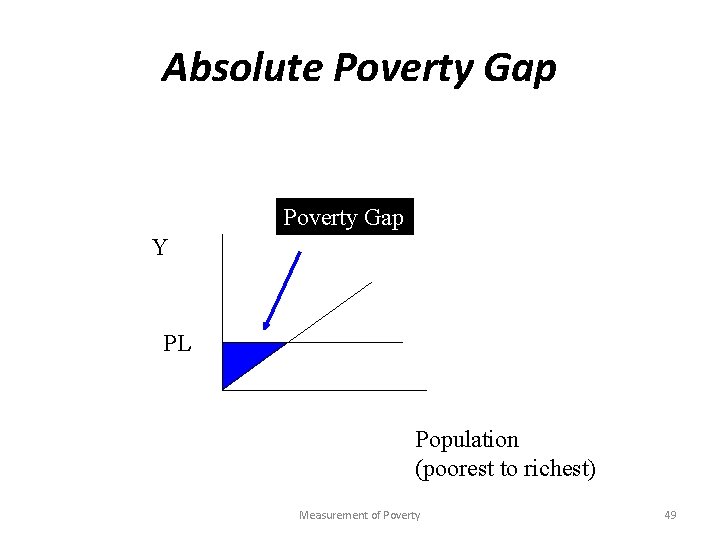
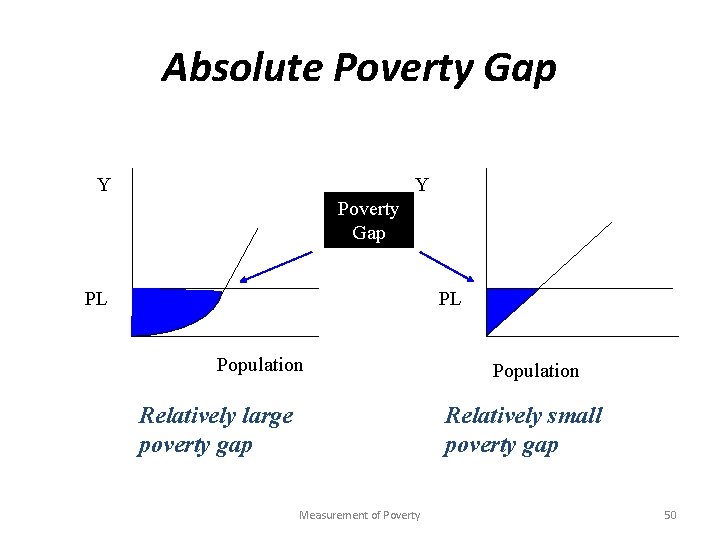
Absolute Poverty Gap • PG = (# Poor) * (Y shortfall) • PG = (Z-Yi) ; – where Z is PL, Yi is income of person i • It tells us the total Y shortfall of the poor; i. e. the absolute amount that would be needed to raise all the poor up to the poverty line. Measurement of Poverty 48
Absolute Poverty Gap Y PL Population (poorest to richest) Measurement of Poverty 49
Absolute Poverty Gap Y Y Poverty Gap PL PL Population Relatively large poverty gap Population Relatively small poverty gap Measurement of Poverty 50
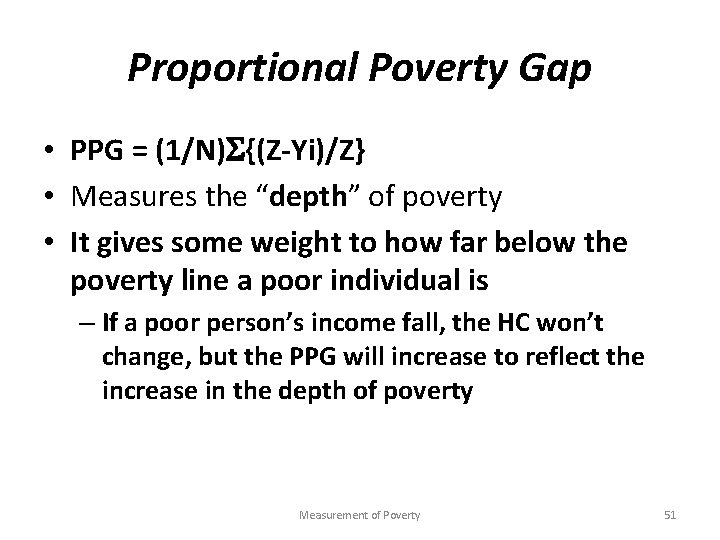
Proportional Poverty Gap • PPG = (1/N) {(Z-Yi)/Z} • Measures the “depth” of poverty • It gives some weight to how far below the poverty line a poor individual is – If a poor person’s income fall, the HC won’t change, but the PPG will increase to reflect the increase in the depth of poverty Measurement of Poverty 51
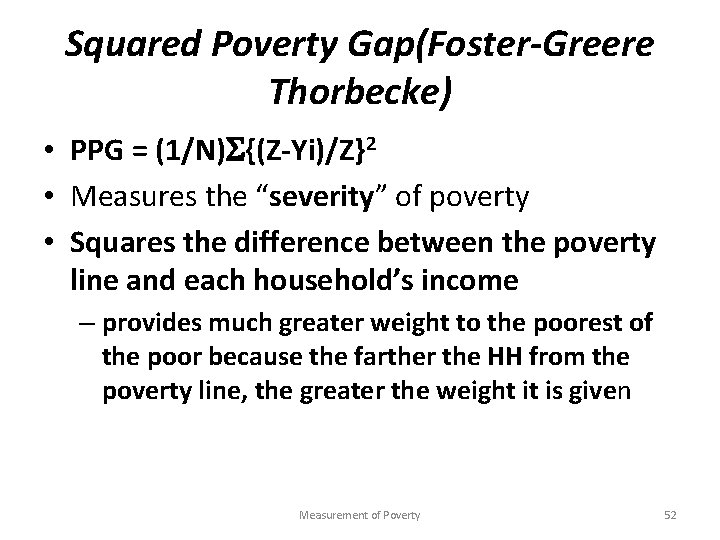
Squared Poverty Gap(Foster-Greere Thorbecke) • PPG = (1/N) {(Z-Yi)/Z}2 • Measures the “severity” of poverty • Squares the difference between the poverty line and each household’s income – provides much greater weight to the poorest of the poor because the farther the HH from the poverty line, the greater the weight it is given Measurement of Poverty 52
Poverty Measures • Head Count • Proportional Poverty Gap • Squared Poverty Gap • Absolute Poverty Gap • Income Distribution Y PL Pop (poorest to richest) Measurement of Poverty 53
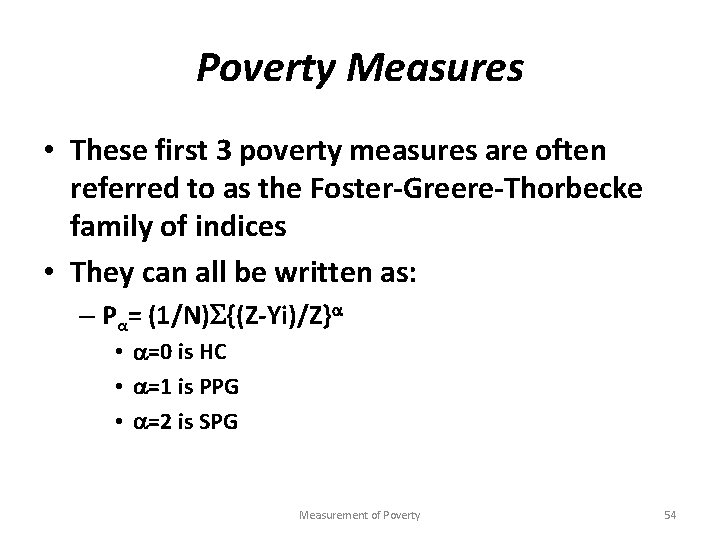
Poverty Measures • These first 3 poverty measures are often referred to as the Foster-Greere-Thorbecke family of indices • They can all be written as: – Pα= (1/N) {(Z-Yi)/Z} • =0 is HC • =1 is PPG • =2 is SPG Measurement of Poverty 54
Poverty Measures from Mexico Measurement of Poverty 55
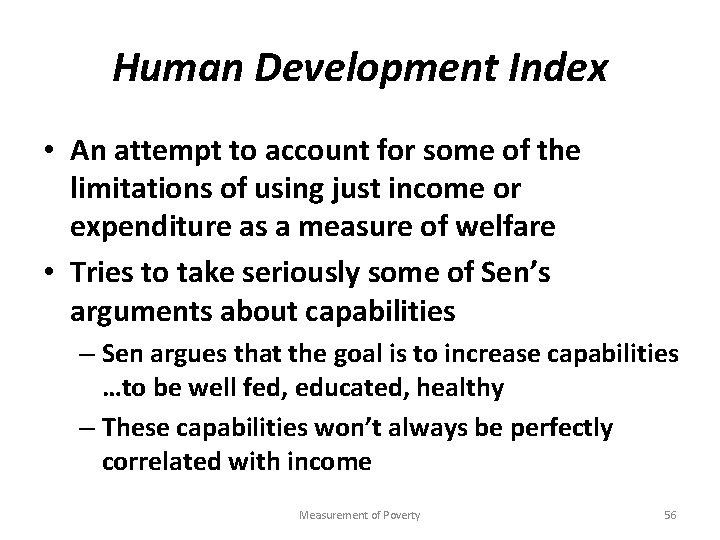
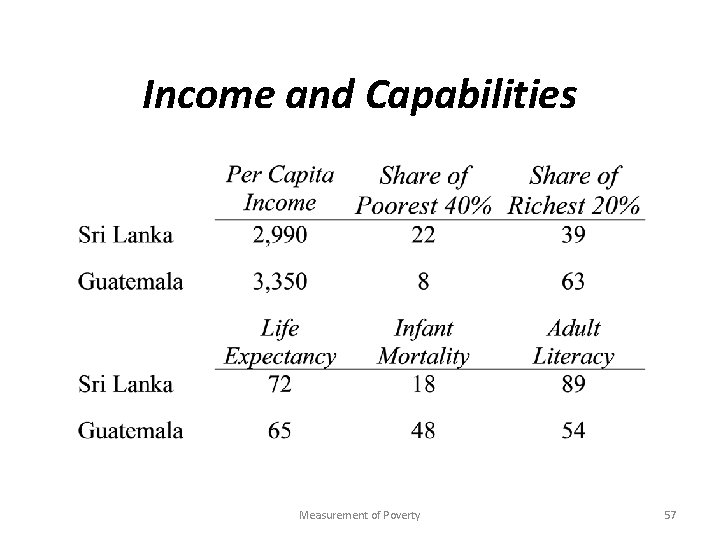
Human Development Index • An attempt to account for some of the limitations of using just income or expenditure as a measure of welfare • Tries to take seriously some of Sen’s arguments about capabilities – Sen argues that the goal is to increase capabilities …to be well fed, educated, healthy – These capabilities won’t always be perfectly correlated with income Measurement of Poverty 56
Income and Capabilities Measurement of Poverty 57
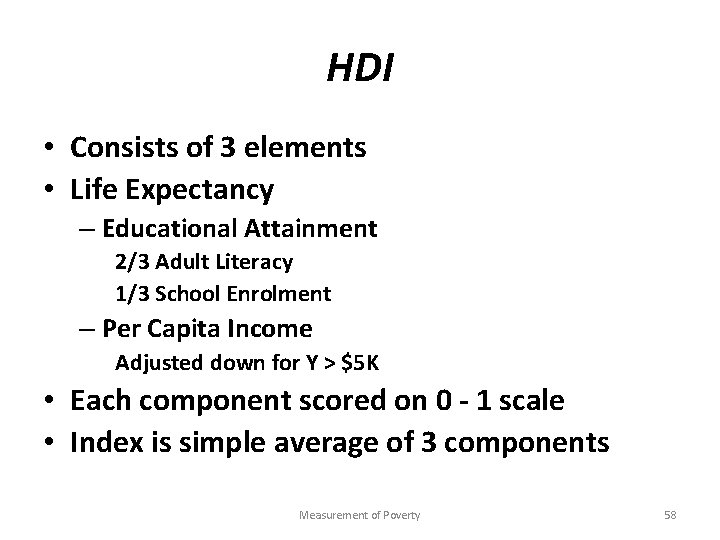
HDI • Consists of 3 elements • Life Expectancy – Educational Attainment 2/3 Adult Literacy 1/3 School Enrolment – Per Capita Income Adjusted down for Y > $5 K • Each component scored on 0 - 1 scale • Index is simple average of 3 components Measurement of Poverty 58
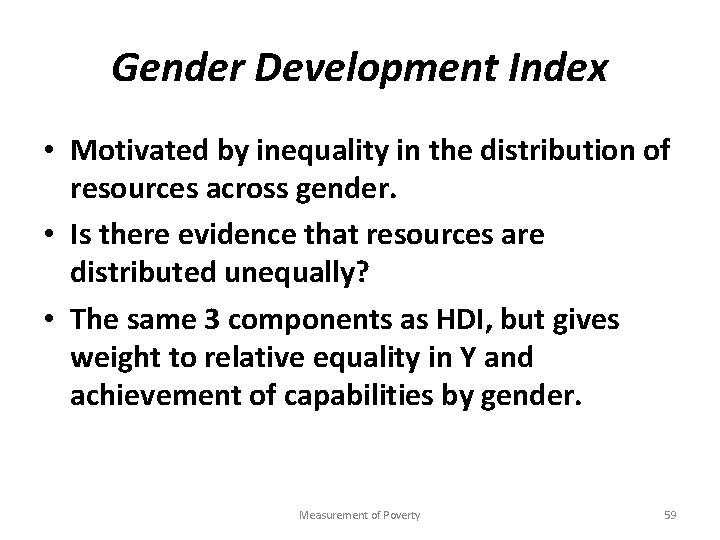
Gender Development Index • Motivated by inequality in the distribution of resources across gender. • Is there evidence that resources are distributed unequally? • The same 3 components as HDI, but gives weight to relative equality in Y and achievement of capabilities by gender. Measurement of Poverty 59
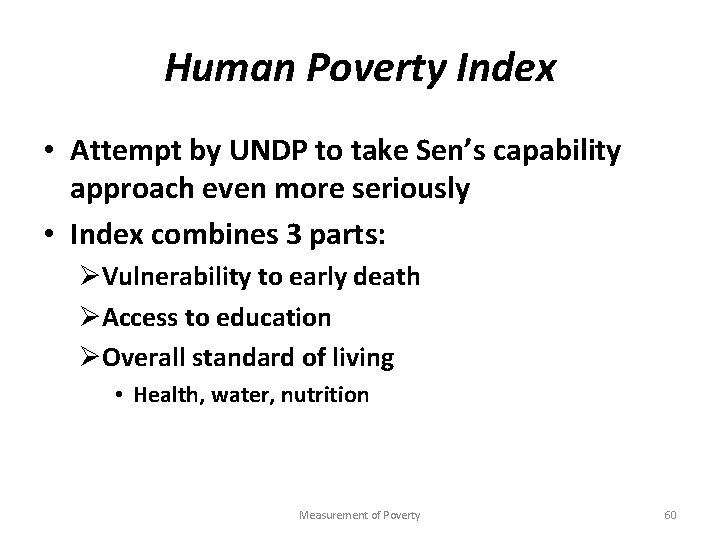
Human Poverty Index • Attempt by UNDP to take Sen’s capability approach even more seriously • Index combines 3 parts: ØVulnerability to early death ØAccess to education ØOverall standard of living • Health, water, nutrition Measurement of Poverty 60
Measurement of Poverty The secret of truth is that there are no facts, only stories. - Joao Ubaldo Ribeira Brazilian novelist Measurement of Poverty 61