
Measurement of particle contamination in vacuum at the
- Slides: 8
Measurement of particle contamination in vacuum at the cryomodule section on the Linear IFMIF Prototype Accelerator T. Ebisawa A), K. Kondo A), A. Kasugai A), K. Sakamoto A), E. Kako B), H. Sakai B), K. Umemori B), N. Bazin C), S. Berry C), G. Phillips D), F. Scantamburlo D), H. Dzitko D), P. Cara E) AQST, BKEK, CCEA, DF 4 E, EIFMIF/EVEDA Project Team LIPAc Accelerator Administration & Research TTC(TESLA Technology Collaboration) meeting 2020 CERN – 6 st February 2020 Linear IFMIF Prototype Accelerator (LIPAc) Rokkasho Fusion Institute (BA Site)
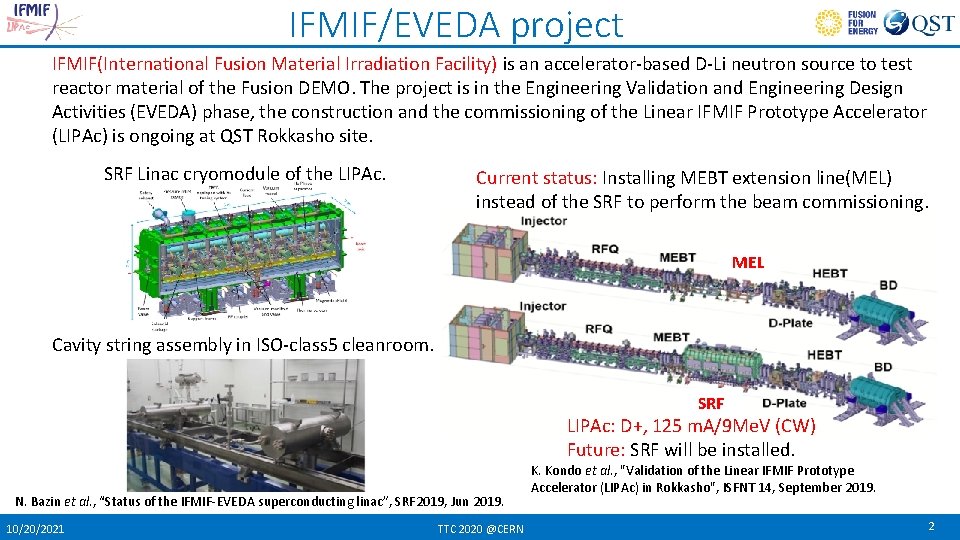
IFMIF/EVEDA project IFMIF(International Fusion Material Irradiation Facility) is an accelerator-based D-Li neutron source to test reactor material of the Fusion DEMO. The project is in the Engineering Validation and Engineering Design Activities (EVEDA) phase, the construction and the commissioning of the Linear IFMIF Prototype Accelerator (LIPAc) is ongoing at QST Rokkasho site. SRF Linac cryomodule of the LIPAc. Current status: Installing MEBT extension line(MEL) instead of the SRF to perform the beam commissioning. MEL Cavity string assembly in ISO-class 5 cleanroom. SRF LIPAc: D+, 125 m. A/9 Me. V (CW) Future: SRF will be installed. N. Bazin et al. , “Status of the IFMIF-EVEDA superconducting linac”, SRF 2019, Jun 2019. 10/20/2021 TTC 2020 @CERN K. Kondo et al. , "Validation of the Linear IFMIF Prototype Accelerator (LIPAc) in Rokkasho", ISFNT 14, September 2019. 2
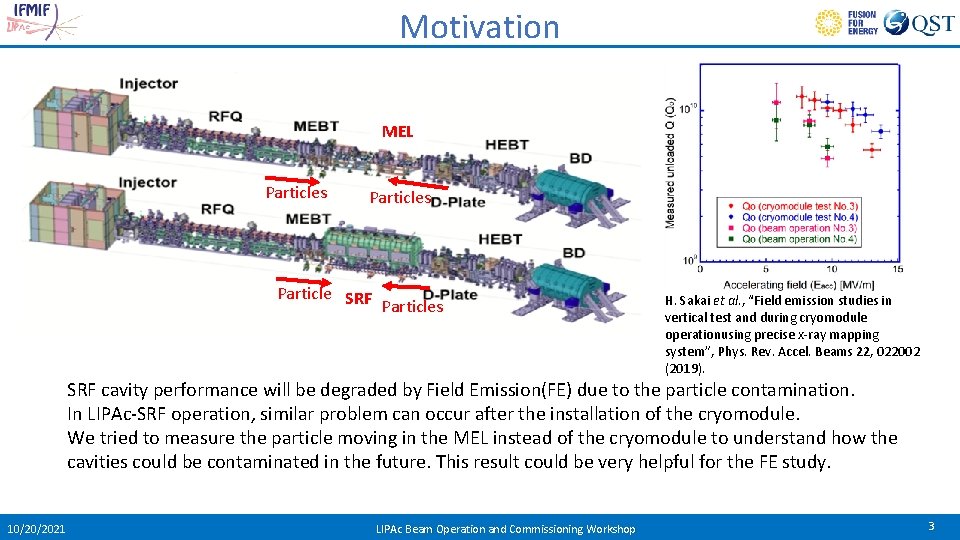
Motivation MEL Particles Particle SRF Particles H. Sakai et al. , “Field emission studies in vertical test and during cryomodule operationusing precise x-ray mapping system”, Phys. Rev. Accel. Beams 22, 022002 (2019). SRF cavity performance will be degraded by Field Emission(FE) due to the particle contamination. In LIPAc-SRF operation, similar problem can occur after the installation of the cryomodule. We tried to measure the particle moving in the MEL instead of the cryomodule to understand how the cavities could be contaminated in the future. This result could be very helpful for the FE study. 10/20/2021 LIPAc Beam Operation and Commissioning Workshop 3
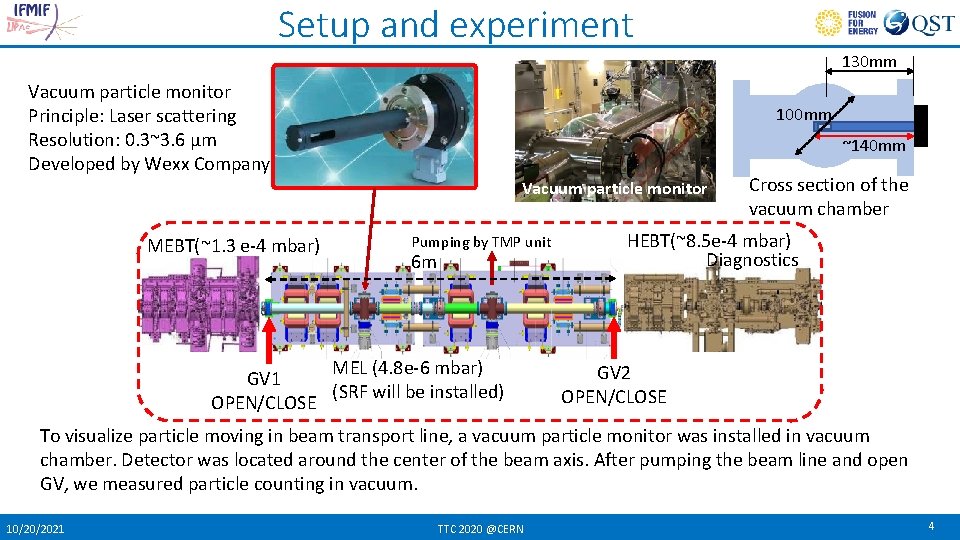
Setup and experiment 130 mm Vacuum particle monitor Principle: Laser scattering Resolution: 0. 3~3. 6 µm Developed by Wexx Company 100 mm GV ~140 mm Vacuum particle monitor MEBT(~1. 3 e-4 mbar) Pumping by TMP unit 6 m MEL (4. 8 e-6 mbar) GV 1 (SRF will be installed) OPEN/CLOSE Cross section of the vacuum chamber HEBT(~8. 5 e-4 mbar) Diagnostics GV 2 OPEN/CLOSE To visualize particle moving in beam transport line, a vacuum particle monitor was installed in vacuum chamber. Detector was located around the center of the beam axis. After pumping the beam line and open GV, we measured particle counting in vacuum. 10/20/2021 TTC 2020 @CERN 4
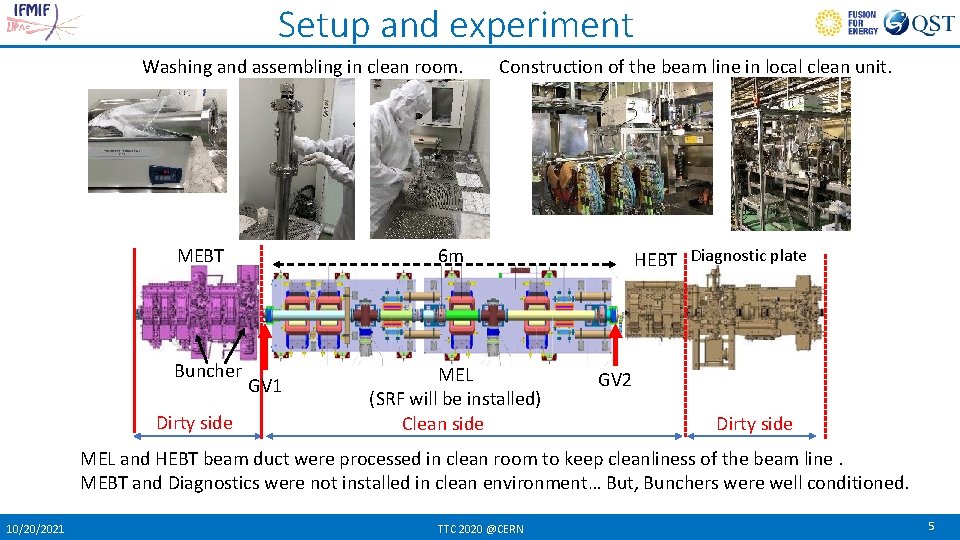
Setup and experiment Washing and assembling in clean room. Construction of the beam line in local clean unit. Vacuum particle monitor 6 m MEBT Buncher Dirty side GV 1 MEL (SRF will be installed) Clean side HEBT Diagnostic plate GV 2 Dirty side MEL and HEBT beam duct were processed in clean room to keep cleanliness of the beam line. MEBT and Diagnostics were not installed in clean environment… But, Bunchers were well conditioned. 10/20/2021 TTC 2020 @CERN 5
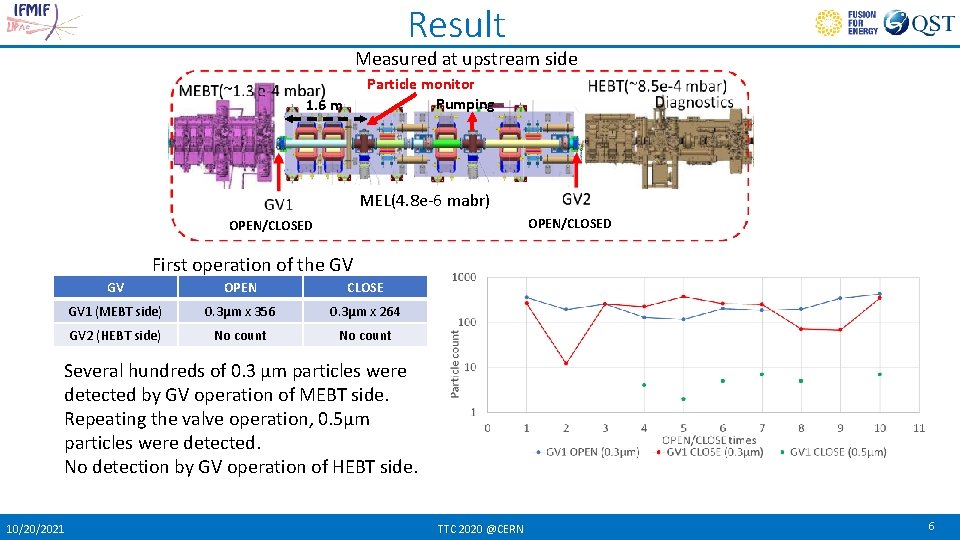
Result Measured at upstream side Particle monitor Pumping 1. 6 m MEL(4. 8 e-6 mabr) Vacuum particle monitor OPEN/CLOSED First operation of the GV GV OPEN CLOSE GV 1 (MEBT side) 0. 3µm x 356 0. 3µm x 264 GV 2 (HEBT side) No count Several hundreds of 0. 3 µm particles were detected by GV operation of MEBT side. Repeating the valve operation, 0. 5µm particles were detected. No detection by GV operation of HEBT side. 10/20/2021 TTC 2020 @CERN 6
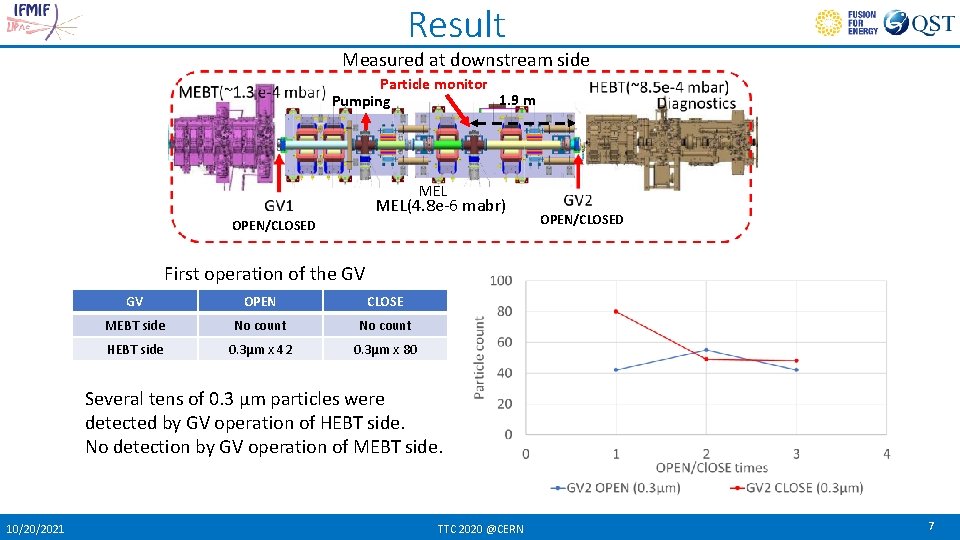
Result Measured at downstream side Particle monitor 1. 9 m Pumping 1. 9 m MEL(4. 8 e-6 mabr) OPEN/CLOSED First operation of the GV GV OPEN CLOSE MEBT side No count HEBT side 0. 3µm x 42 0. 3µm x 80 Several tens of 0. 3 µm particles were detected by GV operation of HEBT side. No detection by GV operation of MEBT side. 10/20/2021 TTC 2020 @CERN 7
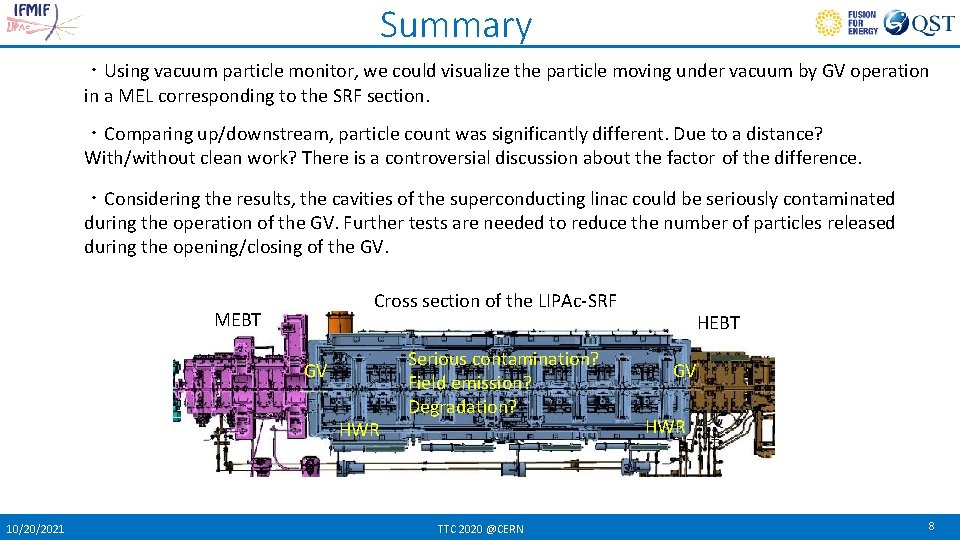
Summary ・Using vacuum particle monitor, we could visualize the particle moving under vacuum by GV operation in a MEL corresponding to the SRF section. ・Comparing up/downstream, particle count was significantly different. Due to a distance? With/without clean work? There is a controversial discussion about the factor of the difference. ・Considering the results, the cavities of the superconducting linac could be seriously contaminated during the operation of the GV. Further tests are needed to reduce the number of particles released during the opening/closing of the GV. Cross section of the LIPAc-SRF MEBT GV HWR 10/20/2021 Serious contamination? Field emission? Degradation? TTC 2020 @CERN HEBT GV HWR 8