
Measurement of Motion SelfInduction Transducers Coil is activated
- Slides: 11
• Measurement of Motion
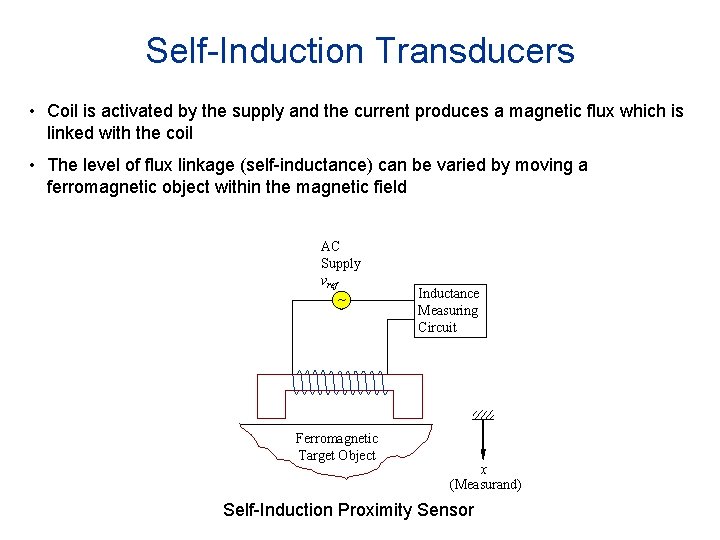
Self-Induction Transducers • Coil is activated by the supply and the current produces a magnetic flux which is linked with the coil • The level of flux linkage (self-inductance) can be varied by moving a ferromagnetic object within the magnetic field AC Supply vref ~ Ferromagnetic Target Object Inductance Measuring Circuit x (Measurand) Self-Induction Proximity Sensor
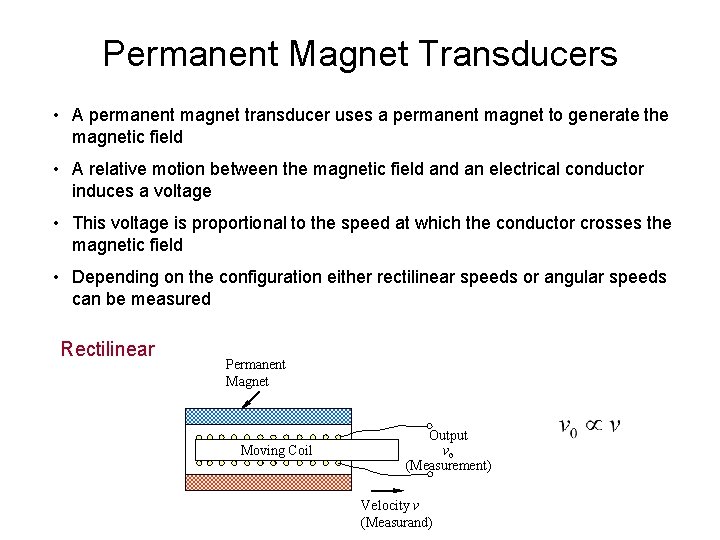
Permanent Magnet Transducers • A permanent magnet transducer uses a permanent magnet to generate the magnetic field • A relative motion between the magnetic field an electrical conductor induces a voltage • This voltage is proportional to the speed at which the conductor crosses the magnetic field • Depending on the configuration either rectilinear speeds or angular speeds can be measured Rectilinear Permanent Magnet Moving Coil Output vo (Measurement) Velocity v (Measurand)
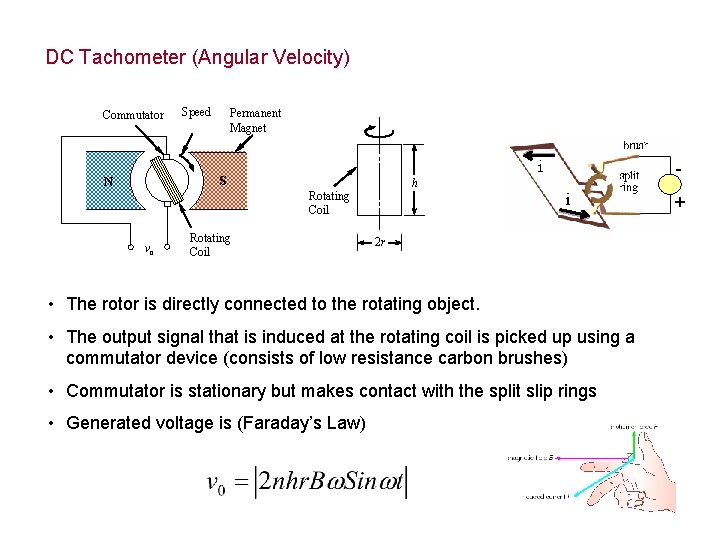
DC Tachometer (Angular Velocity) Commutator Speed Permanent Magnet S N h Rotating Coil vo Rotating Coil + 2 r • The rotor is directly connected to the rotating object. • The output signal that is induced at the rotating coil is picked up using a commutator device (consists of low resistance carbon brushes) • Commutator is stationary but makes contact with the split slip rings • Generated voltage is (Faraday’s Law) -
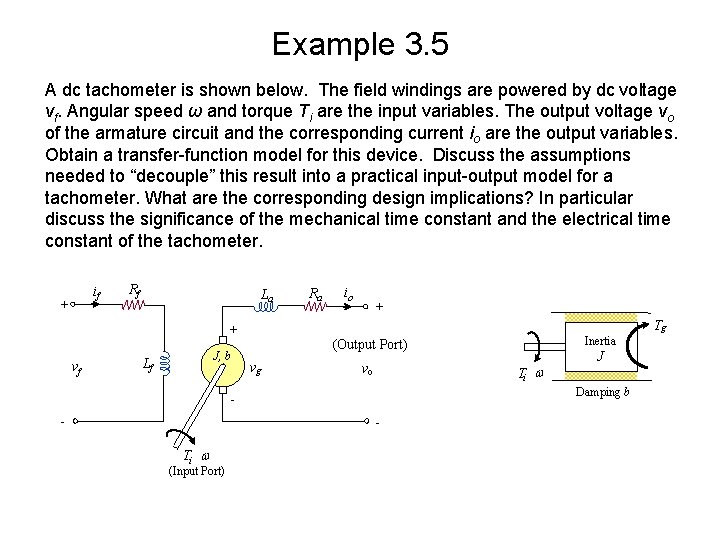
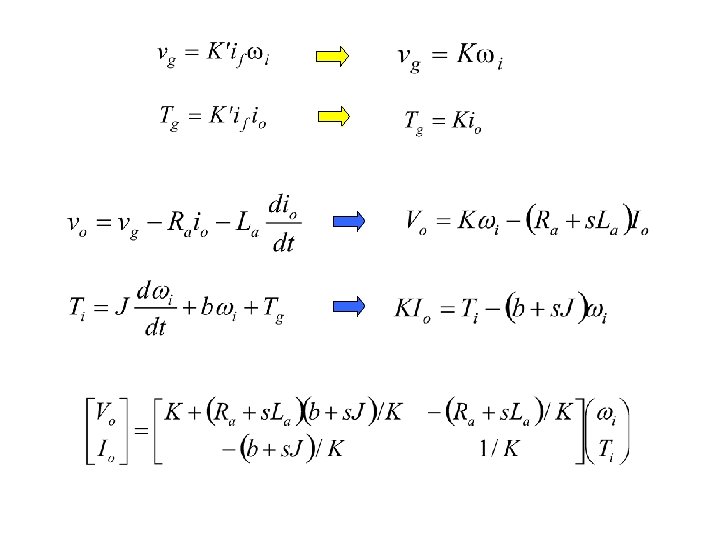
Example 3. 5 A dc tachometer is shown below. The field windings are powered by dc voltage vf. Angular speed ω and torque Ti are the input variables. The output voltage vo of the armature circuit and the corresponding current io are the output variables. Obtain a transfer-function model for this device. Discuss the assumptions needed to “decouple” this result into a practical input-output model for a tachometer. What are the corresponding design implications? In particular discuss the significance of the mechanical time constant and the electrical time constant of the tachometer. if + Rf La J, b Lf io + Tg + vf Ra vg vo Ti w - Ti w (Input Port) J Damping b - Inertia (Output Port)
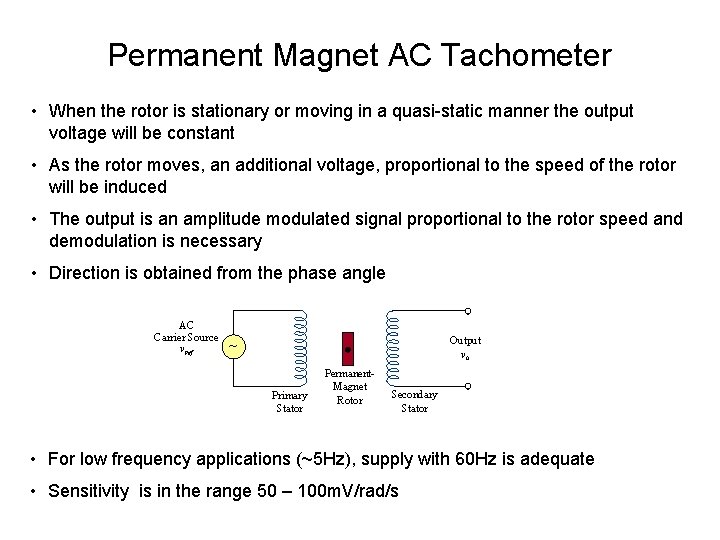
Permanent Magnet AC Tachometer • When the rotor is stationary or moving in a quasi-static manner the output voltage will be constant • As the rotor moves, an additional voltage, proportional to the speed of the rotor will be induced • The output is an amplitude modulated signal proportional to the rotor speed and demodulation is necessary • Direction is obtained from the phase angle AC Carrier Source vref Output vo ~ Primary Stator Permanent. Magnet Rotor Secondary Stator • For low frequency applications (~5 Hz), supply with 60 Hz is adequate • Sensitivity is in the range 50 – 100 m. V/rad/s
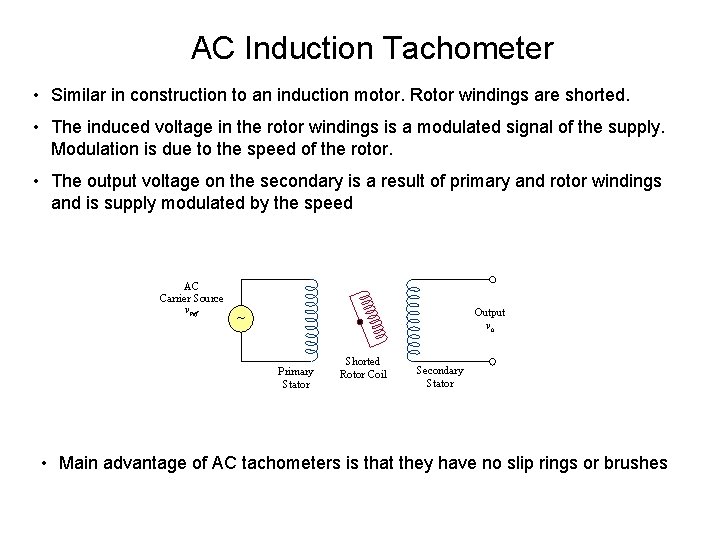
AC Induction Tachometer • Similar in construction to an induction motor. Rotor windings are shorted. • The induced voltage in the rotor windings is a modulated signal of the supply. Modulation is due to the speed of the rotor. • The output voltage on the secondary is a result of primary and rotor windings and is supply modulated by the speed AC Carrier Source vref Output vo ~ Primary Stator Shorted Rotor Coil Secondary Stator • Main advantage of AC tachometers is that they have no slip rings or brushes
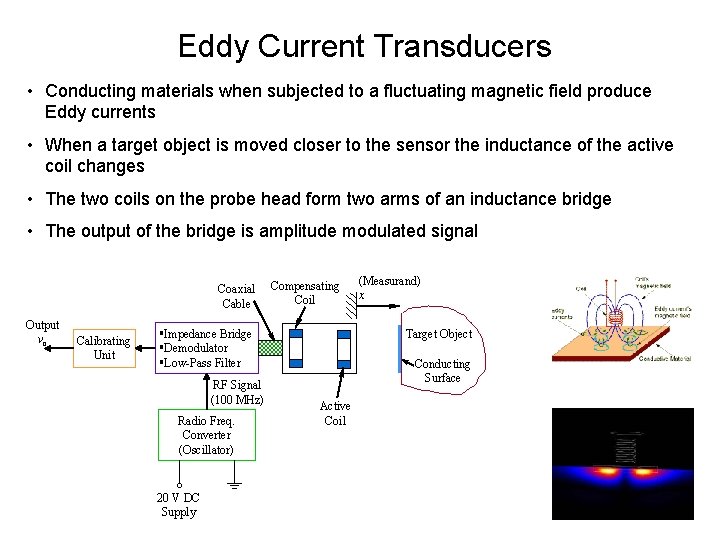
Eddy Current Transducers • Conducting materials when subjected to a fluctuating magnetic field produce Eddy currents • When a target object is moved closer to the sensor the inductance of the active coil changes • The two coils on the probe head form two arms of an inductance bridge • The output of the bridge is amplitude modulated signal Coaxial Cable Output vo Calibrating Unit Compensating Coil §Impedance Bridge §Demodulator §Low-Pass Filter RF Signal (100 MHz) Radio Freq. Converter (Oscillator) 20 V DC Supply (Measurand) x Target Object Conducting Surface Active Coil
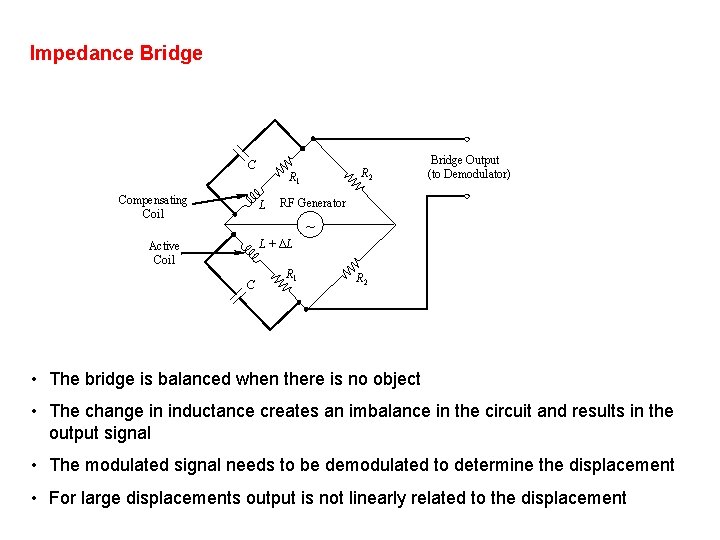
Impedance Bridge C Compensating Coil R 2 R 1 L Bridge Output (to Demodulator) RF Generator ~ L + ΔL Active Coil C R 1 R 2 • The bridge is balanced when there is no object • The change in inductance creates an imbalance in the circuit and results in the output signal • The modulated signal needs to be demodulated to determine the displacement • For large displacements output is not linearly related to the displacement
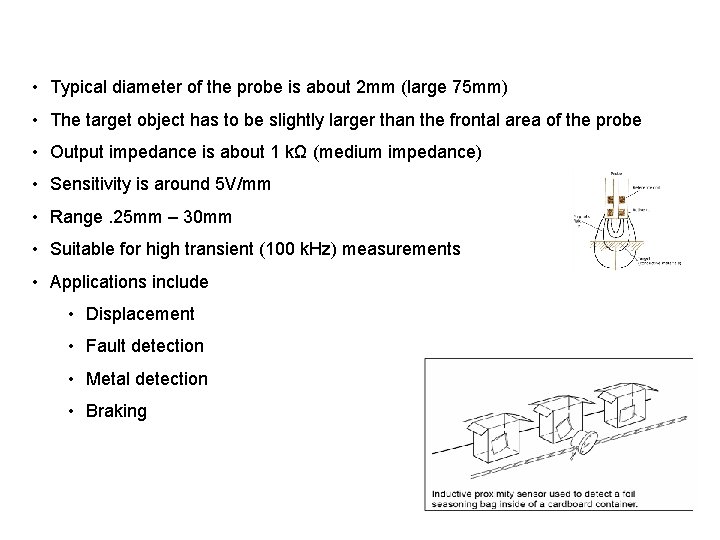
• Typical diameter of the probe is about 2 mm (large 75 mm) • The target object has to be slightly larger than the frontal area of the probe • Output impedance is about 1 kΩ (medium impedance) • Sensitivity is around 5 V/mm • Range. 25 mm – 30 mm • Suitable for high transient (100 k. Hz) measurements • Applications include • Displacement • Fault detection • Metal detection • Braking