
Measurement of molecular transition frequencies with the uncertainties

- Slides: 13
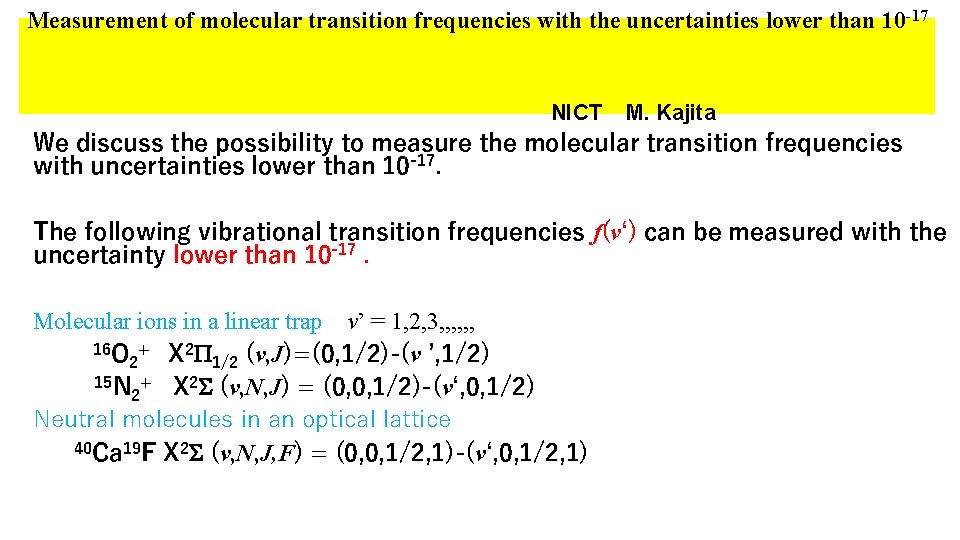
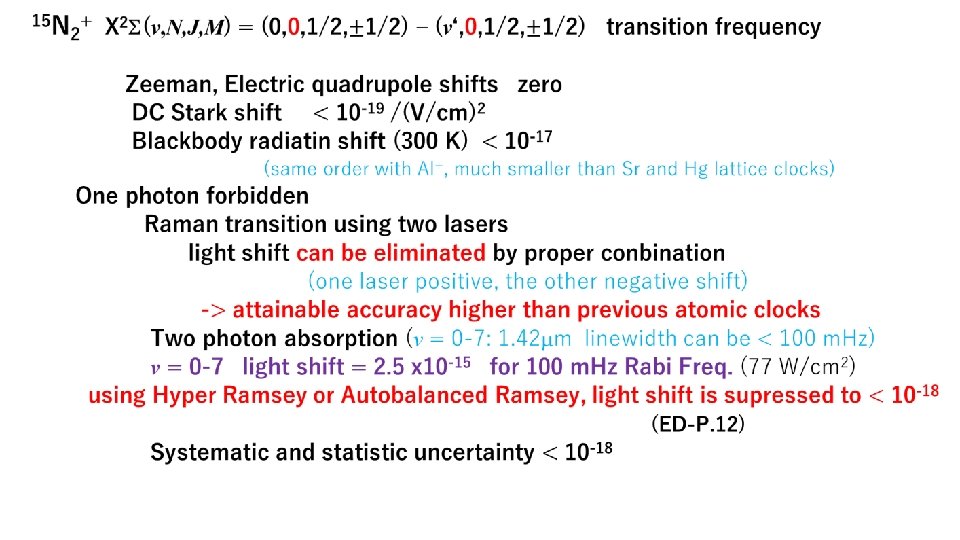
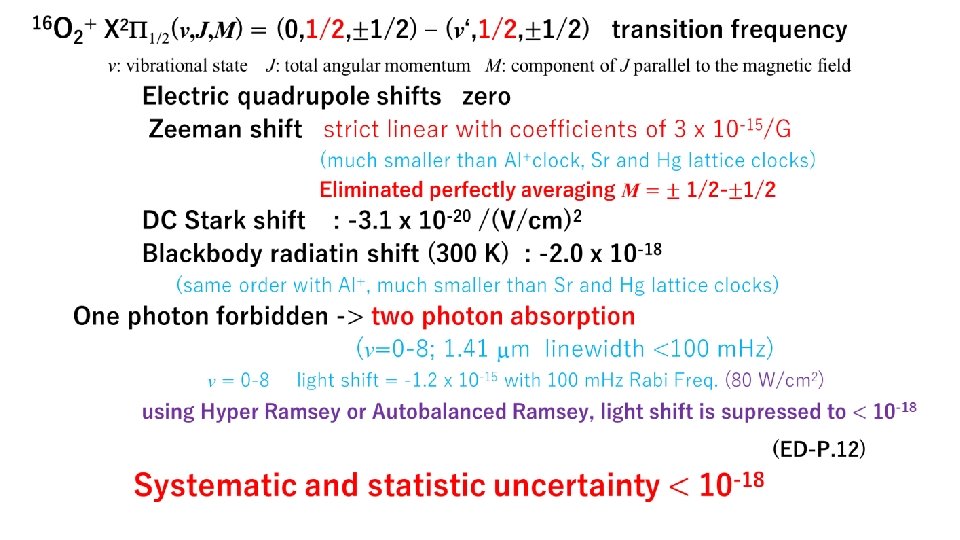
Measurement of molecular transition frequencies with the uncertainties lower than 10 -17 NICT M. Kajita We discuss the possibility to measure the molecular transition frequencies with uncertainties lower than 10 -17. The following vibrational transition frequencies f(v‘) can be measured with the uncertainty lower than 10 -17. Molecular ions in a linear trap v’ = 1, 2, 3, , , 16 O + X 2 P 2 1/2 (v, J)=(0, 1/2)-(v ’, 1/2) 15 N + X 2 S (v, N, J) = (0, 0, 1/2)-(v‘, 0, 1/2) 2 Neutral molecules in an optical lattice 40 Ca 19 F X 2 S (v, N, J, F) = (0, 0, 1/2, 1)-(v‘, 0, 1/2, 1)
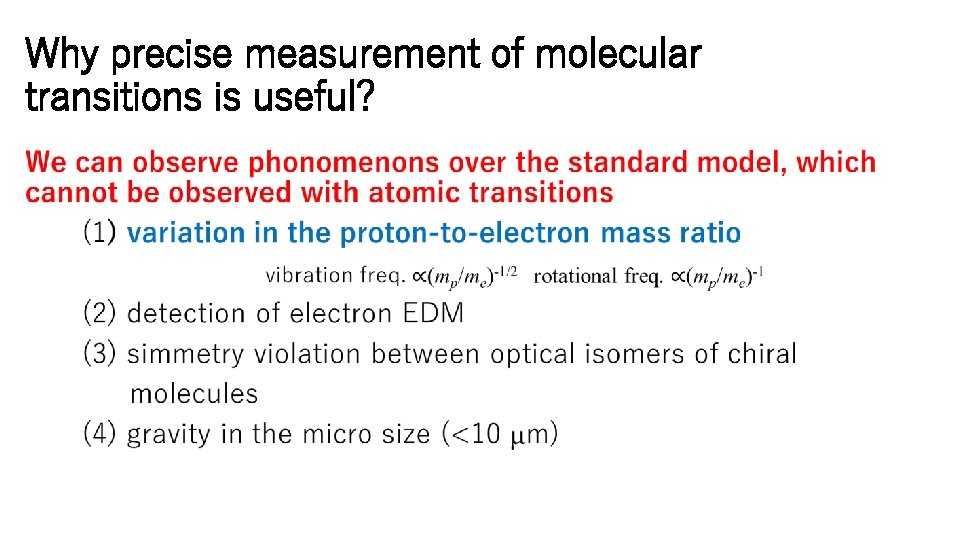
Why precise measurement of molecular transitions is useful?
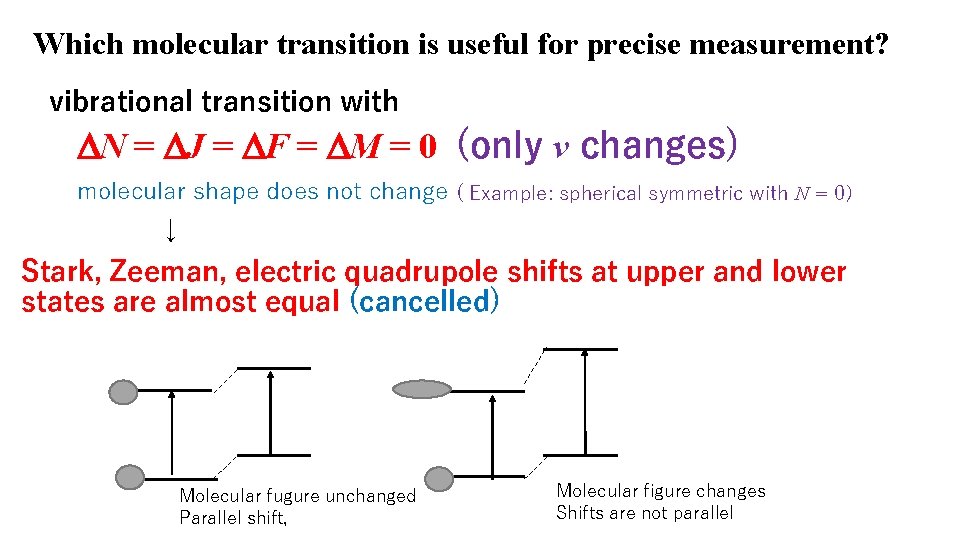
Which molecular transition is useful for precise measurement? vibrational transition with DN = DJ = DF = DM = 0 (only v changes) molecular shape does not change ( Example: spherical symmetric with N = 0) ↓ Stark, Zeeman, electric quadrupole shifts at upper and lower states are almost equal (cancelled) Molecular fugure unchanged Parallel shift, Molecular figure changes Shifts are not parallel
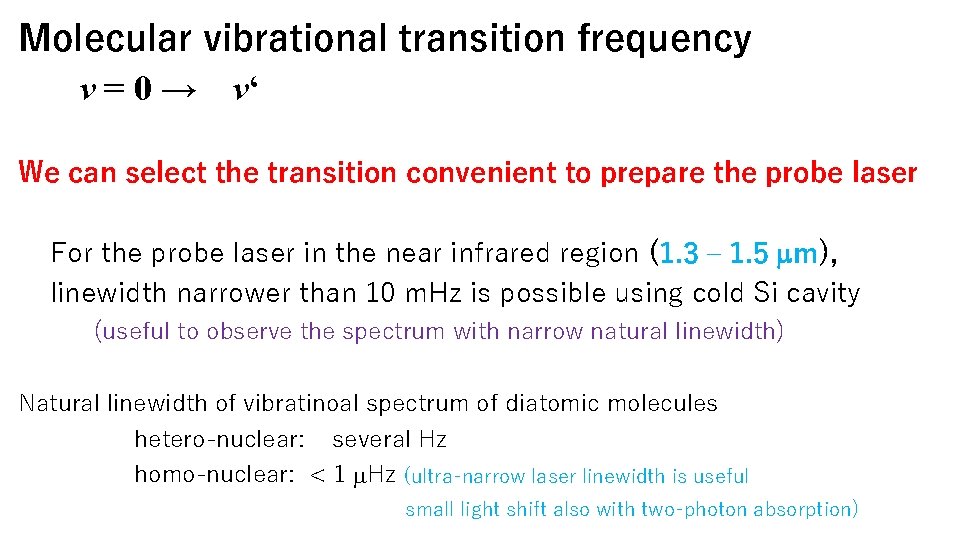
Molecular vibrational transition frequency v = 0 → v‘ We can select the transition convenient to prepare the probe laser For the probe laser in the near infrared region (1. 3 – 1. 5 mm), linewidth narrower than 10 m. Hz is possible using cold Si cavity (useful to observe the spectrum with narrow natural linewidth) Natural linewidth of vibratinoal spectrum of diatomic molecules hetero-nuclear: several Hz homo-nuclear: < 1 m. Hz (ultra-narrow laser linewidth is useful small light shift also with two-photon absorption)
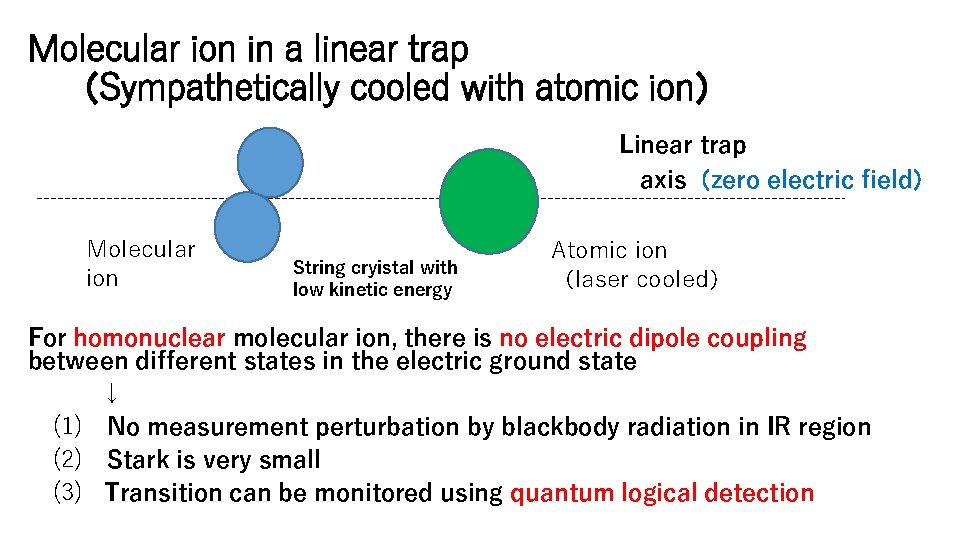
Molecular ion in a linear trap (Sympathetically cooled with atomic ion) Linear trap axis(zero electric field) Molecular ion String cryistal with low kinetic energy Atomic ion (laser cooled) For homonuclear molecular ion, there is no electric dipole coupling between different states in the electric ground state ↓ (1) No measurement perturbation by blackbody radiation in IR region (2) Stark is very small (3) Transition can be monitored using quantum logical detection
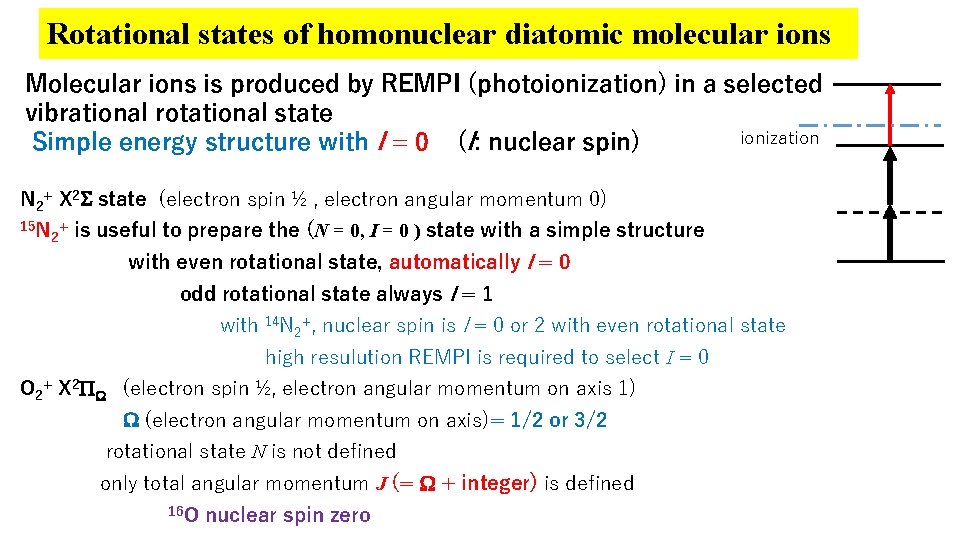
Rotational states of homonuclear diatomic molecular ions Molecular ions is produced by REMPI (photoionization) in a selected vibrational rotational state ionization Simple energy structure with I = 0 (I: nuclear spin) N 2+ X 2 S state (electron spin ½ , electron angular momentum 0) 15 N + 2 is useful to prepare the (N = 0, I = 0 ) state with a simple structure with even rotational state, automatically I = 0 odd rotational state always I = 1 with 14 N 2+, nuclear spin is I = 0 or 2 with even rotational state high resulution REMPI is required to select I = 0 O 2+ X 2 PW (electron spin ½, electron angular momentum on axis 1) W (electron angular momentum on axis)= 1/2 or 3/2 rotational state N is not defined only total angular momentum J (= W + integer) is defined 16 O nuclear spin zero
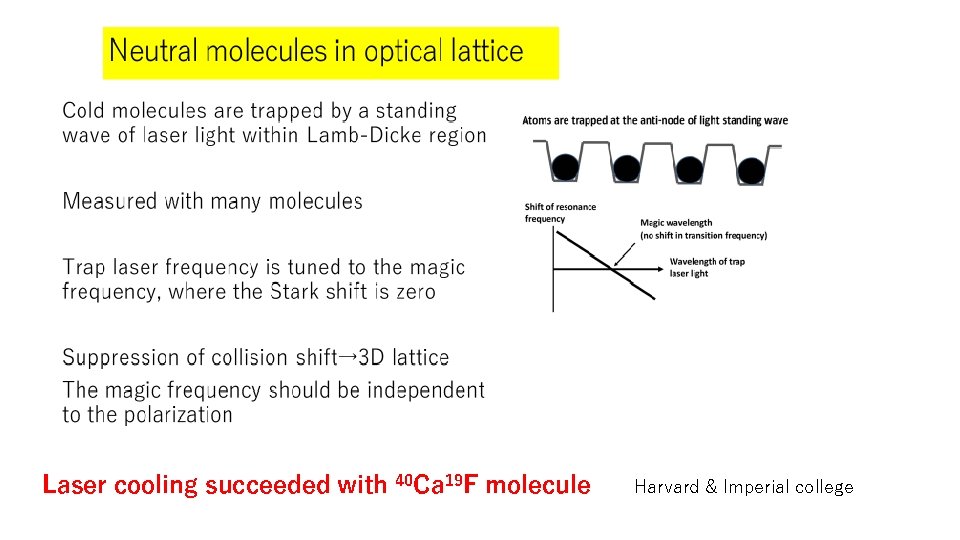
Laser cooling succeeded with 40 Ca 19 F molecule Harvard & Imperial college
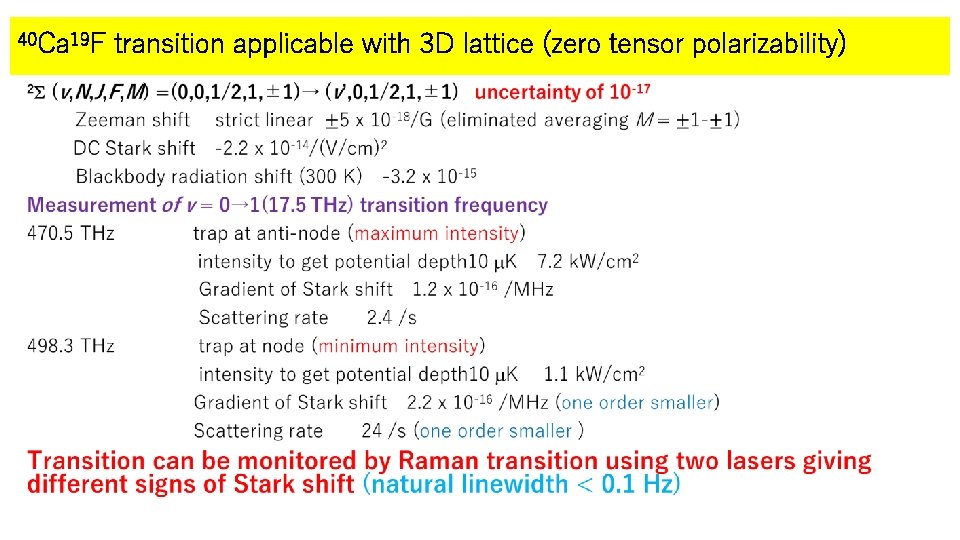
40 Ca 19 F • transition applicable with 3 D lattice (zero tensor polarizability)
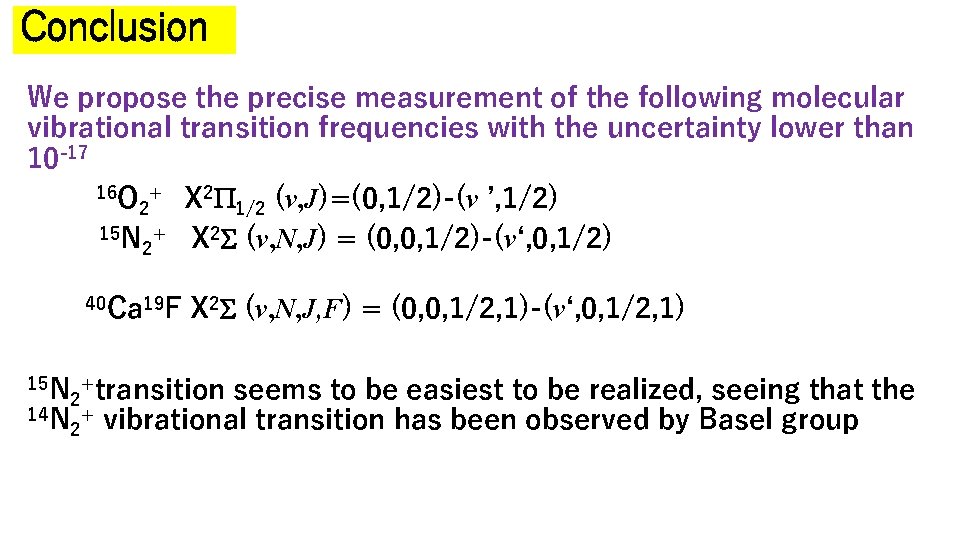
Conclusion We propose the precise measurement of the following molecular vibrational transition frequencies with the uncertainty lower than 10 -17 16 O + X 2 P 2 1/2 (v, J)=(0, 1/2)-(v ’, 1/2) 15 N + X 2 S (v, N, J) = (0, 0, 1/2)-(v‘, 0, 1/2) 2 40 Ca 19 F X 2 S (v, N, J, F) = (0, 0, 1/2, 1)-(v‘, 0, 1/2, 1) 15 N +transition seems to be easiest to be realized, seeing that 2 14 N + vibrational transition has been observed by Basel group 2 the
Publications M. Kajita, Phys. Rev. A 89, 032509 (2014) N 2+ transition M. Kajita, Phys. Rev. A 95, 023418 (2017) O 2+ transition M. Kajita, J. Phys. Soc. Jpn. 87, 104301(2018) Ca. F transition Acknowledgement I got the support from Japan Society for the Promotion Science Grand-in-Aid for Scientific Research (B) (Grand No. JP 17 H 02881) (C) (Grand No. JP 17 K 06483 and 16 K 05500) Books published from IOP Expanding Physics “Measuring Time: Frequency Measurement and Related Developments in Physics” M. Kajita “Measurement, Uncertainty and Lasers” M. Kajita