
Measurement of Mass Volume Weight and Length What
- Slides: 5
Measurement of Mass, Volume, Weight, and Length • What is necessary to perform “good” science? September 2014
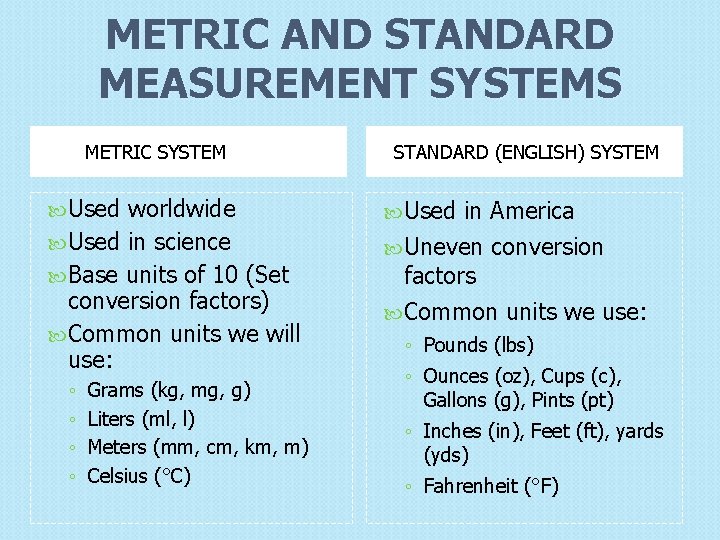
METRIC AND STANDARD MEASUREMENT SYSTEMS METRIC SYSTEM Used worldwide Used in science Base units of 10 (Set conversion factors) Common units we will use: ◦ ◦ Grams (kg, mg, g) Liters (ml, l) Meters (mm, cm, km, m) Celsius (°C) STANDARD (ENGLISH) SYSTEM Used in America Uneven conversion factors Common units we use: ◦ Pounds (lbs) ◦ Ounces (oz), Cups (c), Gallons (g), Pints (pt) ◦ Inches (in), Feet (ft), yards (yds) ◦ Fahrenheit (°F)
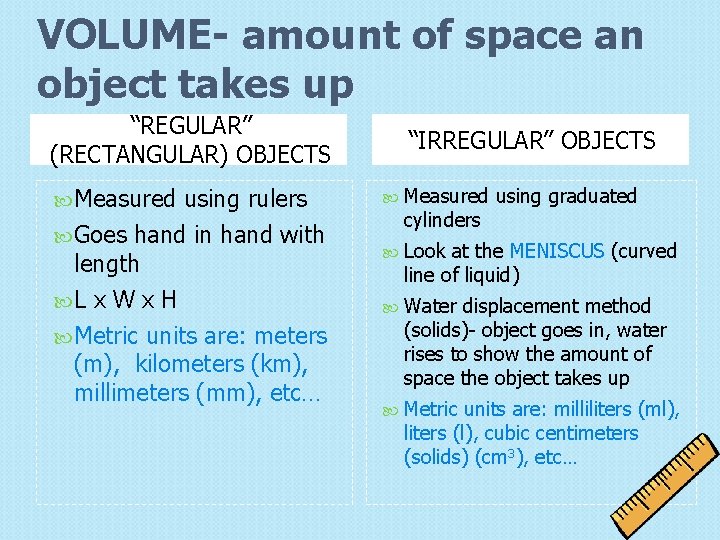
VOLUME- amount of space an object takes up “REGULAR” (RECTANGULAR) OBJECTS Measured using rulers Goes hand in hand with length L x W x H Metric units are: meters (m), kilometers (km), millimeters (mm), etc… “IRREGULAR” OBJECTS Measured using graduated cylinders Look at the MENISCUS (curved line of liquid) Water displacement method (solids)- object goes in, water rises to show the amount of space the object takes up Metric units are: milliliters (ml), liters (l), cubic centimeters (solids) (cm 3), etc…
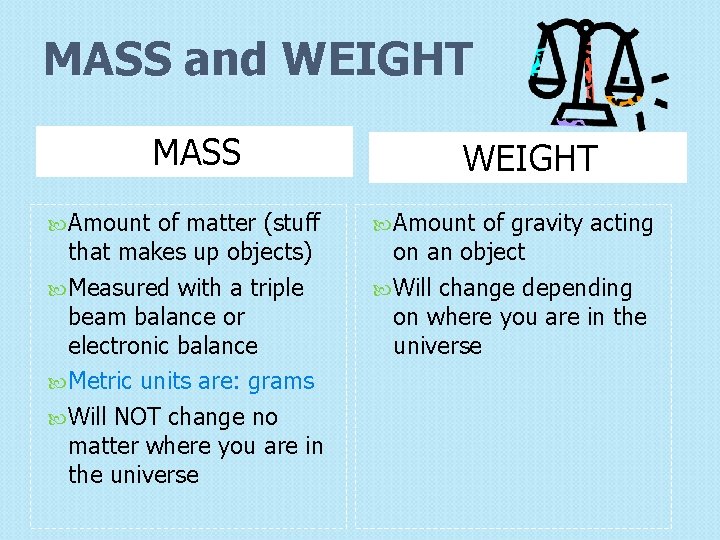
MASS and WEIGHT MASS Amount of matter (stuff that makes up objects) Measured with a triple beam balance or electronic balance Metric units are: grams Will NOT change no matter where you are in the universe WEIGHT Amount of gravity acting on an object Will change depending on where you are in the universe
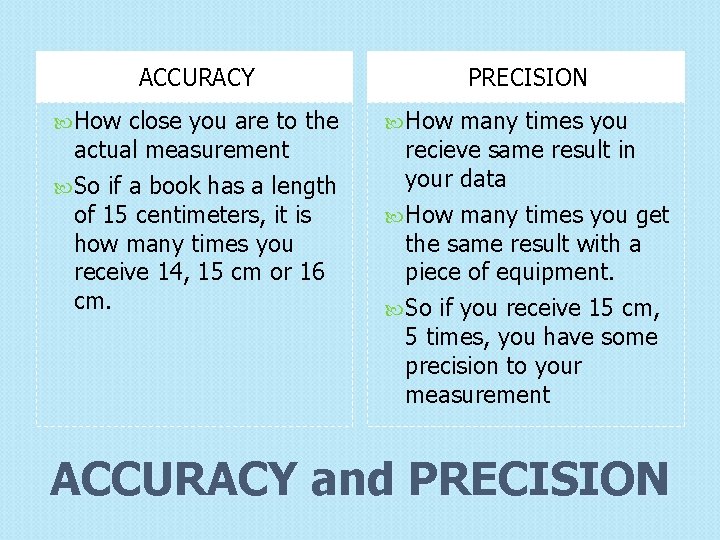
ACCURACY How close you are to the actual measurement So if a book has a length of 15 centimeters, it is how many times you receive 14, 15 cm or 16 cm. PRECISION How many times you recieve same result in your data How many times you get the same result with a piece of equipment. So if you receive 15 cm, 5 times, you have some precision to your measurement ACCURACY and PRECISION