
Measurement of Invariant Mass Spectra of Vector Meson
- Slides: 15
Measurement of Invariant Mass Spectra of Vector Meson Decaying in Nuclear Matter Kyoto Univ. a , KEKb, RIKENc, CNS Univ. of Tokyod, ICEPP Univ. of Tokyoe, Tohoku Univ. f Megumi NARUKIa, J. Chibab, H. En’yoc, H. Funahashia, H. Hamagakid, M. Ieirib, M. Ishinoe, H. Kandaf , M. Kitaguchia, S. Miharae, T. Miyashitaa, T. Murakamia, R. Mutoa, M. Nomachib, K. Ozawad, F. Sakumaa, O. Sasakib, H. D. Satoa, M. Sekimotob, T. Tabaruc, K. H. Tanakab, S. Yadamaa, S. Yokkaichic, Y. Yoshimuraa (KEK-PS E 325 Collaboration) • Introduction • E 325 Setup • Prelimirary Result of 2002 data analysis • Summary
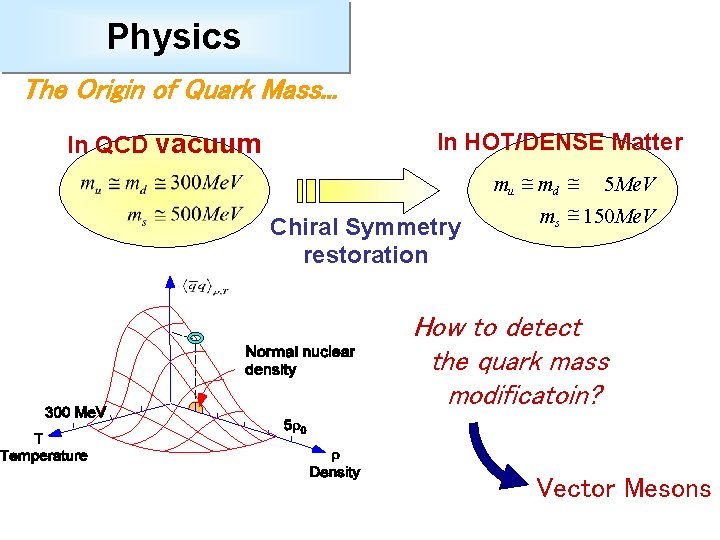
Physics The Origin of Quark Mass. . . In QCD vacuum In HOT/DENSE Matter Chiral Symmetry restoration mu @ md @ 5 Me. V ms @ 150 Me. V How to detect the quark mass modificatoin? Vector Mesons
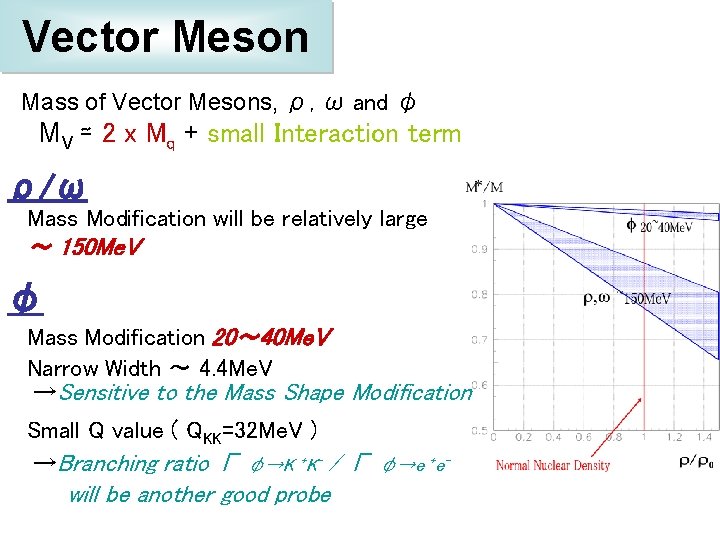
Vector Meson Mass of Vector Mesons, ρ, ω and φ MV ≃ 2 x Mq + small Interaction term ρ/ω Mass Modification will be relatively large ~ 150 Me. V φ Mass Modification 20~ 40 Me. V Narrow Width ~ 4. 4 Me. V →Sensitive to the Mass Shape Modification Small Q value ( QKK=32 Me. V ) →Branching ratio Γ φ→K +K- / Γ will be another good probe φ→e +e-
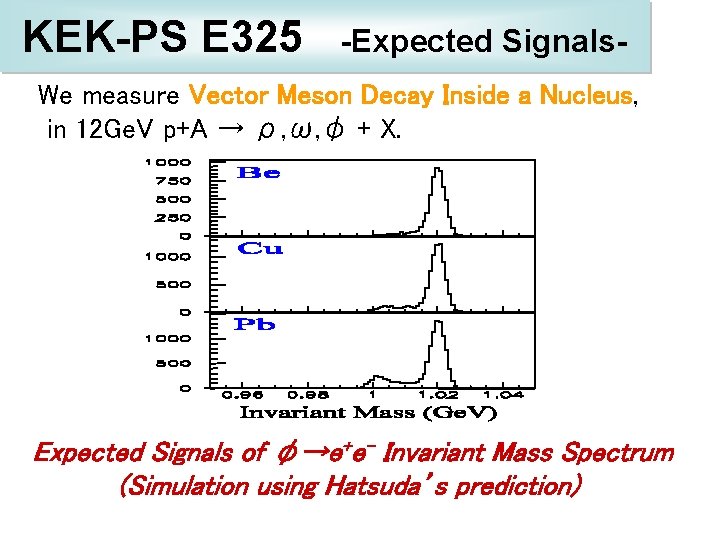
KEK-PS E 325 -Expected Signals- We measure Vector Meson Decay Inside a Nucleus, in 12 Ge. V p+A → ρ, ω, φ + X. Expected Signals of φ→e+e- Invariant Mass Spectrum (Simulation using Hatsuda’s prediction)
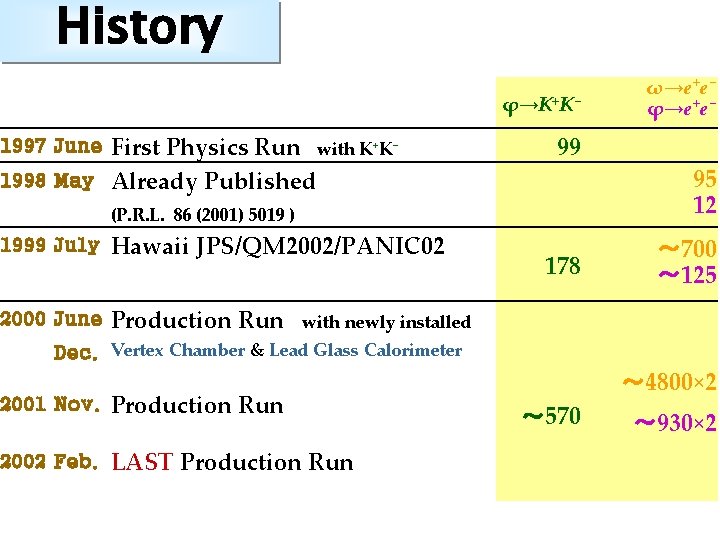
History φ→K+K− First Physics Run with K+K− 1998 May Already Published 1997 June 99 95 12 (P. R. L. 86 (2001) 5019 ) 1999 July Hawaii JPS/QM 2002/PANIC 02 2000 June Production Run ω→e+e− φ→e+e− 178 ~ 700 ~ 125 with newly installed Dec. Vertex Chamber & Lead Glass Calorimeter 2001 Nov. Production Run 2002 Feb. LAST Production Run ~ 4800× 2 ~ 570 ~ 930× 2
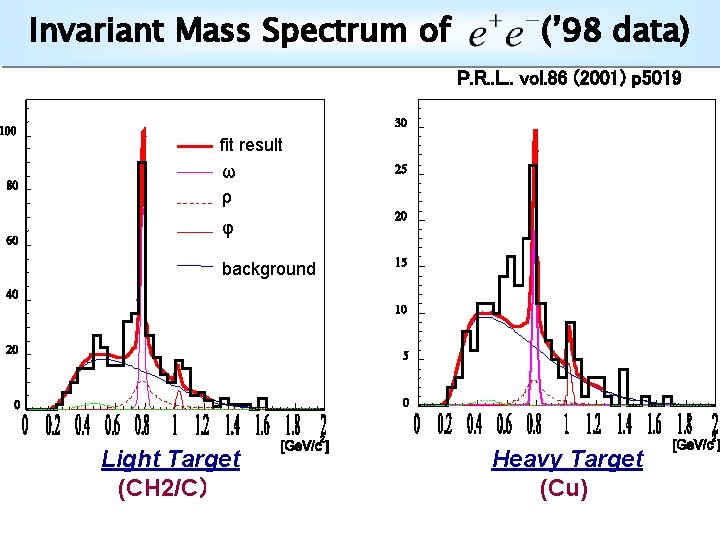
Invariant Mass Spectrum of (’ 98 data) P. R. . L. . vol. 86 (2001) p 5019 fit result ω ρ φ background Light Target (CH 2/C) Heavy Target (Cu)
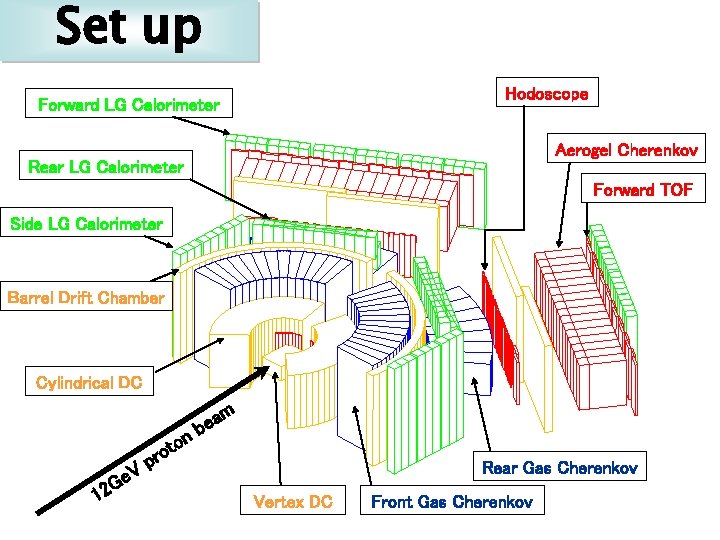
Set up Hodoscope Forward LG Calorimeter Aerogel Cherenkov Rear LG Calorimeter Forward TOF Side LG Calorimeter Barrel Drift Chamber Cylindrical DC m ea b n 1 e. V G 2 to o r p Rear Gas Cherenkov Vertex DC Front Gas Cherenkov
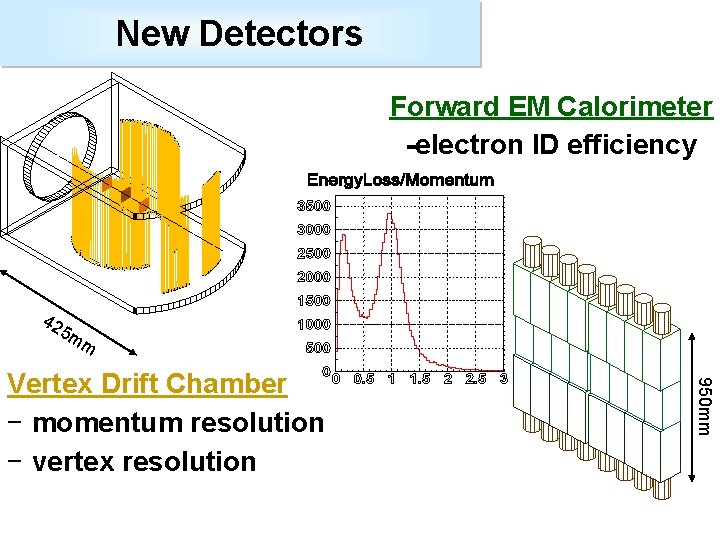
New Detectors Forward EM Calorimeter -electron ID efficiency 42 5 m m 950 mm Vertex Drift Chamber − momentum resolution − vertex resolution
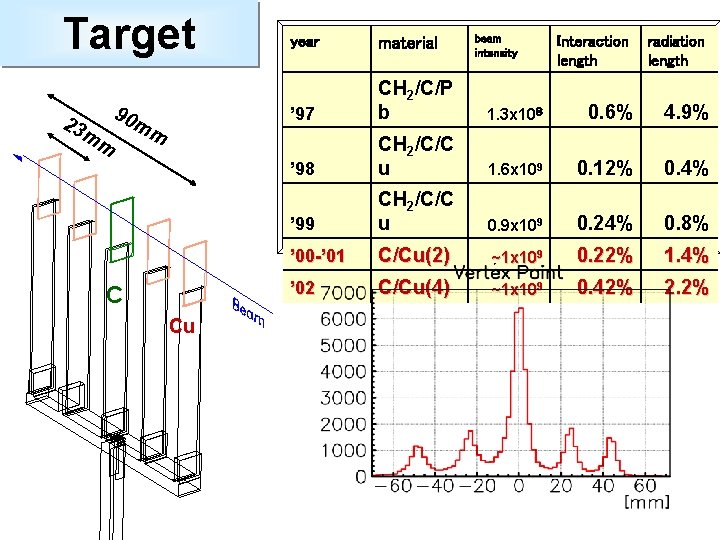
Target 23 mm 90 mm C Cu beam intensity year material Interaction length radiation length ’ 97 CH 2/C/P b 1. 3 x 10⁸ 0. 6% 4. 9% ’ 98 CH 2/C/C u 1. 6 x 10⁹ 0. 12% 0. 4% ’ 99 CH 2/C/C u 0. 9 x 10⁹ 0. 24% 0. 8% ’ 00 -’ 01 C/Cu(2) ~1 x 10⁹ 0. 22% 1. 4% ’ 02 C/Cu(4) ~1 x 10⁹ 0. 42% 2. 2%
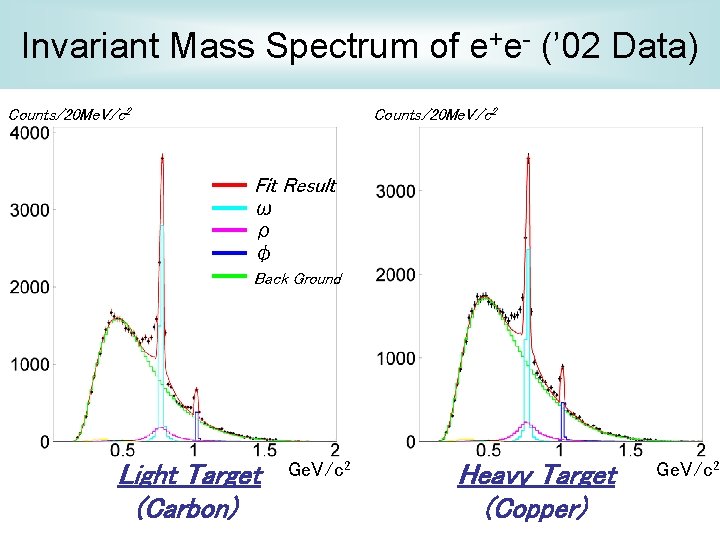
Invariant Mass Spectrum of e+e- (’ 02 Data) Counts/20 Me. V/c 2 Fit Result ω ρ φ Back Ground Light Target (Carbon) Ge. V/c 2 Heavy Target (Copper) Ge. V/c 2
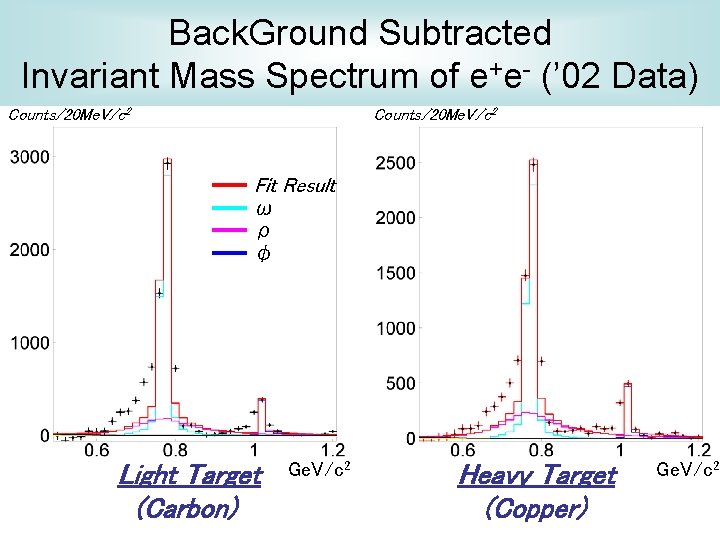
Back. Ground Subtracted Invariant Mass Spectrum of e+e- (’ 02 Data) Counts/20 Me. V/c 2 Fit Result ω ρ φ Light Target (Carbon) Ge. V/c 2 Heavy Target (Copper) Ge. V/c 2
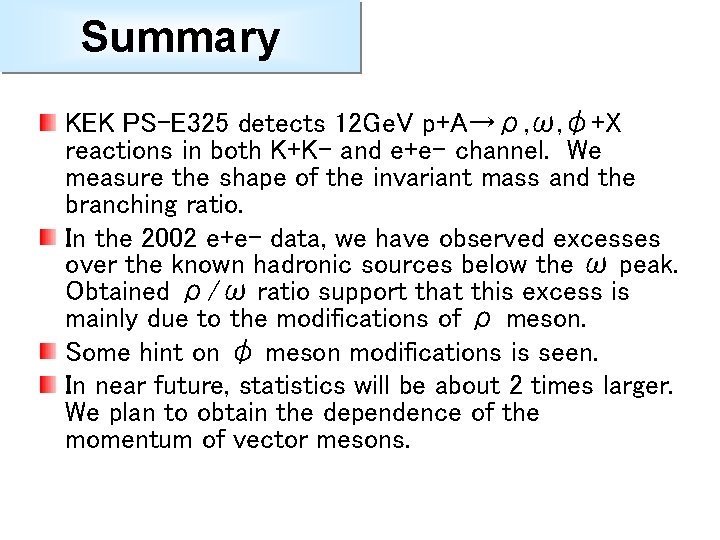
Summary KEK PS-E 325 detects 12 Ge. V p+A→ρ, ω, φ+X reactions in both K+K- and e+e- channel. We measure the shape of the invariant mass and the branching ratio. In the 2002 e+e- data, we have observed excesses over the known hadronic sources below the ω peak. Obtained ρ/ω ratio support that this excess is mainly due to the modifications of ρ meson. Some hint on φ meson modifications is seen. In near future, statistics will be about 2 times larger. We plan to obtain the dependence of the momentum of vector mesons.
Electron ID
Electron ID Performance
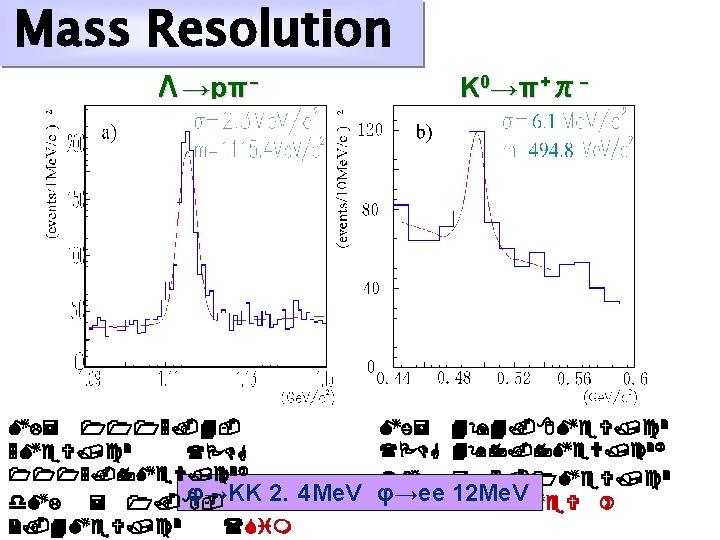
Mass Resolution K 0→π+π- Λ→pπ- ML= 1115. 45 Me. V/c 2 (PDG 1115. 7 Me. V/c 2) M K= 494. 8 Me. V/c 2 (PDG 497. 7 Me. V/c 2) d. Mk = 6. 1 Me. V/c 2 φ→KK 2.4 Me. V φ→ee d. ML = 1. 8(Sim 12 Me. V 6. 3 Me. V ) 2. 4 Me. V/c 2 (Sim