
Measurement of Bs mixing phase bs at the
Measurement of Bs mixing phase bs at the Tevatron Gavril Giurgiu Johns Hopkins University on behalf of the CDF and DØ collaboration Physics at LHC, Split, Croatia October 3, 2008
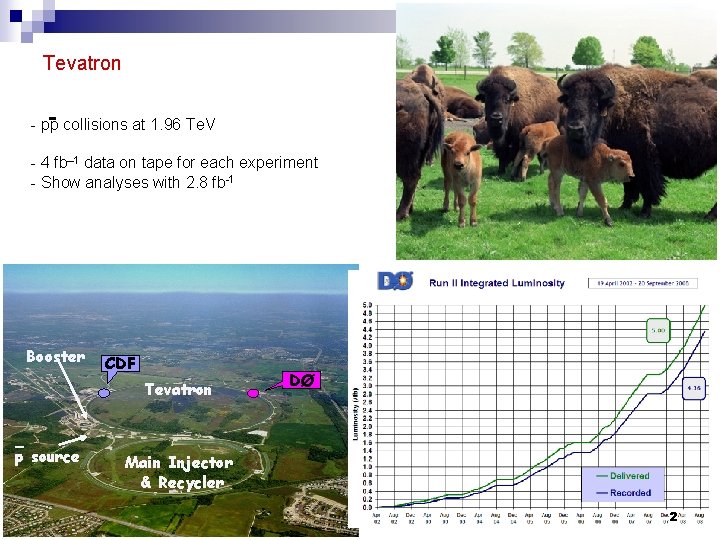
Tevatron - pp collisions at 1. 96 Te. V - 4 fb– 1 data on tape for each experiment - Show analyses with 2. 8 fb-1 Booster CDF Tevatron p source DØ Main Injector & Recycler 2
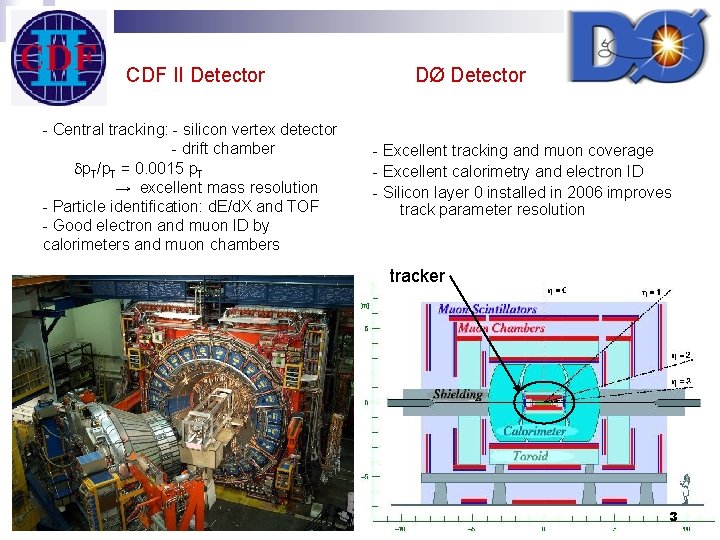
CDF II Detector - Central tracking: - silicon vertex detector - drift chamber dp. T/p. T = 0. 0015 p. T → excellent mass resolution - Particle identification: d. E/d. X and TOF - Good electron and muon ID by calorimeters and muon chambers DØ Detector - Excellent tracking and muon coverage - Excellent calorimetry and electron ID - Silicon layer 0 installed in 2006 improves track parameter resolution tracker 3
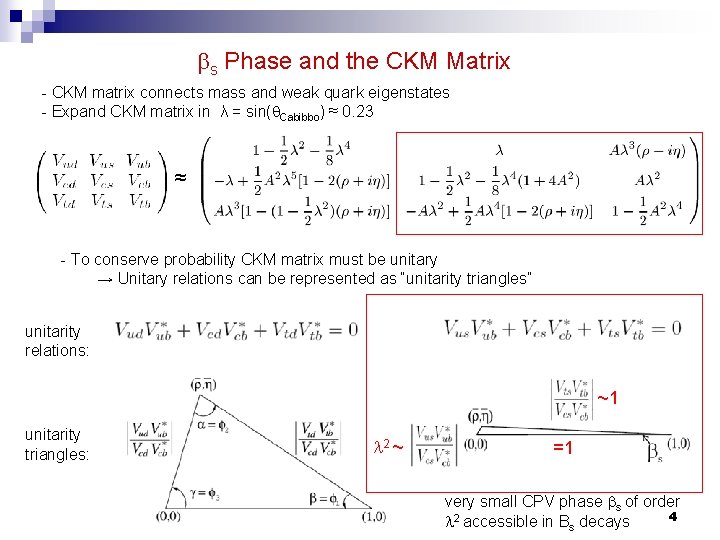
bs Phase and the CKM Matrix - CKM matrix connects mass and weak quark eigenstates - Expand CKM matrix in λ = sin( Cabibbo) ≈ 0. 23 ≈ - To conserve probability CKM matrix must be unitary → Unitary relations can be represented as “unitarity triangles” unitarity relations: ~1 unitarity triangles: l 2 ~ =1 very small CPV phase bs of order 4 l 2 accessible in Bs decays
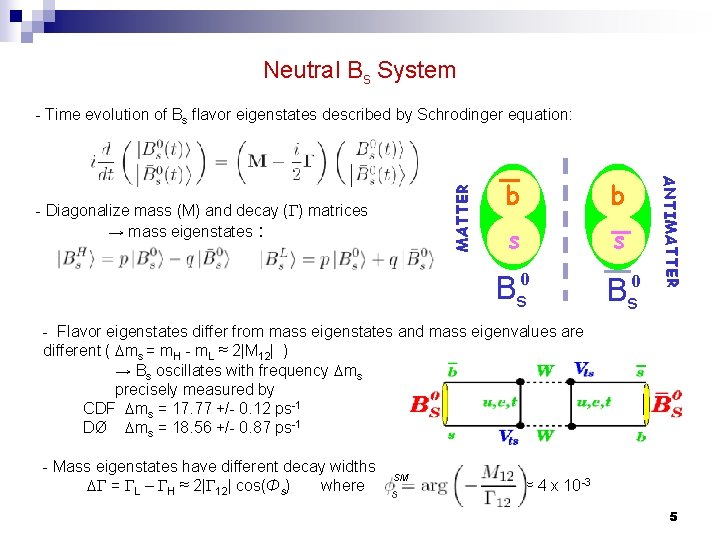
Neutral Bs System - Diagonalize mass (M) and decay (G) matrices → mass eigenstates : b b s s Bs 0 0 Bs ANTIMATTER - Time evolution of Bs flavor eigenstates described by Schrodinger equation: - Flavor eigenstates differ from mass eigenstates and mass eigenvalues are different ( Dms = m. H - m. L ≈ 2|M 12| ) → Bs oscillates with frequency Dms precisely measured by CDF Dms = 17. 77 +/- 0. 12 ps-1 DØ Dms = 18. 56 +/- 0. 87 ps-1 - Mass eigenstates have different decay widths DG = GL – GH ≈ 2|G 12| cos(Φs) where SM s ≈ 4 x 10 -3 5
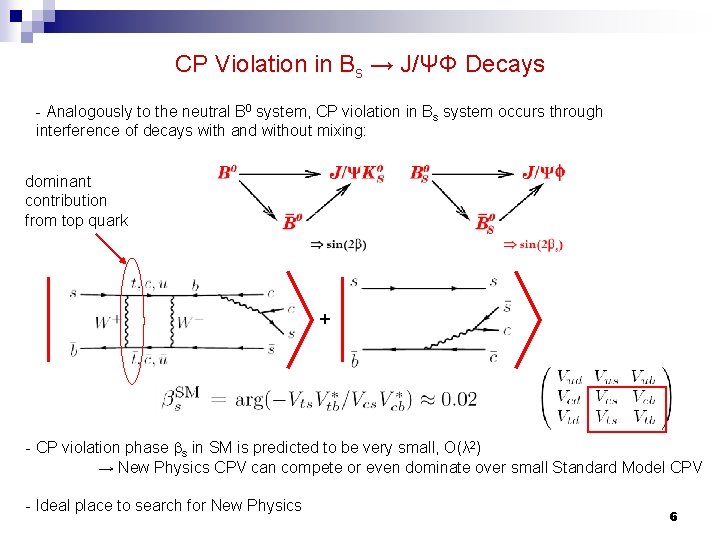
CP Violation in Bs → J/ΨΦ Decays - Analogously to the neutral B 0 system, CP violation in Bs system occurs through interference of decays with and without mixing: dominant contribution from top quark + - CP violation phase bs in SM is predicted to be very small, O(λ 2) → New Physics CPV can compete or even dominate over small Standard Model CPV - Ideal place to search for New Physics 6
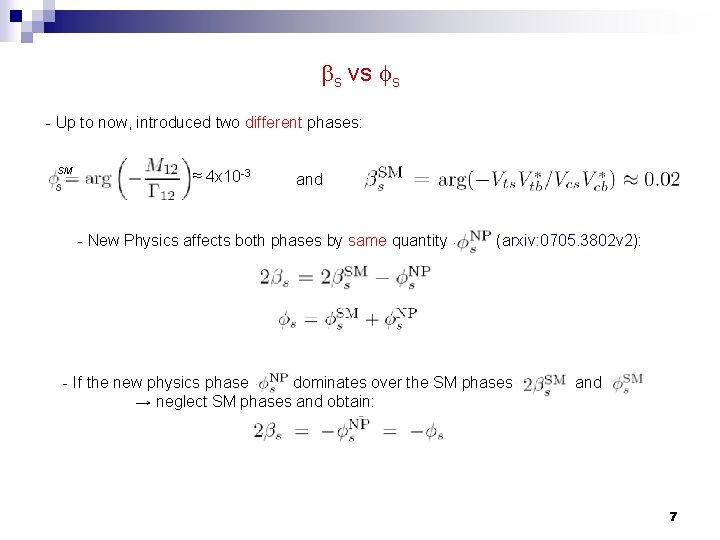
bs vs s - Up to now, introduced two different phases: SM s ≈ 4 x 10 -3 and - New Physics affects both phases by same quantity (arxiv: 0705. 3802 v 2): - If the new physics phase dominates over the SM phases → neglect SM phases and obtain: and 7
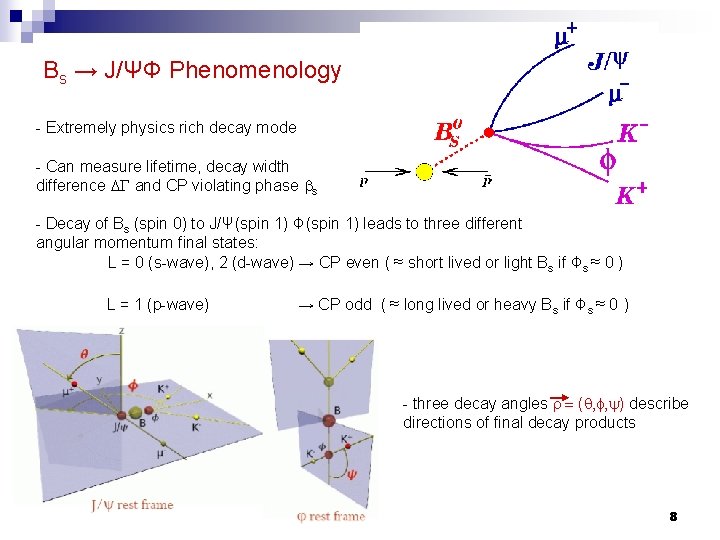
Bs → J/ΨΦ Phenomenology - Extremely physics rich decay mode - Can measure lifetime, decay width difference DG and CP violating phase bs - Decay of Bs (spin 0) to J/Ψ(spin 1) Φ(spin 1) leads to three different angular momentum final states: L = 0 (s-wave), 2 (d-wave) → CP even ( ≈ short lived or light Bs if Φs ≈ 0 ) L = 1 (p-wave) → CP odd ( ≈ long lived or heavy B s if Φs ≈ 0 ) - three decay angles r = ( , , ) describe directions of final decay products 8
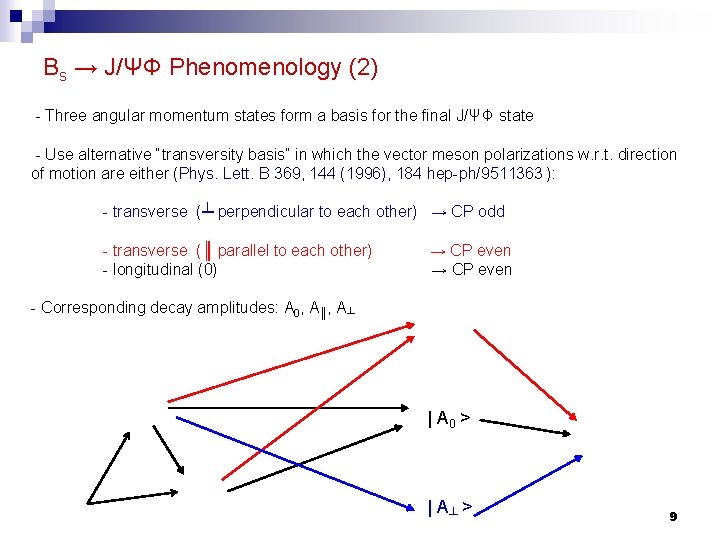
Bs → J/ΨΦ Phenomenology (2) - Three angular momentum states form a basis for the final J/ΨΦ state - Use alternative “transversity basis” in which the vector meson polarizations w. r. t. direction of motion are either (Phys. Lett. B 369, 144 (1996), 184 hep-ph/9511363 ): - transverse (┴ perpendicular to each other) → CP odd - transverse (║ parallel to each other) - longitudinal (0) → CP even - Corresponding decay amplitudes: A 0, A║, A┴ | A 0 > | A┴ > 9
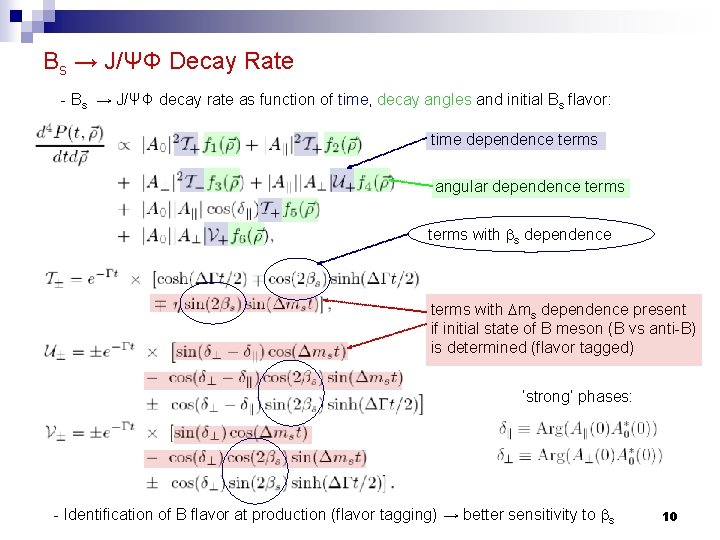
Bs → J/ΨΦ Decay Rate - Bs → J/ΨΦ decay rate as function of time, decay angles and initial Bs flavor: time dependence terms angular dependence terms with bs dependence terms with Dms dependence present if initial state of B meson (B vs anti-B) is determined (flavor tagged) ‘strong’ phases: - Identification of B flavor at production (flavor tagging) → better sensitivity to bs 10
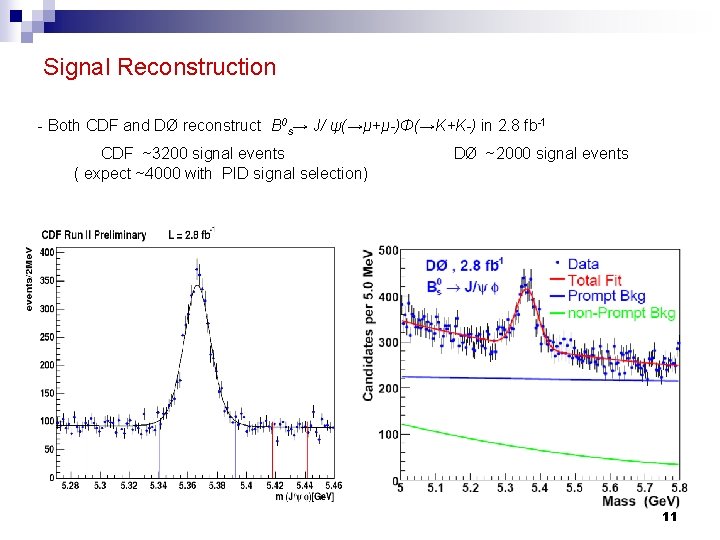
Signal Reconstruction - Both CDF and DØ reconstruct B 0 s→ J/ ψ(→μ+μ-)Φ(→K+K-) in 2. 8 fb-1 CDF ~3200 signal events ( expect ~4000 with PID signal selection) DØ ~2000 signal events 11
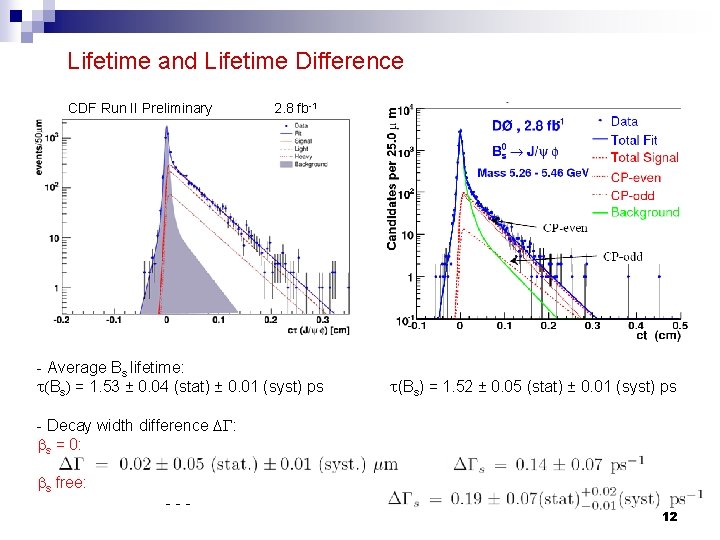
Lifetime and Lifetime Difference CDF Run II Preliminary 2. 8 fb-1 - Average Bs lifetime: t(Bs) = 1. 53 ± 0. 04 (stat) ± 0. 01 (syst) ps t(Bs) = 1. 52 ± 0. 05 (stat) ± 0. 01 (syst) ps - Decay width difference DG: bs = 0: bs free: --- 12
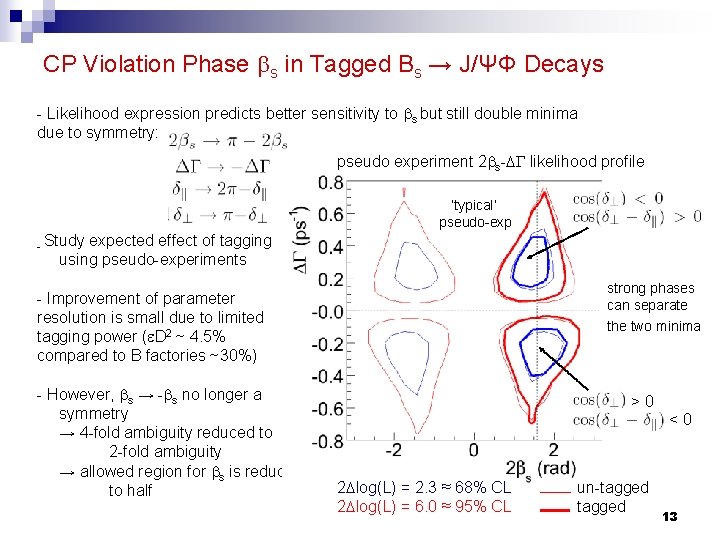
CP Violation Phase bs in Tagged Bs → J/ΨΦ Decays - Likelihood expression predicts better sensitivity to bs but still double minima due to symmetry: pseudo experiment 2 bs-DG likelihood profile ‘typical’ pseudo-exp - Study expected effect of tagging using pseudo-experiments strong phases can separate the two minima - Improvement of parameter resolution is small due to limited tagging power (e. D 2 ~ 4. 5% compared to B factories ~30%) - However, bs → -bs no longer a symmetry → 4 -fold ambiguity reduced to 2 -fold ambiguity → allowed region for bs is reduced to half >0 <0 2 Dlog(L) = 2. 3 ≈ 68% CL 2 Dlog(L) = 6. 0 ≈ 95% CL un-tagged 13
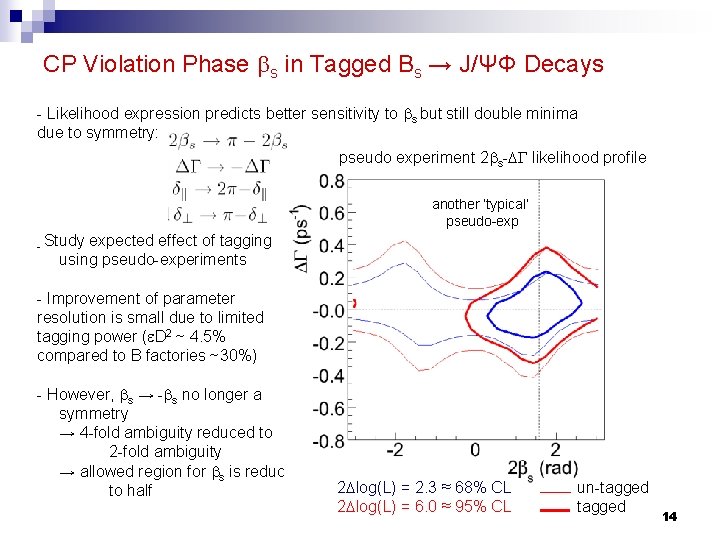
CP Violation Phase bs in Tagged Bs → J/ΨΦ Decays - Likelihood expression predicts better sensitivity to bs but still double minima due to symmetry: pseudo experiment 2 bs-DG likelihood profile another ‘typical’ pseudo-exp - Study expected effect of tagging using pseudo-experiments - Improvement of parameter resolution is small due to limited tagging power (e. D 2 ~ 4. 5% compared to B factories ~30%) - However, bs → -bs no longer a symmetry → 4 -fold ambiguity reduced to 2 -fold ambiguity → allowed region for bs is reduced to half 2 Dlog(L) = 2. 3 ≈ 68% CL 2 Dlog(L) = 6. 0 ≈ 95% CL un-tagged 14
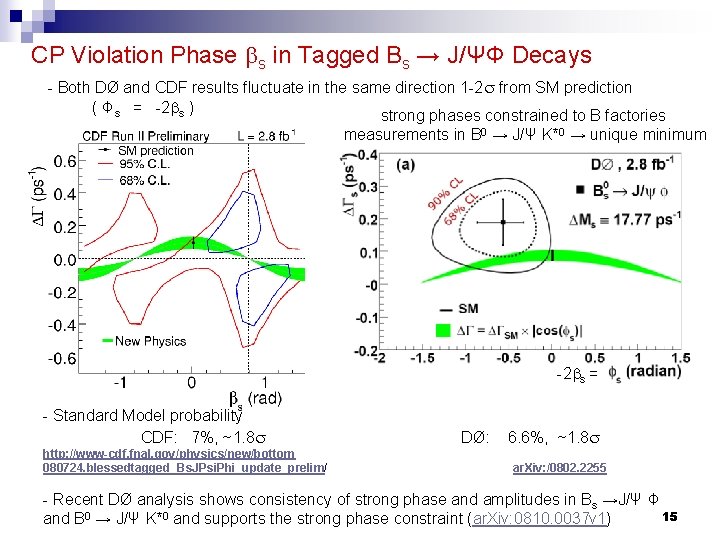
CP Violation Phase bs in Tagged Bs → J/ΨΦ Decays - Both DØ and CDF results fluctuate in the same direction 1 -2 s from SM prediction ( Φs = -2 bs ) strong phases constrained to B factories measurements in B 0 → J/Ψ K*0 → unique minimum -2 bs = - Standard Model probability CDF: 7%, ~1. 8 s http: //www-cdf. fnal. gov/physics/new/bottom 080724. blessedtagged_Bs. JPsi. Phi_update_prelim/ DØ: 6. 6%, ~1. 8 s ar. Xiv: /0802. 2255 - Recent DØ analysis shows consistency of strong phase and amplitudes in Bs →J/Ψ Φ 15 and B 0 → J/Ψ K*0 and supports the strong phase constraint (ar. Xiv: 0810. 0037 v 1)
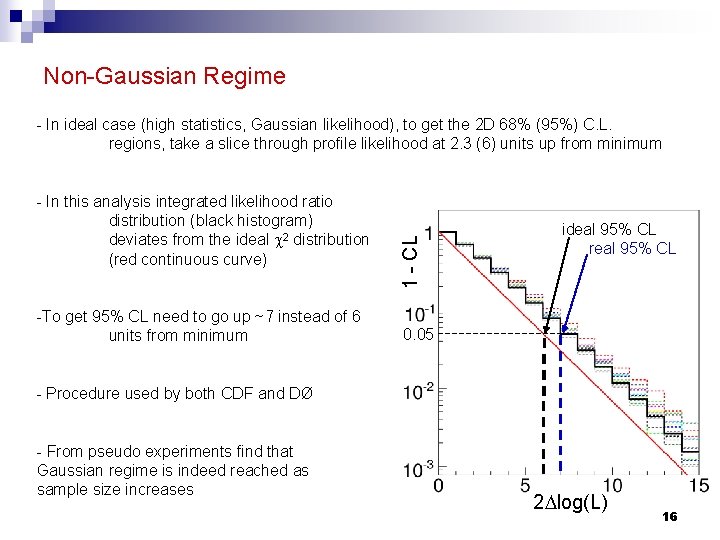
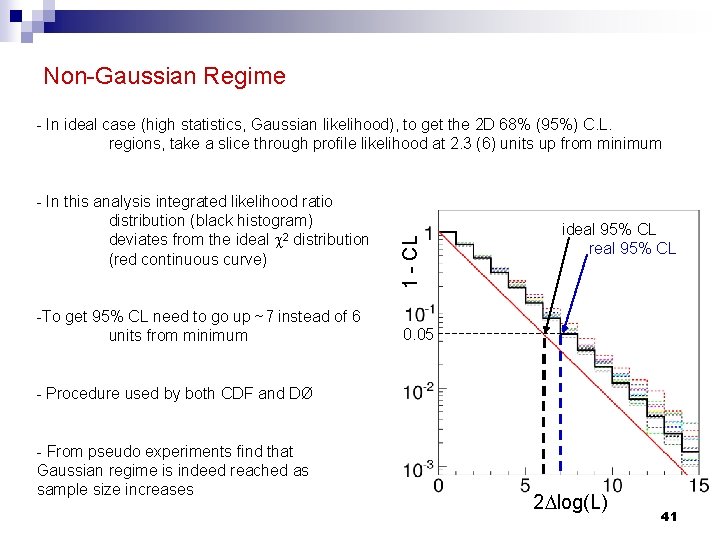
Non-Gaussian Regime - In this analysis integrated likelihood ratio distribution (black histogram) deviates from the ideal c 2 distribution (red continuous curve) -To get 95% CL need to go up ~7 instead of 6 units from minimum 1 - CL - In ideal case (high statistics, Gaussian likelihood), to get the 2 D 68% (95%) C. L. regions, take a slice through profile likelihood at 2. 3 (6) units up from minimum ideal 95% CL real 95% CL 0. 05 - Procedure used by both CDF and DØ - From pseudo experiments find that Gaussian regime is indeed reached as sample size increases 2 Dlog(L) 16
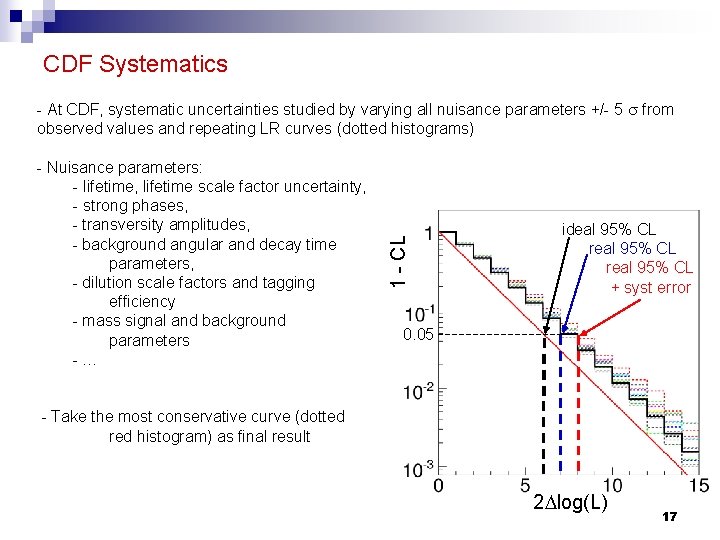
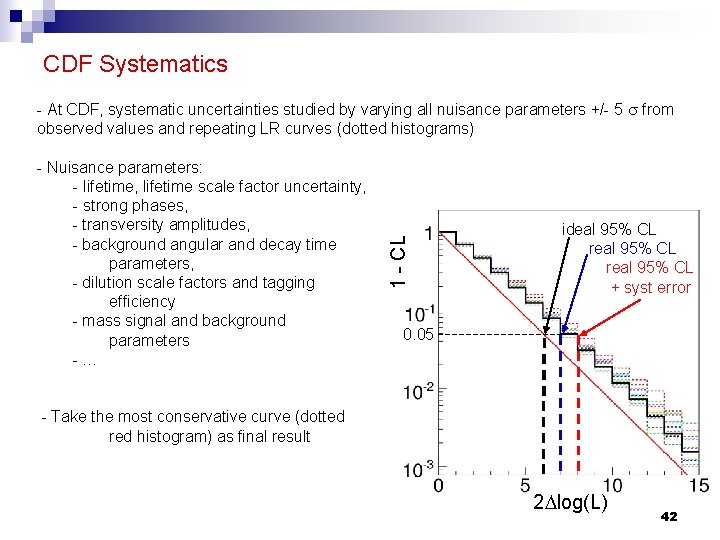
CDF Systematics - Nuisance parameters: - lifetime, lifetime scale factor uncertainty, - strong phases, - transversity amplitudes, - background angular and decay time parameters, - dilution scale factors and tagging efficiency - mass signal and background parameters -… 1 - CL - At CDF, systematic uncertainties studied by varying all nuisance parameters +/- 5 s from observed values and repeating LR curves (dotted histograms) ideal 95% CL real 95% CL + syst error 0. 05 - Take the most conservative curve (dotted red histogram) as final result 2 Dlog(L) 17
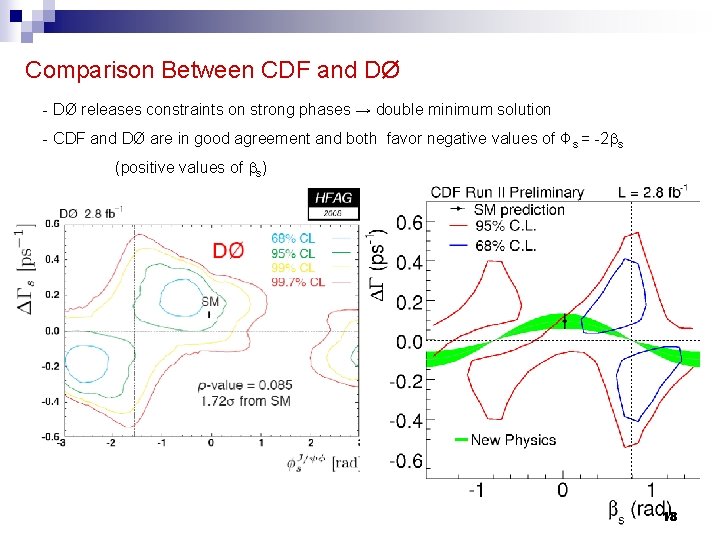
Comparison Between CDF and DØ - DØ releases constraints on strong phases → double minimum solution - CDF and DØ are in good agreement and both favor negative values of Φs = -2 bs (positive values of bs) 18
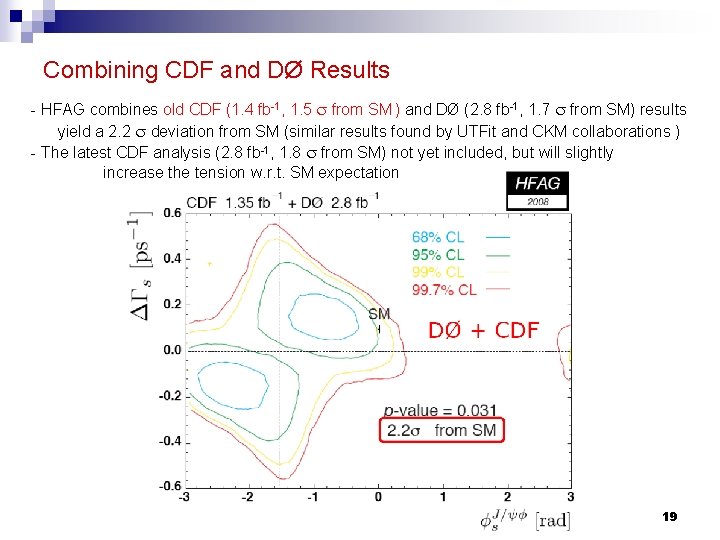
Combining CDF and DØ Results - HFAG combines old CDF (1. 4 fb-1, 1. 5 s from SM ) and DØ (2. 8 fb-1, 1. 7 s from SM) results yield a 2. 2 s deviation from SM (similar results found by UTFit and CKM collaborations ) - The latest CDF analysis (2. 8 fb-1, 1. 8 s from SM) not yet included, but will slightly increase the tension w. r. t. SM expectation 19
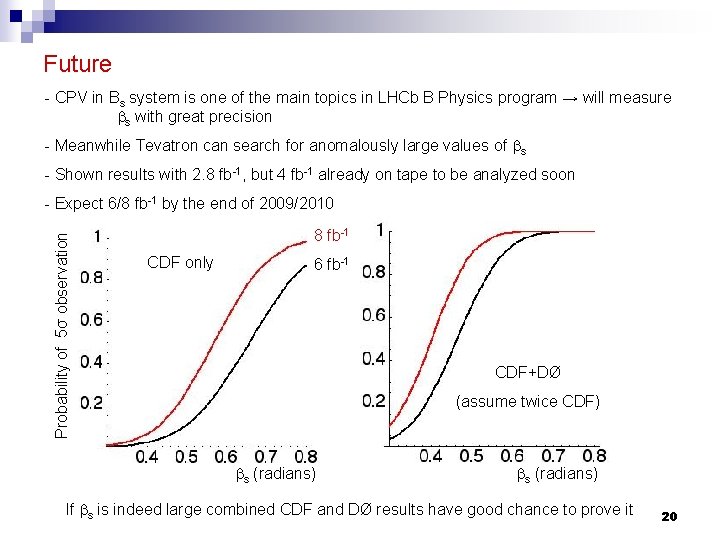
Future - CPV in Bs system is one of the main topics in LHCb B Physics program → will measure bs with great precision - Meanwhile Tevatron can search for anomalously large values of bs - Shown results with 2. 8 fb-1, but 4 fb-1 already on tape to be analyzed soon Probability of 5σ observation - Expect 6/8 fb-1 by the end of 2009/2010 8 fb-1 CDF only 6 fb-1 CDF+DØ (assume twice CDF) bs (radians) If bs is indeed large combined CDF and DØ results have good chance to prove it 20
Conclusions - Measurements of CPV in Bs system done by both CDF and DØ - Significant regions in bs space are ruled out - Best measurements of Bs lifetime and decay width difference DG - Both CDF and DØ observe 1 -2 sigma bs deviations from SM predictions - Combined HFAG result 2. 2 s w. r. t SM expectation - Interesting to see how these effects evolve with more data 21
Backup Slides 22
Analysis - Ingredients: - Signal reconstruction - B flavor identification (tagging) - Angular analysis - Maximum likelihood fit - Statistical analysis 23
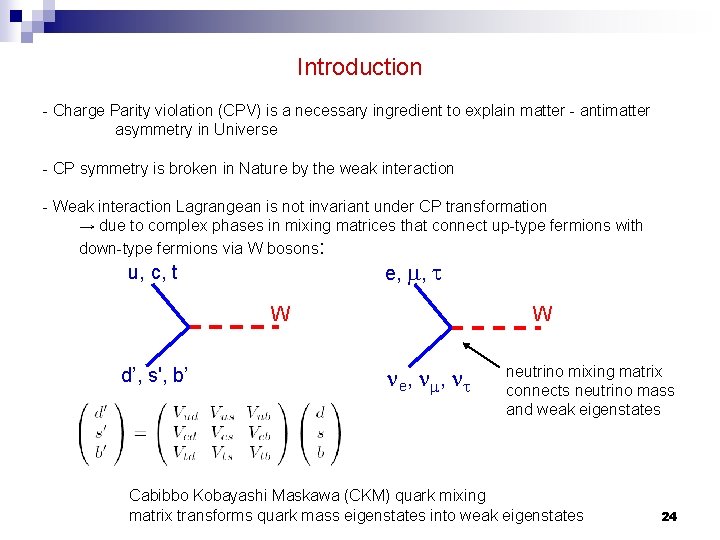
Introduction - Charge Parity violation (CPV) is a necessary ingredient to explain matter - antimatter asymmetry in Universe - CP symmetry is broken in Nature by the weak interaction - Weak interaction Lagrangean is not invariant under CP transformation → due to complex phases in mixing matrices that connect up-type fermions with down-type fermions via W bosons: e, m, t u, c, t W d’, s', b’ W n e, n m, n t neutrino mixing matrix connects neutrino mass and weak eigenstates Cabibbo Kobayashi Maskawa (CKM) quark mixing matrix transforms quark mass eigenstates into weak eigenstates 24
Why Look for CPV in Bs System ? - CP violation has been measured in various Kaon and B-meson decays 1. Indirect CP violation in the kaon system (e. K) 2. Direct CP violation in the kaon system e’/e 3. CP Violation in the interference of mixing and decay in B 0 → J/ K 0. 4. CP Violation in the interference of mixing and decay in B 0 ->h’K 0 5. CP Violation in the interference of mixing and decay in B 0 ->K+K-Ks 6. CP Violation in the interference of mixing and decay in B 0 ->p+p 7. CP Violation in the interference of mixing and decay in B 0 ->D*+D 8. CP Violation in the interference of mixing and decay in B 0 ->f 0 K 0 s 9. CP Violation in the interference of mixing and decay in B 0 -> p 0 10. Direct CP Violation in the decay B 0 K-p+ 11. Direct CP Violation in the decay B rp 12. Direct CP Violation in the decay B p+p- - CKM matrix well constrained - Within the SM framework, CP violation in the quark sector is orders of magnitude too small to explain the matter - antimatter asymmetry - Only place left to find large CP violation without invoking new physics is lepton sector in long baseline neutrino oscillation experiments - … or we can look for non-SM sources of CP violation - Ideal place to look for non-SM CPV is the neutral Bs meson system 25
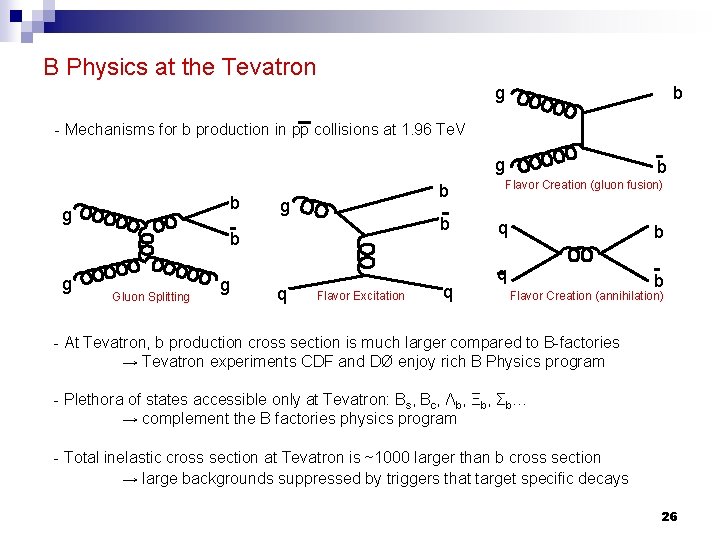
B Physics at the Tevatron g b - Mechanisms for b production in pp collisions at 1. 96 Te. V g b g b b g Gluon Splitting g q Flavor Excitation q b Flavor Creation (gluon fusion) q b Flavor Creation (annihilation) - At Tevatron, b production cross section is much larger compared to B-factories → Tevatron experiments CDF and DØ enjoy rich B Physics program - Plethora of states accessible only at Tevatron: Bs, Bc, Λb, Ξb, Σb… → complement the B factories physics program - Total inelastic cross section at Tevatron is ~1000 larger than b cross section → large backgrounds suppressed by triggers that target specific decays 26
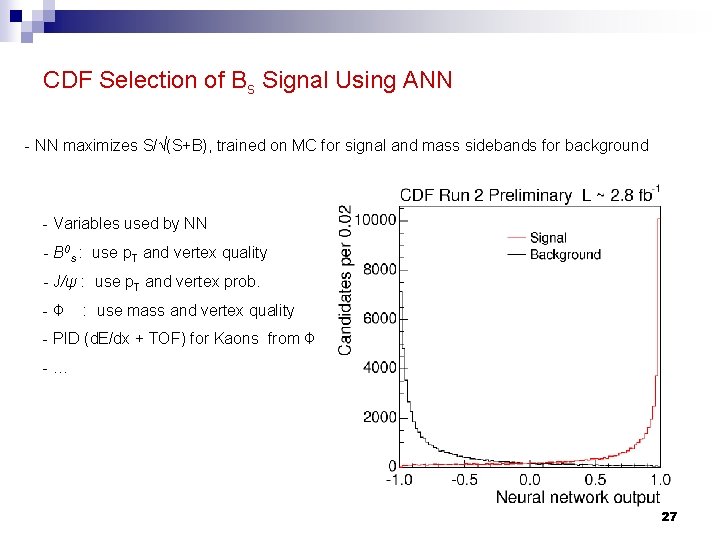
CDF Selection of Bs Signal Using ANN - NN maximizes S/√(S+B), trained on MC for signal and mass sidebands for background - Variables used by NN - B 0 s : use p. T and vertex quality - J/ψ : use p. T and vertex prob. -Φ : use mass and vertex quality - PID (d. E/dx + TOF) for Kaons from Φ -… 27
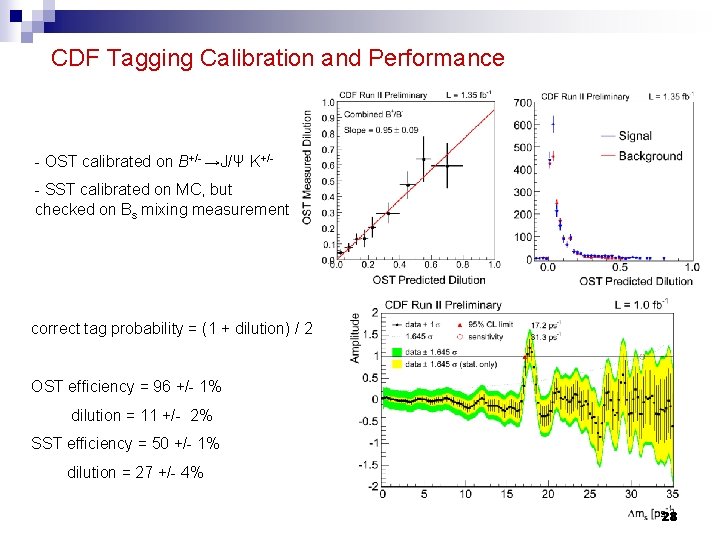
CDF Tagging Calibration and Performance - OST calibrated on B+/- →J/Ψ K+/- SST calibrated on MC, but checked on Bs mixing measurement correct tag probability = (1 + dilution) / 2 OST efficiency = 96 +/- 1% dilution = 11 +/- 2% SST efficiency = 50 +/- 1% dilution = 27 +/- 4% 28
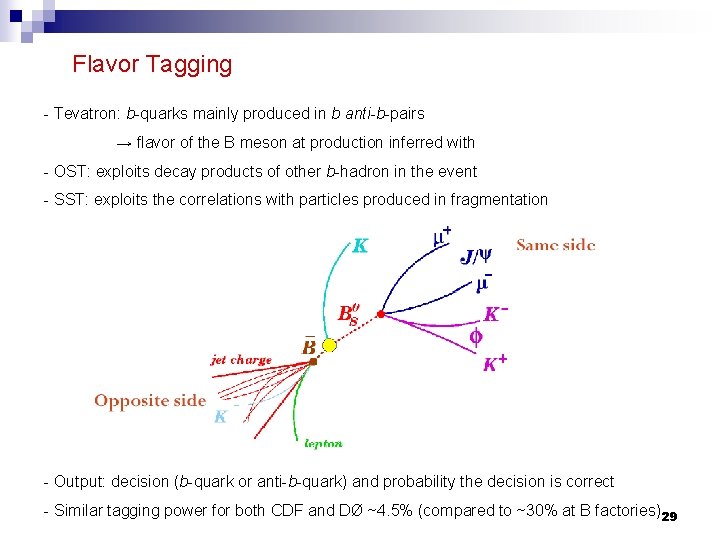
Flavor Tagging - Tevatron: b-quarks mainly produced in b anti-b-pairs → flavor of the B meson at production inferred with - OST: exploits decay products of other b-hadron in the event - SST: exploits the correlations with particles produced in fragmentation - Output: decision (b-quark or anti-b-quark) and probability the decision is correct - Similar tagging power for both CDF and DØ ~4. 5% (compared to ~30% at B factories)29
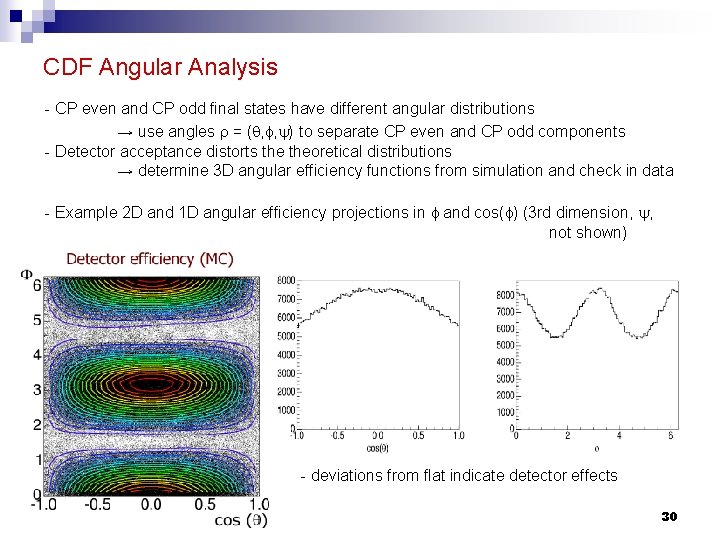
CDF Angular Analysis - CP even and CP odd final states have different angular distributions → use angles r = ( , , ) to separate CP even and CP odd components - Detector acceptance distorts theoretical distributions → determine 3 D angular efficiency functions from simulation and check in data - Example 2 D and 1 D angular efficiency projections in and cos( ) (3 rd dimension, , not shown) - deviations from flat indicate detector effects 30
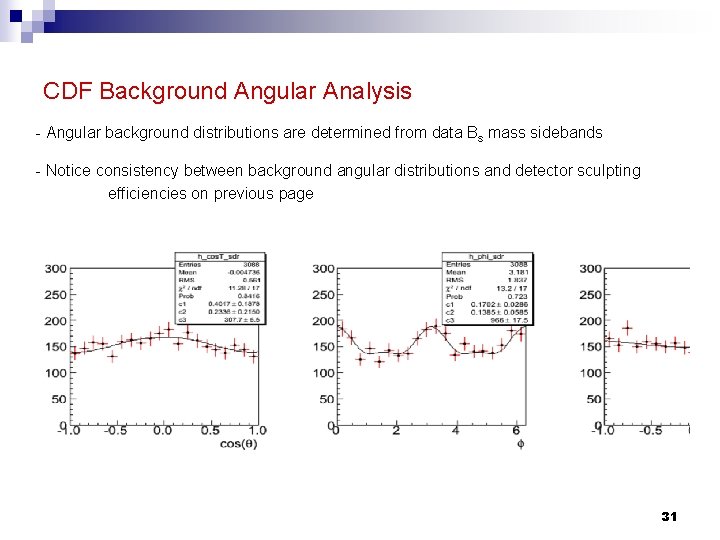
CDF Background Angular Analysis - Angular background distributions are determined from data Bs mass sidebands - Notice consistency between background angular distributions and detector sculpting efficiencies on previous page 31
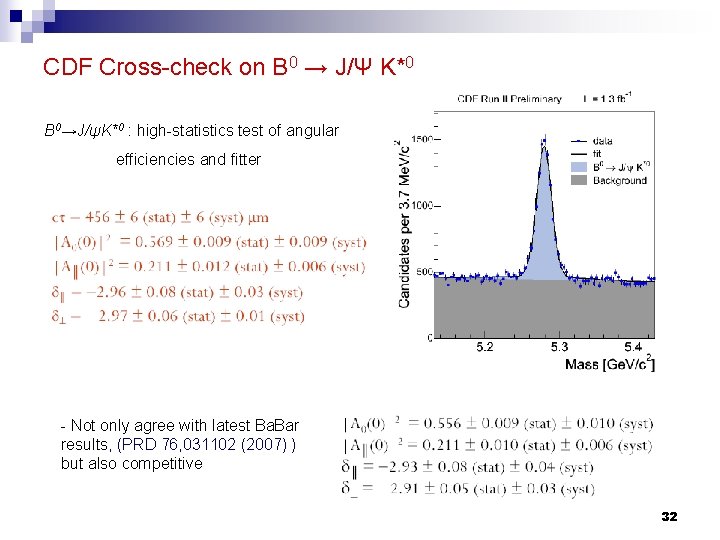
CDF Cross-check on B 0 → J/Ψ K*0 B 0→J/ψK*0 : high-statistics test of angular efficiencies and fitter - Not only agree with latest Ba. Bar results, (PRD 76, 031102 (2007) ) but also competitive 32
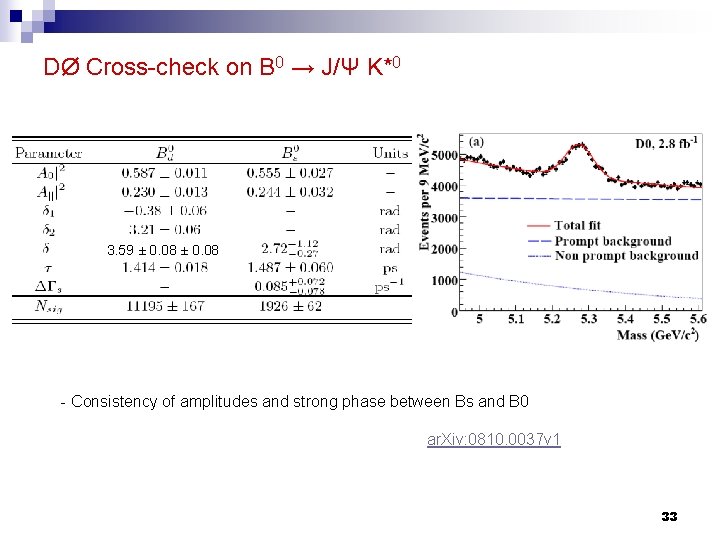
DØ Cross-check on B 0 → J/Ψ K*0 3. 59 ± 0. 08 - Consistency of amplitudes and strong phase between Bs and B 0 ar. Xiv: 0810. 0037 v 1 33
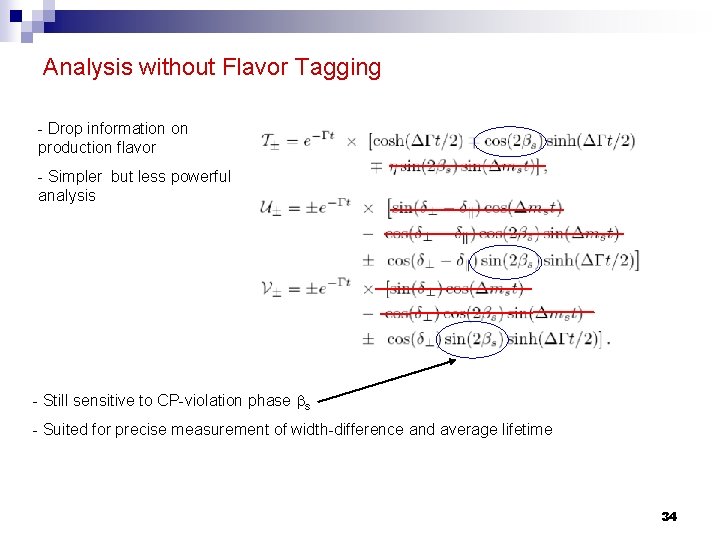
Analysis without Flavor Tagging - Drop information on production flavor - Simpler but less powerful analysis - Still sensitive to CP-violation phase bs - Suited for precise measurement of width-difference and average lifetime 34
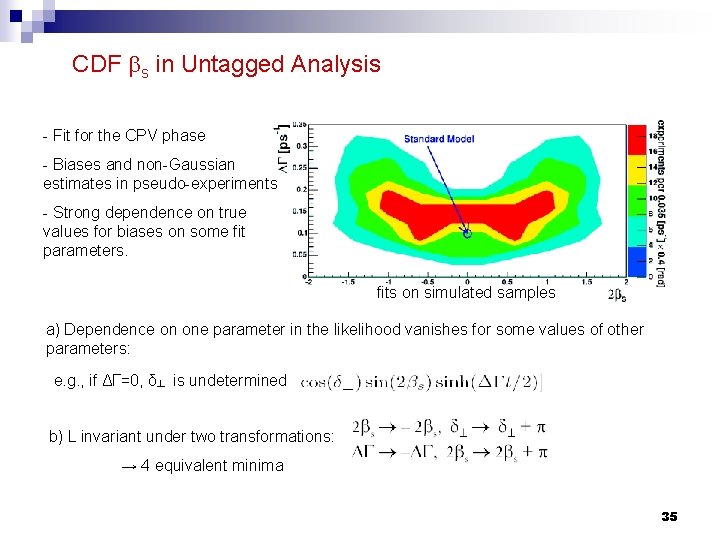
CDF bs in Untagged Analysis - Fit for the CPV phase - Biases and non-Gaussian estimates in pseudo-experiments - Strong dependence on true values for biases on some fit parameters. fits on simulated samples a) Dependence on one parameter in the likelihood vanishes for some values of other parameters: e. g. , if ΔΓ=0, δ┴ is undetermined b) L invariant under two transformations: → 4 equivalent minima 35
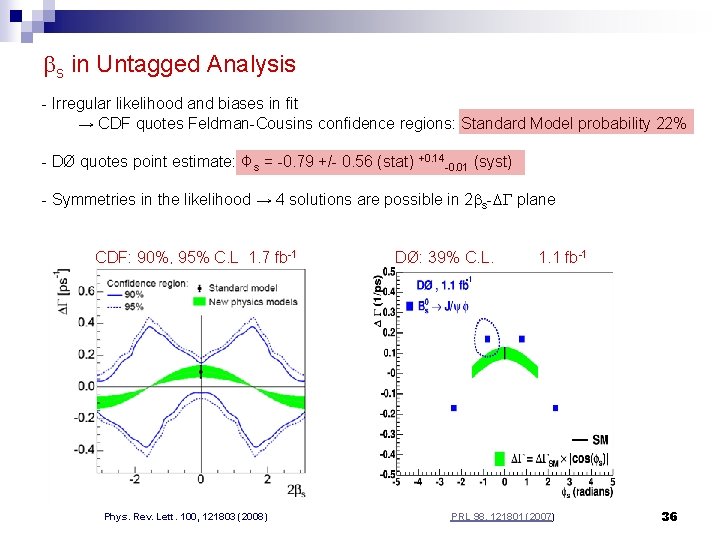
bs in Untagged Analysis - Irregular likelihood and biases in fit → CDF quotes Feldman-Cousins confidence regions: Standard Model probability 22% - DØ quotes point estimate: Φs = -0. 79 +/- 0. 56 (stat) +0. 14 -0. 01 (syst) - Symmetries in the likelihood → 4 solutions are possible in 2 bs-DG plane CDF: 90%, 95% C. L 1. 7 fb-1 Phys. Rev. Lett. 100, 121803 (2008) DØ: 39% C. L. 1. 1 fb-1 PRL 98, 121801 (2007) 36
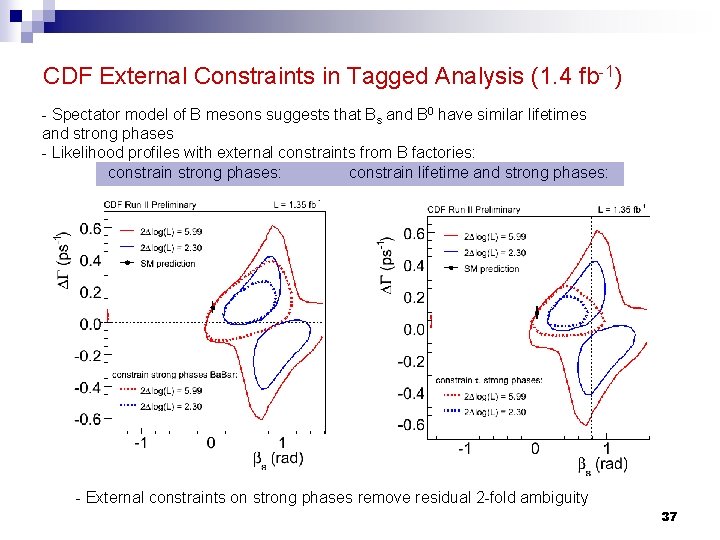
CDF External Constraints in Tagged Analysis (1. 4 fb-1) - Spectator model of B mesons suggests that Bs and B 0 have similar lifetimes and strong phases - Likelihood profiles with external constraints from B factories: constrain strong phases: constrain lifetime and strong phases: - External constraints on strong phases remove residual 2 -fold ambiguity 37
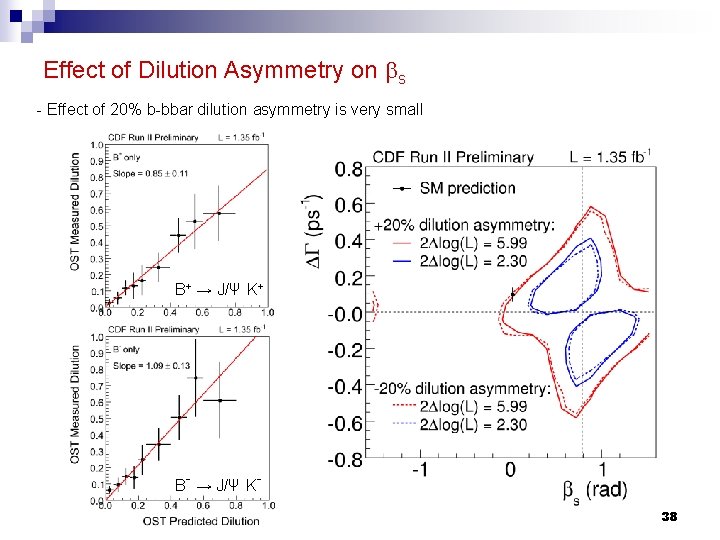
Effect of Dilution Asymmetry on bs - Effect of 20% b-bbar dilution asymmetry is very small B+ → J/Ψ K+ B- → J/Ψ K 38
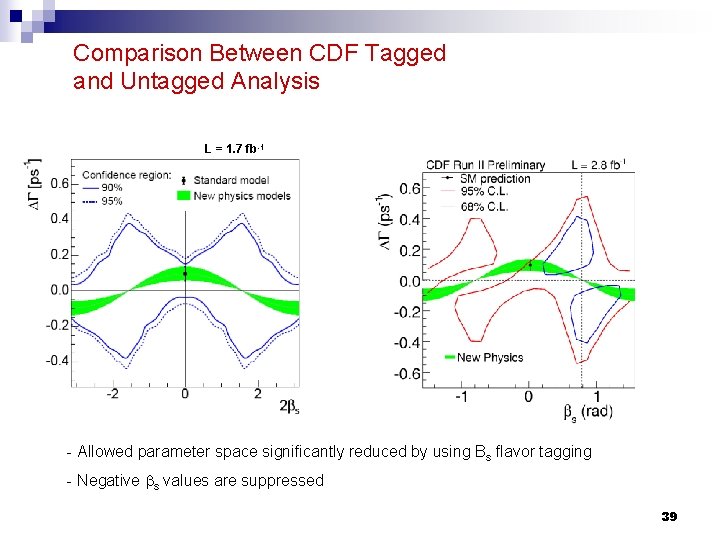
Comparison Between CDF Tagged and Untagged Analysis L = 1. 7 fb-1 - Allowed parameter space significantly reduced by using Bs flavor tagging - Negative bs values are suppressed 39
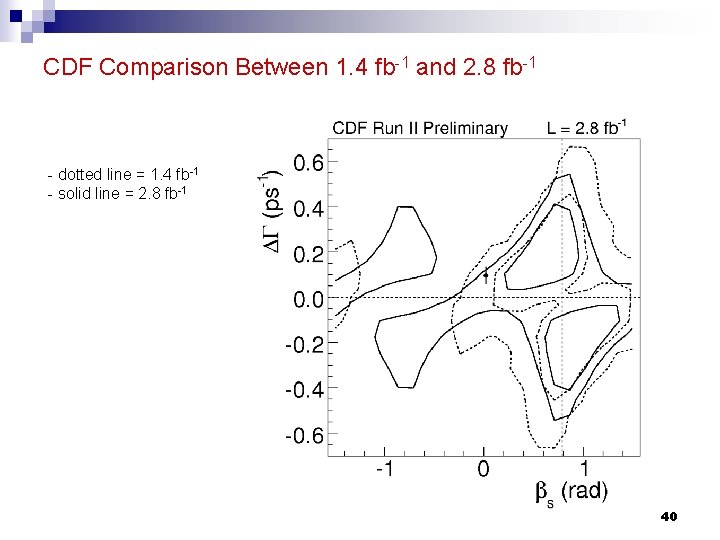
CDF Comparison Between 1. 4 fb-1 and 2. 8 fb-1 - dotted line = 1. 4 fb-1 - solid line = 2. 8 fb-1 40
Non-Gaussian Regime - In this analysis integrated likelihood ratio distribution (black histogram) deviates from the ideal c 2 distribution (red continuous curve) -To get 95% CL need to go up ~7 instead of 6 units from minimum 1 - CL - In ideal case (high statistics, Gaussian likelihood), to get the 2 D 68% (95%) C. L. regions, take a slice through profile likelihood at 2. 3 (6) units up from minimum ideal 95% CL real 95% CL 0. 05 - Procedure used by both CDF and DØ - From pseudo experiments find that Gaussian regime is indeed reached as sample size increases 2 Dlog(L) 41
CDF Systematics - Nuisance parameters: - lifetime, lifetime scale factor uncertainty, - strong phases, - transversity amplitudes, - background angular and decay time parameters, - dilution scale factors and tagging efficiency - mass signal and background parameters -… 1 - CL - At CDF, systematic uncertainties studied by varying all nuisance parameters +/- 5 s from observed values and repeating LR curves (dotted histograms) ideal 95% CL real 95% CL + syst error 0. 05 - Take the most conservative curve (dotted red histogram) as final result 2 Dlog(L) 42
![CDF 1 D Profile Likelihood bs is within [0. 28, 1. 29] at the](http://slidetodoc.com/presentation_image_h2/af9d6ad70a18ebd2dc7814233342816e/image-43.jpg "CDF 1 D Profile Likelihood bs is within [0. 28, 1. 29] at the")
CDF 1 D Profile Likelihood bs is within [0. 28, 1. 29] at the 68% CL 43
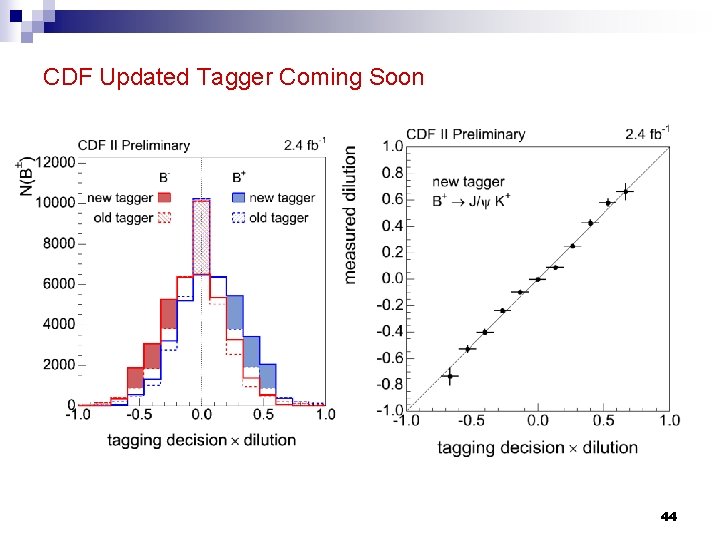
CDF Updated Tagger Coming Soon 44
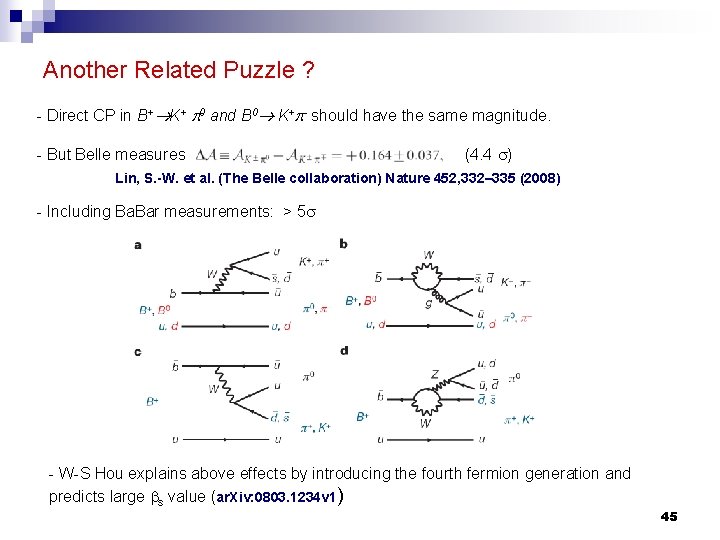
Another Related Puzzle ? - Direct CP in B+ K+ p 0 and B 0 K+p- should have the same magnitude. - But Belle measures (4. 4 s) Lin, S. -W. et al. (The Belle collaboration) Nature 452, 332– 335 (2008) - Including Ba. Bar measurements: > 5 s - W-S Hou explains above effects by introducing the fourth fermion generation and predicts large bs value (ar. Xiv: 0803. 1234 v 1) 45
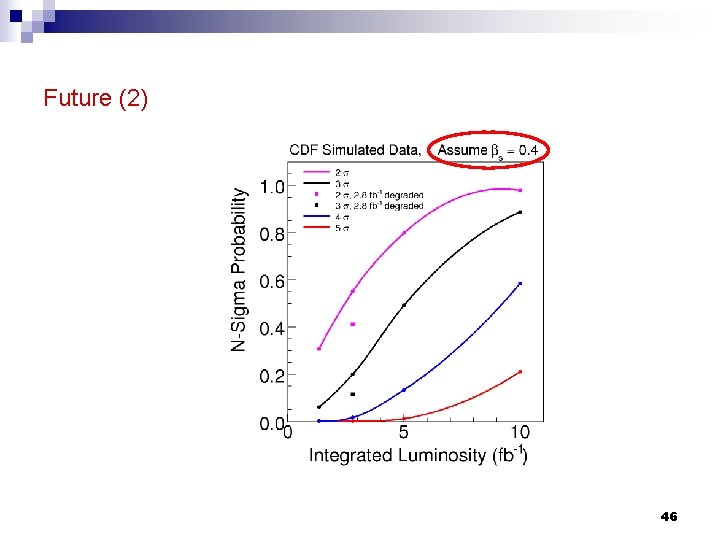
Future (2) 46
- Slides: 46