
Measurement methods for soil moisture and plant water
- Slides: 41
Measurement methods for soil moisture and plant water relations Drs. Colin S. Campbell and Douglas R. Cobos Decagon Devices and Washington State University
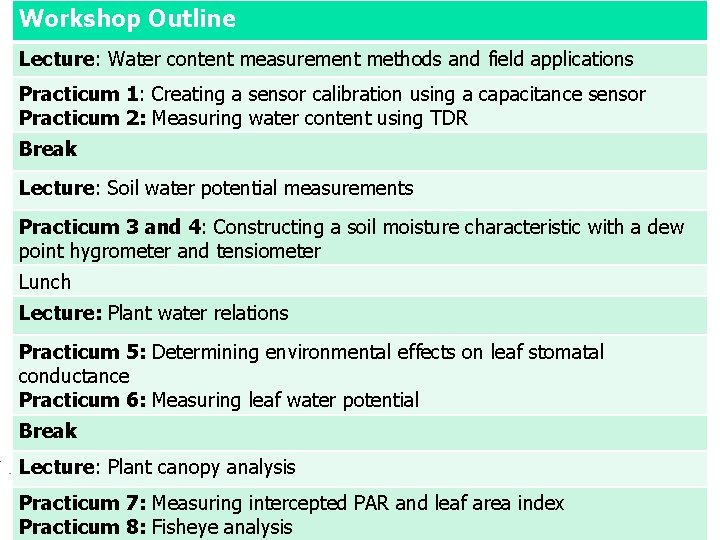
Workshop Outline Workshop outline Practicum 1: Creating a sensor calibration using a capacitance sensor Lecture: Water content measurement methods and field applications Practicum 2: Measuring water content using TDR Break Lecture: Soil water potential measurements Practicum 3 and 4: Constructing a soil moisture characteristic with a dew point hygrometer and tensiometer Lunch Lecture: Plant water relations Practicum 5: Determining environmental effects on leaf stomatal conductance Practicum 6: Measuring leaf water potential Break Lecture: Plant canopy analysis Practicum 7: Measuring intercepted PAR and leaf area index Practicum 8: Fisheye analysis
Water Content Measurement Methods and Field Applications Colin S. Campbell, Ph. D. Decagon Devices and Washington State University
Background n About the presenter n Ph. D. in Soil Physics, 2000, Texas A&M University n Vice President of Research, Development, and Engineering, Decagon Devices, Inc. n Adjunct Associate Professor of Environmental Biophysics, Washington State University n Current research n Insights into plant water use through combining soil moisture and morphology
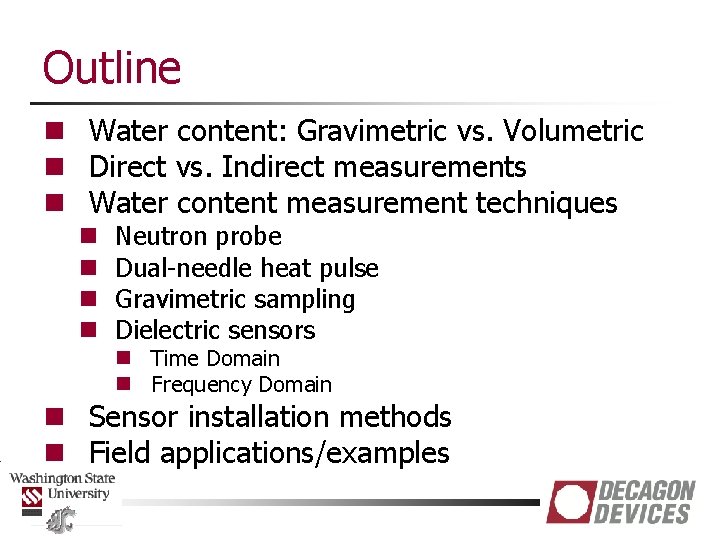
Outline n Water content: Gravimetric vs. Volumetric n Direct vs. Indirect measurements n Water content measurement techniques n n Neutron probe Dual-needle heat pulse Gravimetric sampling Dielectric sensors n Time Domain n Frequency Domain n Sensor installation methods n Field applications/examples
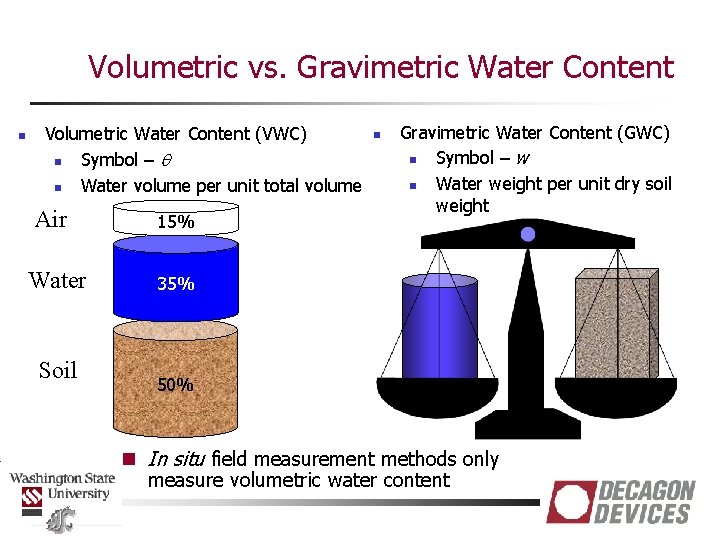
Volumetric vs. Gravimetric Water Content n Volumetric Water Content (VWC) n Symbol – q n Water volume per unit total volume Air Water Soil 15% n Gravimetric Water Content (GWC) n Symbol – w n Water weight per unit dry soil weight 35% 50% n In situ field measurement methods only measure volumetric water content
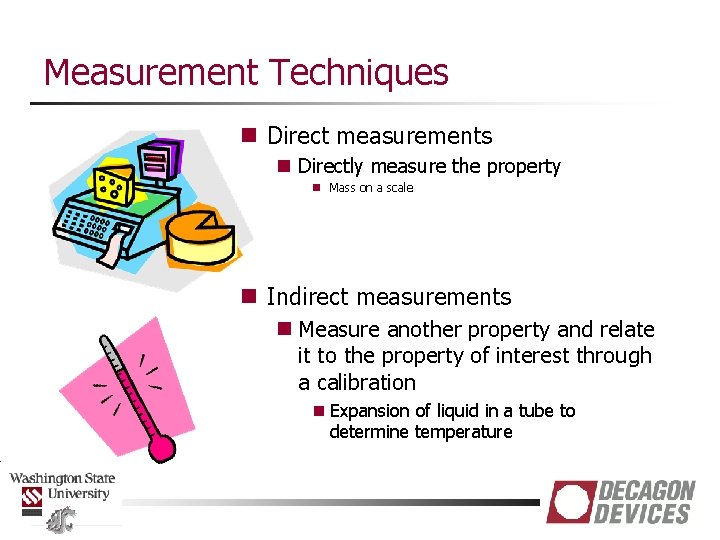
Measurement Techniques n Direct measurements n Directly measure the property n Mass on a scale n Indirect measurements n Measure another property and relate it to the property of interest through a calibration n Expansion of liquid in a tube to determine temperature
Direct Water Content Measurements n Gravimetric (w) Technique n Sample representative weight of soil n Take care to limit water draining/evaporating from soil n Weigh sample on balance with adequate accuracy/precision n Dry sample at 105 o C for 24 h n Allow to cool in desiccators n Obtain dry sample weight and tare weight n Generate volumetric water content n Same as gravimetric except soil is sampled with known volume Calibration instructions: www. decagon. com/appnotes/Calibrating. ECH 2 OSoil. Moisture. Probes. pdf
Direct Water Content Measurements n Advantages n Simple n Direct measurement n Can be inexpensive n Disadvantages n Destructive n does not account for temporal variability n Time consuming n Requires precision balance & oven
Instruments for Measuring in situ Water Content (indirect) n Neutron thermalization n Neutron probes n Dual needle heat pulse probe n Dielectric measurement n Capacitance/Frequency Domain Reflectometery (FDR) n Time Domain Reflectometry (TDR)
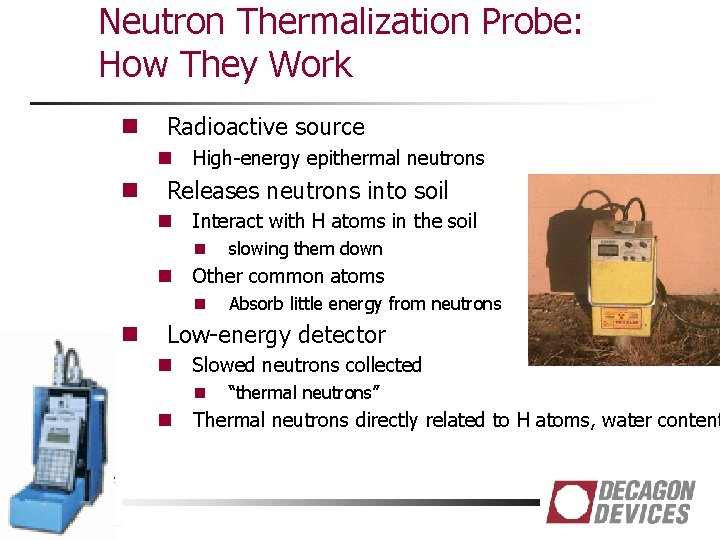
Neutron Thermalization Probe: How They Work n Radioactive source n n High-energy epithermal neutrons Releases neutrons into soil n Interact with H atoms in the soil n n Other common atoms n n slowing them down Absorb little energy from neutrons Low-energy detector n Slowed neutrons collected n n “thermal neutrons” Thermal neutrons directly related to H atoms, water content
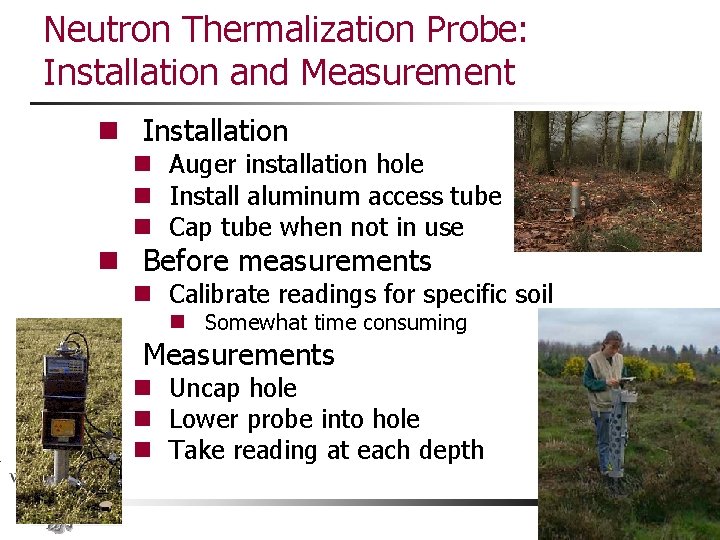
Neutron Thermalization Probe: Installation and Measurement n Installation n Auger installation hole n Install aluminum access tube n Cap tube when not in use n Before measurements n Calibrate readings for specific soil n Somewhat time consuming n Measurements n Uncap hole n Lower probe into hole n Take reading at each depth
Neutron Thermalization Probe n Advantages n Single instrument can measure multiple sites n Large measurement volume n Gets away from issues with spatial variability n Insensitive to salinity, temperature n Disadvantages n No continuous record n Requires radiation certification to use n Expensive n Heavy
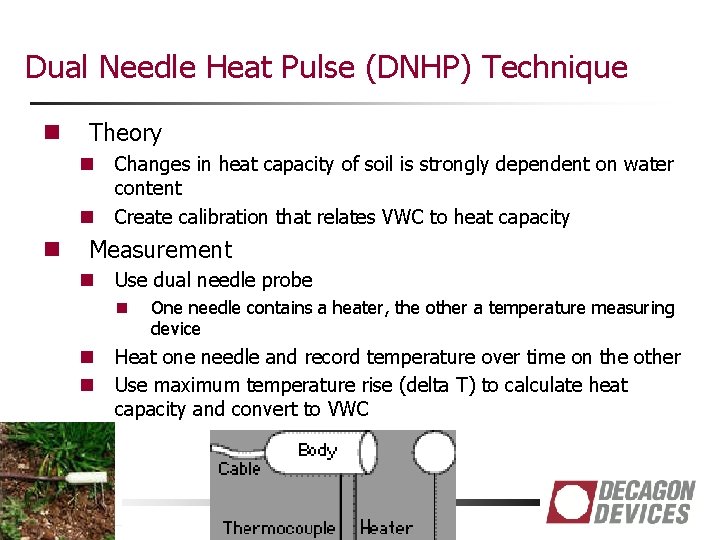
Dual Needle Heat Pulse (DNHP) Technique n Theory n n n Changes in heat capacity of soil is strongly dependent on water content Create calibration that relates VWC to heat capacity Measurement n Use dual needle probe n n n One needle contains a heater, the other a temperature measuring device Heat one needle and record temperature over time on the other Use maximum temperature rise (delta T) to calculate heat capacity and convert to VWC
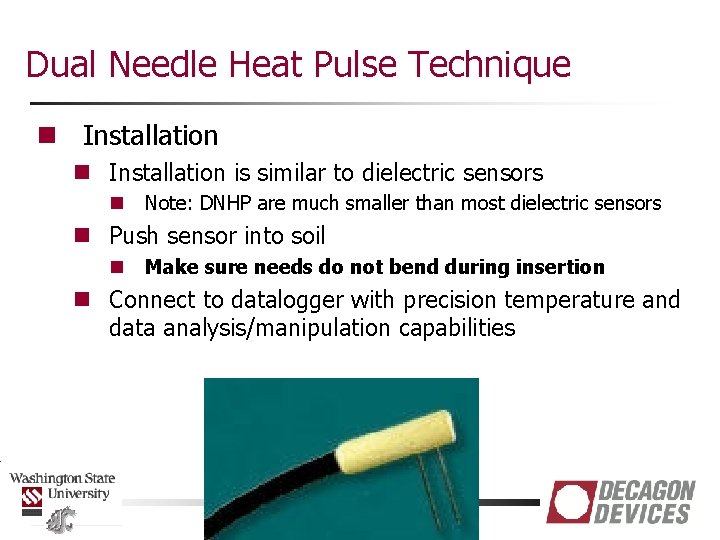
Dual Needle Heat Pulse Technique n Installation is similar to dielectric sensors n Note: DNHP are much smaller than most dielectric sensors n Push sensor into soil n Make sure needs do not bend during insertion n Connect to datalogger with precision temperature and data analysis/manipulation capabilities
Dual Needle Heat Pulse Technique n Advantages n Small measurement volume n. Most locationspecific method available n. Can measure water content around growing seed n Disadvantages n Requires datalogger with precise temperature measurement and analysis n Can be susceptible to temperature gradients in soil n time n depth n Integrates small soil volume n Fragile Young et at. (2008) Correcting Dual-Probe Heat-Pulse Readings for Changes in Ambient Temperature, Vadose Zone Journal 7: 22 -30
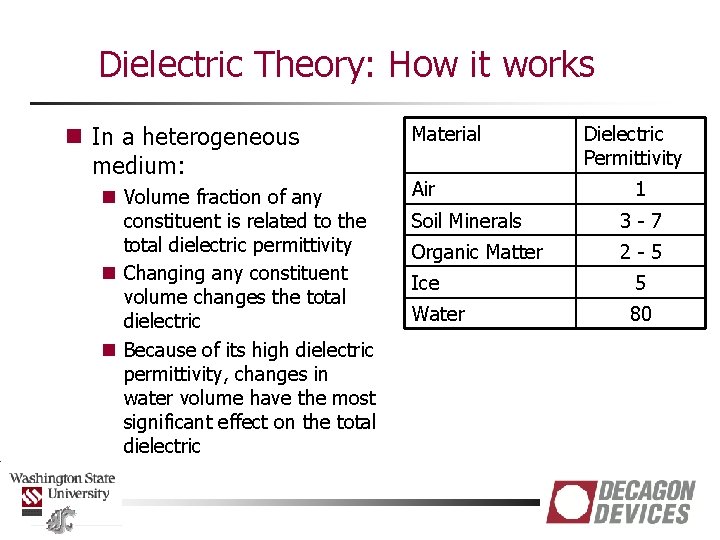
Dielectric Theory: How it works n In a heterogeneous medium: n Volume fraction of any constituent is related to the total dielectric permittivity n Changing any constituent volume changes the total dielectric n Because of its high dielectric permittivity, changes in water volume have the most significant effect on the total dielectric Material Air Dielectric Permittivity 1 Soil Minerals 3 -7 Organic Matter 2 -5 Ice 5 Water 80
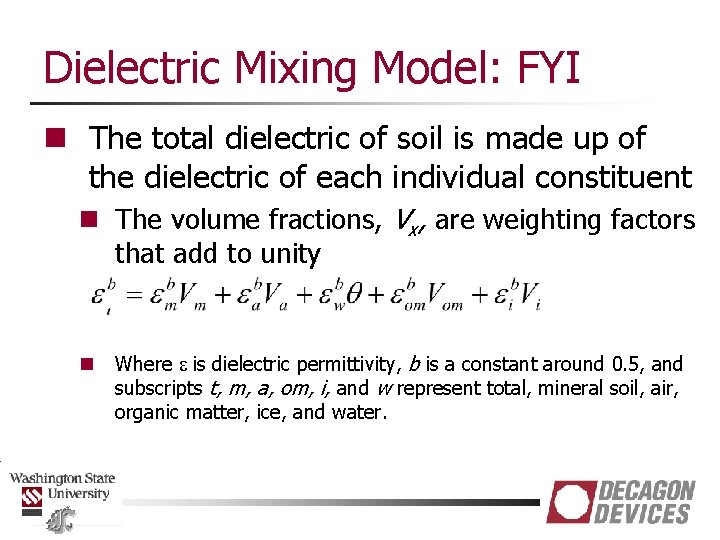
Dielectric Mixing Model: FYI n The total dielectric of soil is made up of the dielectric of each individual constituent n The volume fractions, Vx, are weighting factors that add to unity n Where e is dielectric permittivity, b is a constant around 0. 5, and subscripts t, m, a, om, i, and w represent total, mineral soil, air, organic matter, ice, and water.
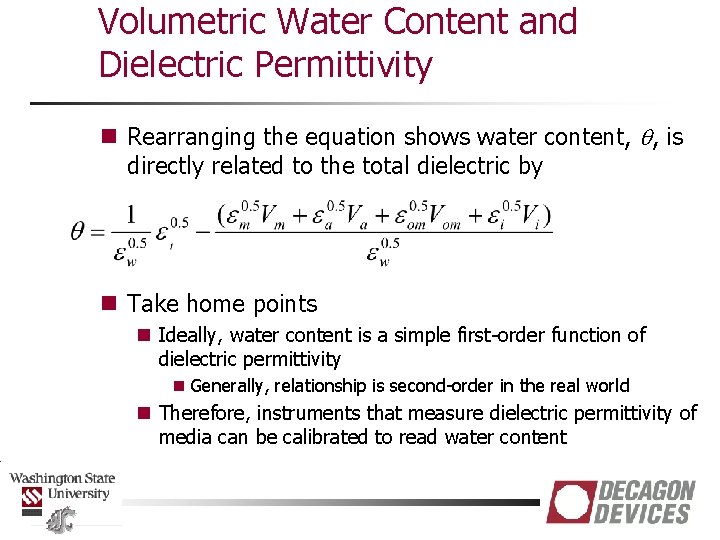
Volumetric Water Content and Dielectric Permittivity n Rearranging the equation shows water content, q, is directly related to the total dielectric by n Take home points n Ideally, water content is a simple first-order function of dielectric permittivity n Generally, relationship is second-order in the real world n Therefore, instruments that measure dielectric permittivity of media can be calibrated to read water content
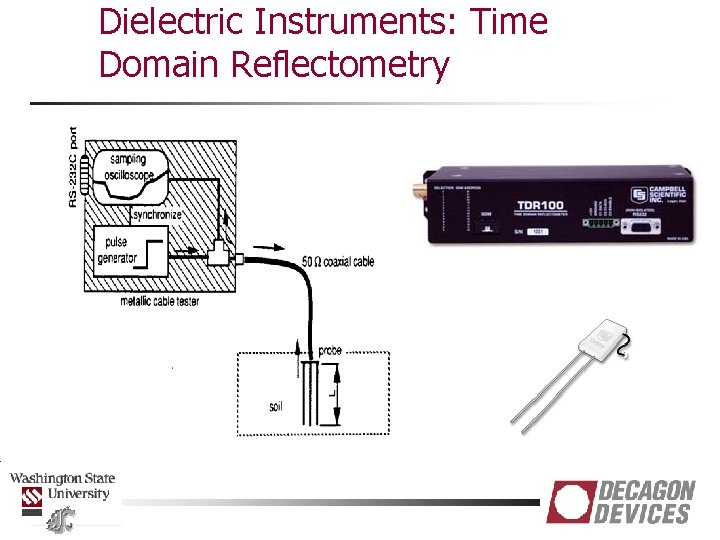
Dielectric Instruments: Time Domain Reflectometry
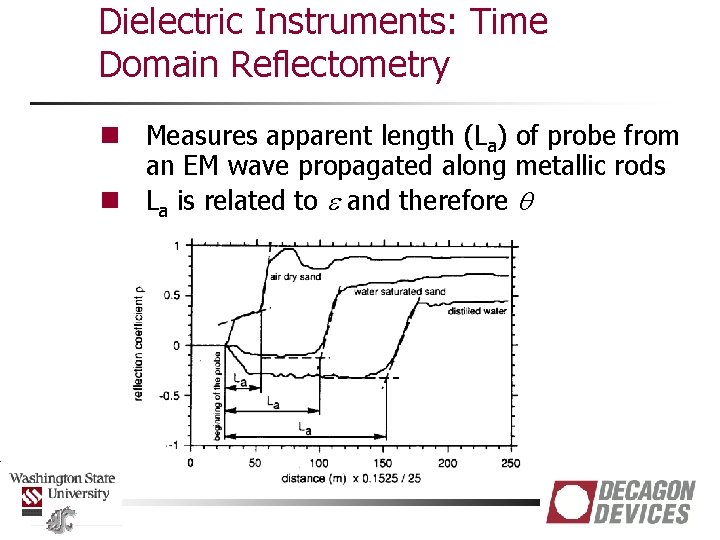
Dielectric Instruments: Time Domain Reflectometry n Measures apparent length (La) of probe from an EM wave propagated along metallic rods n La is related to e and therefore q
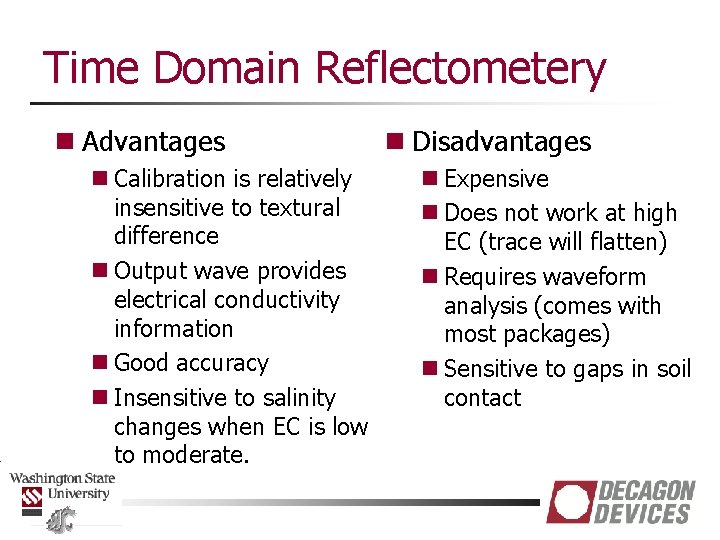
Time Domain Reflectometery n Advantages n Calibration is relatively insensitive to textural difference n Output wave provides electrical conductivity information n Good accuracy n Insensitive to salinity changes when EC is low to moderate. n Disadvantages n Expensive n Does not work at high EC (trace will flatten) n Requires waveform analysis (comes with most packages) n Sensitive to gaps in soil contact
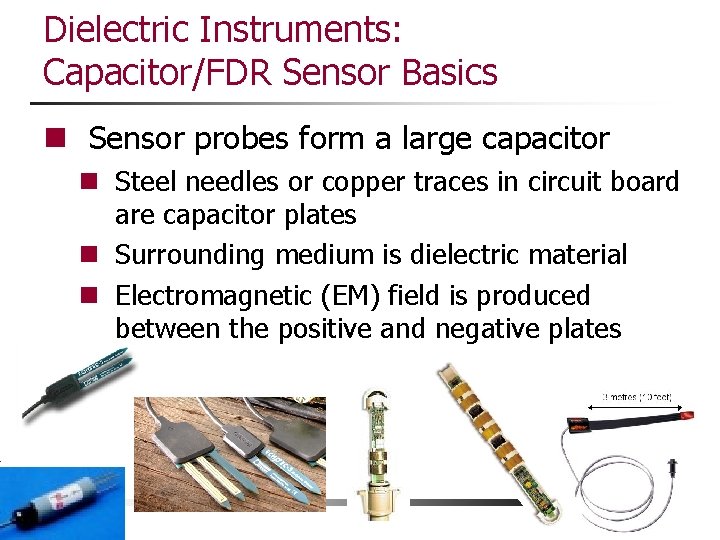
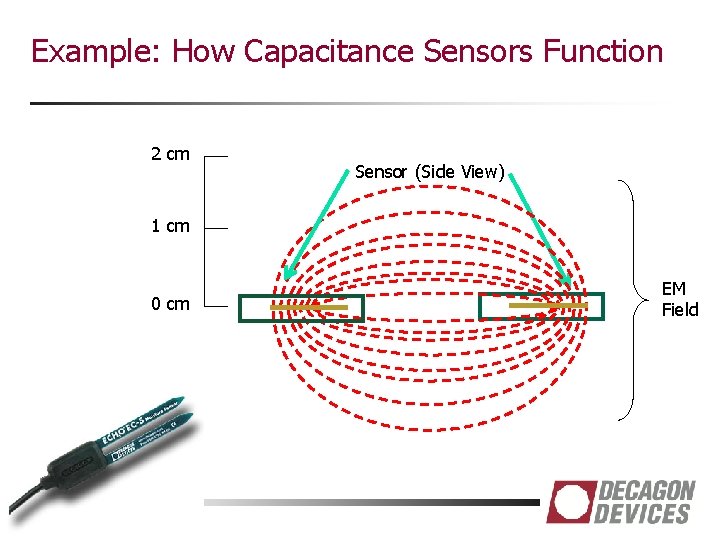
Dielectric Instruments: Capacitor/FDR Sensor Basics n Sensor probes form a large capacitor n Steel needles or copper traces in circuit board are capacitor plates n Surrounding medium is dielectric material n Electromagnetic (EM) field is produced between the positive and negative plates
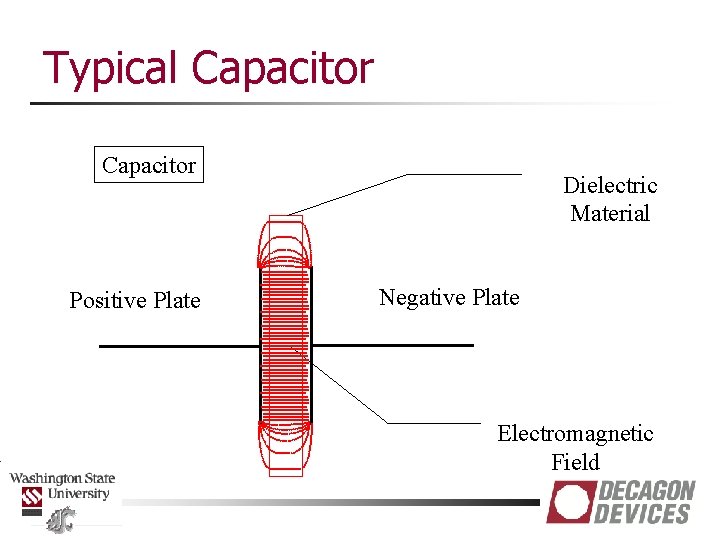
Typical Capacitor Positive Plate Dielectric Material Negative Plate Electromagnetic Field
Example: How Capacitance Sensors Function 2 cm Sensor (Side View) 1 cm 0 cm EM Field
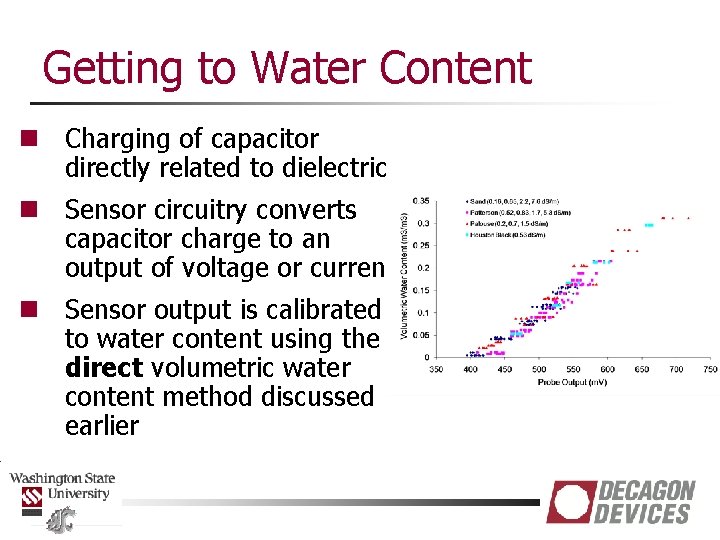
Getting to Water Content n Charging of capacitor directly related to dielectric n Sensor circuitry converts capacitor charge to an output of voltage or current n Sensor output is calibrated to water content using the direct volumetric water content method discussed earlier
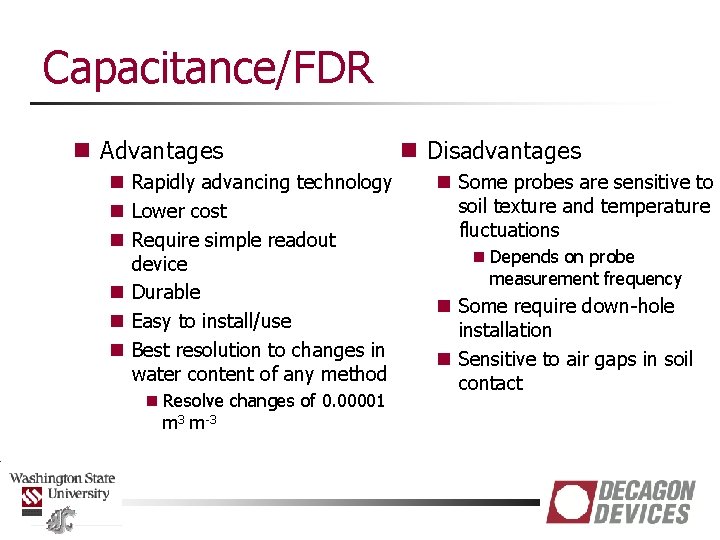
Capacitance/FDR n Advantages n Rapidly advancing technology n Lower cost n Require simple readout device n Durable n Easy to install/use n Best resolution to changes in water content of any method n Resolve changes of 0. 00001 m 3 m-3 n Disadvantages n Some probes are sensitive to soil texture and temperature fluctuations n Depends on probe measurement frequency n Some require down-hole installation n Sensitive to air gaps in soil contact
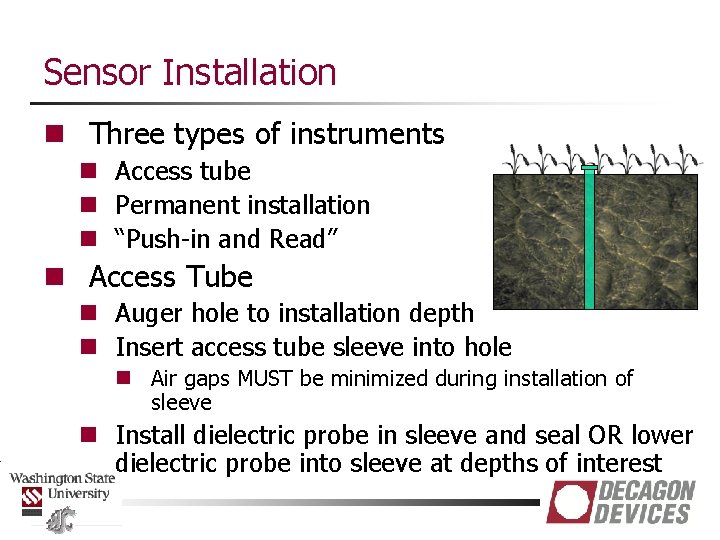
Sensor Installation n Three types of instruments n Access tube n Permanent installation n “Push-in and Read” n Access Tube n Auger hole to installation depth n Insert access tube sleeve into hole n Air gaps MUST be minimized during installation of sleeve n Install dielectric probe in sleeve and seal OR lower dielectric probe into sleeve at depths of interest
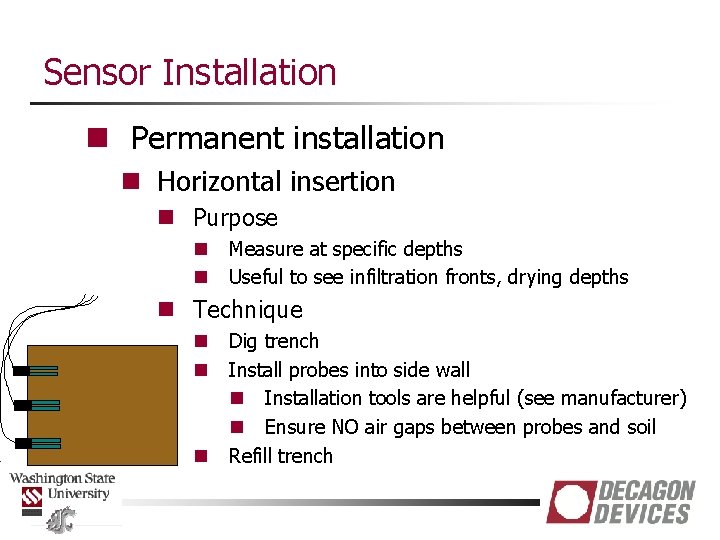
Sensor Installation n Permanent installation n Horizontal insertion n Purpose n n Measure at specific depths Useful to see infiltration fronts, drying depths n Technique n n n Dig trench Install probes into side wall n Installation tools are helpful (see manufacturer) n Ensure NO air gaps between probes and soil Refill trench
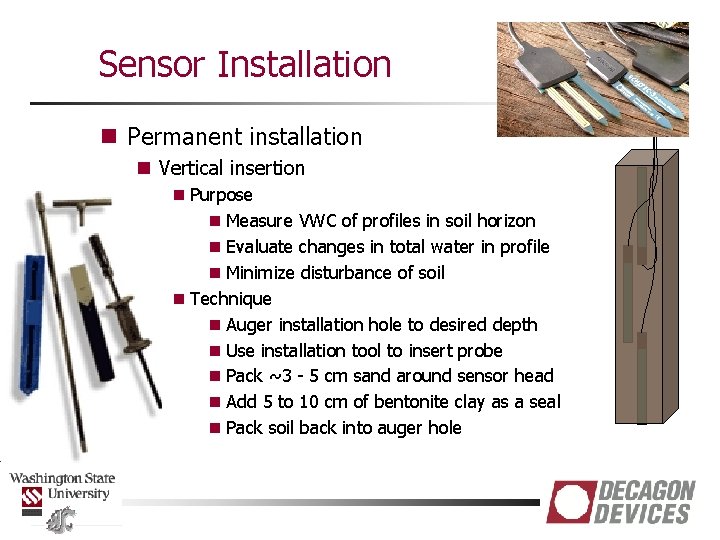
Sensor Installation n Permanent installation n Vertical insertion n Purpose n Measure VWC of profiles in soil horizon n Evaluate changes in total water in profile n Minimize disturbance of soil n Technique n Auger installation hole to desired depth n Use installation tool to insert probe n Pack ~3 - 5 cm sand around sensor head n Add 5 to 10 cm of bentonite clay as a seal n Pack soil back into auger hole
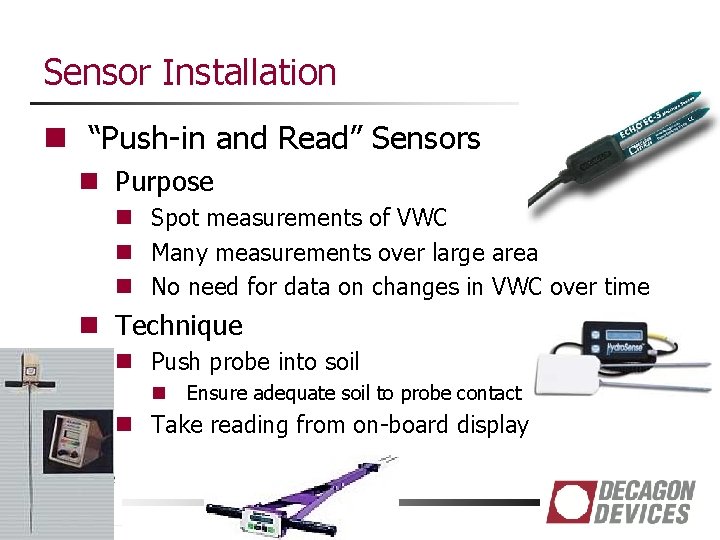
Sensor Installation n “Push-in and Read” Sensors n Purpose n Spot measurements of VWC n Many measurements over large area n No need for data on changes in VWC over time n Technique n Push probe into soil n Ensure adequate soil to probe contact n Take reading from on-board display
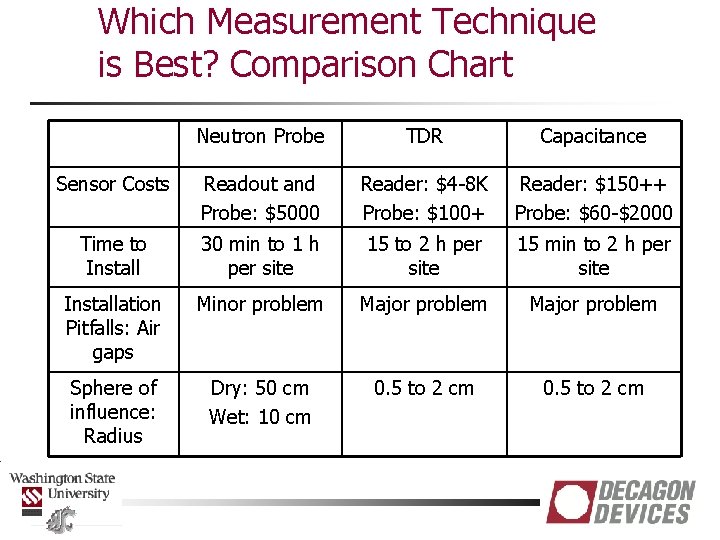
Which Measurement Technique is Best? Comparison Chart Neutron Probe TDR Capacitance Sensor Costs Readout and Probe: $5000 Reader: $4 -8 K Probe: $100+ Reader: $150++ Probe: $60 -$2000 Time to Install 30 min to 1 h per site 15 to 2 h per site 15 min to 2 h per site Installation Pitfalls: Air gaps Minor problem Major problem Sphere of influence: Radius Dry: 50 cm Wet: 10 cm 0. 5 to 2 cm
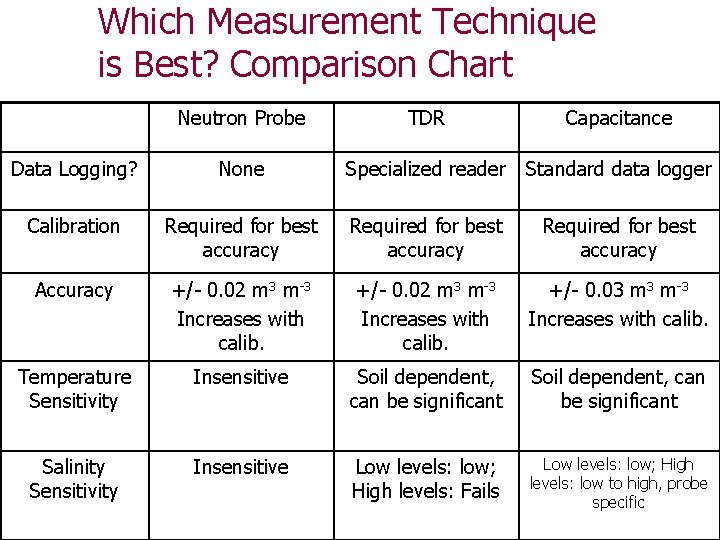
Which Measurement Technique is Best? Comparison Chart Neutron Probe TDR Capacitance Data Logging? None Specialized reader Standard data logger Calibration Required for best accuracy Accuracy +/- 0. 02 m 3 m-3 Increases with calib. +/- 0. 03 m 3 m-3 Increases with calib. Temperature Sensitivity Insensitive Soil dependent, can be significant Salinity Sensitivity Insensitive Low levels: low; High levels: Fails Low levels: low; High levels: low to high, probe specific
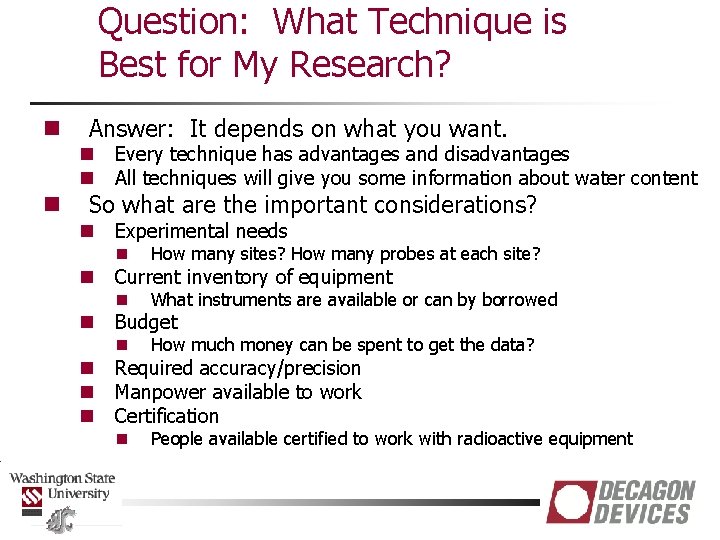
Question: What Technique is Best for My Research? n n Answer: It depends on what you want. n n Every technique has advantages and disadvantages All techniques will give you some information about water content n Experimental needs So what are the important considerations? n n n How many sites? How many probes at each site? n What instruments are available or can by borrowed n How much money can be spent to get the data? n People available certified to work with radioactive equipment Current inventory of equipment Budget Required accuracy/precision Manpower available to work Certification
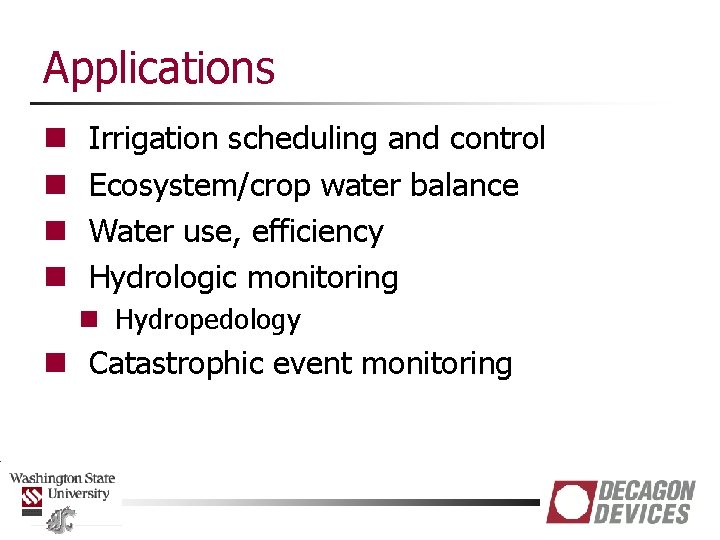
Applications n n Irrigation scheduling and control Ecosystem/crop water balance Water use, efficiency Hydrologic monitoring n Hydropedology n Catastrophic event monitoring
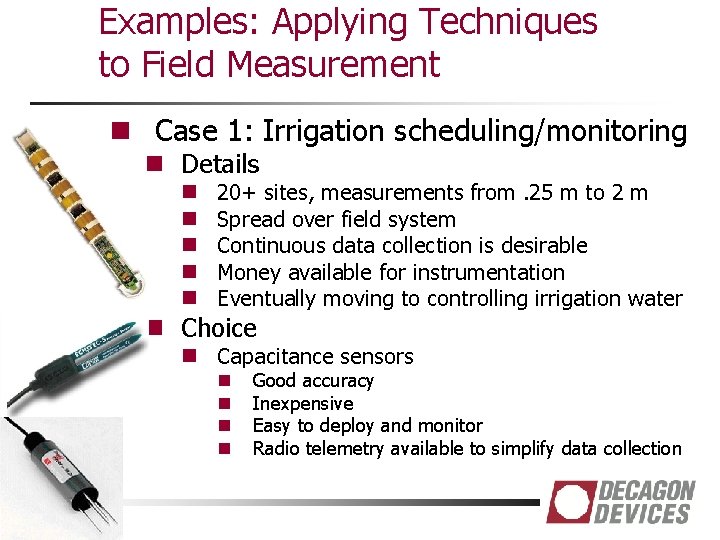
Examples: Applying Techniques to Field Measurement n Case 1: Irrigation scheduling/monitoring n Details n n n 20+ sites, measurements from. 25 m to 2 m Spread over field system Continuous data collection is desirable Money available for instrumentation Eventually moving to controlling irrigation water n Choice n Capacitance sensors n n Good accuracy Inexpensive Easy to deploy and monitor Radio telemetry available to simplify data collection
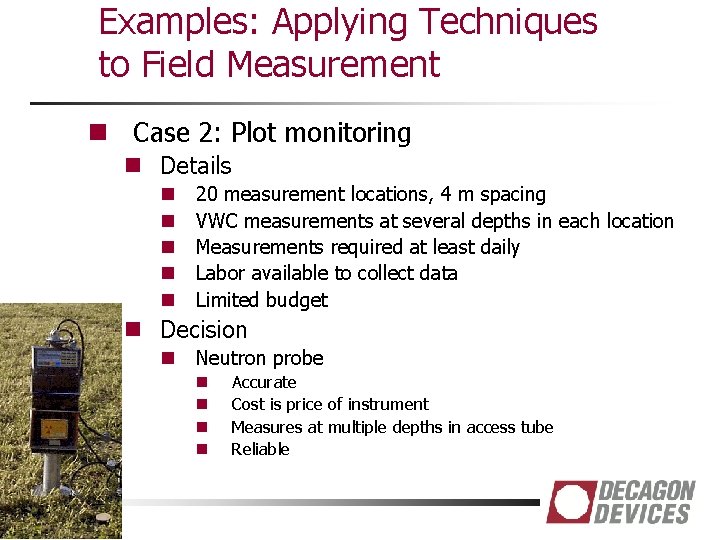
Examples: Applying Techniques to Field Measurement n Case 2: Plot monitoring n Details n n n 20 measurement locations, 4 m spacing VWC measurements at several depths in each location Measurements required at least daily Labor available to collect data Limited budget n Decision n Neutron probe n n Accurate Cost is price of instrument Measures at multiple depths in access tube Reliable
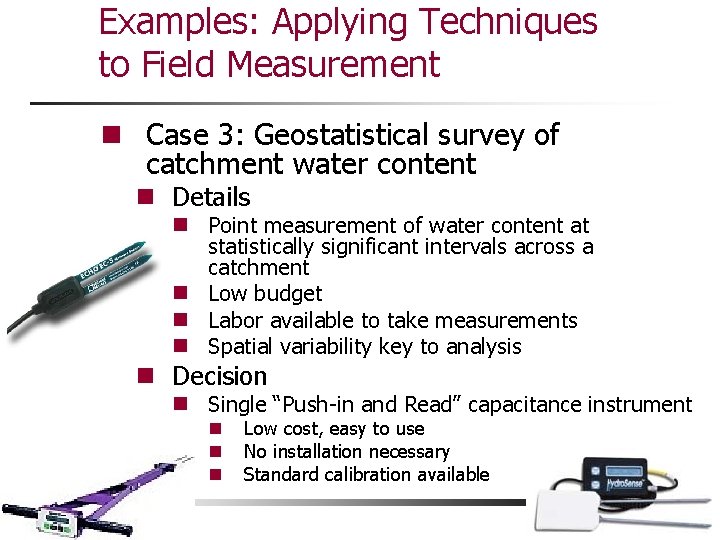
Examples: Applying Techniques to Field Measurement n Case 3: Geostatistical survey of catchment water content n Details n Point measurement of water content at statistically significant intervals across a catchment n Low budget n Labor available to take measurements n Spatial variability key to analysis n Decision n Single “Push-in and Read” capacitance instrument n n n Low cost, easy to use No installation necessary Standard calibration available
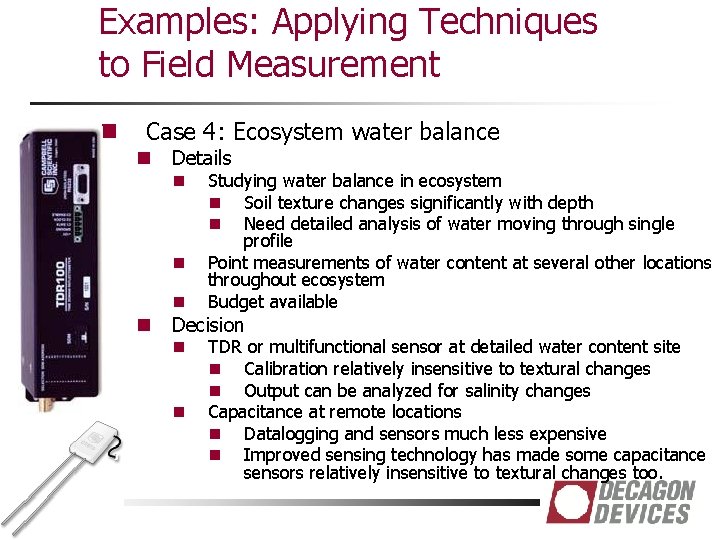
Examples: Applying Techniques to Field Measurement n Case 4: Ecosystem water balance n Details n n Studying water balance in ecosystem n Soil texture changes significantly with depth n Need detailed analysis of water moving through single profile Point measurements of water content at several other locations throughout ecosystem Budget available Decision n n TDR or multifunctional sensor at detailed water content site n Calibration relatively insensitive to textural changes n Output can be analyzed for salinity changes Capacitance at remote locations n Datalogging and sensors much less expensive n Improved sensing technology has made some capacitance sensors relatively insensitive to textural changes too.
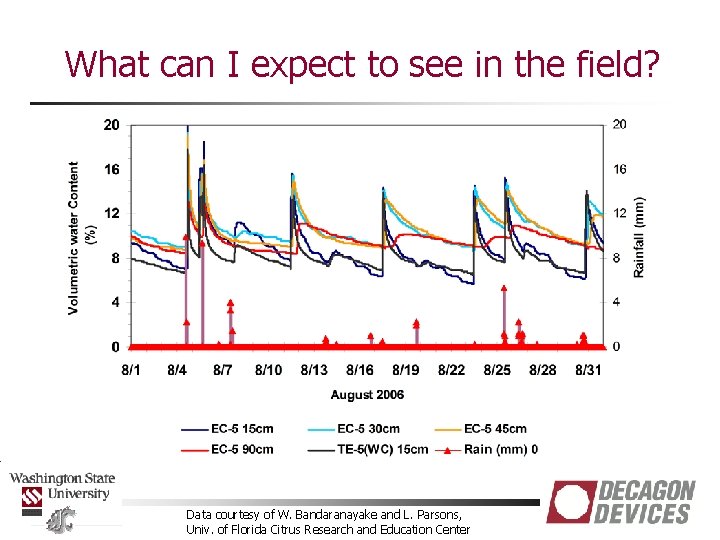
What can I expect to see in the field? Data courtesy of W. Bandaranayake and L. Parsons, Univ. of Florida Citrus Research and Education Center
Conclusion n Many choices for field water content measurement n Several things must be considered to get the right system n Many resources available to make decisions n Manufacturer’s websites n Listservs n http: //www. sowacs. com n Application scientists