
Measurement and simulation of neutron detection efficiency in
- Slides: 1
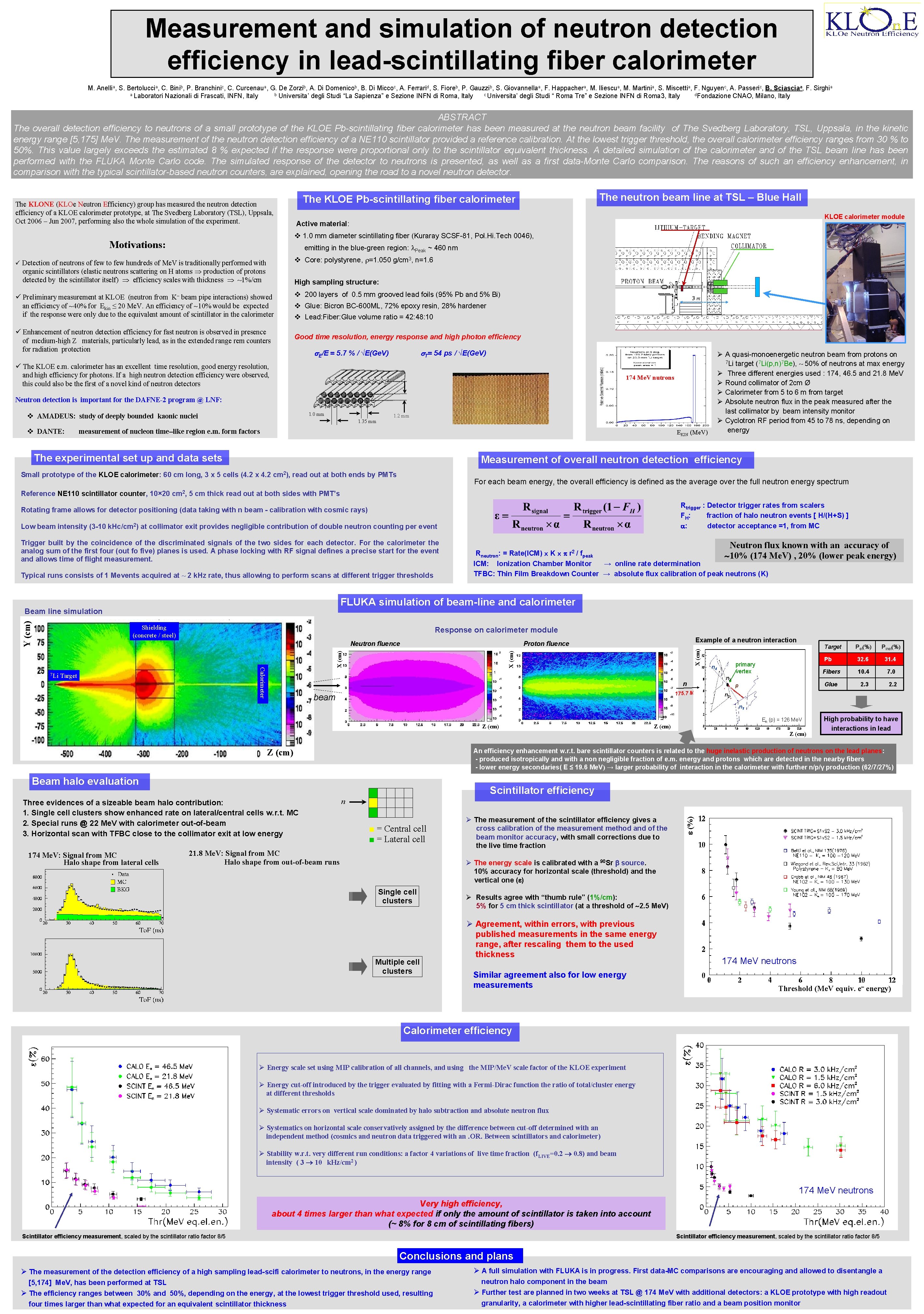
Measurement and simulation of neutron detection efficiency in lead-scintillating fiber calorimeter M. Anellia, S. Bertoluccia, C. Binib, P. Branchinic, C. Curcenaua, G. De Zorzib, A. Di Domenicob, B. Di Miccoc, A. Ferrarid, S. Fioreb, P. Gauzzib, S. Giovannellaa, F. Happachera, M. Iliescua, M. Martinia, S. Miscettia, F. Nguyenc, A. Passeric, B. Sciasciaa, F. Sirghia a Laboratori Nazionali di Frascati, INFN, Italy b Universita’ degli Studi “La Sapienza” e Sezione INFN di Roma, Italy c Universita’ degli Studi “ Roma Tre” e Sezione INFN di Roma 3, Italy d. Fondazione CNAO, Milano, Italy ABSTRACT The overall detection efficiency to neutrons of a small prototype of the KLOE Pb-scintillating fiber calorimeter has been measured at the neutron beam facility of The Svedberg Laboratory, TSL, Uppsala, in the kinetic energy range [5, 175] Me. V. The measurement of the neutron detection efficiency of a NE 110 scintillator provided a reference calibration. At the lowest trigger threshold, the overall calorimeter efficiency ranges from 30 % to 50%. This value largely exceeds the estimated 8 % expected if the response were proportional only to the scintillator equivalent thickness. A detailed simulation of the calorimeter and of the TSL beam line has been performed with the FLUKA Monte Carlo code. The simulated response of the detector to neutrons is presented, as well as a first data-Monte Carlo comparison. The reasons of such an efficiency enhancement, in comparison with the typical scintillator-based neutron counters, are explained, opening the road to a novel neutron detector. The KLONE (KLOe Neutron Efficiency) group has measured the neutron detection efficiency of a KLOE calorimeter prototype, at The Svedberg Laboratory (TSL), Uppsala, Oct 2006 – Jun 2007, performing also the whole simulation of the experiment. The neutron beam line at TSL – Blue Hall The KLOE Pb-scintillating fiber calorimeter KLOE calorimeter module Active material: v 1. 0 mm diameter scintillating fiber (Kuraray SCSF-81, Pol. Hi. Tech 0046), Motivations: emitting in the blue-green region: l. Peak ~ 460 nm v Core: polystyrene, r=1. 050 g/cm 3, n=1. 6 ü Detection of neutrons of few to few hundreds of Me. V is traditionally performed with organic scintillators (elastic neutrons scattering on H atoms production of protons detected by the scintillator itself) efficiency scales with thickness ~1%/cm High sampling structure: ü Preliminary measurement at KLOE (neutron from K beam pipe interactions) showed an efficiency of 40% for Ekin ≤ 20 Me. V. An efficiency of 10% would be expected if the response were only due to the equivalent amount of scintillator in the calorimeter ü Enhancement of neutron detection efficiency for fast neutron is observed in presence of medium-high Z materials, particularly lead, as in the extended range rem counters for radiation protection v 200 layers of 0. 5 mm grooved lead foils (95% Pb and 5% Bi) 3 m v Glue: Bicron BC-600 ML, 72% epoxy resin, 28% hardener v Lead: Fiber: Glue volume ratio = 42: 48: 10 Good time resolution, energy response and high photon efficiency s. E/E = 5. 7 % / √E(Ge. V) s. T= 54 ps / √E(Ge. V) ü The KLOE e. m. calorimeter has an excellent time resolution, good energy resolution, and high efficiency for photons. If a high neutron detection efficiency were observed, this could also be the first of a novel kind of neutron detectors Ø A quasi-monoenergetic neutron beam from protons on 7 Li target (7 Li(p, n)7 Be), ~ 50% of neutrons at max energy Ø Three different energies used : 174, 46. 5 and 21. 8 Me. V Ø Round collimator of 2 cm Ø Ø Calorimeter from 5 to 6 m from target Ø Absolute neutron flux in the peak measured after the last collimator by beam intensity monitor Ø Cyclotron RF period from 45 to 78 ns, depending on energy 174 Me. V nutrons Neutron detection is important for the DAFNE-2 program @ LNF: 1. 0 mm v AMADEUS: study of deeply bounded kaonic nuclei v DANTE: 1. 35 mm 1. 2 mm measurement of nucleon time like region e. m. form factors EKIN (Me. V) The experimental set up and data sets Measurement of overall neutron detection efficiency Small prototype of the KLOE calorimeter: 60 cm long, 3 x 5 cells (4. 2 x 4. 2 cm 2), read out at both ends by PMTs For each beam energy, the overall efficiency is defined as the average over the full neutron energy spectrum Reference NE 110 scintillator counter, 10× 20 cm 2, 5 cm thick read out at both sides with PMT’s Rtrigger : Detector trigger rates from scalers F H: fraction of halo neutron events [ H/(H+S) ] a: detector acceptance =1, from MC Rotating frame allows for detector positioning (data taking with n beam - calibration with cosmic rays) Low beam intensity (3 -10 k. Hc/cm 2) at collimator exit provides negligible contribution of double neutron counting per event Trigger built by the coincidence of the discriminated signals of the two sides for each detector. For the calorimeter the analog sum of the first four (out fo five) planes is used. A phase locking with RF signal defines a precise start for the event and allows time of flight measurement. Typical runs consists of 1 Mevents acquired at ~ 2 k. Hz rate, thus allowing to perform scans at different trigger thresholds Rneutron: = Rate(ICM) K p r 2 / fpeak ICM: Ionization Chamber Monitor → online rate determination TFBC: Thin Film Breakdown Counter → absolute flux calibration of peak neutrons (K) FLUKA simulation of beam-line and calorimeter Beam line simulation Shielding (concrete / steel) Response on calorimeter module Target X (cm) Calorimeter 7 Li Example of a neutron interaction Proton fluence X (cm) Neutron fluence X (cm) Y (cm) Neutron flux known with an accuracy of 10% (174 Me. V) , 20% (lower peak energy) n 175. 7 Me. V beam primary vertex n 4 n 3 p Target Pel(%) Pinel(%) Pb 32. 6 31. 4 Fibers 10. 4 7. 0 Glue 2. 3 2. 2 n 1 Z (cm) En (p) = 126 Me. V Z (cm) An efficiency enhancement w. r. t. bare scintillator counters is related to the huge inelastic production of neutrons on the lead planes: - produced isotropically and with a non negligible fraction of e. m. energy and protons which are detected in the nearby fibers - lower energy secondaries( E ≤ 19. 6 Me. V) → larger probability of interaction in the calorimeter with further n/p/γ production (62/7/27%) Z (cm) Beam halo evaluation Scintillator efficiency n ■ = Central cell ■ = Lateral cell 21. 8 Me. V: Signal from MC Halo shape from out-of-beam runs Ø The measurement of the scintillator efficiency gives a cross calibration of the measurement method and of the beam monitor accuracy, with small corrections due to the live time fraction (%) Three evidences of a sizeable beam halo contribution: 1. Single cell clusters show enhanced rate on lateral/central cells w. r. t. MC 2. Special runs @ 22 Me. V with calorimeter out-of-beam 3. Horizontal scan with TFBC close to the collimator exit at low energy 174 Me. V: Signal from MC Halo shape from lateral cells High probability to have interactions in lead Ø The energy scale is calibrated with a 90 Sr b source. 10% accuracy for horizontal scale (threshold) and the vertical one ( ) Single cell clusters Multiple cell clusters Ø Results agree with “thumb rule” (1%/cm): 5% for 5 cm thick scintillator (at a threshold of 2. 5 Me. V) Ø Agreement, within errors, with previous published measurements in the same energy range, after rescaling them to the used thickness Similar agreement also for low energy measurements 174 Me. V neutrons Threshold (Me. V equiv. e energy) Calorimeter efficiency Ø Energy scale set using MIP calibration of all channels, and using the MIP/Me. V scale factor of the KLOE experiment Ø Energy cut-off introduced by the trigger evaluated by fitting with a Fermi-Dirac function the ratio of total/cluster energy at different thresholds Ø Systematic errors on vertical scale dominated by halo subtraction and absolute neutron flux Ø Systematics on horizontal scale conservatively assigned by the difference between cut-off determined with an independent method (cosmics and neutron data triggered with an. OR. Between scintillators and calorimeter) Ø Stability w. r. t. very different run conditions: a factor 4 variations of live time fraction (f. LIVE=0. 2 0. 8) and beam intensity ( 3 10 k. Hz/cm 2 ) 174 Me. V neutrons Very high efficiency, efficiency about 4 times larger than what expected if only the amount of scintillator is taken into account (~ 8% for 8 cm of scintillating fibers) Scintillator efficiency measurement, scaled by the scintillator ratio factor 8/5 Conclusions and plans Ø The measurement of the detection efficiency of a high sampling lead-scifi calorimeter to neutrons, in the energy range Ø A full simulation with FLUKA is in progress. First data-MC comparisons are encouraging and allowed to disentangle a [5, 174] Me. V, has been performed at TSL Ø The efficiency ranges between 30% and 50%, depending on the energy, at the lowest trigger threshold used, resulting four times larger than what expected for an equivalent scintillator thickness neutron halo component in the beam Ø Further test are planned in two weeks at TSL @ 174 Me. V with additional detectors: a KLOE prototype with high readout granularity, a calorimeter with higher lead-scintillating fiber ratio and a beam position monitor