
Measurement and Significant Digits Measurement Every measurement has
- Slides: 14
Measurement and Significant Digits
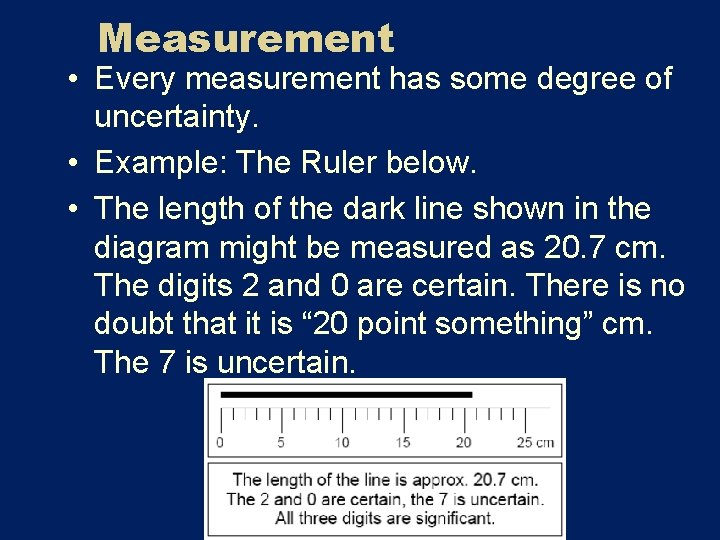
Measurement • Every measurement has some degree of uncertainty. • Example: The Ruler below. • The length of the dark line shown in the diagram might be measured as 20. 7 cm. The digits 2 and 0 are certain. There is no doubt that it is “ 20 point something” cm. The 7 is uncertain.
Measurement • There may be a little less or a little more. The number of significant digits indicates the certainty of the measurement. There are three significant digits in this case. (20. 7). • Thus, significant digits in a measurement or calculation consist of all those digits that are certain, plus one uncertain digit. Your calculator may give you digits to 8 decimal places or more, you should not be included all of these in the answer
Significant Digits • The certainty of a measurement is communicated by its significant digits. • Significant digits are all digits that are all correctly recorded from a measurement.
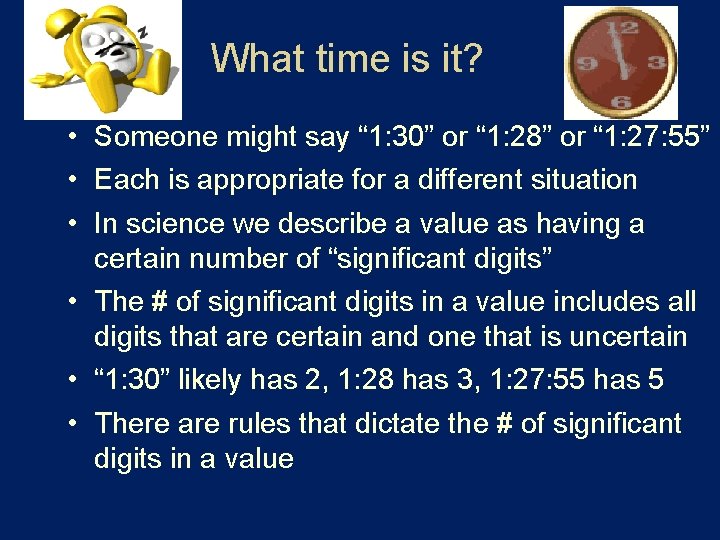
What time is it? • Someone might say “ 1: 30” or “ 1: 28” or “ 1: 27: 55” • Each is appropriate for a different situation • In science we describe a value as having a certain number of “significant digits” • The # of significant digits in a value includes all digits that are certain and one that is uncertain • “ 1: 30” likely has 2, 1: 28 has 3, 1: 27: 55 has 5 • There are rules that dictate the # of significant digits in a value
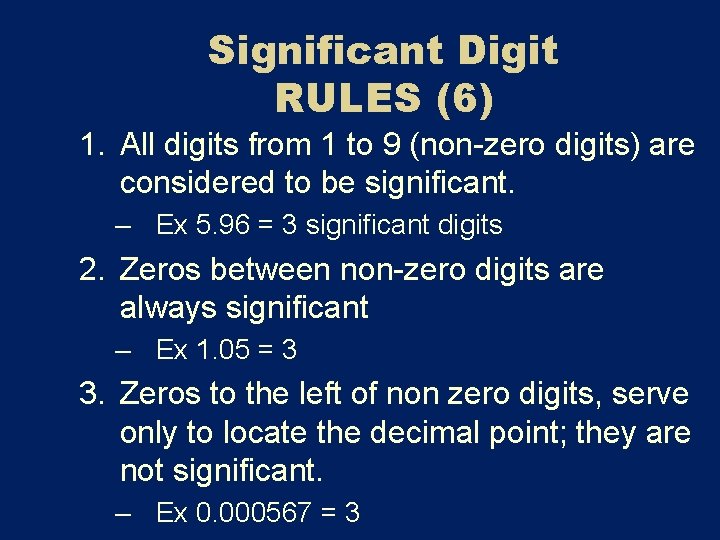
Significant Digit RULES (6) 1. All digits from 1 to 9 (non-zero digits) are considered to be significant. – Ex 5. 96 = 3 significant digits 2. Zeros between non-zero digits are always significant – Ex 1. 05 = 3 3. Zeros to the left of non zero digits, serve only to locate the decimal point; they are not significant. – Ex 0. 000567 = 3
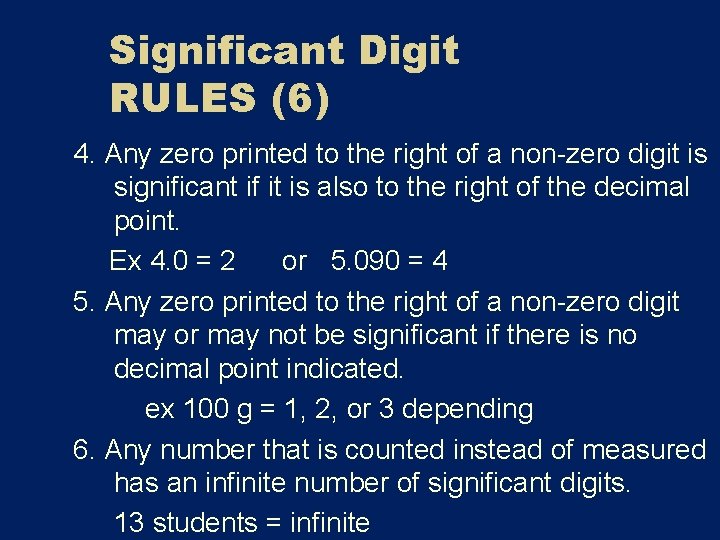
Significant Digit RULES (6) 4. Any zero printed to the right of a non-zero digit is significant if it is also to the right of the decimal point. Ex 4. 0 = 2 or 5. 090 = 4 5. Any zero printed to the right of a non-zero digit may or may not be significant if there is no decimal point indicated. ex 100 g = 1, 2, or 3 depending 6. Any number that is counted instead of measured has an infinite number of significant digits. 13 students = infinite
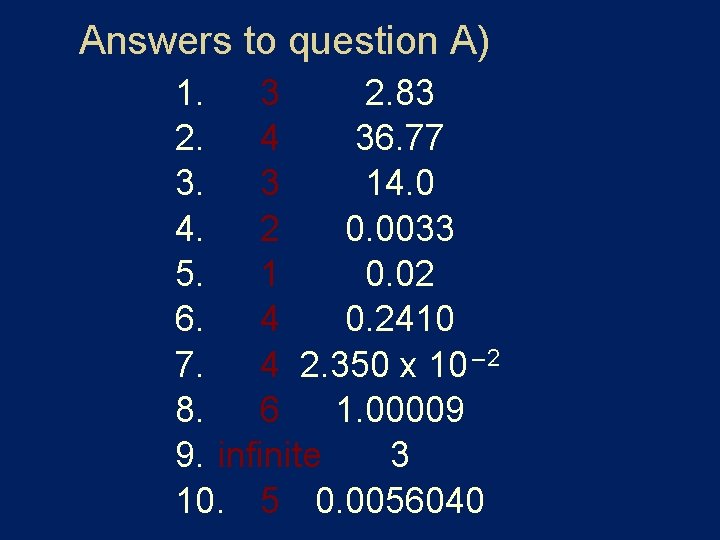
Answers to question A) 1. 3 2. 83 2. 4 36. 77 3. 3 14. 0 4. 2 0. 0033 5. 1 0. 02 6. 4 0. 2410 7. 4 2. 350 x 10 – 2 8. 6 1. 00009 9. infinite 3 10. 5 0. 0056040
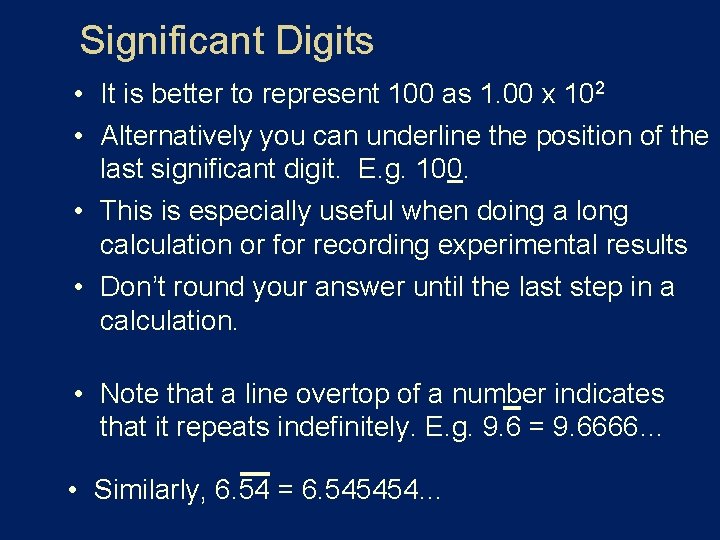
Significant Digits • It is better to represent 100 as 1. 00 x 102 • Alternatively you can underline the position of the last significant digit. E. g. 100. • This is especially useful when doing a long calculation or for recording experimental results • Don’t round your answer until the last step in a calculation. • Note that a line overtop of a number indicates that it repeats indefinitely. E. g. 9. 6 = 9. 6666… • Similarly, 6. 54 = 6. 545454…
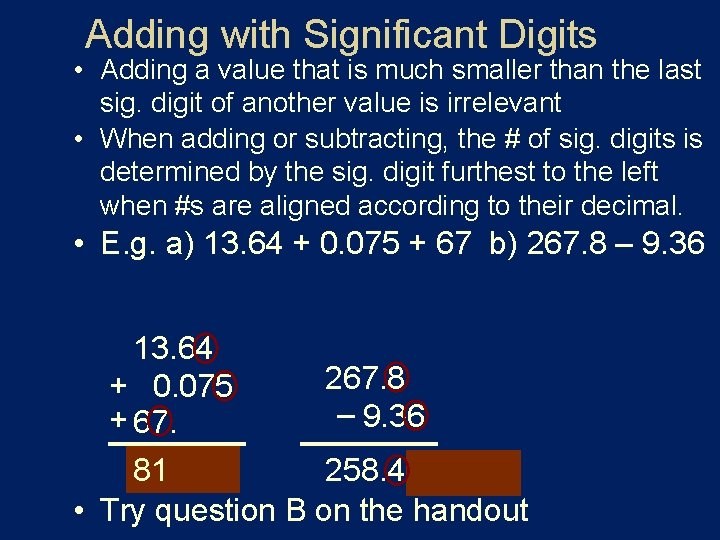
Adding with Significant Digits • Adding a value that is much smaller than the last sig. digit of another value is irrelevant • When adding or subtracting, the # of sig. digits is determined by the sig. digit furthest to the left when #s are aligned according to their decimal. • E. g. a) 13. 64 + 0. 075 + 67 b) 267. 8 – 9. 36 13. 64 267. 8 + 0. 075 – 9. 36 + 67. 81 80. 715 258. 44 • Try question B on the handout
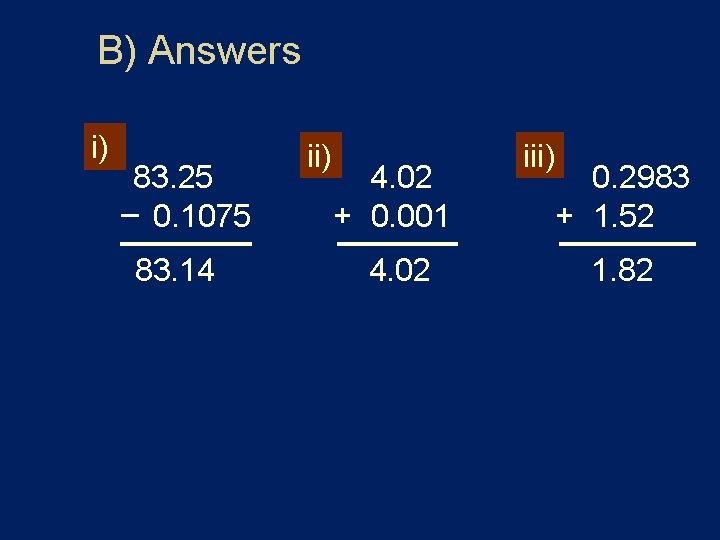
B) Answers i) 83. 25 – 0. 1075 83. 14 ii) 4. 02 + 0. 001 4. 02 iii) 0. 2983 + 1. 52 1. 82
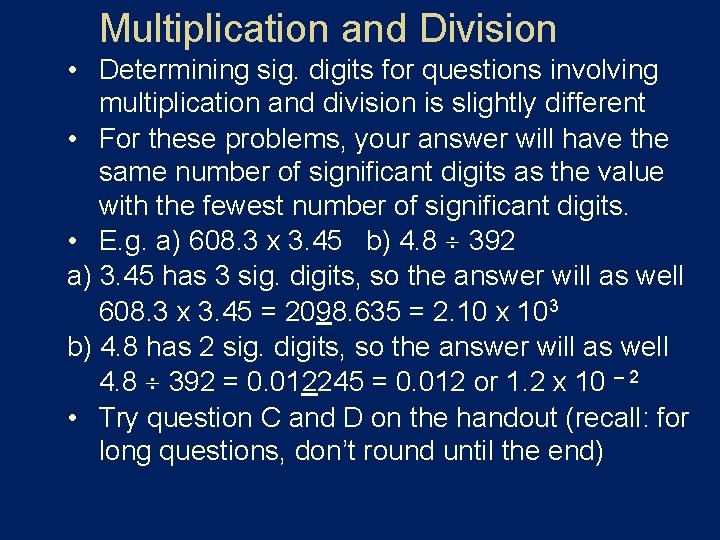
Multiplication and Division • Determining sig. digits for questions involving multiplication and division is slightly different • For these problems, your answer will have the same number of significant digits as the value with the fewest number of significant digits. • E. g. a) 608. 3 x 3. 45 b) 4. 8 392 a) 3. 45 has 3 sig. digits, so the answer will as well 608. 3 x 3. 45 = 2098. 635 = 2. 10 x 103 b) 4. 8 has 2 sig. digits, so the answer will as well 4. 8 392 = 0. 012245 = 0. 012 or 1. 2 x 10 – 2 • Try question C and D on the handout (recall: for long questions, don’t round until the end)
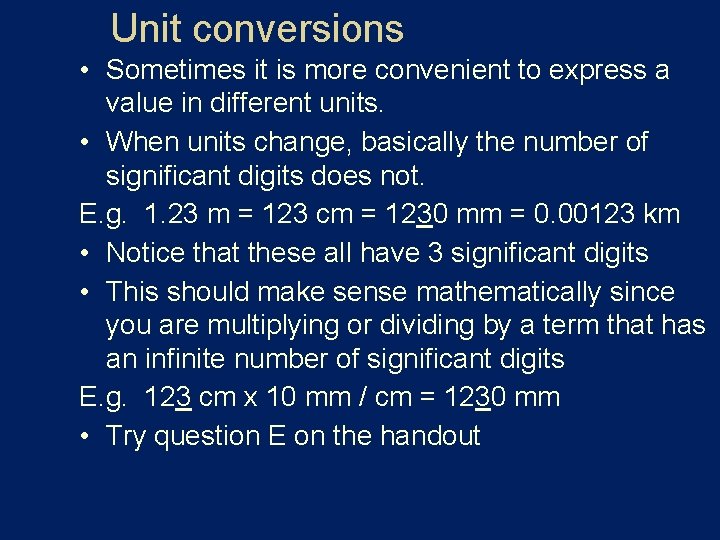
Unit conversions • Sometimes it is more convenient to express a value in different units. • When units change, basically the number of significant digits does not. E. g. 1. 23 m = 123 cm = 1230 mm = 0. 00123 km • Notice that these all have 3 significant digits • This should make sense mathematically since you are multiplying or dividing by a term that has an infinite number of significant digits E. g. 123 cm x 10 mm / cm = 1230 mm • Try question E on the handout
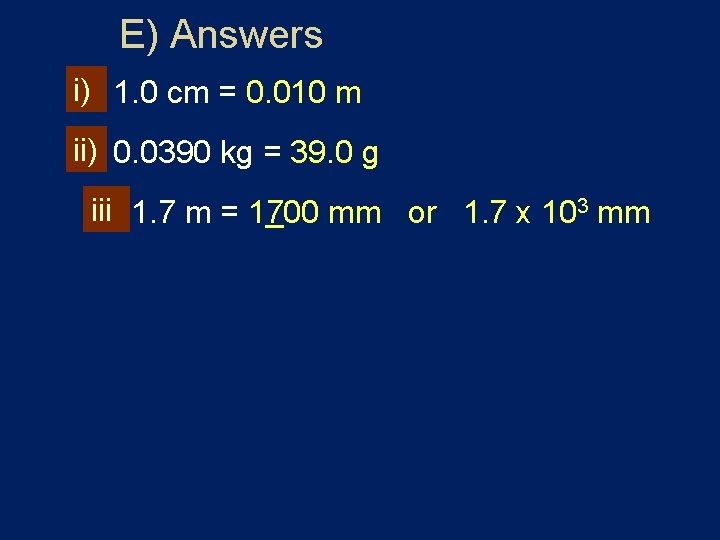
E) Answers i) 1. 0 cm = 0. 010 m ii) 0. 0390 kg = 39. 0 g iii 1. 7 m = 1700 mm or 1. 7 x 103 mm